
Home | Category: Island Ethnic Groups
MANAM ISLAND AND ITS PEOPLE
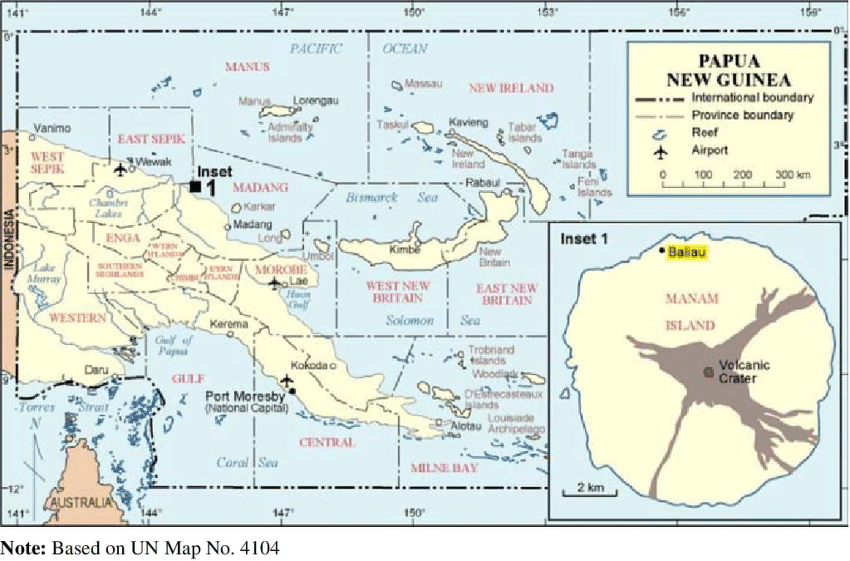
Location of Manam Island, from Researchgate
The Manam people are an ethnic group from Manam Island in Papua New Guinea, known for their subsistence farming and fishing economy, distinct language, and strong musical traditions. Also called the Vulkan Islanders, they have long been affected by the frequent eruptions of Manam volcano, which have led to repeated displacement, food shortages, and dependence on outside aid. Resettlement efforts—often temporary and difficult—have contributed to declining morale and a sense of loss among many islanders. [Source: Nancy Christine Lutkehaus, “Encyclopedia of World Cultures, Volume 2: Oceania,” edited by Terence E. Hays, 1996; Google AI]
Manam Island — known locally as Manam Motu and formerly called Vulkan-Insel or Hansa-Vulkaninsel by the Germans — is situated in the Bismarck Sea across the Stephan Strait from Yawar on the northeast coast of mainland Papua New Guinea's Bogia District. Together with its small outlier Boesa (Aris-Insel), 6.5 kilometers to the northwest, it forms part of the Schouten Islands, a chain of volcanic islands along the country’s northeast coast. Positioned near the mouths of the Ramu and Sepik rivers, Manam belongs to the north-coast and Sepik cultural spheres. The island has no rivers or permanent streams. Northwest monsoon winds bring heavy rains from November to April—a traditional period for canoe building and major feasts—while the southeast trade winds from May to October produce a dry season once associated with scarcity before the arrival of trade stores.
Located just south of the equator at 4°5 S, 145°3 E, Manam is a small, cone-shaped island about 13 kilometers across and 40 kilometers in circumference, formed by one of Papua New Guinea’s most active volcanoes. A major eruption in 2004 forced a full evacuation, and residents were resettled elsewhere in the country. Despite ongoing volcanic activity—Manam remained active as of January 2024—many islanders have since returned.
The Joshua Project estimated the Manam population at around 15,000 in the 2020s. Earlier reports estimated 6,400 people on Manam and another 420 on Boesa in 1982. Although many younger islanders have settled permanently on the mainland due to limited land on Manam, island communities remain largely composed of indigenous Manam people, with only a small number of mainland spouses marrying in.
Language: Manam Islanders speak Manam Pile (“Manam talk”), an Austronesian language also used on nearby Boisa. Classified—along with Wogeo—within the Siassi family of Austronesian languages, Manam Pile is undergoing a sound shift that has produced two variants spoken on different halves of the island. Most Manam Islanders also speak Tok Pisin, and younger, educated speakers often know English. The Manam have a national reputation for musical ability and have produced several well-known local musicians.
RELATED ARTICLES:
SOUTHEAST PAPUA NEW GUINEA ISLANDERS OF MASSIM, MILNE BAY AND DOBU, ROSSEL AND GOODENOUGH ISLANDS ioa.factsanddetails.com
TROBRIAND ISLANDERS: HISTORY, RELIGION, BIG MEN POLITICS, ECONOMY ioa.factsanddetails.com
TROBRIAND ISLANDER CULTURE: CUSTOMS, MATRILINEAL SOCIETY, SEX AND YAMS ioa.factsanddetails.com
ART FROM THE TROBRIAND ISLANDS AND MASSIM REGION OF PAPUA NEW GUINEA ioa.factsanddetails.com
EAST NEW BRITAIN ETHNIC GROUPS — THE BAINING AND TOLAI — AND THEIR CUSTOMS, LIFESTYLES AND DANCES ioa.factsanddetails.com
WEST NEW BRITAIN ETHNIC GROUPS — NAKANAI, AROWE — AND THEIR TRADITIONS AND SOCIETIES ioa.factsanddetails.com
MASKS AND ART OF NEW BRITAIN ioa.factsanddetails.com
NEW IRELAND ETHNIC GROUPS — MADAK, LESU, AND LAK— AND THEIR TRADITIONS AND SOCIETIES ioa.factsanddetails.com
ART FROM NEW IRELAND: MALAGAN, FUNERARY FIGURES AND DRUMS ioa.factsanddetails.com
BOUGAINVILLE ISLANDERS — SIWAI, TINPUTZ, NAGOVISI — AND THEIR HISTORY, SOCIETIES AND CULTURE ioa.factsanddetails.com
NASIOI OF BOUGAINVILLE: HISTORY, RELIGION, LIFE, SOCIETY ioa.factsanddetails.com
NISSAN ISLANDERS: HISTORY, RELIGION, SOCIETY, LIFE ioa.factsanddetails.com
Manam Islander History
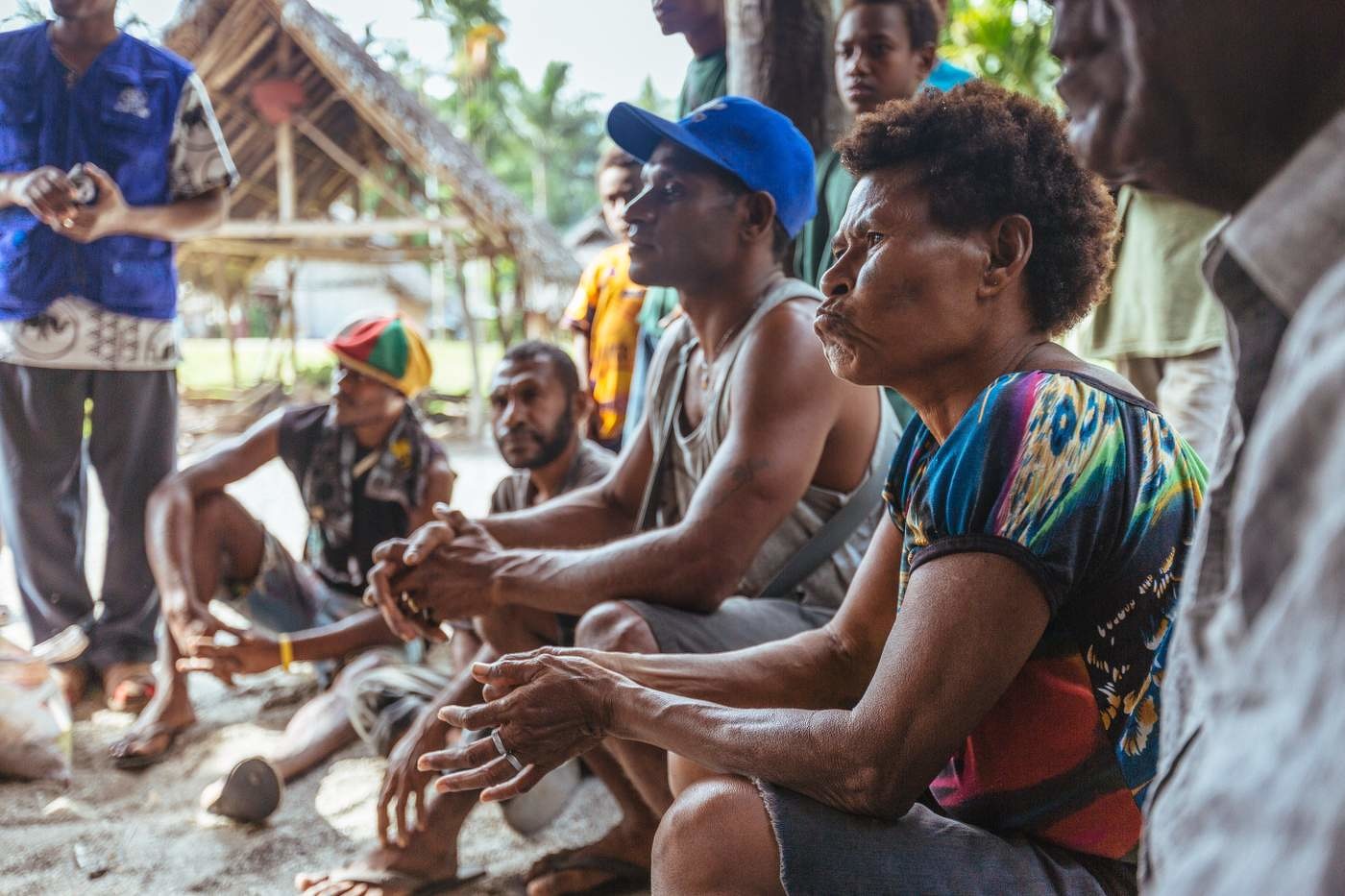
Manam islanders
Austronesian-speaking peoples reached New Guinea later than Papuan groups, bringing domesticated pigs, outrigger canoes, and advanced navigation. The Lapita culture — Proto-Austronesian and established in the Bismarck Archipelago by at least 1600 B.C. — is widely considered ancestral to the Manam. According to their own traditions, the Manam trace their origins to the west before settling on the island. [Source: Nancy Christine Lutkehaus, “Encyclopedia of World Cultures, Volume 2: Oceania,” edited by Terence E. Hays, 1996]
The Manam have long maintained exchange partnerships with hereditary mainland trade allies (taoa). They have little contact with other Schouten Islanders. Most trade is carried out with Momboan communities directly across the water, and with Kaian, Boroi, Watam, and Marangis villages near the Ramu River. In the past, both incidental fighting and organized warfare were common, occurring between Manam villages as well as between the Manam and mainland groups. Disputes were typically resolved through negotiated payments of pigs and other valuables. Today, although violence still occurs, conflict is addressed mainly through monetary compensation or legal penalties such as imprisonment.
Manam enters the written record in the sixteenth century through European ship logs noting the island’s active volcano. The first documented European sighting was on 5 August 1545 by the Spanish navigator Iñigo Órtiz de Retes aboard the San Juan, during an attempted return voyage from Tidore to New Spain. More sustained contact began after Germany claimed northeast New Guinea in 1884. While Manam never hosted foreign-owned coconut plantations, many islanders worked as contract laborers on coastal plantations and in the Wau and Bulolo goldfields. The Society of the Divine Word Catholic mission, established on Manam in 1925, became the most influential Western presence.
During World War II, Japanese control of the mainland forced the Manam to abandon their villages and live in the jungle throughout the occupation. After the war, the island experienced significant social change, including local fascination with the cargo cult movements and the protonationalist activities of Rai Coast leader Yali, as well as expanded copra production and other commercial ventures. These developments—along with growing education and employment options on the mainland—deepened the islanders’ reliance on cash income and a consumer economy.
Manam Island Volcanic Activity
Manam hosts one of Papua New Guinea’s most active volcanoes. Rising to about 1,350 meters, it emits ash almost constantly and occasionally produces lava flows. In 1957 the entire island population was evacuated to the mainland for a year, returning only after the eruption subsided to find their villages buried under ash. The island lies 16 kilometers off the mainland near Bogia, close to Hansa Bay in Madang Province. [Source: Nancy Christine Lutkehaus, “Encyclopedia of World Cultures, Volume 2: Oceania,” edited by Terence E. Hays, 1996]
A major eruption on 24 October 2004 triggered the emergency evacuation of more than 9,000 residents. Although activity was initially judged non-threatening, a shift in wind direction drove ash and debris toward inhabited areas. Five people were killed. Activity declined enough by 11 December for authorities to lower the alert level, but conditions at mainland resettlement camps—Mangem, Asarumba, and Potsdam—proved difficult, with overcrowding, limited resources, and ongoing uncertainty. [Source: Wikipedia]
In March 2007 the Papua New Guinea government allocated land at Andarum near Bogia for the permanent resettlement of displaced islanders. That same month, mudslides on the north side of Manam killed three people. Despite official concerns, an estimated 2,000 to 3,000 people had returned to the island by 2014. The volcano erupted again on 8 March 2022, sending an ash plume 15 kilometers (9 miles) into the atmosphere, as confirmed by the Volcanic Ash Advisory Center in Darwin, Australia.
Manam’s frequent eruptions have produced long-term displacement and significant social disruption. security and health: Recurrent volcanic activity has damaged gardens, contaminated water sources, and created widespread food insecurity. Micronutrient deficiencies, worsened by displacement and changes in diet after the 2004–2005 eruptions, contributed to cases of peripheral neuropathy among some Manam Islanders. Many evacuees have lived in care centers, where they have faced land disputes, limited support, and prolonged uncertainty. Relocation—especially to inland areas—has undermined community cohesion and threatens major shifts in long-standing cultural practices. [Source: Google AI]
Manam Islander Religion and Culture
According to the Christian-group Joshua Project 98 percent of Manam Islanders are Christians, mostly Catholics, with the estimated number of Evangelicals being 10 to 50 percent. Even so indigenous beliefs centered on spirits remain deeply significant on Manam, especially those involving the culture hero Zaria, who is closely linked to the volcano. [Source: Nancy Christine Lutkehaus, “Encyclopedia of World Cultures, Volume 2: Oceania,” edited by Terence E. Hays, 1996]
Masalai—important ancestral beings and culture heroes in Tok Pisin—are central to Manam spirituality. These spirits can shift between human, animal, and inanimate forms, and masalai snakes in particular are associated with the origins of the Manam people. Zaria, the most important culture hero, is a female spirit believed to dwell inside the volcano and to be the source of its fire. Since World War II, various millenarian movements have periodically attracted interest. Alongside long-standing Catholic influence, small communities of Seventh-Day Adventists and evangelical groups are also present.
Death and Funerals: When someone dies, people gather immediately to wail, sing mourning songs, and “give face” at the home of the deceased. Community members spend the nights outside the house until the funeral feast, usually held about five days later. A second, larger commemorative feast should be held several years afterward. The dead are believed to continue as spirits who communicate through dreams and influence events among the living.
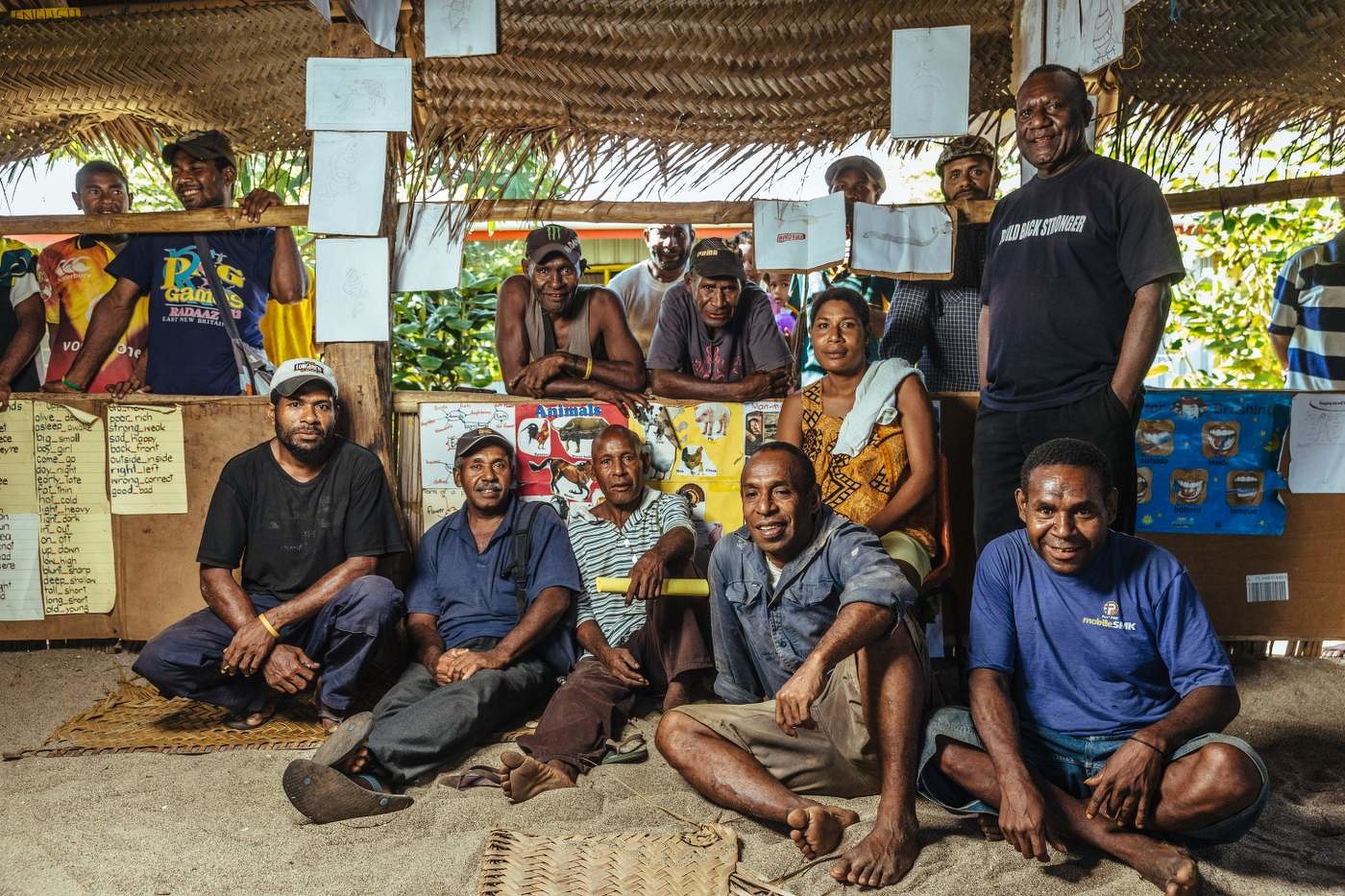
Manan Islanders
Religious Practitioners: Although there are no formal priestly roles, certain individuals inherit supernatural power (marou) from their ancestors. This power enables them to perform canoe magic, influence winds, promote tobacco abundance, and more. A tanepoa labalaba is believed to ensure crop fertility and the general well-being of the village. Mediums known as aeno aine or “sleep women” enter trances to mediate between the living and the dead and to identify the spiritual causes of illness. The Manam draw upon both indigenous and Western medical practices. While beliefs about pollution from blood, semen, and certain foods are fading, illness and death are still widely understood as the result of moral or social imbalance rather than natural processes. Traditional healing includes ceremonies aimed at revealing the underlying social conflict that has manifested as sickness. Most islanders also make use of the government clinic operated by Catholic sisters.
Ceremonies: Life-cycle events—birth, puberty, marriage, and death—are marked by special rituals. Each village holds an annual New Year celebration, Barasi, in May or June. The most common intervillage ceremony is the buleka, a dance and pig-exchange festival. Christian holidays such as Christmas and Easter are also observed.
Arts: The Manam are widely known in Papua New Guinea for their musical ability. Music and singing are the primary art forms, serving not only aesthetic purposes but also important political and economic roles. Dance—performed mainly by men—is another major artistic expression, and new dance complexes are valued trade items. Carving, though based on traditional iconographic forms, plays a relatively minor role.
Manam Islander Society and Family
Unlike most New Guinea societies, which are egalitarian, Manam social organization is hierarchical. People belong to one of two hereditary groups: an elite class (tanepoa) and commoners (gadagada), with membership determined through patrilineal descent. Before sustained outside contact, Manam villages were politically autonomous. Each was led by a hereditary chief, the tanepoa labalaba, whose position passed by primogeniture. Every clan also had a hereditary leader (bagi sema) chosen according to the same principle. Although Manam communities now elect a village councillor to serve on the Local Government Council, the tanepoa labalaba still function as the true village leaders. Islanders also elect provincial and national representatives. In the past, chiefs exercised authority through the threat of sorcery and physical force; today, chiefs and councillors mediate local civil cases—such as adultery, divorce, and theft—or refer them to district authorities.
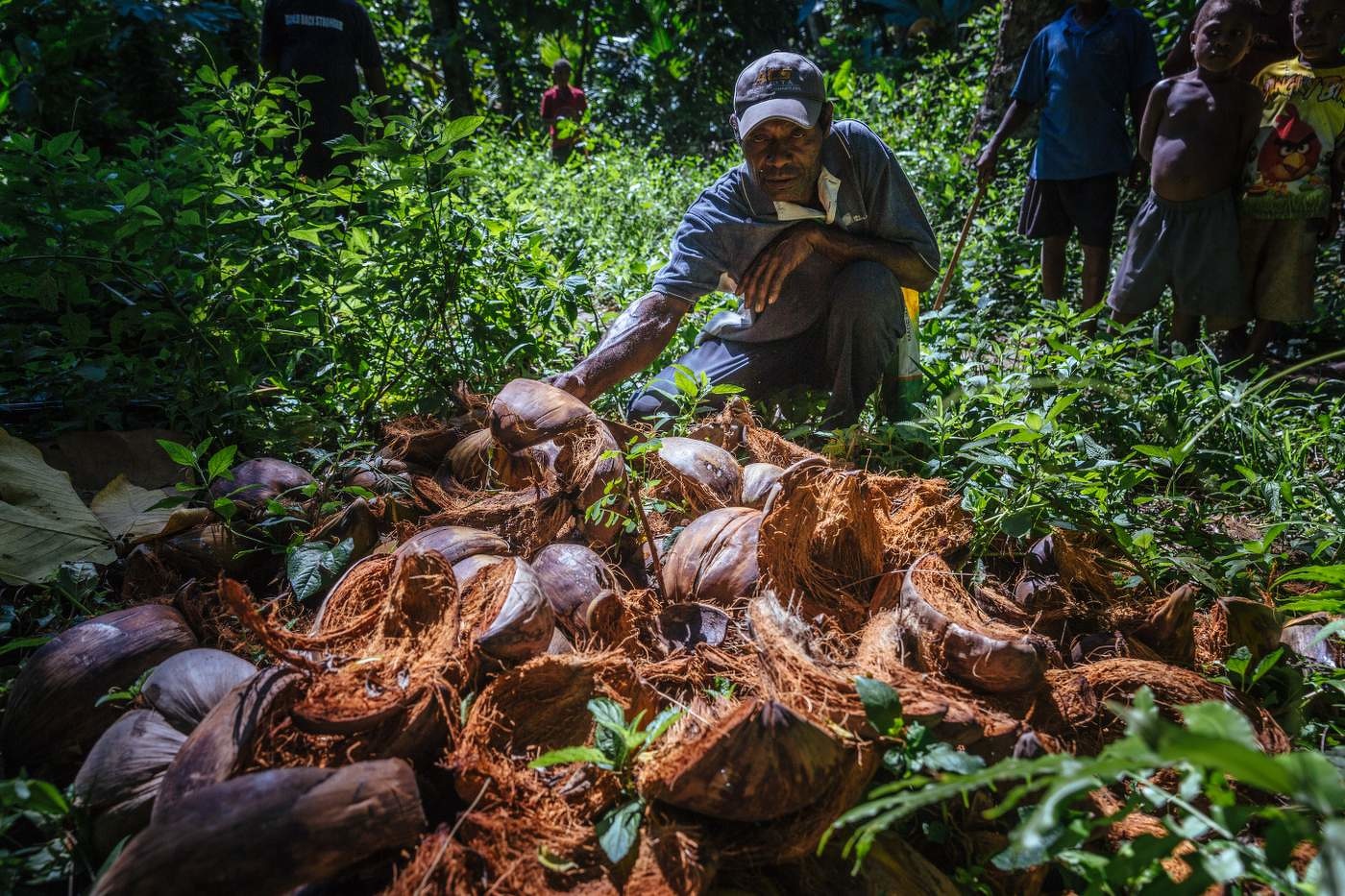
Manam Islanders processing coconuts
The nuclear family forms the basic household, though extended family compounds are common. In polygynous households, each wife maintains her own hearth and gardens and cooks for her husband and children. Parents typically desire at least one son and one daughter, and adoption—especially between siblings—is frequent. Firstborn children, particularly firstborn sons, receive special recognition and have distinct rights and responsibilities. While women are the primary caregivers, men and older siblings also participate actively in child rearing. Gender roles are taught from an early age, and shame is a key cultural mechanism guiding proper behavior. Both sons and daughters inherit property, though firstborn males receive a larger share. A man’s adult children assert their claims to his property through a ritual feast, boro da paso, held in his honor while he is still alive.
Marriages are usually monogamous, though polygyny remains practiced, particularly among chiefs. While marriages were once arranged, couples today generally choose their own partners. The groom’s family provides bride-wealth to the bride’s relatives. Except for the marriages of chiefs, unions are usually endogamous within a village or clan, and residence is patrilocal, with couples living in the husband’s community. A marriage is not considered complete until the birth of a first child; before that, divorce among young couples is relatively common.
Kinship: Individuals belong to named, localized, exogamous clans—bagi or ungguma—whose membership is determined by patrilineal descent. Villages typically contain two to ten such clans. Matrilineal kin, especially a mother’s brother, also play important roles in social life. Homesteads consist of extended-family compounds situated on clan-owned land. Manam speakers use Hawaiian-type (or generational) kinship terms. Relatives are classified primarily by generation and by sex. In this system, all women of one’s parents’ generation—mothers, aunts, and the wives of men in that generation—are called “Mother,” and all men of that generation—fathers, uncles, and the husbands of those women—are called “Father.” Similarly, all male cousins and brothers are referred to as “Brother,” and all female cousins and sisters as “Sister.”
Manam Islander Life and Economic Activity
The Manam have traditionally been fishing people and subsistence farmers who practice slash-and-burn agriculture. They cultivate taro, sweet potatoes, cassava, and bananas, and rely heavily on fishing as well as tree crops such as breadfruit and coconuts. Volcanic ash has repeatedly damaged gardens, reducing yields, creating food insecurity, and undermining income from copra. To cope, many households eat fewer meals, depend on food assistance from mainland relatives, or purchase store-bought foods when they can afford to—though many cannot. [Source: Nancy Christine Lutkehaus, “Encyclopedia of World Cultures, Volume 2: Oceania,” edited by Terence E. Hays, 1996]
Because the soil is poor and groundwater is scarce, only a limited range of crops can be grown; yams, for example, common on the mainland, do not thrive on Manam. Fishing is seasonal, as monsoon winds restrict access to the southern fishing grounds. Pigs provide occasional protein but are valued primarily as wealth items for local and external trade. Other domesticated animals include chickens and dogs; the latter, kept mainly for hunting and protection, are also sometimes eaten. Copra is the only significant cash crop and is sold to local buyers or directly to the Copra Marketing Board in Madang. Coffee and cacao, important mainland crops, do not grow well on the island. Income from copra is used largely to purchase rice, tinned meat and fish, and other imported goods from island trade stores.
Villages: By the 1990s, Manam had fourteen villages and Boesa Island had two, ranging from roughly 115 to 1,000 inhabitants, with an average size of around 500. Settlements extend from the beach up the mountainside into the forest, with gardens typically located beyond the inhabited zone. Houses are built of wood with coconut-frond thatch roofs and walls of woven bamboo or coconut siding. Each village has a central ceremonial ground and a large men’s house (haus tambaran) that women are not permitted to enter. Other facilities include a small volcanology observatory, a government subdistrict headquarters, and two Catholic missions, each with a church and government school. A dirt road circles part of the island, but vehicles are scarce; most travel between villages takes place on foot, by canoe, or by small boat.
Work is divided primarily by gender. Men handle all sea-related activities, including canoe building, fishing, and long-distance trading. Both men and women garden, but routine tasks—planting, weeding, harvesting—are largely performed by women. Men assist with heavy tasks such as clearing new garden sites and building fences, and some help their wives with planting and weeding. Only men climb large trees to harvest breadfruit, coconuts, and Canarium almonds. Both sexes tend pigs, but only men slaughter and distribute pork. Women are responsible for cooking, gathering firewood, and fetching water. Both men and women participate in producing and selling copra.
Compared with many mainland groups, the Manam practice relatively few industrial arts. They do not make pottery, slit drums, dyed skirts, woven baskets, or net bags, relying instead on mainland trade partners for these items. Their most important craft—historically and still to a lesser extent today—is the construction of outrigger canoes. Once used for major trading voyages, canoes are now employed mainly for village-to-village travel and for loading and unloading passengers and cargo from boats traveling to the mainland. Carving, done by men, includes canoes, masks, combs, betel-nut mortars, coconut-shell containers, headrests, and paddles. Women formerly wove pandanus-fiber skirts and men made bark belts; these have largely been replaced by commercial clothing, though traditional items remain important in dances and ritual performances.
Trade: In the past, men visited hereditary mainland trade partners (taoa) to exchange pigs, Canarium almonds, betel nuts, and tobacco for sago, ritual items, and valuables such as dogs’ teeth and boars’ tusks. These long-standing trade partnerships still operate, though trips are now made by motorized canoes and boats. Small markets—introduced through Western influence—exist on the mainland and at mission stations on Manam, where women sell garden produce, betel nuts, tobacco, and Canarium almonds.
Land is held communally by kin groups, while specific productive resources such as trees may be controlled by individuals. Both men and women inherit land and other resources from paternal and maternal relatives, but men typically inherit more. As land grows scarcer, matrilateral claims—rights through the mother’s side—are increasingly restricted by those kin groups.
Manus and Manus Islanders
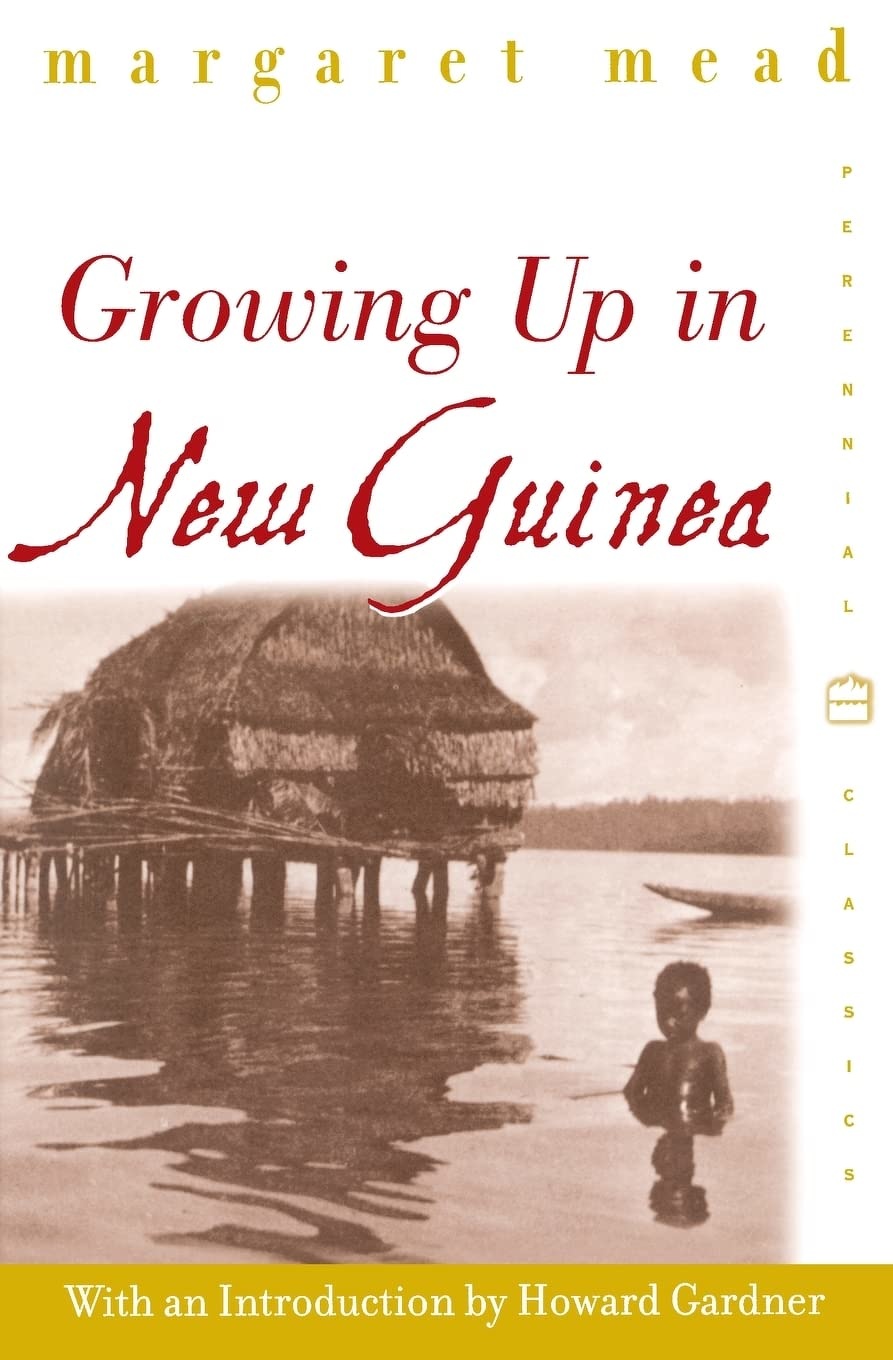
The Manus people live in Manus Province, a region made up of Manus Island and numerous smaller islands about 272 kilometers (169 miles) north-northeast of the Madang coast on mainland New Guinea. They are a diverse population with strong seafaring and trading traditions and many distinct local identities. The Manus people became widely known through anthropological research, notably by Margaret Mead, who studied them from the 1920s to the 1950s. Her book “Growing up in New Guinea” analyzed human development in culture-specific, non-western context and debunked the notion that ‘primitive’ people are like children. [Source: James G. Carrier, “Encyclopedia of World Cultures, Volume 2: Oceania,” edited by Terence E. Hays, 1996; Google AI]
Originally, the term “Manus” referred only to a specific group speaking closely related languages. Today, the entire provincial population may refer to themselves as “Manus people,” though they still distinguish themselves by language, village, or region. The original group is sometimes identified as Manus tru (“true Manus”). “Manus” or “Manusian” can also refer more specifically to the Titan-speaking coastal and island communities in the southeast, who had the earliest and most intensive contact with Europeans. People also classify one another with terms denoting “islanders” (traditionally fishers and traders), “mainlanders” (traditionally agriculturalists), residents versus migrants, or by electoral district.
Manus Province includes the main island of Manus, the adjoining island of Los Negros, and many smaller offshore islands, mostly to the southeast and north, along with several far-western islands inhabited by ethnically distinct groups. Manus lies in the Admiralty Islands at roughly 2° S and 147° E. The mainland is about 96 kilometers long and 24 kilometers wide. Larger volcanic islands are relatively fertile, while many smaller islands are infertile sand cays. The southeast trade-wind season runs from April to October; the northwest monsoon from October to April brings higher tides, more cloud cover, and frequent storms. The climate is hot and wet year-round. The provincial capital is Lorengau, on Manus Island.
According to the Joshua Project, the Titan-speaking Manus population numbered around 11,000 in the 2020s. In 1980, the wider Manus population was about 26,000, including approximately 6,000 living elsewhere in Papua New Guinea—more than double the population estimated in the early twentieth century.
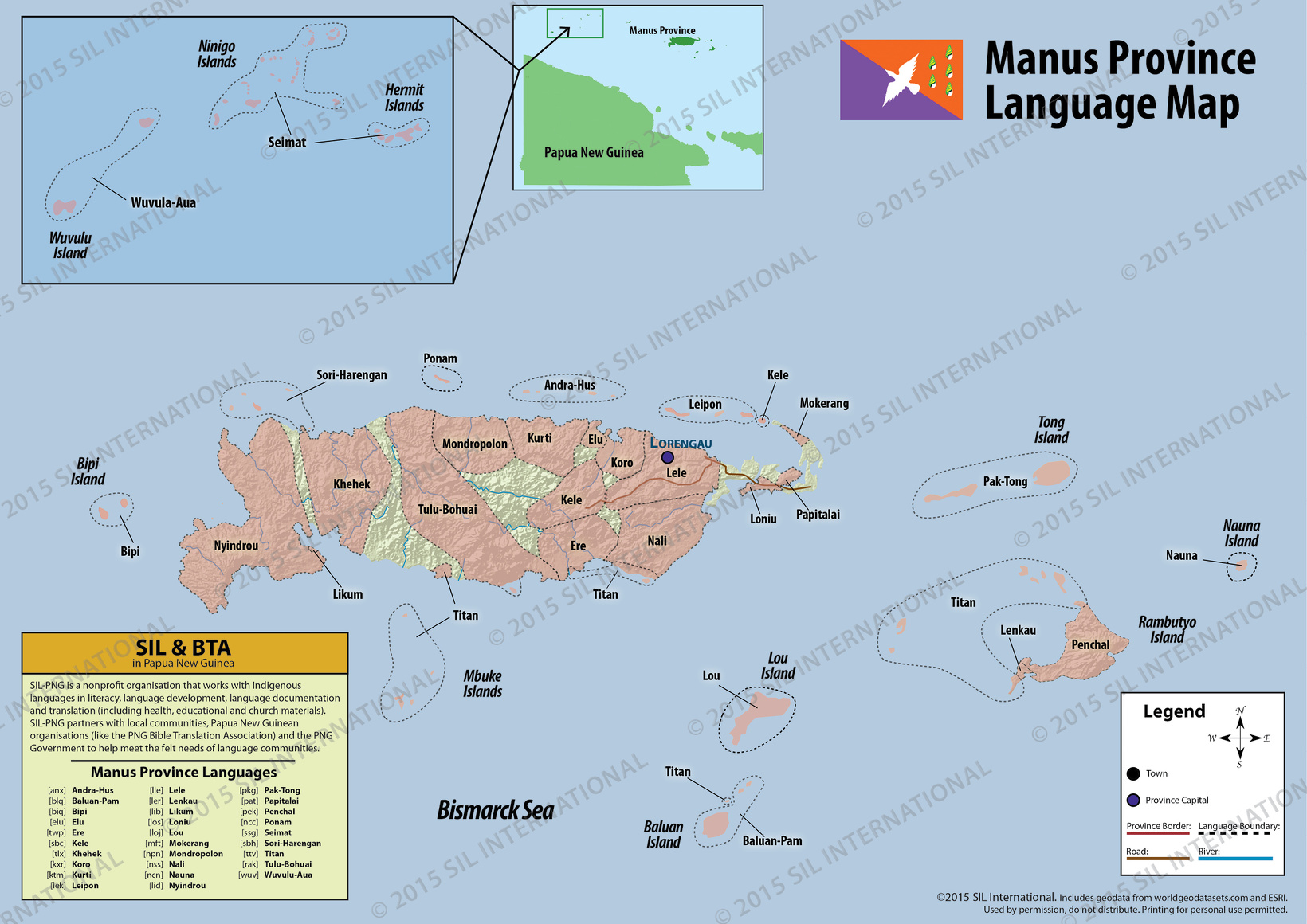
Language: The Manus speak a cluster of Oceanic languages collectively known as the Manus languages, which form a distinct Austronesian family with four subgroups: Eastern Mainland Manus (the largest), Western Mainland Manus, Northern Islands, and Southeastern Islands. Estimates of the number of Manus languages range from eighteen to forty. Although each village typically has its own language, shared grammatical and lexical features link them. Many Manus from small linguistic communities understand several neighboring languages; nearly everyone speaks Melanesian Pidgin, and most have some knowledge of English. The most studied Manus language is Titan.
History: European contact with the Manus mainland began in the sixteenth century, but sustained interaction did not occur until the nineteenth century, through pearlers, whalers, and bêche-de-mer fishers. Germany annexed Manus along with the rest of German New Guinea in 1884; Australian rule followed in 1915. Colonial administration relied on appointed village headmen. Resistance was strong in several areas, and colonial control was not fully established until about 1920. A handful of copra plantations appeared by 1910, and mission activity began around the same time, though relatively little land was alienated. By World War II, most Manus were Christian—mainly Catholic, Seventh-Day Adventist, or Lutheran—yet Indigenous beliefs remained influential. After the war, Manus communities pressed for social, economic, and political reforms, leading to expanded education, elected village officials, and encouragement of village cooperatives. Public services grew through the early 1980s before contracting slightly due to government financial constraints. Following Papua New Guinea’s independence in 1975, Manus gained its own elected provincial assembly. In the twenty-first century, Manus attracted international attention for the Australian government’s offshore immigration detention center, operated from 2001 to 2017.
Prior to colonial control, raiding and open warfare between villages were common. Conflict arose when mainland or island groups moved to coastal land. This helped maintain the ecological division of villages and the related trade system. Intra-village and inter-clan fighting occurred, but such conflicts seem to have been unusual and informal. However, sorcery attacks among villagers did occur. Such fighting could lead to village fission. Modern intercultural conflict is uncommon, occurring mainly when residents of one village use the land or seas of another village. There is also conflict between villages and the government regarding the imposition of taxes and, more recently, provincial government policies. These conflicts reflect the recurring regional division between southern and northern Manus.
Manus Islander Religion and Culture
According to the Christian-group Joshua Project 97 percent of Manus Islanders are Christians, with the estimated number of Evangelicals being two to five percent.Traditional religion centers not on deities but on the spirits of the dead. Ancestors watch over their patrilineal descendants, punishing wrongdoing by withdrawing part of a person’s spiritual substance. Recently deceased relatives may be adopted as household patrons and protectors. Malevolent spirits are also recognized, and certain individuals are believed to control them through sorcery. Although most Manus are Christian, denominational teachings have blended in various ways with Indigenous cosmology. [Source: James G. Carrier, “Encyclopedia of World Cultures, Volume 2: Oceania,” edited by Terence E. Hays, 1996]
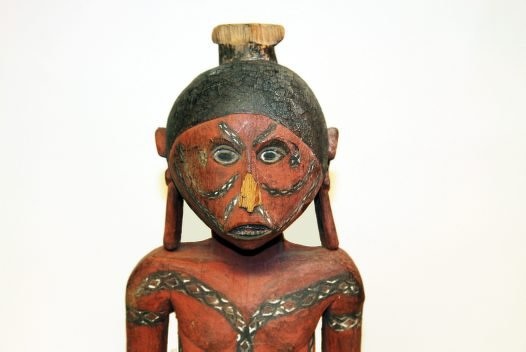
Manus art at the Australian Museum
Death and Funerals: Nearly all deaths — even of the very old — has traditionally been attributed to ancestral illness or sorcery. The spirit is thought to leave the body reluctantly after death, generally before burial. Spirits inhabit a parallel, invisible realm where they continue to behave much like living people. They monitor the conduct of their patrilineal descendants and may retaliate for past grievances or injustices connected to their own deaths. The recently dead are considered the most active; after three or four generations a spirit no longer affects the living. These beliefs coexist with Christian notions of Heaven and Hell, with angels sometimes interpreted as the spirits of the dead.
Religious Practitioners: Divination is common, and most villages have several practitioners, though they hold no special titles. Some individuals are believed to command malevolent spirits, though few openly acknowledge this. Many Manus serve in church roles as catechists, lay officials, or ordained clergy. Prior to colonization, plant-based medicines were widely used; some remain in use today. Illness is often attributed to ancestors, and healing involves diagnosing and addressing the spiritual source. A separate category of illness caused by contact with matriclan totems is treated by invoking matriclan ancestors through matriclan women. With colonization, church and government medical services spread and now serve as the first line of treatment, but when biomedical care fails to provide a quick diagnosis or cure, people may conclude that the illness is ancestral in origin.
Ceremonies: Dancing and feasting occur mainly in connection with other events—men’s-house construction, marriage and bride-price exchanges, visits by important government or church officials, major provincial celebrations, and significant sporting events. Social exchanges are frequent and typically accompanied by speeches and feasting. Church attendance is generally high.
Arts: In the past, houses, everyday objects, and canoes were often carved or painted; this is now less common. Woven mats, baskets, lime gourds, and lime sticks still receive decorative treatment. Indigenous valuables—shell money and dogs’ teeth—serve both aesthetic and ceremonial purposes. They are often mounted on brightly patterned beadwork belts, and people also produce decorative bead-and-shell bracelets and necklaces.
Manus Islander Family, Marriage and Sex
The basic domestic unit among Manus Islanders is the married couple and their unmarried children. Husbands and older sons are no longer required to sleep regularly in the patrician men’s house, though they may do so on occasion. Children are primarily socialized by parents, schools, and churches, with the latter two often overlapping. Certain relatives also hold special responsibility for a child’s welfare. These sources of instruction are generally viewed as having distinct spheres of competence: parents and kin teach traditional and village skills; schools introduce urban and Western knowledge; and churches instill Christian morality. Physical punishment is acceptable only in limited circumstances. Former initiation rites, which once played a role in socialization, have disappeared. Rights to real property are inherited patrilineally (through the male line), while personal property may be passed from parents to children or between siblings. [Source: James G. Carrier, “Encyclopedia of World Cultures, Volume 2: Oceania,” edited by Terence E. Hays, 1996]
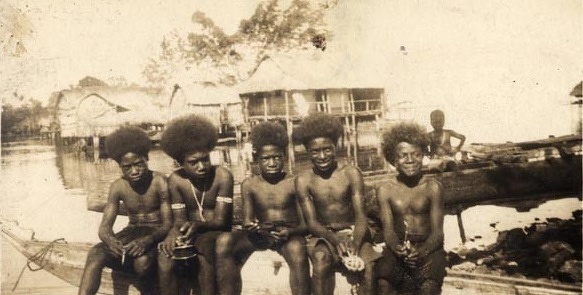
Photograph of Manus islanders taken by Margaret Mead in 1928
Marriage. Endogamy (marrying within a village or clan) and exogamy (marrying outside a village or clan) seem to be enduring marriage preferences. Matrilocal residence is not significant here. Polygyny is limited, with fewer than 20 percent of married men having multiple wives. Additionally, other patterns have emerged in different times and places, influenced by political and economic interests. Notable among these are cross-cousin and intercultural marriages, especially among elite families. Since the conversion to Christianity, church rules have also shaped patterns. Marriage entails the payment of a bride price, which, in the past, made it susceptible to manipulation by entrepreneurial big men. Currently, it is an important conduit through which money passes from migrants to residents. Patrilocal residence, or living in the husband’s family home or community, is commonly preferred. The acceptability of divorce and illegitimacy varies widely and is shaped in part by religious affiliation. ~
Adolescent Sex: Mead wrote in 1930, 40s and 50s: Perhaps the “habits of rough and tumble sex play, established in youth” persist as adult foreplay. However, the children masturbate in hard-to-find solitude and surrounded by shame. Manus girls were betrothed at age 8 or 10. “Engaged girls should not run about too much with younger children, should not play with boys, should stay at home and make bead work for their dowries” arrangements ideally made for children of two male cross-cousins. The taboos associated with this fact continuously disturbed the normal constellations in children’s play groups. An adolescent must not see his betrothal before marriage, “and then only for a brief instant”; men, without exception would be ignorant of menstruation. In the 1930s, R. F. Fortune “[f]irst menstruation is believed to be due to the hymen breaking…As it is understood, first menstruation is believed to come as a matter of course, naturally. The men think that a girl’s first sexual intercourse produces the next menstruation. They conclude that sexual intercourse causes menstruation…When one urges upon them that Manus girls menstruate…they take the statement as an insult upon the chastity of their girls”. Whereas children’s play formerly was found to be “empty of any content which imitated adult social relations”, including betrothals and marriage, they were later found to “play house, they build very tiny houses and also houses big enough to get inside, and play at housekeeping”. Nothing, however, was said about sexual imitations. Boys of four or five, however, begin to imitate displays of phallic “athletics” as is integrated in ceremonial dances. [Source: “Growing Up Sexually. Volume I” by D. F. Janssen, World Reference Atlas. 0.2 ed. 2004. Berlin: Magnus Hirschfeld Archive for Sexology, Last revised: May 2005; Archive of Sexuality, sexarchive.info ]
Manus Islander Society
Villages are organized around patricians, which regulate rights to real property, and cognatic stocks, which structure participation in ceremonial exchange. Matriclans exist but play a relatively minor role. Both patricians and cognatic stocks are localized groups and do not extend relationships across villages. Patricians are often small—sometimes only five or six resident adults—and lineages are even smaller. As a result, they frequently recruit nonmembers for labor and ceremonial activities, typically drawing on cognatic stocks descended from women who married out of the patrician in earlier generations. This creates a persistent contrast between the line of the man (the brother’s descendants) and the line of the woman (the out-marrying sister’s descendants). The distinction first appears at marriage—between the lines of the bride and groom—and persists into later generations as a contrast between paternal and maternal lines. Villagers also distinguish between residents and migrants, though this difference appears more in practice than in formal structure. Many ceremonial exchanges are scheduled to accommodate prominent migrants, and rules of contribution and distribution ensure that migrants’ contributions ultimately remain with resident kin. [Source: James G. Carrier, “Encyclopedia of World Cultures, Volume 2: Oceania,” edited by Terence E. Hays, 1996]

Manus islanders in 2024
Kinship: The principal political and landholding groups are patrilineal descent groups (patricians), internally divided into lineages. Membership is inherited from one’s father, and in some areas women adopt their husband’s patrician affiliation at marriage. These groups primarily manage rights to land and marine resources but also participate in exchange. Provincewide matriclans, though less elaborated structurally, remain important in matters of health—especially the treatment of pollution from contact with forbidden items and purification during life-cycle events. Alongside these are cognatic stocks (with a patrilateral bias), each tracing descent from a married couple in the past or present. These stocks are activated mainly during ceremonial exchanges, which occur frequently and carry substantial economic weight. Individuals inherit all cognatic stock memberships from both parents. Kinship terminology varies across Manus but typically emphasizes distinctions between the descendants of brothers and the descendants of sisters. Generational skewing of the Crow type is common. As in other Crow systems, relatives on the mother’s side receive more descriptive terms, while those on the father’s side are more classificatory, and some distinctions collapse across generations.
Political Organization: Village politics center on patricians and shifting village factions. Hereditary patrician leaders are expected to guide patrician affairs and influence political decisions, operating within a general framework of consensus. Historically, different patricians often took responsibility for villagewide matters such as warfare, peacemaking, or governance. Patrician authority is strongest where clan land remains economically vital and has not been overshadowed by wage labor or other introduced economic opportunities.
Village factions sometimes reflect patrician rivalries, but more commonly express differences in orientation toward modernization, tradition, and Christianity. Villages maintain formal governments, including an elected village leader and assistant, magistrates, a constable, and typically an elected representative to the local subprovincial body. Provincial and national electoral districts encompass several villages, and village solidarity often centers on supporting a candidate from one’s own community. Party loyalties are weak, and representatives are widely believed to be influenced by gifts and favors.
Social control operates through three primary mechanisms. 1) Ancestral sanctions: Patrilineal ancestors monitor the behavior of their living descendants and may inflict illness—sometimes fatal—when grievances remain unresolved. Suspected ancestral illness prompts a meeting of relatives to confess and settle hidden disputes. Because ancestors monitor migrants as well as residents, this helps maintain migrants’ ties to their natal villages. 2) The moral authority of certain kin: Specific categories of relatives—especially the classificatory father’s sister, her daughter, and her son—possess the power to bless or curse and thus ensure proper conduct. 3) Village courts: Village magistrates routinely hear cases ranging from slander and petty theft to more serious matters. Higher courts are seldom used.
Manus Islander Life and Economic Activity
The original Manus people were skilled seafarers and traders, with coastal dwellers particularly noted for building stilt houses over the sea. Subsistence for rural mainland villagers depends on arboriculture and swidden agriculture while fishing is more important among islanders. Agriculturalists cultivate sago palms, taro, sweet potatoes, leafy greens, bananas, and other tree fruits and nuts. Fishers catch a variety of reef species, occasional pelagic fish, sharks, and sea turtles. Almost all villages maintain coconut palms, which provide food, cooking oil, and copra for sale. In some areas, cocoa is also a commercial crop. Many households grow small quantities of leafy greens, squash, sugarcane, bananas, areca (betel) nuts, and betel peppers. Pigs are raised primarily for feasts. Indigenous foods are supplemented by imported items such as rice, tinned fish and meat, biscuits, tea, coffee, sugar, beer, cigarettes, and twist tobacco, available in village shops or more cheaply in Lorengau and Lombrum. [Source: James G. Carrier, “Encyclopedia of World Cultures, Volume 2: Oceania,” edited by Terence E. Hays, 1996]
Before colonization, Manus Islanders produced a wide range of manufactured items. By the mid-20th century, imported goods replaced most indigenous manufacture, though local construction of houses and canoes continues. Handicraft production is reviving in some areas for the tourist market.
Sexual Division of Labor still exists but has weakened. Men construct houses—including village buildings like schools, churches, and aid posts—make canoes and sails, tend coconut and sago palms, and perform heavy garden preparation. Women handle most agricultural tasks, including pounding and washing sago, processing coconuts, preparing oil, and cleaning households, village paths, and communal areas. In fishing villages, both men and women fish nearshore, but offshore or reef fishing is usually reserved for men. Certain fishing techniques remain gender-specific. Although men hold formal authority, women often exert informal influence over ceremonial activities. Villagewide cooperation for communal projects is limited, as institutional structures are relatively recent and weak. An important social-economic distinction exists between residents and migrants: migrants remit money critical for residents’ livelihoods, while residents perform rituals and social obligations to ensure the social and spiritual well-being of migrants.
Villages rarely exceed 400 residents and are often divided into hamlets—clusters of houses around central clearings, sometimes with a patrician men’s house. Clearings and household surroundings are carefully maintained. Houses are usually nuclear-family units, sometimes built on posts up to six feet high, occasionally two stories, with separate dwellings for cooking. Married children may construct adjacent houses. Manus has two urban centers: Lorengau, the provincial capital and market town with about 4,000 people in the 1990s, and Lombrum, a Defense Force naval base with approximately 1,500 residents at that time. Both were built under Australian administration with commercial construction materials.
Trade: Manus historically had a complex trade system reflecting ecological differences between mainland agricultural villages and island fishing communities. Coastal fish-for-starch trade weakened after World War II as many mainland villagers and some islanders moved to the coast and engaged in both agriculture and fishing. By around 1970, most trade had shifted from barter to cash markets. Villages also possessed specialized resources such as clay, obsidian, or shells for shell money, but imported goods largely replaced these. Today, some villages still sell fish and produce in the markets of Lorengau and Lombrum, and trade among villages continues there.
Land is inherited, with almost no private sale. Parcels are held by patrilineal groups, and members control sections used for gardening or housing. In fishing communities, patrilineal groups usually hold marine rights, though these are less formally structured than land tenure. Certain fishing techniques or rights to particular species were historically economically significant but now mainly serve traditional purposes. Urban land can, in principle, be bought and sold, though some village groups claim ancestral ownership and attempt to assert control over these areas.
Wogeo
The Wogeo are the Melanesian inhabitants of the island of Wogeo off the north coast of Papua New Guinea. Referring to themselves as Wageva and also known as Roissy and Vokeo, they are are well described for the period from 1934 to 1948, but have not been studied closely before or since that time. The Wogeo language is a member of the Manam Subfamily of the Siassi Family of Austronesian languages. There are slight dialect differences between villages. According to the Christian-group Joshua Project the Wogeo population in the 2020s was 3,100. The population at contact is unknown. In 1934 there were 929 Wogeo on the island, 839 in 1948, and 1,237 in 1981. [Source: “Encyclopedia of World Cultures, Volume 2: Oceania,” edited by Terence E. Hays, 1996]
Wogeo Island, also known as Vokeo Island, lies near 3° S and 144° E and is part of the Schouten Islands, which also include Manam and Kairiru. The island measures about 24 kilometers in circumference and is mountainous, of volcanic origin, with two peaks rising roughly 600 meters above sea level. Wogeo experiences two main seasons: the southeast trade winds from June to September, and the monsoon season from November to April. Rainfall is abundant, ranging from 228 to 508 centimeters annually. The terrain includes rocky outcrops, beaches, tropical forests, and hilly slopes.
History: Dutch navigators Jacob Le Maire and Willem Schouten first sighted Wogeo in 1616, but regular European contact began only in the late 19th century, primarily through traders, plantation labor recruiters, and government agents from New Guinea. A smallpox epidemic followed initial contact, but the Wogeo population largely avoided serious depopulation. By 1905, men were routinely recruited for plantation labor, serving three to four years off-island. A Roman Catholic mission was established in 1934. Contact with neighboring groups, such as the Manam, largely occurred through organized trading expeditions every two to three years.
Wogeo Society is organized into residential districts, villages, and clans, overlaid by two exogamous moieties (divided social groups, where members must marry outside their own group to form alliances between them). Wealth and status are indicated by the number of garden plots a man controls and by polygynous marriages. The village serves as the primary sociopolitical unit, with frequent interaction and cooperation among residents. Each clan has a headman (kokwal) who adjudicates disputes and exercises magical authority; the most respected headman functions as the village leader. Succession typically passes to the oldest son, though this is not always the case. Serious offenses—such as violating marriage or incest rules, pig theft, or adultery—are met with a range of sanctions, including sorcery, individual retribution, payment of compensation, relocation, shunning, or gossip. The choice of sanction depends on the offense's severity, the offender’s reputation, and the relationship between offender and victim. District rivalries are intense, and brief battles often arise over adultery or theft disputes. Image Sources: Wikimedia Commons
Wogeo Religion and Culture
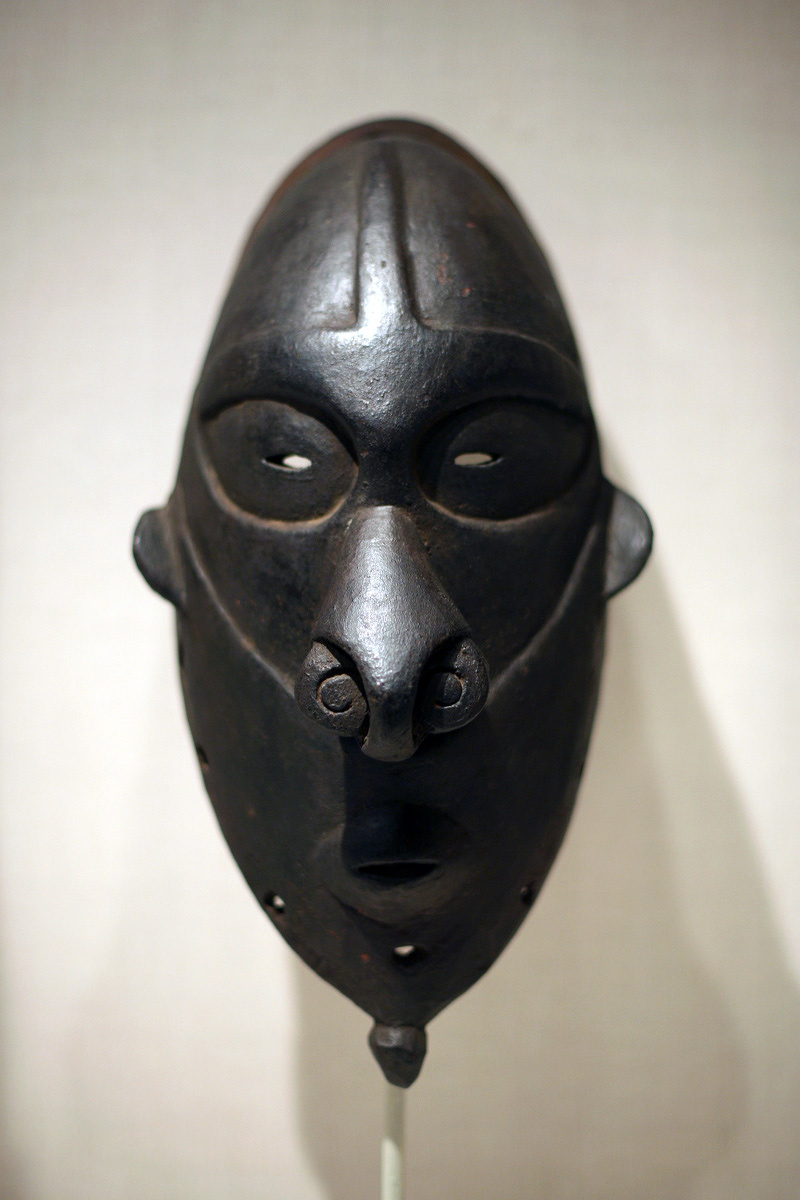
mask (lewa) from Wogeo or Bam, 19th–early 20th century, wood, paint, 38 centimeters (15 inches) high
According to the Christian-group Joshua Project 96 percent of Wogeo are Christians, with the estimated number of Evangelicals being 10 to 50 percent.Like many Oceanic groups, the Wogeo distinguish between the secular, which can be handled rationally, and the sacred, which must be approached with caution. Three categories of supernatural beings are central to Wogeo cosmology: 1) Culture heroes (nanarang): Creators and shapers of the world who establish the rules of daily life. 2) Spirit monsters: Lewa, invoked during district food distributions, and nibek, called upon during interdistrict festivals. 3) Souls of the dead (mariap): These spirits play little role in daily affairs. Magic is pervasive in everyday life and is often wielded by headmen to prevent misfortune, ensure success, and maintain social order. Sorcery is considered a primary cause of illness and death. [Source: “Encyclopedia of World Cultures, Volume 2: Oceania,” edited by Terence E. Hays, 1996]
Death is usually attributed to yabou sorcery, intended to kill rather than merely cause illness. Relatives may demand an inquest to identify and punish the culprit, though these claims are often short-lived. Death is sometimes instead ascribed to violations of incest or menstrual taboos. Funerals are announced publicly, with news spreading to neighboring communities via slit gongs. Ceremonial elaboration depends on the deceased’s status, with headmen receiving the most elaborate rites. Rituals include gift giving, controlled displays of anger, taboos on touching the corpse or eating, ritual wailing, and purification ceremonies for the deceased’s relatives. While an afterlife is recognized, the influence of the dead on the living is minimal.
Religious Practitioners and Healing: Headmen serve as key religious figures, leading local, district, and interdistrict ceremonies. Their authority is tied to demonstrated skill in magic, which is used for communal activities such as planting, trading, or raiding. This magical power is often hereditary, passing to sons. Illness is typically attributed to sorcery, trespassing on another’s property, or failure to perform certain rituals, such as penile incision in the practice of "male menstruation." Each type of illness corresponds to a specific magical system, and knowledgeable practitioners are consulted for cures and guidance.
Ceremonies and the Arts: Rituals focus heavily on the controlled use of magic, often shrouded in secrecy. Music is central to ceremonial life, with singing, drums, slit gongs, and bamboo flutes used extensively. Costumed dancing is an important element of ritual performance. Flutes, typically made from imported bamboo, are the primary musical instruments, and ceremonial activities are often accompanied by elaborate musical performances.
Wogeo Family, Kinship and Sex
The basic Wogeo household consists of a husband, wife, and their children, though other relatives may also reside in the home. In polygynous households, each wife maintains a separate dwelling. Infants are primarily cared for by their mothers, while fathers assume a more active role once children can walk. Maternal and paternal sisters, grandmothers, and unmarried girls often assist in childcare. Children are indulged until about age three, after which they spend much of their time playing and helping adults. Boys undergo a series of rites including ear piercing in infancy, residence in the men’s house during childhood, tongue scarification at puberty, first self-incision of the penis, and finally the wearing of the adult headdress. Girls’ first menstruation is celebrated with body ornamentation, feasting, and the planting of additional gardens. Adoption of children is common. Sons generally inherit land from their fathers, with eldest sons receiving the largest portions. When no sons exist, land passes to daughters and then to their sons. Succession to clan leadership and family magical authority is also patrilineal. [Source: “Encyclopedia of World Cultures, Volume 2: Oceania,” edited by Terence E. Hays, 1996]
Marriages occur through betrothal, elopement, bride capture, or simply establishing a household. Elopement is the most common form, except for firstborn children, whose marriages are typically arranged. Marriages within one’s moiety, clan, or cross cousins are prohibited. About one-third of marriages are polygynous, usually involving older, wealthier men, and are often more contentious than monogamous unions. Postmarital residence is generally patrilocal, keeping couples near the husband’s father’s gardens, though most couples establish independent households after two years. Divorce is common in early years but discouraged after the birth of the first child. Adultery by the husband is considered legitimate grounds for divorce by the wife.
Kinship: The two Wogeo exogamous moieties are he bat and the hawk. These provide marriage partners and underpin ceremonial obligations. The society exhibits a double descent system, combining matrilineal moieties with primarily patrilineal rules for inheritance, political succession, and clan membership. Villages are organized into two or three clans, with membership often tied to allegiance to the clan headman rather than strict descent. Kinship Terminology follows the Iroquois (bifurcate-merging) system. Parallel cousins (children of a father’s brother or a mother’s sister) are treated as siblings, while cross cousins (children of a father’s sister or a mother’s brother) are considered cousins. Same-sex parental siblings share the same terms as the parent, while cross-sex parental siblings have distinct terms translated as “aunt” or “uncle.”
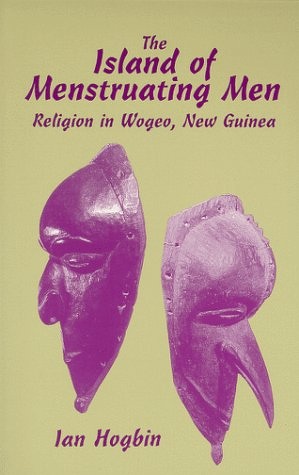
Adolescent Sex: Much attention has been given to the Wogeo practice of "male menstruation" in which men cut their penises to make them bleed or "menstruate." According to Herbert Ian Hogbin (1930s and 40s): Menarche on Wogeo occurs late, at around or after age 17. He wrote: “the sexual life of the islanders does not begin until about the age of 16 or 17 or later...as the title of his later article might suggest, answers negatively on the question of paradoxia on Wogeo. Masturbation is regarded as preparatory. Although knowledge of sexual intercourse is gained by age eight or nine (before, they are told that babies grow on trees, where they are to be picked)... the youngsters do not carry out experiments for themselves”. The “awakening of the sexual impulse” (a rather eurocentric concept) is placed at pubescence, “at least for boys”. In his article on childhood he gives a further (modest) clue to his argument: “play marriages, common elsewhere in Melanesia, do not take place”. On Wogeo infants does not report sexual observations. Hogbin argues that homosexual relations are expected in adolescence, until heterosexual relations are permitted after initiation after about age 19. This would contrast girlhood situation, heterosexual relations being encouraged (and rewarded) from sexual maturity onward. So the possible absence of Paradoxia seems strange in this “permissive” society (Ford and Beach (1951), where “sexual matters are freely discussed by adults in the presence of children [although] parents take some precautions against their own children observing them in intercourse”. [Source:“Growing Up Sexually. Volume I” by D. F. Janssen, World Reference Atlas. 0.2 ed. 2004. Berlin: Magnus Hirschfeld Archive for Sexology; Archive of Sexuality, sexarchive.info ]
Wogeo Life, Villages and Economic Activity
The Wogeo rely on a mixed economy of swidden horticulture, tree cropping, fishing, and shellfish collecting. Their staple foods include taro, bananas, coconuts, yams, breadfruit, sago, pawpaw, and island almonds. Wild pigs are hunted, and domesticated pigs, lizards, and even dogs are eaten. The year-round tropical climate allows a relaxed horticultural cycle with little risk of food shortages. About 40 percent of gardens lie near the coastal villages, while the remaining plots are located inland on hilly slopes. [Source: “Encyclopedia of World Cultures, Volume 2: Oceania,” edited by Terence E. Hays, 1996]
Wogeo is divided into five districts—Wonevaro, Takul, Bukdi, Ga, and Bagiau—each composed of several coastal villages of roughly sixty residents. The men’s house (niabwa) is usually the largest building and occupies the village center, with clusters of two or three dwellings arranged on either side. Village gardens are cleared in the forest behind the settlement or on nearby mountain slopes. Houses are raised 0.9–1.5 meters on piles, with palm-thatch roofs, verandas, and floors of palm wood. Although they vary in size, the basic design is consistent across villages.
Work is divided primarily by sex. Women care for children, maintain the house, cook, plant taro, make garments, and collect shellfish. Men perform heavy garden work, gather nuts, construct houses, carve tools and utensils, fish, and make their own clothing. Wogeo men produce dugout canoes, baskets, drums, bamboo flutes, nets, and a variety of utilitarian and ceremonial objects. Their large seagoing canoes—hewn from whole tree trunks and decorated with carved figureheads—are especially notable. Despite the clear division of tasks, men and women cooperate closely in planning and tending gardens, though their daily routines are otherwise largely separate. Men with exceptional craftsmanship or strong magical knowledge enjoy higher prestige.
Trade is conducted mainly with nearby island groups and mainland communities. Every five or six years, about six large Wogeo canoes embark on long-distance trading voyages carrying almonds, other nuts, nets, and woven baskets. They return with clay pots, produce bags, flute bamboo, shell ornaments, and pigeon feathers. In intervening years, neighboring islanders make similar expeditions that include stops at Wogeo. These journeys involve communitywide canoe construction, accumulation of goods, magical rites, and reciprocal gift exchanges, and they are among the island’s most important collective activities.
Land and Property is individually owned, and using another person’s belongings or land without permission is considered a serious breach of etiquette. Each district collectively controls the forest within its boundaries, and all district members have equal access to forest resources. Unauthorized entry by outsiders often arouses suspicions of adultery or sorcery and may provoke retaliatory raids. Rights to marshland are shared among village residents, while beach rights are divided among the two or three clans in each village. Men have the right to build a house in the village closest to the gardens they may cultivate, typically their father’s village, since garden rights are patrilineally inherited. Garden land is allocated to villages and clans, but once a man begins working a plot he effectively “owns” it. Most men hold rights to ten to twenty plots. Control of a plot depends both on cultivation and on fulfilling obligations to the clan headman and following clan inheritance rules.
Text Sources: “Encyclopedia of World Cultures, Volume 2: Oceania,” edited by Terence E. Hays, 1996, National Geographic, Live Science, Metropolitan Museum of Art, Natural History magazine, Australian Museum, New York Times, Washington Post, Los Angeles Times, Smithsonian magazine, Encyclopedia.com, Times of London, Library of Congress, The Conversation, The New Yorker, Time, BBC, CNN, Reuters, Associated Press, AFP, Lonely Planet Guides, Google AI, Wikipedia, The Guardian and various websites, books and other publications.
Last updated November 2025