
Home | Category: Highland and Mainland Ethnic Groups
ABELAM

Abelam yam mask, Early 20th century;
Fiber and paint; height 63 centimeters (25 inches); Metropolitan Museum of Art
The Abelam, also known as Abulas, Ambelam, Ambelas, or Ambulas, are an indigenous group of the East Sepik Province in Papua New Guinea. Their traditional territory extends from the Sepik River plains to the foothills of the Prince Alexander Mountains. Numbering roughly 250,000 people today, they are linguistically and culturally related to the Iatmul, Sawos, Boiken, and Manambu peoples, together forming the Ndu language family of the Sepik subphylum. [Source: Brigitta Hauser-Schäublin, “Encyclopedia of World Cultures, Volume 2: Oceania,” edited by Terence E. Hays, 1996 ~]
Abelam territory encompasses two ecological zones: the hilly regions rising to 600–700 meters above sea level and the relict alluvial plains. These zones differ in terrain, rainfall, and soil composition. High population density and shifting cultivation have largely replaced virgin forest with secondary growth. Villages range from small hamlets of 50–80 residents in the south to larger northern settlements of up to 1,000 people. Villages are divided into hamlets and are organized around ceremonial grounds (amei) and men’s ceremonial houses (korambo), which serve as centers of ritual and social life.
The Abelam language belongs to the Ndu family of the Middle Sepik stock within the Sepik-Ramu phylum. Linguistic evidence indicates a shared ancestry with other Ndu-speaking groups who likely migrated northward into the Sepik plains several centuries ago. The Abelam first came into direct contact with Europeans in the early 20th century through German ethnologist Richard Thurnwald. Colonial influence intensified after World War I with the establishment of the Maprik administrative post in 1937. During World War II, the area saw heavy fighting between Japanese and Allied forces, which profoundly altered Abelam society through exposure to warfare, modern technology, and subsequent economic integration.
RELATED ARTICLES:
SEPIK RIVER GROUPS: WHERE THEY LIVE, ART, SPIRIT HOUSES, CROCODILES ioa. factsanddetails.com
KWOMA (A SEPIK RIVER TRIBE): HISTORY, LIFE, ART ioa. factsanddetails.com
EAST (LOWER) SEPIK PEOPLE — BOIKEN, MURIK, SAWIYANO — AND THEIR LIVES, HISTORY AND RELIGION ioa. factsanddetails.com
ART FROM THE LOWER (EAST) SEPIK REGION OF PAPUA NEW GUINEA ioa. factsanddetails.com
ART OF THE ABELAM PEOPLE: MASKS, FIGURES AND SHELL RINGS ioa. factsanddetails.com
BIWAT (MUNDUGUMOR): LIFE, RELIGION, FAMILY AND MARGARET MEAD ioa. factsanddetails.com
ART FROM THE MIDDLE SEPIK REGION OF PAPUA NEW GUINEA ioa. factsanddetails.com
IATMUL PEOPLE OF THE SEPIK RIVER: HISTORY, RELIGION, LIFE AND SOCIETY ioa. factsanddetails.com
ART OF THE IATMUL PEOPLE: MASKS, SLIT GONGS, BOWLS AND HOOKS ioa. factsanddetails.com
CHAMBRI: HISTORY, LIFE, SOCIETY, CROCODILE MEN AND MARGARET MEAD ioa. factsanddetails.com
WEST SEPIK HIGHLANDS PEOPLE — WAPI, TELEFOL, MIAN, GNAU, BIMIN — AND THEIR LIVES, HISTORY AND RELIGION ioa. factsanddetails.com
Abelam Religion and Family
Religious life centers on the korambo (men’s ceremonial house), where rituals associated with initiation, yam fertility, and ancestral spirits take place. The façade of each korambo is elaborately painted with images of ngwalndu spirits, considered powerful beings that influence human and agricultural fertility. While ngwalndu are loosely associated with ancestors, they are not part of formal genealogies. Men progress through multiple initiation stages, each revealing new spiritual secrets. Women participate in rituals related to puberty, marriage, and mourning, though the most sacred ceremonies are restricted to men. [Source: Brigitta Hauser-Schäublin, “Encyclopedia of World Cultures, Volume 2: Oceania,” edited by Terence E. Hays, 1996 ~]
Marriage is generally exogamous (outside the group) at the lineage level, though localized endogamy and sister exchange also occur. While women are generally free to choose their husbands, prearranged unions also occur. Marriage transactions traditionally involve shell rings and, more recently, money. In the absence of a bride price, the husband and his family often reside with and assist the wife’s kin. Divorce is not uncommon and typically results in the woman’s return to her natal family.
Abelam kinship follows the Iroquois (bifurcate merging) system, distinguishing parallel and cross cousins. Clans are the principal units of landownership, with lineage plots marked by perennial plants. Land rights are flexible and reinforced through continued use, fostering both cooperation and disputes. Though descent is nominally patrilineal, affiliations may also derive from maternal or adoptive ties, reflecting social fluidity.
Abelam Society, Life and Art
Abelam society is organized around patrilineal clans (kim) and lineages that control land and ceremonial privileges. Each village is divided into two nonlocalized moieties (ara) that structure ritual exchanges and male initiation cycles. Leadership is exercised by influential “big men” (nemandu), whose authority derives from oratory skill, ritual knowledge, and the ability to mediate disputes. Social control is maintained through public assemblies, ceremonial exchanges, and the mediation of nemandu. [Source: Brigitta Hauser-Schäublin, “Encyclopedia of World Cultures, Volume 2: Oceania,” edited by Terence E. Hays, 1996 ~]

Abelam in festival clothing
Traditionally, the Abelam are horticulturalists cultivating yams, taro, and sweet potatoes using slash-and-burn methods. Yams are both staple and ritual crops; the cultivation of long ceremonial yams, often exceeding two meters, forms the basis of male prestige and inter-village exchange. These ritual yams, considered to embody male creative power, are exchanged in competitive festivals that strengthen social and ceremonial ties. Coffee and cocoa are now grown as cash crops. Pig raising is central to exchange networks, particularly in yam ceremonies and marriage transactions.
Abelam art is distinguished by vivid painting and carved imagery associated with the korambo and yam festivals. Paint is regarded as a life-giving substance that animates carvings, paralleling the creative potency attributed to yams. Artists hold high prestige for their ritual expertise but seldom political authority. Women are renowned for weaving and dyeing net bags (bilums), a major trade and ceremonial item.
The Abelam are also renowned for their majestic korambo — towering spirit houses that can reach up to 30 meters high. Reserved for men, these triangular structures feature brilliantly painted façades adorned with the awe-inspiring faces of Ngwalndu, ancestral spirit beings revered by the Abelam. The korambo and its adjacent ceremonial grounds (amei) serve as focal points for major communal events, including yam festivals, village assemblies, and male initiation ceremonies. During initiation, respected elders known as Gual mentor young boys, imparting sacred knowledge, magical practices, and the art of cultivating the long yam — guiding them on their transformation into capable and honorable men. [Source: Tribes of Papua New Guinea]
Traditional medical knowledge includes the use of herbs and plants, though much has declined with the spread of Western medicine. Illness and death are often attributed to sorcery. Death rituals involve public display of the body before burial and successive ceremonies to release the soul. The eternal soul is believed to ascend as a star, while other soul aspects remain linked to blood and bones.
See Separate Article: ART OF THE ABELAM PEOPLE: MASKS, FIGURES AND SHELL RINGS ioa.factsanddetails.com
Abelam Yam Culture
Among the Abelam people of Papua New Guinea, colossal ceremonial yams — often reaching lengths of three to four meters — hold profound cultural and spiritual significance. These extraordinary yams are cultivated exclusively by men in sacred yam gardens, spaces strictly forbidden to women. A man’s social status and prestige are closely tied to his success in growing these revered crops, sparking spirited competition within and between villages. [Source: Tribes of Papua New Guinea]
The cycle of the yam cult begins with the evocative “blowing on the yams” ceremony and culminates in the grand ceremonial exchange. During this ritual, participants from neighboring villages symbolically breathe life into the planting yams, invoking fertility and abundance for the coming season. To protect the yams’ growth, men observe strict taboos — avoiding certain foods and abstaining from sexual relations. The act of cultivation itself is seen as a form of male procreation: straight yams represent masculinity, while yams with protrusions are associated with femininity.
Throughout the five-month growing season, men devote themselves entirely to nurturing their yams and performing complex rituals believed to encourage growth. Women and uninitiated boys are barred from the gardens, as the yams are thought to possess spirits sensitive to disturbance and emotion. Peace and harmony are essential — quarrels, hunting, and any form of conflict are strictly forbidden during this sacred period.
Remarkably, these monumental yams are never eaten. They are reserved solely for ceremonial exchanges, where Abelam men present their finest specimens to rivals and exchange partners from neighboring communities. Though fiercely competitive — sometimes even leading to disputes — the yam exchanges ultimately strengthen inter-village relationships and ensure the spread of superior yam varieties throughout Abelam territory.
Arapesh
The Arapesh inhabit the coastal and mountainous regions of East Sepik Province and are linguistically and culturally related to other Torricelli-speaking groups. Arapesh communities extend from the Pacific coast across the Prince Alexander and Torricelli ranges to the plains of the Sepik River. The Mountain Arapesh — also known as Bukiyip or Pukia — occupy the central ranges between 3°27 and 3°34 S and 143°09 and 143°19 E, a region of dense forests with annual rainfall exceeding 250 centimeters. Early estimates placed their population between 2,600 and 6,000; in the 1990s the broader Arapesh population numbers around 30,000. Major subgroups include the Mountain (Bukiyip), Bumbita, Mufian (Southern), and Abu’ Arapesh. According to Joshua Project the Abu’ Arapesh. numbered 5,100 in the early 2020s. [Source: Paul Roscoe, “Encyclopedia of World Cultures, Volume 2: Oceania,” edited by Terence E. Hays, 1996]
The Arapesh became well known through the anthropological studies of Margaret Mead and Reo Fortune, who conducted fieldwork among the Mountain Arapesh in the early 1930s. Mead described Arapesh society as gentle, cooperative, and egalitarian, with both men and women sharing child-rearing and social responsibilities. While later scholarship has debated the extent of this characterization, ideals of mutual dependence and restraint remain central to Arapesh culture. Childrearing emphasizes affection and the early development of cooperative behavior.
Arapesh Languages form a small dialect chain within the Torricelli family. Major varieties include Bukiyip, Bumbita, Mufian, and Abu’. These languages are known for their intricate noun-class systems, with some dialects — such as Mufian — featuring as many as 17 genders. While traditional languages remain in limited use, Tok Pisin has become the dominant lingua franca, especially among younger generations.
History: Before European contact, the Arapesh lived in small, autonomous communities linked by kinship, trade, and ceremonial exchange. The first sustained European presence came with German colonial expansion in the late 19th century, followed by Australian administration after World War I.

Arapesh group, including two in ceremonial costume in the 1930s
By the time Mead and Fortune conducted their research in 1932, stone tools had disappeared, warfare had been suppressed, and many Arapesh men were employed on coastal plantations. The Second World War caused major disruption, including evacuations and postwar migrations toward coastal and foothill settlements.
Religion: Christianity — both Catholic and Protestant — is now professed by 75 to 90 percent of the population. Traditional Arapesh religion centers on ancestral and nature spirits — the walinab and shades of the dead — believed to inhabit trees, waterholes, and hills. These spirits are invoked for fertility, protection, and success in gardening and hunting. Ceremonial life revolves around the tambaran (or wareh) cult, involving masked performances, initiation rites, and elaborate feasts. Death rituals include brief mourning and burial beneath the village plaza; the bones of prominent men were sometimes exhumed for ritual use to transmit their power.
Arapesh Life, Society and Family
The Arapesh practice subsistence agriculture, cultivating yams, taro, bananas, and sago through shifting (slash-and-burn) cultivation. Hunting, fishing, and pig husbandry provide additional food sources. Trade historically connected them to neighboring lowland and coastal groups, involving the exchange of stone tools, shell valuables, dogs’ teeth, carvings, pottery, and ceremonial objects. Labor is divided along gender lines: men clear gardens, hunt, and build houses, while women cook, care for children, raise pigs, and tend taro gardens. Arapesh artistic traditions include woven ornaments, carved plates, decorated belts, painted bark panels, and slit gongs used in ceremonies. Music, dance, and the crafting of ritual paraphernalia for tambaran ceremonies are key expressions of creative and spiritual life. [Source: Paul Roscoe, “Encyclopedia of World Cultures, Volume 2: Oceania,” edited by Terence E. Hays, 1996]
Society is structured around patrilineages and clans, each associated with an ancestral spirit known as a walinab. Lineages control land, ritual privileges, and totemic spirits believed to protect their territories. Kinship terminology follows the Omaha type, emphasizing patrilineal descent, though adoption and secondary affiliations are common. Villages typically comprise several small ridge-top hamlets, each owned by a lineage. Broader political units — called localities — include multiple hamlets and are divided into two exogamous moieties, symbolized by the hawk and the parrot. Despite social and economic change, many Arapesh continue to maintain their distinctive cultural identity and community ties.

1979 Performance of the mai in front of a zigzagged screen representing the Prince Alexander Mountains researchgate
Marriages are often arranged in childhood, with girls betrothed between six and eight years old to slightly older boys. Virilocal residence is the norm, and polygyny is common. Marriage alliances strengthen ties between lineages and involve the exchange of shell valuables and food. Divorce is rare, typically resulting in the woman’s return to her natal family. Households are nuclear or extended, often including unmarried siblings and the betrothed fiancées of sons.
The Arapesh lack centralized authority or hereditary chieftainship. Leadership rests with “big men” who gain influence through oratory, generosity, and participation in exchange networks. Inter-locality warfare was once common, typically triggered by disputes over women, but it diminished following colonial pacification. Conflicts are now resolved through exchange, mediation, or social ostracism, though belief in sorcery continues to play a role in dispute resolution. Today, Local governance and political participation have expanded, and Arapesh representatives have gained a stronger voice in Wewak District affairs.
Margaret Mead and the Arapesh
After a field trip to Nebraska in 1930 to study the Omaha Native Americans, Margaret Mead and her husband, Reo Fortune, next headed to the Sepik region of Papua New Guinea for two years. While there Mead did pioneering work on gender consciousness. She sought to discover to what extent temperamental differences between the sexes were culturally determined rather than innate. She described her findings in “Sex and Temperament in Three Primitive Societies” (1935) and explored the subject more deeply in the next decade with “Male and Female” (1949). [Source: Library of Congress]
Mead found a different pattern of male and female behavior in each of the cultures she studied, all different from gender role expectations in the United States at that time. She found among the Arapesh a temperament for both males and females that was gentle, responsive, and cooperative. Among the Mundugumor (now Biwat), both males and females were violent and aggressive, seeking power and position. For the Tchambuli (now Chambri), male and female temperaments were distinct from each other, the woman being dominant, impersonal, and managerial and the male less responsible and more emotionally dependent. While Mead's contribution in separating biologically-based sex from socially-constructed gender was groundbreaking, she was criticized for reporting findings that seemed custom-made for her theory. For Mead, each culture represented a different type within her theory, and she downplayed or disregarded information that may have made her simple classifications untenable.
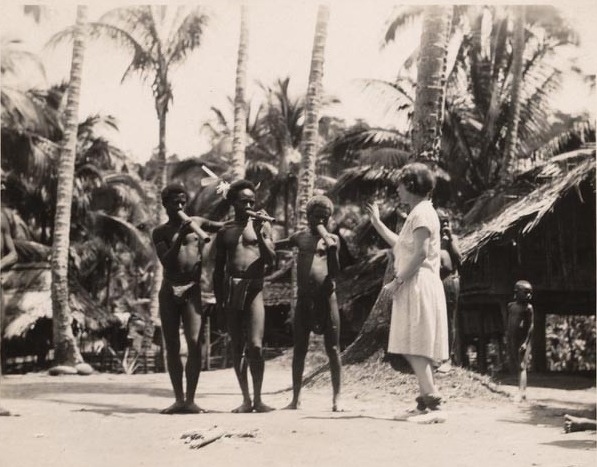
Margaret Mead “Conducting Public Flutes” at Alitoa Village, Arapesh, 1932
In the later stages of the Sepik trip, Mead and Fortune encountered British anthropologist Gregory Bateson, who was studying the Iatmul people. The three worked to develop a systematic explanation of the relationships between cultures and personality types. Mead discovered such an intellectual bond and temperamental affinity with Bateson that she eventually divorced Fortune and married Bateson.
Mead and Fortune arrived in Arapesh in December 1931. The people had no name for themselves, so Mead and Fortune called them "Arapesh," after the word for "person" in the local language. Mead's ankle was too weak for her to hike through the mountains, so she had to be carried to the mountaintop village of Alitoa, she wrote, "strapped like a pig to a carrying pole." The couple was stranded there when the people carrying their belongings would go no further. Fortune went off to do research outside the village, while Mead was left behind. As she had in Samoa, she combatted depression by working constantly, accumulating a mass of notes. She published five technical volumes on the Arapesh. Mead recorded observations about Arapesh culture using note slips or “slip recording.” She first took notes by hand, in a notebook, then typed specific observations about points of the culture onto slips, coding the slips by reference category and date.
From the time of her first field trip, Mead introduced various images and objects as a form of psychological testing. Among the Arapesh, Mead recorded reactions of a group of women and children to HOME Magazine. She notes that “little children, laughed almost hysterically at large covers…Women imitated any overt gesture…Respond with shouts to any picture depicting movement.”
In the picture here Mead is shown “conducting” Arapesh men playing secular flutes. In contrast to sacred flutes, from which women and children must hide, women are permitted to see these flutes. The Tamberan, guardian spirit of the adult males, is embodied through the sound of the sacred flutes and other instruments. The flutes shown in this photo may be the those Mead described in her writing on the Arapesh as “buan flutes, a series of triple flutes which have been secularized among the Arapesh.”
Sex Lives of Adolescent Bumbita Arapesh
The Bumbita Arapesh have traditionally lived in 13 villages within the Bumbita-Muhian Rural LLG in the East Sepik Province. They primarily practice Protestant Christianity. Their dialects include Bonahoi, Urita, Timingir, Weril, and Werir. They are also referred to as Weri or Urita.
According to Stephen .C Leavitt (1995) wrote: “Traditionally, a girl’s first menstruation entails the only celebration of womanhood in bumbita culture…It meant that she was now a woman and she would soon be sought after for marriage…it is physical maturation that defines how a girl becomes a woman [which] follows naturally from the onset of a young woman’s menstrual cycle…it is the physical maturation of a woman that makes her desirable to men…In the first tambaran initiation, Rehin, given to boys, initiate’s penes are slashed to discharge bad blood that develops from this kind of nurturative contact with women…When a boy is an adolescent, he lets blood for the first time. Throughout his adolescence, he must not let blood too frequently because preservation of blood is important for proper maturation…I saw confirmed Tuzin’s observation that penis bleeding was “an act very close to masturbation [involving erections and squeezing]…The ceremony of first menstruation is a celebration of a girl’s maturation into womanhood, while a man’s experience of penile blood suggests that it too is a kind of celebration, a celebration of masculinity. Girls experience with the onset of menstruation a quiet pride that they will now be women, but along with that comes a sense of foreboding, for they sense that their attractiveness to men, simply by virtue of their having matured into women, will propel them headlong into the arena of courtship and marriage…The practice of penis bleeding, by contrast, illustrates a man’s perception that masculine prowess is something that he must actively create in himself ”. [Source: “Growing Up Sexually. Volume I” by D. F. Janssen, World Reference Atlas. 0.2 ed. 2004. Berlin: Magnus Hirschfeld Archive for Sexology, Berlin, June 2005]
On sex: “Bumbita boys and girls interact freely, and sexual play among children is recognized as a common occurrence. Men jokingly assert that while white people begin having sex after adolescence, Papua New Guineans have sex as children. Male informants, in their discussions of their childhood, frequently describe incidents in which they met with a girl in secret, shed their clothes, and together explored each other’s bodies. Sometimes they would even mimic sexual intercourse. Men characterize the girls as always willing, though occasionally they would make an initial effort to protest. Boys and girls imitated the courting ritual in which the boy would ask the girl who it is that she likes or who it is that she will marry. And the girl would inevitably say, “Not you!” Women would not tell me of any of this explicitly sexual play, but they did talk of pretending to be married to a boy and of pretending to cook food for him. Informants conveyed an emotional tone of carefree play, occasionally remarking, “That’s the way children are”.
Adolescent secret get-togethers after dark: “Occasionally…included sexual encounters with the young couple disappearing into the bush away from the others…Young men told me that before they could talk with adolescent girls, they had to “learn how” to flirt…Both sexes describe flirting behaviour in highly specific terms…Love magic is one of many varieties of magic that men perform…contracting a marriage is for Bumbita a protracted and difficult process, both for the apprehensive couple and for the many relatives involved”.
Image Sources: Wikimedia Commons
Text Sources: “Encyclopedia of World Cultures, Volume 2: Oceania,” edited by Terence E. Hays, 1996, National Geographic, Live Science, Metropolitan Museum of Art, Natural History magazine, Australian Museum, New York Times, Washington Post, Los Angeles Times, Smithsonian magazine, Encyclopedia.com, Times of London, Library of Congress, The Conversation, The New Yorker, Time, BBC, CNN, Reuters, Associated Press, AFP, Lonely Planet Guides, Google AI, Wikipedia, The Guardian and various websites, books and other publications.
Last updated November 2025