
Home | Category: Highland and Mainland Ethnic Groups
KWOMA
Kwoma
The Kwoma are a people of northeastern New Guinea who live in the Peilungupo mountains north of the Sepik River in the Ambunti Sub-Province. Also known as Nukuma, Washkuk, and Waskuk, they are divided into two dialect groups. One is located in the Washkuk Hills, a range of low mountains on the north side of the Sepik adjacent to the Ambunti Patrol Post; the other is situated to the north and west of the Washkuk range along tributaries of the Sepik. The hill areas rise to about 486 meters (1,594 feet). [Source: Ross Bowden,“Encyclopedia of World Cultures, Volume 2: Oceania,” edited by Terence E. Hays, 1996]
Kwoma villages in the lowlands were scattered along the branches of the Sanchi River. The people living in the higher areas identified themselves as “Kwoma,” meaning “hill people,” and referred to those in the lower regions as “Nukuma,” meaning “headwater people.” Linguists applied the name Kwoma to the language as a whole and Nukuma to its northern dialect. “Washkuk” or “Waskuk” was a government term of uncertain origin used to refer to both the people and their language.
According to the Christian-group Joshua Project their population in the 2020s was 5,700. In the 1990s, there were approximately 2,000 Kwoma speakers in the Washkuk Hills and 1,200 Nukuma speakers. The total population in 1936 was less than a 1,000 and around 3,000 were counted in 2003. John Whiting's ethnography of the Kwoma, based on fieldwork conducted in 1936, was a groundbreaking effort to describe the socialization of children in a traditional, non-Western culture. [Source: Joshua Project, Wikipedia]
Language: Kwoma was one of about ninety distinct Papuan, or non-Austronesian, languages that made up the Sepik-Ramu (or Middle Sepik) branch. Within this phylum, Kwoma was classified in the Nukuma language group. There were notable linguistic differences between the two Nukuma dialects: 1) the one spoken in the lowlands and 2) the Kwoma dialect spoken in the hills, and these distinctions were strongly felt by both groups. A translation of the New Testament in Kwoma was completed in 1975, but the people feel that it is hard to understand and have persistently made requests for a revision. The Nukuma dialect speakers have also made a request for a translation in their dialect.
The Kwoma were surrounded by other peoples—most with even smaller populations—who spoke entirely unrelated languages. In intertribal encounters, each group typically spoke its own language, relying on mutual understanding rather than on shared speech for communication.
RELATED ARTICLES:
SEPIK RIVER GROUPS: WHERE THEY LIVE, ART, SPIRIT HOUSES, CROCODILES ioa. factsanddetails.com
EAST (LOWER) SEPIK PEOPLE — BOIKEN, MURIK, SAWIYANO — AND THEIR LIVES, HISTORY AND RELIGION ioa. factsanddetails.com
ART FROM THE LOWER (EAST) SEPIK REGION OF PAPUA NEW GUINEA ioa. factsanddetails.com
ABELAM AND ARAPESH OF THE SEPIK RIVER: LIVES, HISTORY AND MARGARET MEAD ioa. factsanddetails.com
ART OF THE ABELAM PEOPLE: MASKS, FIGURES AND SHELL RINGS ioa. factsanddetails.com
BIWAT (MUNDUGUMOR): LIFE, RELIGION, FAMILY AND MARGARET MEAD ioa. factsanddetails.com
ART FROM THE MIDDLE SEPIK REGION OF PAPUA NEW GUINEA ioa. factsanddetails.com
IATMUL PEOPLE OF THE SEPIK RIVER: HISTORY, RELIGION, LIFE AND SOCIETY ioa. factsanddetails.com
ART OF THE IATMUL PEOPLE: MASKS, SLIT GONGS, BOWLS AND HOOKS ioa. factsanddetails.com
CHAMBRI: HISTORY, LIFE, SOCIETY, CROCODILE MEN AND MARGARET MEAD ioa. factsanddetails.com
WEST SEPIK HIGHLANDS PEOPLE — WAPI, TELEFOL, MIAN, GNAU, BIMIN — AND THEIR LIVES, HISTORY AND RELIGION ioa. factsanddetails.com
Kwoma History
Kwoma From Martin Fowler
Kwoma are believed to have arrived on the Sepik River between 3000 and 1000 B.C. The Kwoma traced their origins to several “holes” in the ground located within Nukuma territory. Linguistically, the Kwoma language was closely related to Kwanga, which was spoken by a much larger population in the southern foothills of the Torricelli Mountains, about 48 kilometers to the north. It is almost certain that the Kwoma people migrated from that region to their present settlements within the past few centuries. Relations with outsiders were often hostile, and even relations among the four Kwoma subtribes could be violent, with members of different subtribes engaging in head-hunting expeditions against each other. [Source: Ross Bowden,“Encyclopedia of World Cultures, Volume 2: Oceania,” edited by Terence E. Hays, 1996]
In the past, warfare between tribes was common. Fighting between clans within the same tribe, however, was strongly condemned. Such clans were—and still are—believed to engage in conflict through sorcery, suspicion of which remains a major source of enduring tension between individuals and clans within the same tribe. Ideally, intratribal disputes were settled without bloodshed through discussion, mediation by clan leaders, traditional stick fighting, and the payment of compensation in shell valuables. Village leaders regularly convened meetings in the ceremonial houses, attended by all members of the community, to resolve disputes and address other matters of local concern. It was widely believed that long-standing, unresolved conflict could provoke acts of retaliatory sorcery.
The Kwoma were first encountered by German explorers in 1895, with more sustained European contact occurring shortly before World War I, when the area was under German control. However, European influence remained minimal until after World War II. Christian missions became active in the 1950s, and most Kwoma eventually became nominal members of various Christian denominations. Many men spent several years working elsewhere in Papua New Guinea as wage laborers or as employees of churches, the army, or the police. In daily life, the people spoke Kwoma among themselves and used New Guinea Pidgin when communicating with outsiders. Few spoke English.
Kwoma Religion and Mythology
Kwoma From Martin Fowler
According to the Christian-group Joshua Project 99 percent are Christians. Even so the Kwoma still at least made a nod their traditional ritual and aesthetic life. They have traditionally believed in a complex pantheon of spirits. These fall into two categories: "bush" or "water" spirits occupying streams, boulders, or other natural features, collectively termed (in pidgin) masalai; and clan spirits depicted by ceremonial carvings. [Source: Ross Bowden,“Encyclopedia of World Cultures, Volume 2: Oceania,” edited by Terence E. Hays, 1996 ~]
In the Kwoma creation myth man and woman were the last creatures created on earth. At that time man was stupid because he had no soul and women were wise and mystical. The two lived in separated houses and each night the woman made mysterious sounds with instrument she made from a sacred tree. The man was intrigued by these sounds but when he asked the woman what caused the sound she said nothing. One night the men went to the woman's house and discovered the magic flute and drum, and took them. A bird of paradise told the woman what had happened she visited the man who told her: "Don't bother, for I am stronger than you and I may just kill you." Later the man and woman reconciled and had a son. After he had grown-up the son disgraced his father by telling his mother the secret for growing taro. The mother had also cast a spell so the father wouldn't produce anything. The father slapped the boy on the face and noticed the next day the blood spilled on his yams seemed to break the mother's spell. The father raised his hand to strike his son again but he fled into the jungle and scratched his penis on a thorn. When the boy returned he was more of a man. The scratch was seen as his first and last menstruation. [Source: "Vanishing Tribes" by Alain Cheneviére, Doubleday & Co, Garden City, New York, 1987]
The Kwoma do not dwell on the afterlife and hold no belief that a person’s actions are punished or rewarded after death. The souls of the dead are thought to reside in ghostly villages deep within the forest, or—among the most prominent men—in a subterranean realm entered through lagoons. The Kwoma practice double burial: the second ceremony, held a year or more after the first, coincides with the body’s full decomposition and marks the formal end of mourning and the soul’s permanent departure to the land of the dead. In the past, corpses were exposed on raised platforms, but today they are buried in cemeteries. Although now prohibited, a traditional custom persists in which certain bones are recovered during the second burial and fashioned into daggers or other items of adornment. The skulls of exceptional warriors and orators are interred beside the main posts of men’s houses to impart additional “strength” to the structure.
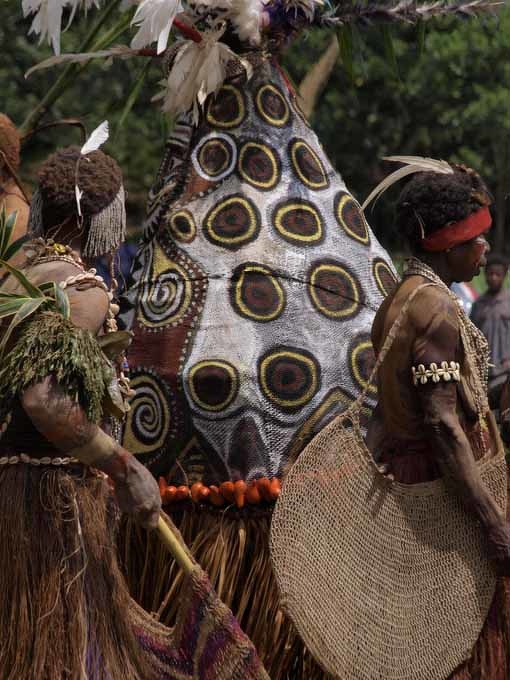
The three major contemporary Kwoma rituals center on the yam harvest. In each, men display elaborately painted and decorated wooden sculptures representing powerful clan spirits—beings believed to ensure the continued fertility of the yam gardens—and perform intricate song cycles recounting notable events in clan histories. Formerly, the Kwoma also held a separate yam-planting ceremony that featured a distinctive carved female figure, though this ritual has now been discontinued. Women’s participation in ceremonies is limited to singing and dancing outside men’s houses on designated occasions; they know the men’s songs well and enthusiastically join in the choruses.
Periods of noise, fire, and sickness are believed to occur when demons invade the village. These demons are expelled through chants and the beating of sacred drums, then chased in dugout canoes into deep water, where they drown—water being fatal to them. All serious illnesses and deaths not caused by direct physical violence are attributed to sorcery. The Kwoma believe that grave illnesses, such as tuberculosis, can be cured only when the underlying conflicts that provoked the sorcery are identified and resolved.
Kwoma Family and Marriage
Kwoma men's house From Martin Fowler
Each Kwoma family—whether monogamous or polygynous—maintains at least one “sleeping house,” where men, their wives, and their children sleep, and an adjacent kitchen. Every sexually mature woman in the household has her own hearth and prepares her own food. In polygynous households, each wife typically occupies her own house or a separate, walled-off section of a shared dwelling. Polygyny is practiced by only a minority of men, generally village elders, many of whom acquire additional wives through the levirate. A woman may consent to her husband taking another wife—often an older brother’s widow—only if the relationship remains nonsexual. Younger women generally prefer monogamy, as sexual jealousy between co-wives of childbearing age is common. When sons reach adulthood, they usually build their own houses beside their father’s and bring their wives there after marriage. [Source: Ross Bowden,“Encyclopedia of World Cultures, Volume 2: Oceania,” edited by Terence E. Hays, 1996 ~]
Marriage: The Kwoma traditionally married at pubescence. As in many Papua New Guinean societies, individual marriages among the Kwoma create alliances between groups that may persist for several generations. These alliances are expressed and maintained through continuing, asymmetrical exchanges of food and wealth between wife-giving and wife-taking lines—food flowing to wife-takers, and wealth (in return) to wife-givers. Members of these lines also exchange reciprocal services such as assistance in gardening, house construction, and formerly, warfare. Major occasions for wealth transfer from wife-takers to wife-givers include marriage (from the husband to the wife’s brother), the puberty of the couple’s eldest child (from father to maternal uncle), and the deaths of the wife or any of her children. The death payment for an unmarried girl, like that for a son, goes to the mother’s clan; for a married woman, as with her bride-wealth, it goes to her natal clan.
For the duration of an affinal alliance, no further marriages may occur between the same two lines, although marriages between other members of the same clans are permitted. This rule prohibits marriage with a wide range of relatives and ensures that marital and political ties are broadly dispersed across clans and villages. The Kwoma do not prescribe marriage with any specific category of kin, but a person’s choice of spouse must be acceptable to the clan as a whole. Traditionally, first marriages were arranged. Clans jointly participate in all major bride-wealth, puberty, and death payments involving their members, either as donors or recipients. Clans that become too small to fulfill such obligations independently may merge with others, while those that grow too large often divide into separate groups to ensure equitable distribution of wealth. Divorce is strongly discouraged—especially in the early years of marriage when part of the bride-wealth would have to be returned—but may occur due to serious incompatibility, abandonment, or a man’s taking another wife without the consent of the first, as custom requires. If a woman dies shortly after marriage, her family may provide a sister to replace her; if a man dies, his widow is encouraged—but not compelled—to marry his brother leviratically.
Child Rearing is the joint responsibility of parents and older siblings. Children are taught self-reliance and strength in social interactions, as well as respect for others’ rights. Learning occurs primarily through observation and imitation. By around age ten, girls possess nearly all the skills required of a married woman, while boys can perform most routine male tasks. All children are regarded as female until puberty. During male initiation, a boy’s penis is ritually cut, and the flowing blood symbolizes his first and last menstruation. Traditionally, boys at or near puberty were secluded for several weeks in ritual enclosures, where magic was performed to foster growth and skill in hunting, and where they received intensive instruction in the society’s dual oral literature. Each boy was assigned a “ceremonial father” from his clan who cared for him during initiation and became his lifelong ally. Older men simultaneously underwent seclusion to receive advanced instruction in magic and ritual from renowned big-men. These initiation rites, known as Handapiya and Nal, have largely disappeared. Today, men’s initiation takes the form of participating in one of the first two yam harvest ceremonies, Yena and Minja. The sculptures displayed during these rituals—though differing in style—symbolize enduring masculine ideals: men as hunters and warriors, and as creators, both in horticulture and procreation. As young men take part and learn the secret forms, painting, and decoration of the sculptures, they begin to master their community’s esoteric knowledge and internalize its ideals of manhood.
Kwoma clans are autonomous ritual and landholding units. Their estates—including land, ceremonial objects, totemic names, and exchange rights in clan-exogamous women—are inherited through male members. Married-out women often retain temporary rights to use portions of their clan’s land but cannot pass these to their children. Movable personal possessions such as tools, utensils, pets, and radios are not inherited by clan members but are transferred to other groups as part of death payments.
Kwoma Gender and Sex
Kwoma From Martin Fowler
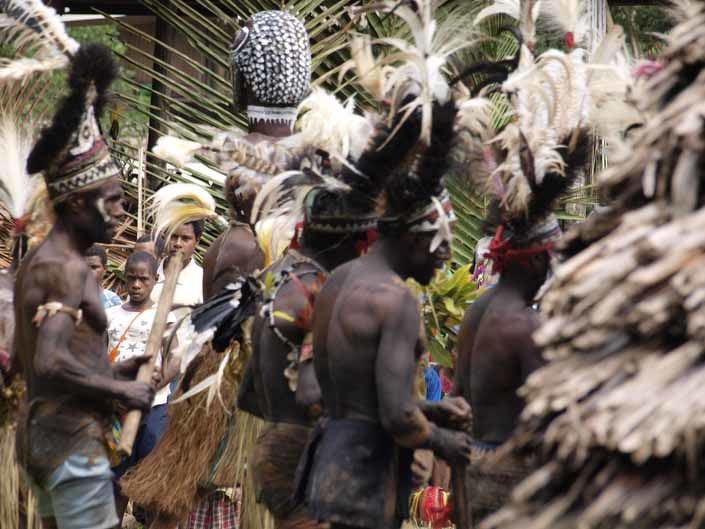
Traditionally, all children were considered female until puberty and were considered both uninterested in sex and uninteresting sexually. A girl’s menarche in itself removed her from the status of child and puts her into a class of “sexy” persons,. Boys practiced periodical penile blood-letting in order to ensure growth. This was done collectively in boy’s initiation, Handapia Sugwia. During the male initiation ritual the boys penis was cut and the blood symbolized his first and last menstruation. When alone in the bush sometimes Kwoma boys scraped their penis with nettles.
Women have traditionally been considered impure. Everything was divided into masculine and feminine. The sexes were considered equal but each is different. Women were thought to possess magical powers that men feared. Men practiced ancestor worship and women couldn’t enter yam fields or spirit houses but the could attend certain festivals, bear arms and dance in front of the haus tambaran.Only pure men, those who haven't had sex for six months, can enter sacred gardens. Once harvested the yams are exchanged under contract with complex terms and competitions are held to see who give his partner the most and largest yams. males that have problems with this sometimes have difficulty finding mates. [Source: "Vanishing Tribes" by Alain Cheneviére, Doubleday & Co, Garden City, New York, 1987]
According to “Growing Up Sexually”:. The Kwoma represents the only culture rated less restrictive for early female childhood, and one of the very few in which this is the case for late childhood; apparently, there is also a reversal of the double standard after late childhood. Whiting and Reed wrote in 1938: “Sexual taboos, imposed early in the child’s life, underlie the later restrictions on marriage and philandering. A boy must not have an erection in public, particularly in the presence of his sisters, who will beat his penis with a stick if they observe it. A child of either sex caught fingering his genitals is told to stop, since the member belongs to its future spouse. The most important sexual restriction imposed at this time [childhood] is against looking at the genitals of the opposite sex. This is considered a sexual advance”. [Source:“Growing Up Sexually. Volume I” by D. F. Janssen, World Reference Atlas. 0.2 ed. 2004. Berlin: Magnus Hirschfeld Archive for Sexology, September 2004; rchive of Sexuality, sexarchive.info ]
In 1941, Whiting wrote: Infants finger their genitalia, though masturbation is not observed. Kwoma boys frequently play a game with sexual connotations: one boy chases another, throws him down, and simulates copulation with him. Other boys in the group then take advantage of the aggressor and pretend to copulate with him until four or five boys line up in this way all laughing and yelling with enjoyment. Then, when the bottom boy has broken free and the chain disintegrates, there follows a hubbub in which each boy calls another his wife and claims to have impregnated “her”. Adolescents often join the game, and, when they do, the children have great difficulty defending their “honor”. When this game was the fad, one or another group of boys played it almost every day for a period of over a month”..
The girl is reared more strictly, although “Kwoma culture defines [looking at opposite sex genitals] as immoral only on the part of the boy”, and both are punished for masturbation. Effectively so, the boys do not even seem to touch the genitalia in urination, and all denied the practice “with considerable embarrassment”. This pattern may be a prelude on adolescent restrictions.
Kwoma Society and Kinship
The Kwoma are organized into several named, politically autonomous tribes. Traditionally, each tribe’s clans formed a single settlement, though today many tribes are divided into multiple villages. Leadership is achieved rather than inherited and is based on oratory skill, ritual knowledge, and formerly, success in warfare. Prominent “big-men,” often also skilled artists, reach peak influence in their sixties or seventies, while men under fifty hold little political sway. In modern times, villages elect councillors to represent them in the Ambunti local government. [Source: Wikipedia; Ross Bowden,“Encyclopedia of World Cultures, Volume 2: Oceania,” edited by Terence E. Hays, 1996 ~]
Each Kwoma subtribe includes several hamlets made up of households with hereditary rights to the surrounding land. Each hamlet centers on a men’s ceremonial house, and all adult males belong to the same patrilineal sib. However, a sib’s hamlets are dispersed throughout subtribal territory. Each sib traces descent from a mythical totemic ancestor and is subdivided into lineages descended from legendary heroes. Within a lineage, related households—especially those of a father and his sons—are built close together. Land is used mainly for subsistence, and the relatively low population density has prevented serious pressure on resources.
The basic kin groups of the Kwoma are named clans that are exogamous (marrying outside the group), patrilineal (based on descent through the male line), patrilocal (living in the husband’s family home or community).Members trace descent from a common male ancestor. Some clans are genealogically linked to others, but these wider units have no collective name or political function. Each clan “owns” many totems—mainly plant and animal species—classified as either male or female. Male species (such as fish) provide most men’s names, while female species (notably birds and cassowaries) provide women’s names. Clans with similar totems form broader totemic divisions that cross tribal and linguistic boundaries, and members of such divisions regard each other as kin. Marriages may occur between clans of the same totemic division, while unrelated people are considered “strangers.”
Kwoma kin terminology follows the Omaha system, grouping relatives by generation and gender. A person’s father and his brothers share the same term, as do the mother and her sisters. Kin terms also extend to members of other clans within the same totemic division: individuals refer to all women of their own generation as “sisters” and to men of the parent’s generation as “fathers.”
Kwoma society is relatively egalitarian and lacks formal leaders, though senior men who have taken enemy heads in warfare command high prestige and hold positions of authority in religious cults. They often have multiple wives. In legal disputes, all initiated men participate in discussions, and every adult male has an equal voice in final decisions.
Kwoma Villages and Economic Houses
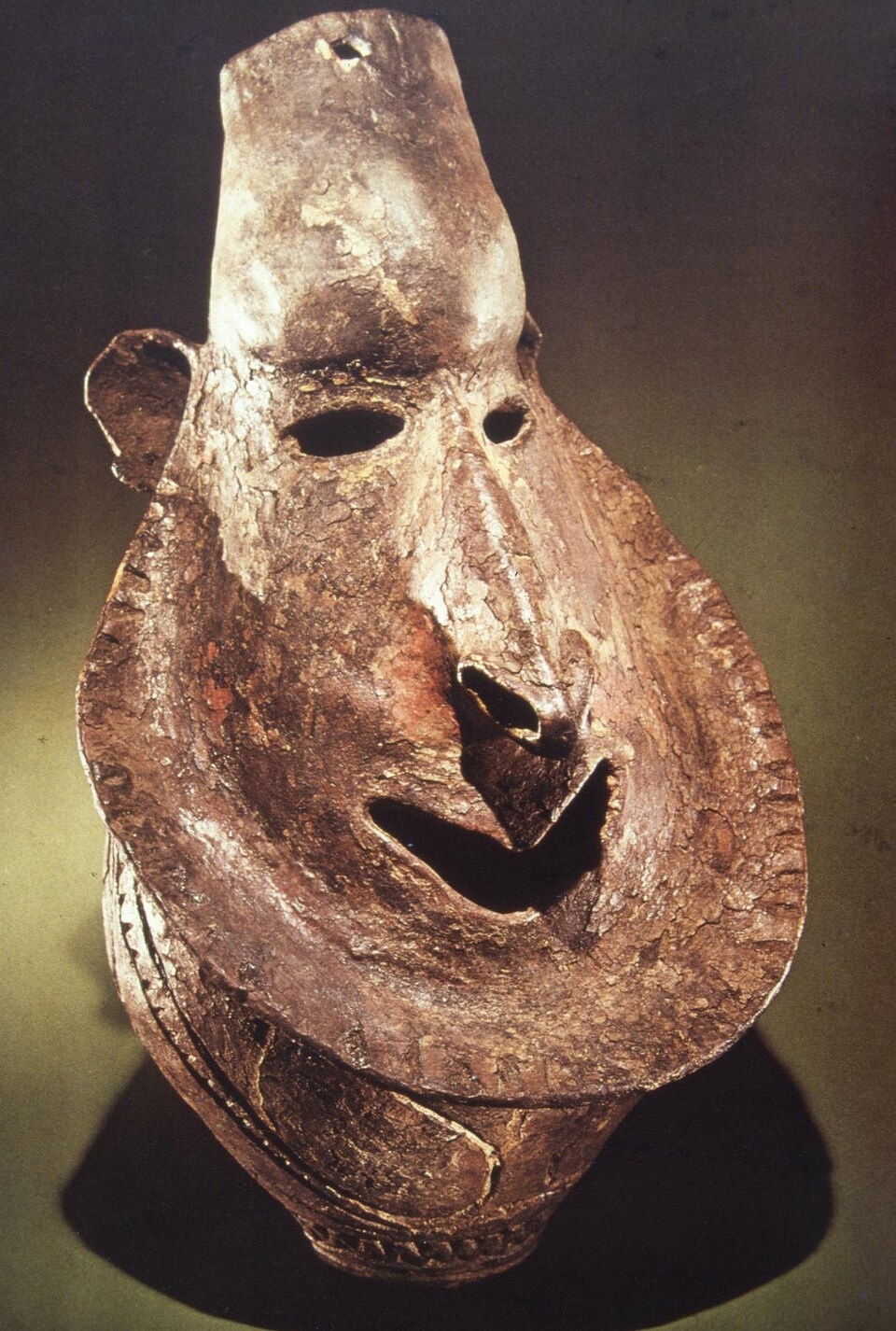
The region where the Kwoma live has a warm, humid climate, with rain falling almost every day. This allows crops to be planted at any time of year. Kwoma territory consists of steep ridges with dense forest cover, rarely rising above 457 meters (1,500 feet), and adjacent swampy lowlands filled with sago palms. Birds are abundant, but feral pigs are the only large mammals. Around homes, people plant coconut and areca palms, pawpaw, breadfruit, and paper mulberry trees. Gardens are cleared by burning small patches of forest, and yams, taro, and greens are grown as the first crop, followed by bananas and plantains. [Source: Ross Bowden,“Encyclopedia of World Cultures, Volume 2: Oceania,” edited by Terence E. Hays, 1996 ~]
Kwoma water container
Kwoma subsist primarily on wild sago, a starchy staple obtained by processing the pith of the sago palm, which grows plentifully in their swamplands. Fish provide the main source of animal protein. The Kwoma do not keep domestic pigs, though pigs and cassowaries are sometimes hunted for food, particularly during ceremonial events. In Western economic terms, the Sepik River region offers little potential for commercial development. Few Kwoma earn money from cash crops or wage labor. The main cash crop is coffee, and in recent decades some have also planted cacao and vanilla. Vanilla has become an important and lucrative addition to the local economy. Within the villages, individual families sometimes run small trade stores that sell items like batteries, kerosene, and soap. Kwoma villages closest to the Sepik River maintain trade relations with neighboring river communities. Trade occurs both through personal partnerships of “friendship” and at regular markets. Women usually conduct market trading, exchanging sago, betel nuts, and other bush products for fish and traditional shell valuables.
Traditionally, the population lived in large settlement groups made up of many hamlets separated by gardens and stretches of forest. In the Washkuk Hills, all settlements were located on hilltops for defense. Each hamlet contained one or more huge ceremonial buildings, called haus tambaran in Tok Pisin, which served as men’s clubhouses and ritual centers. Family dwellings were arranged in a loose circle around the ceremonial house. After pacification around 1945, settlements in the Washkuk Hills were moved to sites beside rivers and streams. At that time, several large hilltop settlements divided into smaller, more distinct villages. Today, villages are more consolidated than in the past and are organized into wards occupied by individual clans. Most still have at least one centrally located ceremonial house. In earlier times, houses were built directly on the ground, as was typical of other “hill” cultures in the region. Today, most houses (though not kitchens) are raised on piles. During the day, when people are not working in their gardens or gathering food, they sit outside or underneath their houses. This encourages friendly social interaction with neighbors and passersby, which the Kwoma regard as an important part of village life.
Men perform the heavier tasks such as clearing forest for gardens and building houses, while women are mainly responsible for household duties. However, this division is flexible. Men help with cooking and childcare, and women assist in garden clearing and maintenance. The processing of sago, the major economic activity, is carried out by both men and women of each household working together. Both sexes also have specific tasks in the gardens. Fishing is done exclusively by women, who use traps, baskets, and handlines in small creeks. Much of the fish consumed by the Kwoma, however, comes through trade rather than local catching. Women exchange sago flour and other forest products for fish at periodic markets held once or twice a week.
Kwoma Art
Painting by a Kwoma artist
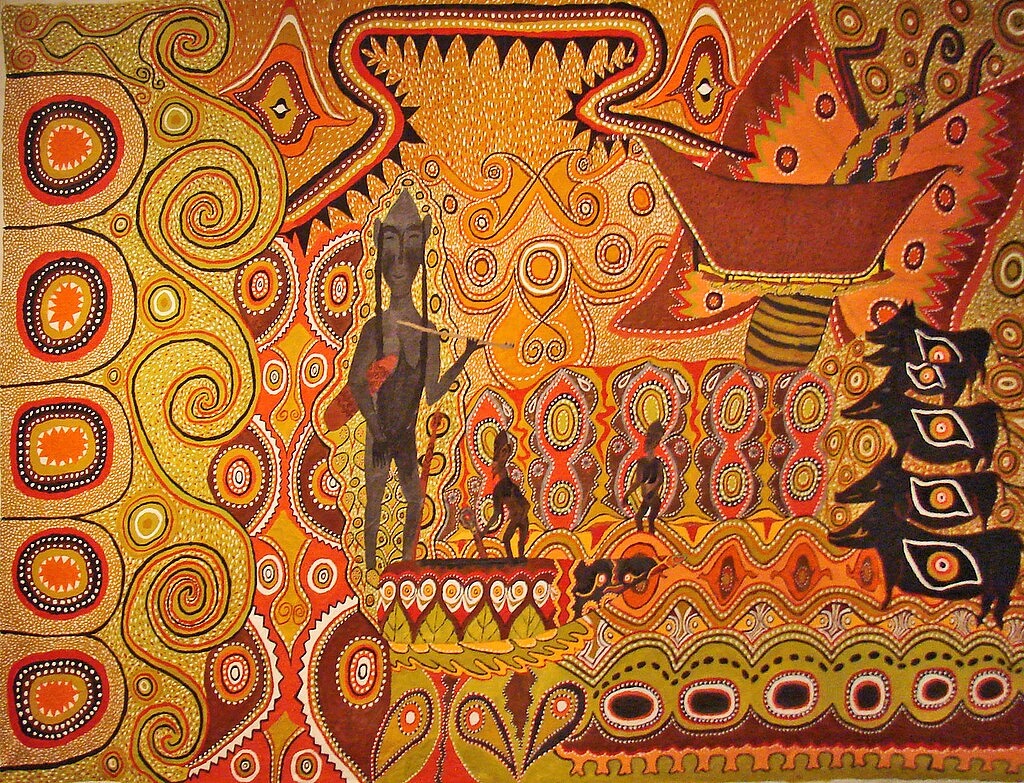
Like other Sepik peoples Kwoma are famous for their art, principally wood carvings and paintings on bark. The bulk of plastic art decorates ceremonial buildings. The ceilings of these structures are lined with hundreds of paintings of totemic species, and the posts and beams are lavishly carved with sculptures depicting mythological personages and spirits. Kwoma men's houses are among the greatest of all artwork in the Pacific region. Art continues to play a major role in Kwoma life, though it is increasingly influenced by tourism. Carved statues are often placed beneath houses to protect them from harm. Drums, flutes, and other sacred ritual objects are kept in the haus tambaran, the men’s ceremonial house.
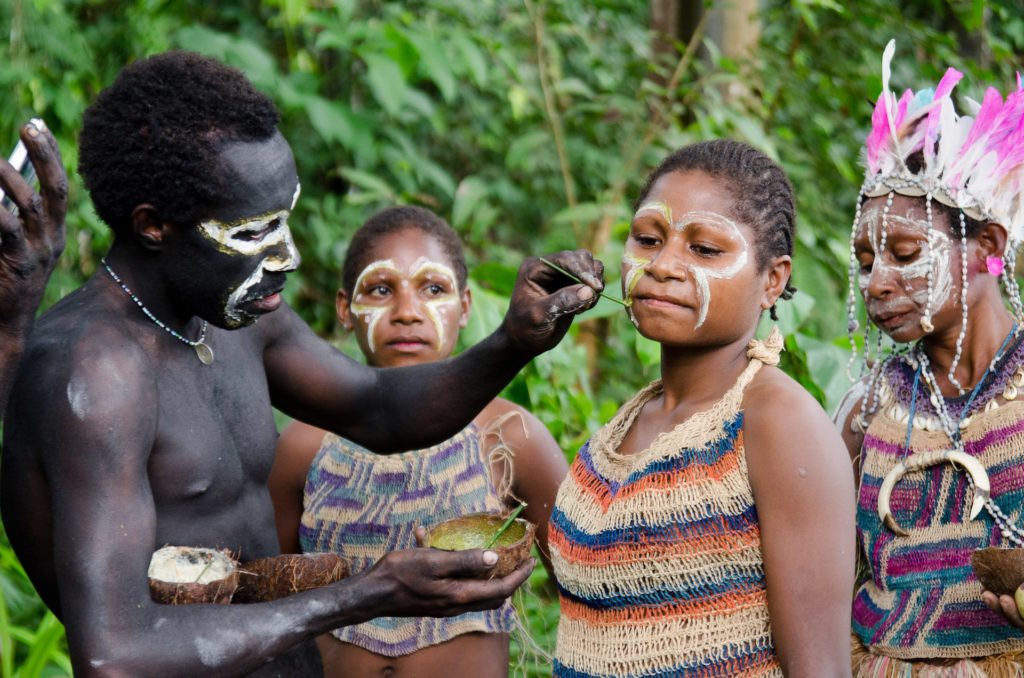
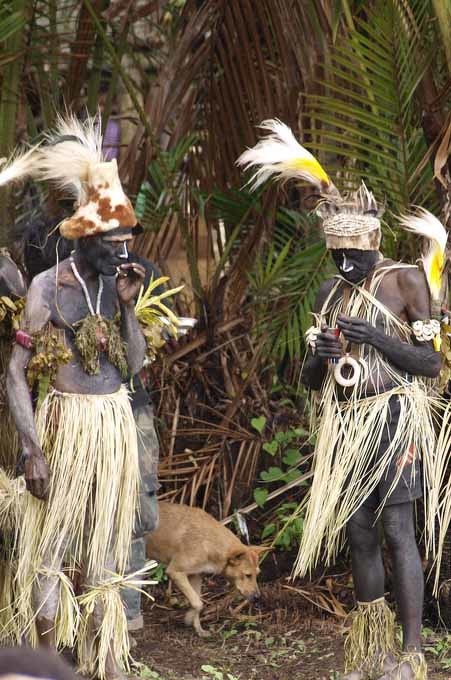
During some ceremonies and big events, the Kwoma cover their body with red and yellow pigments made from clay , black from soot and grease, white from shells. Men and women decorate themselves every day. Men like headdresses made from cassowary and cockatoo feathers while women prefer theirs made from cowry shells. Cowries were once used as currency and are still considered symbols of wealth. Cassowary bones worn in the nose and the ears are considered the most valuable jewels.
The focus of traditional Kwoma art has been their spirit houses (men’s ceremonial house). The Michael C. Rockefeller Wing of Metropolitan Museum of art contains a Ceremonial House Ceiling. This ceiling is composed of over 270 paintings (pangal) commissioned from contemporary Kwoma artists in the village of Mariwai in 1970 and 1973 and extends 80.4 feet (24.5 meters) from end-to-end, making it the largest contemporary art installation in the museum.
According to Metropolitan Museum of Art: Throughout New Guinea, men’s ceremonial houses were, and in many places still are, the primary focus for painting and sculpture. Like the cathedrals of medieval Europe, they are generally the largest and most sacred buildings in the village, rising high above the ordinary dwellings that surround them. Typically, entry into the ceremonial house is restricted to initiated men, although in some cases, women and children can enter under certain circumstances for specific events. Ceremonial houses serve as the venue for nearly all important male religious rites – such as initiation rites for young boys – and at other times function as meeting houses or informal gathering places. Their structure and the way they are decorated can take on many different local forms and styles.
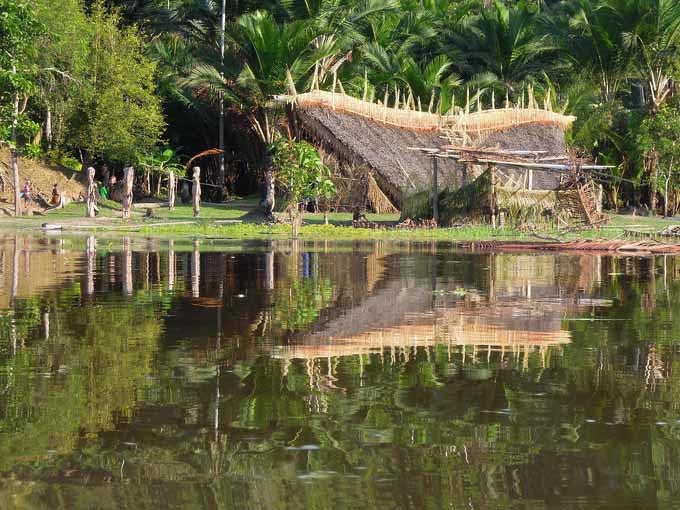
Among the Kwoma people of the Washkuk Hills ceremonial houses have no walls; instead, they consist of a huge steeply pitched roof, which extends nearly to the ground and is supported by a series of massive posts and beams. These structures have no walls and the sides are left open except when rituals are held inside. A finial, carved with images of mythical beings, projects from each gable. Some Kwoma ceremonial houses are unadorned. However, the construction of lavishly decorated examples is a source of pride for the village and its clans. The ceilings of the most ornate ceremonial houses are decorated with hundreds of brilliantly colored paintings and elaborately sculpted posts and rafters.
Paintings are made on sheets of bark or sago petioles, the bark-like bases of the leaves of the sago palm tree, which are trimmed and flattened to create a flat roughly rectangular surface that tapers slightly according to the natural form of the petiole. After a curing process, the artist covers the smooth side of the sheet with a wash of black clay. The main outlines of the design are laid out in clear water, retraced in paint, and then filled in with color. Although one man lays out the design, an assistant may perform the work of infilling and painting the bordering dots. Each painting represents a specific animal, plant, object, supernatural being, or other phenomenon associated with one of the village clans, such as fruit bats or shooting stars for example. The manner in which these clan symbols are depicted varies greatly. Some of the more figurative imagery, such as a relatively naturalistic crocodile, typically do not depict ordinary creatures but rather represent supernatural beings who either are otherworldly animals or have assumed animal form. Many of the paintings employ abstract and geometric designs derived from features of the various animals, plants, and other subjects they portray. Paintings may also include images of natural objects such as the moon in its various phases or legendary figures from the clan’s oral traditions. While there is a fairly well-defined repertoire of specific geometric design types, the meaning of each design can vary according to the intention and clan affiliation of the artist.
Image Sources: Wikimedia Commons
Text Sources: “Encyclopedia of World Cultures, Volume 2: Oceania,” edited by Terence E. Hays, 1996, National Geographic, Live Science, Metropolitan Museum of Art, Natural History magazine, Australian Museum, New York Times, Washington Post, Los Angeles Times, Smithsonian magazine, Encyclopedia.com, Times of London, Library of Congress, The Conversation, The New Yorker, Time, BBC, CNN, Reuters, Associated Press, AFP, Lonely Planet Guides, Google AI, Wikipedia, The Guardian and various websites, books and other publications.
Last updated October 2025