
Home | Category: Highland and Mainland Ethnic Groups
IATMUL
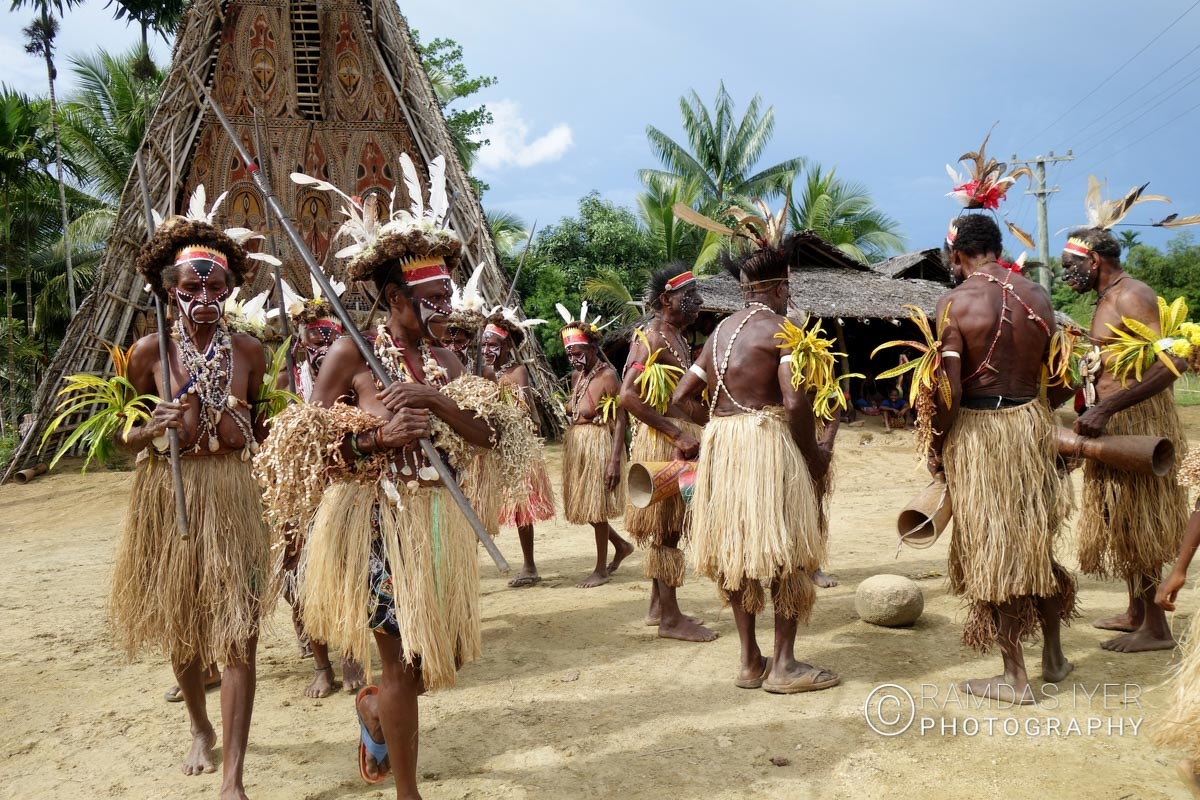
Iatmul in ceremonial clothes Ramdas Iyer Photography
The Iatmul (pronounced YAHT-mool, also spelled Yatmul) inhabit about two dozen autonomous villages along the Middle Sepik River in East Sepik Province. The Iatmul are best known for their art, men’s houses, elaborate totemic systems, and male initiation ceremonies, as well as for the naven ritual, first studied by anthropologist Gregory Bateson in the 1920s and 1930s. Today, they are also known to tourists and scholars alike through the 1988 documentary Cannibal Tours. [Source: Wikipedia, Brigitta Hauser-Schäublin, “Encyclopedia of World Cultures, Volume 2: Oceania,” edited by Terence E. Hays, 1996; J. Williams, “Worldmark Encyclopedia of Cultures and Daily Life,” Cengage Learning, 2009]
According to the Joshua Project, the Iatmul population in the 2020s was about 16,000, up from roughly 10,000 in the 1990s and 12,000 in the 2000s. They identify with three territorial subgroups: Eastern (Woliagui) Central (Palimbei) and Western (Nyaura).
Iatmul territory stretches roughly 230 kilometers (140 miles) upstream from the river’s mouth and extends another 170 kilometers inland. In the 1990s, approximately 25 Iatmul villages were scattered throughout this portion of the Sepik River. The Middle Sepik region is dominated by the vast, meandering river, which floods seasonally, transforming the valley into a vast lake. The Sepik River changes with the seasons. During the five-month rainy season, the river can rise 3.5 to 5.5 meters (12 to 18 feet) and flood the surrounding lowlands. Floating grass islands — sometimes carrying trees and birds — drift with the current as floodwaters reshape the landscape each year.
Iatmul Language, locally called Nyara, belongs to the Ndu family of the Sepik-Ramu Phylum, along with Abelam, Boiken, and Sawos. Two mutually intelligible dialects are spoken. The term Ndu means “man” in all related languages. While some missionary linguists translated the New Testament into Iatmul, many people today also speak Tok Pisin and some English.
RELATED ARTICLES:
SEPIK RIVER GROUPS: WHERE THEY LIVE, ART, SPIRIT HOUSES, CROCODILES ioa. factsanddetails.com
KWOMA (A SEPIK RIVER TRIBE): HISTORY, LIFE, ART ioa. factsanddetails.com
EAST (LOWER) SEPIK PEOPLE — BOIKEN, MURIK, SAWIYANO — AND THEIR LIVES, HISTORY AND RELIGION ioa. factsanddetails.com
ART FROM THE LOWER (EAST) SEPIK REGION OF PAPUA NEW GUINEA ioa. factsanddetails.com
ABELAM AND ARAPESH OF THE SEPIK RIVER: LIVES, HISTORY AND MARGARET MEAD ioa. factsanddetails.com
ART OF THE ABELAM PEOPLE: MASKS, FIGURES AND SHELL RINGS ioa. factsanddetails.com
BIWAT (MUNDUGUMOR): LIFE, RELIGION, FAMILY AND MARGARET MEAD ioa. factsanddetails.com
ART FROM THE MIDDLE SEPIK REGION OF PAPUA NEW GUINEA ioa. factsanddetails.com
ART OF THE IATMUL PEOPLE: MASKS, SLIT GONGS, BOWLS AND HOOKS ioa. factsanddetails.com
CHAMBRI: HISTORY, LIFE, SOCIETY, CROCODILE MEN AND MARGARET MEAD ioa. factsanddetails.com
WEST SEPIK HIGHLANDS PEOPLE — WAPI, TELEFOL, MIAN, GNAU, BIMIN — AND THEIR LIVES, HISTORY AND RELIGION ioa. factsanddetails.com
Iatmul History
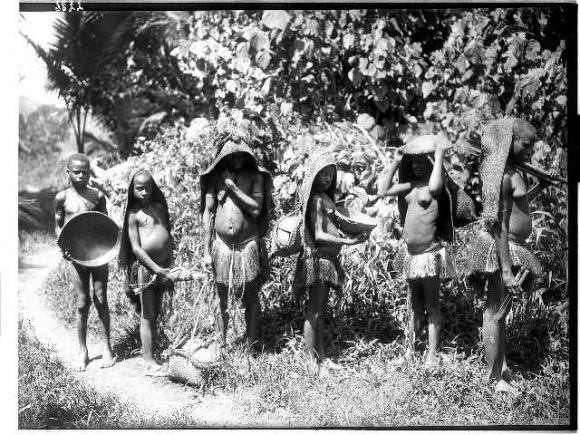
Women on their way to a pottery market near Aibom village; they are wearing plaited capes and use ceramic ware and mats for protection against sun and rain,, 1930
Iatmul oral traditions tell of ancestors emerging from a hole in the ground in Sawos territory or drifting down the river on rafts from the west. Geologically, the Sepik Basin is relatively young — once a sea that became freshwater wetlands around 5,000 years ago. Archaeological and linguistic evidence suggests that Ndu-speaking peoples migrated into the basin from the south. [Source: Brigitta Hauser-Schäublin, “Encyclopedia of World Cultures, Volume 2: Oceania,” edited by Terence E. Hays, 1996; J. Williams, “Worldmark Encyclopedia of Cultures and Daily Life,” Cengage Learning, 2009]
The Iatmul's location in the middle of the vast Sepik River Basin has been advantageous, as it enabled them to serve as middlemen in extensive trade networks prior to the arrival of Europeans. This location still serves them well, as they can attract large numbers of tourists to their villages due to the area's relative accessibility.
During German colonial rule, the Sepik was known as the Kaiserin-Augusta-Fluss and was explored by expeditions beginning in 1886. Later, under Australian administration, headhunting was suppressed. Before their pacification in the 1930s, the Iatmul were cannibals and headhunters. Although there had been attempts to stop the violence integral to achieving status among Iatmul men, public executions of "murderers" were necessary to end those traditions. This marked a turning point, as the Iatmul’s culture — once centered on warfare and ritual — underwent rapid change. Since the 1980s, many Iatmul have left the Middle Sepik for towns such as Wewak, Madang, and Rabaul, with nearly half the population now living outside their homeland, either temporarily or permanently.
The term “Iatmul” was coined by Bateson during his 1920s fieldwork. In reality, it originally referred only to one small clan, while “Iambon” (Yambon) denoted the uppermost village. Bateson’s convenient generalization was later adopted by scholars, though Iatmul themselves rarely use it. Villages are autonomous and politically independent; people identify primarily by clan, lineage, or village, rather than as members of a single ethnic unit.
Urban migration, language loss, and the pressures of tourism are reshaping Iatmul culture. Younger generations often move to cities, adopt Tok Pisin as their main language, and lose connection with ancestral rituals. Still, along the Sepik River, the men’s houses, carvings, and songs of the ancestors continue to express a living tradition — one that bridges myth and modernity.
Iatmul Religion and Beliefs About Death
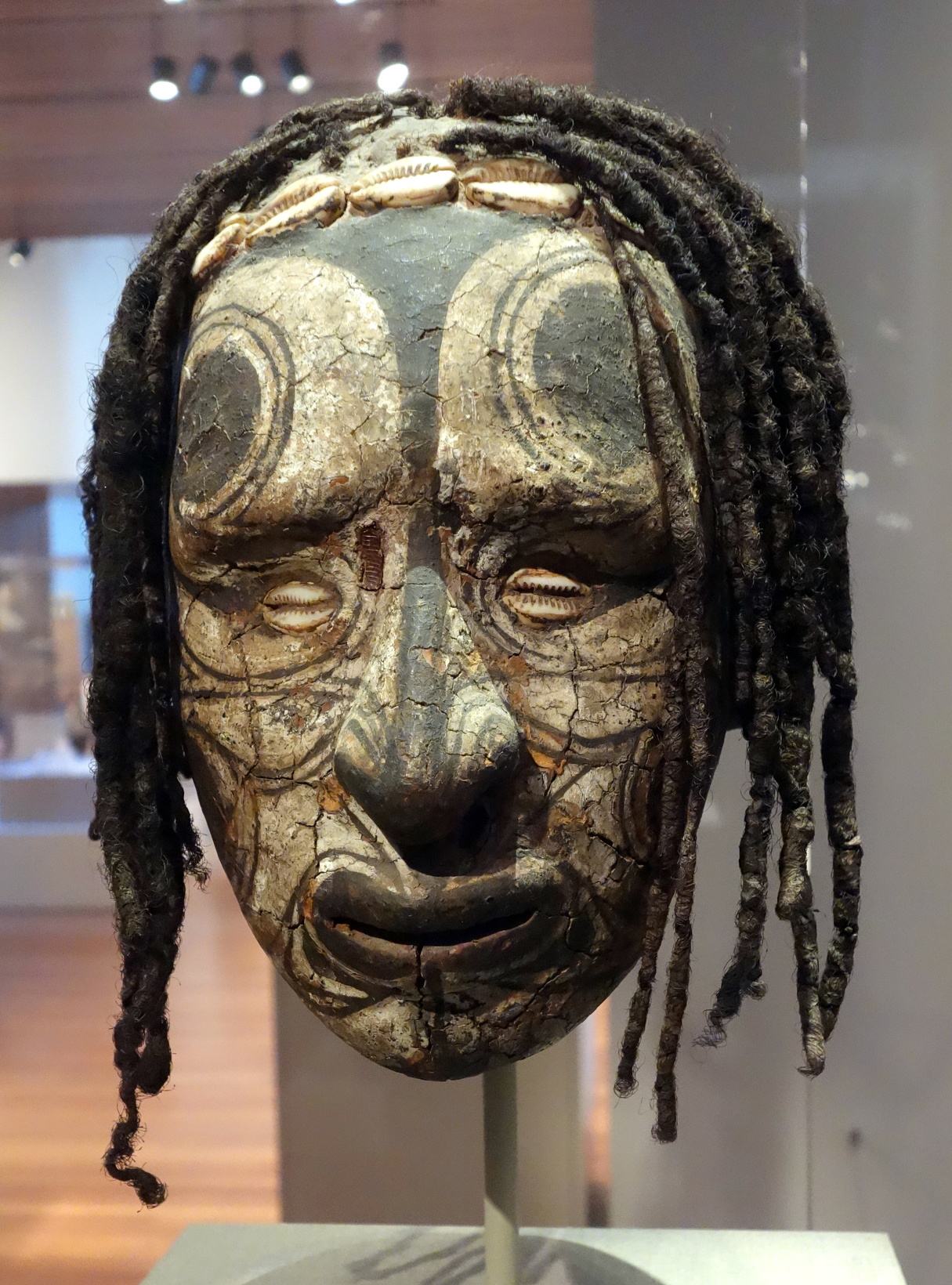
overmolded Iatmul ancestor skull
Today, according to the Christian grouo Joshua Project, about 98 percent of Iatmul identify as Christian, but traditional cosmology remains influential. Since the 1930s, missionaries have been active among the Iatmul, and many people along the Sepik River have converted to Christianity. Some missionaries even burned the men's house and its contents, including artifacts and art. In the process, a great deal of cultural information was lost. [Source: Brigitta Hauser-Schäublin, “Encyclopedia of World Cultures, Volume 2: Oceania,” edited by Terence E. Hays, 1996; J. Williams, “Worldmark Encyclopedia of Cultures and Daily Life,” Cengage Learning, 2009]
Traditional religious beliefs of the Iatmul people centered on the spirits of the rivers, forest, and swamps. There was also a concern for the ghosts of the dead and the havoc they could wreck on the living. Shamans and healers (both men and women) traditionally mediated between the living and the spirit world, invoking ancestral forces for healing or protection. Traditional Iatmul medicine combined practical remedies with spiritual belief. Illness and difficult childbirths were treated through spells and ritual chants, invoking ancestral spirits or celestial forces such as the sun and moon. Healing ceremonies often aimed to symbolically cast off the illness, restoring balance between the individual and the spiritual world.
The men’s house (tambaran or haus tambaran) embodies Iatmul spirituality and social order. In the past, the house posts were beautifully carved to depict parts of clan mythology. These carvings constituted the foundation of not only the house, but also the entire society. The building on the rectangular dance ground represented the first grass island that floated down the Sepik River, as described in a creation myth. At the same time, it represented the first crocodile: the primeval ancestor who emerged from the depths of the flood. Today, the ground level of the men's house is used by initiated men in everyday life. It contains slit gongs, fireplaces, sitting platforms, and ritual objects of minor importance. The upper floor is mainly used for rituals and is where the long flutes and other sacred paraphernalia are kept. Iatmul culture is rich in myths that explain how everything came into being.
In Iatmul mythology, the world began as a vast sea. From a primal pit arose ancestral spirits who named all features of the world — trees, stars, winds, and rivers — into existence. These sacred names, or totemic names, are claimed by specific patrilineal clans and remain central to ritual and identity. Many people in Iatmul culture know the myths, but only a few know the names of the characters and places. Names are among the most highly valued secrets of clans. Clans would try to obtain the secret names of other clans. To do so was to gain power over the other group. Through rituals, myths can become reactivated, making the primeval time the present and the dancing ground and the men's house the original stage.
Death rituals included modeling skulls with clay and preserving bones as relics linking the living to their forebears. The present was legitimized out of the past through the preservation of ancestors' bones and eating their remains. Death meant crossing the border between the present and the past. Only women handled the corpse. If the deceased was important, a representational figure was erected, displaying his or her merits. Occasionally, after burial, the skull was exhumed, molded with clay, and installed during a special ceremony as an influential ancestor. In shamanic séances, ghosts of recently deceased relatives are relevant as mediators between the living and the dead.
Iatmul Rituals, Ceremonies and Initiation
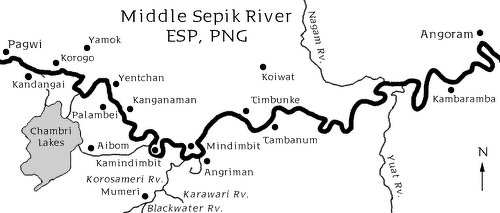
the area where the Iatmul live
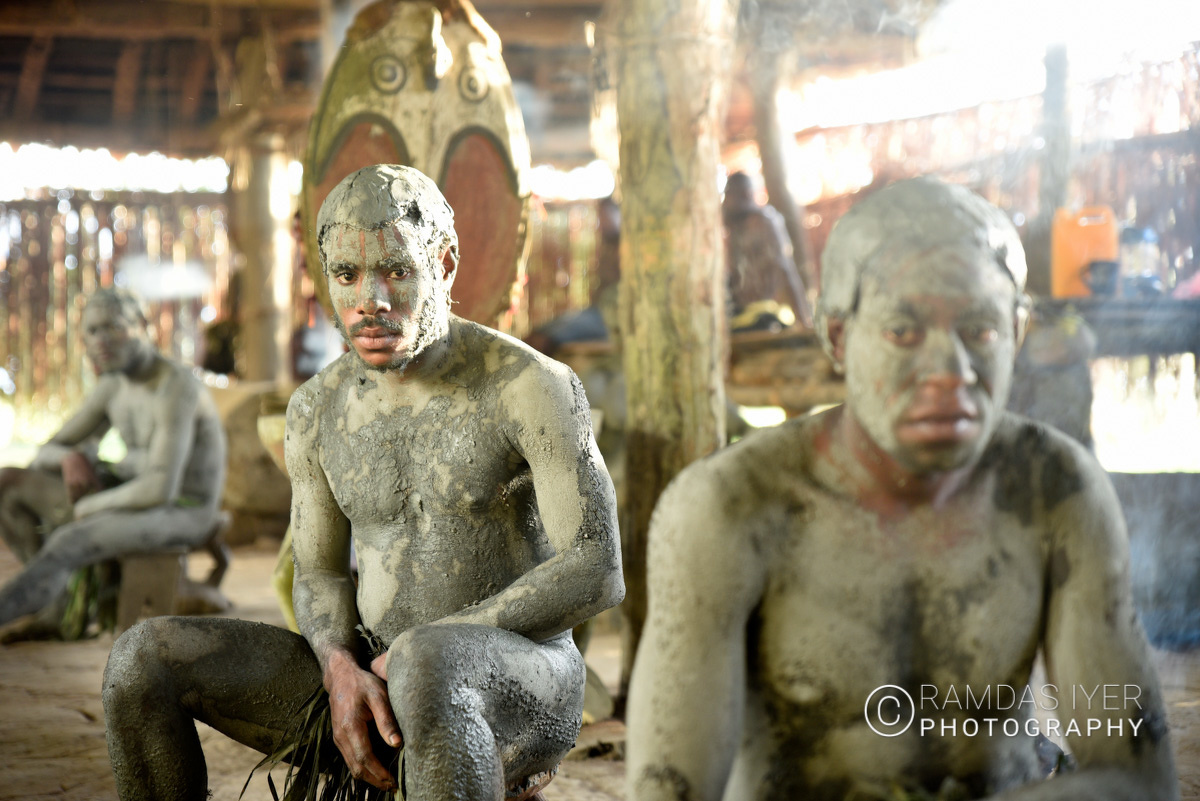
In the past, male initiation was one of the most important Iatmul rituals. The process involved a series of elaborate ceremonies culminating in the scarification of the initiate’s back and chest. The raised patterns symbolized the skin of a crocodile, the most sacred creature in Iatmul cosmology and a representation of ancestral strength. Only a few men still undergo this initiation today—not because of fear or pain, but because of its cost, which can amount to several hundred dollars and several pigs, paid to the elder who performs the ritual. [Source: Wikipedia, Brigitta Hauser-Schäublin, “Encyclopedia of World Cultures, Volume 2: Oceania,” edited by Terence E. Hays, 1996; J. Williams, “Worldmark Encyclopedia of Cultures and Daily Life,” Cengage Learning, 2009]
Initiation marks a boy’s passage into manhood and his formal connection to the world of spirits and ancestors. During the ceremony, initiates’ faces are painted with intricate protective designs, and the ritual ideally takes place during adolescence, though it is often delayed by schooling or work outside the village.
Another significant cultural event was the naven ceremony, held to celebrate personal milestones such as a girl making her first sago pancake or a boy carving his first canoe. These events honored achievement, reinforced kinship bonds, and balanced gender roles within society. Today, naven ceremonies have largely disappeared.
The men’s house (haus tambaran) was at the center of Iatmul ritual life. It hosted initiations, performances by masked figures, victory feasts following headhunting raids, and memorial ceremonies for prominent individuals. The men’s house also symbolized the mythic body of the crocodile and served as a sacred meeting place linking men with their ancestors and clan spirits.
Christian holidays such as Christmas and Easter are observed by converted Iatmul, though without the commercial emphasis found in Western countries. As of the 1990s, there was no Santa Claus visits or Easter Bunny traditions, and public holidays have limited impact since there are no banks or post offices in the region.
Iatmul Family and Marriage
Traditionally among the Iatmul, several closely related nuclear families typically shared a single dwelling. Within the large house, each family occupied its own section, and within that space, husbands and wives maintained separate sleeping compartments. Co-wives and the wives of brothers were expected to cooperate as a single domestic unit, working together in daily subsistence activities such as food preparation, sago processing, and childcare. [Source: Wikipedia, Brigitta Hauser-Schäublin, “Encyclopedia of World Cultures, Volume 2: Oceania,” edited by Terence E. Hays, 1996; J. Williams, “Worldmark Encyclopedia of Cultures and Daily Life,” Cengage Learning, 2009]
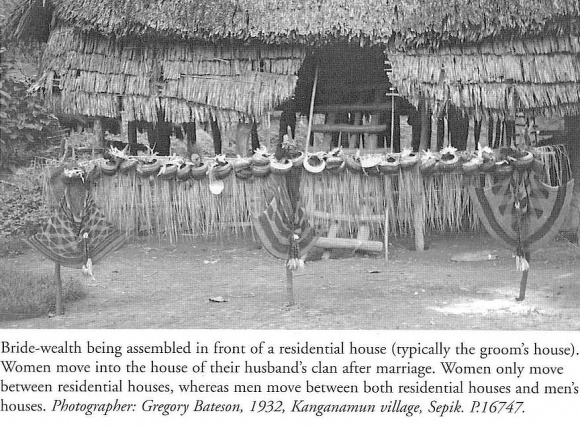
Traditional Iatmul marriage followed prescribed kinship rules, with three preferred forms: 1) Marriage with one’s father’s mother’s brother’s son’s daughter (iai); 2_ Marriage with one’s father’s sister’s daughter (na; and 3) Sister exchange, in which a man gives his sister in marriage to obtain a wife in return Although these were the ideal patterns, marriages outside these categories also occurred.
Marriage ceremonies emphasized the asymmetric relationship between wife-givers and wife-takers, expressed through an unequal exchange of goods—male-classified shell valuables were given by the wife-takers, and female-classified household items by the wife-givers. After marriage, couples typically followed patrilocal residence, living in the husband’s family home or community. A single large house might accommodate the husband’s father, his brothers, their wives, and children. Each nuclear family maintains its own hearth for cooking, while adult men often sleep in the men’s house (haus tambaran), particularly during ritual periods.
Children spend much of their time in independent peer groups, exploring the environment and learning social norms through play. Girls gradually assume adult women’s roles, while boys must later undergo initiation, which marks their separation from the female sphere and their full entry into male social and ritual life. Growing up in Iatmul society is a gradual process of learning through participation. Children are active contributors to the household economy, helping in fishing, gardening, and food preparation. Each new skill or task mastered—such as a girl making her first sago pancake or a boy carving his first canoe—is traditionally celebrated with a naven ceremony, performed by the child’s maternal uncle and his wife.
Some households keep pet birds, especially parrots and lorikeets. Their wings are clipped so they cannot fly away, and they are usually left to perch outside the house rather than being trained to talk. Children often play with these birds, which add color and life to the household. Inheritance among the Iatmul follows principles of seniority and patrilineal descent. The eldest son typically inherits his father’s land rights and ritual knowledge, giving him authority and prestige that his younger siblings do not share. In rare cases where a man has no sons, a daughter may inherit instead. Traditionally, such a daughter underwent initiation with the men, and later her sons inherited the ritual knowledge originally held by her father.
Iatmul Men, Women and Gender Roles
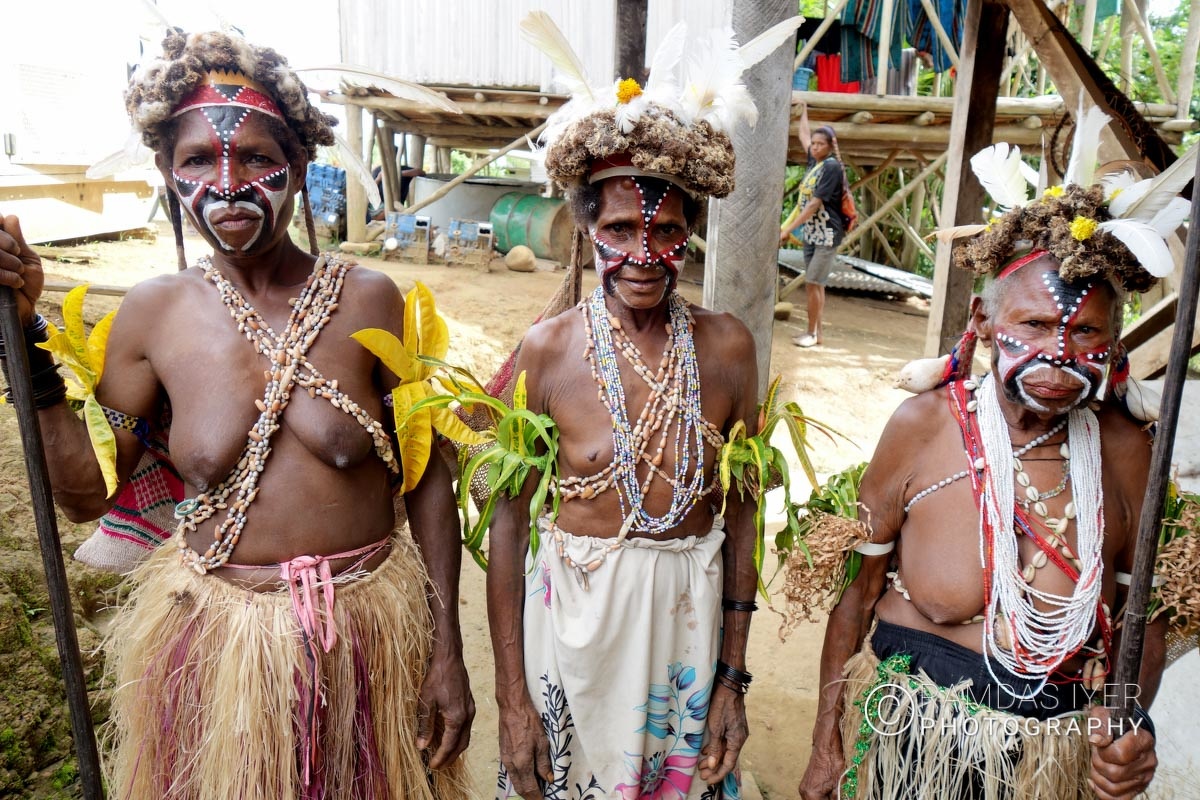
Iatmul women in ceremonial clothes Ramdas Iyer Photography
The Iatmul recognize two genders: ndu meaning “male,” and tagwa meaning “female.” Each has clearly defined roles and behaviors that structure daily and ritual life. Men fish with spears, stand upright in canoes, carve wood, and—before the practice was outlawed—participated in headhunting and received honors for acts of valor. Women, by contrast, fish with traps, sit while paddling canoes, and weave bilum—knotless string bags made from plant fiber. Gender is expressed not only through activities but also through dress, body decoration, and speech, each signaling a person’s place within the social order. [Source: Wikipedia, Brigitta Hauser-Schäublin, “Encyclopedia of World Cultures, Volume 2: Oceania,” edited by Terence E. Hays, 1996; J. Williams, “Worldmark Encyclopedia of Cultures and Daily Life,” Cengage Learning, 2009]
Boys and girls are raised similarly in early childhood, learning communal values and practical skills together. As puberty approaches, gendered socialization becomes more distinct, and boys and girls begin to separate in both activities and space. Boys traditionally underwent a painful initiation ritual involving scarification of the back and chest to symbolize the scales of the crocodile—an act marking their transformation into adult men connected to ancestral power. Marriage and the birth of children further signified the attainment of full adult status for both men and women.
In adult life, activities remain largely gender-segregated. Motherhood holds a revered position in Iatmul culture, embodying both fertility and nurturing strength. Yet, in childrearing, the maternal uncle—not the father—is a boy’s main male mentor and emotional guide. This relationship underscores the importance of maternal kinship ties within Iatmul society. Fathers are responsible for building longhouses that their sons will inherit, but tradition dictates that once a son assumes ownership, his father must vacate the dwelling. Elderly men therefore often spend their remaining years in smaller, more modest huts nearby.
Adult Iatmul men are commonly described as assertive, outspoken, and proud, qualities that are culturally valued as signs of dignity and self-possession. Tourists sometimes misinterpret their stern expressions—particularly when posing for photographs—as anger, but these faces are meant to project strength and seriousness rather than aggression.
Women, meanwhile, play a central role in maintaining both the household economy and community stability. They are responsible for catching fish and exchanging them for sago flour with neighboring Sawos and Chambri communities. Beyond their economic contributions, women act as mediators and unifiers, sustaining harmony within the village and managing relationships with other groups. While men embody competition and prestige, women ensure cohesion, cooperation, and continuity in Iatmul society.
In the past, warfare and headhunting were central to male identity and ritual life. Battles were most often fought between neighboring Iatmul villages, particularly those in the eastern region. Successful raids not only conferred prestige but also formed an integral part of initiation ceremonies, linking violence, masculinity, and ancestral tradition.
Iatmul Society and Kinship
Each Iatmul community is composed of clans, lineages, and smaller “branches”, forming a complex network of kin relations that define every aspect of social, political, and ritual life. Each clan preserves an ancestral narrative of migration through the region, recounting how their forebears journeyed, settled, and shaped the landscape. These oral histories are encoded in tsagi—long, intricate chains of ancestral names known only to ritual specialists. When chanted during ceremonies, the tsagi evoke the mythic migrations and sacred places created by the ancestors, reaffirming each group’s connection to the land and its spiritual geography.
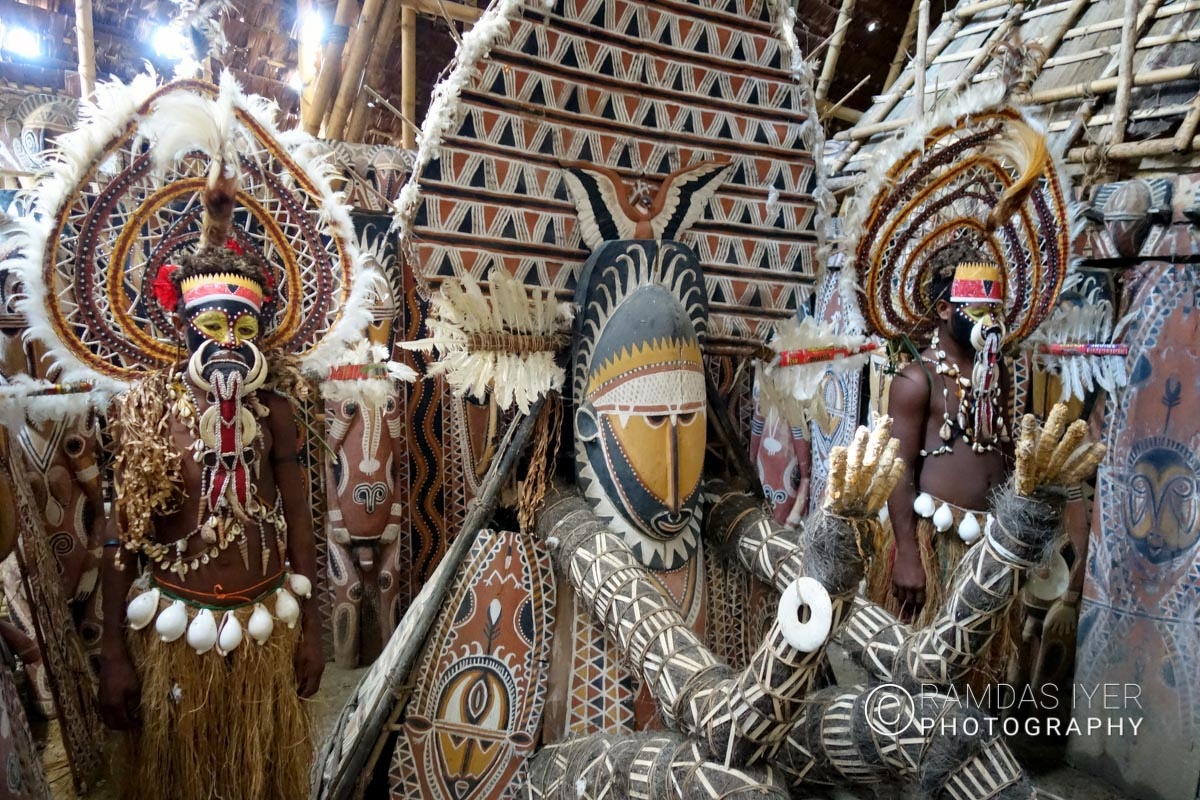
Iatmul society is patrilineal (based on descent through the male line) and divided into clans (ngaiva), often paired as “elder” and “younger brothers,” each tracing descent from founding ancestors. Within each clan, there are also pairs of lineages, with the senior lineage holding ritual authority over the junior. Two main moieties — “sky” (nyaui) and “earth-mother” (hnyamei) — structure community organization and ritual duties, with each performing initiation rites for the other’s boys. Each moiety bears ceremonial responsibilities for the other — for example, men of one moiety conduct the initiation rites, including scarification, for the boys of the opposite group. Among eastern Iatmul, a secondary, nonlocalized moiety system exists, functioning as a framework for competitive exchanges and alliances.
Iatmul kinship terminology distinguishes sharply between maternal (matrilateral) and paternal (patrilateral) relatives. Siblings of the same sex and parallel cousins (children of a father’s brother or a mother’s sister) are grouped together, while in the parental generation, both affinal (by marriage) and consanguineal (by blood) relatives are addressed with similar terms—reflecting the interconnectedness of kin and alliance.
Clans own land, fishing grounds, and ritual rights, inherited through male lines. Lagoons and the open river belong collectively to the village, while clans possess exclusive rights to particular fishing and gathering sites. Garden land is owned by clans or lineages and divided among male members at the end of each flood season, ensuring both continuity and renewal of ancestral rights.
Genealogies are crucial records, providing evidence of land rights, entitlement to sacred knowledge, and permission to use ritual objects or perform ceremonies. Clan membership also determines a man’s status within the men’s house, the political and ceremonial heart of community life. Men are further divided into age-grades, ranging from four to six levels depending on the village. Advancement through these grades marks stages of maturity, prestige, and eligibility for ritual and political roles. Women hold informal but significant power through kinship and trade networks, especially in fish-for-sago exchange with neighboring Sawos and Chambri communities.
The men’s house serves as both the religious and political center of Iatmul life. All public deliberations and community decisions take place here, guided by influential men who possess ritual knowledge, a prerequisite for leadership. Oratory skill—the ability to speak persuasively and poetically—is highly valued, and speeches are delivered beside the ceremonial “chair,” a carved representation of a founding ancestor whose presence legitimizes truth and authority. Leadership is competitive and often hard-won. Men may rise in status through ritual expertise, eloquence, or reputations as powerful sorcerers or master chanters—each embodying a different form of influence and charisma.
Traditionally, the men’s house also served as the court of justice for disputes between clans. Internal conflicts were settled by respected elders within the lineage. Women, though excluded from formal councils, exercised informal power—they could withhold food from their husbands, seek support from their brothers, or leverage their perceived spiritual potency in serious disagreements. Women were also believed to possess polluting powers, associated with both fertility and sorcery, granting them a complex and ambivalent social influence.
Iatmul Daily Life
The Iatmul have traditionally lead an almost amphibian way of life within the two main seasons, wet and dry, each lasting for five months with two intermediate months in between. In the wet season Iatmul villages become clusters of stilted houses situated within a body of muddy water. During this time, all movement must be by canoe. [Source: Wikipedia, Brigitta Hauser-Schäublin, “Encyclopedia of World Cultures, Volume 2: Oceania,” edited by Terence E. Hays, 1996; J. Williams, “Worldmark Encyclopedia of Cultures and Daily Life,” Cengage Learning, 2009]
The Iatmul have been in contact with Western culture since the 1920s, and over time have adopted certain elements of it. Greetings today often follow Western customs—handshakes and short exchanges of polite phrases—replacing the traditional, formalized ceremonial dialogues once held between visiting men of different villages. These earlier encounters involved ritualized exchanges of speech in which each man played a prescribed role.
Electricity and running water are not available in some Iatmul villages. Without plumbing, dishes, clothes, and bodies are all washed in the Sepik River. Bathing is particularly challenging when the river is swollen but not yet flooded. People typically walk upstream about 100 yards, enter the river to wash, and allow the current to carry them back to where they began. Emerging clean from the water is not always easy—the muddy riverbanks, often knee-deep, make climbing out a slippery ordeal.
Clothing: Most Iatmul men today wear Western-style clothing, typically athletic shorts and a T-shirt, though shoes are seldom worn. Women’s attire is more varied, ranging from Western dresses to traditional laplaps—wrap-around skirts worn from the waist down. A woman’s choice of dress often depends on her activity and social context, such as whether she is working in the village or attending a communal gathering. Children generally imitate adult dress, though young children often go unclothed, a common and accepted practice in the Sepik region.
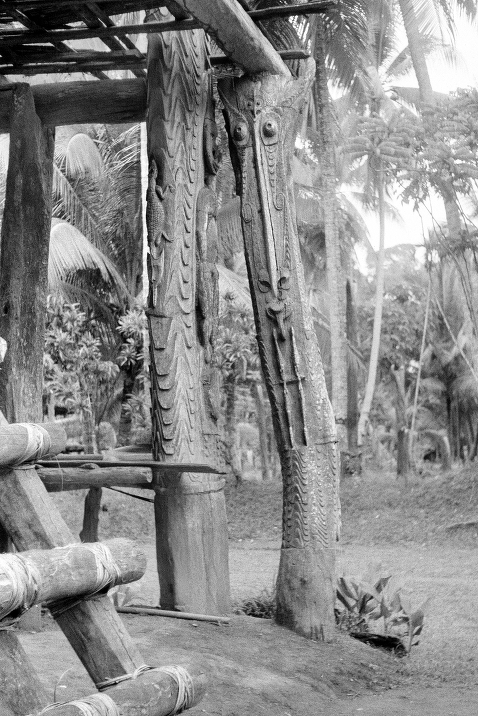
Corner post for platform of Wolimbit ceremonial house, Kanganamun village, 1956
Food: The Iatmul diet is centered on fish and sago, a starch extracted from the edible sago palm. These staples form the foundation of daily meals, sometimes supplemented by fruit, greens, or traded goods. The typical Iatmul meal bears little resemblance to Western dining customs. Families do not gather around a table, as houses lack such furniture. Instead, meals are eaten seated on the floor, often individually and informally throughout the day. The midday meal is the time when most family members eat together, while at other times each person eats when hungry. Food for the day—usually dried fish and sago pancakes—is stored in a woven basket that hangs from a carved hook above each person’s sleeping area. Imported foods such as rice, tinned fish, and canned curry from Indonesia or Malaysia have become popular, though they remain expensive and not always easy to obtain.
Education: As of the 1990s, traditional education remained a vital part of Iatmul life. Boys and girls were taught from an early age to perform the daily tasks necessary to sustain the village — fishing, gardening, weaving, and maintaining the home. Western-style schooling is available in some areas, though few villages have their own schools. Children who attend must usually travel to neighboring communities, and attendance often depends on parental choice and economic means.
Iatmul Villages, Homes and Men’s Houses
Iatmul villages range in size from 300 to 1,200 people and are built on elevated land above the Sepik River's floodplain. These villages often consist of three distinct sections, with a men's house at the center. Houses are often built in two rows, either parallel to or at a right angle from the river's course. The men's house is usually located in the center of an open space called the dancing ground. [Source: Wikipedia, Brigitta Hauser-Schäublin, “Encyclopedia of World Cultures, Volume 2: Oceania,” edited by Terence E. Hays, 1996; J. Williams, “Worldmark Encyclopedia of Cultures and Daily Life,” Cengage Learning, 2009]
Traditionally, villages centered on a men's house, the architectural centerpiece. These massive structures are elaborately decorated with carvings and paintings. They also housed most of the important religious items, including drums, flutes, and sacred sculptures. The role of the men's house has changed over time in Iatmul villages. Currently, most men's houses serve as warehouses for artifacts sold to tourists and art collectors. They also serve as meeting places for adult men.
Older Iatmul men's houses were among the most impressive architectural achievements in New Guinea. These huge buildings were up to 20 meters high and 40 meters long. These structures served as assembly houses for men in daily life and as religious centers during rituals. The dancing ground contained a ceremonial mound on which heads were displayed after a successful raid. Each section of the tripartite village owned a long war canoe, which symbolized cooperation during warfare, as did the ceremonial house, which was used for rituals.
The entire village usually constituted a defensive unit, though only one section may have raided an enemy village. Villages were often surrounded by fences and watchtowers. Traditionally, Iatmul houses were large communal dwellings where families of brothers lived together. Clans are classified into moieties, a fact reflected in the layout of the village and the distribution of houses.
Iatmul Culture and Art
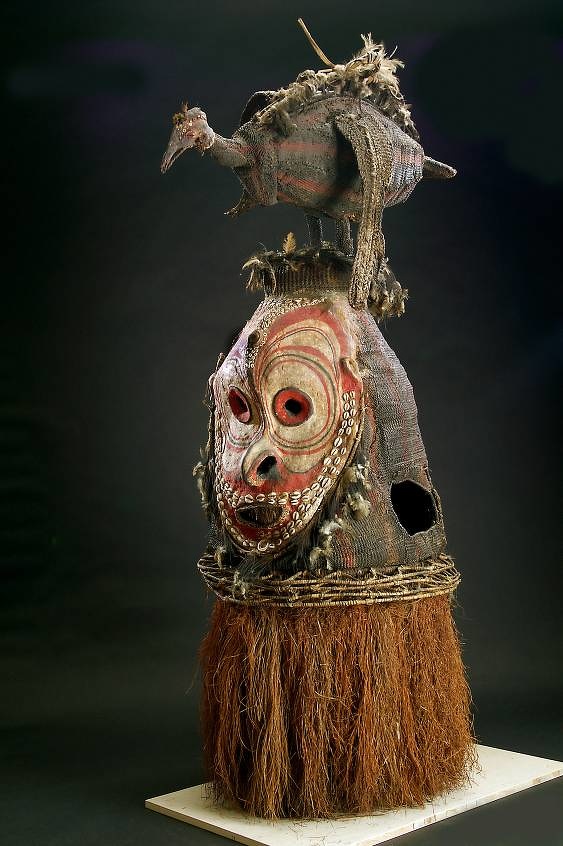
Costume of Mevambül-awan, Mwailambu clan in Mindimbit, as identified by G Bateson in 1929
In rural villages without electricity, television and cinema were unknown luxuries. Entertainment traditionally revolves around storytelling, ritual performance, and music—activities that both educate and strengthen community bonds. For Iatmul communities still living along the Sepik River, organized sports hold little importance. Children play informal games, and boys often make slingshots to shoot hardened mud pellets at birds or small animals. Those living in towns or cities, however, have adopted modern interests such as rugby and soccer.
Music has always held a central place in Iatmul ceremonial life. Men played sacred bamboo flutes during initiation rituals, their haunting tones believed to be the voices of ancestral spirits. These flutes were kept hidden in the rafters of houses or stored in the men’s house, where women and children were strictly forbidden to see them. After the death of an important man, a pair of flutists would perform through the night beneath his house to honor his spirit. By day, female relatives expressed their grief through ritual laments, songs of mourning with a distinctly musical quality.
According to Iatmul mythology, the people emerged from a hole in the mud in the present-day territory of the neighboring Sawos. Other tales tell of a great flood, after which survivors floated down the Sepik River on rafts or mats of grass until they came to rest on a patch of ground that became the site of the first men’s house. All modern men’s houses are said to represent this original piece of earth—the foundation of the Iatmul world. Another myth recounts the creation of the heavens and earth from a giant ancestral crocodile. When the crocodile split in two, his upper jaw became the sky and his lower jaw formed the land, establishing the cosmic order that still defines Iatmul cosmology today.
The Iatmul are renowned for their superb woodcarvings, painted in flowing, curvilinear designs. Nearly all art forms were ritual objects, acquiring meaning only through their ceremonial use. Particularly striking are the overmodeled skulls, coated with clay and painted to honor the dead. Alongside these permanent artifacts, Iatmul art also includes ephemeral forms such as body painting and elaborate decorations made from leaves, flowers, and feathers. Everyday items in traditional society were both functional and artistic, often incised or painted with intricate designs. In recent decades, the rise of tourism has transformed Iatmul art into an important source of income. Masks, sculptures, and especially the famed “debating stools” are now created for visitors and collectors. The debating stool, once a sacred ceremonial object, featured a large stylized human head with a small body and a ledge-like seat on its back. These stools were used in formal debates held in the men’s house, where speakers from opposing clans would strike bunches of leaves to emphasize their points—ritualized performances that helped prevent disputes from turning violent. Today, while such stools might sell for about $100 in a Sepik village, their value can reach $1,500 or more in foreign galleries, making Iatmul art highly sought after by collectors and dealers abroad.
See Separate Article: ART OF THE IATMUL PEOPLE: MASKS, SLIT GONGS, BOWLS AND HOOKS ioa.factsanddetails.com
Work in Iatmul society is divided by gender and age. Women are responsible for most subsistence activities, including fishing, sago collection, gardening, and food preparation. Men craft the canoes, paddles, and tools used in daily life, build houses, and serve as ritual specialists in religious and ceremonial matters. Children assist their mothers in household and subsistence tasks; however, boys traditionally ceased helping with “women’s work” after initiation, when they began learning the responsibilities and ceremonies of adult men.
Iatmul Agriculture, Fishing and Economic Activity
Traditionally, the Iatmul have lived primarily as hunters, gatherers, and fishers, with agriculture playing a secondary role. The fertile riverbanks of the Sepik provide space for gardens, but periodic flooding often destroys crops before they mature. As a result, fish and sago remain the staples of the Iatmul diet, supplemented by bananas, coconuts, and root crops such as taro and yams. Hunting—of wild pigs, crocodiles, and occasionally cassowaries—is practiced only irregularly. [Source: Wikipedia, Brigitta Hauser-Schäublin, “Encyclopedia of World Cultures, Volume 2: Oceania,” edited by Terence E. Hays, 1996; J. Williams, “Worldmark Encyclopedia of Cultures and Daily Life,” Cengage Learning, 2009]
Fishing is largely the domain of women, who use hooks, nets, and traps, while men fish with spears. Among women, an informal redistribution system ensures that those unable to fish—due to illness, menstruation, childbirth, or age—still receive their share. Although many villages have access to sago palms, local production is insufficient to sustain them year-round. For this reason, Iatmul women regularly travel by canoe to neighboring Sawos and Sepik Hills villages to barter fish for sago. These trading expeditions, often led by elderly women, can take an entire day and remain an important feature of inter-village cooperation and exchange.
Different Iatmul and neighboring villages have developed specialized crafts that support both traditional exchange and modern trade. Aibom village is renowned for its pottery, historically traded for sago and now sold for cash. Chambri, a non-Iatmul village to the south, specializes in tightly plaited mosquito bags woven by women—essential sleeping enclosures in a region where mosquitoes and malaria are widespread. Tambunum is known for its decorative plaited bags (bilum) featuring colorful geometric patterns.
The Iatmul are also celebrated woodcarvers, producing masks, spirit figures, and ceremonial objects admired across New Guinea. When early travelers and art dealers expressed interest in these carvings, men began crafting them in greater numbers for trade. Some anthropologists have described the Iatmul as a “cultural factory”, exporting not only material objects but also ritual knowledge and sacred artifacts to neighboring groups. While direct evidence for large-scale export of ritual expertise is limited, exchanges of ritual items likely occurred in both directions, as suggested by Abelam-style paintings discovered in early German collections from Iatmul villages.
Trade networks extended widely across the region. Goods such as paint, edible earth, and medicinal bark were brought in from southern tributaries, while shell rings, turtle shell ornaments, pearlshells, and stone blades were imported from the Abelam, Sawos, and highland areas farther afield.
In recent decades, many Iatmul men seek wage labor outside their villages, while others use their canoes and river expertise to guide tourists along the Sepik River, arranging homestays with relatives in nearby villages. Tourism and the production of art for sale have become the primary sources of income in many communities. However, economic change has brought social challenges. Young people increasingly migrate to urban centers, where they adopt Tok Pisin as their main language and become detached from traditional knowledge and customs. The influx of cash, consumer goods, and visitors has also altered local values and aesthetics. Items such as tennis shoes, toothpaste, and Western clothing have become symbols of modern identity and examples of participation in the cash economy.
Image Sources: Wikimedia Commons
Text Sources: “Encyclopedia of World Cultures, Volume 2: Oceania,” edited by Terence E. Hays, 1996, National Geographic, Live Science, Metropolitan Museum of Art, Natural History magazine, Australian Museum, New York Times, Washington Post, Los Angeles Times, Smithsonian magazine, Encyclopedia.com, Times of London, Library of Congress, The Conversation, The New Yorker, Time, BBC, CNN, Reuters, Associated Press, AFP, Lonely Planet Guides, Google AI, Wikipedia, The Guardian and various websites, books and other publications.
Last updated November 2025