
SETTLERS EXPAND WESTWARD IN AUSTRALIA

Johnson’s Map of Australia, 1865
Between 1788 and 1851, the European population in Australia rose only to 400,000. Most made a living in the sheep industry. Britain didn't claimed all of Australia until 1829 after settlements had been establish all over the continent. It wasn't until 1813 that a road was built through the Blue Mountains and the broad plains to west of these mountains were settled. Later explorers pushed further westward and they were followed by farmers and cattle and sheep ranchers. Many of these were squatters that occupied large tracts of land but didn't pay anyone. To combat the Aborigines the settlers used muskets and poison flour given away to the Aboriginals as a gift.~
Matthew Everingham was one of the first settlers to cross the mountains to the west of Sydney. Below the mountains he built a rough pioneer hut and raised nine children on "corn, damper bread, and the fear of God." The family survived despite heavy taxes from a corrupt government and floods. Aboriginal attacks left his wife and himself with spears in them, but still alive, and their home looted and in flames. [Source: "Children of the First Fleet" by John Everingham, National Geographic, February 1988 ~]
The first colonist arrived in Western Australia in Perth in 1829. Western Australia was founded by settlers who attempted to launch a convict-free state, but sheep and cattle station owners needed cheap labor and eventually they resorted to hiring convicts. Parts of western Australia were settled by settlers who were given free passage there, rations for 12 months, 20,000 acres of land, 20 head of cattle and some sheep. Many of these programs were disasters. People and animals arrived when temperatures topped 49̊C (120̊F) and began dying almost immediately. There was nothing for the cattle to eat and water was miles away and even then it was brackish.
Related Articles:
EARLY CONVICTS IN AUSTRALIA: MEN. WOMEN, CHILDREN, THEIR LIVES AND LEGACY ioa.factsanddetails.com
EARLY FREE SETTLERS IN AUSTRALIA: DEVELOPMENT, SQUATTERS, SHEEP ioa.factsanddetails.com
AUSTRALIAN ABORIGINALS AT THE TIME EUROPEAN COLONIZATION BEGAN ioa.factsanddetails.com
DISCOVERY OF AUSTRALIA BY EUROPEANS ioa.factsanddetails.com
ABORIGINAL TASMANIANS: HISTORY, ABUSE, LIFESTYLE AND NEAR EXTINCTION ioa.factsanddetails.com
CAPTAIN JAMES COOK IN NEW ZEALAND AND AUSTRALIA ioa.factsanddetails.com
FIRST EUROPEAN IN NEW ZEALAND: EXPLORERS, SETTLERS AND SEALERS ioa.factsanddetails.com
FAMOUS BUSHRANGERS (AUSTRALIAN OUTLAWS): THEIR LIVES, EXPLOITS AND DEATHS ioa.factsanddetails.com
NED KELLY: HIS LIFE, GANG, WRITINGS, ARMOR, DEATH AND MISSING HEAD ioa.factsanddetails.com
AUSTRALIA ABORIGINALS FROM 1900 TO PRESENT: DISCRIMINATION, ASSIMILATION, SOME RESTITUTION ioa.factsanddetails.com
AUSTRALIA’S STOLEN GENERATIONS: VICTIMS, LAWS, RATIONALE, OUTRAGE ioa.factsanddetails.com
Settlers in Tasmania, Queensland, Victoria and South Australia
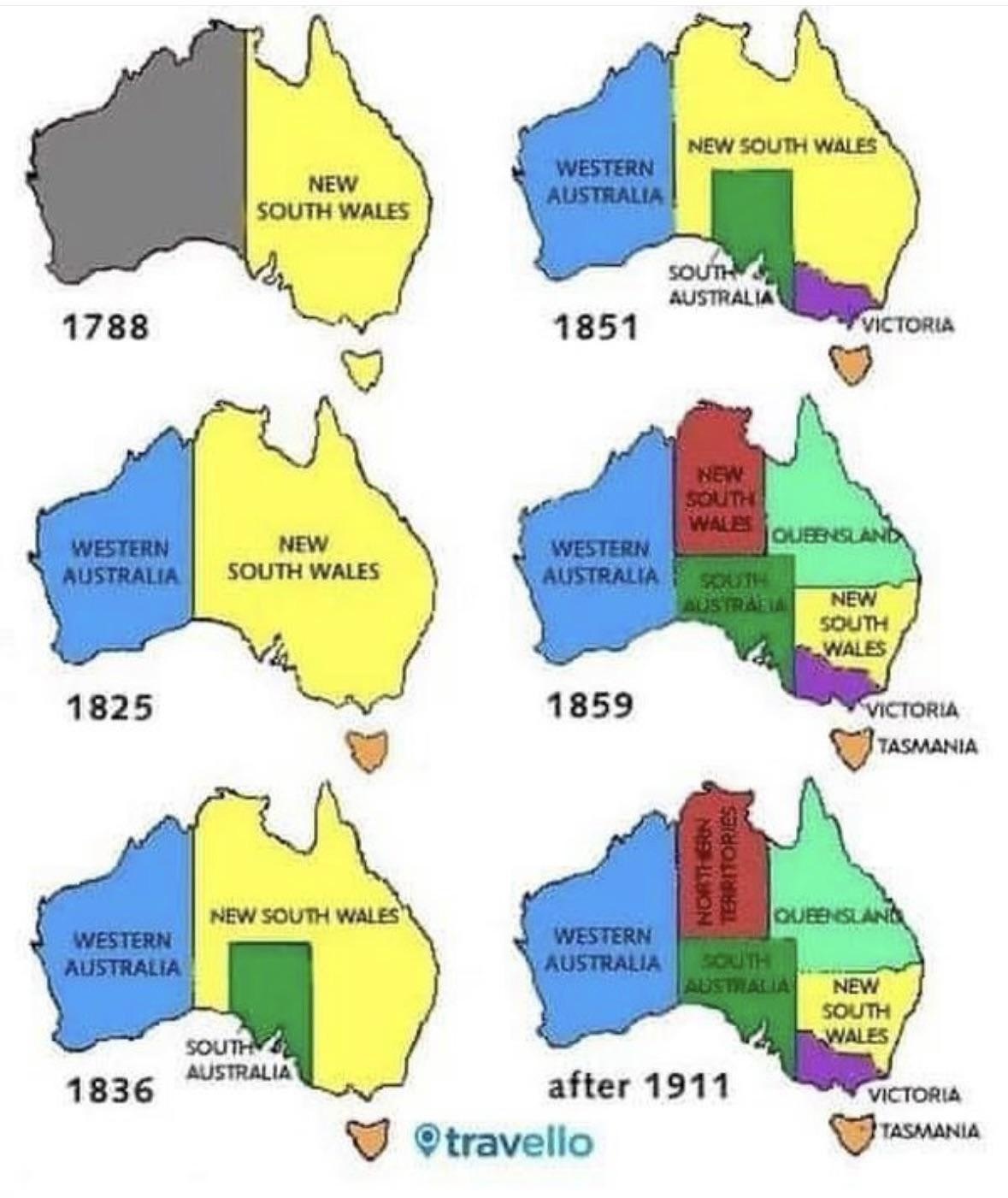
New South Wales and Tasmania were the earliest convict settlements. Settlement of Van Diemen's Land (Tasmania) began in 1803 with the establishment of notoriously cruel penal colony. It's capital Hobart was founded in 1804. In 1804, the coal industry was started with convict labor.
Queensland ironically began as a settlement for repeat offenders. Mortan Bay (Brisbane) was settled in 1824 by ex-convicts who got tired of their treatment in Sydney. When the Brisbane colony was abandoned in 1839, a large number of free settlers lived here.
In 1835, the Port Phillip district (Victoria) was settled by stockmen from Tasmania. Convict free Victoria was founded by an entrepreneur who made a "treaty" with the local Aboriginals.
Colonist from the England founded South Australia in 1836. South Australia, also convict free, was established, like some of the colonies of the United States, by people in search of freedom.
Early Explorers and the Name Australia
As late as 1800, it was still widely believed that Australia was too separate islands. The first man to sail completely around the continent was British captain Matthew Flinders. He accomplished the task in 1801-1803. Kangaroos and other strange creatures were described by scientists aboard Flinders' ship. Flinder's book “A Voyage to Terra Australia” suggested the name landmass Australia, from the Latin word for "southern." The book helped popularize the name Australia for the continent. Over time it replaced the name New Holland.
Edward John Eyre is credited with the first east-west crossing of Australia. In 1840 he left Adelaide in an effort to reach the center of Australia. He abandoned this endeavor at Mt. Hopeless and then made his to way to Albany in Western Way. His second in commanded was killed by Aboriginal guides. His team probably would have died from starvation or lack of water were it not for a timely encounter with a French whaling ship.
A German scientist named Ludwig Leichhardt traveled from northern Queensland to present-day Darwin in 1844 and 1845. He disappeared during an attempt to reach the west coast in 1847. In 1848, Edmund Kennedy suffered a number of hardships in an attempt to cross Cape York and died just 32 kilometers (20 miles short of his goal). Thirteen others died. Only one man, an Aboriginal, made it.
Charles Darwin in Australia
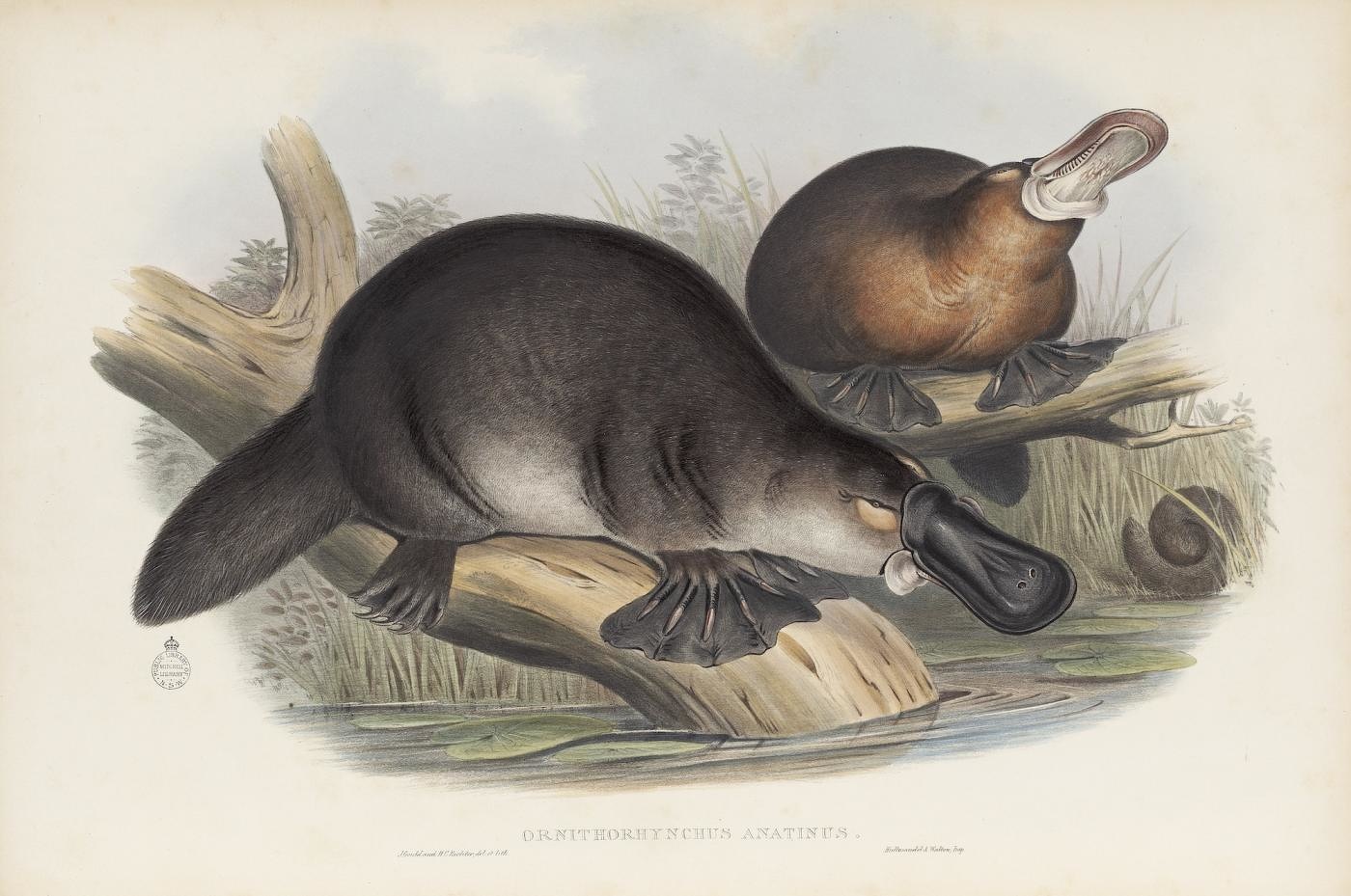
Duck-billed platypus in "The Mammals of Australia", 1855
By John Gould
The “Beagle” and Charles Darwin stopped in Australia and their round the world voyage. On a kangaroo hunting trip he said he didn't even see a "wild dog." The Aboriginals he saw "appeared far from being such utterly degraded beings as they are usually represented." They showed off their spear throwing skills by piercing a cap 30 yards way "like an arrow from the bow of a practiced archer."
Darwin also saw platypuses "diving and playing about the surface of the water, but they showed so little of their bodies that they might easily have been mistaken for water-rats...a most extraordinary animal. He climbed Mt. Wellington in Tasmania. He saw a "corroboree of the White Cockatoo and King George Aboriginals: "A most rude, barbarous scene, and to our ideas, without any sort of meaning...hideous harmony...a perfect display of a festival amongst the lowest barbarians." ["In the Wake of Darwin's Beagle", Allen Villiers, National Geographic October 1969]
On Sydney Darwin said: "This is really a wonderful colony: ancient Rome, in her Imperial grandeur, would not have been ashamed of such an offspring."
Burke and Wills
In the mid 19th century, around the time of the American Civil War, the South Australian government announced a big reward of £2000 for the first party to cross Australia from south to north. William John Wills and Robert O' Hara Burke began their attempt from Melbourne. They began their journey across the outback with an experienced team, lots of camels and horses and plenty of provisions. But unlike early expeditions they eschewed Aboriginal guides and their camels were slower than anticipated in certain terrains.
Burke's stubbornness did the team in in the end. Many members of team dropped out. After crossing nearly the entire continent they were forced to turn back. They got lost going back and failed to find provisions left for them and failed to take advantage of local food supplies utilized by Aboriginal. Wills and Burke literally died going around in circles. All but one of their party starved to death.
John McDouall Stuart, a rival of Wills and Burke, crossed the continent from south to north, from Adelaide to Darwin, in 1862. and collected the £2,000 prize.
Some believe that Burke, Wills and other is in the party die of starvation but instead died from a decency of thiamine (Vitamin B1) by improperly preparing a fern eaten by Aborigines. The fern is supposed by ground and mixed with water, which breaks down an enzyme that breaks down thiamine, It is believed that the party did not use water and the enzyme didn’t break down the thiamine.
Gold Rushes in Australia
Gold and silver rushes beginning in the 1850s brought thousands of new immigrants to New South Wales and Victoria, helping to reorient Australia away from its penal colony roots. In 1851, gold was discovered in New South Wales and Victoria. In 1883, silver was discovered at Broken Hill, New South Wales.
The Australian gold rush began in May, 1851, when Edward Hargraves, a veteran of the California Gold Rush, found gold neat Bathhurst, New South Wales. Reports of huge finds there set off a huge gold rush. Early gold discoveries were kept secret. Gold was discovered at Summerhill Creek. New South Wales in 1823 but the New South Wales government suppressed the news. When a government official was shown a gold sample from Victoria in 1851, he said, "Put it away...or we shall all have our throats cut." Government officials were worried that workers would abandon the cities, livestock stations and farms and a create an Australian version of the wild west. The officials had a right to be worried. There was a mass exodus from Sydney and other places, with businessmen losing so many workers they had no choice but to follow their workers to the gold rush towns.
Gold was discovered on the Palmer River on the Cape York Peninsula in 1872. Cookstown became a boomtown with 30,000 fortuneseekers. Half of the 30,000 prospectors that arrived in northern Queensland for the goldrush in the 1860's were pigtailed Chinese. Most of the gold was found on Aboriginal land near the Palmer River, and many of the Aboriginals living there were killed after being accused of cannibalism. The largest settlement was Cookstown, which at the time boasted 94 bars and 163 brothels. Gold is still found in the area "but showing too much interest could be fatal." [Source: "The Happy Isles of Oceania" by Paul Theroux]
Gold was discovered in Western Australia in 1880, long after the other gold rushes ended. The town of Kalgoorie was the site of one of western Australia's many gold rushes. The rush got started in the late 1800s when Robert McKenzies jumped off his camel into a heap of nuggets and gathered up £750,000 worth of gold in two hours. In Western Australia, gold diggers panned gold by dry blowing. They shook sand from a height. The wind blew away the sand and dirt and the heavier gold dust dropped straight down.
Gold Rush Miners in Australia
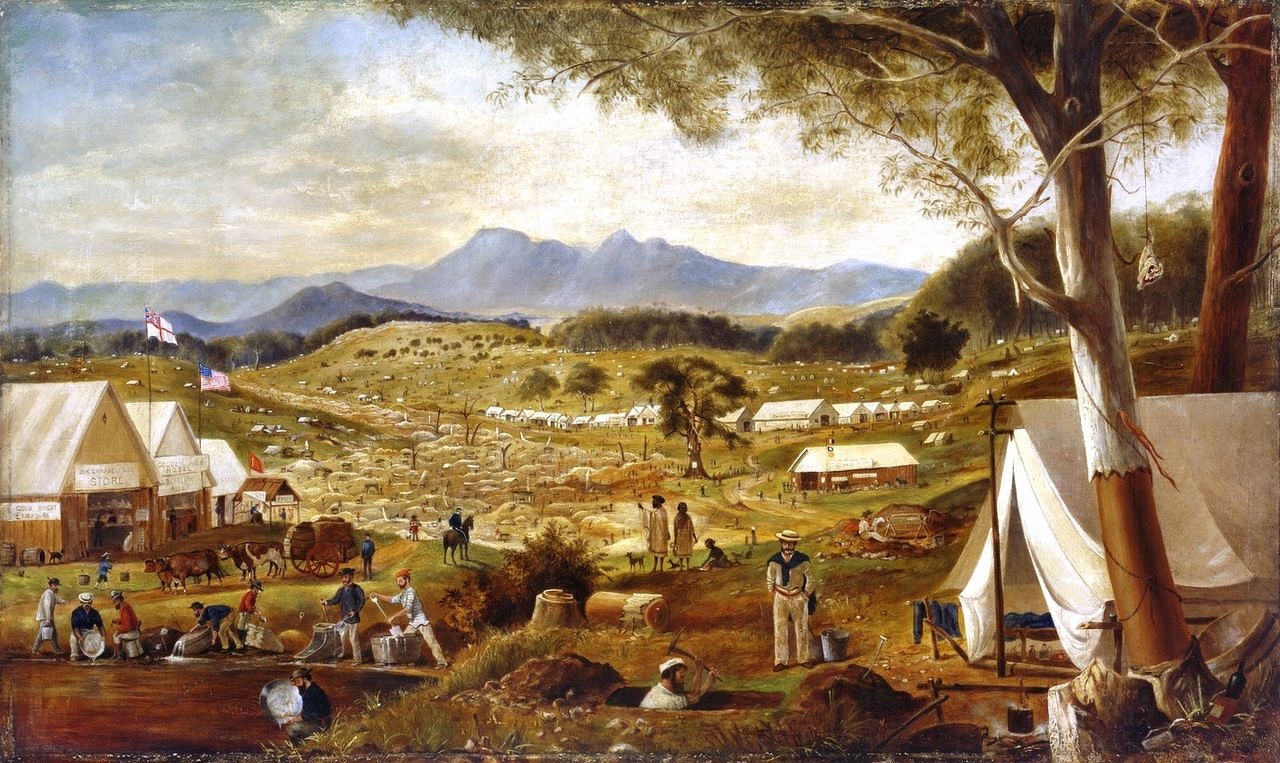
Gold diggings, Ararat, Victoria, by Edward Roper, 1854
The gold rush attracted a multitude of diggers, first from Australia then from overseas, mainly England, Ireland, Europe and China. Many also came from America. The fields in Australia started producing just as those in California were being played out.
In 1952, hopeful miners arrived in Melbourne at a rate of almost 2,000 a week. Riding the gold rush wave, the population Australia almost tripled, from 400,000 to 1,146,000, between 1851 and 1861. In that time as $538 million worth of gold was mined.
Some diggers struck it rich but the vast majority didn't. They endured terrible working conditions and many spent most of the money they made on drinking and gambling. One the conditions in the gold field in the 1850s, Edwin Carton Booth wrote: "it may be fairly questioned whether in any community in the world there were ever existed more of an intense suffering, unbridled wickedness and positive want...To look at the thousands of people...induced the belief that sheer and absolute unfitness or a useful life in the colonies...had been the only qualifications requisite to a fortunate digger."
The gold rush towns became infamous as centers of lawlessness. "If I offered 50 cents for “your skin”," one man said, "you wouldn't last five months. Outlaws known bushrangers robbed banks and attacked gold shipments. Image Sources: Wikimedia Commons
Gold Rush in Victoria
After gold was discovered at Bathurst in New South Wales, Melbourne suffered a mass exodus as well. Local business there, worried about losing workers, offered a large reward for the discovery of gold within 200 miles of Melbourne. Within weeks gold was found in the Yarra Valley. Later gold was also found in Clunes, Warrandyte and Bunninyong. In September 1951, the biggest discovery was found in Ballarat. By then there were considerably more gold diggers in Victoria than New South Wales.
Most of the gold from Australia’s gold rushes was found in Victoria. Much of the gold was found near the surface and men got rich by pulling up bushes and claiming the nuggets clinging to the roots. The largest gold nugget ever found is the Welcome Stranger, discovered in Moliagul, Victoria, in 1869 by John Deason and Richard Oates. Victoria, Australia. It weighed 2,520 troy ounces (78 kilograms, 173 pounds) gross and yielded 2,284 troy ounces (71 kilograms, 157 pounds) after it was broken apart because it was too large for the local scales.
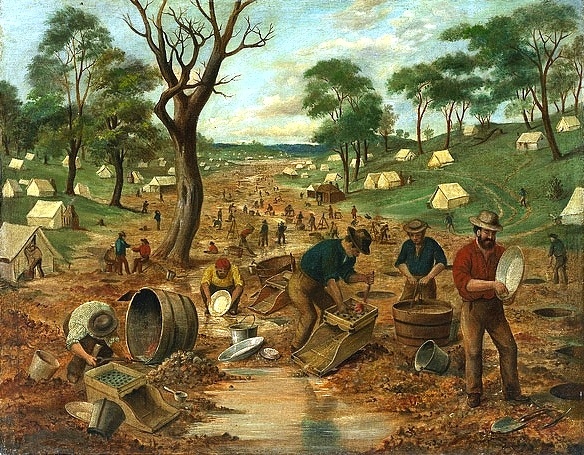
Australian gold diggings, by Edwin Stocqueler, 1855
Large amounts of gold were discovered in Ballarat, Victoria. The Welcome Nugget there in 1858 is the second largest nugget ever found. It weighed 2,218 troy ounces (69 kilograms, 152 pounds) and was melted down in London in 1859. The story goes, the nugget was pried from a road by a farmer who ran over it with his carriage.
Melbourne owes its development to Victoria’s gold rush, much like San Francisco owed its development to the California Gold Rush. The Victoria government charged diggers 30 shillings a month (when the daily wage of a laborer was five shillings) for a miner's license, which had to be paid whether they found gold or not.
The idea behind the license was to discourage workers from leaving their job, to make sure the government earned money even if gold wasn’t discovered, and to keep foreign prospectors who would leave the country after making a find. Many miners worked their claims illegally. To seek them out state troopers were brought in to do license checks. Although the license were very unpopular they did bring some order to the mining operations in Victoria and helped avoid the lawlessness that characterized the California Gold Rush and the development of the American West.
Eureka Rebellion
The closest Australia ever came to revolution occurred in 1854 during the Eureka Rebellion, caused by a disputes over a gold license. The event was triggered by the murder a miner after an argument with a hotel owner, who was tried and found not guilty. Miners rioted over the verdict. During the retrial the hotel owner was found guilty but so too were the miners that rioted. During November and December the miners called for the abolition of the licensing fees, and burned their liscnses in a bonfire and built a stockade maned by 150 miners.
On December 3, the government ordered soldiers to attack the stockade. In a battle that lasted only 20 minutes, 30 miners and five soldiers were killed. The miners lost the battle but won the war. Sympathy by ordinary Australians helped get the license fees lowered to only two shillings a month.
Ilsa Sharp wrote in “CultureShock! Australia”: The incident is an icon of the left wing and socialist Australia, and considered to be one of the sparks that lit up Australian democracy. You can compare its meaning to that of the Storming of the Bastille for the French or the Battle of the Alamo for the Americans. ‘We swear by the Southern Cross to stand truly by each other and fight to defend our rights and liberties’, was the oath sworn by thousands of gold diggers gathered in protest at Ballarat, Victoria, in 1854. ‘It is the inalienable right of every citizen to have a voice in making the laws he is called on to obey... taxation without representation is tyranny’, the diggers declared, demanding the vote they did not have and opposing property-owning qualifications for members of Parliament. The gold diggers’ uprising may well be the original reason for Aussie fighters or soldiers earning the proudly boasted name ‘Diggers’. [Source: Ilsa Sharp, “CultureShock! A Survival Guide to Customs and Etiquette: Australia”, Marshall Cavendish, 2009]
But in fact, the 25,000 diggers living at Ballarat were a multicultural lot, including immigrants from America, Ireland, Europe and China, among other places, very few of them born in Australia. It was the rebellious diggers who adopted the Southern Cross flag as their emblem and flew it for the first time in Australia; today the Southern Cross constellation of stars is a motif integral to the national flag. You can see the diggers’ original flag still proudly displayed at the Ballarat Fine Art Gallery today. Protesters for various causes occasionally still coopt the simple Southern Cross flag to their cause even today.
The Eureka Stockade was a justified gold diggers’ rebellion against petty and oppressive government authority and as such it stands for the tradition of Australian resistance to authority in general. The officials governing the early Victorian goldfields were cruel in their exercise of elite power and privilege, oppressive and corrupt in their arbitrary policing and farming of the gold-digging licences. The actual process of extracting the gold was particularly gruelling and uncertain. After a series of brutal incidents between the diggers and their oppressors, thousands of diggers rose up and declared ‘war’. Led by Peter Lalor, the most militant of them marched to a predominantly Irish area called ‘The Eureka’ and proceeded to fortify it behind a wooden stockade. But with only a few hundred men behind the stockade on 3 December 1854, government troops made short work of their flimsy defences, rounding the stockaders up, killing 20–30 diggers and quickly declaring martial law. However, the incident was seen as a turning point in the development of Australian democracy; 13 arrested stockaders were acquitted in court in 1855, a Commission of Enquiry castigated the administration of the goldfields, and in a short time most of the miners’ demands were granted, including their inclusion in parliamentary democracy. Peter Lalor was even elected to Parliament.
After the Australia Gold Rushes
Over time the diggers in Australia’s gold fields were replaced by large companies that invested heavily in the regions were they established themselves and helped plant the seeds for long-term, sustained growth. They were the source of the money that raised the great Victoria buildings in Bendigo and Ballarat as well as Melbourne. These towns peaked in the 1880s. After that many deposits were played out. Much of the mythology about the outback, the bush swaggerman and the literature, music and poetry associated with it has it roots in the gold rush era.
As the veins of gold played themselves out, the diggers had no work and source of money. Many of them vented their frustration against Chinese immigrants who were brought in as laborers during the gold rush. A strong ant-foreigner sentiments was the basis for the "White Australia" policy.
Many of the unemployed diggers became farmers and miners. Prospectors found large deposits of copper, silver, lead and zinc in the eastern colonies and Tasmania. Even so, the economic situation didn't improve much. Unemployment and depression were serious problems. In the 1890s there were a number of bank failures and conflicts between unions and management. There was also a prolonged drought.
Text Sources: “Encyclopedia of World Cultures, Volume 2: Oceania,” edited by Terence E. Hays, 1996, National Geographic, Live Science, Natural History magazine, Australian Museum, Australia Geographic, New York Times, Washington Post, Los Angeles Times, Smithsonian magazine, Encyclopedia.com, Times of London, Library of Congress, The Conversation, The New Yorker, Time, BBC, CNN, Reuters, Associated Press, AFP, Lonely Planet Guides, Culture Shock! Australia, Wikipedia, The Guardian and various websites, books and other publications.
Last updated October 2025