
MIGRATION OF MODERN HUMANS IN AUSTRALIA
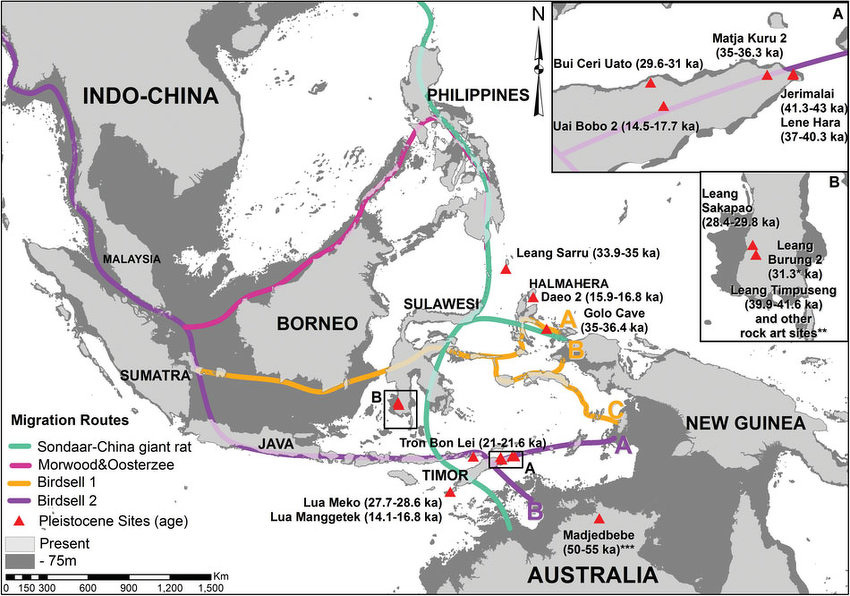
Four possible migration routes of early modern humans from Southeast Asia to New Guinea and Australia: 1) Southern lines proposed by Birdsell (orange); 2) with western variations (purple); 3) northern route (green) proposed by Sondaar; and 4) with Morwood and Van Oosterzee's (2007) route (pink) in between; Pleistocene archeological sites (and corresponding calibrated ages) are indicated by red triangles Researchgate
Some of the earliest evidence of modern humans outside of Africa and the Middle East is not in Asia or Europe but in Australia. The earliest evidence of modern humans in Australia comes from Madjedbebe, a sandstone rock shelter in Arnhem Land, in the Northern Territory of Australia. Artifacts there have been dated to be 50,000 to 65,000 years old. Some sources and DNA evidence seem to refute the 65,000 year old date. The oldest human skeletal remains are the 40,000-year-old Lake Mungo remains in New South Wales. [Source: Wikipedia]
The fact that some of earliest evidence of modern humans outside of Africa and the Middle East is in Australia suggests that the early man followed a coastal route through South Asia and Southeast Asia to Australia. It is believed that the migration was not a caravan-like journey but rather one in which some huts were set up on the beach and the migrants lived there for a while moving and then moved to a new location further to the east every couple of years. Traces of such a migration if it took place were covered in water and sediments when sea levels rose at the end of the Ice Age.
DNA studies of people living today indicate that modern humans migrated from Eastern Africa to the Middle East, then Southern and Southeast Asia, then New Guinea and Australia, followed by Europe and Central Asia. Perhaps they didn't enter Europe because that region was dominated by Neanderthals. According to research by geneticist at the University of Cambridge in the mid 2000s all modern humans descend from a small number of Africans that left Africa between 55,000 and 60,000 years ago. Another less reliable DNA study determined that an intrepid group of 500 hominids marched out of Africa about 140,000 years ago and they are the ancestors to all modern people today. [Source: Guy Gugliotta, Smithsonian magazine, July 2008]
Related Articles:
DID HUMANS REALLY MIGRATE TO AUSTRALIA 65,000 YEARS AGO ioa.factsanddetails.com
EARLY MODERN HUMANS IN AUSTRALIA factsanddetails.com ;
OUT OF AFRICA AND THEORIES ABOUT EARLY MODERN HUMAN MIGRATIONS factsanddetails.com ;
MIGRATIONS OF EARLY MODERN HUMANS factsanddetails.com ;
EARLY MODERN HUMANS MIGRATE TO ASIA factsanddetails.com ;
LIFE OF EARLIEST HUMANS IN AUSTRALIA: TOOLS, WEAPONS, ART, SETTLEMENTS ioa.factsanddetails.com
PEOPLE WHO LIVED AUSTRALIA 20,000 TO 10,000 YEARS AGO ioa.factsanddetails.com ;
EARLY ABORIGINALS ioa.factsanddetails.com ;
VERY, VERY OLD AUSTRALIAN AND ABORIGINAL ROCK ART ioa.factsanddetails.com ;
ANCIENT ABORIGINAL ART OF NORTHERN AUSTRALIA ioa.factsanddetails.com
RITUAL LIFE AND MYTHS OF ANCIENT AUSTRALIANS ioa.factsanddetails.com
AUSTRALIAN HISTORY ioa.factsanddetails.com ;
MODERN HUMANS 400,000-20,000 YEARS AGO factsanddetails.com
RECOMMENDED BOOKS:
“Australia’s Ancient Aboriginal Past: A Global Perspective” by Murray Johnson Amazon.com;
“The First Boat People” (Cambridge Studies in Biological and Evolutionary Anthropology by S. G. Webb Amazon.com;
“First Migrants: Ancient Migration in Global Perspective” by Peter Bellwood Amazon.com;
“Ancestral DNA, Human Origins, and Migrations” by Rene J. Herrera (2018) Amazon.com;
“Out of Africa I: The First Hominin Colonization of Eurasia” by John G Fleagle, John J. Shea, Editors (2010), Amazon.com;
“The Global Prehistory of Human Migration” by Immanuel Ness and Peter Bellwood (2014) Amazon.com;
“Out of Eden: The Peopling of the World” by Stephen Oppenheimer Amazon.com;
“The Journey of Man: A Genetic Odyssey” (Princeton Science Library) by Spencer Wells (2017) Amazon.com;
“Past Human Migrations In East Asia by Alicia Sanchez-Mazas” Amazon.com;
“Homo Sapiens Rediscovered: The Scientific Revolution Rewriting Our Origins” by Paul Pettitt Amazon.com;
“The Forgotten Exodus: The Into Africa Theory of Human Evolution” by Bruce Fenton (2017) Amazon.com;
“The Real Eve: Modern Man's Journey Out of Africa” by Stephen Oppenheimer (2004) Amazon.com;
“Asian Paleoanthropology: From Africa to China and Beyond” (Vertebrate Paleobiology and Paleoanthropology) by Christopher J. Norton and David R. Braun Amazon.com;
“Evolution: The Human Story” by Alice Roberts (2018) Amazon.com;
“Perspectives on Our Evolution from World Experts” edited by Sergio Almécija (2023) Amazon.com;
“Who We Are and How We Got Here: Ancient DNA and the New Science of the Human Past” by David Reich (2019) Amazon.com;
“Our Human Story: Where We Come From and How We Evolved” By Louise Humphrey and Chris Stringer, (2018) Amazon.com;
Low Sea Levels and the Modern Human Migration to Australia
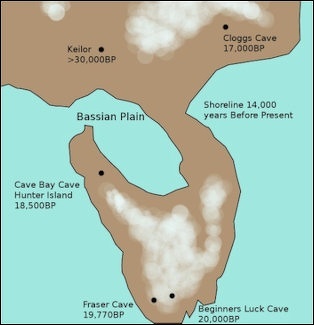
Ice-age land bridge from Australia to Tasmania
Modern humans reached Australia about 65,000 years ago in the middle of a major ice age, glaciers covered nearly 17 million square miles of the Earth, including much of northern Europe and Canada, and sea levels were more than 122 meters (400 feet) lower than what they are today. Much of Europe was covered by ice. In southern Asia and western Oceania, islands and land masses that are now separated by ocean water were connected by land bridges. The shores of Australia, for example, extended out several hundred miles further than they do today.
There has always been a relatively large expanse of ocean separating Asia and Australia. At times this distance was reduced by Ice Ages and sea level changes but never enough so that crossing a large stretches of water wasn’t necessary. For much of their history Australia and New Guinea were joined together in a landmass called Sahul. They were not separated by rising sea levels until about 8,000 years ago, when Tasmania and Australia were also separated. Genetic evidence supports the close ties between these two countries – the Indigenous peoples from these regions are more closely related to each other than to anyone else in the world, suggesting a recent common ancestry. [Source: Fran Dorey, Australian Museum, September 12, 2021]
Java, Bali, Sumatra and the Philippines were connected to Southeast Asia by land bridges 65,000 years ago but even during the maximum period of glaciation Australia, New Guinea and the western island of Indonesia were isolated by waters of Java Trench and North Australian and Weber basins. Even when the sea levels were at their lowest there was 80 kilometers (50 miles of sea) between Indonesia-Southeast Asia and Australia-new Guinea. During times of low sea levels the shortest path to Australia was between Timor and Sahul, where the stretch of sea that has to be crossed is only about 90 kilometers wide (55 miles). Ancient aboriginal myths say the continent's original ancestors came from the north and west from across the sea. The first Australians most likely arrived on foot by crossing a land bridge that connected Australia with New Guinea.
How Ice Ages Affected Movements Between Indonesia, Australia and New Guinea
Data shows between 71,000 and 59,000 years ago, sea levels were roughly 40 meters (130 feet) lower than they are today. This drop exposed a curving string of islands at the Australian continent's outer northwestern edge that reached some large, now-submerged pieces of land that could have supported tens of thousands of people. These islands were not so difficult to travel between using voyaging boats and stretched between Australia and the island of Timor, which is part of Indonesia. [Source: Emma Bryce published January 17, 2024]
According to Live Science: Then, between 29,000 and 14,000 years ago, there was another more precipitous dip in sea levels, coinciding with the peak of the last ice age. This was a time when large amounts of water became suspended in ice, which further lowered sea levels. These plummeting levels exposed a large swathe of continental shelf right beside modern-day Australia. "We're really looking at a landmass that was about 1.6 times the size of the UK," Kasih Norman, an archeologist at Griffith University in Queensland, Australia, told Live Science.
This, combined with the previously exposed ring of islands, "would have meant that there was basically a contiguous archipelago environment to move from the Indonesian archipelago, across to Sahul, and then from that archipelago into the supercontinent itself," Norman said. This could have enabled what she called a "staged migration" between modern-day Indonesia and Australia.
Meanwhile, the sonar mapping revealed a landscape where humans could well have thrived: a tall, sheltering escarpment, containing an inland sea adjacent to a large freshwater lake. There was also evidence of winding river beds carved across the land. Norman calculated that the large shelf, with these life-supporting features, could have harbored anywhere between 50,000 and half a million people. "It's important to bear in mind these aren't real population numbers we're talking about, it's just a matter of projecting the carrying capacity of our landscape," she said. "We're basically saying it could have had that many people."
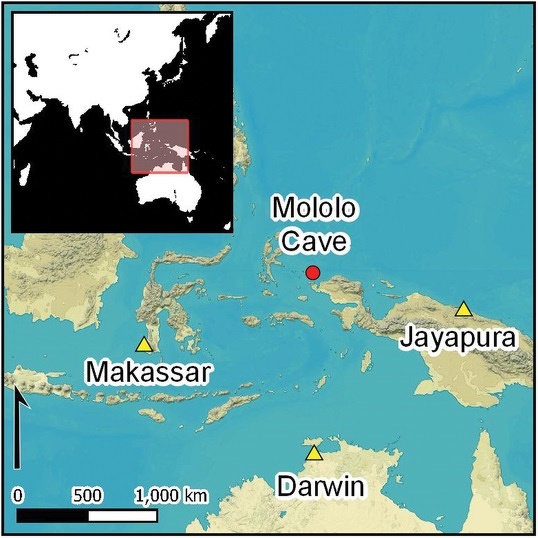
Location of Mololo Cave Cosmos magazine
As the last ice age began to taper off, melting ice caps shed water into a rising sea, Between roughly 14,000 and 14,500 years ago, sea level rose at an accelerating rate, going from about 3.2 feet (1m) per year to a meter [3.2 feet] over the course of 100 years, to 16 feet. "In this 400 year period, over 100,000 square kilometers of land go underwater," Norman said. Between 12,000 and 9,000 years ago, that pattern repeated, and another 100,000 square kilometers were swallowed up by the sea. "People would have really seen the landscape change in front of them, and been pushed back ahead of that encroaching coastline quite rapidly," Norman said.
This hypothesis is supported by other research. A recent study published in the journal Nature analyzed the genetics of people living in the Tiwi Islands, which sit on the edge of the shelf today. It revealed that at the end of the last glacial period, there was change in genetic signatures indicating an influx of new populations there. What's more, about 14,000 years ago, and then again between 12,000 and 9,000 years ago, the archaeological record at edge regions of modern-day Australia shows an increase in the deposit of stone tools — "which is normally interpreted to mean that there's a lot more people suddenly in that area," Norman said.Around this time in Kimberly and Arnhem Land, cave art also changed to incorporate new styles and subjects, including more human figures in the mix. This may have been from new people arriving in the area, Norman said.
Early Modern Humans Had to Have Taken Boats to Australia
The earliest evidence of humans in Australia suggests that some from of boatbuilding had been developed at that time. Although the earliest inhabitants may have walked from New Guinea at some point they would have had to use some sort of boat to get across the Java Trench which created a water barrier between Indonesia and New Guinea. It seems likely that the first human inhabitants of Australia arrived from Timor, 90 kilometers (55 miles from Australia), when Australia's shore stretched further north during the ice age. To reach Australia would have involved traveling in the open sea with no view of land. It seems unlikely that early swam the distance.
Fran Dorey of the Australian Museum wrote: The settlement of Australia is the first unequivocal evidence of a major sea crossing and rates as one of the greatest achievements of early humans. However the motive and circumstances regarding the arrival of the first Australians is a matter for conjecture. It may have been a deliberate attempt to colonise new territory or an accident after being caught in monsoon winds. The lack of preservation of any ancient boat means archaeologists will probably never know what kind of craft was used for the journey. None of the boats used by Aboriginal people in ancient times are suitable for major voyages. The most likely suggestion has been rafts made of bamboo, a material common in Asia. [Source: Fran Dorey, Australian Museum, September 12, 2021]
The oldest dates for human occupation of Australia represent the earliest, indirect evidence for sea faring by humans anywhere in the world. The oldest known boat is the Pesse canoe, a dugout made from a hollowed out tree trunk found in the Netherlands and dated to 8200-7600 B.C.. It was about one meter long and was was made from a hollowed Pinus Sylvestris tree. A dugout found in Denmark was dated to 6000 B.C. It is believed some kind of boat or raft was by ancient people to reach Australia at least 65,000 years ago. The oldest known vessels made with planks were found in Egypt and date to about 3000 B.C. [Source: Marine Insight, April 15, 2022]
Some scientists speculate that early homo sapiens might have crossed the open ocean in rafts made of bamboo logs. "Bamboo makes sea travel wonderful," anthropologist Alan Thorne told National Geographic. "You don't have any waves breaking over you — you just sort of flex over them." He and other scientists have re-created log and bamboo crafts and found them to seaworthy enough to make a 50 mile trip.
Route Used by First Humans to Reach Australia
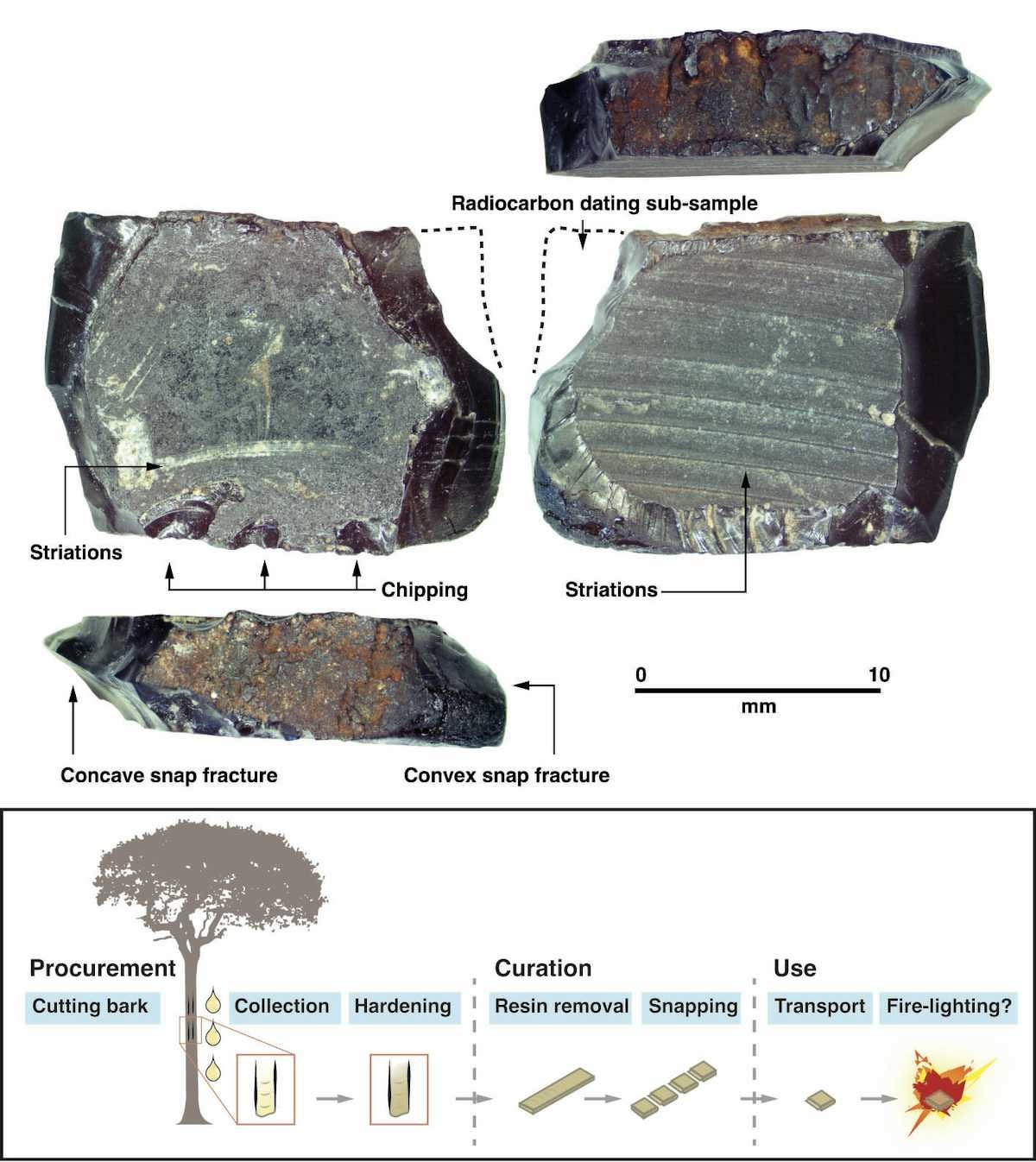
tree resin artefact found at Mololo Cave dated back to 55,000 to 50,000 years ago; the diagram t shows how it may have been made and used
There are a number of likely paths of migration across Asia and into Sahul. These are based on the shortest possible route and take into consideration the land bridges that would appear during times of low sea levels. However, travel may have also occurred when sea levels were high. High sea levels would have reduced the amount of usable land and increased the population pressure. During these times it may have been necessary to expand into new areas. [Source: Fran Dorey, Australian Museum, September 12, 2021]
In a study published in the Journal of Human Evolution in October 2018, researchers at Australian National University said they had found the most likely route used by first humans into Australia. The university reported: Co-lead researcher Shimona Kealy said these people probably travelled through Indonesia's northern islands, into New Guinea and then Australia, which were part of a single continent between 50,000 and 70,000 years ago, when sea levels were 25-50 metres below the current level. Ms Kealy, a PhD scholar at the School of Culture, History and Language and an Associate Investigator at the ARC Centre of Excellence for Australian Biodiversity and Heritage at ANU, said, "Archaeologists have yet to explore most of Indonesia's northern islands for human settlements predating the oldest sites found in Australia. These islands could hold the key to the mystery of how the first humans made it to Australia's shores." [Source: Australian National University, October 31, 2018]
The findings challenge a popular theory that these early adventurers travelled from Southeast Asia, through Indonesia and Timor and then across sea to reach Australia's shores and land that is part of the Northern Territory today.The study modelled the least-cost path from Southeast Asia to Australia, by considering factors such as difficulty to travel up slopes, visibility at sea, access to fresh water along the many potential pathways and the sophistication of maritime technology at the time.
The islands directly north and west of Sahul (known as Wallacea) were never connected to the mainland, requiring multiple successful water crossings east from mainland Southeast Asia (Sunda). "These people hopped their way along these islands, probably looking for a place to live where they would have access to reliable food staples and other resources - the visibility between islands would have been very favourable in terms of enabling this adventurous spirit," Ms Kealy said.
Co-lead researcher Professor Sue O'Connor from ANU said the proposed alternative route through Timor onto the northwest coast of Australia is now seen as less likely as a result of this study's least-cost pathway modelling. "The suggested route through Timor is also considered less likely given comprehensive archaeological evidence indicates the earliest human settlements in Timor are much younger than those found in Madjedbebe in Arnhem Land in the Northern Territory," said Professor O'Connor, a researcher at the School of Culture, History and Language and a Chief Investigator at the ARC Centre of Excellence for Australian Biodiversity and Heritage at ANU.
Hominids Cross the Wallace Line
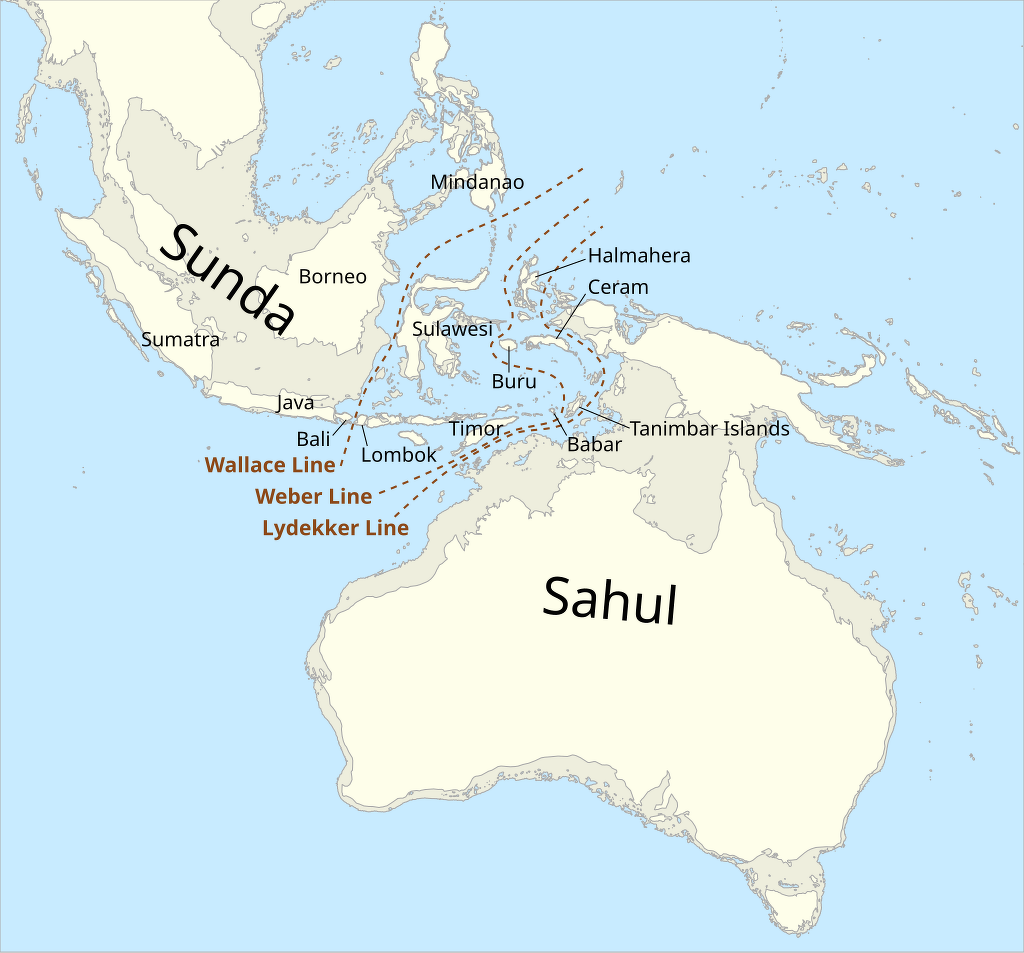
Wallace's Line separates Sahul (Australia and New Guinea) and Sunda (Southeast Asia) wildlife; Here is the Wallace Line along with other theorized lines delineating Sahul and Sunda fauna; The probable extent of land at the time of the Last Glacial Maximum, when the sea level was more than 110 meters (360 feet) lower than today, is shown in grey; The deep water of the Lombok Strait between Bali and Lombok formed a water barrier even when lower sea levels linked the now-separated islands and landmasses on either side
Stone flake tools, found near a stegodons (ancient elephant), dated to 840,000 years ago, were found in the Soa Basin on Indonesian island of Flores. The tools are thought to have belonged to Homo Erectus. They only way to get the island is by boat, through sometimes turbulent seas, which implies Homo erectus built seaworthy rafts or some other kind of vessel. This discovery is regarded with caution but may mean that early hominids may have cross the Wallace Line 650,000 years earlier than previously thought.
During several ice ages when sea levels dropped Indonesia was connected to the Asian continent. It is believed that Homo erectus arrived in Indonesia during one of the ice ages.
The Wallace Line is an invisible biological barrier described by and named after the British naturalist Alfred Russell Wallace. Running along the water between the Indonesia islands of Bali and Lombok and between Borneo and Sulawesi, it separates the species found in Australia, New Guinea and the eastern islands of Indonesia from those found in western Indonesia, the Philippines and the Southeast Asia.
Because of the Wallace Line Asian animals such as elephants, orangutans and tigers never ventured further east than Bali, and Australian animals such as kangaroos, emus, cassowaries, wallabies and cockatoos never made it to Asia. Animals from both continents are found in some parts of Indonesia.
The first people to cross the Wallace line from Bali to Lombok, Indonesia, scientists speculate, arrived in a kind of paradise free of predators and competitors. Crustaceans and mollusks could be collected from tidal flats and pygmy elephants unafraid of man could be easily hunted. When food supplies ran low, the early inhabitants moved on to the next island, and the next until the finally reached Australia.
The discovery of the Hobbits in Flores is thought to confirm that Homo Erectus crossed the Wallace Line.
RELATED ARTICLES:
FIRST HOMININS IN SOUTHEAST ASIA factsanddetails.com
HOMO FLORESIENSIS: HOBBITS OF INDONESIA factsanddetails.com
ORIGINS AND ANCESTORS OF HOMO FLORESIENSIS (HOBBITS) factsanddetails.com
DENISOVANS: CHARACTERISTICS, DISCOVERY AND DNA factsanddetails.com
WHERE DENISOVANS LIVED: MOSTLY IN ASIA IT SEEMS factsanddetails.com
EARLY MODERN HUMANS MIGRATE TO ASIA factsanddetails.com
EARLIEST MODERN HUMANS IN ASIA factsanddetails.com
EARLY MODERN HUMANS IN SOUTHEAST ASIA factsanddetails.com
LIFESTYLE OF EARLY HUMANS IN SOUTHEAST ASIA factsanddetails.com
DNA EVIDENCE ON THE FIRST HUMANS IN EAST ASIA factsanddetails.com
EARLY HUMANS IN BORNEO: NIAH CAVES 40,000-YEAR-OLD ROCK ART factsanddetails.com
EARLY HUMANS IN SULAWESI, INDONESIA AND THEIR 45,000-YEAR-OLD CAVE ART factsanddetails.com
Movements Between Indonesia and New Guinea 55,000 Years Ago
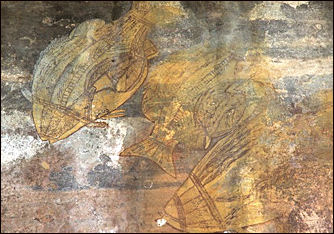
Aboriginal art of a fish Evidence from Mololo Cave on Waigeo Island in the Raja Ampat archipelago of West Papua, Indonesia — between North Maluku Island in Indonesia and northeast New Guinea — indicates that early seafarers navigated to the island at least 55,000 years ago. Archaeologists unearthed stone artifacts, animal bones from marsupials, megabats, and ground-dwelling birds and the oldest known plant artefact outside Africa—a carved tree resin object likely used as fuel — attesting to human occupation in the cave at that early date. [Source: Archaeology magazine, November-December 2024]
There is a large amount of water between Waigeo Island and the islands of Indonesia and New Guinea. This implies these early humans were skilled seafarers who could travel and settle on small islands. The multi-step production of the tree resin artefact — likely involving cutting the bark, letting the resin harden, and then snapping it into shape — shows advanced technological skills. The animal bones found in the cave suggests a diverse diet and that these humans were adaptable hunters, not just maritime specialists.
Around 13,000 years ago, early seafarers carried wallabies in their canoes when they traveled between Southeast Asia and the paleocontinent of Sahul (New Guinea and Australia). According to Archaeology magazine: In one of the earliest known examples of animal translocation, these ancient travelers introduced the marsupials to areas where they were not native. Evidence from Mololo Cave in the Raja Ampat Islands, near New Guinea, reveals that people were butchering and cooking brown forest wallabies as long as 13,000 years ago. The animals were also used for their pelts and as a source for making bone tools. [Source: Archaeology magazine, September-October 2025]
42,000-Year-Old Deep-Sea Fishermen in East Timor Hint How Humans Got to Australia
More than 40,000 years ago, prehistoric humans living in what is now East Timor ago possessed the skills necessary to catch deep ocean fish such as tuna. East Timor is one of the closest islands to Australia. Discovery News reported: “In a small cave at the eastern end of East Timor, north of Australia, archaeologist Sue O’Connor from the Australian National University has unearthed the bones of more than 2,800 fish, some of which were caught as long as 42,000 years ago. [Source: Discovery News, November 28, 2011 |^|]
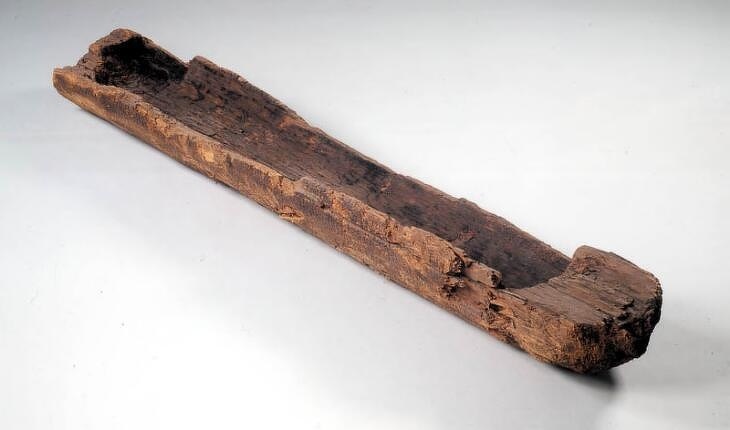
Pesse canoe
“The find shows that the people living in the region had the sophisticated cognitive skills needed to haul in such a difficult catch, O’Connor says. Her findings appeared in the journal Science. “What the site has shown us is that early modern humans in island Southeast Asia had amazingly advanced maritime skills,” she said. “They were expert at catching the types of fish that would be challenging even today — fish like tuna. It’s a very exciting find.” |^|
“It isn’t clear exactly what techniques the people living in the area at the time used to catch these fish. Tuna can be caught using nets or by trolling hooks on long lines through the water, O’Connor said. “Either way it seems certain that these people were using quite sophisticated technology and watercraft to fish offshore. She said it also demonstrated prehistoric man had high-level maritime skills, and by implication, the technology needed to make the ocean crossings to reach Australia.|^|
“The site where the discoveries were made, known as Jerimalai cave, is a small rock overhang hidden behind in foliage, a few hundred meters from the shore. “When I discovered it in 2005, I didn’t think that Jerimalai would tell us about the very early occupation of Timor,” O’Connor said. “I was quite surprised when I found all these fish bones and turtle bones.” So far, she and her colleagues have only excavated two small test pits at the cave, which contained a number of stone artifacts, bone points, animal remains, shell beads and fish hooks. In just one of those pits, 1 meter square and 2 meters deep, they found 39,000 fish bones. . “I think Jerimalai gives us a window into what maritime coastal occupation was like 40,000 to 50,000 years ago that we don’t really have anywhere else in the world,” said O’Connor. |^|
O’Connor said: “They were expert at catching the types of fish that would be challenging even today - fish like tuna. It's a very exciting find. Simple fish aggregating devices such as tethered logs can also be used to attract them. So they may have been caught using hooks or nets,' she said. 'Either way it seems certain that these people were using quite sophisticated technology and watercraft to fish offshore.” [Source: Simon Tomlinson, Daily Mail, November 25, 2011]
According to the Daily Mail: “She added that the finds may shed light on how Australia's first inhabitants arrived on the continent, with the implication that seaworthy boats would have been used to fish in the deep ocean. “Ee have known for a long time that Australia's ancient ancestors must have been able to travel hundreds of kilometres by sea because they reached Australia by at least 50,000 years ago,' said O'Connor. 'When we look at the watercraft that indigenous Australians used at the time of European contact, however, they are all very simple, like rafts and canoes.”“
See Separate Article: HISTORY OF FISHING: IN THE PREHISTORIC, ANCIENT, MEDIEVAL AND MODERN ERAS ioa.factsanddetails.com
World’s Oldest-Known Boats
The oldest boat recovered so far is the three-meter-long Pesse canoe — a dugout-style canoe that was 44 centimeters (17 inches) wide and formed from a single Scots pine log. It was found in 1955 in the village of Pesse in the Netherlands. Marks present in the cavity indicate it was likely formed from flint or antler tools. According to carbon-14 dating analysis it was constructed somewhere between 8200 and 7600 B.C. This canoe is exhibited in the Drents Museum in Assen, Netherlands;.
Other craft existed even earlier. A rock carving in Azerbaijan dating to around 10,000 B.C. shows a reed boat manned by about 20 paddlers. In Northern Europe, some argue that hide boats (kayaks) were used as early as 9,500 B.C.. The remains of a 7000 year old reed boat were found in Kuwait. Other very old dugout-style boats have been found in Denmark, France and Germany. They were thought to have been used to navigate local waterways and lakes.
The Dufuna canoe was 8.5 meters long and dated to 6550 B.C. The oldest boat found in Africa, it was discovered in 1987 by a Fulani tribesman digging a well and excavated by German and Nigerian archeologists 1994 at Dufuna, Yobe State, northern Nigeria. The boat — a dugout canaoe— was retrieved at depth of five meters below the surface. The 5.2-meter Pirogues de Bercy was found in France and dated to 4500 B.C..
The very first sea-worthy boats appear to predate modern humans. Homo erectus appears to have built rafts or boats to reach a remote Indonesian Island around 800,000 years ago which was not connected to any land masses by land bridges when sea levels dropped during the Ice Ages. Modern humans are thought to have used rafts or boats 60,000 years ago to reach Australia, which also was not connected to any land masses by land bridges when sea levels dropped during the Ice Ages
Five canoes found at the bottom of a lake in Italy were used more than 7,000 years ago for fishing and transport by people living in a Neolithic village near what is now Rome. Archaeologists discovered the boats at La Marmotta, a prehistoric coastal settlement that is now under Lake Bracciano, while conducting ongoing excavations, according to a study published on March 20, 2024 in the journal PLOS One. The large dugout canoes — which were constructed of alder, oak, poplar and European beech — were built between 5700 and 5100 B.C., radiocarbon dating revealed. The boats are the oldest ever found in the Mediterranean and may have had sails. [Source: Jennifer Nalewicki, Live Science, March 21, 2024]
See Separate Article: TRANSPORT IN NEOLTHIC-BRONZE-AGE EUROPE: HORSES, CATTLE-PULLED CARTS, SAILING CANOES europe.factsanddetails.com
Image Sources: Wikimedia Commons
Text Sources: Australian Museum, National Geographic, New York Times, Washington Post, Los Angeles Times, Smithsonian magazine, Nature, Scientific American. Live Science, Discover magazine, Discovery News, Natural History magazine, Archaeology magazine, The New Yorker, Time, BBC, The Guardian, Reuters, AP, AFP and various books and other publications.
Last updated September 2025