
DANGEROUS ANIMALS IN AUSTRALIA
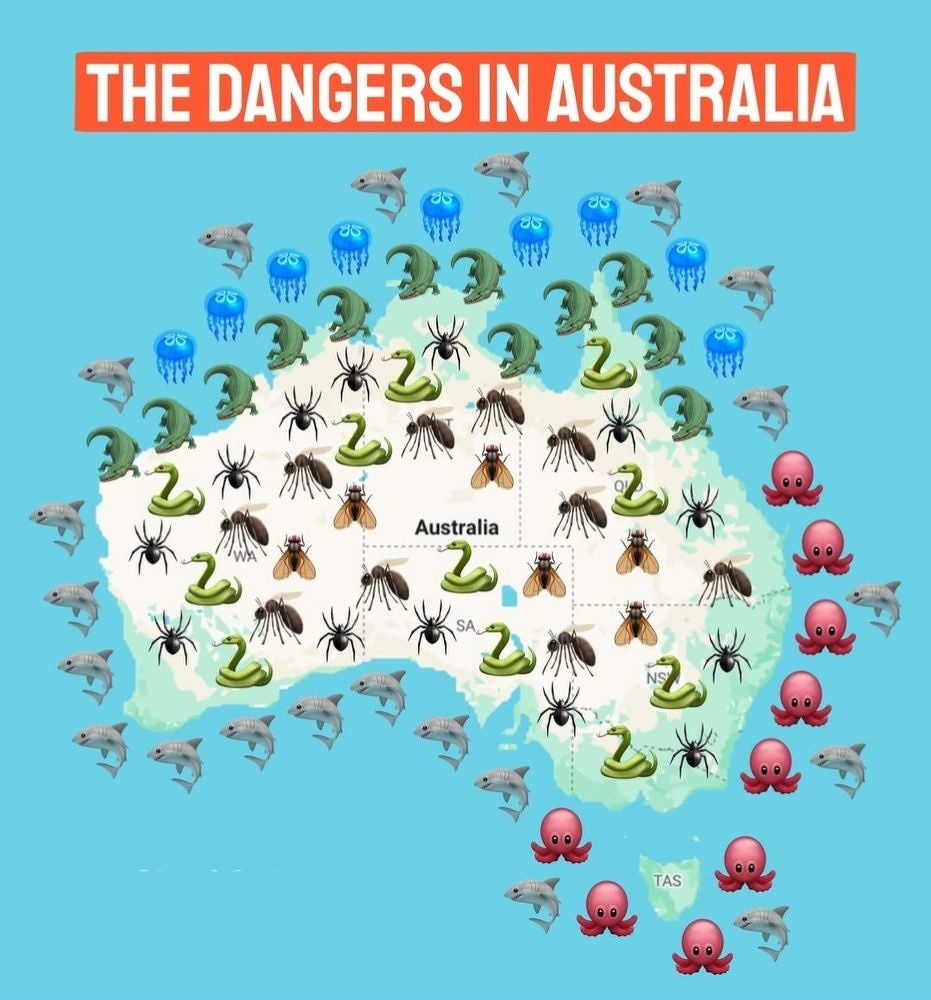
Dangerous animals in Australia include saltwater crocodiles, blue-ringed octopuses, box jellyfish, great white sharks, stonefishes, various venomous spiders like the Sydney funnel-web spiders and venomous snakes like inland taipan and eastern brown snake. While some animals like kangaroos and cassowaries can pose a threat, many of the animals labeled as dangerous are actually quite shy and avoid human interaction.
Australia is home to more than 160 species of sharks and eleven of the top 15 most venomous snakes in the world, including the red-bellied black snake, tiger snake and the western brown and king brown snakes. Funnel web spiders are said to be the most venomous arthropods (insects and spiders) in the world. They and the nearly-as- venomous cousin, the redback spider are found in the Sydney area. Box jellyfish are among the most venomous creature on earth. Saltwater crocodile are one of the world's deadliest reptiles. Zookeeper Pip Grieg said: ''They sit on the bottom of the river and just come up on you. You don't know what hit you, and they do that death roll and you're gone. They stick you under some log and let you rot until you're nice and tender.''
Among small nasty creatures in Australia are paralysis ticks, which can cause paralysis in humans and animals, particularly in eastern Australia. Honey bees can account for a lot of Emergency room admissions, mostly people with severe allergic reactions. Louise Gentle wrote: There are lots of dangerous animals in the world. Some are dangerous because they spread disease, like mosquitoes that can carry malaria. Others are dangerous because they have deadly venom, like some kinds of snakes. It is likely that Australia has the most dangerous animals because their only ancestors were also dangerous, though not as potent. Yet very few Australian animals actually cause deaths. So even though Australia has the most deadly species in the world, it is unlikely that you will be harmed by them, especially as they only bite humans in self-defence. [Source: Louise Gentle, Senior Lecturer in Wildlife Conservation, Nottingham Trent University, The Conversation, June 8, 2020]
Most animal attacks are a result of accidental encounters, often when humans venture into their habitat. Staying aware of your surroundings, especially in areas known to be inhabited by dangerous animals, is crucial for safety. If you are bitten or stung by a venomous animal, seek immediate medical attention.
RELATED ARTICLES:
KANGAROO ATTACKS: HUMANS, DOGS, HOW, WHY, WHERE ioa.factsanddetails.com
CASSOWARIES AND HUMANS: HISTORY, SIDE BY SIDE, ATTACKS ioa.factsanddetails.com
CROCODILE ATTACKS IN AUSTRALIA: HOW, WHERE, WHY, DETAILS ioa.factsanddetails.com
CROCODILE ATTACKS IN NORTHERN TERRITORY AUSTRALIA ioa.factsanddetails.com
SURVIVING CROCODILE ATTACKS IN AUSTRALIA ioa.factsanddetails.com
VENOMOUS ("POISONOUS") ANIMALS IN AUSTRALIA ioa.factsanddetails.com
VENOMOUS SNAKES IN AUSTRALIA: VENOM, SPECIES, BITES, AVOIDANCE, TREATMENT ioa.factsanddetails.com
TAIPANS (WORLD'S DEADLIEST SNAKES): SPECIES, VENOM, BITES, CHARACTERISTICS, BEHAVIOR ioa.factsanddetails.com
TIGER SNAKES: CHARACTERISTICS, REGIONAL MORPHS, VENOM, BITE VICTIMS ioa.factsanddetails.com
BROWN SNAKES: SPECIES, CHARACTERISTICS, BEHAVIOR, VENOM, BITE VICTIMS ioa.factsanddetails.com
PYTHONS IN AUSTRALIA: SPECIES, CHARACTERISTICS, BEHAVIOR AND REPRODUCTION ioa.factsanddetails.com
ANIMALS IN AUSTRALIA: TYPES, UNIQUENESS, HABITATS, CLIMATE ioa.factsanddetails.com
ENDANGERED ANIMALS IN AUSTRALIA: SPECIES, THREATS, TRENDS, CONSERVATION ioa.factsanddetails.com
WORLD'S OLDEST LIFE FORMS: STROMATOLITES, ALGAE AND THROMBOLITES ioa.factsanddetails.com
CAMBRIAN EXPLOSION AND THE WORLD'S OLDEST ANIMALS ioa.factsanddetails.com
DINOSAURS IN AUSTRALIA: TYPES, CHARACTERISTICS, WHEN AND WHERE ioa.factsanddetails.com
ICE-AGE ANIMALS IN AUSTRALIA: WHEN, WHERE AND HOW THEY LIVED AND WENT EXTINCT ioa.factsanddetails.com
GIANT ICE-AGE ANIMALS IN AUSTRALIA: WOMBATS, KANGAROOS AND THUNDER BIRDS ioa.factsanddetails.com
Venomous Animals in Australia
Venomous creatures in Australia — some of them with poisons strong enough to kill you — include spiders, snakes, jellyfish, octopuses, ants, bees and even platypuses. In his book “Sunburned Country”, Bill Bryson wrote that Australia “has more things that can kill you than anywhere else...This is a country where even the fluffiest of caterpillars can lay you out with a toxic nip; where seashells will not just sting you but will actually sometimes go for you...It’s a tough place,
Of Australia's 220 snake species, 145 are venomous, Lee told Live Science. These deadly serpents account for 65 percent of Australia's snake population, though only about 15 percent of the world's snakes are venomous. Venomous is the correct term for animals with poison. If you call them poisonous technically that means they are poisonous to eat, like poisonous mushrooms or possibly fugu (blowfish in Japan). Ethan Freedman told Live Science, The terms "venom" and "poison" are not interchangeable. Venom is injected directly by an animal, whereas poison is delivered passively, such as by being touched or ingested. "If you bite it and you get sick, it's poisonous. If it bites or stings you and you get sick, then it's venomous," said Jason Strickland, a biologist at the University of South Alabama who studies venom.[Source:Ethan Freedman, Live Science, March 27, 2023]
Powerful toxins (lethal dose): 1) anthrax (0.0002); 2) geographic cone shell (0.004); 3) textrodoxotine in the blue ring octopus and puffer fish (0.008); 4) inland taipan snake (0.025); 5) eastern brown snake (0.036); 6) Dubois’s sea snake (0.044); 7) coastal taipan snake (0.105); 8) beaked sea snake (0.113); 9) western tiger snake (0.194); 10) mainland tiger snake (0.214); 11) common death adder (0.500). Lethal doses is defined as the amount in milligrams needed to kill 50 percent of the animals tested.
See Separate Article: VENOMOUS (POISONOUS) ANIMALS IN AUSTRALIA factsanddetails.com
Shark Attacks in Australia
In Australia there had been a total of 904 unprovoked shark attacks as of 2016, with non-fatal and unprovoked attacks numbering 645 and fatal and unprovoked ones being 259. In 1929, nine people died from unprovoked shark bites in Australia – a record that preceded debate about introducing the first shark nets at Australian beaches several years later. [Source: Global Shark Attack File (GSAF), compiled by the Shark Research Institute, sharkattackdata.com, 2016]
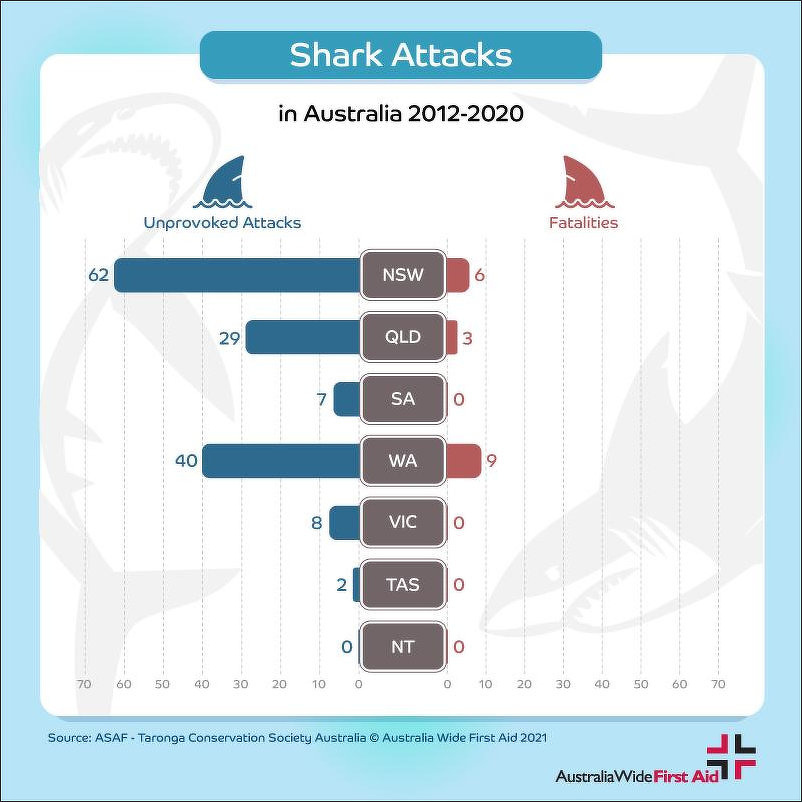
Unprovoked attacks in Australia (attacks on people spearfishing are considered provoked)
YEAR — TOTAL BITES — FATAL — NON-FATAL
2012 — 14 — 2 — 12
2013 — 10 — 2 — 8
2014 — 11 — 2 — 9
2015 — 18 — 1 — 17
2016 — 15 — 2 — 13
2017 — 14 — 1 — 13
2018 — 20 — 1 — 19
2019 — 11 — 0 — 11
2020 — 18 — 6 — 12
2021 — 12 — 3 — 9
TOTAL — 143 — 20 — 123
[Source: Shark Files, Florida Museum of Natural History]
Australians are three times more likely to die from a bee sting than from a shark attack. Nevertheless lots of shark attacks so occur. In the first three months of 1997, there were seven reported shark attacks. Between 1990 and 2007 there were 19 fatal shark attacks in Australia compared to seven in the U.S. In 2015, 33 people were attacked by sharks of all species in the oceans off Australia, according to data from the Taronga Conservation Society Australia.
Australian diver Greg Pickering has the unfortunate distinction of being mauled by a shark two times in nine years. First he was bitten on the leg while spearfishing near Cervantes, Australia in 2004. Then, in October 2013, during another spearfishing trip, he was attacked by a suspected great white, sustaining injuries to his head and face. He was airlifted to a hospital in Perth for treatment.
See Separate Article: SHARK ATTACKS IN AUSTRALIA factsanddetails.com
Great White Shark Attacks in Australia
Between 1876 and 1999, there were 52 attacks by great whites in Australia. Of these 27 were fatal. In 1985 a woman was bitten in half and devoured at a public beach at Peake Bay in South Australia. In 1993, newlyweds John and Deborah Ford were scuba diving at a seal rock 600 kilometers north of Sydney. They were decompressing a few meters from the surface when Johan saw a five-meter (16-foot) great white shark heading straight for his wife. He pushed her out of the way only to be swallowed himself.
In Australia there had been a total of 904 unprovoked shark attacks as of 2016, with non-fatal and unprovoked attacks numbering 645 and fatal and unprovoked ones being 259. A good portion of these have been by great white sharks. There were six fatal great white shark attacks in Australia between December 2008 and September 2011. All but one were off the west coast. A 31-year-old man died in 2010 ago while surfing in Cowaramup Bay. In February 2011 a man diving for abalone was savaged off South Australia.
CSIRO, Australia's leading scientific research body, has identified two great white populations in Australia; an eastern population and a southern-western population. "The eastern Australasian population ranges along the entire eastern seaboard from the cold waters as far south as Macquarie Island into tropical waters of Papua New Guinea, and extends eastwards to include New Zealand and tropical islands such as New Caledonia," CSIRO says. "The southern-western population ranges from western Victoria to northwest Western Australia." CSIRO has sized the eastern population at 5460, but admitted there could be more than 12,802 great white cruising the waters. [Source: Raffaella Ciccarelli, Tara Blancato, Nine News, February 17, 2022]
See Separate Articles: GREAT WHITE SHARK ATTACKS IN AUSTRALIA ioa.factsanddetails.com ; GREAT WHITE SHARK ATTACKS IN WESTERN AUSTRALIA ioa.factsanddetails.com ; GREAT WHITE SHARK ATTACKS ioa.factsanddetails.com
Kangaroo Attacks
Adult kangaroos big strong animals and males especially can be formidable fighters. They have seriously injured and even killed humans and are known for drowning dogs. They have also seriously damaged cars and killed passengers of cars that collided with them. Kangaroos sometime hop through the doors of houses and destroy furniture and attack children. Coming across a kangaroo may seem like a great photo opportunity, but the animals can become violent and aggressive with tourists that get too close. [Source: Taiyler Simone Mitchell, Business Insider December 24, 2022]
Kangaroos rarely attack humans but will fight if they feel threatened. Dogs often chase kangaroos, which have been known to lead the pets into water and then pin them underwater and drown them. The Canberra government warns people: Don't approach a kangaroo when it is standing up and looking straight at you, especially if it growls or snorts. People with dogs should keep them on a leash away from kangaroos.
In 1936, William Cruickshank, 38, died in a hospital in Hillston in New South Wales state on the Australian east coast months after he'd been attacked by a kangaroo. Cruickshank was a hunter. He suffered extensive head injuries including a broken jaw as he attempted to rescue his two dogs who were fighting with a large kangaroo, The Sydney Morning Herald newspaper reported at the time. [Source: Associated Press, September 13, 2022]
See Separate Article: KANGAROO ATTACKS: HUMANS, DOGS, HOW, WHY, WHERE factsanddetails.com
Feeding Wildlife Behind Many Animal Attacks and Encounters
Feeding wildlife is behind at least some animal attacks in Australia. Darryl Jones, a senior lecturer in ecology at the Australian School of Environmental Studies at Griffith University in Brisbane, has researched this topic. Stephanie Peatling wrote in National Geographic News: Jones has focused much of his research on why people persist in feeding wildlife despite the best efforts of the Australian federal and state governments to convince the public that, for example, spicy french fries are not good for pelicans. [Source: Stephanie Peatling, National Geographic News, May 6, 2005]
"There is a huge proportion of people who feed wildlife," Jones said. "Even though it's frowned on, everyone has done it. When we asked people why they did it, the majority of people said they enjoyed it," he said. "An enormous number of people said they feed wildlife because they're really conscious that humans have done enormous damage to nature, and they're trying to give something back."
What makes Jones's work even more interesting is his definition of feeding. It does not mean the tourist who flicks a bit of bread to a seagull but people who spend money with the specific purpose of feeding wild birds and animals. Neither does his definition include giving food scraps to wildlife instead of putting scraps in the rubbish bin or on the compost heap. Jones's surveys indicated that between 40 and 60 percent of people are feeding wildlife. "It's totally unpoliceable. [People] are concerned about nutrition or the animals becoming dependent. … People are convinced there are whole ecosystems dependent on them."
As cities and towns eat up more undeveloped land in Australia, previously wild species are finding themselves living in urban environments. Birds such as currawongs are increasing in number and competing with smaller birds for food and habitat, while ibis are growing bolder in their dealings with people.At the same time, some Australians are complaining about animal disruptions, such as the pungent smell of fruit bats or the loud noise made by rainbow lorikeets. "A big philosophical problem is getting the community to see it's their problem," Jones said. "The animals are the easy bit, because they are doing things pretty much the same way all the time."
Image Sources: Wikimedia Commons
Text Sources: Animal Diversity Web animaldiversity.org , National Geographic, Live Science, Natural History magazine, Australian Museum, David Attenborough books, Australia Geographic, New York Times, Washington Post, Los Angeles Times, Smithsonian magazine, Discover magazine, The Conversation, The New Yorker, Time, BBC, CNN, Reuters, Associated Press, AFP, Lonely Planet Guides, Wikipedia, The Guardian, Top Secret Animal Attack Files website and various books and other publications.
Last updated June 2025