
Home | Category: Birds, Crocodiles, Snakes and Reptiles
HOW TO SURVIVE A CROCODILE ATTACK
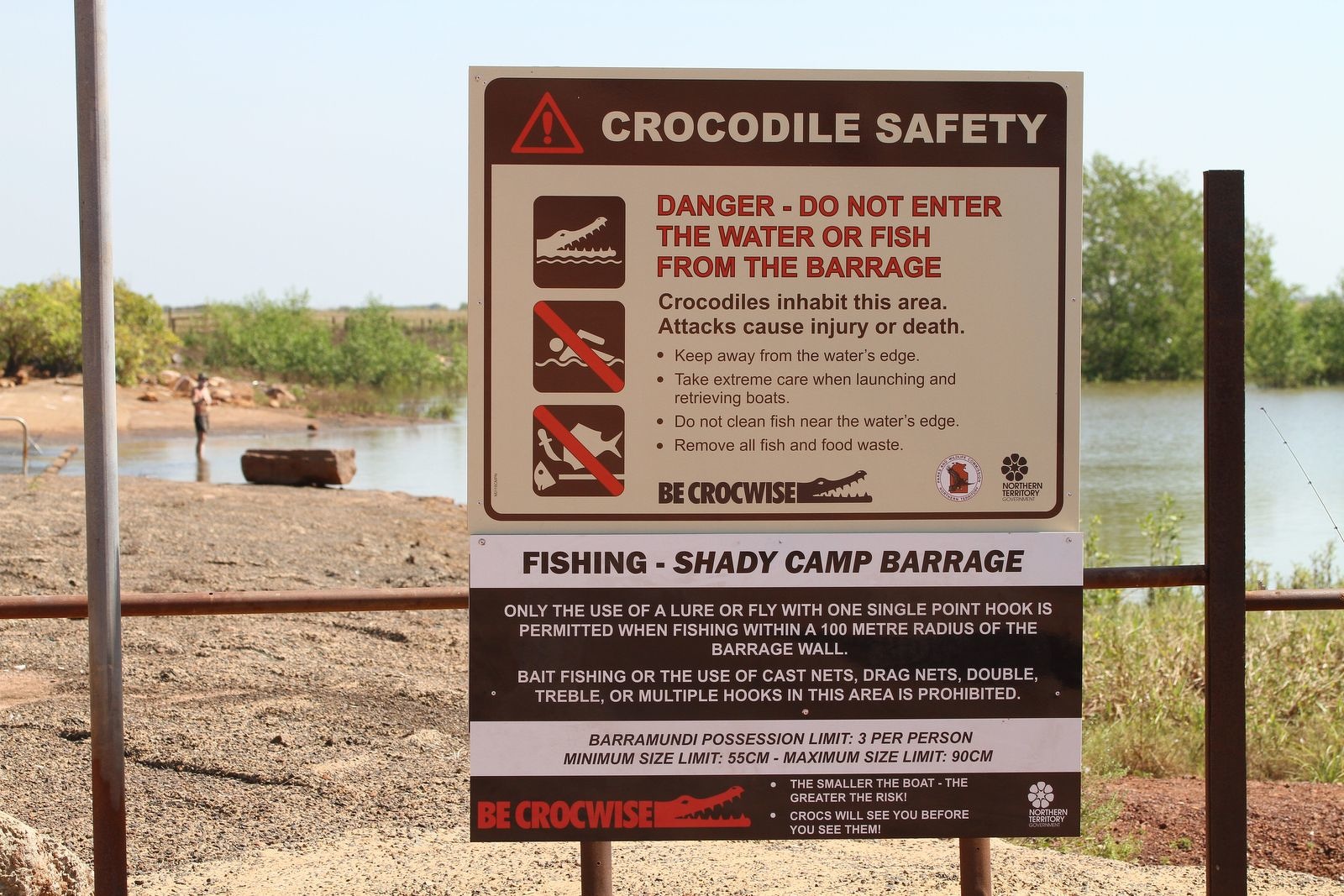
Saltwater crocodile warning sign at Shady Camp along the Mary River in the Top End of Australia's Northern Territory; This site has some of the highest male saltwater crocodile densities in the world and is also the location of frequent irresponsible human behavior, as is evident in the photo! crocattack
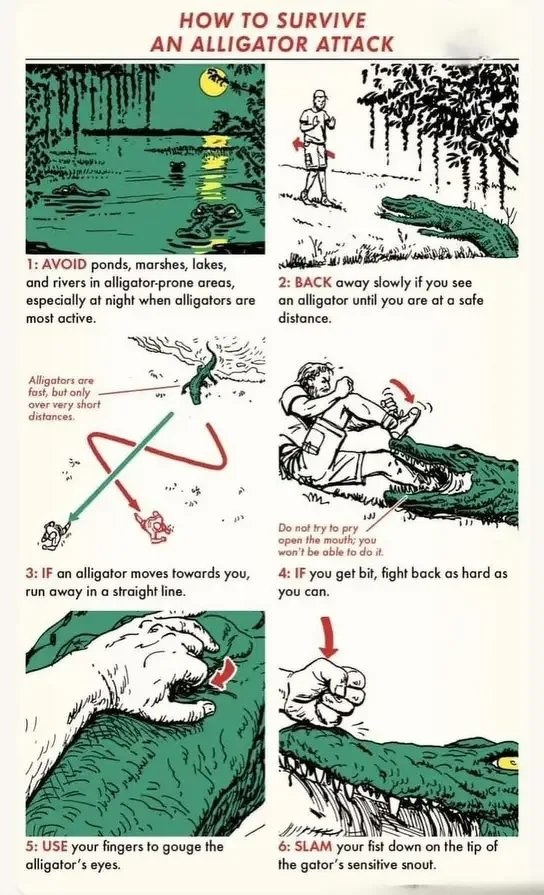
1) Faced with a croc? Back away slowly and run in a straight line: Robert Shapiro of the History Channel wrote: In 2016, a video of a woman making noise with her flip flop to scare away crocodiles in Kakadu National Park, Australia became a viral sensation. While she was successful, confronting a crocodile is a risky thing to do. Pro Tip: If you spot a croc, back away slowly and try not to make sudden movements. Splashing in water will only draw attention. If a crocodile heads your way, run away in a straight line. The myth about moving in a zig-zag motion is just that — a myth. Crocodiles can move at 10 miles per hour, so remove those flip flops so you can run faster. [Source: Robert Shapiro, History Channel, May 4, 2018]
According to WikiHow: Crocodilians rely on the element of surprise to capture prey, so it's extremely unusual for one of these animals to pursue a person on land. Crocodiles and alligators, however, are not as sluggish on land as some people believe, though they're not as fast as many other people think, either. The land speed record for a crocodilian is about 10 miles per hour (about 17 kilometers per hour) and these animals quickly grow tired when running on land, which means that as long as you can see it coming, any teen or adult in decent shape can easily outrun one of these animals. Run away from the water, as crocodiles and alligators seldom run on land unless they're trying to get back into the water and out of danger.
2) A crocodile’s eyes are impressive and vulnerable — gouge them: In 2014, Stephen Moreen waded into water near Peppimentari, Australia to retrieve geese he had been hunting when a crocodile grabbed his arm. The croc began to roll him under the water when Moreen spotted the croc’s eye and poked it with his fingers. The creature released him and swam away. A crocodile’s eyes are impressive: They can see underwater and at night, and they can retract during a fight. They are also, however, one of the most vulnerable parts of the creature’s body.
3) When pulled into a “death roll,” fight like crazy: Val Plumwood survived a very intense crocodile attack in Kakadu National Park in 1985. Plumwood was canoeing alone when she saw a crocodile in the water. As it approached the side of her craft, she yelled “Go Away!” but it was no use. She tried to jump onto surrounding low-hanging branches, but the crocodile grabbed her legs and pulled her into a death roll — an attack meant to drown and subdue the prey. After surviving two death rolls, Plumwood attempted to climb a paperbark tree when she was pulled back under into a final roll. Determined to survive, she fought against the crocodile by hitting it and jabbing her fingers into what may have been its eyes or nose. Plumwood escaped by clawing her way up a slippery mud bank and using torn clothing as a tourniquet for her wounds.
4) When in doubt, sacrifice a limb: Rudy Francis was feeding crocodiles at a Malaysian farm on February 20, 2017 when the unimaginable happened: The croc latched onto his arm. Almost immediately, the reptile pulled him into shallow water and began a death roll. As an ecologist and former zoo worker, Francis knew that his best chance of survival was to hug the creature’s underbelly “to avoid further bites and [get] away from the threatening tail,” according to Carol Ankangon, the victim’s older sister. Francis attempted to get out of the water, but his leg was crushed between the crocodile’s teeth. Fearing the worst, he told his co-workers to pull him to safety by letting the crocodile tear his leg away. While he lost his right leg below the knee and his right hand, he survived the ordeal.
RELATED ARTICLES:
CROCODILE ATTACKS IN AUSTRALIA: HOW, WHERE, WHY, DETAILS ioa.factsanddetails.com
CROCODILE ATTACKS IN NORTHERN TERRITORY AUSTRALIA ioa.factsanddetails.com
SALTWATER CROCODILES ioa.factsanddetails.com
CROCODILES IN AUSTRALIA: HISTORY, SPECIES, BIG ONES, DWARVES, BATS, SHARKS ioa.factsanddetails.com
CROCODILE CULTURE AUSTRALIA: URBAN CROCS, ABORIGINALS, DUNDEE, STEVE IRWIN ioa.factsanddetails.com
CROCODILES: CHARACTERISTICS, ANATOMY, DIFFERENCES WITH ALLIGATORS factsanddetails.com
PREHISTORIC CROCODILES: EVOLUTION, EARLIEST SPECIES, TRAITS factsanddetails.com
CROCODILE BEHAVIOR: COMMUNICATION, FEEDING, MATING factsanddetails.com
CROCODILES AND HUMANS: WORSHIP, THREATS, HANDBAGS factsanddetails.com
HOW TO CATCH A CROCODILE factsanddetails.com
CROCODILE ATTACKS IN ASIA factsanddetails.com
SPECIES OF CROCODILES IN ASIA factsanddetails.com
Being Crocwise: How to Avoid Crocodile Attack
Crocodile attacks are often at the shore. To avoid crocodiles stay away from the shore on areas where crocodiles might be. If you need to bathe or wash do so in a place with clear, shallow water, where a crocodile can not launch a surprise attack. Avoid swimming in places where crocodiles have been spotted. Crocodiles have an attack zone of about two meters. To be safe sure you at least this distance away from the shore or rive bank. To check for crocodiles you are supposed to slap the water loudly and see if the snout of a curios croc appears on the surface of the water. If you tries do it with a paddle or stick to ensure you are a safe distance from the shore.
Officials in Australia urge people to be "Crocwise," and look out for the predators. Police and Queensland’s Department of Environment and Sciences advise people to stay away from the water's edge and remember — just because you can't see a crocodile, doesn't mean it isn't there. They also say not to feed the animals, to dispose of all food and to stay away from traps. The department says crocodiles use their advanced sense of smell to find prey and usually wait at the water's edge and then ambush their target. [Source: Caitlin O'Kane, CBS News, May 3, 2023]
“Crocodiles are opportunistic feeders that can feed on any sized animal they can overpower. They can also be highly territorial, particularly during breeding seasons, and will attack anything in their habitat that they perceive is a threat. As a result, crocodiles can and do attack humans,” Australia’s Department of Environment and Science said in their crocodile management plan. “While the likelihood of being attacked by a crocodile is relatively low when compared to many other risks (e.g. the risk of drowning) the consequence for an individual who is attacked can be very severe.” [Source: Jon Haworth, Good Morning America, May 3, 2023
People visiting or living in crocodile territory across the north of Australia are told never to swim where crocodiles may be present, to look out for crocodile slide marks on river banks and not to dangle arms or legs out of boats. Also, be aware that crocodiles can jump on and capsize small vessels such as canoes, kayaks and dingies. Fishermen are advised never to clean fish or discard scraps near the water’s edge. “Just because you can’t see a crocodile, it doesn’t mean there is not one close by,” Queensland wildlife authorities warn. “Crocodiles can stay underwater for more than an hour. Even large crocodiles can be completely concealed in knee-deep water. “Stay at least five meters from the water’s edge — crocodiles often hunt their prey at the water’s edge.” [Source: Nick Squires, The Telegraph, May 1, 2023]
Don't mix drinking and crocodiles: An Australian review of unprovoked crocodile attacks on humans between 1971 and 2004 found that 29 percent of the 62 attacks had involved some alcohol consumption by the victim. It’s also not a good idea to tease and try to take selfies with crocodiles. In 2008, The Telegraph reported: A monster saltwater crocodile came within a meter of making a meal out of fisherman Novon Mashiah. The creature, which was gliding alongside the small boat hoping for a free feed of fish, suddenly exploded out of the water after Mr Mashiah pointed at it while posing for a photograph. The snap almost cost the 27-year-old his life as he leaned over the back to pose for the picture. The crocodile — estimated to be more than 4 meters long — landed on the side of the boat before crashing back into the water. "I was shocked, the animal clearly wanted to kill me. One minute I was leaning over the boat teasing it for a picture," Mr Mashiah said. "The next minute it burst out of the water with incredible speed... its jaws fully open. I jumped back and the croc landed on the boat and then slapped into the water. I was shaking.'" Mr Mashiah's mate Doron Aviguy, 22, took the photo from a bigger boat nearby. The two Israelis were working as fishermen on the South Alligator River when they came face-to-face with the saltie. Mr Mashiah lent over the back of the boat when he saw the croc. "I began playing with it for a photo," he said. "I was pointing at it when it suddenly jumped up at me. I didn't realise that crocs were so aggressive. "They came near the boat all the time, probably because we were fishing. We'd seen eight different crocs in the past month. "I was laughing, but it wasn't funny in the end. That's it, I'm not getting close to crocs any more." [Source: Daily Telegraph, March 5, 2008]
Crocodile Survivors
In September 2000, a 12-year-old boy fought his way from the jaws of a three-meter crocodile by gouging its eyes, his father said. AAP reported: The saltwater croc clamped Sam West as he snorkelled near Montilivet Island, off Western Australia's Kimberley coast. "It gripped his head first, released him then gripped his hands," said Mr West, a prawn trawler owner. "It gripped him four or five times. He's very, very lucky to be alive." Mr West said his son's courage in fighting back by gouging the croc's eye had probably saved him. Sam, who lives with his mother in Cairns, was discharged from the Royal Darwin Hospital yesterday after being treated for cuts to the head, wrists and hands. [Source: Rod McGuirk Saturday, AAP, September 23, 2000]
A zoologist, Graeme Webb, a crocodile expert, said the eye gouge was probably the only chance of fending off a three-meter specimen, which would weigh up to 120 kilograms. "My guess is that it would be enough, but it would take a cool-headed boy to manage it," Dr Webb said. "The croc's head is so well armored and horny, the eye is the only place you can actually get at it."
The boy had been spending school holidays with his father aboard the trawler Amanda Lee. The crew had been relaxing on the beach of the remote island when the croc attacked about 20 meters from shore, Mr West said. Crew members rushed in a dinghy to the boy's aid when they heard his screams. "It was probably over in moments, but it seemed like ages," Mr West said. A float plane in the area heard the trawler's emergency calls and collected the boy. He was transferred to an aeromedical plane, which flew him to Darwin. Dr Webb said crocodiles tended to be attracted by the splashing and the posture of snorkellers.
Woman Taken From a Canoe by a Crocodile Survives Three Death Roles
In February 1985, Philosopher Val Plumwood survived a crocodile attack while paddling in a canoe in Kakadu National Park. Before she shoved off she was told by the canoe outfitter that crocodiles don’t attack people in canoes. Plumwood wrote in The Age: I was in a canoe on a side channel of the East Alligator River in Kakadu, looking for an Aboriginal rock art site. I had been out the previous day and it had been idyllic. This day began with drizzle, which progressed into torrential rain. By early afternoon I had a strong feeling of being watched and suddenly the canoe seemed flimsy. I had a sense of danger or vulnerability and decided I wanted to go back. [Source: Val Plumwood, the Age, January 12, 2004]
I started paddling back down the channel and hadn't got far when I saw what looked like a stick ahead of me. As I was swept towards it I saw eyes and realised it was a crocodile. I was almost past it when there was this great blow on the side of the canoe. I paddled furiously but it followed, bashing on the canoe. I looked for a place to get out, but couldn't see one. I felt sheer terror. I saw a tree growing from the water near the bank and thought maybe I could leap into it. I got ready to jump and as I did so, the crocodile came up close. I looked straight into its eyes and it looked straight into mine. It had beautiful golden-flecked eyes. I remember those vividly.
I did the thing you're advised to do, to try to look fearsome: I waved my arms and shouted. It might work with tigers but it doesn't work with crocodiles. Then I jumped, but it got me in mid jump. I saw this blur, a flash of teeth and water as it grabbed me between the legs and took me down for a death roll. I thought: "I'm not food, I'm a human being; I don't believe this."
There was searing pain, but the worst thing was the roll, which seemed to last forever. It pushes water in your lungs and it felt like my arms and legs were coming off. When it finished, my head came clear of the water and I coughed the water out of my lungs and started to howl with pain. Then the crocodile pushed me into the second death roll. We came up again, and this time right next to me was a big, solid, branch so I grabbed on to it. I hung on grimly, thinking I'd sooner let it tear me apart than go through another death roll.
Then, suddenly, I felt the pressure relax and realised the crocodile had let go. I tried again to jump into the tree. This time it grabbed me around the leg - the upper left thigh, which was badly damaged. It took me down for a third death roll. Again I thought I was going to die. I just thought it was going to take a long time over it, which seemed worse than having it kill me straight out.
But a minute later it let me go, again. I gave up on the tree and tried to throw myself at the mud bank. After several tries, I got to the top and stood up and couldn't believe it; I was still alive. It was an incredible rush of elation. Because I was still in danger, I flopped away, finding my leg was in bad shape. I had shock right through my body and was feeling pretty sick; I tried lying down but felt worse, so continued to walk back in the direction of the ranger's station. I felt just a glimmer of hope that I might survive.
The rain was still torrential and it took me hours to reach the lagoon between me and the ranger station. At this stage, I started to black out and had to crawl. But then the rain stopped and it was still, abnormally still, and so the ranger heard me shouting.Then I had a 13-hour trip to Darwin hospital. I almost lost the leg in hospital but I recovered after almost a month in intensive care and another month of skin grafts.
It was really a life-changing event for me. Those final experiences have an incredible intensity - that's why they have such a life-changing power. You see things at that point which you wouldn't normally see; it strips away a lot of your illusions about life and death. It was quite a while before I took in the full extent of how it changed my way of looking at the world. It left me with a strong sense of gratitude about being alive, which has faded but never really gone, and a feeling that life is not to be wasted.
For the complete article from which the material here is derived see “Taken by a Crocodile” by Val Plumwood, The Age theage.com.au For longer versions of the event see: “Val Plumwood Prey to a Crocodile”, Aisling Magazine aislingmagazine.com ; “Surviving a Crocodile Attack”, Utne, utne.com
Surviving a Crocodile Attack by Prying It Jaws off Your Head
In May 2023, a snorkeller survived crocodile attack in far northern Queensland by prising its jaws off his head The Telegraph reported: Marcus McGowan was attacked by a saltwater crocodile while on a snorkelling trip from a luxury resort on Haggerstone Island, off the coast of Cape York in the tropical north of Queensland. He managed to fight it off — only for the reptile to attack again.
Mr McGowan, his wife and a group of friends had anchored their boat and jumped into “crystal clear” waters about 25 miles off the Queensland coast at the weekend. The 51-year-old said he was admiring coral and tropical fish when the crocodile came out of nowhere. “I was attacked from behind by a saltwater crocodile which got its jaws around my head. I thought it was a shark but when I reached up, I realised it was a crocodile. I was able to lever its jaws open just far enough to get my head out.” But his ordeal was not yet over. “The crocodile then attempted to attack me a second time, but I managed to push it away with my right hand, which was then bitten by the croc.” He managed to “escape the crocodile’s grip once again” and swam to the boat, which came to the rescue after the crew heard his screams for help. [Source: Nick Squires, The Telegraph, May 29, 2023]
The attack happened quickly but Mr McGowan estimates that the saltwater crocodile was probably a juvenile, perhaps three meters (10ft) long. Mr McGowan was taken by boat back to Haggerstone Island, one of the most remote private island resorts in Australia, where he was given first aid by a friend, a fireman who “knew what he was doing”. A helicopter took him to a hospital on Thursday Island, another resort along the Great Barrier Reef, and from there to a bigger hospital in the city of Cairns on the mainland. He suffered lacerations to his scalp as well as puncture wounds to his head and his hand.
A similar encounter occurred in 2021. The BBC reported: A 44-year-old told medics he was swimming in Lake Placid in Queensland when he was attacked by a saltwater crocodile that he described as being 1.5 to 2 meters (4.9 to 6.5 feet) long. He was taken to hospital with multiple "minor lacerations". Officials said the man was lucky to escape without more serious injuries. Critical care paramedic Paul Sweeney said the man was "remarkably calm" when emergency responders arrived at the scene. “What he said to us was that a crocodile had bitten his head and in his effort to remove the jaws of the crocodile, he put his hands in to try and prise the jaws apart. In the process of trying to remove his hands, the jaws snapped shut on his forefinger," he told reporters. Mr Sweeney said that following the attack the man swam a considerable distance back to shore and pulled himself onto the bank. “It was clear from our assessment of him that there were puncture marks [on his head]," he said. “Mr Sweeney told reporters the man had been swimming in the lake three times a week for about eight years, and said he "would not be surprised if he ventured into those waters again for further exercise". [Source: BBC, January 28, 2021]
In December 2004, UPI reported: A young Australian man was nursing wounds to his scalp and face after successfully escaping a crocodile's grip on his head. The attack occurred in Cairns, in northeastern Australia, when Drewe Ramsden, 18, bent over a river to splash off his face while at a pub with friends, The Sun reported. He didn't notice as an 8-foot crocodile swept towards him, pushing a wave in front of its snout. His began yelling, but the reptile lunged and clamped onto Ramsden's head. The man began punching, and as his friends arrived, they began pelting the croc with rocks and cans of beer. "He didn't know what it was but he sort of punched it and got away," one of his friends said.Paramedics rushed Ramsden to a hospital, where he received nine stitches for a gaping hole to his right cheek and several puncture wounds on his scalp. [Source: UPI, December 15 2004]
How It Is Possible to Pry the Jaws of a Crocodile Off Your Head
"It is generally surprising [McGowan survived]," Paul Gignac, an anatomical researcher at the University of Arizona, told Live Science. Crocodiles are "not known to let go once they hold on." Gignac noted that "this man's probably especially lucky that the juvenile was either too small or didn't have a positioning to start rolling," a behavior known as a "death roll," in which crocodiles violently twist in the water while holding their prey to disorient or dismember it. "Otherwise, it might be the case that this person would have lost a limb." [Source: Kiley Price, Live Science published June 6, 2023]
Kiley Price wrote in Live Science: So how exactly did McGowan escape the crocodile's vice-like grip? There could be a few factors at play. For one, the crocodile may not have been able to wrap its entire jaw around McGowan. "The bite force gets lower as you go out away from the jaw joint," Gignac said. "So the tip of their snout will typically have about 40 percent lower bite force, and that's just due to the engineering or the physics behind the way levers work."
The croc's stamina may also have played a part. Reptiles are cold blooded, or ectothermic, meaning they largely rely on external heat sources to manage their body temperatures and have slower metabolisms than warm blooded, or endothermic animals. As a result, they typically have smaller reserves of energy than most endothermic animals. So even though a crocodile's attack may be vicious at first, "they do become tired relatively quickly," Gignac said, adding that crocodiles need rest before reaching peak performance again.
Under these conditions, then, it may be possible for a human to dislodge themselves from a crocodile's mouth. When attacked, humans often release massive amounts of adrenaline, which speeds up the heart and breathing rate. This reaction increases the oxygen sent to muscles, giving someone a temporary energy boost. "A full grown man with adrenaline could — in that situation — pry open a 200-pound vise essentially," Gignac said. "I think it would be difficult but, you know, when you don't really have any other choice, you go for it. So it's not out of the realm of possibility."
Ten-Year-Old Girl Escapes from Crocodile Jaws
In October 2005, a 10-year-old girl has told was attacked by a crocodile while swimming in the far north of Western Australia and survived. ABC reported: Chantal Burnup's family says she was saved by her older brother who bashed the animal with his fist. Bearing the scars of her lucky escape, Chantal has described how she was mauled by a three-meter crocodile. [Source: ABC, October 5, 2005]
She was swimming in a lagoon near Doubtful Bay north-east of Derby when the animal attacked. "My dad and my brother had jumped in, I jumped in a little while after them and I turned around to call my dog and something grabbed me underwater," she said. "I tried to get it off me and my dad pulled me out of the water and he pulled me back onto the rocks."
After being dragged underwater, Chantal's father managed to pull her from the crocodile's jaws while her brother, Simon, beat the animal away with his fist. "By that time I had got out of the water and was watching and dad was shouting at me to help so I got back in and smacked it on the head," Simon said.
The girl suffered wounds and lacerations to her arms, back and chest. After spending the night at a remote cattle station she was flown to Derby Hospital. Her mother, Gabrielle, was not present at the time of the attack but flew to her daughter's bedside. "I just couldn't imagine that a crocodile could grab her and she would be as alright as she is, she is so little," she said.
Local crocodile expert Malcolm Douglas says the area is infested with crocodiles which are extremely territorial at this time of year. "I wouldn't go swimming there for a billion dollars... that's one of the biggest crocodile populations in the Kimberley," he said. Mr Douglas says tourists and tour operators need to be better educated about the dangers of crocodiles.
Crocodile Attack Rescues
In April 2008, a crocodile grabbed the woman and her husband jumped on the back of the animal in an attempt to free her. The reptile released the woman, 36, and fled. The incident occurred at a creek crossing where the couple was swimming in northern Australia, 160 kilometers southwest of Darwin. She suffered serious leg and back injuries. [Source: Associated Press]
In October 2000, a racehorse saved man from crocodile attack. ABC reported: A Rockhampton horse trainer has had a lucky escape after a crocodile lunged at him on the banks of the Fitzroy River. Jim Morris was taking a horse for a swim in the river when the large croc came at him. Mr Morris says his horse probably saved his life when it bolted away from the crocodile. "I just walked towards the river and put my foot in the river and just a big surge of water come straight out of the river and a croc came straight up at me," he said. "I reckon it hit my leg because I felt something hit me on the leg and the mare pulled me back, because she pulled away and I hung on to the rope. "She pulled me up the bank a bit, that's sort of what saved the croc from grabbing hold of me." [Source: ABC, October 5, 2000]
In November 2003. A woman punched a three-meter saltwater crocodile on the nose to free her teenage nephew from its jaws during an attack in the Northern Territory. Associated Press reported: Margaret Rinybuma, in her 50s, let her fists fly when the reptile lunged at 19-year-old Manual Gandigorrtij's leg as he was loading wild geese into a small boat at the edge of a creek about 400 kilometers (250 miles) east of Darwin. Speaking from his hospital bed, Mr Gandigorrtij said: "He dragged me into the water and then my uncle and my aunty went and jumped it". He. Mrs Rinybuma told the Northern Territory News newspaper: "I hit him with my fist on the nose and I yelled out 'Help! In the name of Jesus!' and it let him go." After the crocodile let go, Mr Gandigorrtijj's aunt and uncle dragged the teenager from the water. Mr Gandigorrtij is recovering in Royal Darwin Hospital following surgery for three deep cuts and muscle damage in his left leg. [Source: Associated Press, November 3, 2003]
Sixty-Year-Old Woman Jumps on Crocodile’s Back and Saves Camper
In 2004, the Sydney Morning Herald reported: Perhaps the luckiest man in Australia is recovering in Cairns Base Hospital after a 60-year-old woman wrestled him from the jaws of a crocodile. The woman jumped on the back of the 4.2 meter (13.7-foot) reptile as it dragged the man from his tent in the early hours of the morning and made for a nearby river. It appears the woman's flurry convinced the crocodile to let go of the man. But it then turned on her, breaking her arm with a flick of its tail. [Source:Sydney Morning Herald, October 12, 2004]
“"Extraordinary" was how Stephen Penberthy of the Queensland Royal Flying Doctor Service described the rescue, which happened at a camping site in coastal bushland north of Cooktown. "A crocodile takes the man and the woman hears a commotion, sees what's happening and she jumps on the confounded thing," Mr Penberthy said. "It's an act of heroism. "It would have been a different story if the croc had made it to the water with the guy."
The pair, believed to be from Brisbane, were flown to Cairns where they are in a serious but stable condition. They were with eight others on a camping holiday in far north Queensland. The man has a broken arm and leg, while both sustained wounds from the crocodile's jaws. The crocodile was shot and killed by another member of the group.
"It's heating up and the crocodiles are becoming more active," said Mark Read, of the Queensland Parks and Wildlife Service. "We're also coming into breeding season which makes the male more territorial. But on this occasion it's difficult to understand what's motivated the animal."
The crocodile came into the tent, where the man was sleeping with his wife and baby, at 4am. "North Queensland beaches are pristine looking. It's just the animals ... that you need to be careful of," Dr Read said. "People who travel into these parts of north-west Queensland really have to be aware that crocodiles are there, and they're pretty dangerous creatures," Mr Penberthy said. "If I was camping, I'd be up a tree."
Image Sources: Wikimedia Commons
Text Sources: Animal Diversity Web animaldiversity.org , National Geographic, Live Science, Natural History magazine, Australian Museum, David Attenborough books, Australia Geographic, New York Times, Washington Post, Los Angeles Times, Smithsonian magazine, Discover magazine, The Conversation, The New Yorker, Time, BBC, CNN, Reuters, Associated Press, AFP, Lonely Planet Guides, Wikipedia, The Guardian, Top Secret Animal Attack Files website and various books and other publications.
Last updated August 2025