
Home | Category: Birds, Crocodiles, Snakes and Reptiles
CROCODILE ATTACKS IN AUSTRALIA
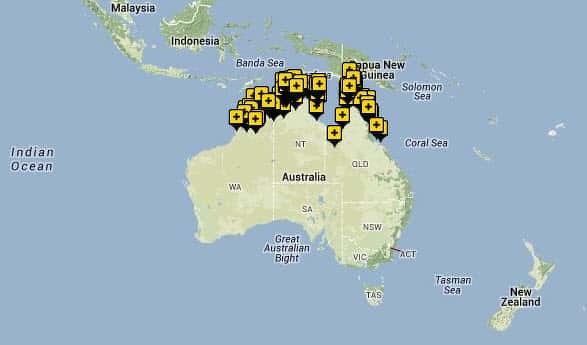
location of recorded crocodile attacks in Australia, from CrocBITE 2014
Nearly all the crocodile attacks in Australia involve saltwater crocodiles. Salties are called man-eaters with good reason. On average they kill and often eat one or two people a year in Australia. In 2014 they took three. Their ability to take advantage of human behavior can be unsettling. Bill Bryson wrote in a “Sunburned Country”: “The chronicles of crocodile killings are full of stories of people standing in a few inches of water or sitting on a bank or strolling along an ocean beach when suddenly the water splits and, before they can even cry out, much less enter into negotiations, they are carried away for leisurely devouring.” [Source: Franz Lidz, Smithsonian magazine, March 2015]
Ilsa Sharp wrote in “CultureShock! Australia”: There were about 15 fatal crocodile attacks in the 20 years between 1985 and 2005, although the total number of attempted killings is greater of course. Crocs are efficient killers. The animal grips larger prey in its jaws and then takes it below water to drown it in a ‘death roll’, rolling over and over in the process, then stores the body underwater before eating it a few days later. The danger to humans has probably been increased by tourist operators who bait crocodiles by hanging carcases like chickens high above the water from large boat decks, thus teaching the beast to leap ever higher. The average small fisherman’s boat then becomes no problem for the crocodile. Make no mistake about it, the seemingly lumbering ‘saltie’ can move at an impressive speed on land. Just watch ‘showtime’ at some of the Northern Territory crocodile farms, when rangers feed huge specimens by offering them dead chickens at the water’s edge, and see what you think after that. [Source: Ilsa Sharp, “CultureShock! A Survival Guide to Customs and Etiquette: Australia”, Marshall Cavendish, 2009 ^^]
Of the 31 crocodile attacks reported there between 1970 and 1996, 18 were fatal. Most of the victims were swimmers although one man was pulled from a boat at night in 1993 and killed. In the 1970s a mine worker disappeared while taking a swim in Northern Australia. The police later found what was left of him inside an 18 foot crocodile.
RELATED ARTICLES:
CROCODILE ATTACKS IN NORTHERN TERRITORY AUSTRALIA ioa.factsanddetails.com
SURVIVING CROCODILE ATTACKS IN AUSTRALIA ioa.factsanddetails.com
SALTWATER CROCODILES ioa.factsanddetails.com
CROCODILES IN AUSTRALIA: HISTORY, SPECIES, BIG ONES, DWARVES, BATS, SHARKS ioa.factsanddetails.com
CROCODILE CULTURE AUSTRALIA: URBAN CROCS, ABORIGINALS, DUNDEE, STEVE IRWIN ioa.factsanddetails.com
CROCODILES: CHARACTERISTICS, ANATOMY, DIFFERENCES WITH ALLIGATORS factsanddetails.com
PREHISTORIC CROCODILES: EVOLUTION, EARLIEST SPECIES, TRAITS factsanddetails.com
CROCODILE BEHAVIOR: COMMUNICATION, FEEDING, MATING factsanddetails.com
CROCODILES AND HUMANS: WORSHIP, THREATS, HANDBAGS factsanddetails.com
HOW TO CATCH A CROCODILE factsanddetails.com
CROCODILE ATTACKS IN ASIA factsanddetails.com
SPECIES OF CROCODILES IN ASIA factsanddetails.com
Being Crocwise; How to Avoid Crocodile Attack
Crocodile attacks are often at the shore. To avoid crocodiles stay away from the shore on areas where crocodiles might be. If you need to bathe or wash do so in a place with clear, shallow water, where a crocodile can not launch a surprise attack. Avoid swimming in places where crocodiles have been spotted. Crocodiles have an attack zone of about two meters. To be safe sure you at least this distance away from the shore or rive bank. To check for crocodiles you are supposed to slap the water loudly and see if the snout of a curios croc appears on the surface of the water. If you tries do it with a paddle or stick to ensure you are a safe distance from the shore.
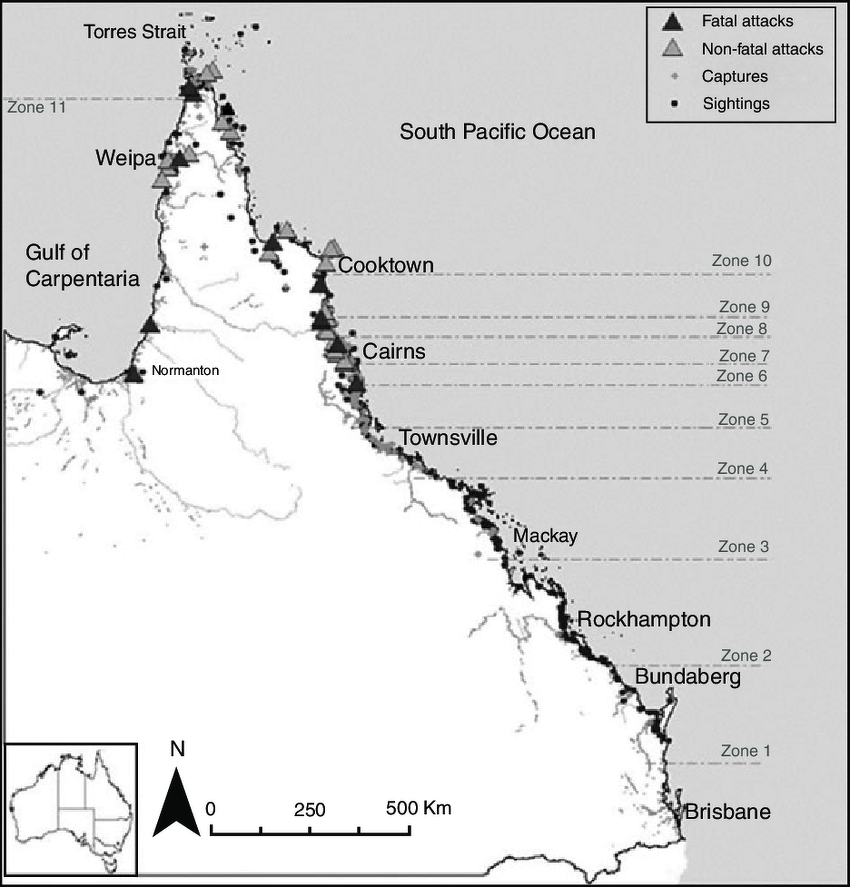
Distribution of recorded estuarine crocodile attacks, sightings and removals and relocations in Queensland: Attacks: 1971–2015; sightings: 2003–15, and removals and relocations: 1985–2015, from Researchgate
Officials in Australia urge people to be "Crocwise," and look out for the predators. Police and Queensland’s Department of Environment and Sciences advise people to stay away from the water's edge and remember — just because you can't see a crocodile, doesn't mean it isn't there. They also say not to feed the animals, to dispose of all food and to stay away from traps. The department says crocodiles use their advanced sense of smell to find prey and usually wait at the water's edge and then ambush their target. [Source: Caitlin O'Kane, CBS News, May 3, 2023]
“Crocodiles are opportunistic feeders that can feed on any sized animal they can overpower. They can also be highly territorial, particularly during breeding seasons, and will attack anything in their habitat that they perceive is a threat. As a result, crocodiles can and do attack humans,” Australia’s Department of Environment and Science said in their crocodile management plan. “While the likelihood of being attacked by a crocodile is relatively low when compared to many other risks (e.g. the risk of drowning) the consequence for an individual who is attacked can be very severe.” [Source: Jon Haworth, Good Morning America, May 3, 2023
People visiting or living in crocodile territory across the north of Australia are told never to swim where the reptiles may be present, to look out for crocodile slide marks on river banks and not to dangle arms or legs out of boats. Fishermen are advised never to clean fish or discard scraps near the water’s edge. “Just because you can’t see a crocodile, it doesn’t mean there is not one close by,” Queensland wildlife authorities warn. “Crocodiles can stay underwater for more than an hour. Even large crocodiles can be completely concealed in knee-deep water. “Stay at least five meters from the water’s edge — crocodiles often hunt their prey at the water’s edge.” [Source: Nick Squires, The Telegraph, May 1, 2023]
Crocodile Attacks in Queensland
Coastal areas in Queensland are often called "Croc Country." There were 13 fatal crocodile attacks in Queensland between 1985 and 2023. Since a ban on hunting in 1974, Queensland's crocodile population has rebounded from a low of some 5,000 animals to around 30,000 today. A 2019 report suggested an average of 1.7 adult crocs living in each kilometer of river surveyed. Under Queensland's management programme, "problem crocodiles" are removed from areas where they threaten public safety and, in rare instances, euthanised. [Source: Tiffanie Turnbull, BBC, May 3, 2023]
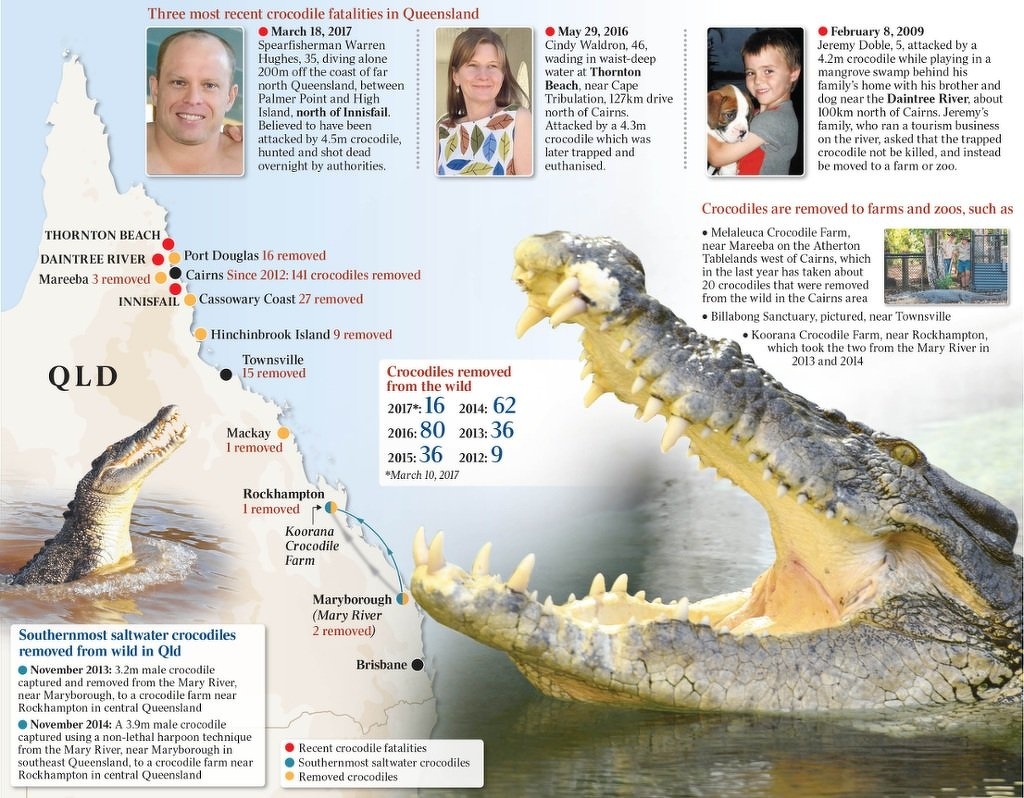
Between 1985 and 2016, the Queensland government recorded eight fatal crocodile attacks and 17 non-fatal attacks. While crocodiles in the area nearly went extinct in the 1970s due to hunting, they are now listed as a now listed as a vulnerable species in Queensland and the department balances conservation and public safety. They regularly set traps in this area to help reduce the amount of crocodiles. However, the removal of one crocodile opens up its territory for another to come in and the department says the area will never be completely free of the predators.[Source: Caitlin O'Kane, CBS News, May 3, 2023]
In the early 1990s, a crocodile killed a man at ferry crossing for a Cape York Peninsula road on the Jardine River. Further upstream on the same river is a place where a man disappeared, presumable after being eaten by a crocodile. The Jardine River is regarded as best place in Australia to see saltwater crocodiles in the water because the Jardine is one of the few rivers in northern Australia with really clear water.
In September 1999, a man in far north Queensland man was airlifted to Townsville for neurosurgery after a crocodile attacked him, leaving him with a broken skull. ABC reported: The attack occurred at the Russell Heads boat ramp near Babinda late Monday night. Innisfail police say the man was transported to a nearby doctor by a friend and was treated for cuts to his face and neck. An ambulance spokeswoman says he was airlifted to Townsville General Hospital for surgery. [Source: ABS, September 22, 1999]
In October 2017, Anne Cameron, 79, disappeared from aged care facility Ozcare near Port Douglas after she went for a walk. Later police found human remains, jewellery and Ms Cameron's walking stick on the banks of a creek inlet near the Mowbray River, north of Cairns. ABC reported: Wildlife officers found and killed a crocodile in the Mowbray River system around 1:00am. Human remains and a number of items which belonged to Ms Cameron were found in the animal, which has been euthanased. Chris Artiemiew from the Department of Environment and Heritage Protection said wildlife officers had been tracking the crocodile. "It had subtle behaviour differences which highlighted to us that it was the target animal," Mr Artiemiew said. The department does not believe the crocodile had been living in the area, as it was unfamiliar to wildlife officers working in Port Douglas. [Source: Casey Briggs, ABC, October 17, 2017
In February 2023, wildlife rangers killed a large crocodile after it attacked a man and ate his pet dog at a boat-launching ramp near the town of Cooktown, Queensland. Video of the attack showed the big “saltie” exploding out of murky river water and snatching the dog in just a second or two. In April 2023, a spear fisherman was attacked underwater by a crocodile and another man was bitten on the foot as he slept on a beach about 50 miles north of Cairns. In April 2024, a 16-year-old boy died in a suspected crocodile attack in Torres Strait waters while trying to swim ashore from a broken-down dinghy. [Source: Nick Squires, The Telegraph, May 29, 2023]
Woman Killed by Crocodile at Beach in Daintree National Park
In May 2016, two Australian women went for a stroll and took what they thought would be a quick dip off Thornton beach Daintree National Park, north of Cairns. One, 46-year-old Cindy Waldron, was killed by saltwater crocodile. . Waldron was celebrating the end of her friend's cancer treatment and was swimming when a crocodile dragged her away. The friend, 47-year-old Leeann Mitchell, tried to pull her to safety, police said.
“Senior Constable Russell Parker said: "They decided to take a swim in the ocean just in waist-deep water and at that point, we believe that a crocodile has taken one of the women, taken hold of her," he told the Australian Broadcasting Corporation. "Her friend tried valiantly to drag her to the shore but unfortunately wasn't able to do so and the woman subsequently disappeared."Now her friend raised the alarm with a nearby business and they subsequently contacted the police." A rescue helicopter was sent up with thermal imaging equipment but was unable to find her. Parker added that the surviving woman was "very, very shaken and shocked" but appeared to have escaped with only grazes. [Source: AFP, May 30, 2016] The BBC reported: Media reports said the pair, both originally from New Zealand, were walking arm-in-arm in knee-deep water before the attack, which occurred in Australia's Daintree National Park. Nine News reported that witnesses heard Ms Waldron yell: "A croc's got me, a croc's got me." The last fatal attack in the area occurred in 2009, according to the Australian Broadcasting Corp.
A search for Ms Waldron's body resumed a day after the attack. Neil Noble, of the Queensland state ambulance service, said a 5 meter (16 foot) crocodile had been reported in the area. Residents told Australian media that the area was a known crocodile habitat. Local MP and former crocodile farmer Warren Entsch said the area was popular with crocodile-spotting tours and there were many warning signs. "This is a tragedy but it was avoidable," he told reporters."If you go in swimming at 10 o'clock at night, you're going to get consumed."
“The Brisbane Courier-Mail said Thornton Beach was next to a creek where croc-spotting tours were organised, and there were plenty of warning signs throughout the vicinity. The attack is not the first in the area. A giant crocodile known as Big Jim took local postal worker Beryl Wruck in 1985 when she had a late-night swim about an hour's drive from Thornton Beach.
Fishermen in a Dingy Eaten by Large Crocodile in North Queensland
On February 11, 2021, Andrew Heard, a 69-year-old fisherman, was eaten by a crocodile on an island an north of Queensland. Brandon Specktor wrote in Live Science: Human remains were found inside the stomach of a 14-foot-long (4.2 meters). Local authorities said the remains likely belong to Heard. Heard was last seen in the afternoon when he left his yacht on Hinchinbrook Island (close to the coast of northeastern Australia) in a small fishing dinghy, according to the Australian Broadcasting Corporation (ABC) news site. When he failed to return that night and stopped responding on his radio, Heard's wife called the authorities.[Source: Brandon Specktor, Live Science, February 18, 2021]
His dinghy was found capsized the next morning, showing damage indicative of a crocodile attack. That night, investigators discovered human remains in the area; the next day, they found the gigantic croc nearby, according to the Queensland government.Environmental authorities euthanized the croc and cut it open, revealing more human remains in its guts. "The crocodile captured yesterday is believed to be the animal involved in the disappearance of a man," Queensland Environment, a local government agency, tweeted. "Our thoughts are with the family at this difficult time."
Other crocodile attacks were reported in Queensland area in the two previous weeks, according to Vice News. In late January, a man in his 40s was bitten on the head while swimming at Lake Placid, roughly 100 miles (160 kilometers) north of Hinchinbrook Island. The man survived with minor injuries after prying the croc's jaws open with his hands, according to news reports. Several days later, a 22-year-old man was attacked by a 12-foot-long (3.6 meters) crocodile while swimming near Australia's northernmost tip. He survived with lacerations to his hand, and the croc was subsequently euthanized.
Another Fishermen Eaten by Large Crocodile in North Queensland
In late April 2023, 65-year-old Kevin Darmody was last seen at Kennedy's Bend — a well-known saltwater crocodile habitat in a remote part of northern Queensland. After a two-day search of the area, police euthanised two large crocodiles and found human body parts belonging to Darmody inside one of them. The attack took place on the Kennedy River at Rinyirru (Lakefield) National Park in Queensland — approximately 400 kilometers (250 miles) north of Cairns. Lying more than 200 miles north west of Cairns. The park consists of grasslands, wetlands, coastal estuaries and mangroves — habitat favored by saltwater crocodiles. [Source: Tiffanie Turnbull, BBC, May 3, 2023]
The BBC reported: Mr Darmody was an experienced fisherman and a well-known member of the community in Cape York. The two crocodiles, which measured 4.1 meters (13.4 feet) and 2.8 meters in length, were killed about 1.5 kilometers (0.9 miles) from where he was last seen. Human remains were found inside only one of the reptiles, but wildlife officers believe both were involved in the incident. The fishermen with Mr Darmody at the time did not see the attack, but reported hearing him yell, followed by a loud splash. "I raced down… but there was no sign of him, just his thongs [flip-flops] on the bank and nothing else," his friend John Peiti told the Cape York Weekly.
Nick Squires wrote in The Telegraph: Darmody ran a pub called the Peninsula Hotel in the tiny, remote town of Laura in the far north of Queensland, about 80 kilometers (50 miles) from the spot where he disappeared. He was fishing for barramundi at the time of the attack. He was a keen fisherman, posting photos on Facebook in which he holds huge fish he has caught, including barramundi. He also posted a series of images which shows a large crocodile apparently attacking and mauling a smaller crocodile. [Source: Nick Squires, The Telegraph, May 1, 2023]
Bart Harrison said a friend of his was close to the place where Mr Darmody vanished. “A lad came up on the road shouting ‘he’s gone, he’s gone’ and my mate ran down the bank, and said the water was all stirred up and dirty, you could see something bad happened,” he told The Cairns Post. “He was standing right there fishing a few minutes earlier, then he was gone, his thongs were left on the bank. He had lived up here since I was a kid, been at the pub a long time, went fishing a lot. He knew the river pretty well, it really is sad.”
Doctor Killed in Crocodile Attack in Cooktown
In August 2024, while holidaying with his wife and three sons in northern Queensland, 40-year-old doctor David Hogbin from New South Wales was taken by a 3.9 metre saltwater crocodile when a riverbank on the Annan River in Cooktown gave way and he slipped into the water below. His wife tried to pull him out of the water, but she too began slipping down the river bank, prompting him to let go of her arm. Remains later found inside the crocodile were confirmed to be Hogbin’s.
The BBC reported: News.com.au, journalist Alexis Carey, sister-in-law of Dr Hogbin, said the family had been walking along a path on a 5-meter (16-foot) - high river bank when a portion of it gave way and he was unable to get out of the water. She said his wife, also a GP, slid down to pull Dr Hogbin out and was able to grab his arm, but she also began slipping into the river herself. "Dave’s final, decisive act was to let go of Jane’s arm when he realised she was falling in, despite knowing she was his only lifeline. Within moments, he was taken," Ms Carey said. "Dave’s brave decision in that terrifying moment very likely saved his wife’s life, ensuring she was able to return to their boys." [Source: André Rhoden-Paul, BBC News, 6 August 2024]
She said the fact his children did not witness their dad's final moments was a "small piece of consolation". Dr Hogbin's wife, Jane, said: “We were just enjoying a standard day of our holiday and everything just changed within 30 seconds. He wasn’t doing anything wrong – in fact, he was doing everything right, and this still happened...He saved me – his last act was to not pull me in with him."
For a While Maneaters X-Rayed Rather Than Shot in Queensland
In the 2000s, potential man-eating crocodiles in Queensland were X-rayed for human remains and relocated rather than shot for humanitarian reasons. The policy was later changed so that when a person was killed or badly injured by a crocodile, likely suspects were caught and euthanized rather than shot and then cut open.
Rory Callihan wrote in Time magazine: When Saltwater crocodiles killed a human on Australia's northeast coast in the old days, a posse of gun-toting locals would converge on the area, blast all crocs to death, slit open their bellies to establish guilt, and release the unfortunate victim's remains for a decent burial. But in these environmentally enlightened times, authorities are taking a very different approach — and not everybody is happy about it. [Source: Rory Callihan, Time magazine, November 10, 2008]
In October 2008, Arthur Booker, 62, wandered down to retrieve his crab pots on the mangrove-lined banks of the Endeavour River, near Cooktown, in Queensland. Lying in wait was a large crocodile, which is thought to have dragged the Scottish-born camper into the water and eaten him, leaving only his sandals, watch and video camera beside a huge belly-slide mark.
The state government quickly dispatched two dozen wildlife rangers to collect any aggressive crocodiles in the area and search for Booker's remains. Within days, traps anchored to the banks of the river snared three potential man-eaters. But instead of executing and disemboweling the reptiles, the rangers gently loaded them into trailers and transported them to Cairns, 160 miles to the south, where they were X-rayed. Two were also given an endoscopy, with a tiny camera passed into their stomach to probe for Booker's remains.
Queensland's chief wildlife manager, Mike Devery, defended the costly operation, saying the animals were listed as vulnerable under the state's Nature Conservation Act, which labels crocodiles over 13 feet long as "iconic." But the kid-glove treatment outraged many locals, including Federal Parliamentarian Bob Katter, a cowboy-hatted, blunt-spoken cattle rancher whose 218,000 square-mile electoral district is home to thousands of wild crocodiles.
Katter accused the government of making human sacrifices to a crocodile god, saying, "The only time I'd like to see that croc is through the sights of my rifle." Once, if a crocodile ate a human, all crocodiles in the area would be shot immediately, he says. "Now they are getting X rays. You've got patients who can't get X rays or endoscopies in Queensland's hospitals, but a crocodile can get one."
Arguing that crocodile numbers are booming, Katter has called for a cull. "They're wandering into people's backyards," he says. State Environment Minister Andrew McNamara says numbers have increased only slightly since the ban on hunting was imposed, and that for safety's sake, animals over six-foot-six long are relocated out of urban areas. Queensland crocodile expert Gordon Grigg says culling is futile: "You can never be sure you've got them all, and it risks giving people a false sense of security."
Forensic scientists are testing suspected human remains found in one of the thee crocodiles captured after Booker's disappearance, a three-legged, 14-foot brute. Culprit or not, its life will be spared. To the dismay of Katter and other nostalgic northerners, its next role will be as a stud on a crocodile farm rather than a range of handbags and shoes.
Crocodile Attacks Near Darwin in the Northern Territory
Australia's Northern Territory (NT), which is home to the world's largest wild crocodile population of about 100,000 of them according to the Northern Territory's tourism site. Since crocodiles became a protected species under federal law in 1971, crocodile numbers in the Northern Territory have soared from 3,000 to an estimated 80,000 to 100,000. Saltwater crocodiles can live up 70 years and grow throughout their lives, reaching up to seven meters (23 feet). The Northern Territory's tourism site says. "These 'salties' side along the coastline and waterways of the Territory. They have a taste for fish, but will eat just about anything including cows and buffaloes, wild boar, turtles, birds and crabs." [Source: Li Cohen, CBS News, July 6, 2024; Associated Press, January 20, 2017]
Nearly all the crocodile attacks in Australia involve saltwater crocodiles. Despite publicity campaigns to be "crocwise" around rivers, there was an average of one or two deaths from crocodile attacks in the Northern Territory each year from 2005 to 2018, but none have occurred since then. [Source: Tiffanie Turnbull, BBC, May 3, 2023]
In the 1970s a mine worker disappeared while taking a swim in Northern Australia. The police later found what was left of him inside an 18 foot crocodile. In 1987, Ginger Faye Meadows, an American tourist, was cornered by a huge salt water crocodile at King's Cascade, west of Darwin. As she tried to swim to a beach 25 yards away the crocodile grabbed her in its jaws and lifted her out of the water and then pulled her down while her friends looked on helplessly. Another time a crocodile somehow found is way onto the streets of Darwin and terrorized the town before it was caught.
In the mid-1980s, a local guide named Terry McLoughlin was showing some tourists some crocodiles on a concrete causeway over the East Alligator River, about 100 southeast of Darwin. As tourists looked on in horror, McLoughlin lost his footing and when he fell a crocodile bite him on the head, killing him instantly. Because he was killed in an area where the Aboriginals consider crocodiles sacred, the animal was not killed and swam around in the East Alligator river for years afterwards.
See Separate Article: CROCODILE ATTACKS IN NORTHERN TERRITORY AUSTRALIA: HOW, WHERE, WHY, DETAILS ioa.factsanddetails.com
Crocodile Attacks in Western Australia
In November 2000, a man named Norman Stanley survived a crocodile attack while fishing in Western Australia. The attack occurred in the Cambridge Gulf, a river estuary north of Wyndham in the remote far north of Western Australia. A crocodile, estimated to be 2-3 meters long, lunged out of the water and bit Stanley's shoulder. He was part of a fishing group of three and they were trapped by a storm afterwards, forcing them to spend the night in the bush before returning to Kununnurra for help. Stanley sustained bruises and needed stitches for his injuries. Other incidents:
In April 2012, a crocodile bit a woman on the leg while she was swimming at a remote bay in Western Australia's Kimberley region. AAP reported: Tara Hawkes, 23, was swimming in a freshwater pool near the tourist vessel True North in Dugong Bay north of Derby in the afternoon when a two-meter crocodile bit her upper leg as she left the water. Ms Hawkes, who was a crew member on the boat, was flown by helicopter to Derby Hospital where she was in a stable condition on Monday night being treated for lacerations and puncture wounds. [Source: AAP, April 3, 2012]
Peter Trembath of North Star Cruises, the vessel's operator, said in a statement that the attack happened at a swimming hole that was only waist deep."Crew members checked the pool before entering the water, however they did not detect the crocodile which was estimated to be two meters in length." Mr Trembath said Ms Hawkes was bitten while getting out of the water. A Department of Environment and Conservation spokesman told AAP the department had put out a warning to tourist operators not to let people swim in the area because it was believed the crocodile was still there. He said it was not known if the animal was a freshwater or a saltwater crocodile but the attack took place in fresh water. He said freshwater crocodiles would usually attack only if people seriously disturbed them. A wildlife officer was on the way to the scene of the attack and the department says it is assessing options to deal with the crocodile.
Image Sources: Wikimedia Commons
Text Sources: Animal Diversity Web animaldiversity.org , National Geographic, Live Science, Natural History magazine, Australian Museum, David Attenborough books, Australia Geographic, New York Times, Washington Post, Los Angeles Times, Smithsonian magazine, Discover magazine, The Conversation, The New Yorker, Time, BBC, CNN, Reuters, Associated Press, AFP, Lonely Planet Guides, Wikipedia, The Guardian, Top Secret Animal Attack Files website and various books and other publications.
Last updated August 2025