
Home | Category: Birds, Crocodiles, Snakes and Reptiles
CROCODILE ATTACKS IN NORTHERN TERRITORY, AUSTRALIA
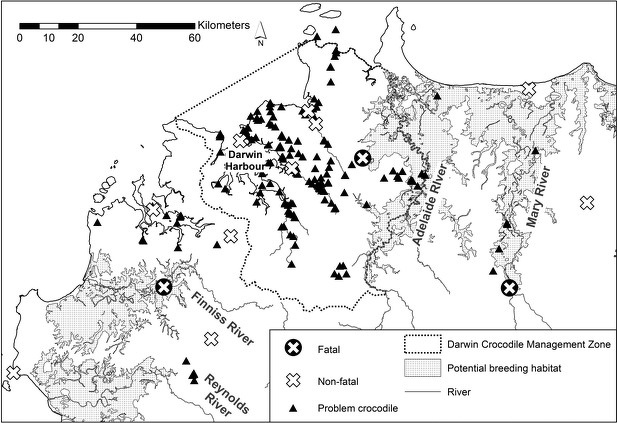
Saltwater crocodile attacks (fatal and non-fatal) in the Darwin area of Northern Territory between 1979 and 2013; (n = 63), problem saltwater crocodiles captured between 1977 and 2013 (n = 5,792), and saltwater crocodile breeding habitats in and around the Darwin Crocodile Management Zone (DCMZ) in the Northern Territory, Australia, from Researchgate
Australia's Northern Territory (NT), which is home to the world's largest wild crocodile population of about 100,000 of them according to the Northern Territory's tourism site. Since crocodiles became a protected species under federal law in 1971, crocodile numbers in the Northern Territory have soared from 3,000 to an estimated 80,000 to 100,000. Saltwater crocodiles can live up 70 years and grow throughout their lives, reaching up to seven meters (23 feet). The Northern Territory's tourism site says. "These 'salties' side along the coastline and waterways of the Territory. They have a taste for fish, but will eat just about anything including cows and buffaloes, wild boar, turtles, birds and crabs." [Source: Li Cohen, CBS News, July 6, 2024; Associated Press, January 20, 2017]
Nearly all the crocodile attacks in Australia involve saltwater crocodiles. Despite publicity campaigns to be "crocwise" around rivers, there was an average of one or two deaths from crocodile attacks in the Northern Territory each year from 2005 to 2018, then there were none after that until 2024 , when a 12-year-old Aboriginal girl was killed (See Below). [Source: Tiffanie Turnbull, BBC, May 3, 2023]
In the 1970s a mine worker disappeared while taking a swim in Northern Australia. The police later found what was left of him inside an 18 foot crocodile. In 1987, Ginger Faye Meadows, an American tourist, was cornered by a huge salt water crocodile at King's Cascade, west of Darwin. As she tried to swim to a beach 25 yards away the crocodile grabbed her in its jaws and lifted her out of the water and then pulled her down while her friends looked on helplessly. Another time a crocodile somehow found is way onto the streets of Darwin and terrorized the town before it was caught.
In the mid-1980s, a local guide named Terry McLoughlin was showing some tourists some crocodiles on a concrete causeway over the East Alligator River, about 100 southeast of Darwin. As tourists looked on in horror, McLoughlin lost his footing and when he fell a crocodile bite him on the head, killing him instantly. Because he was killed in an area where the Aboriginals consider crocodiles sacred, the animal was not killed and swam around in the East Alligator river for years afterwards.
In November 2011, President Barack Obama made a quick visit to the Northern Territory to talk to U.S. Marines and Australian troops at the RAAF Base in Darwin. As an official gift, he was given crocodile insurance, which would have paid out A$50,000 to his wife, Michelle, if the president had been attacked by a crocodile. “I was just presented with the most unique gift I have ever received as president — crocodile insurance. My wife, Michelle, will be relieved,” Obama told about 2,000 troops in Darwin. “I have to admit when we reformed health care in America, crocodile insurance is one thing we left out.” Darwin is the capital of the remote and sparsely populated Northern Territory. It was featured in the Crocodile Dundee movies.The Territory’s Chief Minister Paul Henderson took out the crocodile insurance policy for Obama, worth about A$10, and presented him with the certificate as a memento of his visit. [Source: Reuters, November 17, 2011]
RELATED ARTICLES:
CROCODILE ATTACKS IN AUSTRALIA: HOW, WHERE, WHY, DETAILS ioa.factsanddetails.com
SURVIVING CROCODILE ATTACKS IN AUSTRALIA ioa.factsanddetails.com
SALTWATER CROCODILES ioa.factsanddetails.com
CROCODILES IN AUSTRALIA: HISTORY, SPECIES, BIG ONES, DWARVES, BATS, SHARKS ioa.factsanddetails.com
CROCODILE CULTURE AUSTRALIA: URBAN CROCS, ABORIGINALS, DUNDEE, STEVE IRWIN ioa.factsanddetails.com
CROCODILES: CHARACTERISTICS, ANATOMY, DIFFERENCES WITH ALLIGATORS factsanddetails.com
PREHISTORIC CROCODILES: EVOLUTION, EARLIEST SPECIES, TRAITS factsanddetails.com
CROCODILE BEHAVIOR: COMMUNICATION, FEEDING, MATING factsanddetails.com
CROCODILES AND HUMANS: WORSHIP, THREATS, HANDBAGS factsanddetails.com
HOW TO CATCH A CROCODILE factsanddetails.com
CROCODILE ATTACKS IN ASIA factsanddetails.com
SPECIES OF CROCODILES IN ASIA factsanddetails.com
Crocodile Attacks in Northern Territory in the 2000s and 2010s
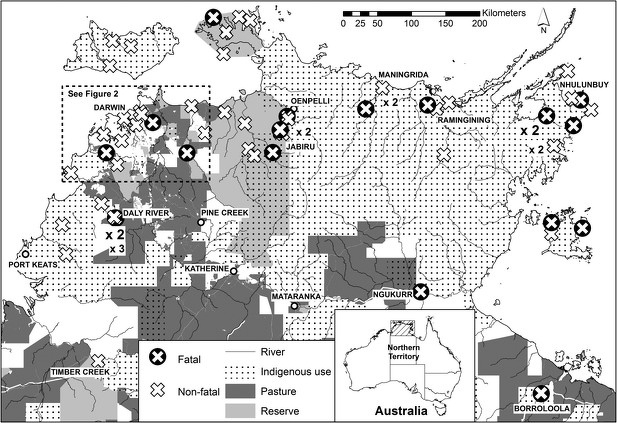
Terrain and land usage around where Saltwater crocodile attacks occurred in Northern Territory, Australia, from Researchgate
In July 2006, human remains found in the stomach of a five-meter long crocodile in a remote area of Northern Territory about 400 kilometers east of Darwin belonged to an eight-year-old girl snatched from a river bank. Associated Press reported: Aboriginals from the Gagji community, in a tribal area of the Northern Territory known as Arnhem Land, shot and harpooned the crocodile on the banks of the Blyth River, said police spokeswoman Sandra Mitchell said. A pair of shorts found with the remains may have belonged to an Aboriginal child who was attacked by a crocodile in the same area on July 8, Mitchell said. The remains will be sent to Darwin, the capital of the Northern Territory, for DNA tests, to establish if they belonged to the missing girl, Mitchell said. Some of her remains were found in the same area, four days after the attack. At least three large crocs have been slaughtered in the hunt for the killer. [Source: Associated Press, July, 30, 2006]
In the Northern Territories, crocodiles sometimes attack boats and bite outboard motors. In June 2014, a 4.7-meter crocodile snatched a 62-year-old fisherman from his dinghy on the South Alligator River in the Northern Territory. In 2011 a 54-year-old fisherman is believed to have taken by a croc on Elcho Island, 515 kilometers east of Darwin, A wallet and fishing rod belonging to the man were found but not the man himself. At least three crocodiles were seen in the area he disappeared.
In January 2014, a four-meter (13-foot) crocodile snatched a 12-year-old boy and mauled his friend as they swam in a water hole in a popular Outback tourist destination in northern Australia. Associated Press reported: The missing boy was taken by a saltwater crocodile as he and four other boys swam in the afternoon at Mudginberri Billabong in World Heritage-listed Kakadu National Park, southeast of the Northern Territory capital of Darwin, Police Sergeant Stephen Constable said. [Source: Associated Press, January 27, 2014
Moments earlier, his 12-year-old friend was mauled as he fought the crocodile and sustained deep wounds to both arms, he said. “One boy fought off the crocodile, and then the crocodile turned and took the other boy,” Constable told Australian Broadcasting Corp. radio. The missing boy is from the small Aboriginal settlement of Mudginberri, west of the uranium mining town of Jabiru. Police and park rangers searched with spot lights for the crocodile and boy by land and boat into Sunday night. A fresh team of searchers resumed the hunt after dawn on Monday.
German Backpacker Killed by a Crocodile Kakadu National Park — Tour Guide Deemed Negligent
The crocodile population is very dense in Kakadu National Park, a major tourist attraction. Sign posts throughout Kakadu warn visitors not to swim in waterways because of the crocodile danger. Crocodile numbers have boomed in the Kakadu National Park since they became a protected species in 1971, but attacks are rare. Located more than 250 kilometers (150 miles) east of Darwin, Kakadu is a U.N. World Heritage site and attracts 200,000 tourists annually. Covering 12,000 square miles of pristine floodplain and plateau, it boasts spectacular waterfalls, a tower 125-mile sandstone escarpment and many rare and endangered animal species.
In October 2002, a crocodile killed 24-year-old German backpacker Isobel Von Jordan as she swam Kakadu National Park in Northern Territory. Associated Press reported: Witnesses said they heard her scream and she vanished beneath the water. James Rothwell, 24, of Essex, England, said he felt a crocodile brush against his leg. "Seconds later I heard a girl scream and the girl went under the water." Rothwell said people on shore thought it may have been a gag. But when he reached shore, he cast a flashlight on the water and "saw two red eyes going away from where the girl had just gone under, and we saw the outline of a crocodile swimming along the surface of the water." [Source: Associated Press, October 23, 2002]
Police from the nearby town of Jabiru and park rangers searched through the night for the woman after the leader of her nine-member tour group called authorities on a satellite phone. Park rangers retrieved the girl's body the following morning after harpooning and killing a 13-foot crocodile slightly more than a mile from where the woman was attacked. "The harpooning caused the crocodile to let go of what he had," Northern Territory Police Commander Max Pope said.
Pope said the tour group ignored signs warning about the danger of crocodiles. The park contains both freshwater and saltwater crocodiles. The park's Web site warns visitors against swimming in natural pools, recommending instead the Jabiru swimming pool. The tour guide who encouraged foreign tourists to swim in crocodile infested waters 2002 acted in a “grossly negligent” manner that led to the death of a German visitor, a coroner’s report said in 2005. Tour guide Glenn Robless, who told the tourists it was safe to swim, pleaded guilty in 2003 to a charge of making a dangerous omission that caused von Jordan’s death. He was given a three-year suspended prison sentence. Coroner Greg Cavanagh said Robless was responsible for the safety of his visitors, many of whom did not know saltwater crocodiles were common in the park. “Robless was well aware that large saltwater crocodiles would have inhabited that stretch of water, and that his decision to allow the group to swim in the waterway was inexplicable, indefensible and grossly negligent,” he said. [Source: Associated Press, January 12, 2005]
Men Watch From a Tree as Crocodile Kills Friend
A crocodile killed a 22-year-old man and then kept his body in its jaws while his two friends watched in horror from a nearby tree. Associated Press reported: Shaun Blowers and Ashley McGough, both 19, recounted on Tuesday how the reptile snatched Brett Mann at Finniss River, which cuts through a flooded tropical wilderness about 50 miles southwest of Darwin in the Northern Territory. Blowers said the 13-foot saltwater crocodile also lunged at them, but they scrambled up a tree in the swollen stream. A police search party found them still in the tree 22 hours later. The three friends had been riding quad bikes along a muddy trail, and stopped by the river to bathe. Mann was swept away by a strong current. As his friends swam out to help, he was taken by a crocodile that had been lurking in the waters. [Source: Associated Press, December 23, 2003]
“We both jumped in and swam after him and we got in front of him and were leading him back to the bank,” Blowers said. “I went past the croc. I didn’t see it. Ashley screamed out ‘croc, croc’... we just swam to the nearest tree and straight up we went. We were looking around for Brett (but) didn’t hear a thing, didn’t hear a scream, no splashing or anything,” he said. Two minutes later the croc brought Brett to the surface and pretty much showed him off to us and off he swam. Five minutes later he was back stalking the tree around us. He just hung around us all night and pretty much all the next morning.”
A police helicopter took the two survivors to Darwin, where they were treated for shock and exposure. Authorities searched the river for Mann’s remains and for the man-eating crocodile. Nick Squires wrote in The Telegraph: The pair were rescued in torrential rain and low visibility by two police officers winched from a Puma helicopter. At one point police were worried that the powerful downward thrust from the helicopter's rotor blades would knock the pair back into the water. They were flown to the Royal Darwin Hospital where they were treated for exposure and extreme shock. "It's a horrific thing to happen to anyone," said a police spokesman, John McCourt. "The survivors are okay physically but it is their mental state we are most worried about." [Source: Nick Squires, The Telegraph, December 24, 2003]
Two crocodile experts joined about 20 police and fisheries officers in trying to track down the killer crocodile in the swamps, with police vowing to continue until they find it. "We will probably have to shoot it," Mr McCourt said. "It has the potential to kill again. Our priority is to find the remains of the poor lad and give his family some sort of closure." Police said the tragedy highlighted the danger of fast-flowing rivers. They said that Mr Mann, who was from Howard Springs, about 25 miles south of Darwin, must have underestimated the strength of the current. "People don't realise how dangerous floodwaters can be," Mr McCourt said. "And in this part of the country you always have to be aware that the presence of large crocodiles is a possibility. They are territorial and highly opportunistic."
Crocodiles Mauls Man with a Chainsaw
In 2006, Associated Press reported: A 14.5-foot crocodile mauled a chainsaw a worker was using to clear up debris left by a tropical storm that lashed northern Australia. While the croc and worker were both uninjured, the saw's woodcutting days are over. Freddy Buckland was cutting up a tree that fell against a crocodile enclosure at the Corroboree Park Tavern, 50 miles east of the northern port city of Darwin when the crocodile, called Brutus, apparently took exception to the chainsaw's noise and attacked. "As he was trimming up the tree on the outside the croc jumped out of the water and sped along the tree about 18, 20 feet and actually grabbed the chainsaw out of his hands," said Peter Shappert, the tavern's owner. [Source: Associated Press, April 28, 2006]
"It must have been the noise.... I don't think he was actually trying to grab Freddy, but I'm not sure. He had a fair go at him.... I think he just grabbed the first thing he could and it happened to be the chainsaw," Shappert added. Neither Buckland nor Brutus were injured. The saltwater crocodile, which Shappert said he now is considering renaming Two-stroke in honor of the saw's fuel, appeared to like the snack. "He chewed on the chainsaw for about an hour-and-a-half, then we finally got it out," Shappert said, adding that the saw was destroyed when it finally was retrieved from Brutus' giant jaws. Saltwater crocodiles have been known to attack small power boats, apparently because they do not like the noise of outboard motors.
Man Killed by Crocodile in the Mary River During a Birthday Celebration
Sean Cole, a 26-year-old IT worker from Darwin, was killed by a by a 4.7-meter (15.4-foot) crocodile as he swam across the Mary River while on a camping trip for his friend's 30th birthday in the Northern Territory's Mary River Wilderness Retreat, 10 kilometers (60 miles) east of Darwin . UPI reported: Cole and another man went for a swim down the river on a Saturday afternoon when a five-meter (16-foot) -long crocodile snatched him and pulled him underwater. Northern Territory police said about 15 campers witnessed the attack. Police found Cole's body the next day. [Source: Kate Stanton, UPI.com, August 25, 2013]
While the Wilderness Retreat is a popular holiday destination, visitors are warned not to swim in the water. 'The Mary River is known worldwide to have the greatest saturation of adult saltwater crocodiles in the world. You don't swim in the Mary River,' a watch commander told reporters. Eric Linhart of Victoria said many campers saw a five meters crocodile lurking on the opposite bank to the camp ground in the afternoon. "I would never ever go in that water. Why that young man did I don't know," he told NT News. Other witnesses said they heard gunshots as police searched in vain for Cole and the croc.
News Corp reported: Mr Cole and a friend swam to the middle of the muddy Mary River and were heading back when the saltie lunged at the pair taking one of the men below the surface. Campers described hearing semi-automatic gunfire late into the night as crocodile catchers and police hunted for the rogue crocodile.[Source: Sarah Crawford, News Corp Australia, August 26, 2013]
According to the Daily Mail: A friend who was with Mr Cole staggered ashore crying out that there had been a crocodile attack. 'He realised that it could have been him,' said a local man. 'It would have seen two of them swimming and just went for them and the fellow that got taken was the unlucky one.' Anyone swimming in the Mary River could expect, with 100 per cent certainty, to be taken by a saltwater crocodile, said Northern Territory crocodile expert Dr Grahame Webb. 'People who swim there sort of know they shouldn't but they let their guard down,' he said. 'They're having fun and do something they wouldn't normally do and in that particular location it's a pretty tragic situation.' During the hunt for Mr Cole's body, police and park rangers shot four crocodiles hoping to find the rogue beast that grabbed the young man.
Crocodile ‘Michael Jackson’ Kills Fisherman in Front of His Wife
A rare part-albino saltwater crocodile nicknamed ‘Michael Jackson’ was killed after he ate a fisherman in front of his wife. Associated Press reported: Michael Jackson, a 4.5-meter (14.7-foot) -long crocodile and tourist attraction in Australia's Northern Territory, is dead after it ate a fisherman while his wife looked on in horror, according to media reports. The 57-year-old fisherman entered the Adelaide River in around 5:30 in the afternoon to unsnag his line when he was taken by the saltwater crocodile, Northern Territory Police Duty Superintendent Jo Foley said. The woman did not see her husband taken, but heard "a scream and then turned around and saw a tail splashing in the water," Foley said. Police Senior Constable Travis Edwards said searchers in boats found the victim's body the night after the attack and shot the crocodile. [Source: Associated Press, August 19, 2014]
Michael Jackson is a rare part-albino crocodile, with white coloring on its head only. "They acted appropriately to shoot him but it's a real shame they had to do it," crocodile researcher Adam Britton of Charles Darwin University told the Sydney Morning Herald. "He is a well-known, well-loved crocodile." The Adelaide River crocodiles are a major tourist attraction. The man was attacked near the Arnhem Highway bridge, close to where cruise ships show sightseers crocodiles leap from the water to snatch chicken carcasses suspended from poles. Police Superintendent Bob Harrison told Australian Broadcasting Corp. that the killer crocodile had regularly leapt for chickens dangled from the cruise ships and was well known to operators of the Spectacular Jumping Crocodile Cruise.
Susannah Cullinane of CNN wrote: Peter Saltmarsh, from Spectacular Jumping Crocodile Cruise, told CNN it was the first time in his 20 years working as a guide on the river that such an incident had occurred. “There are plenty of crocodiles up here and we don’t have many problems as a rule. There are lots of signs, there are lots of cruises, there are lots of warnings and there’s lots of knowledge,” he said. [Source: Susannah Cullinane, CNN, August 19, 2014]
Five companies operate crocodile cruises in the area with the giant reptiles distributed about one every 100 meters along the river, on the banks of which they could sometimes be spotted, Saltmarsh said. “They normally eat fish and kangaroos and other things — they’re not after us. They’re very timid and elusive animals, they’re very lazy and very rarely seen.” He said crocodiles could stay underwater for up to four hours. “Michael Jackson” was recognizable for its pale head and had been known to locals for about 10 years, Saltmarsh said. The late pop singer Michael Jackson had suffered from the skin condition vitiligo, which caused parts of his skin to lighten. Saltmarsh said it was unfortunate that the victim had apparently entered water inhabited by big crocodiles at dusk to retrieve his lure. “The crocodile could have thought he was any sort of an animal. It’s just really, really unfortunate. This person’s made a tragic error of judgment.”
Dr. Adam Britton has been researching crocodiles in the Northern Territory for about 18 years and was familiar with “Michael Jackson.” “What made that particular animal special was that it had a very light colored head, so it was very recognizable,” he said. “It was missing part of its tail, two limbs and had a big scar on its belly. “He was an old, beaten up, battle-scarred crocodile that everyone knew,” Britton said. “When this report of someone being killed came in, people knew he was pretty much the only crocodile that lived in that territory,” he said. “A lot of people didn’t want to see him shot.”
While “Michael Jackson” was not actually an Albino — a genetic mutation — it was rare to see crocodiles with its coloring, which likely resulted from temperature changes during its incubation, he said.“It doesn’t happen very often. But if you hatch out thousands of eggs you’ll see a few examples every few years,” he said. Britton said Michael Jackson was probably 40 to 50 years-old, meaning he would have hatched at a time when the number of crocodiles in Australia was low.
Man Taken by Crocodile While Wading Across East Alligator River
A 47-year-old man was killed by crocodile while trying to cross the flooded East Alligator River in the wilderness of the Northern Territory. Associated Press reported: The man had been wading through the river with two women when he disappeared at Cahill’s Crossing near the World Heritage-listed Kakadu National Park, a police statement said. The women made it across safely then reported the man missing. [Source: Associated Press, January 20, 2017]
Police and rangers found the body downstream near a 3.3-meter (11-foot) crocodile. The crocodile was shot dead and the body taken to the city of Darwin for an autopsy. The three lived in a nearby Aboriginal community, according to media reports. The crossing is a renowned fishing spot for prized barramundi, but it also attracts crocodiles as well as anglers.
Authorities are frustrated by the risks some people take near the river despite an angler being decapitated by a large crocodile at the crossing in 1987. The signs are saying not to swim or even go in the water at Cahill’s Crossing. There’s been a lot of media attention around that crossing. People continue to do it,” Police Sergeant Bob Harrison told the Australian Broadcasting Corp.
Twelve-Year-Old Girl' Killed in Crocodile Attack
In July 2024, a 12-year-old girl was killed in a crocodile attack. CBS News reported: Police said the girl's remains were found in a river system near where she went missing two days earlier in the Northern Territory's Indigenous community of Palumpa. [Source: Li Cohen, CBS News, July 6, 2024]
Northern Territory Police said that the injuries on the girl's body confirmed a crocodile attack, adding that her remains were found after an "extensive search effort." "The recovery has been made. It was particularly gruesome and a sad, devasting outcome," Senior Sergeant Erica Gibson said. "It was an extremely difficult, essentially 36 hours... For the family, it is the most devastating outcome possible for them. They are in a state of extreme shock and disbelief."
In a statement shared on the Facebook page for the Northern Territory's emergency services, Gibson said officers were providing support to the family and the local community. Gibson was quoted by the AP a saying officials were still trying searching for the crocodile to trap the animal, as the territorial creatures often remain in and around the same area. "We live in a place where crocodiles occupy our water places," Northern Territory Police Minister Brent Potter said, according to News. "It's just a reminder to stay out of the water as best we can."
Rules and Behavior of Northern Territory Crocodiles
Susannah Cullinane of CNN wrote: Britton said that it was a legal requirement that the crocodile be killed so that the coroner could confirm the cause of death by, for example, matching bite marks and examining the reptile’s stomach contents. Evidence also suggested that if a crocodile successfully took a human it would be more likely to do so again in the future, he said. “Crocodiles learn patterns and routines and we know from their wild behavior that they’ll actually come back to the same spot to catch a prey animal.” [Source: Susannah Cullinane, CNN, August 19, 2014]
Britton said that he had heard of other people previously fishing from the same area where the man was taken. It had better access than most of the Adelaide River, which is mainly edged by muddy mangroves, he said. The fact that others may have fished there without incident could have created a mistaken sense of safety, Britton said. “One of the things that makes crocodiles so dangerous is that you can do things like that and get away with it. Because crocodiles don’t always attack,” he said. “That leads people into a false sense of security about how risky it actually it is.”
“Often crocodiles will hone in on people who are actually fishing,” Britton said. “There have been examples of crocodiles sneaking up and stealing fish. Likely when [the victim] stepped in to get his lure back, it was right there under the water — probably expecting a fish. As far as the crocodile was concerned that was potential food for it.”
Image Sources: Wikimedia Commons
Text Sources: Animal Diversity Web animaldiversity.org , National Geographic, Live Science, Natural History magazine, Australian Museum, David Attenborough books, Australia Geographic, New York Times, Washington Post, Los Angeles Times, Smithsonian magazine, Discover magazine, The Conversation, The New Yorker, Time, BBC, CNN, Reuters, Associated Press, AFP, Lonely Planet Guides, Wikipedia, The Guardian, Top Secret Animal Attack Files website and various books and other publications.
Last updated August 2025