
Home | Category: Highland and Mainland Ethnic Groups
KERAKI
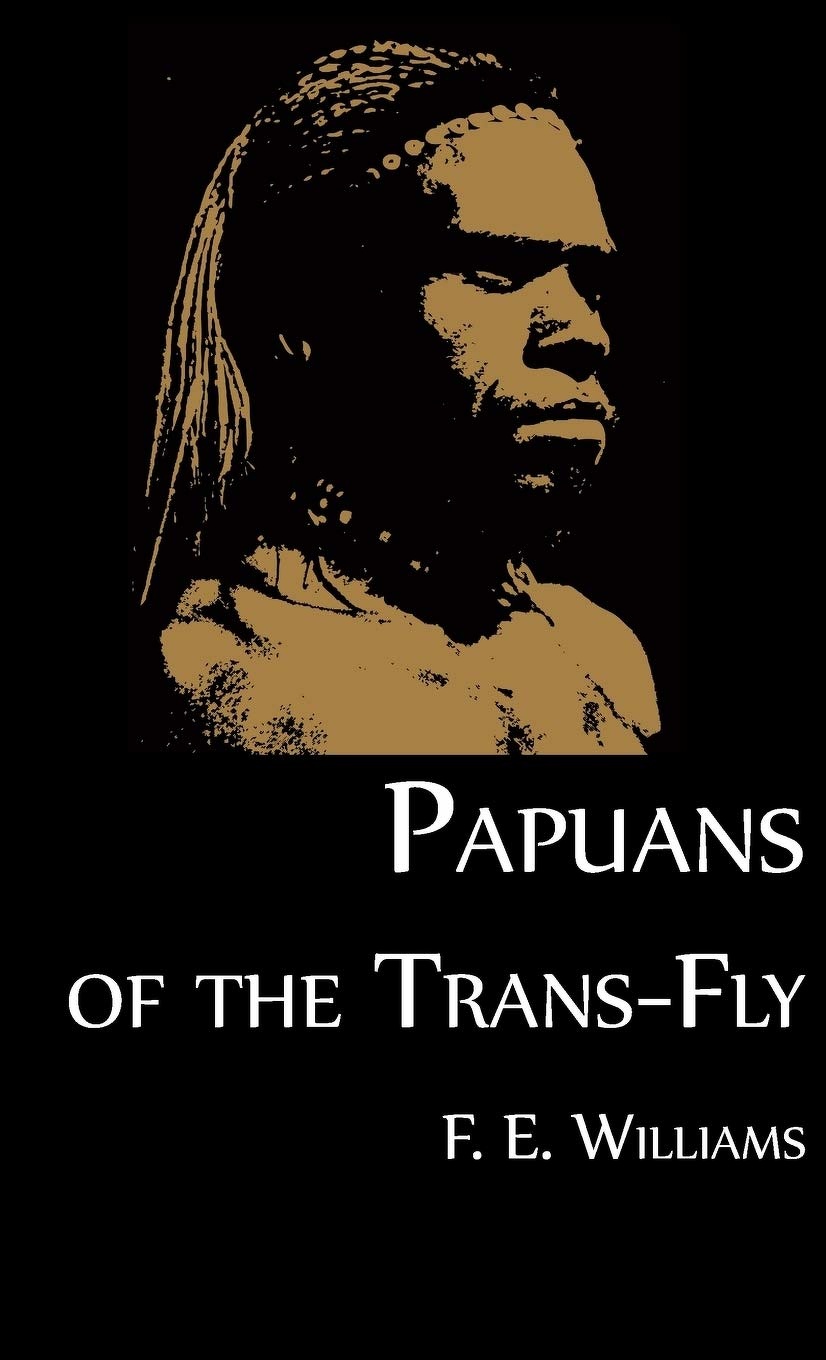
The Keraki are a cultural group that lives in the Trans-Fly region of southwestern Papua New Guinea, east of the Morehead River. Also known as the Morehead, Nambu and Trans-Fly, they are recognized for their transhumant lifestyle, moving between high ground during the rainy season, when much of the land is flooded, to areas near water when the land dries, and have been the subjects of anthropological studies, notably by the anthropologist Francis Edgar Williams, who described initiation rites involving same-sex relationships for young men as a rite of passage in the 1930s— practices which appear to have since been abandoned or changed.
The Keraki are divided into several small "tribes," with the name often referring to Nambu speakers within this group but also Including some of their immediate neighbors. In the 1990s, the name referred to one of the roughly nine small "tribes" into which the Keraki are divided. According to the Christian-group Joshua Project the population of Rouku, Upper Morehead in the 2020s was 1,100. In 1931, F. E. Williams estimated the entire Keraki population at about 700 to 800. Estimates in the 1990s indicated 700 Nambu speakers and another 800 speakers of the Tonda and Lower Morehead languages.
The Keraki territory is characterized by extreme weather conditions. Much of the land is underwater during a large part of the rainy season, especially between January and March. The Keraki are forced to live in semipermanent villages along high ground during this time. In May or June, the rains subside, the land dries up and becomes parched, and the Keraki move to locations along lagoons or larger streams to be near water. During the height of the dry season, people often live in small forest clearings to escape the intense heat. [Source: Richard Scaglion , “Encyclopedia of World Cultures, Volume 2: Oceania,” edited by Terence E. Hays, 1996 ~]
Language: Nambu, Tonda, and Lower Morehead are three of the seven small non-Austronesian languages that make up the Morehead and Upper Maro River family.
Society is organized into tribes, each divided into three or four local section groups. Villages are typically dominated by one section, and when multiple sections are present, their members live together. These kin-based local groups are the core of Keraki social life. They cooperate in hunting, sago making, gardening, rituals, and feasts, and collectively manage initiations, fertility and death ceremonies, and marriage exchanges. Marriages are exogamous, linking groups through reciprocal partnerships—husbands become tambera (exchange partners), while men of similar age become kamat (brothers-in-law), bound by mutual friendship and hospitality.
Each local group has a hereditary headman, usually the eldest active male. Leadership passes from elder brother to younger brother, then to the eldest son. Authority is limited—the headman’s role is primarily to express group consensus rather than impose decisions—and there is no higher political structure beyond the local level. Social order is maintained through strong norms of reciprocity, solidarity, and conformity, reinforced by fear of ridicule, sorcery, or supernatural punishment. Serious conflict within the group is rare, with occasional theft or jealousy being the most common sources of tension.
RELATED ARTICLES:
FLY RIVER PEOPLES — GOGODALA, BOAZI, KIWAI — AND THEIR LIFE, HISTORY AND RELIGION ioa. factsanddetails.com
ETHNIC GROUPS OF THE GREAT PAPUAN PLATEAU AND WESTERN HIGHLANDS ioa. factsanddetails.com
KALULI (BOSAVI): HISTORY, RELIGION, LIFE SOCIETY ioa. factsanddetails.com
NINGERUM PEOPLE OF CENTRAL NEW GUINEA: HISTORY, RELIGION, LIFE, SOCIETY ioa. factsanddetails.com
MOTU — THE PORT MORESBY AREA PEOPLE — AND THEIR HISTORY, CULTURE, LIFE, SOCIETY ioa. factsanddetails.com
ETHNIC GROUPS IN SOUTHERN PAPUA NEW GUINEA: GEBUSI, PURARI, OROKOLO ioa. factsanddetails.com
ETHNIC GROUPS IN SOUTHEAST PAPUA NEW GUINEA: MEKEO, MAILU, WAMIRA ioa. factsanddetails.com
OROKAIVA AND MAISIN PEOPLE OF ORO PROVINCE IN SOUTHEAST PNG ioa.factsanddetails.com
Trans Fly Region
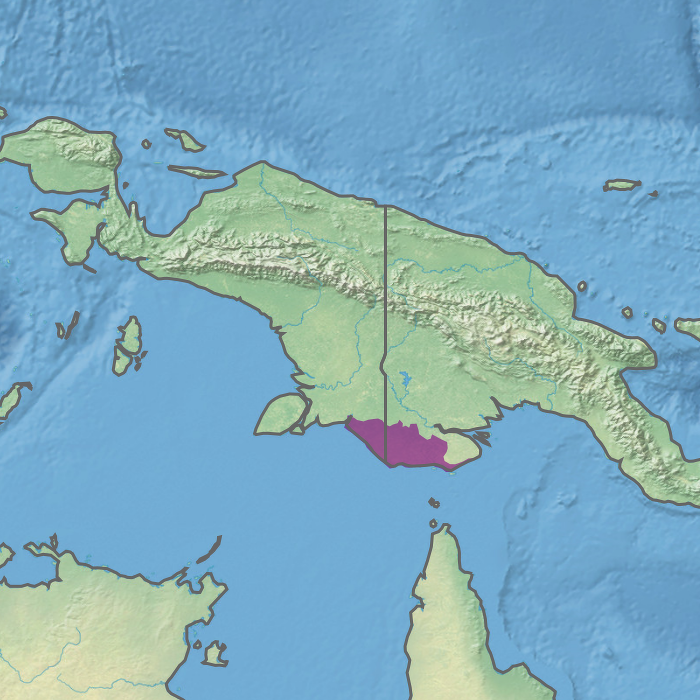
Trans-Fly savanna and grasslands in purple
The Trans-Fly Region spans the southern lowlands of New Guinea, across both Indonesia and Papua New Guinea. Characterized by open savannas and grasslands, its monsoonal climate sets it apart from the island’s surrounding rainforests, giving it a landscape similar to northern Australia. [Source: Wikipedia]
Most of the terrain consists of grasslands, eucalyptus and melaleuca woodlands, and patches of dry evergreen forest. Seasonal fires at the end of the dry season renew the grass cover. Local variations in rainfall, flooding, drainage, and traditional burning shape the region’s diverse habitats. Flooded areas support melaleuca forests, while bamboo thickets often mark the transition between forest and savanna.
Although less species-rich than the rainforests, the Trans-Fly supports several endemic animals, including the New Guinean planigale, bronze quoll, spectacled hare-wallaby, dusky pademelon, Fly River grassbird, spangled kookaburra, and the pig-nosed turtle.
The Trans-Fly remains sparsely populated, with most habitats still intact. However, wildlife faces pressure from hunting, logging, and the spread of settlement—particularly on the Indonesian side. Introduced Javan rusa deer have altered the grasslands, but significant areas are protected within Wasur National Park in Indonesia and the adjacent Tonda Wildlife Management Area in Papua New Guinea.
Keraki History
Trade with merchants from Makassar and other Indonesian islands began as early as the 16th century, bringing iron tools to local tribes long before European contact. Owing to its sparse and scattered population, inhospitable climate, and apparent lack of development potential, the Morehead area where the Keraki live was little affected by European contact in the 1920s and 1930s. Even today, the region is somewhat isolated with little economic development. Flooding in the wet season, lack of water in the dry season, and constant raiding by powerful headhunters from across the western border during the precontact and early-contact era hamper cultural relations and communications among groups.
Francis Edgar (F. E.) Williams (1893-1943) was an anthropologist who worked for the Australian colonial government of Papua from 1922 to 1942. During that time, he made five trips to study the Keraki: from June to September, 1926; from May to September 1927; and three "shorter but successively more profitable visits" in 1928, 1930 and 1932. In the 1930s, E.F. Williams wrote: "For many years they have been protected and befriended by the Government and now consequently they show a very hospitable front towards the European." These positive sentiments were mainly due to the government's protection against an aggressive tribe of head hunters to the west.
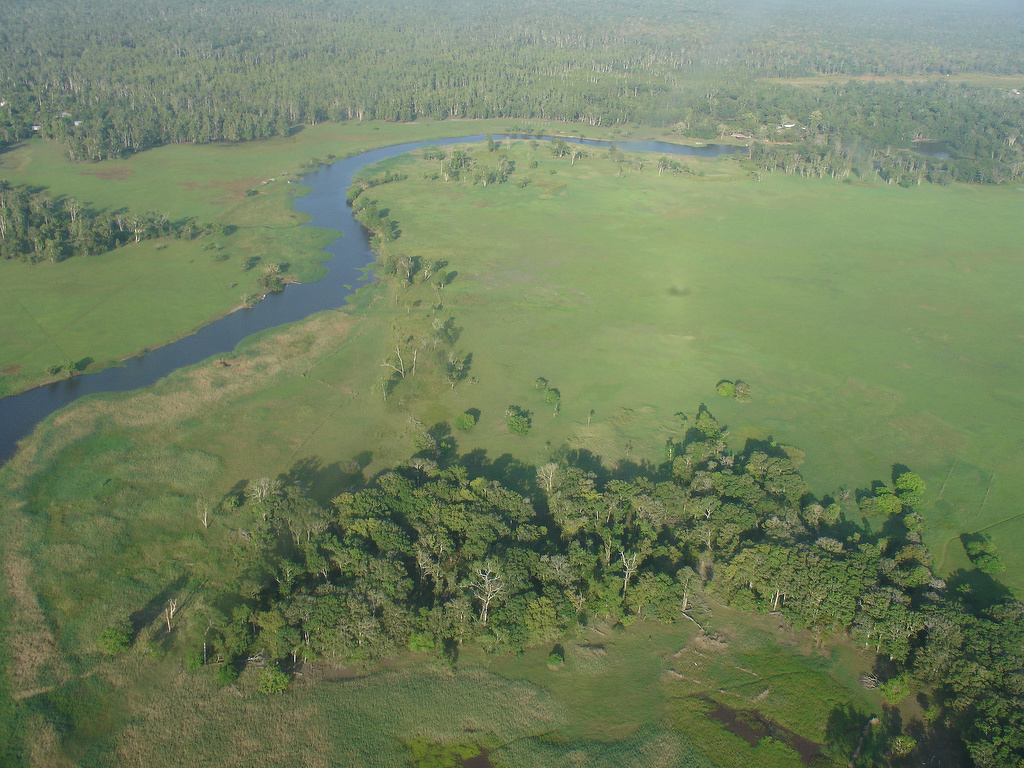
aerial view of the Trans-Fly savanna and grasslands
While some missionary activity had taken place in the area, it had had little impact on village life. Of life in general Williams reported: "In respect of intra-group relations, however, I can say that during the whole of my time among the Keraki I never witnessed a serious quarrel, and that although differences, even carried to the point of bloodshed, are, of course, not unknown, nevertheless the general tone of a village is one of great good-humour. In broad terms, then, the native's life is peaceful, and, in as far as happiness depends on social concord, it is essentially happy."
Fighting and Headhunting: Among the Keraki, inter-village fighting, known as guwari, involved open confrontations between neighboring groups. These clashes often began as loud verbal disputes that could escalate into brawls using sticks or arrows, but they typically ended in reconciliation. More serious was the moku, or headhunting raid, launched against non-Keraki groups such as the Gunduman. These surprise attacks, often carried out before dawn, involved quickly decapitating victims with bamboo knives and fleeing with the heads tied to cane carriers. Back at camp, the raiders cooked and cleaned the skulls, sometimes tasting a small piece of flesh before mounting the heads on poles as trophies. Men who took heads gained prestige and influence.Despite this practice, the Keraki were generally a peaceful people and were more often victims of raids by the Marind or Wiram than aggressors themselves.
Keraki Religion and Culture
According to the Christian-group Joshua Project 70 percent of of Rouku, Upper Morehead are Christians, with the estimated number of Evangelicals being 10 to 50 percent. Traditional religious practices center on magic, especially sympathetic magic. While all Keraki engage in some form of it, two main specialists exist: rainmakers and sorcerers. Artistic expression includes woodcarving, textile work, music, and dance, all closely tied to ritual. Illness and death are often blamed on sorcery, with healing attempts involving bleeding or removing the harmful object believed to have been placed inside the body. [Source: Richard Scaglion , “Encyclopedia of World Cultures, Volume 2: Oceania,” edited by Terence E. Hays, 1996]
Many Keraki myths describe an Originator and his family—the Sky Beings of the gainjan age, when all creatures were larger and more powerful. These deities can bless or harm humans, including causing illness by seizing a person’s spirit, and are approached through prayers and pleas.
Ceremonial life is rich and varied. Large exchange feasts unite different groups, encouraging food production and social ties; hosts provide food, hospitality, and partners, and guests later reciprocate. For individuals, male initiation is the key rite of passage—an extended seclusion period in which boys learn sacred lore and undergo rituals meant to foster growth.
Death and Afterlife: The dead are buried within a house, wrapped in bark, facing south toward the sea. Women mourn for a year, cutting and regrowing their hair, wearing layered grass costumes (makamaka), and observing food taboos. Small and later larger feasts mark the stages of mourning, ending when the makamaka is removed and the grave memorial destroyed. The Keraki believe the soul survives death, though its destination remains uncertain.
Keraki Family and Kinship
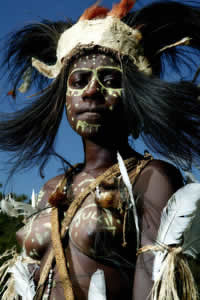
A woman from the Trans Fly region in traditional dress in Rhoku village, by a tributary of the Bensbach River; Her headdress is made from cassowary feathers and she is adorned with white palm cockatoo feathers, World Wildlife Fund
The basic Keraki domestic unit is the household, generally consisting of a man, his wife or wives, and their younger children. Occasionally a close relative may reside with them, but households are typically small and simply constituted. Inheritance is normally patrilineal (based on descent through the male line). A woman will leave her possessions to the "sons' wives" who live in her village. [Source: Richard Scaglion , “Encyclopedia of World Cultures, Volume 2: Oceania,” edited by Terence E. Hays, 1996]
Marriage is generally arranged by men, through "sister exchange," although "sisters" are frequently classificatory. Since two couples are created simultaneously, someone (typically a "bride") may still be adolescent when these Exchanges are technically effected. In such cases, the girl becomes a member of the husband's household, even if the husband is still residing in the young men's house, and years may pass before the marriage is actually consummated. In the 1930s, Williams reported that polygamy was common, with an average of 1.55 wives per married man. He said "girls marry at, say, the age of ten years, whereas men commonly wait until twenty and perhaps much longer." At that time only about 55 percent of marriages were monogamous. Mates are chosen from outside the moiety (each of two parts of a divided thing) and, Generally, from outside the local totemic group. The levirate and sororate are both loosely practiced in a classificatory sense. Divorce is rare: since it directly affects another couple, considerable social pressure is brought to bear on women to uphold the marriage contract. ~
Keraki have no form of institutionalized instruction except during the seclusion and initiation of young boys, when they learn the secrets of the bullroarer and "sacred pipe," learn of hunting and other rituals, and hear secret mythological stories. At other times, children of both sexes are left to observe the day-to-day norms of behavior and to conduct themselves accordingly. By the norms of Western Society, parents are quite indulgent and somewhat neglectful, although they do instruct and scold children when necessary.
Kinship: Keraki society is divided into exogamous moieties of unequal size. A moiety is a thing with two parts and exogamous in this case means marrying outside the group. One of the moieties is subdivided into three major sections. This moiety system overlays a system of local totemic groups. Descent is reckoned patrilineal (based on descent through the male line). Kinship terminology is of the Iroquois type (also known as bifurcate merging), which distinguishes 'same-sex' and 'cross-sex' parental siblings in addition to gender and generation. The brothers of an individual’s father, and the sisters of the individual’s mother, are referred to by the same parental kinship terms used for Father and Mother. The sisters of the individual’s father, and the brothers of individual’s mother, on the other hand, are referred to by non-parental kinship terms, commonly translated into English as "Aunt" and "Uncle". [Source: Wikipedia]
Keraki Life, Villages and Penis Covering
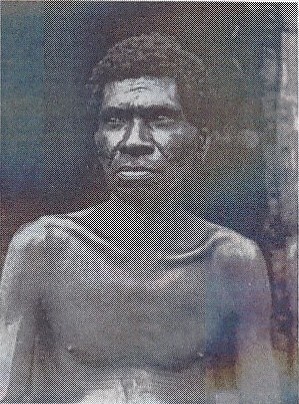
Keraki man in the 1930s
Among the Keraki, labor is divided by age and gender. Women care for children, clean houses and village grounds, prepare daily meals, and weave textiles. Men handle hunting, house building, rituals, and most of the cooking for feasts. Both men and women garden: men clear, fence, plant, and harvest, while women weed, clean, and help with daily harvesting. [Source: Richard Scaglion , “Encyclopedia of World Cultures, Volume 2: Oceania,” edited by Terence E. Hays, 1996]
Keraki villages are semi-permanent, typically located on forest edges or elevated ground. The clearings are planted with coconut palms and surrounded by gardens, with houses scattered irregularly among decorative plants. The main dwelling, the mongo-viví, is a long rectangular house with a ridged roof, clay floor, and semicircular verandas at both ends—often used for storing food, especially yams. Smaller open shelters called gua-mongo consist of a simple roof supported by four poles and serve as resting places. Temporary settlements—used during the dry season, for hunting, or for travel—are much simpler, with rough shelters and little clearing of the surrounding vegetation.
William wrote: The ordinary dress of males in the Morehead district is confined to the phallocrypt, worn in such a manner as to cover the penis and leave the testicles exposed. This phallocrypt (together with a tail-piece of frayed sago) might be spoken of as clothing; but it is obvious that all other articles of personal wear fulfil one or more of the following functions: they are either meant for ornament, or they possess some social significance, or they serve some purpose which we may speak of as utilitarian. The phallocrypt may fulfil all these functions, and it may be that its use as a shame-covering is only secondary. It might be even argued that, while more or less concealing them, it draws attention to the genitalia and acts as a means of sex attraction. [Source: “Papuans of the Trans-Fly” by F. E. Williams, 1934]
Keraki Agriculture and Economic Activity
The Keraki are subsistence farmers who practice swidden (slash-and-burn) agriculture. Their main crop is the lesser yam (Dioscorea esculenta), planted when the first thunder of the wet season is heard around October or November. Several families work together to clear land, which is then divided into individually owned plots about 45 meters square and fenced to keep out wild pigs and wallabies. By June, the yam vines begin to yellow, marking the start of harvest. Yams are dug with wooden digging sticks, sorted for eating, replanting, or feasting. Other crops include taro, manioc, sweet potatoes, sugarcane, coconuts, bananas, and papayas. Sago, though rare, is a prized delicacy. Hunting—especially for wallabies, cassowaries, and wild pigs—supplements the diet, along with limited fishing using traps, hooks, bows, and plant-based poisons. [Source: Richard Scaglion , “Encyclopedia of World Cultures, Volume 2: Oceania,” edited by Terence E. Hays, 1996]
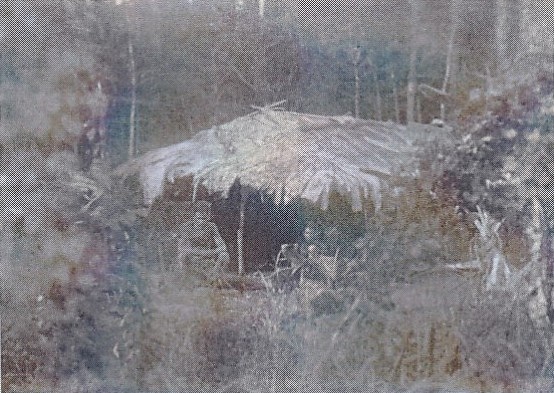
Keraki house in a yam garden in the 1930s
Keraki craftsmanship is modest, centered on practical tools and textiles. They make carved drums, yam spatulas, and boomerang-shaped hair ornaments. Formerly, they produced ornate arrows and ceremonial clubs (parasi) for raids. Their finest creations are woven mats, embroidered bags, plaited belts, armlets, and women’s mourning garments.
Trade with neighboring groups is extensive. Because local stone is scarce, the Keraki obtained stone axes and club heads from the Wiram in exchange for melo shells used as men’s coverings, and also sourced stone from Buji near the Mai Kussa River.
Land is abundant but clearly regulated. Each of the nine Keraki tribes holds large, named territories divided among villages and individual owners. The yure, or landholder, grants permission to cultivate plots—usually freely. Land passes from father to younger brother and then to son, with portions often divided among male kin.
Keraki Sodomic Boys' Initiation
According to E. F. Williams Keraki boys are introduced to homosexual practices “at about the age of 13” at a bull-roarer ceremony, which he said occurred when a Keraki boy could “be trusted to keep the secret from his mother”. In “Papuans of the Trans-Fly”, Williams wrote: It was frequently maintained that setiriva, or bachelors, remained truly celibate until they entered upon sexual relations with their own wives. Without giving too much credence to this statement, we may note that the hospitable exchange above noted was nominally restricted to married adults. Some informants maintained that setiriva could secure the favours of married women at feast times, but it seems evident that this was not definitely sanctioned. [Source: “Papuans of the Trans-Fly” by F. E. Williams, 1934]
The bachelors had recourse to sodomy, a practice which was not reprobated but was actually a custom of the country — and a custom in the true sense, i.e. fully sanctioned by male society and universally practised. For a long time the existence of sodomy was successfully concealed from me, but latterly, once I had won the confidence of a few informants in the matter, it was admitted on every hand. It is actually regarded as essential to the growing boy to be sodomized. More than one informant being asked if he had ever been subjected to unnatural practice answered, "Why yes! Otherwise how should I have grown?"
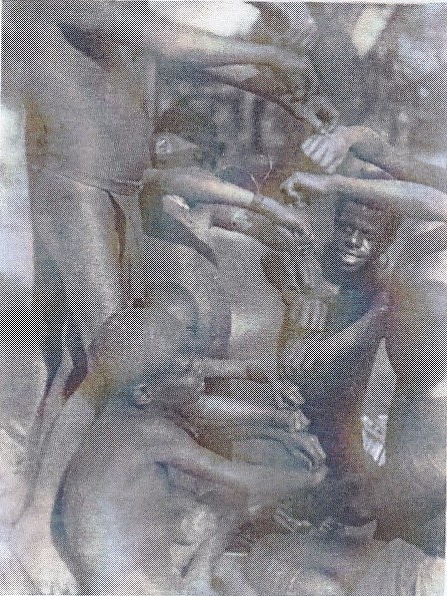
Children playing Homban — the Game pf Ants
It is enough to note that every male adult in the Morehead district has in his time constantly played both parts in this perversion. The boy is initiated to it at the bull-roarer ceremony and not earlier... When he becomes adolescent his part is reversed and he may then sodomize his juniors, the new initiates to the bull-roarer. I am told that some boys are more attractive and consequently receive more attention of this kind than do others; but all must pass through it, since it is regarded as essential to their bodily growth. There is indeed no question as to the universality of the practice It is commonly asserted that the early practice of sodomy does nothing to inhibit a man's natural desires when later on he marries; and it is a fact that while the older men are not debarred from indulging, and actually do so at the bull-roarer ceremony, sodomy is virtually restricted as a habit to setiriva.
Williams describes the beginning of sodomy with complex mythology, featuring the originator, Kambel, his wife, Yumar, and their son, Gufa: Gufa, despite good feeding and attention, was a wretched under-sized little boy, described as pot-bellied and constipated. He was the despair of his father until one day, ostensibly with the sole idea of promoting his growth, he conceived the idea of sodomizing him. He took him apart from his mother during the night and put his idea into effect, rubbing semen over the child's body. The result was a miraculous increase in growth. The boy was instructed to keep this a dead secret from his mother, and when she next saw him she was delighted at the change but attributed it wrongly to the good food which Kambel must have given him, just as nowadays mothers are supposed to attribute the size of initiates to the special feeding they have had at the waramongo.
Keraki Bull-Roarer Ceremony
Keraki boys were initiated at about the age of thirteen in bullroarer ceremony. A bullroarer is an ancient musical instrument and signaling device made from a flat piece of wood, bone, or other material attached to a string. When swung in a large circle, it produces a deep, roaring, or whirring sound that can be heard over long distances. It has been used historically across many cultures for communication, religious rituals, and as a toy.
Williams gives a detailed description of the Keraki bull-roarer, its sacred nature and the need to always keep it and any knowledge of it hidden from the women and children. The initiation ceremony centres on the revelation of the bull-roarer to the boy, but also features a ritual beating (light blows with a banana stalks), a feast, and a parade through the village where the boys are ceremonially beaten by the women.
F. E. Williams wrote in “Papuans of the Trans-Fly”: When a number of boys within the tribe are seen to be pubescent, its villages will combine to initiate them. No chiefly mandate goes forth: the move originates with the suggestion of some man of weight, and if the people at large are in good heart and prepared to undertake the work involved, the decision is reached by a sort of general consent. The people extend the scope of their gardens and set to work therein with vigour, not to prepare for the initiation itself but, looking farther ahead, for the large feast which will celebrate the ending of the boys' seclusion. [Source: “Papuans of the Trans-Fly” by F. E. Williams, 1934]
At the ceremony which I was privileged to witness at Bebedeben there were six of them, averaging about thirteen years of age, though one was a good deal younger. Their respective fathers are typically responsible for providing food both for the minor feast at the initiation and the larger one at the termination of the seclusion; but all the men of the villages concerned will combine their efforts for the honour of the tribe.
A number of individuals officiate in the various capacities for each of the initiates... There are two functionaries known by title...Tabulamant. 1) The first tabulamant brings the initiate from the village to the waramongo [a hut constructed for the boys' initiation and subsequent seclusion]; he embraces him tightly when the bull-roarers are brought before him, holding his hands over his eyes until the moment of revelation; he also at the end of the day escorts the initiate when he makes his progress through the village and is beaten by the women, bending over him to shield his body from their blows...2) The second tabulamant is the youth, belonging to the previous batch of initiates, who is privileged to sodomize the boy for the first time. There are likewise two uyamade. 1) The first is the young man who shows the bull-roarer to the initiate, i.e. who swings it before him... (2) The second is the man who beats the initiate and who strikes the first blow in the rough and tumble which follows the revelation.” Sahanumant “is the youth, belonging to the previous batch of initiates, who specially provides food for the boy during his seclusion. Yahomant, a fourth term, means fellow initiate.
All these terms are reciprocal, and the indiviuals concerned maintain them until the end of their lives. The elder tabulamant and uyamade continue to have claims on the services of the younger (i.e. the youths whom they have helped to initiate) which the latter are supposed never to refuse. The younger sahanumant repays the services of the elder by subsequent gifts of food, and thereafter the two are pledged to mutual hospitality. The yahomant are alleged to help each other in fencing, hunting, and so on, though I believe this has little practical purport. They do not forget their association, however, and having been thrown together in the thrilling experience of initiation and in the subsequent seclusion they become something like chums. Lastly we should note that the bava or maternal uncle...presents him with a pwatapwata, or melon-shell phallocrypt, at the end of the seclusion. This is of course a definite kinship obligation whereas those afore-mentioned are the result of arrangement.
Keraki Initiation Seclusion, Sodomy and Bestowal of the Pwatapwata
F. E. Williams wrote in “Papuans of the Trans-Fly”: Towards the end of the afternoon the initiates parade through the village where they run the gauntlet of the womenfolk, the tabulamant bending over their charges to shield them from the blows. Finally each is brought back to the waramongo and there formally handed over to his second tabulamant, who during the night initiates him to the practice of sodomy. For this purpose he is thereafter at the disposal of his seniors of the opposite moiety.
The boys continue to live in the waramongo for a period of some months, until the food is ready for the feast at which they will make their debut in the village. During this time they must not allow themselves to be seen by the women, but they may come and go in the bush, hunting or fishing when they please. They do not wash, but keep their bodies greased and blackened. They are well fed, thanks to their sahanumant, and on the whole they have a very good time of it. They become familiar with the bull-roarers; they are instructed in the yuvi or tabus; they learn some of the myths which are told in the waramongo (though not all of them, for men may remain ignorant of some until well on in life); and they are initiated to certain hunting rites. Meanwhile they are at the service of those of the opposite moiety, whether fellow villagers or visitors, who wish to practise sodomy. [Source: “Papuans of the Trans-Fly” by F. E. Williams, 1934]
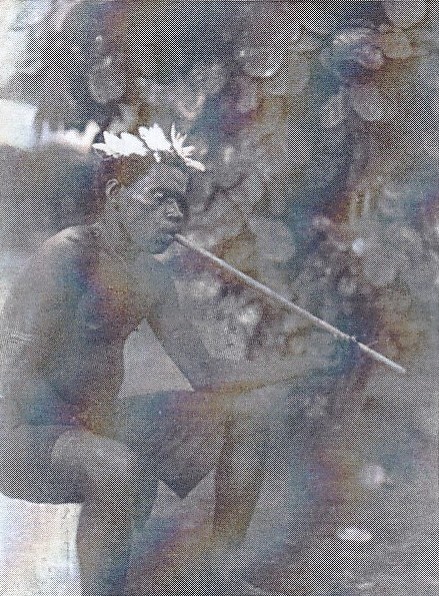
Young Man Playing the Boraro in the 1930s
It is questionable whether they receive much in the way of deliberate tuition. Their knowledge of the myths — a highly important branch of Keraki education — is only partly acquired in the waramongo. This and other lore they acquire naturally throughout life by listening to and conversing with their seniors, particularly in the setiriva-mongo [a men-only shelter] and in the hunting camp. During their seclusion they enjoy a great deal of freedom and leisure, and their main business, it would seem, is to grow. The desirability of growing fast is often emphasized, an end to which it is really thought that the practice of sodomy conduces. Here, as elsewhere, it is hoped that the women will hardly recognize their sons when they return to the village, for the difference that seclusion has made to them. ...
The ceremony should by rights take place in the village in full view of the assembled guests, both men and women. But as I saw it in Bebedeben it was performed in an obviously perfunctory manner at the waramongo, since there was no large feast to mark the occasion. After the bull-roarers had been ceremoniously detached from their rods and stowed away, the boys came forward to be invested by their maternal uncles. One after another they step out and confront the assemblage, accompanied each by the bava who is giving him the shell. The bava simply ties the supporting string about the boy's waist, and the boy himself adjusts it as a pubic covering. There is no special solemnity about the procedure except on the part of the candidate, who tries hard to preserve his dignity, and nothing is said except it be for some ribald or jocular comment from the audience.
The youth is henceforward known as setiriva, or bachelor. He wears his pwatapwata continually (unless he prefers a modern calico loin-cloth) and, except at odd times, does not return to a second childhood of nakedness until his old age. He associates more freely with his elders and does not have to flee whenever a subject with religious implications is touched upon. He works in the garden, as he did before; but now he shows an increased predilection for hunting. Before long he and his yahomant, or initiation mates, will have blossomed forth into the young bloods of the village.
Keraki Lime-Eating Ceremony and Bestowal of the Jemberi
F. E. Williams wrote in “Papuans of the Trans-Fly”: The youths continue to play the passive part in sodomy for a year or so. At some stage within this period they together undergo a curious rite of lime-eating, which I describe from hearsay. A feast is prepared in the village and a waramongo once more made in the bush nearby. Here the Maiawa men — for among the Keraki Proper it is their prerogative and secret — engage in preparing lime (tumani). They do so in the usual way, by burning bivalve shells (eta); and when these have been thoroughly calcined they are wrapped in a parcel of bark. A barrier of palm leaves is thrown across one end of the waramongo behind which the Maiawa men are found in hiding when the others arrive from the village bringing with them the youths who are to undergo the ceremony. Then the Maiawa men, their faces whitened with their own lime, and to the accompaniment of the ari pipes, come hopping out in the manner of kangaroos. One of them carries the parcel of lime, which he opens before the assemblage, exclaiming, "Here is our taitu!" The lime is thus openly displayed, but the secret of its manufacture is supposed to remain in the keeping of the Maiawa. [Source: “Papuans of the Trans-Fly” by F. E. Williams, 1934]
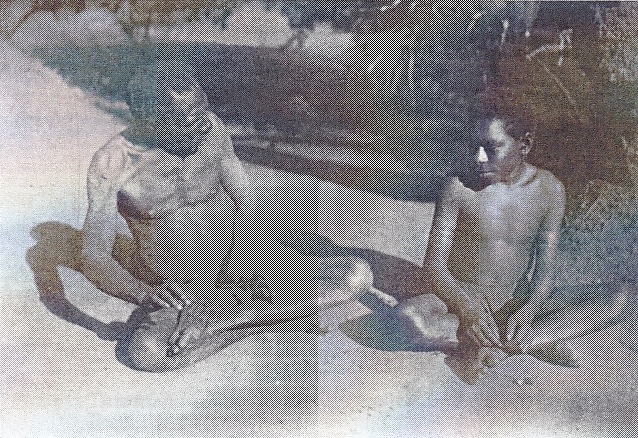
Boy playing cat's cradle with an elder in the 1930s
I have given this bare description of the preliminaries at its face value. What follows is more interesting. The lime has been prepared for the youths who are to receive the jemberi. Each of them must sit between the legs of one of his elders, his head thrown back and his mouth open. A quantity of the lime is then taken up in a leaf and emptied down his throat. As it is presumably only partly slaked the effect is instantaneous. The unfortunate youth springs to his feet and dashes off to the bush in agony, to return some hours later with his throat and mouth severely blistered.
The express purpose of this ceremony is to neutralize the effects of the homosexual intercourse; in fact, to ensure that the young men do not become pregnant. At first I could not credit this; but the existence of the implied belief was amply verified. Among a lean and often scraggy people a corpulent or pot-bellied native is a comparative rarity. His condition is possibly due to disease of the spleen. By the natives it is put down to pregnancy. I have recorded the names of five such individuals, well remembered, who were thought to be with child. One of them, Sosopa of Wekamar, whom I knew as a sorcerer and marked because of his protuberant stomach — an extreme case — died prior to my last visit. The theory was that he had become pregnant because the lime had not gone down his throat properly and that he died because he could not deliver the child. We must not examine native theories of gestation too critically: it is not thought impossible that a man should go pregnant for years. Cases of what appears to be prolapsus ani have been described to me in awed breath and put down to the unavailing effort of the male mother at delivery. The native indeed fears that such unduly corpulent men may actually succeed in delivering their children and thus betray the secret of sodomy to their womenfolk — a revelation which, they say, would cause extreme shame to every man. Not long ago, it is said, there was secret discussion as to whether a man named Mangan, of Derideri, should be put out of the way before he could disgrace his sex in this manner; and informants quote a more or less legendary case in which a pregnant man was enticed to join a hunting expedition and killed by concerted attack of his fellows, his body being ripped up, the entrails and foetus scattered, and the news brought home that he had been bitten by a snake and buried in the bush.
Some time after the lime-eating rite, when the youths' whiskers are showing themselves, they receive a different kind of phallocrypt, viz. the fusus shell, jemberi. It is given formally by the bava, and is accompanied by other gifts — the sair belt, a sheaf of arrows, a necklet of pigs' tails called poj, armlets, leglets, and a small bag (kwarat yaumba), the last three decorated with the yellow dendrobium damugwar. There are once more gifts from the boy's father to his tambera, and the same understanding that the services and gifts will be reciprocated.
With the acquisition of the jemberi the youth's compulsory services in homosexuality come to an end. He is now entitled to adopt the opposite role, and he well have an opportunity of doing so when the next batch of boys are initiated to the bull-roarer. The cycle of his own initiation is complete. It only remains for him to marry in order to obtain the full status of manhood.
Image Sources: Wikimedia Commons
Text Sources: “Encyclopedia of World Cultures, Volume 2: Oceania,” edited by Terence E. Hays, 1996, National Geographic, Live Science, Metropolitan Museum of Art, Natural History magazine, Australian Museum, New York Times, Washington Post, Los Angeles Times, Smithsonian magazine, Encyclopedia.com, Times of London, Library of Congress, The Conversation, The New Yorker, Time, BBC, CNN, Reuters, Associated Press, AFP, Lonely Planet Guides, Google AI, Wikipedia, The Guardian and various websites, books and other publications.
Last updated November 2025