
Home | Category: Highland and Mainland Ethnic Groups
SOUTHEAST PAPUA NEW GUINEA

The Southeastern Region of Papua New Guinea includes the national capital Port Moresby and and Central and Milne Bay Provinces. and the National Capital District (Port Moresby). The Southern Region of Papua New Guinea is dominated by southwestern lowlands, which form the largest contiguous lowland area in the country and home home to the Southeastern Papuan rain forests, Southern New Guinea freshwater swamp forests and Southern New Guinea lowland rain forests. There are large rivers, deltas and swamps.
Central Province stretches along Papua New Guinea’s southern coast. It covers 29,998 square kilometers (11,582 square miles) and had 237,016 people in the 2010 census. Its administrative seat is in Konedobu, within the National Capital District, though plans announced in 2007 proposed relocating the capital to Bautama—a project that has seen little progress. While Tok Pisin is Papua New Guinea’s dominant lingua franca, Hiri Motu remains widely used in parts of the southern mainland coast around Central Province. [Source: Wikipedia]
Milne Bay Province, whose capital is Alotau, includes 14,345 square kilometers (5,540 square miles) of land and 252,990 square kilometers (97,680 square miles) of sea, encompassing more than 600 islands, about 160 of which are inhabited. Around 276,000 people live in the province, speaking roughly 48 languages, mainly of the Eastern Malayo-Polynesian branch. Tourism, oil palm, and the former Misima gold mine are key economic activities, alongside small-scale cocoa and copra production. The province was the site of the World War II Battle of Milne Bay.
Southern Papua New Guinea is home to a diverse array of indigenous ethnic groups. While most of the population is classified as Melanesian, there are also smaller minorities of Polynesians, Chinese, and Europeans in the country as a whole. Culturally, the region is known as the Massim, noted for matrilineal descent, extended mortuary ceremonies, and intricate exchange networks such as the Kula ring.
RELATED ARTICLES:
MOTU — THE PORT MORESBY AREA PEOPLE — AND THEIR HISTORY, CULTURE, LIFE, SOCIETY ioa. factsanddetails.com
OROKAIVA AND MAISIN PEOPLE OF ORO PROVINCE IN SOUTHEAST PNG ioa.factsanddetails.com
SOUTHEAST PAPUA NEW GUINEA ISLANDERS OF MASSIM, MILNE BAY AND DOBU, ROSSEL AND GOODENOUGH ISLANDS ioa.factsanddetails.com
TROBRIAND ISLANDERS: HISTORY, RELIGION, BIG MEN POLITICS, ECONOMY ioa.factsanddetails.com
TROBRIAND ISLANDER CULTURE: CUSTOMS, MATRILINEAL SOCIETY, SEX AND YAMS ioa.factsanddetails.com
ART FROM THE TROBRIAND ISLANDS AND MASSIM REGION OF PAPUA NEW GUINEA ioa.factsanddetails.com
ETHNIC GROUPS IN SOUTHERN PAPUA NEW GUINEA: GEBUSI, PURARI, OROKOLO ioa. factsanddetails.com
NINGERUM PEOPLE OF CENTRAL NEW GUINEA: HISTORY, RELIGION, LIFE, SOCIETY ioa. factsanddetails.com
Motu
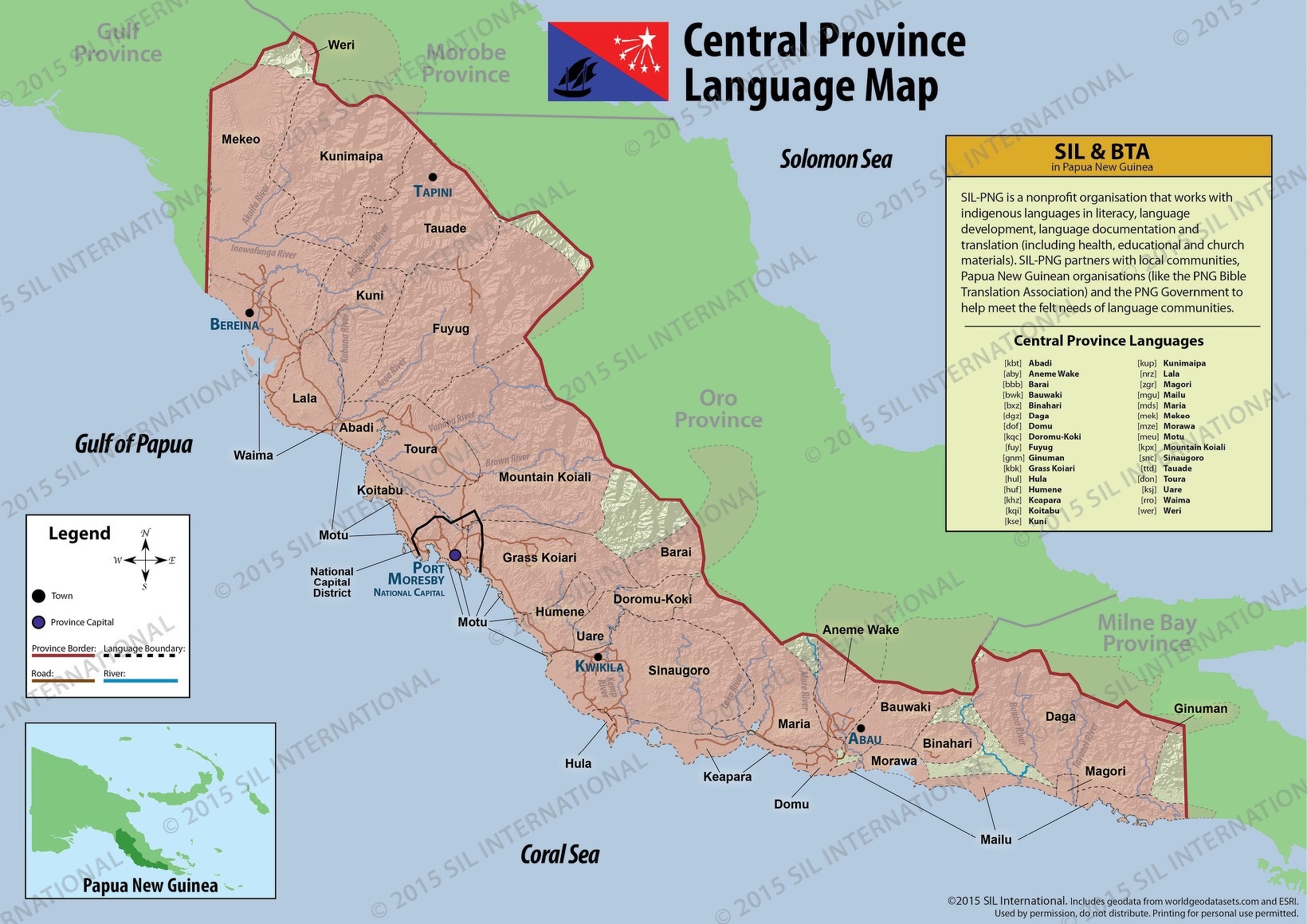
The Motu are an Austronesian-speaking group that lives along the southern coastal areas of Papua New Guinea, They and the Koitabu people are the original inhabitants and owners of the land on which Port Moresby — the capital of Papua New Guinea — is located. The largest Motu village is Hanuabada, northwest of Port Moresby. Despite increased Westernization, the Motu people still engage in some traditional practices. These include valuing traditional music and dance, observing bridewealth, and retaining most land rights in the Port Moresby region. [Source: Murray Groves, “Encyclopedia of World Cultures, Volume 2: Oceania,” edited by Terence E. Hays, 1996; J. Williams, “Worldmark Encyclopedia of Cultures and Daily Life,” Cengage Learning, 2009; Wikipedia]
The Motu (pronounced MOH-too) occupy a stretch of coastline that became the first area of permanent European settlement on the island of New Guinea. They figure prominently in the ethnographic record, largely because of their elaborate annual trading voyages across the Gulf of Papua. Their homeland lies in Papua New Guinea’s Central Province, with Port Moresby—built on land traditionally belonging to both the Motu and the Koitabu—now dividing their territory in half.
According to the Christian research group Joshua Project, the Motu population in the 2020s was around 65,000. At first European contact, early missionary observations suggest the combined population of Motu villages—including small Koita minorities—was between 4,000 and 5,000. Numbers fluctuated during the early colonial period, but grew modestly overall. After World War II, rapid urbanization, wage labor, and improved medical services led to dramatic population growth. Records from 1954–1968 show an increase in the fourteen Motu villages from about 7,500 to 13,500. Although precise village-level figures are no longer available, the Motu population has continued to grow and may now exceed 25,000. Because of their proximity to Port Moresby, the Motu have played a historically significant role in the development of Papua New Guinea disproportionate to their size.
See Separate Article: MOTU — THE PORT MORESBY AREA PEOPLE — AND THEIR HISTORY, CULTURE, LIFE, SOCIETY ioa.factsanddetails.com
Mekeo
The Mekeo people inhabit the coastal plain of southeastern Papua New Guinea, where they live in village communities that share a common language, culture, and social organization. They have traditionally been divided into four tribes that share similar social structures and cultural practices. Mekeo society is organized into patrilineal clans, each with its own complex system of chiefly offices. Authority is localized—there is no single leader for the entire group. Their culture is rooted in a rich oral tradition, and ceremonies and dances—often featuring dramatic headdresses or masked figures—play a central role in community life. [Source: Mark S. Mosko, “Encyclopedia of World Cultures, Volume 2: Oceania,” edited by Terence E. Hays, 1996; ~]
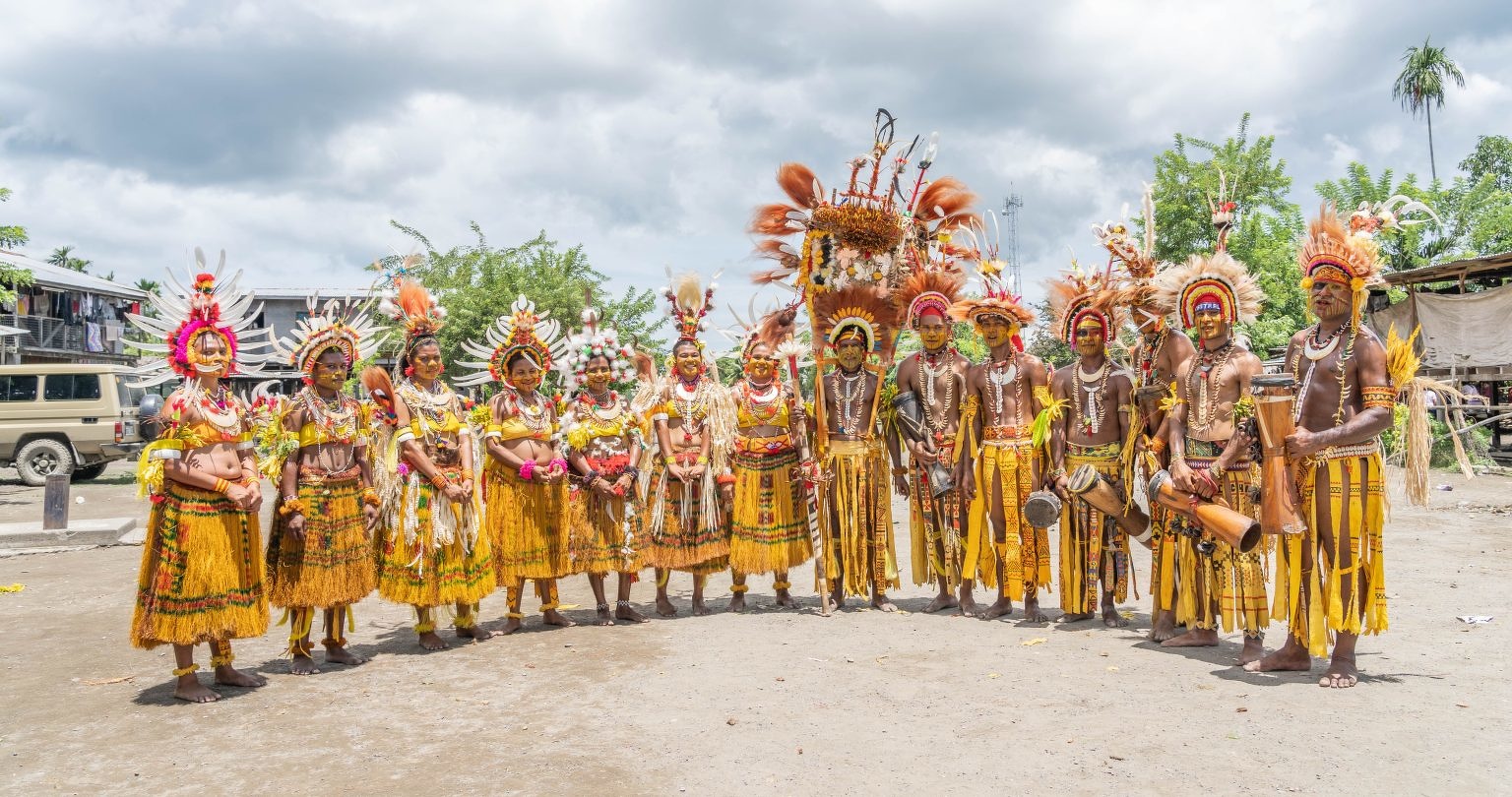
Mekeo dancers
The Mekeo live roughly 100 kilometers northwest of Port Moresby in a low-lying riverine plain marked by grasslands, forests, and swamps. Their villages lie along the tributaries of the Angabanga and Biaru rivers. The climate alternates between a wet monsoon season (December–April) and a dry season (May–November). According to the Christian-group Joshua Project their population in the 2020s was 36,000. Precontact estimates ranged from 10,000 to 20,000, but epidemic disease after European arrival reduced the population drastically. By 1980 it stood at 8,603. Today, a significant number of Mekeo also live in Port Moresby and other towns.
Language: Mekeo is an Oceanic Austronesian language spoken by about 19,000 people in the early 2000s. It has four main dialects—East (Bush Mekeo), West, Northwest (Kovio), and North—of which East Mekeo is considered the standard. The language continues to evolve, incorporating English vocabulary and even new phonemes. Mekeo-based pidgins also exist.
History: Archaeological evidence indicates that Austronesian-speaking agriculturalists have occupied the Mekeo region for at least 2,000 years. Oral traditions trace the origin of the tribes to a split between two ancient villages—Isoisovapu and Isoisovino—after a quarrel involving a joking argument about a bird’s cries. In the past, intertribal warfare was waged over land and in revenge for previous killings. With "pacification," conflict is expressed in competitive courting and feasting and in accusations of adultery and sorcery.
European contact began in 1846 and increased with the arrival of Catholic missionaries in 1875. British colonial forces subdued the area by 1890, after which the Mekeo suffered catastrophic population loss from introduced diseases. Under Australian rule, they were required to plant cash crops, pay taxes, clear paths, and occasionally serve as carriers on government patrols. The early 20th century saw brief millenarian movements (cargo cults), and World War II brought further disruptions as men were conscripted as carriers for Allied forces. In recent decades, education, development projects, and the rise of Port Moresby have widened Mekeo horizons, though village communities remain culturally conservative. Traditional relations with neighboring groups—formerly shaped by warfare, trade, and sorcery—now persist mainly through trade networks and occasional intermarriage, which is slowly increasing.
Mekeo Religion and Culture
According to the Christian-group Joshua Project 97 percent of Mekeo are Christians, with the estimated number of Evangelicals being 10 to 50 percent. Traditional beleifs endure. Mekeo sorcery has long drawn anthropological interest. During the early colonial era, accusations intensified as epidemics swept the region, and sorcery practices continue to hold cultural importance today. [Source: Mark S. Mosko, “Encyclopedia of World Cultures, Volume 2: Oceania,” edited by Terence E. Hays, 1996]
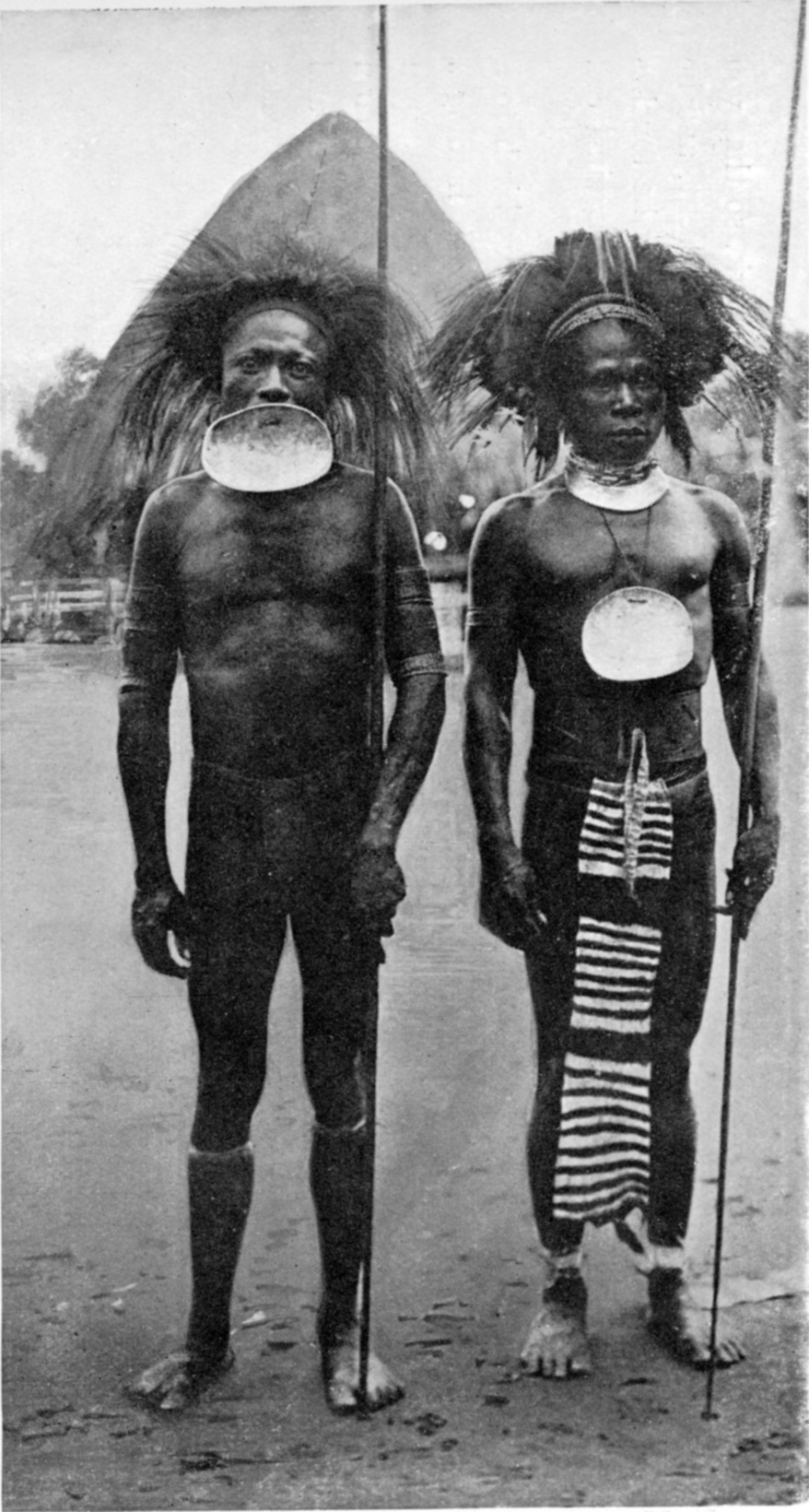
Two Mekeo men in war costumes in 1910
Traditional Mekeo mythology centers on ancestral spirits and the immortal culture hero Akaisa, who is said to have given the ancestors their customs and social institutions. Today villagers also venerate Christian figures — God, Old Testament prophets, Jesus, Mary, Joseph, and the saints — and many describe Akaisa as a kind of “Mekeo Jesus Christ.” Akaisa’s younger brother Tsabini, ancestral spirits, and a category of shape-shifting bush beings called faifai—spirits linked to particular animals and thought to live underground or underwater—also play roles in the spiritual world. When disturbed, faifai may cause illness or monstrous births.
Religious Practitioners and Ceremonies: Clan chiefs and sorcerers, regarded as ritual descendants of Akaisa, are believed to inherit his sacred powers. Other ritual specialists focus on hunting, gardening, curing, courtship, and other communal needs. All adult men possess secret, inherited rites tied to their own ancestors. Catholic priests and catechists, both local and European, administer Christian sacraments and ceremonies. Mekeo ceremonial life is marked by dramatic dances, masked performers, and elaborate costumes. Major rituals include the installation of clan chiefs and sorcerers, funerary rites, and ceremonies lifting mourning restrictions. Additional rituals accompany birth, first clothing, male instruction, marriage, pregnancy, and cases of homicide. Catholic observances include Mass, the sacraments, and festivals for village patron saints. Sorcerers and other specialists use a wide array of plant, animal, mineral, and human substances to influence health, emotion, behavior, and fate—causing illness or death, inspiring love, or removing these conditions. Most medicinal knowledge is secret and passed from father to son or mother to daughter.
Death and Funerals: Death is understood as the result of both human and spiritual forces and is always viewed as a social event requiring secret vengeance by kin. Public actions focus first on burial and grief. Months later, the mourning clan’s lopia hosts a large feast, offering food gifts to allied clans who, in return, remove the mourners’ pollution and restrictions. At this death feast, the deceased’s bodily remnants are publicly destroyed, though close relatives may secretly keep hair, bones, or teeth for ritual or sorcery purposes and to maintain communication with the dead. These feasts also help reorganize social ties after a person’s passing.
Arts: Mekeo visual art is distinguished by geometric motifs appearing on carved architectural insignia, women’s tattoos, ceremonial dress, face paint, woven bags, dance drums, weapons, lime gourds, and carved cassowary-bone tools. Traditional courting involves drumming and flute playing, while modern youth favor guitars. In warfare dances, spears and bows may be struck as rhythm sticks. Magic spells—kept secret—and various song styles share a poetic structure.
Mekeo Family and Kinship
A typical Mekeo household includes a man, his wife, their unmarried children (except bachelor sons), and—after marriage—the eldest son with his wife and children. Other relatives may also live in the home. Household members normally work closely together. In households with multiple married women, each couple maintains its own garden plot, and each wife cooks separately at her own hearth. Unmarried sons who reside in bachelors’ dormitories or the clan clubhouse contribute little to household labor and receive little from its production. [Source: Mark S. Mosko, “Encyclopedia of World Cultures, Volume 2: Oceania,” edited by Terence E. Hays, 1996]

Mekeo tattoos, 1915
Child-rearing is shared by grandparents, siblings, and other relatives. Weaning and the birth of a younger sibling often bring a sudden end to maternal indulgence, shifting a child’s primary companionship to peers. Older siblings are held responsible for their juniors, and sharing is strongly emphasized. Boys and girls are socialized differently from an early age. For many young women, marriage brings emotional difficulty due to separation from lifelong playmates.
Marriage occurs mostly within the tribe. Most people marry choose partners outside both their own clan and their mother’s clan. Formerly, marriages were arranged before the couple lived together. Today, most couples elope, with exchanges of pigs and other valuables between in-laws occurring only after the first child is born. Under Catholic influence, polygyny has become uncommon and divorce is rare. Traditionally, divorce was also infrequent because bride-wealth payments accompanied arranged marriages. Postmarital residence is patrivirilocal, with couples living in the husband’s family home or community.
Kin Groups (ikupu) are patrilineal, ideally organized into lineage, subclan, clan, and moiety units. Male lineage members are linked through male ancestors, often share residence and gardens, and hold hereditary rights to specific bodies of ritual knowledge—such as peace, sorcery, curing, warfare, weather, and hunting. Men who cooperate daily, gather at the same clubhouse, and follow the same “peace chief” form the core of a subclan, which typically corresponds to a village residential block. Subclans belonging to the same clan are ranked as senior and junior branches and participate together in major feasts and ceremonies whether or not they live in the same village. In some cases, patrilineal ties traditionally united multiple clans of a tribe into moieties. Mekeo people use a Hawaiian (generational) kinship system, distinguishing relatives mainly by generation and gender. All women of the parental generation are called “Mother,” all men “Father,” and in one’s own generation all male relatives are “Brother” and all female relatives “Sister.” Additional distinctions are made by relative age, birth order, and marriageability.
Mekeo Society
Mekeo thought draws symbolic connections between the human body and the landscape. The village center is often described as the community’s “abdomen,” and movement between village and bush is likened to cycles of intake and release. Feathered headdresses—especially those adorned with bird-of-paradise plumes—represent the link between earth and sky.
Before European contact, Mekeo tribes were autonomous sociopolitical units organized around patrilineal descent, cognatic kinship ties, hereditary chieftainship and sorcery, mutual military support, and formalized “friend” relationships between clans. These “friends” traditionally preferred to intermarry, exchanged hospitality and feasts, lifted one another’s mourning taboos, installed each other’s heirs in chiefly and sorcery roles, and inaugurated each other’s clan clubhouses. Such relationships still shape everyday social life. [Source: Mark S. Mosko, “Encyclopedia of World Cultures, Volume 2: Oceania,” edited by Terence E. Hays, 1996]
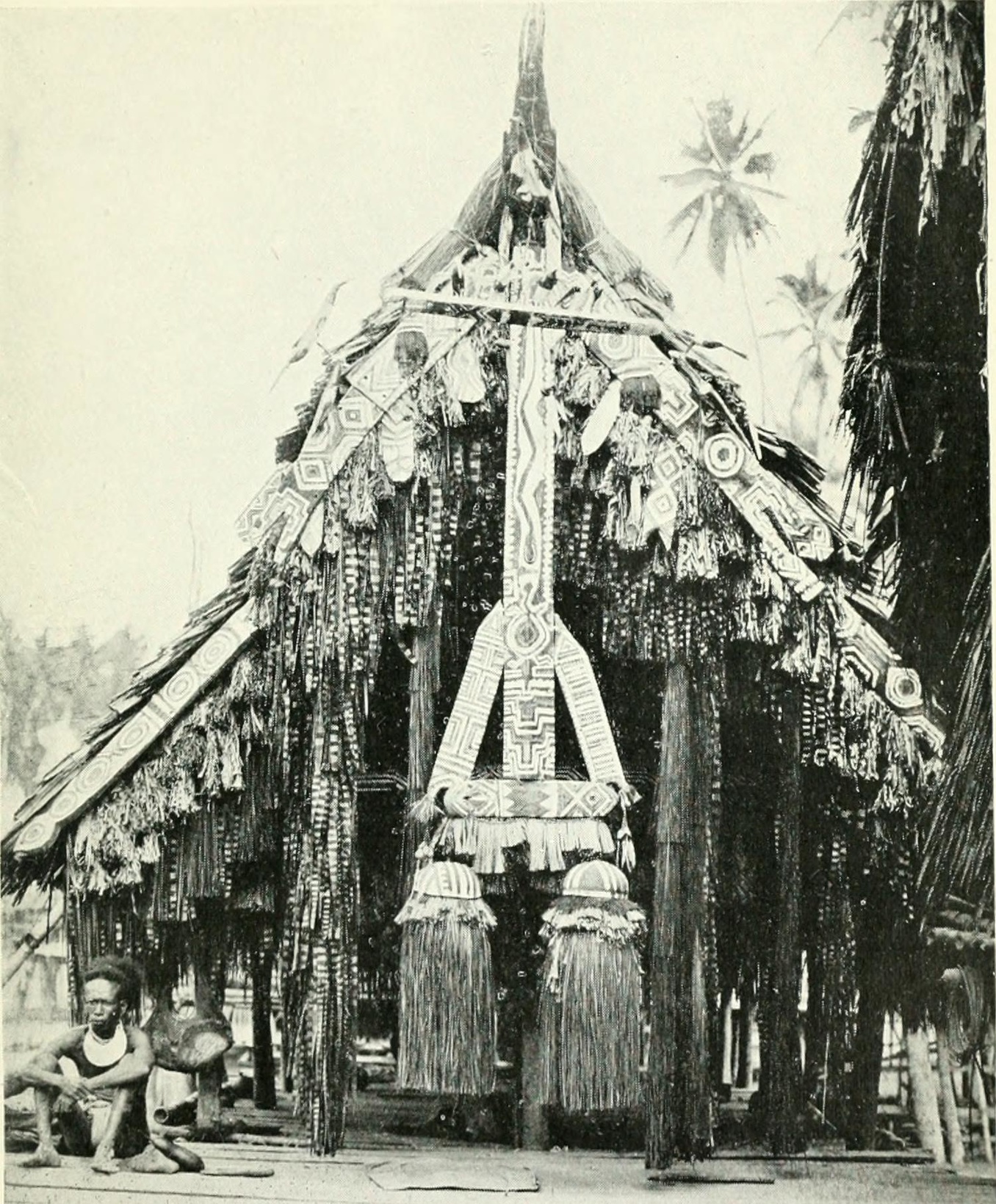
Mekeo ceremonial house in 1922
Governance centers on hereditary clan and subclan officials and ritual specialists, with offices typically passed from father to eldest son. The most important roles are the peace chief (lopia) and his peace sorcerer (unguanga), who oversee interclan relations among “friends.” Although the powers of war chiefs (iso) and war sorcerers (fai’a) are now obsolete, their titles still command respect. In the past, additional specialists controlled gardening, hunting, fishing, weather, courtship, curing, and food distribution. People remain subject not only to the authority of their own clan leaders but also to those of their mother’s and spouse’s clans.
Much everyday regulation is maintained through gossip, peer pressure, and fear of public shame. Serious offenses against the authority of the peace chief are believed to be punished by the peace sorcerer, who is said to employ snakes, poisons, and spiritual agents to inflict illness or death. Because death is attributed to sorcery, the influence of chiefs and sorcerers has been historically strong. The introduction of money and manufactured goods has sometimes allowed wealthy individuals to hire sorcerers privately, bypassing legitimate chiefly authority. Formal governance is carried out by village courts, elected councillors, police, state courts, and other administrative bodies. Catholic missionaries and Christian moral teachings also reinforce social order.
Land is owned collectively by patrilineal clans. Each clan’s peace chief holds nominal control but must consult the entire clan for major decisions. All clan members—men and women—hold rights to use specific areas for gardening, hunting, fishing, and housing, typically based on where their fathers lived and worked. In practice, however, men usually exercise and transmit these rights. Members of other clans may be permitted to garden on clan land, but they may not plant permanent tree crops such as coconut or betel palm, which function as inherited property and boundary markers. The recent introduction of commercial rice cultivation has tended to benefit families and clans with large landholdings.
Mekeo Life and Economic Activity
Villages of Mekeo are typically rectangular and cleared of most vegetation except coconut palms, betel palms, and breadfruit trees. Houses are raised on stilts with palm-thatch or corrugated-iron roofs and contain a kitchen and sleeping rooms, though most socializing takes place outside on attached platforms or verandas. Dwellings line both sides of a long central avenue, while large, elaborately built clan clubhouses stand facing each other at opposite ends. The homes of chiefs and sorcerers are specially decorated and made with more durable materials. Bachelors’ dormitories are located behind the main residential area. Each village also has a church and nearby cemetery, and today some villagers operate small trade stores. [Source: Mark S. Mosko, “Encyclopedia of World Cultures, Volume 2: Oceania,” edited by Terence E. Hays, 1996]
Agriculture has traditionally beem mainly been slash-and-burn style. The Mekeo grow sweet potatoes, taro, coconuts, plantains, yams, breadfruit, sugarcane, and numerous other native and introduced crops. Pigs and fowl are kept mainly for ceremonial use. Diets are supplemented by hunting bush pigs, wallabies, cassowaries, and other wildlife, as well as by fishing. Since European contact, many commercial projects—rice, copra, coffee, cattle, cocoa, trucking, canoe transport, and retailing—have been attempted with limited long-term success. A few families now profit from mechanized dry-rice farming. For most villagers, the main cash sources remain the profitable betel-nut trade in Port Moresby and remittances from salaried relatives living in towns.
Tasks follow age and gender lines. Men handle the heavy cutting and clearing of gardens; women do lighter clearing, planting, and harvesting. Hunting is done exclusively by men, while fishing is shared by both sexes using different techniques. Women cook and serve food; men prepare and secretly perform magical and sorcery rituals. Child care is shared by all ages, though grandparents and older sisters take on much of the daily supervision. From about age ten—or today, after finishing school—unmarried young men are largely freed from work to focus on courting and love magic; traditionally, they also served as warriors. Men ideally pass house sites, garden land, shell valuables, magical knowledge and paraphernalia, and hereditary titles through the male line, with eldest sons receiving preference. Women’s durable goods—such as clay pots and cooking tools—are inherited by their sisters and daughters. Personal belongings of both sexes are ritually destroyed during funerary rites.
Most adults are skilled in the tasks appropriate to their gender. Men construct canoes, carve wood, and make tools and weapons. Women devote much of their leisure time to weaving string bags. Both men and women possess complementary carpentry skills, though in different domains. A long-standing network of hereditary trade partnerships links individuals and groups throughout the Mekeo region. Within and between tribes, people exchange food, pigs, pots, string bags, shell and feather valuables, dogs’ teeth, and now money during marriages, funerals, and other events. Historically, intertribal routes carried pottery, salt, pigs, dogs, dried meat, lime, betel nuts, shell and feather valuables, bark cloth, canoes, black palm for weapons, stone axe heads, carved cassowary-bone tools, and pandanus nuts. Weekly markets continue today, where Mekeo women trade garden produce for fish and shellfish caught by coastal Roro people.
Mailu
The Mailu are a Papuo-Melanesian people of the southern coast of eastern Papua New Guinea and its offshore islands, long recognized as skilled seafarers, canoe builders, and regional traders. Centered on Mailu Island—historically the main settlement and trading hub—they produced pottery and oceangoing canoes that were exchanged widely along the coast. According to the Joshua Project, the Mailu (Derebai) population in the 2020s is about 16,000. The Mailu also refer to themselves as Magi, a term used both for the people as a whole and for the principal village on Mailu Island. Today, they continue to honor their maritime heritage through traditions such as the Mailu Toea Festival. [Source: Nancy E. Gratton, “Encyclopedia of World Cultures, Volume 2: Oceania,” edited by Terence E. Hays, 1996; Google AI]
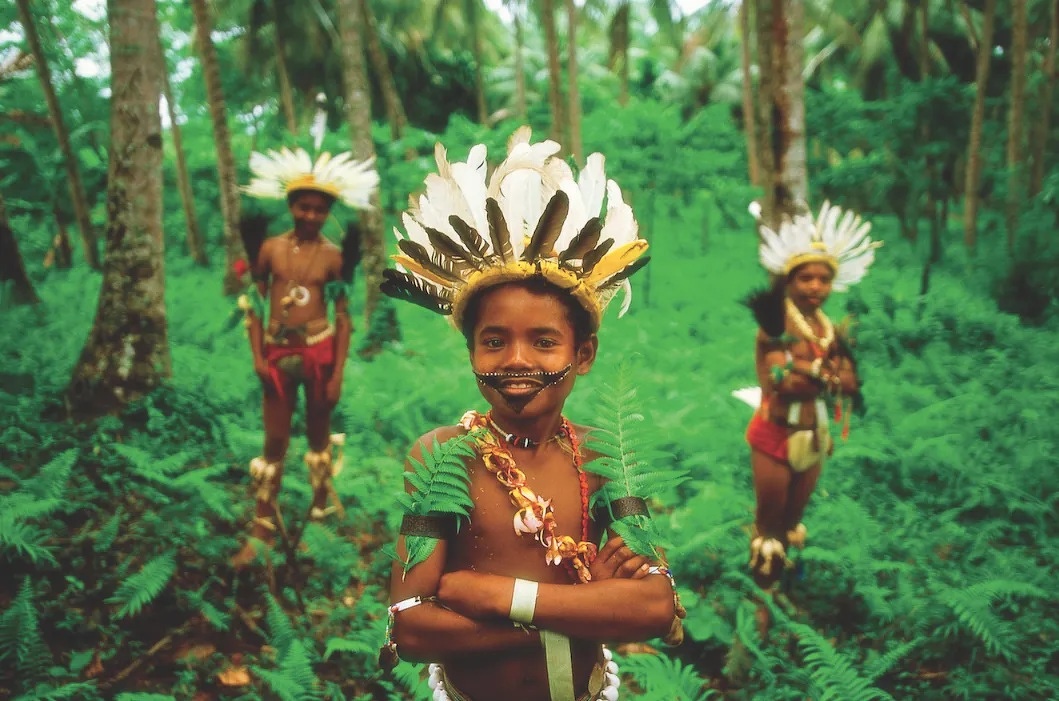
Mailu kids
Mailu Territory stretches from Cape Rodney in the east to Orangerie Bay in the west. Several villages lie on the larger offshore islands, while the mainland is characterized by tropical rainforest, heavy rainfall throughout the year, and swampier lowlands toward the west. Mailu Island—also known as Toulon Island—has rich clay deposits ideal for pottery but lacks swampland and thus depends on the mainland for access to sago. The island, about 1.8 kilometers long and located 8 kilometers offshore, supports bananas, taro, yams, betel, sugarcane, coconuts, areca palms, and sago palms. The main village sits on the northeastern shore, and women traditionally produced pottery that was traded with coastal groups such as the Aroma and South Cape peoples.
Language of the Malilu is Magi, a Papuan (non-Austronesian) language of the Mailuan family. In the 1990s, there were roughly 6,000 Magi speakers living on Mailu, Laluoru, Loupomu, and Eunuoro islands and along the coast between Cape Rodney and mid-Orangerie Bay. Magi includes two major dialect groupings—eastern (Maisi/Varo) and western (Island)—and shows heavy Austronesian influence, reflecting long-standing contact with neighboring peoples. In turn, several local Austronesian languages have incorporated Magi elements.
History: Archaeological evidence indicates pottery-using populations have lived in the Mailu region for at least 2,000 years. The people of Mailu/Toulon Island established early dominance based on their dual control of pottery production and canoe building, allowing them to dominate direct trade and to act as intermediaries between other communities. Their power was reinforced through raiding, which pushed many coastal groups into safer hilltop settlements. Before European arrival, Mailu Island functioned as a specialized manufacturing and trading center and warfare between villages was common and centered on acquiring human heads for male initiation rites. Conflicts were waged with spears and clubs and were often triggered by accusations of sorcery or retaliation for past raids.
The first recorded European contact occurred in 1606, when Torres anchored off the island—an encounter marked by violence and the abduction of children. Over 250 years later, the region was incorporated into the Protectorate of British New Guinea, bringing missionaries, administrators, and new trade goods. Mailu men quickly found work with Europeans, especially in maritime industries, altering traditional systems of wealth. The London Missionary Society established a mission on Mailu Island in 1894, and colonial authority and mission influence soon ended raiding, head-hunting, and the male initiation rites associated with warfare.
Mailu Island was visited by Bronisław Malinowski in 1914 during his first fieldwork. In 1932, Hugo Bernatzik photographed the islanders, admiring their houses, canoes, and craftsmanship. Frank Hurley also photographed the region. Between 1972 and 1974, archaeologist Geoffrey Irwin conducted an extensive survey of Mailu Island and the surrounding mainland communities that speak Mailuan languages.
Mailu Religion and Culture
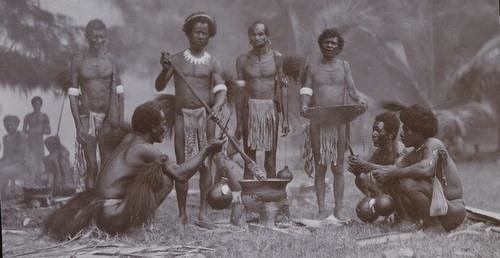
Ritual cooking of sago by men at Mailu Island, William Saville, early 1900s
According to the Christian-group Joshua Project 99 percent of Mailu are Christians, with the estimated number of Evangelicals being 10 to 50 percent. Mailu traditional beliefs center on a culture hero known as Tau or Samadulele, who is said to have sailed from the west with his mother, bringing pigs, sago, coconuts, and betel nuts—the core resources of Mailu subsistence and ceremonial life. Outside of chants performed during the Govi Maduna, the hero’s role in daily religious life is limited. Far more central are two categories of spirits. Ancestral spirits, considered protective and benevolent, are consulted for guidance and are believed to reside in the skulls of the deceased kept in family houses. A second group consists of dangerous female spirits that possess people and compel them to commit harmful acts.
Religious Practitioners have traditionally been mostly adult men, who possess some personal magical knowledge involving herbs, spells, and taboos used to protect gardens, ensure successful canoe building, and promote individual well-being. This knowledge is privately held and passed from father to son; a man may also teach his wife. Community-level magic for collective undertakings—such as major feasts or trading expeditions—is performed by senior men. Sorcerers, though entirely human, wield harmful magic that allows them to move unseen at night and inflict illness or death. Sorcery is widely believed to be common in Mailu society. Illness is always attributed to sorcery. Treatment involves incantations, massage, and the ritual extraction of foreign objects believed to have been magically inserted into the patient. Healers—usually men—charge substantial fees in the form of armbands and other valuables.
Death has traditionally been believed to be the result of sorcery. Two spirits are thought to survive the body: one travels southwest to a ladder leading into Biula, the underworld; the other remains within the skull, enabling communication with the living. Immediately after a death, the spouse and classificatory siblings begin ritual mourning—shaving their heads, blackening their skin with burned coconut fiber, and wearing full-body mourning dress. A loud lamentation begins at once, while more distant relatives bring coconuts for village-wide distribution. The corpse is washed, decorated, and chanted over to identify the sorcerer responsible; the body is expected to react when the offending village is named. Burial takes place as soon as possible, either beneath the deceased’s house or in the gardens. Garden burials are marked with a small mortuary hut. Over the next several months, a series of small feasts accompany the mourning period. After two or three months, the grave is opened and the skull removed, then kept in a basket in the family house. A final large mortuary feast—often held during the maduna—occurs six months to a year after death, when a close kinsman (never the father or widow) dances with the skull and the mortuary hut is destroyed, ending mourning.

Mailu facial tattoos, 1915
Mailu Toea Festival is a major contemporary celebration of canoe building, seafaring traditions, warrior dances, and storytelling. The principal traditional ceremony was the Govi Maduna, a large annual pig feast held after the final trading voyages of the year. Hosted by the entire village, the maduna encompassed many important events—exchanging pigs, concluding marriage negotiations, and transferring paternal rights to children. Each clan’s headman oversaw his group’s preparations and food contributions. Smaller feasts held beforehand involved fewer villages and were used to gather promises of support and accumulate wealth for trading voyages to Aroma territory to acquire the pigs slaughtered during the main feast.
Arts include decorative carvings on house posts, canoes, and household implements. Their motifs closely resemble those of the Southern Massim and likely derive from them. Songs and dances performed at feasts also show Southern Massim and other regional influences. Many dances imitate birds or animals, while others dramatize key activities such as gardening or canoe building.
Mailu Society and Family
Traditionally, Mailu households were nominally headed by the eldest male, though each adult man maintained his own gardens and therefore enjoyed considerable independence. Large undertakings—trading voyages, garden clearing, major feasts—required cooperation beyond a single household and were directed by respected headmen in whom participants placed their trust. Clan affiliation determined membership in men’s houses (when these were still built) and organized contributions of wealth during pig feasts. [Source: Nancy E. Gratton, “Encyclopedia of World Cultures, Volume 2: Oceania,” edited by Terence E. Hays, 1996]
Mailu society recognized no central authority. Leadership rested informally with elders, whose prestige and judgment earned them influence. Under colonial rule, administrators appointed intermediaries, but such roles had no traditional legitimacy. Within the village, elders—particularly headmen—mediated disputes. Major offenses, such as adultery by a woman or the killing of kin, were punishable by death, while lesser offenses were regulated by public opinion and communal pressure. Sorcerers living within the village were typically placated rather than confronted.
Marriages have traditionally been arranged through betrothal, sometimes when the girl is quite young but usually by her mid-teens. The boy’s family provides a series of increasingly valuable gifts, and both families exchange food of roughly equal worth. Betrothed couples are expected to remain celibate; an affair by either party nullifies the agreement. Bride-wealth—pigs, tobacco, and other valuables—is presented at a maduna, since pigs can be formally exchanged only during feasts. Marriage itself is simple: the bride prepares a meal for her betrothed in his father’s house, then returns to her own for about a week. Afterward the marriage may be consummated, and she moves to her husband’s father’s house, joining his clan. A man enters avoidance relationships with certain of his wife’s relatives, especially her older sister. Polygyny is allowed but rarely practiced because of the high cost of pig-based bride-wealth. Adultery is a serious offense for both spouses, but punishments are harsher for women, extending to severe beating or even death; men typically face only public scorn. Divorce is possible but uncommon.
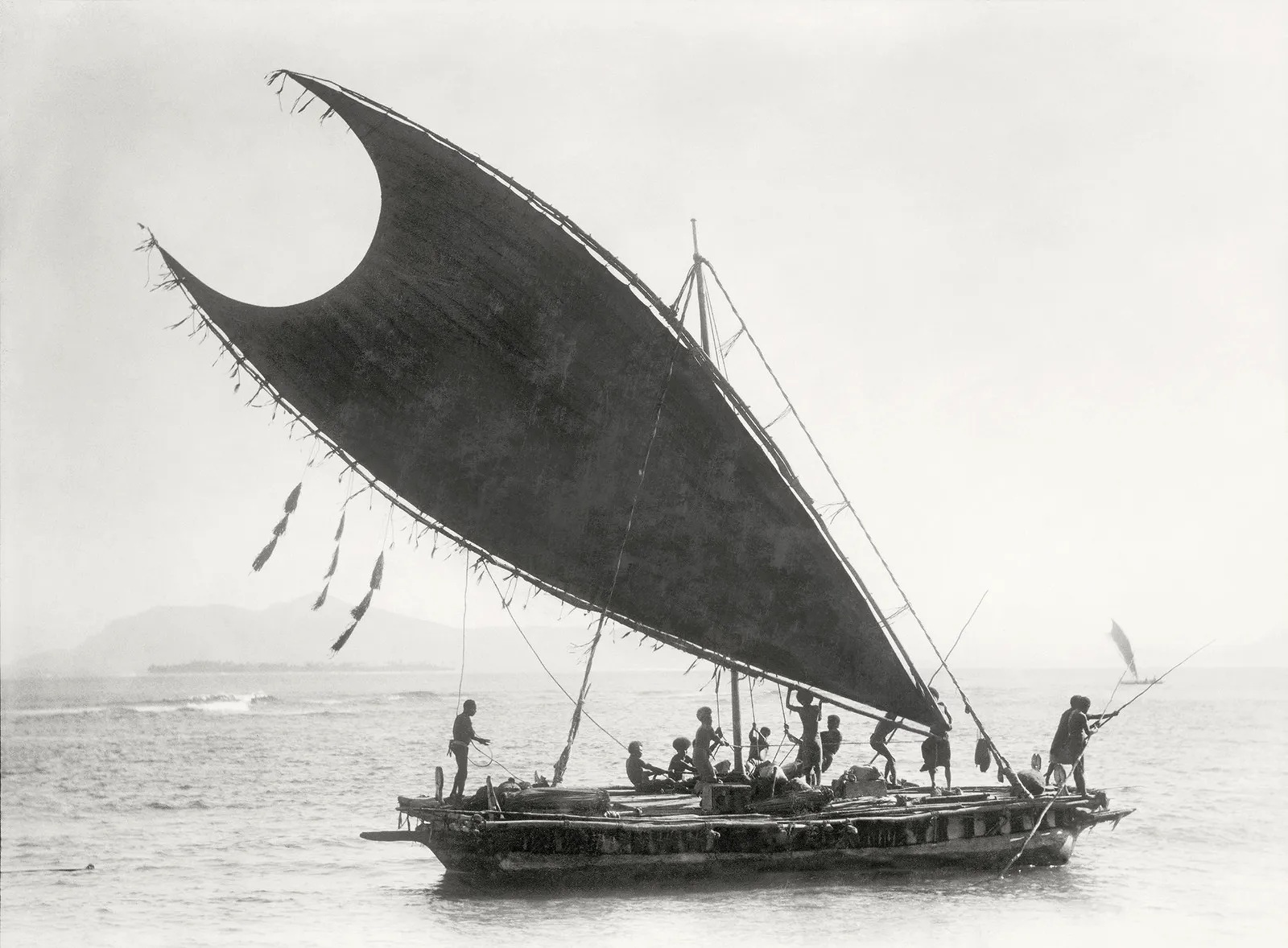
Mailu ocean-going canoe
Young children are cared for by their mothers and female relatives and are given wide freedom, rarely scolded or disciplined. Boys receive miniature canoes, nets, and spears to imitate adult activities, and both boys and girls learn by watching and gradually assisting their elders. Ear piercing—and formerly nose piercing—occurs soon after birth. Girls begin extensive tattooing around age four, culminating in facial tattooing at adolescence during women-only feasts. Male initiation, once linked to head-taking during raids, has ceased. Infanticide is practiced in cases of twin births (the younger twin), when the mother dies in childbirth, or in cases of illegitimacy.
A man’s personal ornaments and wealth pass to his “real” (not classificatory) brothers; his coconut palms go to his brothers and sons; and his house passes to his eldest surviving son. Women do not typically hold or inherit property, except when a father dies without sons.
Kinship: Mailu clans are patrilineal and spread across multiple villages. Local clan sections are named, exogamous, and recruited through the male line. A woman who marries into a clan adopts her husband’s affiliation. Although her children are initially considered to belong to her brother (and thus her father’s lineage), the husband normally assumes full paternal rights through the gift of a pig. Childless men may adopt a sister’s son. Mailu use classificatory kin terms for all relatives of the parental and grandparental generations to avoid the taboo on speaking personal names. Terms distinguish genealogical position and relative age within a generation. While several relationships can share a single term, additional qualifiers may be used for precision when needed.
Mailu Life and Economic Activity
Mailu Villages consist of two facing rows of stilted family houses, divided by a broad central road. Before European contact, men’s houses (dubu) stood in the middle of this road, positioned perpendicular to the dwellings. Houses were two-story structures: the upper floor was a single, windowless room enclosed by heavy thatch and reached by a ladder and trapdoor, while the lower floor remained open, with pandanus or woven reed mats set up as temporary screens when needed. Ridgepoles were elaborately carved, and pig jaws and fish tails were hung on the front supports as decoration. Domestic space was not formally divided into men’s and women’s areas, though men typically gathered toward the roadside end and women toward the back. Fenced gardens were located behind the houses. [Source: Nancy E. Gratton, “Encyclopedia of World Cultures, Volume 2: Oceania,” edited by Terence E. Hays, 1996 ~]
Agriculture plays a smaller role on Mailu Island than on the mainland. The island economy relies heavily on pottery, fishing, and long-distance trade. Fishing with spears and nets is done individually or in pairs and small groups. Pottery is made from coiled ropes of clay. Gardens are swidden-style with long fallow cycles, producing bananas, taro, yams, and sugarcane. Coconut and betel palms grow near the village but outside the fenced gardens. Sago palms are felled and processed for starch. Europeans later introduced papaws and pumpkins. Pigs are raised in the village, but only sows are kept; these roam into the forest to mate with wild boars. Hunting is especially important on the mainland, where people pursue wallabies, wild pigs—driven into nets and speared—and many species of birds taken in traps. Shellfish are collected along coastal reefs.
Women alone make pottery, while men carry out arm-shell production, seagoing trade, canoe building, house construction, and hunting. Men also handle garden clearing and fence construction; all weeding is done by women. Women are responsible for daily cooking and most childcare. Apart from limited night fishing with torches, women do not fish. Pig tending is primarily a woman’s task. Men craft or trade for their own tools.
Beyond house construction, Mailu manufacture includes garden fences, pandanus and reed mats, baskets, arm shells, and stone tools. On Mailu Island, the most important products are coiled clay pots and the canoes that underpin the island’s trading economy. Garden lands and canoes are owned by the local clan section under the authority of its headman. Dwelling houses belong to the household head and pass to his eldest son. Men’s houses were once corporate clan property. Individual ownership applies to coconut and betel palms.
Trade: Mailu Islanders have traditionally used their large oceangoing canoes to maintain an extensive seasonal trade network. In July–August they sailed west with locally made pottery to exchange for betel nuts from the Aroma, collecting shellfish on the return journey to make trade armbands. In September–October, they traveled west again with surplus sago to trade for pigs and dogs. In November–December they sailed east, trading these pigs and dogs for arm shells, ebony carvings, baskets, and formerly polished-stone axe blades. They also traded boar tusks, shell disks, and imported netted string bags. This trade formed the core of the island economy and supplied the wealth necessary for the annual clan feasts (maduna).
Wamira
Wamira refers to a village and region and the people that live there. Also known as the Wedau and people of Bartle Bay, they have traditionally lived on the southern shore of Goodenough Bay in Milne Bay Province along a 2.5-kilometer stretch of coastline between the Wamira and Uruam rivers. Behind the coastal hamlets lies a fertile alluvial plain leading into the Owen Stanley foothills. A rain shadow makes the area unusually dry for the tropics, with long dry seasons and about 140 cm of annual rainfall. Temperatures average 27°C. [Source: Miriam Kahn, “Encyclopedia of World Cultures, Volume 2: Oceania,” edited by Terence E. Hays, 1996]
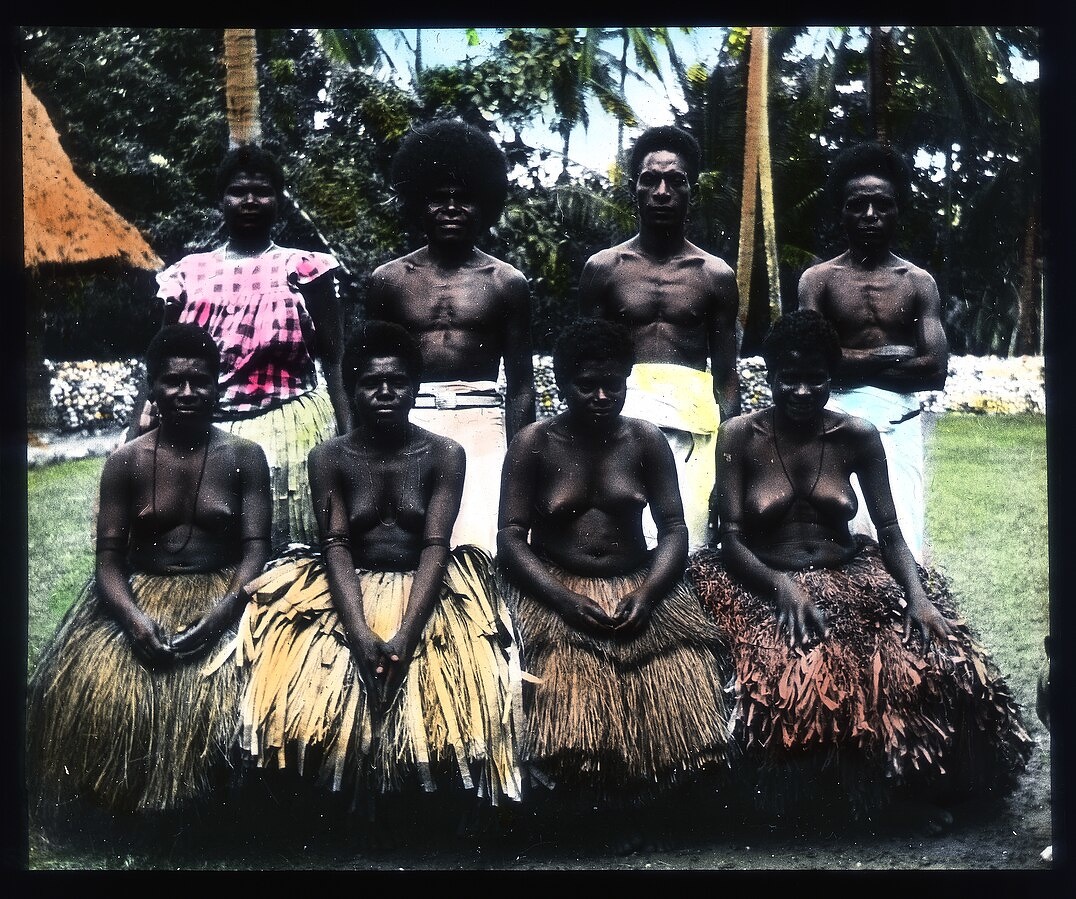
Teachers, St Matthew’s School, Wamira, 1930s
According to Joshua Project the Wamira population in the 2020s was 4,500. They numbered around 400 the late 1800s and 1,200 in the 1990s. Today many young adults live in towns. The Wamira speak Wedau, an Austronesian language also used in nearby coastal villages. Missionaries adopted Wedau in the 1890s for preaching and schooling, and literacy in the language is high. English is taught in schools, and younger Wamirans understand it reasonably well.
History: European contact began in 1888 with the British annexation of southeastern New Guinea; the Anglican mission arrived in 1891 and established Dogura station. The large Cathedral of St. Peter and St. Paul (1936) remains a regional landmark. Mission influence ended warfare and introduced schooling and health care. Since independence (1975), villagers have expressed frustration at the lack of roads, electricity, or development.
Religion: Traditional beliefs center on spirits inhabiting people, animals, and places. Today most Wamirans are Christian, and Anglican practices coexist with older animistic ideas. Healers use magic for illness and agriculture; sorcery and witchcraft are also acknowledged. Feasts mark marriages, deaths, and stages of taro cultivation.
Wamira Society and Family
People belong to one of about twenty matrilineages, each associated with taboo animals. Matrilineal descent and marriage link otherwise separate patrilocal residence groups and patrilineal political units. Leadership is hereditary, passing from father to eldest son. The village, each ward, and each hamlet have recognized leaders whose authority depends on their ability to organize work and feasts. Rivalries between minor leaders often surface during taro cultivation. Social control relies primarily on ridicule and ostracism; extreme cases lead to temporary banishment to banana gardens. Since 1964 local councils have helped settle major disputes. Conflict today emerges mainly during gardening, feasts, dances, and sports.
Marriage is lineage-exogamous. Women usually move to their husband’s land, which disperses matrilineal groups across the village. Weddings now include both traditional exchanges of taro and pork and church ceremonies. Divorce is common and easily enacted. Inheritance follows both parents: land and some garden magic pass father to son, and other ritual knowledge from mother to daughter. Kinship terminology follows the Iroquois pattern.
Only aqueduct construction unites the entire village, and even then tensions between wards are common. Within hamlets, men cooperate in garden and canal work; women work collectively in taro plots. Men build houses, hunt, garden, and make tools; women cook, carry firewood, market food, and do communal river fishing. Women’s clubs now run small income-generating projects.
Wamira Life and Economic Activity
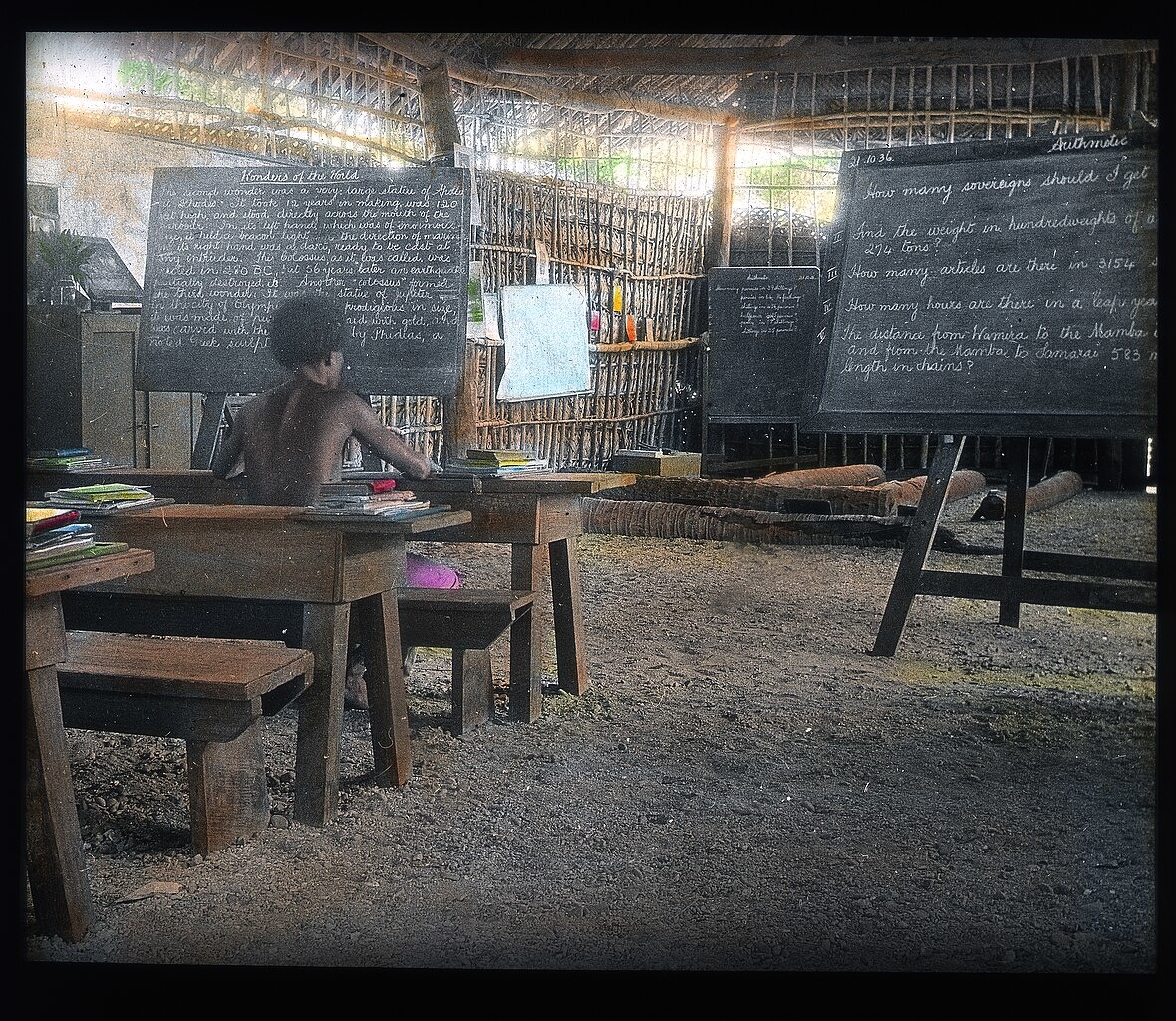
St Matthew’s School, Wamira, 1930s
In the 1990s Wamira covered roughly five square kilometers and was divided into two wards: the older Damaladona (Wadubo) and Rumaruma. Eighteen seaside hamlets contain households of nuclear or small extended families. Traditional houses were built of coconut-frond walls and thatch, though tin roofs and rain tanks are increasingly used.
Households are the key production units. Subsistence is based on swidden gardens and a wide variety of gathered and cultivated foods. Meat is a small portion of the diet (about 3 percent), with fish the most consistent source. Pigs are numerous and essential for feasts; hunting now relies mostly on shotguns. Taro is the main staple and ritual crop. To support its year-round cultivation, Wamirans maintain an extensive irrigation system: 12 km of canals, stone diversion dams, and a historically important hollow-log aqueduct (now replaced by metal pipe). Other crops include bananas, yams, sweet potatoes, sugarcane, beans, greens, and many fruits. Cash-crop ventures have largely failed due to the dry climate.
Wamirans produce houses, canoes, mats, bowls, lime spatulas, baskets, nets, net bags, drums, ornaments, and dance gear. The aqueduct, flanked by carved wooden figures, is their most notable technological achievement. Formerly, coastal–inland trade moved coconuts and fish inland and returned hardwoods and areca nuts. Today exchange centers on wages and goods sent from towns such as Alotau, Lae, and Port Moresby. Purchased foods, clothing, and tools supplement village life.
Image Sources: Wikimedia Commons
Text Sources: “Encyclopedia of World Cultures, Volume 2: Oceania,” edited by Terence E. Hays, 1996, National Geographic, Live Science, Metropolitan Museum of Art, Natural History magazine, Australian Museum, New York Times, Washington Post, Los Angeles Times, Smithsonian magazine, Encyclopedia.com, Times of London, Library of Congress, The Conversation, The New Yorker, Time, BBC, CNN, Reuters, Associated Press, AFP, Lonely Planet Guides, Google AI, Wikipedia, The Guardian and various websites, books and other publications.
Last updated November 2025