
Home | Category: People and Life / Maori
MĀORI LIFE
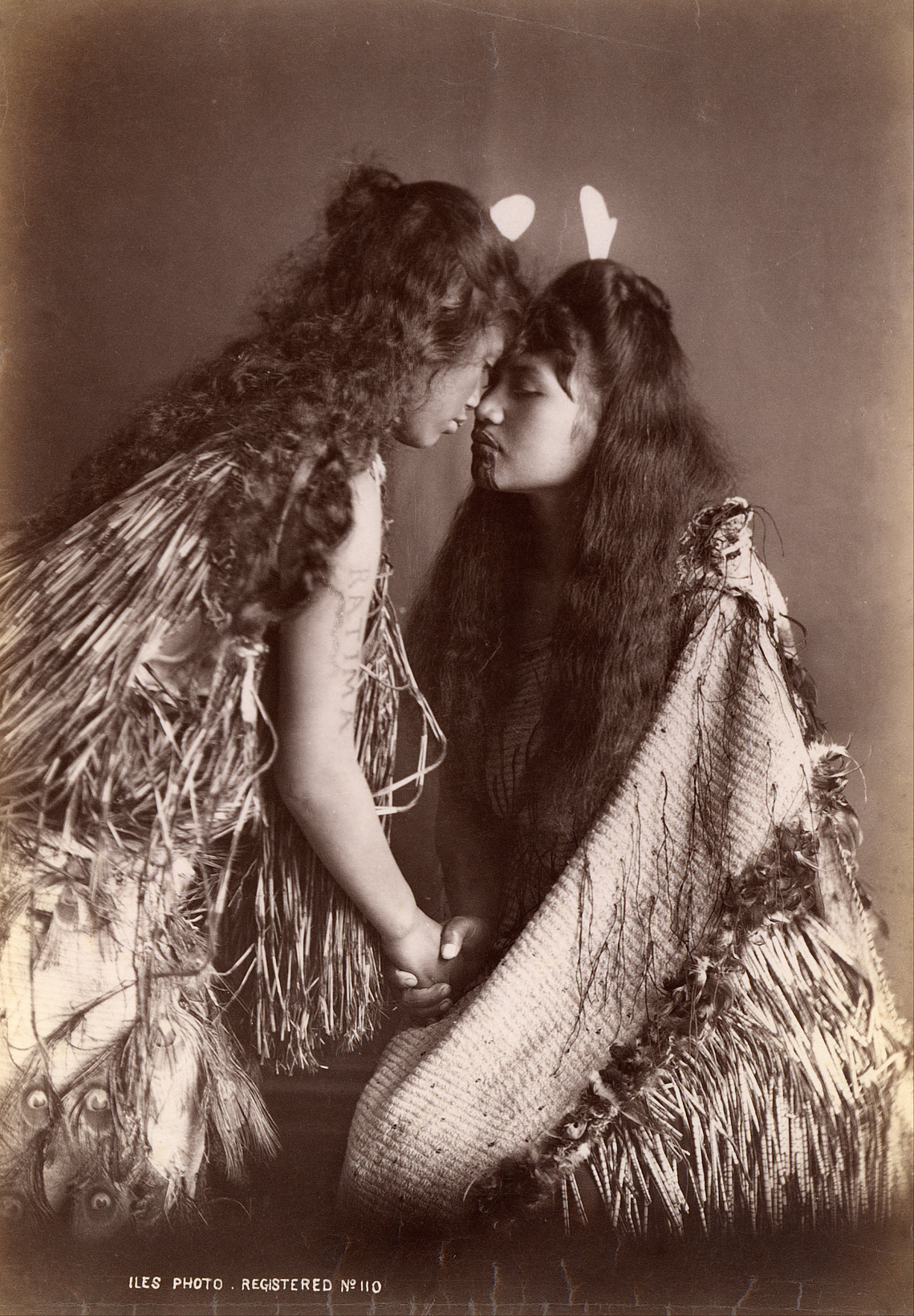
Two Māori women rubbing noses as a greeting in 1890-1920
About 80 percent of Māori live in the urban areas in New Zealand. The Māori population changed from 75 percent rural to 75 percent urban in between the 1960s and the early 2000s. Until the 1920s, almost all Māori lived in rural areas. Māori for the most part is like that of other New Zealanders.[Source: J. Williams, “Worldmark Encyclopedia of Cultures and Daily Life,” Cengage Learning, 2009]
Most Māori live in towns and cities of the northern sections of North Island. In the past there were two types of Māori settlements: fortified (pā) and unfortified (kainga). The pa, where people took refuge during wartime, were typically situated on hills and protected by ditches, palisades, fighting platforms, and earthworks. Houses in the pa were tightly packed, often on artificial terraces. Kainga were unfortified hamlets consisting of five or six scattered houses (whare), a cooking shelter (kauta) with an earth oven (hangi), and one or two roofed storage pits (rua). [Source: Christopher Latham,“Encyclopedia of World Cultures, Volume 2: Oceania,” edited by Terence E. Hays, 1996]
The traditional Māori greeting is called a “hongi”. It involves a hand shake and a nose press in which two people press their nose together, close their eyes and go "mm-m." Men and women, women and women and men and men greet each other using the “hongi”. It is believed that their spirits mingle when doing this. Hakari (feasting) is and has been an important component of Māori culture. Māori feasts traditionally brought together a number of different families and other social groups and have been hosted by a man of status, who provided food and gifts for those who attended and was left broke in the end but with a higher level of status. These days it is customary for Hakari participants to donate some money when they join the event to help defer the costs.
RELATED ARTICLES:
MĀORI: POPULATION, LANGUAGE, CULTURE ioa.factsanddetails.com
MĀORI CUSTOMS: ETIQUETTE, THE POWHIRI AND THE HAKA ioa.factsanddetails.com
CUSTOMS AND ETIQUETTE IN THE PACIFIC REGION, POLYNESIA AND MELANESIA ioa.factsanddetails.com
MĀORI RELIGION: TRADITIONAL BELIEFS, CHRISTIANITY, CEREMONIES ioa.factsanddetails.com
MĀORI SOCIETY AND FAMILY: MARRIAGE, KINSHIP, MEN AND WOMEN ioa.factsanddetails.com
TRADITIONAL MĀORI BUILDINGS, VILLAGES AND HOMES ioa.factsanddetails.com
MĀORI CULTURE AND ART ioa.factsanddetails.com
MĀORI TATTOOS: HISTORY, HOW THEY WERE MADE, SMOKED HEADS ioa.factsanddetails.com
WAKA (MĀORI CANOES): HISTORY, TYPES, ART, HOW THEY ARE MADE ioa.factsanddetails.com
MĀORI GOVERNMENT: KING, QUEEN, POLITICS, CHIEFS ioa.factsanddetails.com
FIRST PEOPLE OF NEW ZEALAND: MODELS, IMPACT AND LATE ARRIVAL ioa.factsanddetails.com
EARLY MĀORI: ORIGIN, ARRIVAL IN NEW ZEALAND, LIFE, WARFARE
ioa.factsanddetails.com
MĀORI AFTER THE ARRIVAL OF EUROPEANS ioa.factsanddetails.com
Māori Food
In New Zealand, food is referred to by everyone by the Māori word "kai." A fondness for seafood (kaimoana), particularly shellfish such as paua (abalone)and eels, seems natural enough as New Zealand is made of islands and most places are not far from the sea. The kumara, a sweet potato that was traditionally one of the most important crops, is perhaps the most famous Māori food and is now one of New Zealand’s most beloved foods. Rewena paraoa, a traditional Māori bread made from potatoes, is becoming popular among all New Zealanders.
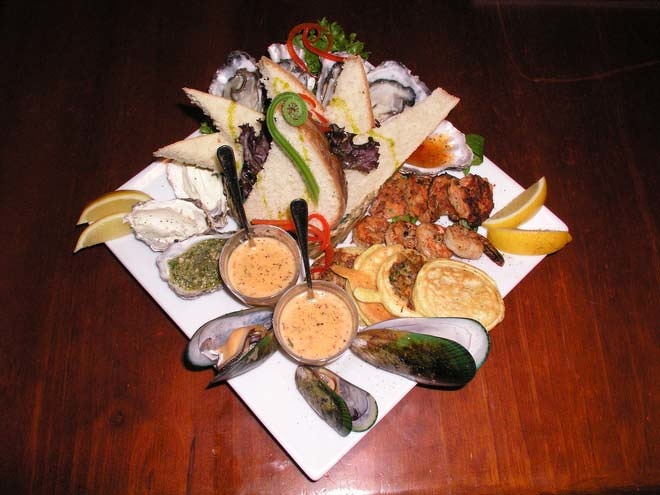
Contemporary Māori cuisine: seafood platter includes fresh mussels, oysters and cooked seafood, garnished with pikopiko (fern shoot)
Māori today typically eat the same kinds of foods as other New Zealanders. Breakfast often consists of eggs and sausage or bacon. Lunch may be a meat pie or sandwich. Dinner is a full meal with a meat dish as the main course. The traditional Polynesian foodstuffs of taro (a starchy root), yams, and breadfruit were not well adapted for cultivation on the temperate islands of New Zealand. [Source: J. Williams, “Worldmark Encyclopedia of Cultures and Daily Life,” Cengage Learning, 2009 *]
Kumara has traditionally been the staple of the Māori diet. It and taro, gourds and yams were brought to New Zealand from their home islands in Polynesia. Today, bread made with potato yeast and cooked on heated stones is very popular.
One of the Māori's favorite foods is “kina” (sea urchin), which is best eaten raw and fresh from the sea. To eat it you crack the shell open with a knife, scoop out the animal with you thumb and drop it into your mouth. Pūhā, a bitter, green plant that is a traditional part of the Māori diet, is often cooked with pork. Huhu grubs, a traditional food, particularly in inland communities, are still eaten by Māori.
Another Māori delicacy is “kiore”, a kind of rat brought by the ancient Māori from Polynesia. Kiore, native birds and fish were the main sources of protein before British settlers introduced pigs, sheep and cattle. Kiore were considered vermin by European settlers and nearly eradicated. Now they are found mostly on New Zealand's offshore islands. Some Māori tribes have discussed exporting the rat to some Asian countries as a delicacy.
Māori translations for commonly-eaten vegetables: aniana – onion (also riki), aonanī – Brussels sprout), apareka – asparagus), atihoka – artichoke), harere – celery (also herewī), harore – mushrooms), herewī – celery (also harere), kānga – corn), kāpeti – cabbage), kareparāoa – cauliflower), kāroti / kāreti – carrot), kīkini – green pepper), kōkihi – spinach (also rengamutu), korare – silverbeet), kūkama – cucumber), kūmara – sweet potato), otahua – aubergine/eggplant), paukena – pumpkin), pī – peas), pīni – beans), puananī – broccoli), rapikama – capsicum (peppers), rarihi – radish (also uhikura), rengamutu – spinach (also kōkihi), rengakura – beetroot), rētihi – lettuce), riki – onion (also aniana), rikiroa – leek), rīwai – potato), tōmato – tomato), tōnapi – turnip), uhikura – radish (also rarihi)
Māori Eating Customs
Māori eating customs emphasize community and respect, with meals often starting with a spiritual blessing (karakia) and guests waiting for elders to begin eating. Traditional practices include community-prepared meals in a communal dining hall (wharekai) and hygiene practices like washing hands before eating. Visitors are expected to thank hosts and sometimes sing songs as a show of gratitude for their hospitality.
Communal meals are common, and visitors are encouraged to interact and mingle with the hosts during the meal. Māori groups such as families and subclans have traditionally seen as groups that ate together. Meals are often served in a wharekai (dining room), a space separate from the main meeting house. Community members often cook and serve meals voluntarily, so showing appreciation for their work is important.
It is a good idea for people to wash their hands before eating as a nod to good hygiene. Elders (kaumātua) and children are often served or allowed to begin eating first. There is an expectation to finish all the food on your plate, or other family members will help, to avoid waste. It is customary for guests to thank their hosts, especially towards the end of the meal, to acknowledge the hospitality and effort put into the meal.
Peter Oettli wrote in “CultureShock! New Zealand”: “ It is customary for a senior member of the group to say grace before the meal. This is generally said in Māori and you should not start to eat before the karakia has been said. Also, Māori find it most offensive if you sit on a table where food has been served or may be served later. The best thing to do is simply never to sit on a table in a Māori setting.
Hangi — the Māori Feast
The “hangi” (traditional Māori feast) evolved out of traditional Polynesian pig roasts in which a pig was buried in a shallow pit and cooked with stones heated with firewood. In a Māori hangi, beef, pork, chicken, corn, potatoes, “kumaras”, shellfish and eels are placed on top of the stones, covered with sacks and earth and cooked for several hours. Modern “hangi” usually features lamb, trussed chickens, pork, local fish, tomatoes, pumpkins and potatoes. Sometimes hangi take place at geothermal vents. These are only done in the regions of the country where there are hot springs. A pit is dug in the ground and filled with rocks heated by the vents, which sometimes give off a sulfury smell .
A hangi involves digging a pit, heating stones with a large fire for several hours, placing food wrapped in cloth or leaves into wire baskets on the hot stones, and then covering everything with a wet cloth and earth to create a steam oven for 3-4 hours. After the cooking period, the food is uncovered to reveal tender, smoky, and earthy-flavored meat and vegetables, which are then shared with family and friends at a communal celebration.
A hangi is a communal event, so inviting friends and family to participate in the cooking process is the first step. Choosing the location and digging the pit is next step. For this one needs to : find a suitable outdoor area free from flammable materials and dig a pit, typically around one meter deep and 1.5 meters wide. The heating stones are usually rounded river stones or volcanic stones such as andesite or basalt and need to be able to withstand high heat. The large fire used for cooking is made with wood placed in the pit or outside the pit and the stones are placed in the fire until they heat up to high temperatures.
For food preparation, meat, root vegetables, seafood and other items are wrapped in leaves or wet cloths to shield them from direct heat. When the the food is ready, the hot stones are carefully removed from the burning wood and placed in the pit. Baskets of food are placed on top of these hot stones. The food baskets are covered with a wet cloth to create steam and then cover the entire pit with earth to trap the heat and allow the food to cook. The food cooks for three to four hours. Once cooked, uncover the hāngī to reveal the tender, flavorful food, which is then shared among everyone. the pit. The food is left to steam for several hours.
Māori Sex
Premarital sexual relationships were considered normal for Māori adolescents. Both males and females were expected to have several discreet relationships before marriage. When Māori females became sexually active, they publicly acknowledged it so they could be tattooed. The tattooing ritual marked their passage into adulthood. This practice was also considered extremely attractive and erotic. [Source: J. Williams, “Worldmark Encyclopedia of Cultures and Daily Life,” Cengage Learning, 2009 *]
Polack (1840) wrote: “The girl of ten years, is frequently a married woman in New Zealand, and at eleven becomes a mother”. Tregear (1890) state Māori wouldn’t know about the fate of their virginity“for she had love affairs with boys from the cradle”. The custom of betrothal in infancy was by no means uncommon among the Māori people as it some times occurred at the conclusion of the Pure ceremony over a newly-born child (Best, 1914). Ford and Beach (1951) said:“Māori children frequently meet in the bush for sex play... Māori children “play together at being husband and wife at night in the Bush. Full copulation frequently occurs before puberty”[Source: “Growing Up Sexually, Volume” I by D. F. Janssen, World Reference Atlas, 2004]
But, according to the Beagleholes (1946): “Perhaps because of [the] trait of casualness spills over into other parts of life and because this Māori society is still fairly casual about the biology of sex, it appears that sex play and masturbation among these Māori children are rare. One young mother said that the only sex play she learned as a child was taught by pakeha (white) schoolboys. Another young mother could remember only one Māori boy who masturbated and no girls. There may, of course, be other cases in the community. The fact remains, however, that sex play among these Māori children seems to be infrequently indulged in”. Enlightenment by the same-sex parent seems customary, at least in early adolescence.
Māori, according to to some, has traditionally been viewed as a normal, integrated part of society, with the ancient term takatapui being reclaimed to describe diverse gender and sexual identities. Historically, Māori society accepted and even honored takatapui individuals, who held respected positions within their communities. While European colonization introduced more restrictive views, the concept of takatapui and the understanding of sexual diversity have experienced a resurgence in contemporary Māori culture.
No all Māori share this view and controversial gender topic in modern Māori society is that of role of homosexuality in precontact times. Takatapui was defined in the earliest dictionary of the Māori language as "an intimate companion of the same sex" (Williams 1834). Following colonization and the impact of Christian missionaries, the word had fallen into disuse, but it has recently become part of the vocabulary of the lesbian, gay, bisexual, transgender (LGBT) community in New Zealand. There is controversy over whether homosexuality was part of precontact Māori gender relations. Current and comprehensive accounts clearly demonstrate the important roles of takatapui in pre-contact Māori society and their incorporation into iwi and whānau. *\
Māori Clothes
Māori typically wear modern Western-style clothing, but still wear their traditional clothing for special occasions. Traditional Māori garments includes kākahu (cloaks), such as the korowai adorned with feathers and the piupiu skirt made from woven flax. Made primarily from harakeke (flax) and often decorated with intricate woven patterns called tāniko, these garments hold deep cultural significance, reflecting identity, status, and a connection to the natural world.
The “kakahu” is a feathered cape used by Māori for ceremonial purposes. It has traditionally been made of flax without needles, without looms, and without tools of any kind except the fingers of the women who make them. Kakahu worn by esteemed Māori chiefs sometimes are adorned with kiwi feathers. They are decorated with intricate geometric patterns created with the tāniko weaving technique.
The traditional garment for Māori men is a woven-flax “piupa” often worn with out a shirt. Women also wear piupa but with a top. The korowai is a particularly prestigious and iconic example of a cloak, worn during significant ceremonies by high-ranking individuals. Piupiu are commonly worn during performances, such as the haka (war dance). The Māori tunic is a simple, elegant, and versatile garment made from soft, natural materials, worn for both everyday activities and special occasions.
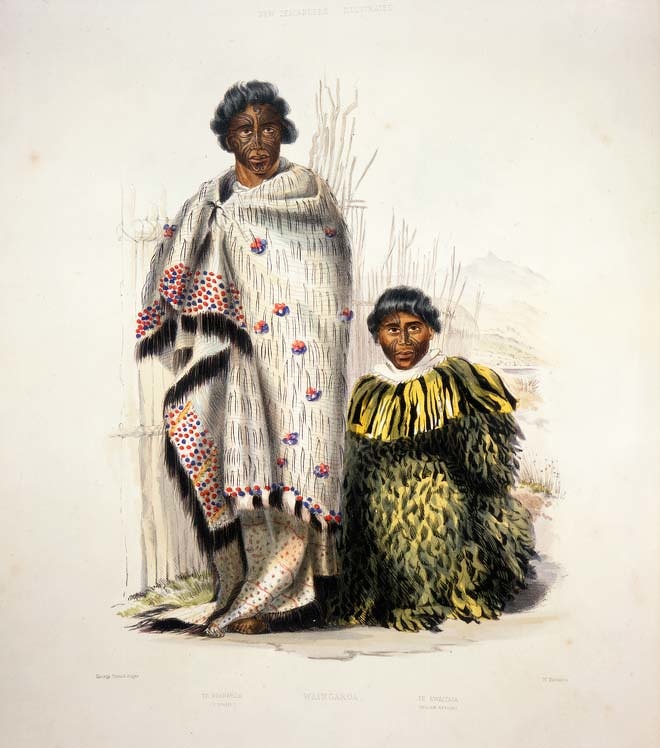
Waikato chiefs Te Moanaroa and Te Awa-i-taia wearing prestige cloaks
Harakeke (Flax) is the primary material used to make many traditional Māori garments, It is harvested from flax plants and processed into fibers. Feathers used to adorn cloaks have traditionally symbolized status and power. Tāniko is A distinctive weaving technique used to create intricate geometric patterns on cloaks, skirts, and other garments. Traditional Māori clothing is deeply connected to the wearer's identity and social status within the community. These garments are generally reserved for important cultural performances, ceremonies, and special occasions. The use of natural materials like flax and feathers signifies a deep connection between the people and the natural world.
Māori Cloaks (Kaitaka)
The Metropolitan Museum of Art collection contains Cloak (Kaitaka aronui) made of flax (Phormium tenax), wool. Dating to the mid-19th century, it measures 113.7 × 172.7 centimeters (44.75 inches high, with a width of 68 inches). Another cloak at the museum — a Kaitaka — is also made of Flax (phormium tenax species) and wool. It dates to the 19th century and measures 160 x 188 centimeters (63 x 74 inches)
On the Kaitaka aronui, the Metropolitan Museum of Art says, This magnificent Māori cloak from New Zealand is a singular example of the genre known as kaitaka aronui and features wefts which run in a horizontal direction when worn. The main body of the cloak is broadly rectangular, flaring out gently to each side at the bottom. Soft and supple to the touch, a series of extra seams are ingeniously woven into the main body (kaupapa) of the cloak creating darts that enable the cloak to rest comfortably on the shoulders when worn. The lower border of the cloak is decorated with a wide woven taniko border. This distinctly Māori technique of finger-twining used traditionally dyed fibers highlighted with touches of brightly colored wool yarns, and was an innovation born out of early interaction with Europeans. This example is no exception and features a set of characteristic designs—triangles, chevrons and zig-zags—in natural with black, brown and red highlights, arranged symmetrically to produce a lively, dynamic aesthetic. [Source: Evelyn A. J. Hall and John A. Friede, Oceanic Art, Metropolitan Museum of Art]
Cloaks of this caliber are rare and this example is in exceptional condition given its age. The kaitaka form as a genre attained particular eminence in New Zealand during the first quarter of the 19th century. A special type of flax (Phormium tenax) was cultivated to produce the fine silken fiber (muka) that creates the lustrous sheen of these extremely prestigious cloaks, which were worn by high-ranking Māori men and chiefly women. The fibers were prepared carefully with no recourse to the usual soaking and beating in preparation since these processes reduced the silken sheen of the final garment. The unadorned surface of the cloak also called for expert execution of the double-pair twining technique (whato aho rua) which produced its supple, silken quality.
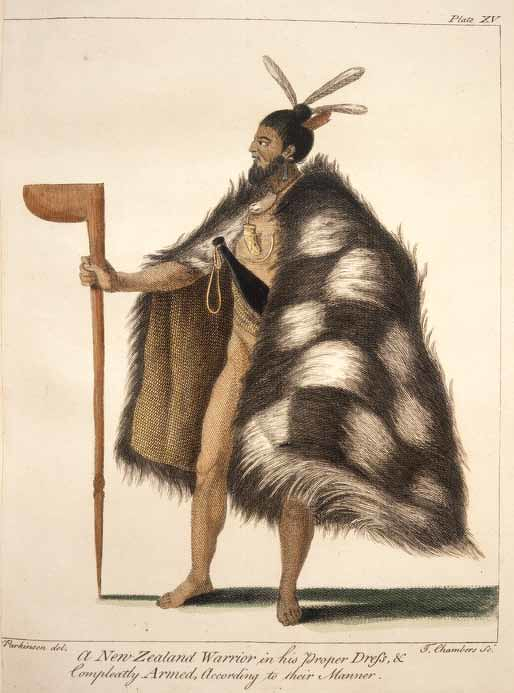
Chief wearing an ihupukupuku (full dog skin cloak), 1769–70 engraving after a sketch by Sydney Parkinson
The knowledge embedded in the weaving arts belongs to Te Whare Pora (The House of Weaving), which is associated with Hine-te-iwa-iwa, the spiritual entity who presides over the art form. According to Māori, Hine-te-iwaiwa is the daughter of the great Tane-nui-a-rangi, the deity associated with the forests and birds, and Hine-rauamoa, who is variously described as the female element Tane searched for to create mankind, and as the youngest and most fragile child of light who was taken by Tane to illuminate the world of darkness. Important protocols were, and continue to be, strictly adhered to at each stage in the cultivation, harvesting and preparation of flax fibers for the weaving of fine cloaks.
These protocols are in keeping with strict guidelines established to ensure the spiritual safety of the weaver as the art form is deemed to be a sacred (tapu) activity overseen by Hine-te-iwaiwa who is also the personification of childbirth and the cycles of the moon. The close genealogical relationship of Hine-te-iwaiwa with the primordial gods of Ranginui (Sky) and Papatuanuku (Earth) accounts for the high esteem in which the art form is held and the status of the women who were chosen to learn the art. Weavers continue to be held in high esteem and the art of weaving (raranga) continues as one of the most dynamic and innovative Māori art forms to this day.
Kahu Kuri (Dog skin cloak) (Te Huringa I, 1800–1900) attributed to Te Ati Awa is made of flax fiber and dog skin strips; This magnificent cloak is made from strips of skin taken from the kuri (Pacific dog). The strips were arranged by hair color, then sewn with painstaking precision to a foundation of tightly woven New Zealand flax fiber. Each Kahu kuri had its own personal name and carefully preserved history. On ceremonial occasions these cloaks were often exchanged between people of rank, in recognition of the high status of both giver and receiver. [Source: Māori Treasures from the Museum of New Zealand Te Papa Tongarewa Tokyo National Museum, Heiseikan Special Exhibition Gallery 1 & 2, January — March 2007]
Kahu huruhuru (feather cloak) (Te Huringa I, 1800–1900) is made of flax fiber, kereru, tui, and kaka feathersThe vivid pattern of this kahu huruhuru comes from feathers of native New Zealand birds. The green and white feathers are from the kekeru (wood pigeon), while the red and orange feathers are from the kaka, a forest parrot.
Māori Cloth and Weaving
Eric Kjellgren wrote: Māori clothing was made primarily from flax, or harakeke, which was woven (or, more accurately, twined), to create a variety of garments. Māori weavers used two types of flax: harakeke (Phormium tenax}, which is the most widely used, and wharariki {Phormium wokianum}, which is occasionally used for special purposes. Garment weaving was a woman's art form, though weavers created clothing for both sexes. In some areas men reportedly participated in weaving to a limited extent Māori clothing consisted primarily of cloaks and matlike cloths worn around the waist, as well as belts and sandals. In the most prestigious cloaks the flax foundation was often embellished with precious materials such as feathers or dog skin, or accented with intricately woven decorative borders. [Source: Eric Kjellgren, “Oceania: Art of the Pacific Islands in The Metropolitan Museum of Art”, 2007]
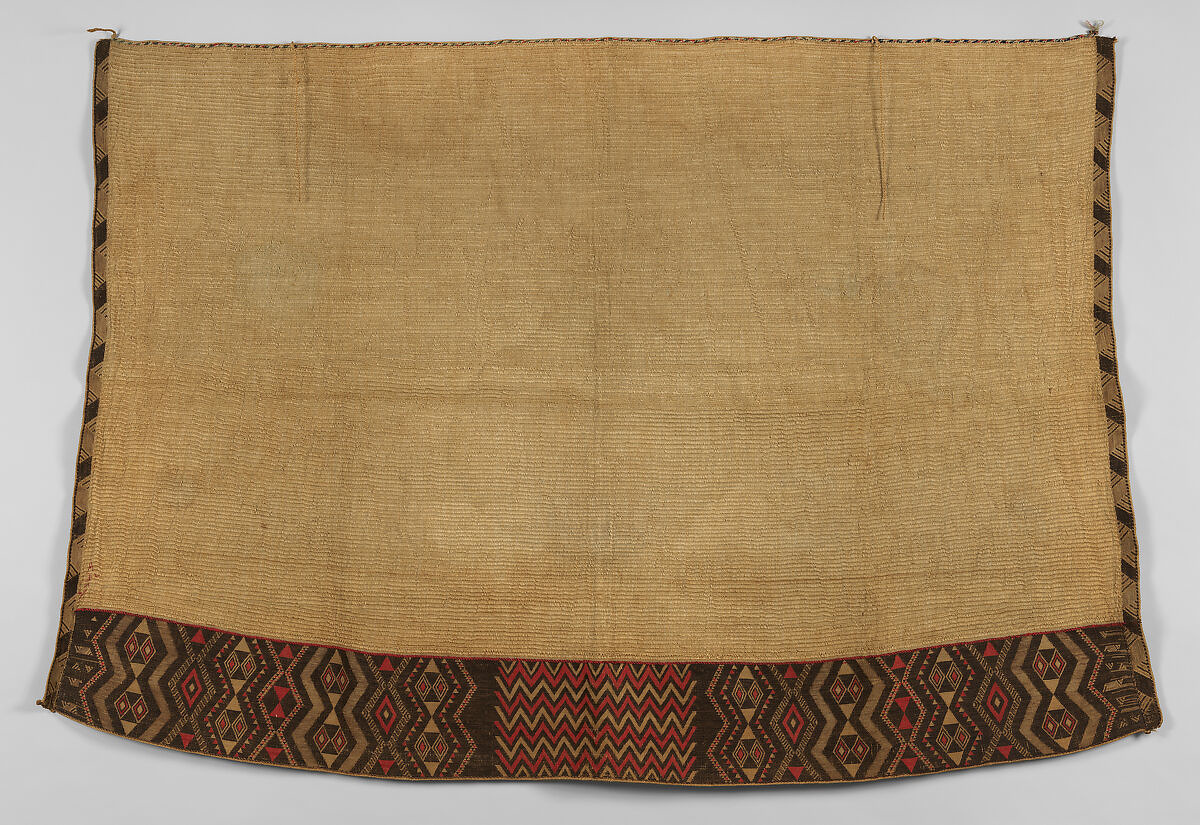
Kaitaka aronui at the Metropolitan Museum of Art
According to the Metropolitan Museum of Art: Most Māori garments, including cloaks, were made using a twining technique known as whatu, in which single or double pairs of wefts were wrapped around each warp thread individually by hand. The practical preparation of fibers for weaving was a lengthy process. Fibers from the leaves of the flax plant (Phormium tenax) were extracted by skillful cutting and scraping with a shell, and then washed. Prepared fibers were gathered into rolls and pounded with a stone beater to soften them. The process of twining began when the weaver drove two pegs into the ground and stretched between them a single cord from which the strands of flax were hung.
The act of weaving was emboldened by this integration of cosmological principles into its material frame. It was a strategy intended to heighten the efficacy and potency of textiles which were conceived as a means to mirror the very fabric of the universe itself and our own integral, and interconnected, relationship with it.
Weaving declined markedly in the nineteenth and early twentieth centuries due to the introduction of imported cloth. However, the weaver's art endured, and during the past several decades it has undergone a renaissance as a new generation of Māori weavers has embraced and revitalized the traditions and techniques of their ancestors.
The entire Māori weaving process was carried out by women and governed by strict ritual protocols. Novice weavers prepared to enter the whare pora (house of learning), where they received knowledge of weaving arts through karakia (prayers) and initiation ceremonies. These ceremonies endowed each student with a receptive mind and attuned her to the knowledge necessary to understand the practical and spiritual concepts associated with weaving. [Source: Evelyn A. J. Hall and John A. Friede, Metropolitan Museum of Art]
Māori Weaving Process
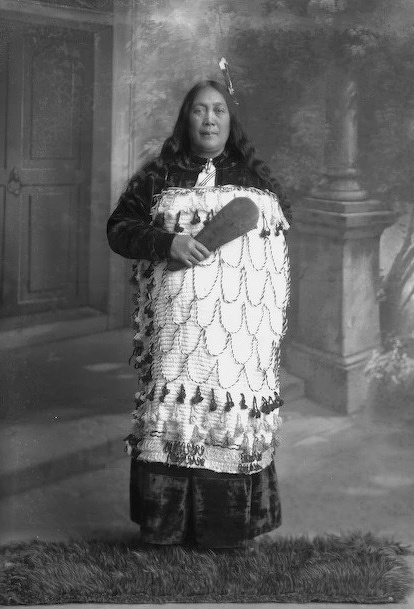
woman in a kiwi feather cloak
Eric Kjellgren wrote: Māori weavers did not use a loom. Rather, they employed two upright weaving pegs, or turuturu, which held the threads of the textile during weaving. Carved by men, the two pegs were of different types. The peg on the left side was undecorated; that on the right was considered sacred (tapu) and was often adorned, as here, with one or more tiki (human images), likely representing important ancestors. A woman's career as a weaver began in earliest childhood when, at the age of eight days, she was ceremonially dedicated to the art of weaving. This initial ceremony was followed by many years of practice and observation of experienced weavers. [Source: Eric Kjellgren, “Oceania: Art of the Pacific Islands in The Metropolitan Museum of Art”, 2007]
When the time was deemed appropriate she would be initiated into the fare para (house of weaving) in a ceremony assisted by a tohunga (religious specialist). During the ceremony the weaving pegs were inserted into the ground and the ti rst ti ber of the new textile was stretched between them. Before the young woman began to weave, the tohunga chanted an incantation:
Stick in the peg; it is the peg Of eager desire, of swiftness.
Stand medium of authority, stand medium of the house,
Send here the weft to be hastily woven
So it may be woven quickly to be soon completed,
Soon above, soon below; Soon to be completed the bottom end,
Completed wide apart, completed in the house.
Tremble the hill , The hill heaped up, the mound gathered together;
Heaped up to the sky, Widely across the land.
Be completed! Be completed!
At the conclusion of the chant, the young woman bent forward and bit the sacred right-hand weaving peg, and the power embodied in the chant entered her body through her mouth. 9 After the ceremony was concluded, the weaver was deemed to have the necessary mana (supernatural power) and confidence to join the company of the weavers and continue to master her art.
Māori Education
Public education has become the norm for most urban Māori, though several preschools based on Māori cultural education have been established throughout New Zealand. Education is state-supported and compulsory in New Zealand for children between the ages of six and 15. Students planning to attend one of the country's six universities continue their secondary education until age 17 or 18, at which point they must take university qualifying exams. [Source: J. Williams, “Worldmark Encyclopedia of Cultures and Daily Life,” Cengage Learning, 2009]
In the later 19th century and early 20th century, the use of the Māori language was officially discouraged in schools. In 1867, New Zealand passed the Native Schools Act, outlawing the use of the Māori language in schools. Teachers and school administrators beat students who dared to speak their mother tongue. [Source: Aroha Awarau, National Geographic, June 29, 2024]
In an effort to keep their language alive the Māori have started language-immersion child-care centers called kohanga reo, or language nests, "where kids spend te day with fluent elders." Preschools that offer instruction in Māori language have sprung up all over the country at a rapid rate as a result of Māori activism. [Source: “Junior Worldmark Encyclopedia of World Cultures,” The Gale Group, Inc., 1999]
Māori Jobs, Work and Economic Life
Today, Māori work in the same wide range of occupations and professions typical of any modern industrial society, with about two-thirds employed in the service sector. However, traditional Māori society had already developed a sophisticated division of labour and professional specialization long before European contact. Skilled experts such as tattoo artists, canoe builders, house builders, and carvers were all known as tohunga—a term that conveys both sacredness and mastery, often translated as “priest” or “expert.” Each tohunga was dedicated to the gods associated with their craft and underwent ritual initiation. These artisans generally came from chiefly families and held high social status within their communities. [Source: J. Williams, “Worldmark Encyclopedia of Cultures and Daily Life,” Cengage Learning, 2009]
Māori unemployment in New Zealand is at approximately 8.4 percent as of 2024, a figure that is consistently higher than the national average of about 5.1 percent. This rate has been increasing since 2023 due to factors like public sector job cuts and an economic slowdown. While national unemployment is at 5.2 percent (June 2025 quarter), specific regional and demographic rates, such as youth unemployment (19.1 percent for Māori aged 15-24), are significantly higher. [Source: Google AI]
Traditionally, Māori subsistence was based on fishing, gathering, and horticulture, particularly the cultivation of sweet potatoes (kūmara), along with taro, yams, and gourds. Fishing involved the use of lines, nets, and traps, while birds were caught using spears and snares. Māori also gathered shellfish, berries, roots, shoots, and piths, and hunted rats for food. In regions with poor soil or during harsh seasons, fern roots were an important supplementary starch. Kūmara was typically planted in October and harvested in February or March, while winter was the key hunting season. Procuring food required considerable time and effort, reflecting the close relationship between Māori and their environment. [Source: Christopher Latham,“Encyclopedia of World Cultures, Volume 2: Oceania,” edited by Terence E. Hays, 1996 |~|]
Land ownership was communal, held by descent groups or tribes (iwi). Each group controlled its own territory and granted its members rights to use and occupy specific areas. Only the tribe as a whole could transfer or alienate land, and even then only with collective consent. Disputes over boundaries were a frequent cause of conflict. Within the tribe, the whānau (extended family) held rights to particular resources or parcels of land, which were passed down through generations. Non-members could be granted usage rights only with the permission of the group, reflecting the strong collective nature of Māori land tenure and kinship ties.
Image Sources: Wikimedia Commons, Te Ara Encyclopedia of New Zealand,
Text Sources: “Encyclopedia of World Cultures, Volume 2: Oceania,” edited by Terence E. Hays, 1996, National Geographic, New Zealand Tourism Board, New Zealand Herald, New Zealand government, Te Ara Encyclopedia of New Zealand, Live Science, Natural History magazine, New Zealand Geographic, New York Times, Washington Post, Los Angeles Times, Smithsonian magazine, Encyclopedia.com, Library of Congress, The Conversation, The New Yorker, BBC, CNN, Reuters, Associated Press, AFP, Lonely Planet Guides, Culture Shock! New Zealand, Wikipedia, The Guardian and various websites, books and other publications.
Last updated October 2025