
Home | Category: Nature, Environment, Animals
CONTROLLING INTRODUCED ANIMALS IN NEW ZEALAND
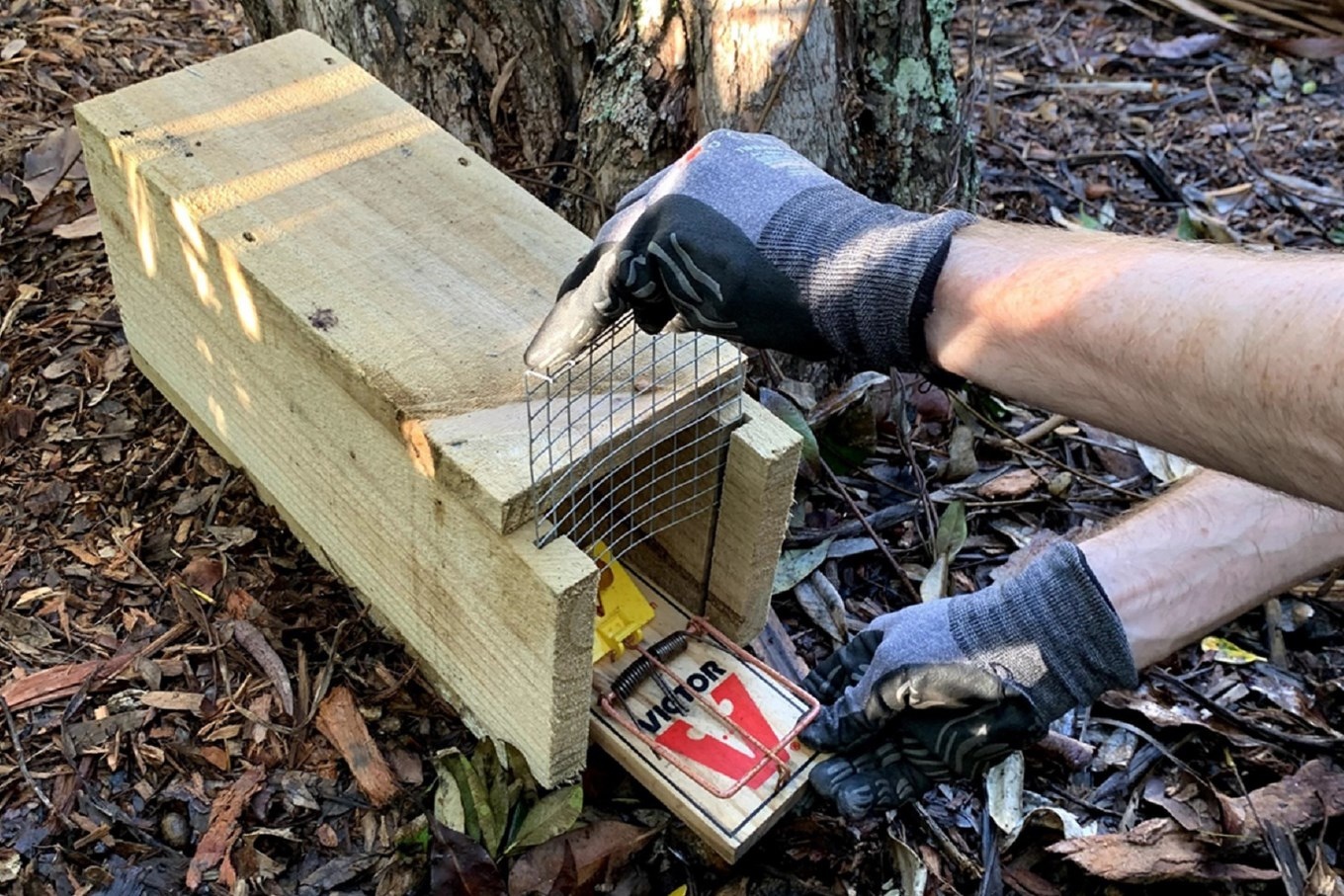
backyard rat trap in Auckland area
Richard C. Paddock wrote in the Los Angeles Times: Much of the ecological management in New Zealand entails correcting the mistakes of the past and combating intruder species introduced intentionally or by accident. The Department of Conservation spends so much of its resources killing possums and other unwanted creatures that it has earned the nickname "Department of Culling." New Zealand recently slashed its defense budget, grounded its combat air force and cut the size of its navy by a third. But it spends more and more each year fighting what it sees as its real enemy: alien species. [Source: Richard C. Paddock, Los Angeles Times September 9, 2001]
To get rid of the rabbits, stoats and weasels were introduced but they favored bird eggs to rabbits. The rabbits were finally brought under control by feeding them poison carrots dropped from planes and introducing a rabbit-killing virus. Around 2000, a disease used in Australia to control rabbits arrived in New Zealand. It worked fairly well but there was some blowback. Stoats, introduced as a predator to rabbits, were left deprived of food, and turned to targeting young kiwis. This represent a classic case of what not to do regarding the introduction and management of invasive species, says Elaine Murphy, principal scientist at New Zealand's Department of Conservation and an expert on introduced mammals and the threats to diversity they pose. Similar blowback occurred when European birds were brought into to control introduced insects. [Source: Delphine Paysant, AFP, September 3, 2023]
Peter Oettli wrote in “CultureShock! New Zealand”: “ The New Zealand authorities are still working on containing the damage done by the indiscriminate introduction of foreign animals. Opossum and rabbit control cost millions of dollars. Offshore islands have been rid of goats and rats to allow the natural flora to regenerate and the indigenous birds to re-establish themselves. Deer are now farmed under controlled conditions, and a thriving industry has developed around them. There are now about 1.6 million deer being farmed on more than 4,000 farms throughout the country — about half the world’s farmed deed population. New Zealand is the major world supplier of venison today. [Source: Peter Oettli, “CultureShock! A Survival Guide to Customs and Etiquette: New Zealand”, Marshall Cavendish International, 2009]
University of Auckland Prof. Mick Clout is involved in the struggle to remove invasive species from islands, mostly in a bid to protect seabird populations. They have targeted dozens of islands over the past few decades with mixed success. Cats were removed from Little Barrier island off New Zealand, but it took a second campaign against a growing rat population. On the remote Campbell island off New Zealand, authorities successfully removed sheep, cattle, cats and rats in one of the biggest eradication projects to date. [Source: Associated Press, January 14, 2009]
How Nature-Loving New Zealanders Deal With Killing Invasive Predators
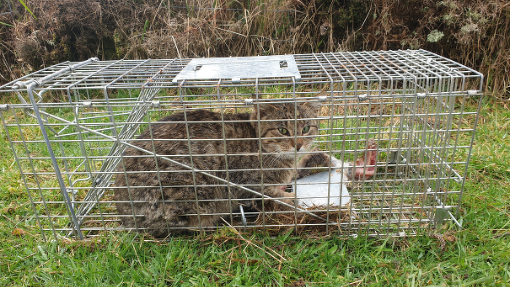
trapped feral cat
New Zealanders tend to be nature lovers. Elizabeth Kolbert wrote in The New Yorker: On a per-capita basis, New Zealand may be the most nature-loving nation on the planet. With a population of” 5.3 million people “the country has some four thousand conservation groups. But theirs is, to borrow E. O. Wilson’s term, a bloody, bloody biophilia. The sort of amateur naturalist who in Oregon or Oklahoma might track butterflies or band birds will, in Otorohanga, poison possums and crush the heads of hedgehogs. As the coördinator of one volunteer group put it to me, “We always say that, for us, conservation is all about killing things.” [Source: Elizabeth Kolbert, The New Yorker, December 22 & 29, 2014]
The reasons for this are in one sense complicated — the result of a peculiar set of geological and historical accidents — and in another quite simple. In New Zealand, anything with fur and beady little eyes is an invader, brought to the country by people — either Maori or European settlers. The invaders are eating their way through the native fauna, producing what is, even in an age of generalized extinction, a major crisis. So dire has the situation become that schoolchildren are regularly enlisted as little exterminators. (A recent blog post aimed at hardening hearts against cute little fuzzy things ran under the headline “Mrs. Tiggy-Winkle, Serial Killer.”)
Not long ago, New Zealand’s most prominent scientist issued an emotional appeal to his countrymen to wipe out all mammalian predators, a project that would entail eliminating hundreds of millions, maybe billions, of marsupials, mustelids, and rodents. To pursue this goal — perhaps visionary, perhaps quixotic — a new conservation group was formed this past fall. The logo of the group, Predator Free New Zealand, shows a kiwi with a surprised expression standing on the body of a dead rat.
Nick Smith, New Zealand’s minister for conservation told the The New Yorker: “I say to people, If you want your grandkids to see kiwi only in sanctuaries, well, that’s where we’re headed. And that’s why we need to use pretty aggressive tools to try to turn this around.” [Source: Elizabeth Kolbert, The New Yorker, December 22 & 29, 2014]
Stoat and Cat Traps
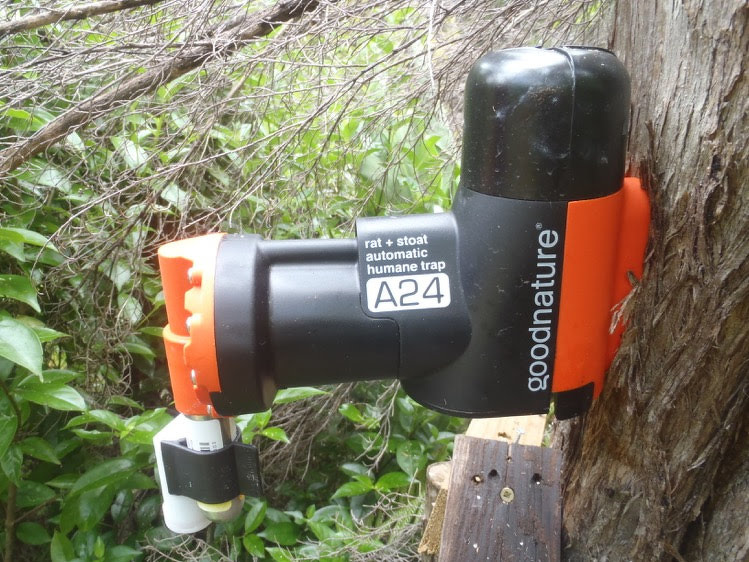
A24 rat and stoat trap
Elizabeth Kolbert wrote in The New Yorker: In the days — perhaps weeks — it had spent in the trap, the stoat had lost most of its fur, so it looked as if it had been flayed. Its exposed skin was the deep, dull purple of a bruise, and it was coated in an oily sheen, like a sausage. Stoat traps are often baited with eggs, and this one contained an empty shell. Kevin Adshead, who had set the trap, poked at the stoat with a screwdriver. It writhed and squirmed, as if attempting to rise from the dead. Then it disgorged a column of maggots. “Look at those teeth,” Adshead said, pointing with his screwdriver at the decomposing snout. [Source: Elizabeth Kolbert, The New Yorker, December 22 & 29, 2014]
The Adsheads had lined their farm with powerful traps, known as DOC 200s, which feature spring-controlled kill bars. DOC 200s are also helpful against ferrets, but the opening is too small for cats, so the Adsheads bought cat traps, which look like rural mailboxes, except that inside, where the letters would go, there’s a steel brace that delivers an uppercut to the jaw.
The Adsheads put out about four hundred traps in all, and they check them on a regular rotation. When I visited, they offered to show me how it was done. They packed a knapsack of supplies, including some eggs and kitty treats, and we set off. As we tromped along, Kevin explained his trapping philosophy. Some people are fastidious about cleaning their traps of bits of rotted stoat. “But I’m not,” he said. “I like the smell in there; it attracts things.” Often, he experiments with new techniques; recently he’d learned about a kind of possum bait made from flour, molasses, and cinnamon, and Gill had whipped up a batch, which was now in the knapsack. For cats, he’d found that the best bait was Wiener schnitzel. “I slice it thin and I tie it over the trigger,” he told me. “And what happens with that is it starts to dry out and they still go for it.”
Anti-Predator Fences
Describing an 47-kilometer-long anti-predator fence at a special mountaintop reserve, Kolbert wrote: The fence is seven feet high and made of steel mesh with openings so narrow an adult can’t stick a pinkie through. At the base of the fence, an eighteen-inch apron prevents rats from tunnelling under; on top, an outwardly curved metal lip stops possums and feral cats from clambering over. To get inside, human visitors have to pass through two sets of gates, an arrangement that made me think of a maximum-security prison turned inside out. [Source: Elizabeth Kolbert, The New Yorker, December 22 & 29, 2014]
Matt Cook, the reserve’s natural-heritage manager. Cook told us that it had taken teams of exterminators three years to eliminate mammals from inside the fence and that they’d never managed to finish off the mice. The entire perimeter was wired so that when, say, a section of fence was hit by a falling branch, a call automatically went out to a maintenance crew.
“This always happens at three A.M. on a Saturday morning,” he said. If the fence was breached, Cook reckoned, the crew had about ninety minutes to repair it before rats would find the opening and sweep back in.
Compound 1080
A poison called compound 1080 is widely used in the fight against invasive rats and stoats. Elizabeth Kolbert wrote in The New Yorker: The key ingredient in 1080, sodium fluoroacetate, interferes with energy production on a cellular level, inflicting what amounts to a heart attack.) New Zealand, which has roughly one-tenth of one per cent of the world’s land, uses eighty per cent of its 1080.
The Department of Conservation was planning to spread 1080 over nearly two million acres — had been prompted by an unusually warm winter, which had produced an exceptionally large supply of beech seed, which in turn had produced an explosion in the number of rats and stoats. When the beech seed ran out, the huge cohort of predators was expected to turn its attention to the native fauna.
The New Zealand government had approved the 1080 operation, which had been dubbed Battle for Our Birds, but the timing of it troubled him; owing to the exigencies of rat biology, the drop had to take place right around the time of a national election. “If you ask the cynical politics of it, people don’t like poisons but they like rats even less,” Conservation Minister Nick Smith said. “And so I’ve been doing a few quite deliberate photo opportunities with buckets of rats.”
Later, we landed on a small island named Adele, where we were greeted by a large sign: “Have You Checked for Rats, Mice and Seeds?” A few years ago, after an intensive campaign of poisoning and trapping, Adele was declared “pest-free.” The arrival of a single pregnant rat could undo all that work; hence the hortatory signage.
World's Largest Island Eradication of Rats
Rats are often poisoned with an anticoagulant that causes internal hemorrhaging. Alison Ballance reported for Radio New Zealand: It all began in 1964, when the late Don Merton and fellow conservationists declared that they had got rid of Norway rats on tiny Maria Island, in the Hauraki Gulf. At that time just 0.5 per cent of New Zealand islands were free of mammalian pests; today, 10 per cent are pest-free. Following Maria Island, conservationists began to tackle larger and larger islands, such as 170 hectare Breaksea Island in Fiordland and then 2000 hectare Kapiti Island. [Source: Alison Ballance, Radio New Zealand, March 26, 2015]
The New Zealand Department of Conservation, meanwhile, is planning its next subantarctic island eradications. Eradication manager Stephen Horn says "the main Auckland Island (with mice, cats and pigs) and Antipodes Island (mice) are the only two island groups remaining in the New Zealand Subantarctic with introduced mammalian pest species."
"The Antipodes Island Mouse Eradication, planned for winter in 2016, is the next step towards a long term goal of a pest-free New Zealand subantarctic region," says Stephen. "The Antipodes project follows on from successes on Campbell Island — rats in 2001- and Enderby island — mice and rabbits in 1993 — with experience and expertise gained on these eradications helping to shape the strategy and identify the risks on Antipodes. The sites are of huge biodiversity value and a one-off eradication operation leaves a legacy of recovery and preservation for incredibly valuable ecosystems. The subantarctic region also has low risk of a return on mammalian pest species, so eradication is the single most effective conservation strategy for these situations."
Possum Eradication in New Zealand
Possum eradicators in New Zealand go after the animals by using guns and spotlights, and trained "possum dogs" who seek them out in their burrows. Poisons, including cyanide, have proved to be the most effective way to get rid of them. Some animal rights activists have objected to the way the animals are being disposed of. Maori have objected to the poison being used on their land. In areas were the numbers of possums have been reduced, native birds such as tuis, bellbirds and kakapos have returned. On a dog food made with possum meat, New Zealand farmer Bryan Basset-Smith said: “It smells and tastes much like good corned beef. It’s got a nice odor and dogs just go quite bananas over it.”
Richard C. Paddock wrote in the Los Angeles Times: A generation of New Zealanders grew up making pocket money by hunting possums for bounty. Today, people across the country help out by trapping or poisoning the animals. "At the end of the day, New Zealand's clean and green image comes down to possum control," said Herb Christophers, a Conservation Department spokesman. "People want to come here because of the pristine nature." Most of the country is united against the pest. Conservationists loathe it because of the damage it causes to native trees and rare birds. City-dwellers hate it because it eats the plants in their back yards. And farmers detest it because it spreads tuberculosis among cattle. "The only good possum is a flat possum," farmers like to say. [Source: Richard C. Paddock, Los Angeles Times September 9, 2001]
Ian Roberts is one of many New Zealanders to have spent a lifetime killing possums. As a boy, he collected the government bounty for killing them. As a young man, he hunted them for fur. After fur coats became unpopular in the 1980s, he got into the possum-eradication business. Now 48, he is director of Epro, a large pest-management company in Taupo in North Island farming country. "A lot of people underestimate the possum," he said. "It's not a wise thing to do. Possums are survivors." Spending on eradication efforts in farming areas is expected to double in 2001, with the aim of suppressing bovine tuberculosis by 2013. For the time being, this gives a boost to efforts to protect native wildlife, but government interest in wiping out possums could fade if tuberculosis is brought under control.
With brushtail possums, immunocontraception blocked fertility is about 80 percent of treated animals. Among Australian tammar wallabies, the vaccine proved to be 100 percent effective. In the United States, a trial of immunocontraception on white-tailed deer resulted in an 87 percent reduction in fertility. [Source: Mary Roach, Discover, Dec 1, 2000] In New Zealand, researchers are testing a bioengineered virus on brushtail possums. To prevent the virus from spreading, they're using a "crippled" form of it that has been engineered not to replicate. The virus would be sprayed in a possum's face when the animal puts its head inside a feed box. Lowell Miller of the National Wildlife Research Center says this particular procedure will not be coming soon to America: "We'd be run out of the country if we tried to use a virus. We'd never get it registered with the Food and Drug Administration."
Using Compound 1080 and Bio-engineered Worms to Control Possums
Possums are regularly bombed with carrots,and enticed with peanut butter laced with the poison Compound 1080. Richard C. Paddock wrote in the Los Angeles Times: . Depending on the terrain, conservation workers set traps, place poison in bait stations or drop carrots Roberts said New Zealand began to make significant advances in controlling the possum after it obtained satellite-guided positioning technology used for dropping smart bombs during the Persian Gulf War. Now a skilled helicopter pilot can lay down a blanket of poison carrots with a margin of error of two yards or less. On a recent mission outside Taupo, pilot Dean Matthews flew through a canyon and over power lines to drop carrot chunks laced with Compound 1080 on a steep, forested hillside. "I don't want to fling it into the paddock," he said as he flew. "It will kill the sheep." [Source: Richard C. Paddock, Los Angeles Times September 9, 2001]
The controversial toxin is banned in the United States for nearly all uses because it can kill animals other than the intended target. In New Zealand, hunters oppose its use because it can kill deer that eat the bait, as well as hunting dogs that eat the carcasses of poisoned animals. But conservation and agriculture officials argue that Compound 1080 is essential in controlling the possum population until a more effective alternative is developed. "Without the use of the poison, New Zealand's forests will collapse," said Kevin Smith, an adviser to the conservation minister.
Scientists hope to combat the brush-tail possum by introducing yet another species into the wild — a tiny genetically engineered worm that would block the possum's ability to reproduce. While some question the wisdom of releasing a genetically altered creature, supporters say it may be the only way to bring the possum under control and could sterilize much of the possum population. The nematode would be developed from a species found only in brush-tail possums, said Phil Cowan, a leading scientist involved in creating the worm. It would be altered so that it would turn the possum's immune system against its reproductive system, thereby preventing conception.
Scientists hope the worm would spread among the population and reach possums even in remote areas. But success would depend on the ability of the altered worm to beat out its natural cousins. Even if it worked, it could be years before the nematode had a noticeable effect. The altered worm is still at least five years away from development and would have to pass public scrutiny before it would be deemed an acceptable risk.
Strategies for Tackling Invasive Species in New Zealand
Elizabeth Kolbert wrote in The New Yorker: New Zealanders are nothing if not practical. They like to describe the national mind-set as “the No. eight wire mentality”; for much of the country’s history, No. eight wire was used to fix livestock fences and just about everything else. Nevertheless, Kiwis refuse to “embrace” novel ecosystems. In the past few decades, they have cleared mammalian predators from a hundred and seventeen offshore islands. The earliest efforts involved tiny specks, like Mokopuna, or, as it is also known, Leper Island, which is about the size of Gramercy Park. But, more recently, they’ve successfully de-ratted much larger islands, like Campbell, which is the size of Nantucket. [Source: Elizabeth Kolbert, The New Yorker, December 22 & 29, 2014]
With its predator-free islands and its fenced-in reserves and its massive poison drops from the air, New Zealand has managed to bring back from the very edge of oblivion several fantastic birds, including the kakapo, the South Island saddleback, the Campbell Island teal, and the black robin. At its lowest point, the black robin was down to just five individuals, only one of which — a bird named Old Blue — was a fertile female. (When Old Blue died, her passing was announced in Parliament.)
Meanwhile, by tackling larger and larger areas, New Zealanders have expanded the boundaries of what seems possible, and they increasingly find their skills in demand. When, for example, Australia decided to try to get rid of invasive rodents on Macquarie Island, roughly halfway between Tasmania and Antarctica, it hired a New Zealander to lead the effort, and when the U.S. National Park Service decided to get rid of pigs on Santa Cruz Island, off the coast of Southern California, it hired Kiwis to shoot them. The largest rat-eradication effort ever attempted is now in progress on South Georgia Island, a British territory in the South Atlantic with an area of nearly a million acres. A New Zealand helicopter pilot was brought in to fly the bait-dropping missions. One day, when I was driving around with James Russell, he got an e-mail from Brazil: the government wanted to hire him to help it get rid of rats on the Fernando de Noronha archipelago, off Recife. David Bellamy, a British environmentalist and TV personality, has observed that New Zealand is the only country in the world that has succeeded in turning pest eradication into an export industry.
Ridding New Zealand of All Mammal Predators?
Elizabeth Kolbert wrote in The New Yorker: The idea of ridding all of New Zealand of its mammalian predators was proposed by Paul Callaghan, a world-renowned physicist, in a speech delivered in Wellington, in February, 2012. In scientific circles, Callaghan was celebrated for his work on nuclear magnetic resonance. [Source: Elizabeth Kolbert, The New Yorker, December 22 & 29, 2014]
“Let’s get rid of the lot,” Callaghan said. “Let’s get rid of all the predators — all the damned mustelids, all the rats, all the possums — from the mainland...It’s crazy,” he continued, referring to his own proposal. But, he went on, “I think it might be worth a shot. I think it’s our great challenge.” Callaghan compared the project to the moon landing. It could be, he said, “New Zealand’s Apollo program.”
I listened to Callaghan’s speech, via YouTube... It seemed to me that what he was proposing was more like New Zealand’s Manhattan Project than its Apollo program, though I could see why he hadn’t framed it that way. New Zealand’s North Island is roughly forty-four thousand square miles. That means that it’s nearly a thousand times bigger than the largest offshore island from which predators have, at this point, been eradicated. James Russell serves as an adviser to Predator Free New Zealand, the group that was formed to pursue Callaghan’s vision. I asked him about the feasibility of scaling up by such an enormous amount. In response, he showed me a graph: the size of the islands from which predators have been successfully removed has been increasing by roughly an order of magnitude each decade.
“It is a daunting scale that we’re talking about,” Russell told me. “But, then, you see the rate at which we have scaled up. Some people think scientists should just be objective,” he went on. “They sit in the lab, they report their results, and that’s it. But you can’t separate your private life from your work life. So I do this science and then I go home and think, Wouldn’t it be great if New Zealand had birds everywhere and we didn’t have to worry about rats? And so that’s the world I imagine.”
Listening to Callaghan on YouTube also reminded me of a point that Nick Smith had made the day of the saddleback release: in New Zealand, killing small mammals brings people together. During my travels around the country, I found that extermination, weird as it may sound, really is a grassroots affair. I met people like the Adsheads, who had decided to clear their own land, and also people like Annalily van den Broeke, who every few weeks goes out to reset traps in a park near her home, in the suburbs of Auckland. In Wellington, I met a man named Kelvin Hastie, who works for a 3-D mapping company. He had divided his neighborhood into a grid and was organizing the community to get a rat trap into every hundred-square-meter block. “Most of the neighbors are pretty into it,” he told me.
Extermination Technology in New Zealand
Elizabeth Kolbert wrote in The New Yorker: Just about everyone I spoke to, including Hastie, expressed excitement about the latest breakthrough in extermination technology, a device designed by a company called Goodnature. Robbie van Dam, one of the company’s founders, showed me around. In a back room, bins of plastic parts were being assembled into an L-shaped machine that resembled a portable hair dryer. Van Dam pulled out one of the finished products, known as the A24. At one end, there was a CO2 cannister of the sort used in bicycle pumps. Van Dam uncapped the other end and pulled out a plastic tube. It was filled with brown goo. In the crook of the L was a hole, and in the hole there was a wire. Van Dam gingerly touched the wire, and a piston came flying out. [Source: Elizabeth Kolbert, The New Yorker, December 22 & 29, 2014]
The A24 is designed to be screwed to a tree. The idea is that a rat, smelling the goo, which is mostly ground nuts, will stick its head into the hole, trip the wire, and be killed instantly. The rat then falls to the ground, and the device — this is the beauty part — automatically resets itself. No need to fish out rotten eggs or decaying flesh. Each CO2 cannister is supposed to be good for two dozen rats or, alternatively, stoats — hence the name. (For stoats, there’s different bait, made of preserved rabbit.) Van Dam also showed me a slightly larger machine, the A12, designed for possums.
“The humaneness problem was probably the hardest part,” he told me. In the case of possums, it had turned out that a blow to the head wasn’t enough to bring about quick death. For that reason, the A12 is designed to fill the animal’s skull with carbon dioxide and emulsify its brain. Goodnature also sells cannisters of possum bait, laced with cinnamon. I picked up a tube. “12 out of 12 possums choose this as their final meal,” the label said.
A couple of miles from Goodnature’s headquarters is a rocky beach where little blue penguins sometimes nest. The beach is infested with rats, which can attack the nests, so Goodnature has installed some A24s along it, and van Dam took me down to have a look. It was a beautiful windy day, and the surf was high. Under the first A24, which was attached to a gnarly bush, there was nothing. Often, van Dam explained, cats or other rats drag off dead animals that have dropped from the A24, so it’s not always possible to know what, if anything, has been accomplished. This had proved to be something of a sales problem. “If people didn’t find something dead under there, they were really disappointed,” he said. Goodnature now offers a digital counter that attaches to the A24 and records how many times the piston has been released.
Image Sources: Wikimedia Commons
Text Sources: Animal Diversity Web animaldiversity.org , National Geographic, Live Science, Natural History magazine, David Attenborough books, New Zealand Geographic, New Zealand Tourism, New Zealand Herald, Te Ara Encyclopedia of New Zealand, New York Times, Washington Post, Los Angeles Times, Smithsonian magazine, Discover magazine, The Conversation, The New Yorker, Time, BBC, CNN, Reuters, Associated Press, AFP, Lonely Planet Guides, Wikipedia, The Guardian and various books, websites and other publications
Last updated September 2025