
Home | Category: Nature, Environment, Animals
SOUTHERN BROWN KIWI
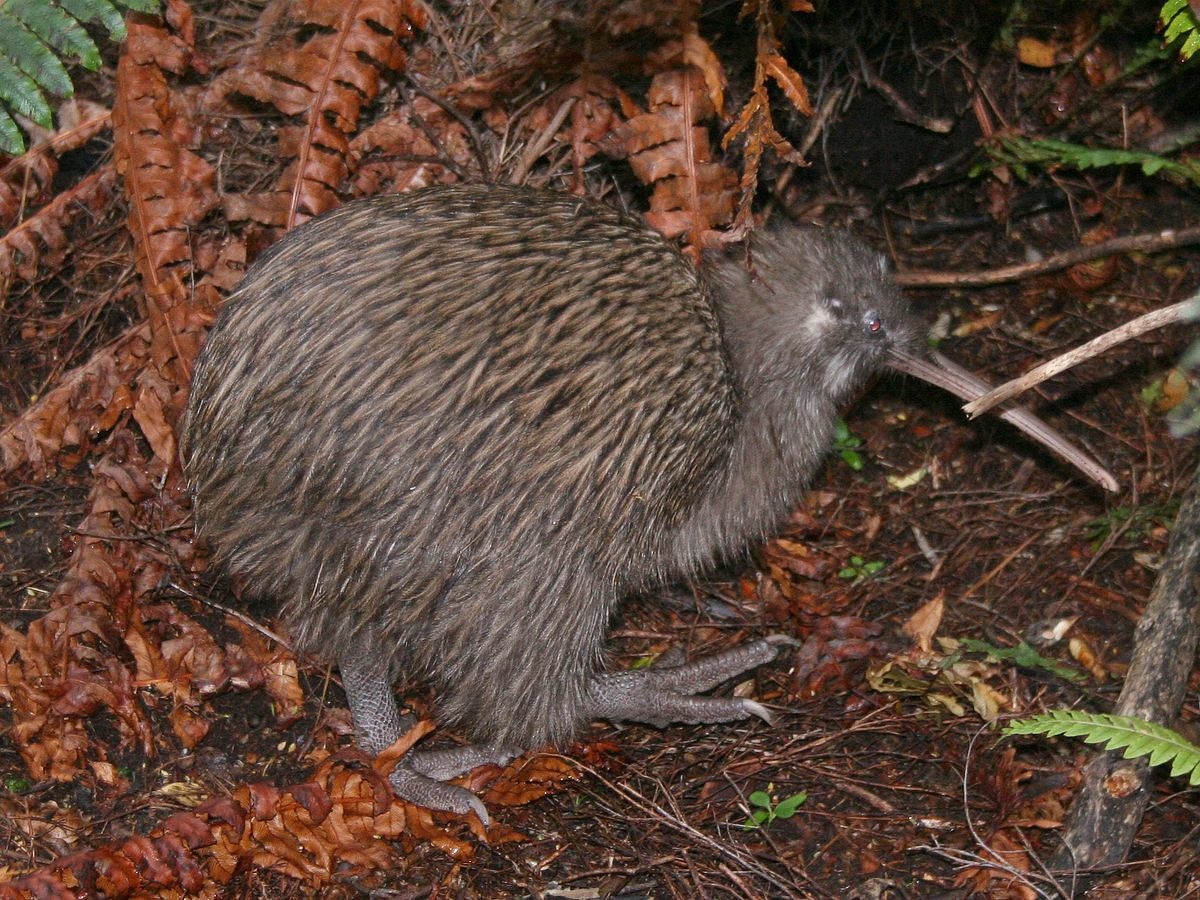
Southern brown kiwis (Apteryx australis) on Stewart Island
Southern brown kiwis (Apteryx australis) are also known as tokoeka, common kiwis and brown kiwis. They are a species of kiwi from South Island of New Zealand. Until 2000 they and North Island brown kiwis were considered subspecies of the same species and still are by some authorities.
The second largest of the kiwi species, southern brown kiwis are about 40 centimeters (1.3 feet) tall and weigh around three kilograms (6.6 pounds). Groups of southern brown kiwis regularly forage for sandhoppers and other arthropods on beaches on Stewart island, probing with their beaks into the sand for prey. Afterwards the birds can sometimes be seen drinking from streams that empty into the sea. Stewart Island is home to New Zealand last major population of wild kiwis, with 15,000 to 20,000 southern brown kiwis there. [Source: Derek Grzelewski, New Zealand Geographic. January-March 2000]
Southern brown kiwis live in temperate forests and grasslands. They prefer to live in large, dark forest areas, which allow camouflage for the birds as they sleep during the day. In undisturbed habitats, they dig burrows under stones, banks of streams, or in soft flat open ground. In disturbed areas, they have adapted to human presence by making burrows in rough farmland under logs and shrubs. Their habitat ranges from sea level to areas at elevations of 1,200 meters (3,937 feet).[Source: Smitha Gudipati, Animal Diversity Web (ADW) |=|]
On the International Union for Conservation of Nature (IUCN) Red List, Southern brown kiwis are listed as Vulnerable. While their numbers are decreasing, the population is still relatively stable, with estimates of around 21,350 birds. The primary threat to these birds is predation by introduced mammals such as dogs, pigs, cats, possums and stoats.
RELATED ARTICLES:
KIWIS: EVOLUTION, CHARACTERISTICS, BEHAVIOR, REPRODUCTION ioa.factsanddetails.com
KIWI SPECIES: NORTHERN, SOUTHERN, SPOTTED, LARGEST, SMALLEST ioa.factsanddetails.com
KIWIS, HUMANS AND CONSERVATION ioa.factsanddetails.com
MOAS: HISTORY, CHARACTERISTICS, REPRODUCTION, EXTINCTION, DE-EXTINCTION? ioa.factsanddetails.com
MOA SPECIES: GIANT, SMALL AND HEAVY-FOOTED ONES ioa.factsanddetails.com
KEAS: CHARACTERISTICS, BEHAVIOR, PLAYFULNESS, INTELLIGENCE, REPRODUCTION ioa.factsanddetails.com
KAKAPO: CHARACTERISTICS, BEHAVIOR, REPRODUCTION, SAVING THEM FROM EXTINCTION ioa.factsanddetails.com
KOKAKOS: CHARACTERISTICS, BEHAVIOR AND REPRODUCTION ioa.factsanddetails.com
BIRDS OF NEW ZEALAND: SPECIES, CHARACTERISTICS, BEHAVIOR AND REPRODUCTION ioa.factsanddetails.com
Southern Brown Kiwi Characteristics and Diet
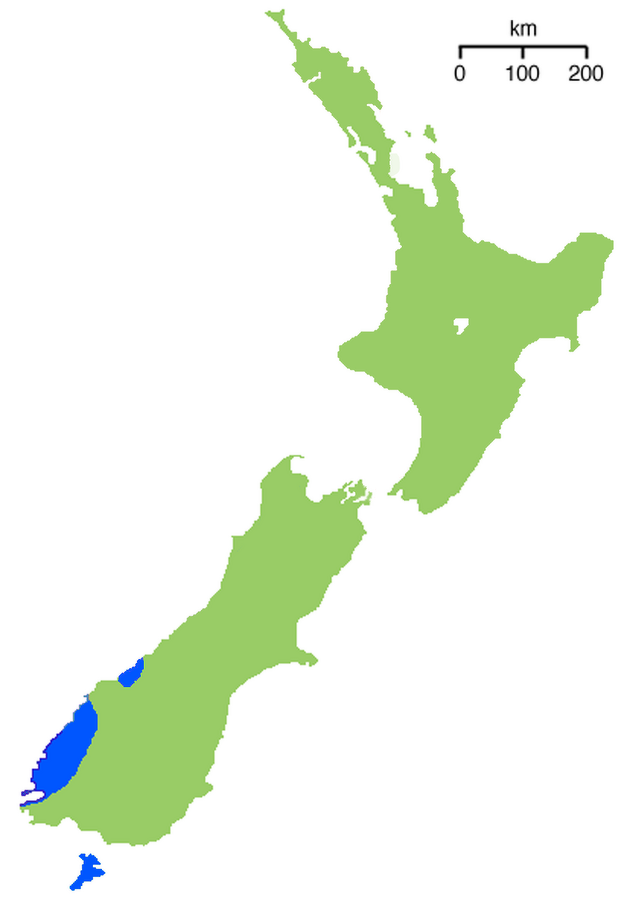
range of the southern brown kiwi
Southern brown kiwis range in weight from 2.8 to 3.5 kilograms (6.17 to 7.71 pounds) and are 45 to 54 centimeters (17.72 to 21.26 inches) tall. Their average basal metabolic rate is 4.029 watts. Their average lifespan in the wild is estimated to be 20 years. They have lived over 40 years captivity. Sexual Dimorphism (differences between males and females) is present but not so much: Both sexes look similar but females are larger. [Source: Smitha Gudipati, Animal Diversity Web (ADW) |=|]
Southern brown kiwis are brownish grey in color with long, soft feathers that look and feel very fur-like. Their skin is tough and they have whiskers at the base of their bill used for touch. This is especially important for these birds because they have small eyes and poor vision. These birds do not have a tail and their five centimeters long wings prevent them from flying.
Southern brown kiwis have powerful legs and can run quickly. The nostrils are at the end of their long bills and they have a keen sense of smell. The birds thrust their bill into the ground, gather the food, and beat the prey on the ground before they consume it. Other characteristics include heavy bone marrow, a body temperature lower than most other birds, and underdeveloped pectoral muscles. Southern brown kiwis have body temperatures of 38 degrees Celsius.
Southern brown kiwis are primarily carnivores (eat meat or animal parts) and recognized as insectivores (eat insects and non-insect arthropods) and vermivores (eat worms). Animal foods include amphibians, fish, insects, non-insect arthropods such as spiders, mollusks terrestrial worms. aquatic crustaceans. Among the plant foods they eat are fruit. Southern brown kiwis feed mainly on soil-dwelling and aquatic invertebrates such as worms, insects, crayfish, amphibians, and eels. At night, these birds use their long bills to dig deep into the ground to find creatures living on the ground. After they have caught something, they use their bills to beat the creature on the ground, or on stones to kill it before eating. Cone-shape holes left in the ground after hunting are easy ways to determine that kiwis are in a given area.
Southern Brown Kiwi Behavior and Communication
Southern brown kiwis are cursorial (with limbs adapted to running), terricolous (live on the ground), nocturnal (active at night), motile (move around as opposed to being stationary), sedentary (remain in the same area) and territorial (defend an area within the home range). If another bird enters their territory, they will cry out a call to warn that bird to leave or else prepare to fight. Their home territories range from five to 50 hectares (12.3 to 123 acres), with size being correlated to the quality of the habitat. [Source: Smitha Gudipati, Animal Diversity Web (ADW) |=|]
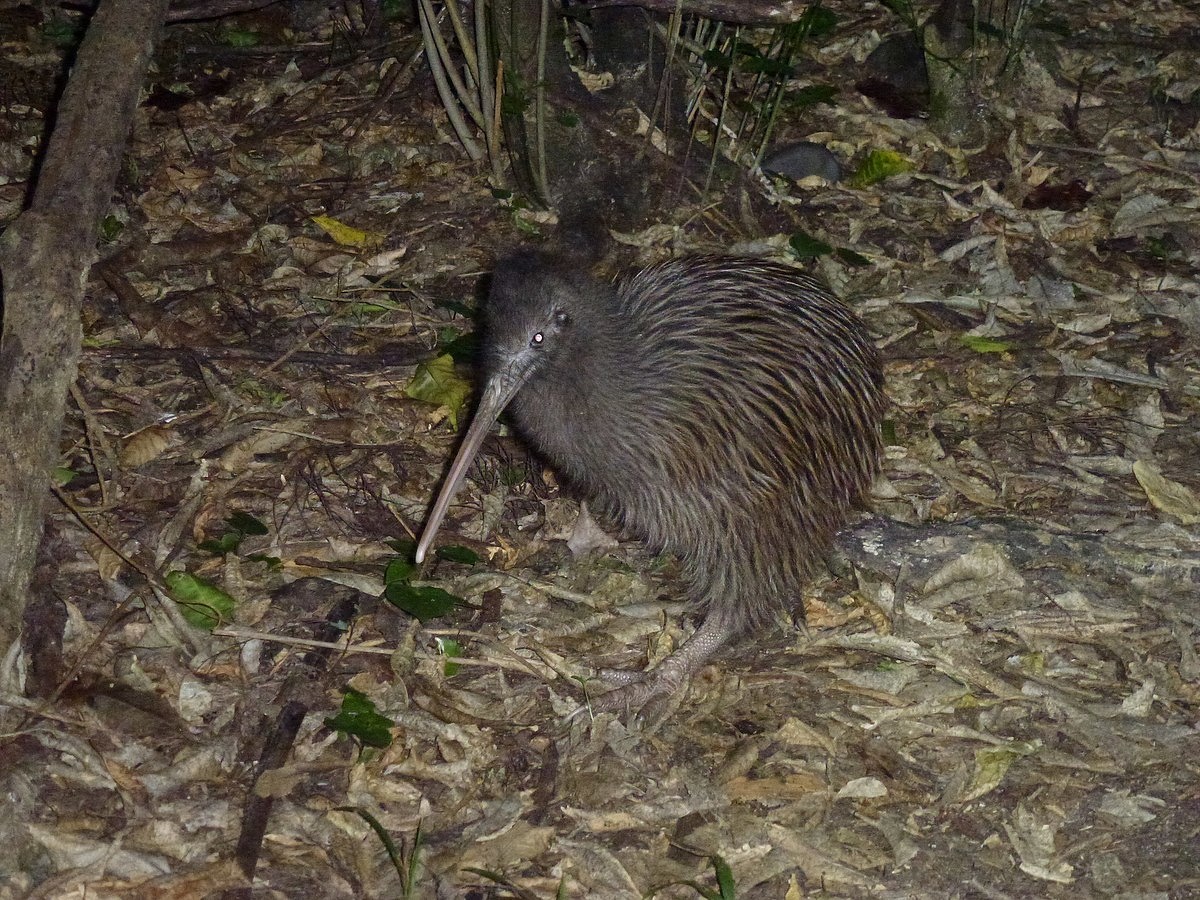
Okarito Brown Kiwis (Apteryx rowi)
Southern brown kiwis are shy and mainly solitary, but sometimes travel in groups of six to twelve. Advantages of being nocturnal include reduced competition, availability of food not available during the day, and safety from predators. Southern brown kiwis will attack if threatened but are more likely to flee an perceived threat. During the day, southern brown kiwis hide and coil themselves into a ball in their burrows. Much of the nightf is spent foraging for food.
Southern brown kiwis communicate with sound and sense using vision, touch, sound and chemicals usually detected with smell. Their main call sounds like a prolonged whistle slightly ascending and descending. Males make a mournful shriek, "kee-wee," and females have a low hoarse cry. Chicks tend to make a clicking sound. The cry indicates their presence at night, and helps in finding mates.
Southern Brown Kiwi Mating, Reproduction and Offspring
Southern brown kiwis are monogamous unless a “better” mate comes along and engage in year-round breeding. They can reproduce as often as every four to six weeks. However, the massive amount of energy needed to produce a single huge egg means that females generally lay eggs much less frequently than that. The number of eggs laid is one. A second egg might be laid four to six weeks after the first one. The average time to hatching is 11 weeks, with the fledging occurring six to 10 days after that. On average females reach sexual or reproductive maturity at age three to five years; and males do so at 18 months months. [Source: Smitha Gudipati, Animal Diversity Web (ADW) |=|]
Southern brown kiwis eggs are huge — one-third of the female's mass. Males and females meet in nesting burrows every few days and call to each other at night to begin mating. This ritual occurs most frequently between March and June. The relationship is volatile and physical with the females primarily being the dominant one. Female southern brown kiwis dig out the nest and deposit the kiwi eggs, which are smooth and are either ivory or light green in color.
Young Southern brown kiwis are precocial. This means they are relatively well-developed when born. During the pre-fertilization stage provisioning and protecting are done by females. Pre-birth provisioning is done by females and protecting is done by males.After the eggs are laid, males incubate them and maintain the nest until the eggs hatch. During this time males lose one-third of their weight. After hatching, the chicks do not rely on parents for food. They weigh 275 grams and are about 15 centimeters (five inches) tall and survive from large amount of yolk in their belly. Kiwi chicks venture out of the burrow soon after hatching, although there have been reports of chicks being near their parents for up to a year. Because kiwi chicks are slow, small and unable to respond to predators, few survive to twelve months old. After that time, they reach a size that enables them to escape most predators.
Brown Kiwi Subspecies and Species
There are two formally recognized subspecies of southern brown kiwi: 1) the Fiordland kiwi (Fiordland tokoeka, Apteryx australis australis) and 2) the Stewart Island kiwi (Stewart Island tokoeka,Apteryx australis lawryi). A third form, the Haast kiwi (Haast tokoeka, Apteryx australis 'Haast'), is also recognized as a distinct, though not formally listed as a subspecies, due to its genetic differences and the need for specific management efforts to conserve it. It is found in the Haast Range and Arawhata Valley. Some regard it is a separate species.
There are about 15,000 Fiordland kiwis. They are found on and near the Fiordland in the southwest part of the South Island of New Zealand. A disjunct population, near Haast, called the Haast tokoeka or Haast brown kiwi (not to be confused with Apteryx haastii), is rare (with only about 350 specimens left) and is characterised by their rufous plumage.
There are about 20,000 Stewart Island kiwis, also known as the Rakiura tokoekas and Rakiura kiwi. They arr relatively common throughout their range, with about 17 birds per square kilometer. Their feathers are streaked lengthwise with reddish brown. Stewart Island is home to New Zealand’s last major population of wild kiwi.
There are three recognised species of brown kiwis: 1) the North Island brown kiwi, found in the North Island of New Zealand;, 2) Okarito brown kiwi (Rowi), rare species, that lives in the Ōkārito forest on the West Coast of the South Island; and 3) the Southern brown kiwi (Tokoeka) kiwi. For a long time it was thought there was one species of brown kiwi. Genetic research confirmed that the brown kiwi should be separated into three distinct species.
North Island brown kiwis, southern brown kiwis and Okarito brown kiwis were formerly considered subspecies of brown kiwis (Apteryx australis): 1) North Island brown kiwis ( now Apteryx mantelli) were known as Apteryx australis mantelli. 2) Southern brown kiwi (now Apteryx australis) were known as Apteryx australis australis (for those on the South Island) and Apteryx australis lawryi (for those on Stewart Island). 3) Okarito Brown Kiwis (Apteryx rowi) are rare species, formerly called Rowis. The only wild population lives in the Ōkārito forest on the West Coast of the South Island. Their population has only about 600 birds.
Derek Grzelewski wrote in New Zealand Geographic: Recent research into the genetic variation between populations of brown kiwi shows that there are distinct but almost identical species, not the traditional North, South and Stewart Island races. Instead, the distribution pattern may fit better with the New Zealand geography of the ice ages of the past one or two million years, when lower sea levels saw the North and South Islands much closer together, if not actually linked, and kiwi habitat in the western South Island was broken in the middle by ice and tundra. [Source: Derek Grzelewski, New Zealand Geographic. January-March 2000]
Okarito Kiwis
Okarito kiwis (Apteryx rowi) were first identified as a new species in 1994. They are slightly smaller than North Island brown kiwsi and have a greyish tinge to their plumage and sometimes white facial feathers. Females lay up to three eggs in a season, each one in a different nest and each weighing about a fifth a the female’s weight. Males and females both incubate the eggs. Their distribution is now limited to a small area on the West Coast of the South Island, but studies of ancient DNA have shown that before the arrival if humans in New Zealand they were far more widespread on the western side of the South Island and were the main kiwi species on the southern half of the North Island.
On his effort to find to track down an Okarito kiwi, Derek Grzelewski wrote in New Zealand Geographic: I drive up to the glaciers, to the block of land between the Waiho and Okarito Rivers. I want to walk in the coastal forest at night and listen out for the rarest of our kiwi, the Okarito brown. There isn’t much hope of hearing them, I know, because the night is bright, near the full moon, and that usually puts a damper on kiwi vocalisation. [Source: Derek Grzelewski, New Zealand Geographic. January-March 2000]
Suddenly, there is a rustle in the ferns, then a dog-like snuffling, and out of the forest, across a small ditch and on to the trail hops a familiar hunchbacked figure.” It moves “with the stop-go approach of a puppy, tentative yet uncontrollably curious. It moves towards me with a series of jolty, patting footfalls, freezing, craning its neck, sniffing the air, taking a few more steps.
Now it is standing at my feet, the rarest kiwi in the world, touching me with its beak, examining me as a doctor would with a stethoscope. I melt into this magical moment of communion with the ghost of the forest, and feel my throat knotting up as I remember what McLennan said about the soul of the land and how it touched his own. Suddenly, the little rascal jumps up and kicks me! It is a kangaroo kind of kick, with a catlike scratch, as feeble and experimental as the bird is young, but the attitude is there already, and the message is clear: “This is my turf. Hop it!”
I take heed. The bird, I learn later, is one of the new generation of kiwi, hatched and brought up in captivity and released back into the wild. It has obviously made the transition successfully. It found, claimed and defended its territory — no mean feat in this tough neighbourhood. It was curious and brave, streetwise and assertive; it stood its ground.
Fiordland Kiwis and Haast Kiwis
Fiordland kiwis (Apteryx australis australis) are also known as Fiordland tokoeka. They are a subspecies of southern brown kiwi that live in the Fiordland of the southwest part of the South Island of New Zealand. They are among the largest of southern brown kiwis and have reddish brown feathers. There are about 15,000 of them. [Source: Wikipedia]
Haast kiwis (Apteryx australis 'Haast') are also known as Haast tokoeka. They are a putative subspecies of southern brown kiwis and one of the rarest kiwi in New Zealand. The Haast tokoeka lives high in the mountains on the west side of New Zealand's South Island. About half of its habitat is in the protected Haast Kiwi Sanctuary. Both males and females incubate eggs. ot all scientists recognize the Haast kiwi as a separate subspecies from the Fiordland tokoeka. New Zealand Birds Online refers to the Haast tokoeka as "recognised as being distinct for management purposes" because of its genetic and bodily differences from the Fiordland tokoeka.
Derek Grzelewski wrote in New Zealand Geographic: Reddish plumage is one of the distinguishing features of the Haast southern brown kiwis, a variety of kiwi found between the Haast and Cascade Rivers in South Westland. Many of the birds live above the treeline, and they can be found as high as 1500 meters. Because fewer than 250 of these birds exist, scientists try to monitor the status of the population as accurately as possible. [Source: Derek Grzelewski, New Zealand Geographic. January-March 2000]
Compared with the other varieties of kiwi, almost nothing is known about the sociology of the Haast southern brown kiwis. Interactions between birds are rare, because they have huge territories. The Haast Range population spills into the neighbouring valleys. We were surprised to find that, at the end of the winter, the birds were fat and healthy and nesting in rock crevices under half a meter of snow. Scientists thinks that this preference for the harshest of habitats is due to the profusion of invertebrate life to be found there — weta, land snails, weevils.
Even during heavy winters the sun warms the rocks, creating miniature nunataks, and the kiwi probe around their soft peripheries for plentiful and comatose insects. Life in the fridge can have its advantages — keeping the food fresh and the predators at bay — just as long as you can fight off the cold. Appropriately, the Haast southern brown kiwis is as fluffy as a malamute husky.
Image Sources: Wikimedia Commons
Text Sources: Animal Diversity Web animaldiversity.org , National Geographic, Live Science, Natural History magazine, David Attenborough books, New Zealand Geographic, New Zealand Tourism, New Zealand Herald, Te Ara Encyclopedia of New Zealand, New York Times, Washington Post, Los Angeles Times, Smithsonian magazine, Discover magazine, The Conversation, The New Yorker, Time, BBC, CNN, Reuters, Associated Press, AFP, Lonely Planet Guides, Wikipedia, The Guardian and various books, websites and other publications
Last updated September 2025