
Home | Category: Nature, Environment, Animals
DECLINE OF KIWIS
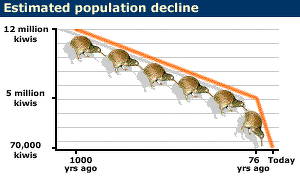
from the BBC
There are roughly 68,000 kiwis left, and two percent of unmanaged kiwi die every year — about 20 a week — according to the Department of Conservation. Of the kiwi that hatch in the wild, 95 percent are killed before they reach adulthood. Conservation efforts have for years tried to increase kiwi population numbers, but still their status ranges from “recovering” to “nationally critical”, depending on the species. [Source: Eva Corlett, The Guardian, July 2, 2022]
Derek Grzelewski wrote in New Zealand Geographic: In the late 1980s, the Department of Conservation started to get a few disconcerting reports. Hunters and trampers were noting that kiwi sign and calls were missing from areas where, just a few years earlier, they had been abundant. [Source: Derek Grzelewski, New Zealand Geographic. January-March 2000]
Results from a survey in 1992-93 of “kiwi country” were compared with results from a similar survey made by the Wildlife Service 20 years earlier, confirming that the ranges of kiwi were indeed shrinking. By 1995-96, the full extent of the decline was becoming apparent: there were only about 70,000 kiwi left. One species, the little spotted kiwi — smallest and once apparently the most common — was already gone from the mainland, and populations of the others were melting away at a rate of six per cent a year. Last century, settlers complained that kiwi kept them awake at night with their calls. Now people were again losing sleep over kiwi, this time trying to figure out how to halt the decline.
RELATED ARTICLES:
KIWIS: EVOLUTION, CHARACTERISTICS, BEHAVIOR, REPRODUCTION ioa.factsanddetails.com
KIWI SPECIES: NORTHERN, SOUTHERN, SPOTTED, LARGEST, SMALLEST ioa.factsanddetails.com
SOUTHERN BROWN KIWI: CHARACTERISTICS, BEHAVIOR AND REPRODUCTION ioa.factsanddetails.com
MOAS: HISTORY, CHARACTERISTICS, REPRODUCTION, EXTINCTION, DE-EXTINCTION? ioa.factsanddetails.com
MOA SPECIES: GIANT, SMALL AND HEAVY-FOOTED ONES ioa.factsanddetails.com
KEAS: CHARACTERISTICS, BEHAVIOR, PLAYFULNESS, INTELLIGENCE, REPRODUCTION ioa.factsanddetails.com
KAKAPO: CHARACTERISTICS, BEHAVIOR, REPRODUCTION, SAVING THEM FROM EXTINCTION ioa.factsanddetails.com
KOKAKOS: CHARACTERISTICS, BEHAVIOR AND REPRODUCTION ioa.factsanddetails.com
BIRDS OF NEW ZEALAND: SPECIES, CHARACTERISTICS, BEHAVIOR AND REPRODUCTION ioa.factsanddetails.com
Maori and When There Were Lots of Kiwis
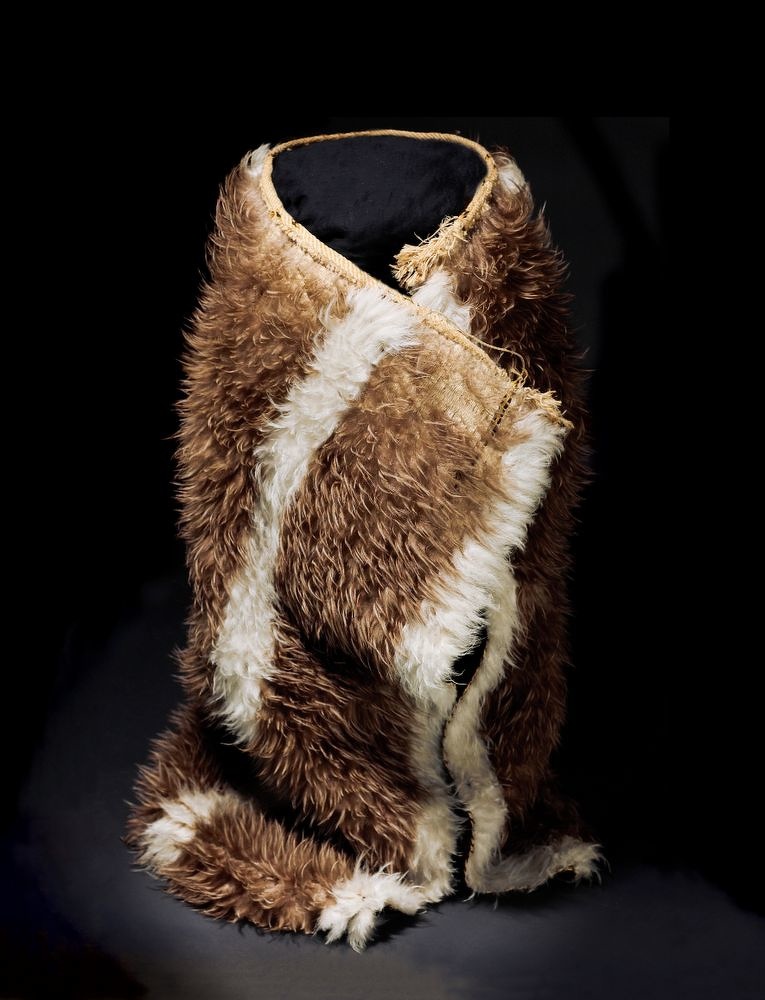
Maori kiwi feather cloak
Derek Grzelewski wrote in New Zealand Geographic: 1200 years ago, there were an estimated 12 million kiwi in New Zealand, living in densities of up to 100 birds per square kilometer. [Source: Derek Grzelewski, New Zealand Geographic. January-March 2000]
Even 100 years ago, the birds were still sufficiently numerous for one hunter, who captured kiwi for their feathers to decorate European hats and muffs, to admit to having taken 2200 birds. It was an indication of the perceived merits of native and introduced wildlife that the 1867 Animals Protection Act gave protection to exotic game animals but not to native birds. Some were later classed as “native game” to give them a measure of protection from hunting, but it was not until 1922 that most native birds were given absolute protection.
No one paid much attention to how kiwi were faring. Their cries were heard at night, they were protected by law and, unlike rarities such as kakapo, takahe, saddlebacks and black robins, they were widely distributed. It seemed ludicrous to think that they might become extinct.
The Maori considered kiwis “taonga” — culturally treasured items — and called them “te manu huna a Tane,” the hidden bird of Tane, god of the forest. Maori hunted kiwis with dogs, sometimes using caterpillars that lived on sweet potato vines as bait. But there were still lots of them when European settlers started arriving in numbers in the 19th century. At that time were still so abundant that settlers complained their shrill cries kept them awake at night.
According to Archaeology magazine: Nineteenth-century Maori history is written in the DNA of long-dead kiwi birds. Prized cloaks of kiwi feathers were worn into battle. The genetic material preserved in more than 100 cloaks in museum collections, alongside DNA from modern birds, has identified the small area where the cloak tradition may have arisen, and suggests that a previously undocumented trade in feathers grew after internecine wars broke up traditional groups in the early part of the century. [Source: Archaeology magazine, September-October 2011]
Europeans and Kiwis
Derek Grzelewski wrote in New Zealand Geographic: So unusual is the kiwi that when the first specimen skin arrived in England around 1811, it was considered a hoax on a par with the outlandish platypus; an unlikely anatomical hotchpotch skilfully stitched together by a clowning taxidermist. But then the early 19th century was a time when, in terms of biological discoveries, almost anything was possible. Only 28 years later, a single fist-sized bone fragment from the very same islands would convince the renowned comparative anatomist Sir Richard Owen of the existence of a large bird he called Dinornis, “the terrible bird.” Commonly, it would be known by its Maori name, moa, the tallest bird that ever lived, a flightless, totally wingless browser, and a neighbour of the kiwi. [Source: Derek Grzelewski, New Zealand Geographic. January-March 2000]
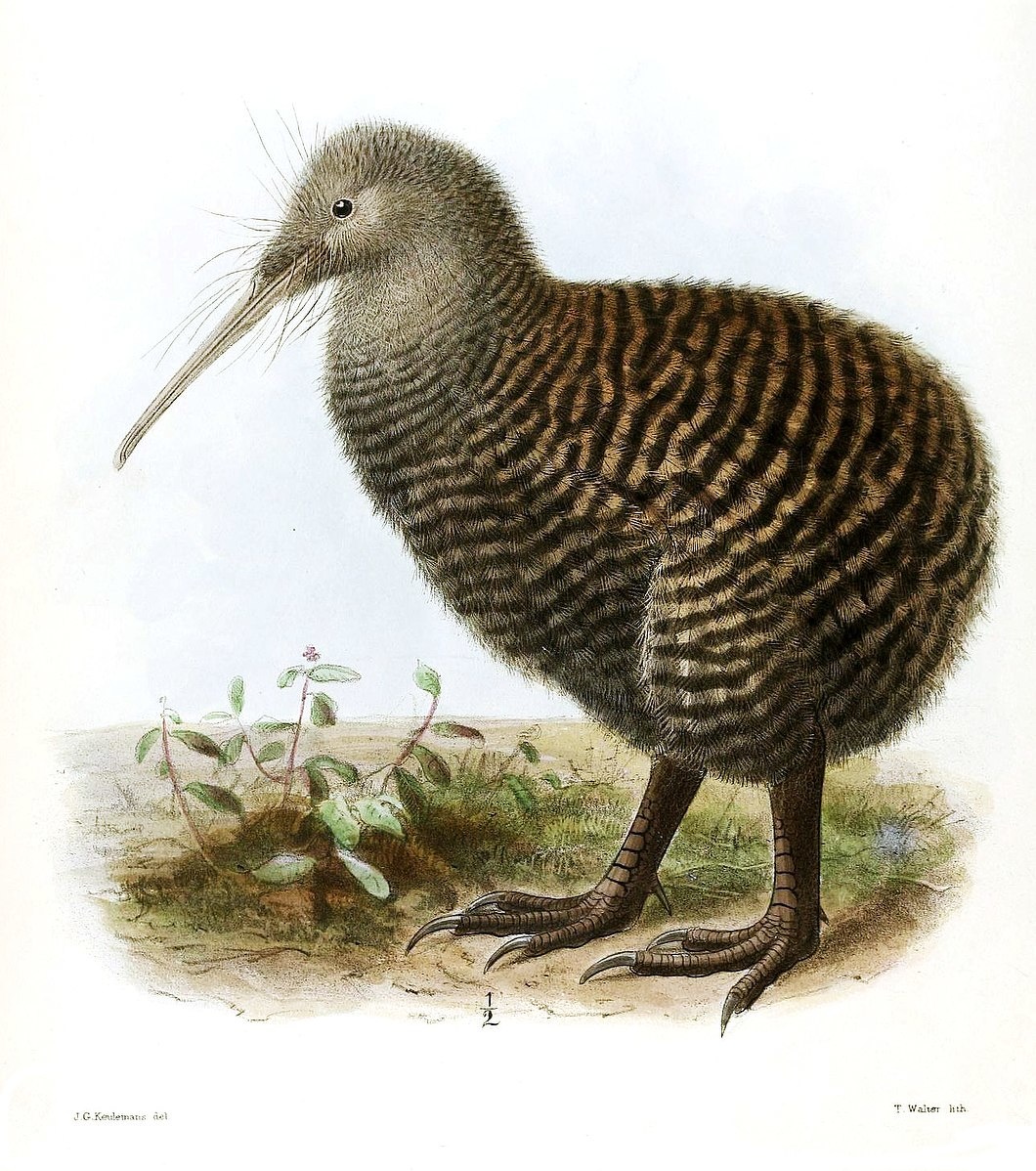
illustration of a Haast kiwi from 1876
In 1813, George Shaw, the Assistant Keeper of Zoology at the British Museum, described as best he could the anomalous bird in front of him, and gave it the name Apteryx australis. The artist’s impression that accompanied the description showed a penguin-like creature with a Pinocchio nose — probably not a bad rendering considering that the only source of information was a dry, boneless skin. Only later, as more specimens arrived, did it become apparent that the kiwi was neither a collector’s jest nor an evolutionary whim, and its posture and shape were corrected. In 1851, a live female kiwi was sent to London Zoo, where it laid infertile eggs and lived for more than 15 years.
As was the case with huia feathers, kiwi “fur” accessories became fashionable in Europe in the latter part of the 19th century, and thousands of kiwi were slaughtered to supply this trade. The early colonists weren’t averse to tossing the odd kiwi into the cooking pot, though it was rarely a favourite repast. Charlie Douglas, explorer, surveyor and keen observer of nature, described how once, crossing a large swamp, he sprained his ankle and had to crawl for several days to reach his camp. Along the way he came across two kiwi in their burrow. “Being pushed with hunger, I ate the pair of them. Under the circumstances I would have eaten the last of the Dodos,” he related. They had an earthy flavour, he added, “like a piece of pork boiled in an old coffin.”
Apteryx must have been tasty, or exotic, enough to be served in country inns. Rudyard Kipling had one in Tokaanu, and thought it acceptable. Today, though the literal kiwi is off the menu, plenty of takeaway joints offer a burger by the same name, where it’s not the meat but the moniker you’re buying. In fact, everywhere you look you can see the nosy, amiable bipeds lending their name to every product under the New Zealand sun.
Threatened Kiwis
Of the five recognized species of kiwi, four are currently listed as vulnerable, and one is near threatened. All species have been negatively affected by historic deforestation, but their remaining habitat is well protected in large forest reserves and national parks. Most Kiwis today live in protected areas.. At present, the greatest threat to their survival is predation by invasive mammalian predators, namely weasel-like stoats. Dogs, pigs and cats tend to feed on adult birds. Stoats and cats feed on the young, and possums and stoats destroy kiwi eggs. As with many small animals, kiwi sometimes fall victim to motor vehicles. The Automobile Association now erects signposts at vulnerable sites, such as national parks.
Derek Grzelewski wrote in New Zealand Geographic: “The Okarito browns and the Haast southern brown kiwis are the most vulnerable, because there are so few of them. But Okarito has the most intensive recovery regimen in the country, and the birds are starting to come back. We are now trying to set up a similar system here, in Haast.
“The North Island browns are definitely the worst off. They’re the media stars of the avian apocalypse. There are 30,000 northern brown kiwi — say, 15,000 pairs. Each pair is capable of producing up to four eggs per year, but being conservative we calculate they can bring up only two chicks. That’s 30,000 new birds, and almost all of them die every year due to predators. At the moment, all we can do is protect selected populations in their representative areas, in mainland islands, until a large-scale solution for controlling mustelids is found. When the predators are dealt with, kiwi will bounce back like rabbits. With just one year’s recruitment of juveniles their population could double. But for now, we’re just buying time.” [Source: Derek Grzelewski, New Zealand Geographic. January-March 2000]
The thing about kiwis that they are extremely unfussy birds. They don’t need to be put on a conservation pedestal, they don’t need national parks or reserves. As long as there is food and shelter, they will live on the most marginal land, in bracken, in gorse even. They will readily live with people, if only we choose to live with them. “The birds are born survivors — tough, adaptable and resilient,” says McLennan. “They can live almost anywhere. They are breeding machines, producing those huge eggs with the consistency of battery hens. All they need is some peace during the first few months of their life, because at the moment,
Kiwis and Introduced Predators
Before the arrival of man, kiwis were perfectly adapted to their environment. In some parts of New Zealand they were plentiful. Human-introduced mammalian predators that are a threat to kiwis are dogs, cats, ferrets (Mustela putorius furo), and stoats (ermine, (Mustela erminea). Common brushtail possums — introduced from Australia — are predators of kiwi eggs. Young kiwis are at more risk of mortality because they lack sufficient behavioral defenses. In much of New Zealand stoats and cats have caused the population of kiwi chicks to decline by about 50 percent. At the age of six months to a year, when the larger kiwis reach one kilograms in weight, stoats are less of a threat. Dogs and ferrets are mainly responsible for the deaths of adult kiwis in the northland. As many as 95 percent of wild kiwi chicks don't survive their first year. A study in the 1990s found that predators were responsible for 60 percent of deaths in "young" kiwis and 45 percent of deaths in "juveniles." [Source: Cari Mcgregor, Animal Diversity Web (ADW) |=|]
Stoats are the biggest threat to young kiwis. Derek Grzelewski wrote in New Zealand Geographic: The stoat is cunning enough not to attack prey that it cannot handle. An adult kiwi could kick one to shreds, but a gawkish chick makes an easy meal. The predator knows its match precisely, and for a kiwi it is about 1200 g — four to six times the body weight of a stoat. Reaching this weight usually assures the bird’s survival, but it can take 40 long and perilous weeks....The stoats just wait for the eggs to crack open so they can kill the hatchlings. [Source: Derek Grzelewski, New Zealand Geographic. January-March 2000]
Kiwis and Dogs
Kiwis numbers in some places have declined significantly due to dogs, which find kiwis to be easy prey. Kiwis can't fly, they move slower than a dog, they give off of a strong odor, they make calls that carry a long distance and they are easy to track because they produce a rustling noise when they move through the undergrowth. In 1987, researchers discovered that a stray German shepherd killed 500 kiwis in Waitangi National Park in two months. This was about half the birds in one of New Zealand's largest kiwi populations. To save the kiwis, conservationists and government officials inaugurated a campaign to eliminate stray dogs and encourage dog owners not let their animals go.
Eva Corlett wrote in The Guardian: The most prolific killers of kiwi, after stoats, weasels and ferrets, are dogs. It is difficult to assess exactly how many birds are killed by dogs each year – some owners are not aware, or deliberately hide the evidence – but Save the Kiwi estimates it is about 400.Kiwi have underdeveloped wing and chest muscles and no sternum, making them particularly vulnerable to dog bites. Desperate efforts at conservation have led to trials of measures such as the electric collar, which have raised concerns about the welfare of the dogs as much as the kiwi, and their use is banned in some places overseas. [Source: Eva Corlett, The Guardian, July 2, 2022]
On the training of one dog: Tip, a young hunting dog, pads up a goat track through New Zealand’s damp forest undergrowth, alert and excited as her nose hoovers the ground for smells. She stops suddenly to investigate an irresistible scent – the sweet, musty aroma of kiwi.Tip is allowed a moment to inhale before a low-level electric pulse, issued from a collar, warns her that this bird is out of bounds. She briefly recoils, the electric signal enough to form an immediate negative association with the smell.It’s a controversial method, but when Tip gives a wide berth to the second kiwi – another freeze-dried bird placed a few metres up the track – she is rewarded with a “good girl” and a pat. She has passed the test and will now be certified with her kiwi avoidance training for the next year.
Helping Kiwis
Projects set to help kiwis have included 1) the Rotoiti Nature Recovery Project, a conservation program to restore a community of great spotted kiwis in the montane southern honeydew beech forests; 2) the Kiwi Recovery Program, which helps raise juveniles until they reach a weight of 800 to 1200 grams; and 3) the Bank of New Zealand Operation Nest Egg (BNZONE), which take eggs into captivity in order to protect them, giving the hatchlings a better chance of survival. [Source: Cari Mcgregor, Animal Diversity Web (ADW) |=|]
Derek Grzelewski wrote in New Zealand Geographic: Operation Nest Egg, initiated by DoC in 1995, is another way of buying time — and giving ailing kiwi populations a much-needed boost. The programme involves collecting eggs from the wild, hatching them in incubators (at Auckland Zoo, Rainbow and Fairy Springs in Rotorua and Westshore Wildlife Reserve in Napier), rearing the chicks to a size at which they can look after themselves, then releasing them back into the wild. Through Operation Nest Egg, Okarito brown kiwi numbers have increased from 140 to 160, and several populations of North Island browns are also benefiting. [Source: Derek Grzelewski, New Zealand Geographic. January-March 2000]
The difficulty kiwis have producing fertile eggs in captivity has made it difficult to increase their numbers using artificial methods. Despite this, scores of kiwis have been bred and born in the Auckland Zoo, The Kiwi breeding center in Rotorua and elsewhere and have been released into the wild. Captive-raised kiwis are set free in places like the Karoro reserve in the Wellington suburbs, where forests and habitat are surrounded by fences with special gates designed to keep out predators like stoats, rats and possums. The fences are embedded deep in the ground so the predators can not burrow under them.
Puketukutuku, a 750 hectares peninsula jutting into Lake Waikaremoana, in the heart of Urewera National Park, is one of the few places on mainland New Zealand where kiwi chicks are safe from stoats. Conservations there have eradicated stoats and prevent their return by maintaining a trapline across its base.
Island Sanctuaries for Kiwis
Derek Grzelewski wrote in New Zealand Geographic: The concept of island sanctuaries is not new. In 1894, Richard Henry masterminded the transfer of some 750 kiwi and kakapo to Resolution Island, in Fiordland. But he underestimated the enemy. Stoats swam across from the mainland, and 14 years of work was undone. [Source: Derek Grzelewski, New Zealand Geographic. January-March 2000]
Despite that setback, many of our offshore islands have now been turned into refuges for species that elsewhere are either extinct or extremely rare. Some of them were natural sanctuaries on account of their distance from the mainland or their inaccessibility, and only needed to have landings strictly controlled. Others, in the fashion of McLennan’s peninsula, have had to be restored through painstaking trapping of noxious animals and subsequent vigilance against reinvasion. Whatever their past, these islands now serve as insular aviaries, genetic safe houses which offer endangered species an evolutionary second chance, the opportunity of an assisted comeback.
For kiwi, there is no more telling example than Kapiti, a sliver of mountainous, rain-soused land lying off the west coast north of Wellington. Former home of Te Rauparaha, then the site of a whaling station, then a ne’er-do-well sheep farm, in 1897 the island was turned into a wildlife sanctuary. The cleared forest slowly grew back, and the resident caretakers methodically eradicated the vermin. Between 1980 and 1986, 22,500 possums were removed from this 2000 hectares island, and a week before my visit the reserve was officially declared rat-free. [Source: Derek Grzelewski, New Zealand Geographic. January-March 2000]
Kapiti, now aflutter with birds unseen in most parts of the country, is also home to the largest population of little spotted kiwi. The birds are thought to have been brought here from the South Island in 1912 or 1923, when it became clear that the species was not going to survive on the mainland. In recent years, “little spots” have filled the island to capacity. There are more than 1000 resident birds, and a number of pairs have been shipped to other islands such as Hen, Tiritiri Matangi and Red Mercury, where they have founded healthy and self-sustaining populations.
Kiwi Research
Methods used in kiwi research include field monitoring through call counts and dog surveys to assess population health and trends, radio tracking to study movement and behaviour, and genetic studies using morphological and molecular techniques to understand variation and identify key populations. Researchers also use 3D-printed "smart eggs" with sensors to study incubation, and Operation Nest Egg for captive breeding and rearing to boost wild populations. Additionally, studies focus on developing predator control techniques, like using 1080 poison, and investigating the causes of mortality to improve conservation. [Source: Google AI]
Derek Grzelewski wrote in New Zealand Geographic: Kiwi researchers and protection workers depend on trained sniffer dogs and radiotracking equipment to locate their well-camouflaged quarry. Tom Herbert, of the Department of Conservation in Trounson Kauri Park, has 40 kiwi tagged with radio transmitters to follow the health of the population in the 586 hectares forest. [Source: Derek Grzelewski, New Zealand Geographic. January-March 2000]
Describing the difficulties in doing radiotelementery kiwi research, Michael Taborsky and Barbara Taborsky wrote in Natural History magazine, "Catching kiwis is an adventure, taking place at night in dense bush where orientation is accomplished mainly by ear. In our study area, primarily pine forest, the most efficient way to proceed was just to run after the birds and grab them by hand. More often than not, “we” got caught in the thick undergrowth, trapped by thorny 'bush lawyer.'"
"Often only through some mistake on the part of the pursued bird," they wrote, "were we able to get a hold of it. We then attached a transmitter to its leg with a flexible band, the type used as name tags for hospital patients. These bands tear after about a month and release the transmitter...The individual signs emitted by each transmitter allowed us to locate the bird at any time of day." One of the Taborsky's other primary duties was regularly weighing the female kiwis and examining eggs in the nests.
Image Sources: Wikimedia Commons
Text Sources: Animal Diversity Web animaldiversity.org , National Geographic, Live Science, Natural History magazine, David Attenborough books, New Zealand Geographic, New Zealand Tourism, New Zealand Herald, Te Ara Encyclopedia of New Zealand, New York Times, Washington Post, Los Angeles Times, Smithsonian magazine, Discover magazine, The Conversation, The New Yorker, Time, BBC, CNN, Reuters, Associated Press, AFP, Lonely Planet Guides, Wikipedia, The Guardian and various books, websites and other publications
Last updated September 2025