
Home | Category: Coral Reefs / Sea Life Around Australia / Places
GREAT BARRIER REEF
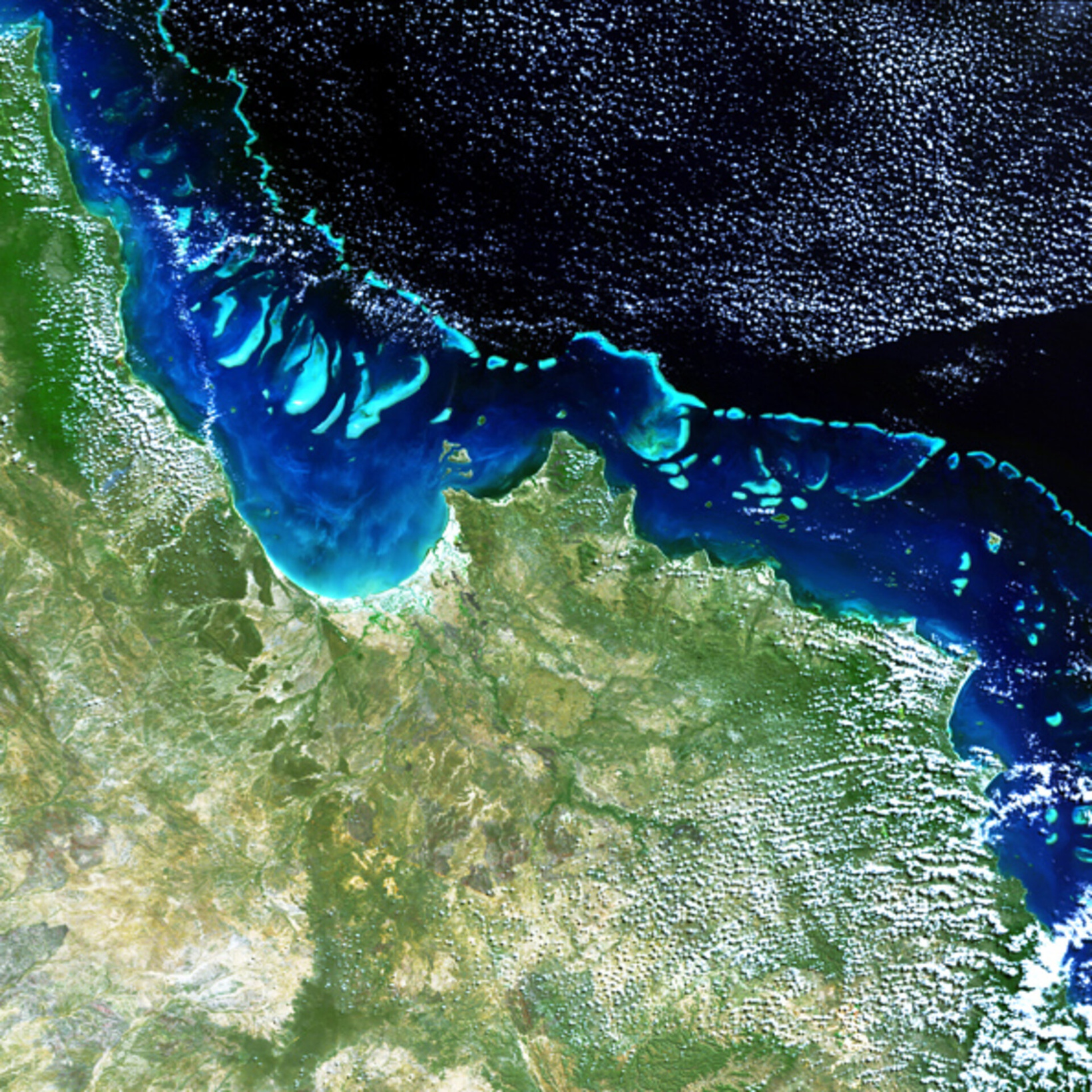
Great Barrier Reef from a European Space Agency satellite
The Great Barrier Reef is the world's largest coral reef system and the largest structure built by living organisms, covering 350,000 square kilometers (135,000 square miles), an area larger than Poland. Designated by UNESCO as World Heritage Site, it extends 2,300 kilometers (1,400 miles) from north to south Cape York in northern Queensland south to Bundaberg in southern Queensland and shelters over half of Australia's eastern coast. The Great Barrier Reef can be seen from the moon. Only a small portion of it is open to the public. A large part of it is protected by the Great Barrier Reef Marine Park, which helps to limit the impact of human use, such as fishing and tourism.
By one count the Great Barrier Reef is a composite of 2,900 reefs but there are various ways of counting individual reefs. Only some are true barrier reefs — breakwaters rising from the edge of a continental shelf. The majority are platform reefs (irregular circles and crescents of corals that grow in calm waters) and patch reefs (small scattered formations that grow in shallow water) and fringing reefs (which grow outward from the shore). The Great Barrier Reef islands have been ranked as among the top ten islands in the world by Travel and Leisure readers.
The Great Barrier Reef is located in the Coral Sea, an extension of the Pacific Ocean. It is separated from the coast of Queensland by a channel up to 160 kilometers (100 miles) wide in places, but generally closer than that, and over 61 meters (200 feet) deep. The reef first evolved over 25 million years ago. In 1770, Capt. James Cook crashed his ship into one of the system reefs. By 1900, 1,200 ships had sunk around the reef. [Source: Douglas H. Chadwick, National Geographic, January 2001]
RELATED ARTICLES:
CORAL REEFS: TYPES, PARTS, COMPOSITION AND BENEFITS ioa.factsanddetails.com ;
CORAL: POLYPS, ALGAE, EGGS, MASS SPAWNS ioa.factsanddetails.com ;
TYPES OF CORAL: HARD, SOFT, BRAIN, ELKHORN ioa.factsanddetails.com ;
ENDANGERED CORAL REEFS AND THEIR RECOVERY AND REBIRTH ioa.factsanddetails.com ;
GLOBAL WARMING AND CORAL REEFS ioa.factsanddetails.com ;
CORAL BLEACHING: CAUSES, CONSEQUENCES AND RECOVERY ioa.factsanddetails.com ;
HELPING CORAL RECOVER AND REVIVE ioa.factsanddetails.com
Geology and Islands of the Great Barrier Reef
The Great Barrier Reef system embraces 900 islands, including 618 continental, or high, islands, which were mountains and hills along the Australian coast during the last Ice Age when ocean levels were lower; and 300 low islands or cays, formed on coal shoals from reef sediments.

How some of the Great Barrier Reef reefs evolved
According to UNESCO: The Great Barrier Reef area has been exposed and flooded by at least four glacial and interglacial cycles, and over the past 15,000 years reefs have grown on the continental shelf. During glacial periods, sea levels dropped, exposing the reefs as flat-topped hills of eroded limestone. Large rivers meandered between these hills and the coastline extended further east. During interglacial periods, rising sea levels caused the formation of continental islands, coral cays and new phases of coral growth. This environmental history can be seen in cores of old massive corals.
Today the Great Barrier Reef forms the world’s largest coral reef ecosystem, ranging from inshore fringing reefs to mid-shelf reefs, and exposed outer reefs, including examples of all stages of reef development. The processes of geological and geomorphological evolution are well represented, linking continental islands, coral cays and reefs. The varied seascapes and landscapes that occur today have been moulded by changing climates and sea levels, and the erosive power of wind and water, over long time periods. One-third of the Great Barrier Reef lies beyond the seaward edge of the shallower reefs; this area comprises continental slope and deep oceanic waters and abyssal plains.
The globally significant diversity of reef and island morphologies reflects ongoing geomorphic, oceanographic and environmental processes. The complex cross-shelf, longshore and vertical connectivity is influenced by dynamic oceanic currents and ongoing ecological processes such as upwellings, larval dispersal and migration. Ongoing erosion and accretion of coral reefs, sand banks and coral cays combine with similar processes along the coast and around continental islands. Extensive beds of Halimeda algae represent active calcification and accretion over thousands of years.
Eighty kilometers (50 miles) off the coast of Queensland is tiny One Tree Island. Elizabeth Kolbert wrote in National Geographic, One Tree, which actually has several hundred trees, is shaped like a boomerang, with two arms that stretch out into the Coral Sea. In the crook of the boomerang there's a small research station run by the University of Sydney. As it happened, just as I arrived one spectacular summer afternoon, an enormous loggerhead turtle heaved herself up onto the beach in front of the lab buildings. The island's entire human population — 11 people, not including me — gathered around to watch. One Tree Island is part of the Great Barrier Reef. The entire island is composed of bits of coral rubble, ranging from marble to basketball size, that began piling up after a peculiarly violent storm about 4,000 years ago. Even today, the island has nothing that could really be called dirt. The trees seem to rise up directly out of the rubble like flagpoles. [Source: Elizabeth Kolbert, National Geographic, April 2011]
Sea Life in the Great Barrier Reef
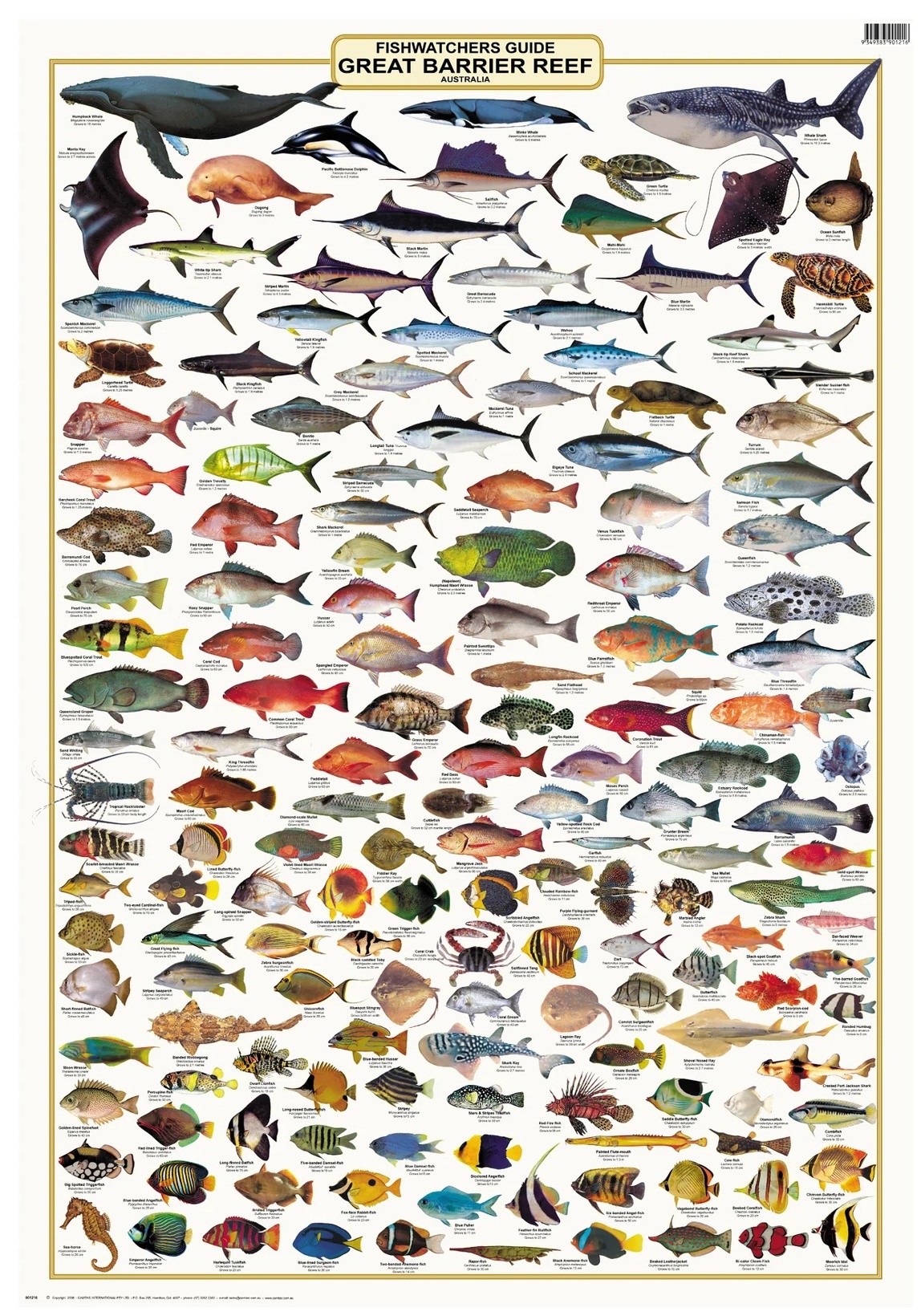
from boatbooks-aust
Life in the Great Barrier Reef includes 1,500 species of fish, 4,000 types of mollusk, 500 varieties of seaweed, 400 species of corals and 240 species of birds. New species are discovered every year. Over 250 types of shrimp have been seen around Heron Island. One soccer-ball-size piece of coral there contained 1,441 worms from 103 species. Six of the world's seven species of sea turtle are found that reef. The most plentiful are the flatbacks.
The Great Barrier Reef is ablaze with colorful sea fans and staghorn and brain coral that are grouped into large coral heads called "brommies," the destination of most snorkeling and diving outings. Hiding in coral crevasses's are parrot fish, lionfish and triggerfish, and lurking in caves are speckled moray eels and giant clams with fleshy polychromatic lips. Swimming in schools around the coral heads are yellow-banded hussars and red rock cods. And venturing from the open seas are 200 pound potato cods, manta rays and linebacker sized green turtles.
You can also see cuttlefish, bizarre and colorful nudibranches, sponge gardens and sharks. The mist common sharks are gray reef sharks, silvertips and whitetips. Bronze whalers are regarded as the most dangerous shark. There aren't really any Great Whites around the Great Barrier Reef, they prefer the colder waters off of southern Australia.
Snorkelers can view minke whales in the waters on the northern parts the Great Barrier Reef. Situated on the reef itself are hundreds of low-lying coral cays which are the breeding grounds for millions of seabirds including terns, boobies, shearwaters and red-throated frigate birds.
The world’s largest green turtle breeding site at Raine Island. The Great Barrier Reef also includes many regionally important marine turtle rookeries. Some 242 species of birds have been recorded in the Great Barrier Reef. Twenty-two seabird species breed on cays and some continental islands, and some of these breeding sites are globally significant; other seabird species also utilize the area. The continental islands support thousands of plant species, while the coral cays also have their own distinct flora and fauna.
RELATED ARTICLES:
See Cods of Australia Under GROUPERS: CHARACTERISTICS, BEHAVIOR AND BIG SPECIES ioa.factsanddetails.com ;
See Giant Black Stingrays Under SEA LIFE OF THE TASMAN SEA, SOUTHERN AUSTRALIA AND NEW ZEALAND ioa.factsanddetails.com
SEA TURTLES IN AUSTRALIA: SPECIES, CHARACTERISTICS, BEHAVIOR ioa.factsanddetails.com
SHARKS OF AUSTRALIA: SPECIES, CHARACTERISTICS, BEHAVIOR AND REPRODUCTION ioa.factsanddetails.com
COPPER SHARKS (BRONZE WAILERS): CHARACTERISTICS, BEHAVIOR AND REPRODUCTION ioa.factsanddetails.com
REEF SHARKS: BLACKTIP, WHITETIP AND GREY REEF SHARKS ioa.factsanddetails.com ;
REEF FISH ioa.factsanddetails.com
CORAL REEF LIFE ioa.factsanddetails.com ;
SPECIES OF DOLPHIN IN THE SOUTHERN HEMISPHERE ioa.factsanddetails.com
Great Barrier Reef Park
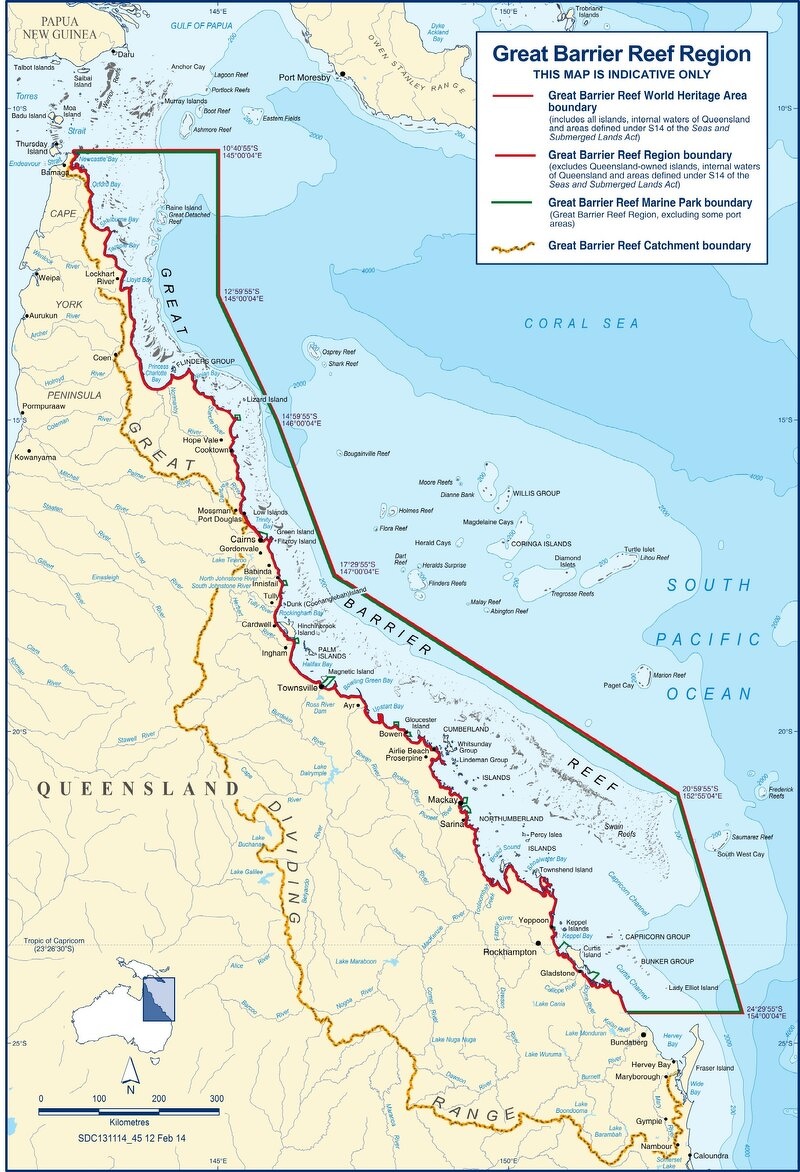
In 1975 nearly the entire Great Barrier Reef was declared the Great Barrier Reef Marine Park. Established main to keep companies from mining and drilling for oil, the marine park covers and area the size of Germany and was the first national marine sanctuary and still the largest. About 95 percent of the visitors visitor only five percent of the park.
Commercial fishing, sportfishing, spearfishing and shell collecting is allowed but regulated. Parts of Great Barrier Reef have been damaged to varying degrees by pollution, overfishing, sedimentation from heavy rains, agricultural run-off and excessive freshwater run-off, deforestation but most of the reef is in good shape,
Overfishing have made some species of conch, spiny lobster, whelk, red snapper and some types of grouper commercially extinct in many places. During the sixties and seventies sport and commercial fishing took its toll on the reef's marine life, especially the larger fish and turtles; but with strict rules the population of many of these sea animals have returned to healthy sizes and numbers. The inshore reefs haven't fared quite so well, many of them may be lost forever, the victims of fertilizer and silt that run off from mainland farms.
The nonprofit Great Barrier Reef Legacy and its partners have established the Living Coral Biobank in Australia, where a seaside “ark” house the more than 800 hard-coral species from around the world.
Diving and Recreation in the Great Barrier Reef:
The best way to explore the Great Barrier Reef is with a snorkel and fins or scuba gear. Snorkeling or diving in the Great Barrier Reef is about the greatest thing you'll ever do this side of having sex with your favorite movie star.
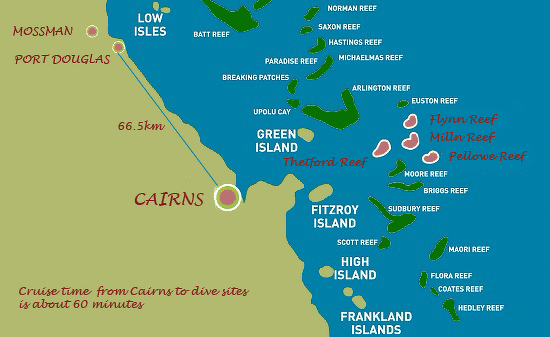
The Great Barrier Reef is a large reef and there as many good dives sites as there are stars in the sky. Although there is an Inner Reef close to shore most of the marine life for which the Great Barrier Reef is famous for is found in the Outer Reef which lies between 25 to 350 kilometers (15 to 220 miles) offshore.
The Queensland cities which provide easiest access to the reef are Gladstone, Townsville, and Cairns, all of which offer glass bottom boat excursions, helicopter and plane tours, and in some cases submarines trips and even walking tours of the reef during the low tide.
Several of islands contain resorts where you can walk right off the beach into the reef. The forested continental islands near the shore are popular with sailors. The most dazzling sections of the reef system, and unfortunately the most difficult to get to are in the north. Long boats are the only way to reach the best spots. Liveaboard dives, where you stay a week or so on a boat, and dive from the boat, are nice if you have the money.
Great Barrier Reef: UNESCO World Heritage Site
The Great Barrier Reef was inscribed as a UNESCO World Heritage Site in 1981 due to its outstanding universal value, recognized for its unique natural attributes and enormous scientific and environmental importance. It was the first coral reef to be included on the World Heritage List. According to UNESCO: As the world’s most extensive coral reef ecosystem, the Great Barrier Reef is a globally outstanding and significant entity. Practically the entire ecosystem was inscribed as World Heritage in 1981. It extends across a contiguous latitudinal range of 14̊ (10̊ S to 24̊ S). The Great Barrier Reef (hereafter referred to as GBR) includes extensive cross-shelf diversity, stretching from the low water mark along the mainland coast up to 250 kilometres offshore. This wide depth range includes vast shallow inshore areas, mid-shelf and outer reefs, and beyond the continental shelf to oceanic waters over 2,000 metres deep. [Source: UNESCO]
Within the GBR there are individual reefs of varying sizes and shapes, and islands, ranging from small sandy cays and larger vegetated cays, to large rugged continental islands rising, in one instance, over 1,100 metres above sea level. Collectively these landscapes and seascapes provide some of the most spectacular maritime scenery in the world.
The latitudinal and cross-shelf diversity, combined with diversity through the depths of the water column, encompasses a globally unique array of ecological communities, habitats and species. This diversity of species and habitats, and their interconnectivity, make the GBR one of the richest and most complex natural ecosystems on earth. There is a great diversity of sponges, anemones, marine worms, crustaceans, and other species. It also holds great scientific interest as the habitat of species such as the dugong (‘sea cow’) and the large green turtle, which are threatened with extinction.
No other World Heritage property contains such biodiversity. This diversity, especially the endemic species, means the GBR is of enormous scientific and intrinsic importance, and it also contains a significant number of threatened species. At the time of inscription, the IUCN evaluation stated "… if only one coral reef site in the world were to be chosen for the World Heritage List, the Great Barrier Reef is the site to be chosen".
Why the Great Barrier Reef is a UNESCO World Heritage Site
On why the Great Barrier Reef was selected as a World Heritage Site, UNESCO reports: The Great Barrier Reef is of superlative natural beauty above and below the water, and provides some of the most spectacular scenery on earth. It is complex string of reefal structures along Australia's northeast coast. From the air, the vast mosaic patterns of reefs, islands and coral cays produce an unparalleled aerial panorama of seascapes comprising diverse shapes and sizes. The Whitsunday Islands provide a magnificent vista of green vegetated islands and spectacular sandy beaches spread over azure waters. This contrasts with the vast mangrove forests in Hinchinbrook Channel, and the rugged vegetated mountains and lush rainforest gullies that are periodically cloud-covered on Hinchinbrook Island. On many of the cays there are spectacular and globally important breeding colonies of seabirds and marine turtles, and Raine Island is the world’s largest green turtle breeding area. On some continental islands, large aggregations of over-wintering butterflies periodically occur.
Beneath the ocean surface, there is an abundance and diversity of shapes, sizes and colours; for example, spectacular coral assemblages of hard and soft corals, and thousands of species of reef fish provide a myriad of brilliant colours, shapes and sizes. The internationally renowned Cod Hole near Lizard Island is one of many significant tourist attractions. Other superlative natural phenomena include the annual coral spawning, migrating whales, nesting turtles, and significant spawning aggregations of many fish species.
Biologically the unique diversity of the Great Barrier Reef reflects the maturity of an ecosystem that has evolved over millennia; evidence exists for the evolution of hard corals and other fauna. Globally significant marine faunal groups include over 4,000 species of molluscs, over 1,500 species of fish, plus a great diversity of sponges, anemones, marine worms, crustaceans, and many others. The establishment of vegetation on the cays and continental islands exemplifies the important role of birds, such as the Pied Imperial Pigeon, in processes such as seed dispersal and plant colonisation. Human interaction with the natural environment is illustrated by strong ongoing links between Aboriginal and Torres Strait Islanders and their sea-country, and includes numerous shell deposits (middens) and fish traps, plus the application of story places and marine totems.
The enormous size and diversity of the Great Barrier Reef means it is one of the richest and most complex natural ecosystems on earth, and one of the most significant for biodiversity conservation. The amazing diversity supports tens of thousands of marine and terrestrial species, many of which are of global conservation significance. As the world's most complex expanse of coral reefs, the reefs contain some 400 species of corals in 60 genera. There are also large ecologically important inter-reefal areas. The shallower marine areas support half the world's diversity of mangroves and many seagrass species. The waters also provide major feeding grounds for one of the world's largest populations of the threatened dugong. At least 30 species of whales and dolphins occur here, and it is a significant area for humpback whale calving.
Threats to the Great Barrier Reef
Environmental pressures on the reef and its ecosystem include runoff of human-made pollutants, climate change accompanied by mass coral bleaching, dumping of dredging sludge and cyclic population outbreaks of the crown-of-thorns starfish. According to UNESCO: A number of natural pressures occur, including cyclones, and sudden large influxes of freshwater from extreme weather events. As well there is a range of human uses such as tourism, shipping and coastal developments including ports. There are also some disturbances facing the Great Barrier Reef that are legacies of past actions prior to the inscription of the property on the World Heritage list. [Source: UNESCO]
The 2009 Outlook Report identified the long-term challenges facing the Great Barrier Reef; these are dominated by climate change over the next few decades. The extent and persistence of damage to the Great Barrier Reef ecosystem will depend to a large degree on the amount of change in the world’s climate and on the resilience of the Great Barrier Reef ecosystem to such change. This report also identified continued declining water quality from land-based sources, loss of coastal habitats from coastal development, and some impacts from fishing, illegal fishing and poaching as the other priority issues requiring management attention for the long-term protection of the Great Barrier Reef.
Emerging issues since the 2009 Outlook Report include proposed port expansions, increases in shipping activity, coastal development and intensification and changes in land use within the Great Barrier Reef catchment; population growth; the impacts from marine debris; illegal activities; and extreme weather events including floods and cyclones.
Crown-of-Thorns Starfish Ravage the Great Barrier Reef
Largest areas of the central section of the Great Barrier Reef have been damaged by Crown of Thorn starfish. Million of these of creatures ravaged the Great Barrier Reef in early 1960s, late 1970s, early 1980s and late 1990s, leaving behind thousands of hectacres of bleached, dead coral. The attack in the 1960s was particularly devastating. It lasted for 10 years and killed one fifth of the 2,600 reefs that comprise the Great Barrier Reef. On the Great Barrier Reef near Townsville crown-of-thorns starfish starfish turned once vibrant reefs into bleached skeletons. Around Cairns people were hired to remove the starfish from popular diving and snorkeling spots on a daily basis. Divers attempted to get ride of the starfish by injecting them with copper sulfate but environmentalists worried the toxin could damage the reef more than starfish and enter the food chain.
In the early 1990s, the crown-of-thorns starfish mysteriously disappeared. But in 1994, scientist began noticing a build up of starfish in the north of the reef and predicted another outbreak would occur when these starfish matured. Females lay up to 100 million eggs at one time and these eggs can float for hundred of miles before settling on a reef and developing into starfish. It was first thought the starfishes were flourishing because the natural predator the giant triton mollusk was being taken by shell hunters, but most scientists now insist the infestation is part of a natural cycle.
Surveys conducted since the early 1990s have illustrated that declines in live hard coral cover have occured at the same time as crown-of-thorns outbreaks along the reef systems between Lizard Island and Townsville in the Great Barrier Reef off of Queensland, Australia. The decline of the coral reef is bad in itself but also seriously and negatively affects the tourism industry in the region. Researchers are trying to determine if and how human activities affect the cycle of starfish outbreaks, particularly how increased nutrient runoff from land affects survival, recruitment, and growth of larval crown-of-thorns starfish.
Coral Bleaching at the Great Barrier Reef
In the 1980s Peter Harrison, a marine ecologist at Australia’s Southern Cross University, witnessed the first recorded large-scale coral bleaching event. Diving off Magnetic Island in the Great Barrier Reef, he was stunned by what he saw. “The reef was a patchwork of healthy corals and badly bleached white corals, like the beginnings of a ghost city,” he told National Geographic. Just months before, the same site had bustled with tropical life in Crayola colors. “Many of the hundreds of corals that I’d carefully tagged and monitored ultimately died,” he says. “It was shocking and made me aware of just how fragile these corals really are.” [Source: Jennifer S. Holland, National Geographic, April 7, 2021]
In 1998 and 2002 the Great Barrier Reef suffered major bleaching that was blamed on El Nino-related warming. Though much of damaged coral recovered about five percent was permanently damaged. In 2016, a record-hot year, 91 percent of the reefs that comprise the Great Barrier Reef bleached. Along the northern part of the reef, reefs were monitored in real time by scientists, who found that two-thirds of the corals had died.
The Great Barrier Reef was hit by four mass bleaching events between 2014 and 2021. According to National Geographic: Scientists surmise that about four decades ago severe bleaching occurred roughly every 25 years, giving corals time to recover. But bleaching events are coming faster now — about every six years — and in some places soon they could begin to happen annually. One study found that the growth of Porites corals, which form massive, boulderlike clumps, declined 14 percent on the Great Barrier Reef between 1990 and 2005.
Conservation at the Great Barrier Reef
According to UNESCO The ecological integrity of the Great Barrier Reef is enhanced by the unparalleled size and current good state of conservation across the property. At the scale of the Great Barrier Reef ecosystem, most habitats or species groups have the capacity to recover from disturbance or withstand ongoing pressures. The property is largely intact and includes the fullest possible representation of marine ecological, physical and chemical processes. About 99 percent of the Great Barrier Reef lies within the Great Barrier Reef Marine Park. The park’s legal jurisdiction ends at low water mark along the mainland (with the exception of port areas) and around islands (with the exception of 70 Commonwealth managed islands which are part of the Marine Park). In addition the Great Barrier Reef also includes over 900 islands within the jurisdiction of Queensland, about half of which are declared as 'national parks', and the internal waters of Queensland that occur within the World Heritage boundary (including a number of long-established port areas). [Source: UNESCO]
The World Heritage property is and has always been managed as a multiple-use area. Uses include a range of commercial and recreational activities. Some of the key ecological, physical and chemical processes that are essential for the long-term conservation of the marine and island ecosystems and their associated biodiversity occur outside the boundaries of the property and thus effective conservation programs are essential across the adjoining catchments, marine and coastal zones. The management of such a large and iconic world heritage property is made more complex due to the overlapping State and Federal jurisdictions. The Great Barrier Reef Marine Park Authority, an independent Australian Government agency, is responsible for protection and management of the Great Barrier Reef Marine Park. The Great Barrier Reef Marine Park Act 1975 was amended in 2007 and 2008, and now provides for “the long term protection and conservation ... of the Great Barrier Reef Region” with specific mention of meeting "... Australia's responsibilities under the World Heritage Convention".
Queensland is responsible for management of the Great Barrier Reef Coast Marine Park, established under the Marine Parks Act 2004. This is contiguous with the Great Barrier Reef Marine Park and covers the area between low and high water marks and many of the waters within the jurisdictional limits of Queensland. Queensland is also responsible for management of most of the islands. Development and land use activities in coastal and water catchments adjacent to the property also have a fundamental and critical influence on the values within the property. The Queensland Government is responsible for natural resource management and land use planning for the islands, coast and hinterland adjacent to the Great Barrier Reef. Other Queensland and Federal legislation also protects the property’s Outstanding Universal Value addressing such matters as water quality, shipping management, sea dumping, fisheries management and environmental protection.
The Great Barrier Reef Marine Park and the adjoining Great Barrier Reef Coast Marine Park are zoned to allow for a wide range of reasonable uses while ensuring overall protection, with conservation being the primary aim. The Federal Environment Protection and Biodiversity Conservation Act 1999 (EPBC Act) provides an overarching mechanism for protecting the World Heritage values from inappropriate development, including actions taken inside or outside which could impact on its heritage values. This requires any development proposals to undergo rigorous environmental impact assessment processes, often including public consultation.
Many Aboriginal and Torres Strait Island peoples undertake traditional use of marine resource activities to provide traditional food, practice their living maritime culture, and to educate younger generations about traditional and cultural rules and protocols. In the Great Barrier Reef these activities are managed under both Federal and Queensland legislation and policies. Other key initiatives providing increased protection for the Great Barrier Reef include the comprehensive Great Barrier Reef Outlook Report (and its resulting 5-yearly reporting process); the Reef Water Quality Protection Plan; the Great Barrier Reef Climate Change Action Plan; and the Reef Guardians Stewardship Programs which involve building relationships and working closely with those who use and rely on the Great Barrier Reef or its catchment for their recreation or their business.
Image Sources: Wikimedia Commons
Text Sources: Animal Diversity Web animaldiversity.org , National Geographic, Live Science, Natural History magazine, Australian Museum, David Attenborough books, Australia Geographic, New York Times, Washington Post, Los Angeles Times, Smithsonian magazine, Discover magazine, The Conversation, The New Yorker, Time, BBC, CNN, Reuters, Associated Press, AFP, Lonely Planet Guides, Wikipedia, The Guardian, Top Secret Animal Attack Files website and various books and other publications.
Last updated September 2025