
Home | Category: Dolphins / Sea Life Around Australia / Nature, Environment, Animals
FRIENDLY DOLPHINS OF NEW ZEALAND

Some dolphin species: 3) Peale’s Dolphin (Lagenorhynchus australis); 4) Hourglass Dolphin (Lagenorhynchus crucigen; 5) Pacific White-sided Dolphin (Lagenorhynchus obliquidens); 6) Dusky Dolphin (Lagenorhynchus obscurus); 7) Irrawaddy Dolphin (Orcaella brevirostris); 8) Australian Snubfin Dolphin (Orcaella heinsohni)
Dolphins in the Fiordland area are famous for welcoming ships into the bays and sounds. There are also places where people swim with dolphins. The major species found in New Zealand include dusky dolphins, Hector's dolphins and bottlenose dolphins.
A Risso’s dolphin by the name of Pelorus Jack guided boats and entertained tourists for nearly thirty years in Admiralty Bay on the South Island. So popular was he that boats went out of their way to visit him and a special law was passed to protect him. Sailors came to rely on Jack to navigate the French Pass, a dangerous stretch of water through D'Urville Islands from Pelorus Sound to Tasman Bay. The first ship that Jack helped, the schooner “Brindle”, was on its way from Boston to Sydney, and decided to take the dangerous passage as a short cut. When the dolphin was first spotted some sailors suggested shooting it but the captain's wife reportedly intervened and the ship ended up following the dolphin through French Pass.
The ship arrived safely and the dolphin was nicknamed Pelorus Jack after the sound. For the next 30 year almost every ship that approached the passage was lead by Jack. In 1903, a drunken passenger on the shop “Penguin” shot and wounded Jack, a deed which nearly got the passenger thrown overboard by a mob. Jack disappeared briefly and then showed up two weeks later apparently unharmed. Even so, Jack never went anywhere near the “Penguin” again and the ship sunk in 1909, killing scores of people. Jack survived another nine years. The last time he was seen was in April, 1912.
An even friendlier dolphin by the name of Opo appeared in 1955. She used play ball with children at Oponomi Beach and let them stroke and ride her. So popular was she that traffic jams were formed by tourists anxious to see her. Aware of what happened to Pelrous Jack, local people erected a sign that read "Welcome to Opononi, but don't try to shoot our Gay Dolphin." In 1956, Opo failed to appear on the beach and later she was found dead among some rocks. One theory was that she had been killed by fisherman who used explosives to stun fish. The grave where she was buried can still seen today. [Source: Robert Leslie Conly, National Geographic, September 1966]
RELATED ARTICLES:
CATEGORY: DOLPHINS ioa.factsanddetails.com ;
TOOTHED WHALES: SWIMMING, ECHOLOCATION AND MELON-HEADS ioa.factsanddetails.com ;
DOLPHIN CHARACTERISTICS, HISTORY, TAXONOMY ioa.factsanddetails.com ;
DOLPHIN BEHAVIOR, SEX AND REPRODUCTION ioa.factsanddetails.com ;
DOLPHIN SENSES, COMMUNICATION AND LANGUAGE ioa.factsanddetails.com ;
DOLPHIN INTELLIGENCE: THEIR BRAIN, INNOVATION AND MEMORY ioa.factsanddetails.com ;
DOLPHINS AND HUMANS: HISTORY, FISHING TOGETHER AND RESEARCH ioa.factsanddetails.com ;
DOLPHIN TOURISM AND SWIMMING WITH DOLPHINS ioa.factsanddetails.com ;
SPECIES OF DOLPHIN ioa.factsanddetails.com
Dolphins Save Swimmers from Great White Shark Attack

Pelorus Jack
In November 2004, a pod of dolphins saved a group of swimmers from a great white shark off the northern coast of New Zealand. Associated Press reported: The incident happened when lifeguard Rob Howes took his 15-year-old daughter Niccy and two of her friends swimming near the town of Whangarei, according to the Northern Advocate newspaper. Mr Howes told the newspaper that the dolphins "started to herd us up, they pushed all four of us together by doing tight circles around us". He explained that, when he had attempted to break away from the protective group, two of the bigger dolphins herded him back.[Source: Associated Press, November 23, 2004]
He then saw what he described as a three-meter great white shark cruising toward them — but it appeared to be repelled by the ring of dolphins and swam away. "It was only about two meters away from me, the water was crystal clear, and it was as clear as the nose on my face," he said. At that point, he realised that the dolphins "had corralled us up to protect us".
The dolphins kept their vigil for 40 minutes until the shark lost interest, and the group could swim 100 meters back to the shore. Another lifeguard, Matt Fleet, who was on patrol in a lifeboat, saw the dolphins circling the swimmers and slapping their tails on the water to keep them in place. He told the newspaper he also had a clear sighting of the shark. "Some of the people later on the beach tried to tell me it was just another dolphin — but I knew what I saw," he said.
Expert Ingrid Visser, who has been studying marine mammals for 14 years, told the Northern Advocate that there had been reports from around the world about dolphins protecting swimmers. She said that, in this case, the dolphins probably sensed the humans were in danger and took action to protect them. Ms Visser, of the group Orca Research, said dolphins would attack sharks
New Dolphin Species in Australian Waters
In July 2005, researchers with at James Cook University and the Museum of Tropical Queensland announced that they had identified a new species of dolphin. — the Australian Snubfin Dolphin — the first new dolphin species to be identified in 30 years. The new species of dolphin had been observed before but was thought to a subspecies of Irrawaddy dolphins, which are an extremely rare and found predominantly found in coastal waters and rivers in Southeast Asia. [Source: Reuters, July 6, 2005]
Reuters reported: Researcher Isabel Beasley said the newly identified Australian Snubfin Dolphins, (Orcaella heinsohni), live in shallow waters off northern Australia and possibly in neighbouring Papua New Guinea. Beasley said it was impossible to estimate the population of these dolphins because not enough was known about them, but thought one group of about 200 of the dolphins lived off Townsville in the far north of Australia's Queensland state. "It means that Australia now has an endemic species living in its waters and it's a higher conservation priority now," Beasley told Reuters. Conservation group WWF International estimates there are fewer than 1,000 Irrawaddy dolphins (Orcaella brevirostris) — a small, migratory and poor-sighted species — left in the shallow, murky coastal waters and rivers of countries such as Myanmar, Laos and Cambodia. Because the new Australian species also lives in shallow waters, Beasley fears they face the same threats as Irrawaddy.
In 2013, researchers announced the discovery of a new species of humpback dolphin in the waters off northern Australia. Science News reported: Humpback dolphins — named for a peculiar hump just below the dorsal fin — belong to the dolphin genus Sousa. These animals measure from 5 to 8 feet in length and range from dark gray to pink or white in color. They are found throughout the Indian and Pacific oceans to the coasts of Australia. [Source: Science News, October 30, 2013]
Team leader Dr Martin Mendez from American Museum of Natural History in New York and Wildlife Conservation Society with colleagues used both physical features and genetic data to determine the number of species in the genus Sousa. While the Atlantic humpback dolphin is a recognized species, the scientists provide the best evidence to date to split the Indo-Pacific humpback dolphin into three species. “Based on the findings of our combined morphological and genetic analyses, we can suggest that the humpback dolphin genus includes at least four member species,” Dr Mendez said.
According to their results, published in the journal Molecular Ecology, there are at least four species of humpback dolphins, one of which is new to science. 1) The Atlantic humpback dolphin, Sousa teuszii, occurs in the eastern Atlantic off West Africa. 2) The Indo-Pacific humpback dolphin, Sousa plumbea, lives in the central to the western Indian Ocean. 3) Another species of Indo-Pacific humpback dolphin, Sousa chinensis, inhabits the eastern Indian and western Pacific Oceans. 4) The fourth species, Sousa sp. nov., which has yet to be named, occurs off northern Australia.
Dusky Dolphins
Dusky dolphins (Scientific name: Lagenorhynchus obscurus) live the Southern Hemisphere. They can be found near the coasts of South America, South Africa, Kerguelen Islands in the southern Indian Ocean, South Australia and New Zealand. They are usually found in warm to cool temperate waters and are particularly associated with New Zealand. They are acrobatic, curious and easy to approach. They are known for their displays — turning, jumping and charging line-abreast formations near ships. Swimming with these dolphins has became a major tourist attraction. In Kaikoura, New Zealand, there is a lucrative dolphin-watching and swimming with dolphins tourism industry centered around these animals. [Source: Helen Yu, Animal Diversity Web (ADW) /=]
The main prey species of dusky dolphins are anchovies, squid and schooling shrimp. Dusky dolphins feed near the surface, deep in the water column and at or near the sea bottom. Groups with 3000 or more individuals engage in cooperative herding of large schools of small fish. Dusky dolphins have been recorded swimming with schools of Common Dolphins, and even mating with them
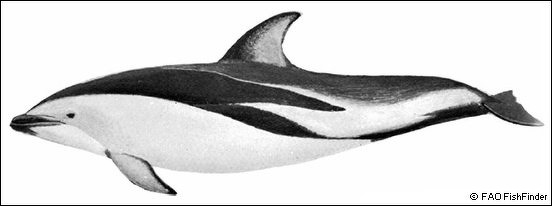
dusky dolphin
Dusky dolphins are classified as "data deficient" on the International Union for Conservation of Nature (IUCN) Red List of Threatened Species. They are not considered endangered or threatened but hundreds, maybe thousands of dusky dolphins have been killed annually by the small-cetacean fishery in Peru and as bycatch by anchovy fisherman. In 1990 the Peruvian government banned the direct fishery for small cetaceans, but the ban has not been very effective. After the ban was put in place one could buy fresh dusky dolphins meat in Lima markets for US$1-1.25 per kilograms. Nearly 10,000 of these dolphins were killed each year in the 1970s. Orcas (killer whales) prey on dusky dolphins.
Dusky Dolphin Characteristics, Behavior and Reproduction
Dusky dolphins are a medium-sized dolphin that reach 1.8 meters to 2 meters (6 to 6.5 feet) in length as adults. Their head slopes evenly down from the blowhole to the tip of the snout and they have virtually no beak. According to Animal Diversity Web: The tip of the dorsal fin is rather blunt and is not markedly hooked. These dolphins have a bluish-black tail and back. A dark band runs diagonally across the flanks from below the dorsal fin towards the vent and along the tailstock. The underside of the body is white, and whitish-grey color extends over the flanks. The tips of the snout and lower jaw are dark. A grey area extends from the eye down to the flipper. Two diagonal whitish streaks run forward from tail up past the base of dorsal fin. There are 24-36 pairs of small, pointed teeth about 3 millimeters in diameter in each jaws. The upper jaw usually has two less teeth than the lower. [Source: Helen Yu, Animal Diversity Web (ADW) /=]
Dusky dolphins are diurnal (active mainly during the daytime), motile (move around as opposed to being stationary) and social (associates with others of its species; forms social groups). They are often seen in groups of 6-15, occasionally up to 300 for feeding aggregations. Groups are a mixture of ages and include members of both sexes. Groups are usually stable for at least several days. Dusky dolphins are among the most altruistic of the dolphins. They have been reported to assist other dolphin species in distress, and to aid humans. Dusky dolphins are extremely fond of playing and leaping; they often leap in schools. Dusky dolphins are especially attracted to boats. They are fast swimmers, reaching speeds up to 40 kilometers per hour (23 miles per hour).
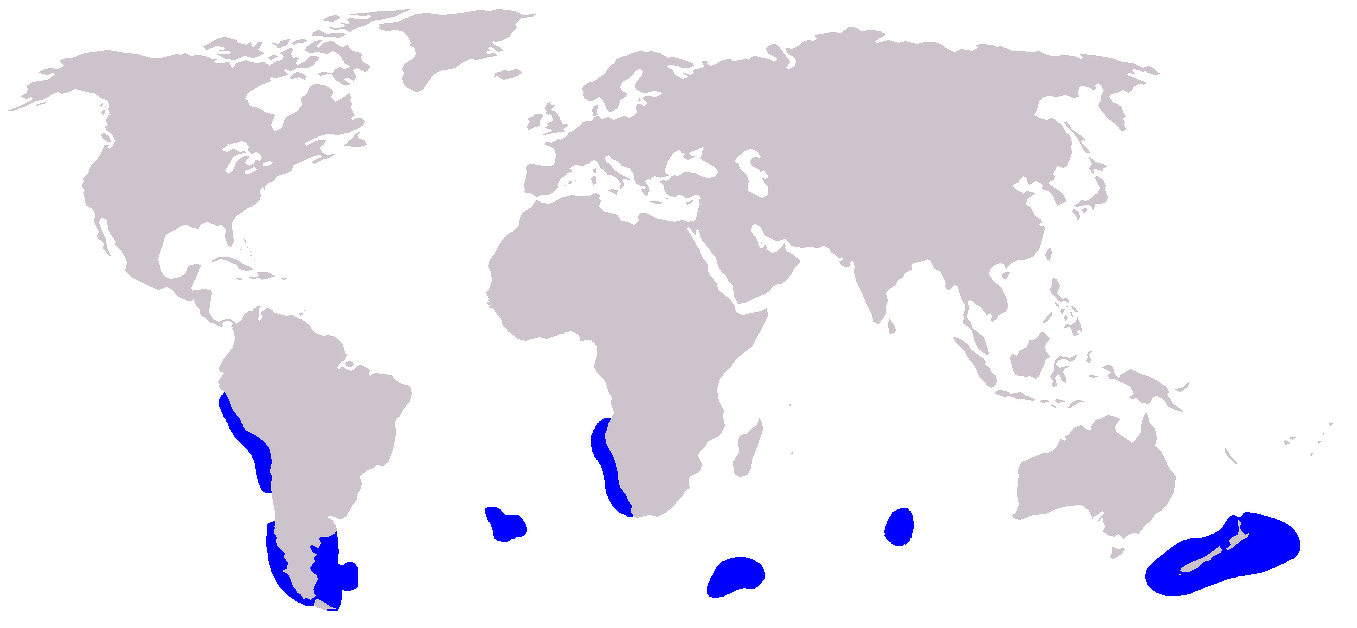
Dusky dolphin range
Dusky dolphins spend night-time in small schools no more than a kilometer offshore. During this period, they rest, with only slow movements. In the morning, they move into deeper water, about two to ten kilometers from shore. At this time, they search for food in groups, swimming in a line abreast with each animal 10 meters from the next. Then they may aggregate up to 300 for cooperative herding. By mid-afternoon, feeding may be concentrated in one area. At this time they also start to interact socially in play and sexual activity. In the evening, the large school of dusky dolphins splits up into smaller groups and returns inshore.
Dusky dolphins produce a variety of whistles, squeaks, squeals and clicks. These sounds are loud and directional. The sound of a dusky dolphin reentering the water after a leap carries at least 500 meters but less than 1km underwater. In air, the sound can be heard as far away as 3-km distance. Dusky dolphins often leap before and after feeding. The leap has been hypothesized to function to recruit other dolphins to assist in feeding activities (Herman 1980). /=\
Dusky dolphins are viviparous, meaning they give birth to live young that developed in the body of the mother, and engage in seasonal breeding. Mating usually takes place during spring, with the average number of offspring being one, and the peak months for birth being June to August.. The average gestation period is 11 months. The average weaning age is 18 months. Dusky dolphins are polygynandrous (promiscuous), with both males and females having multiple partners. Adult males compete for mating access with females. Pair bonds do not appear to be formed, but social cohesion within the school seems strong. Calves weigh about five kilograms (11 pounds) at birth. /=\
Hector’s Dolphin
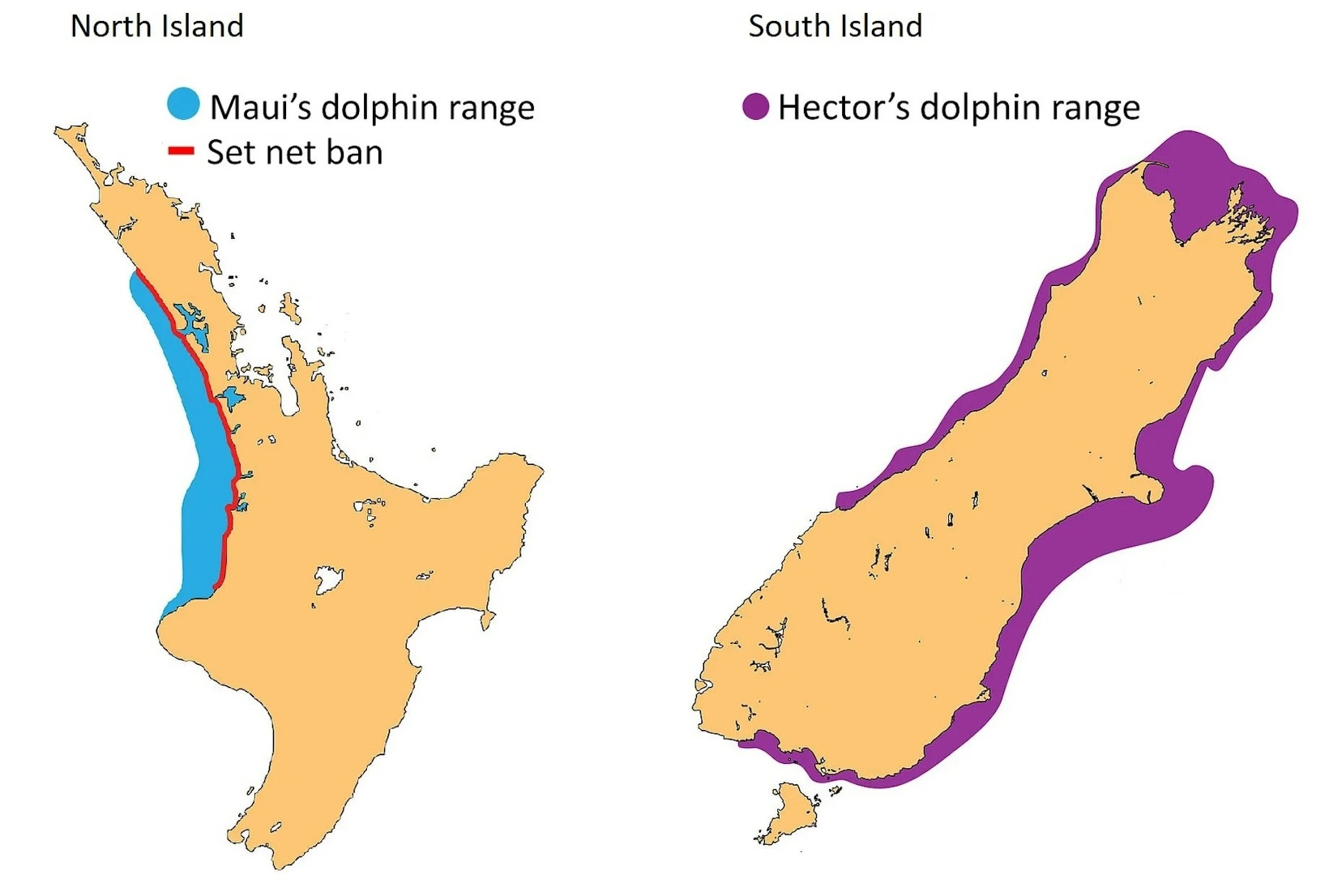
Hector’s dolphins (Cephalorhynchus hectori) are one of the world’s smallest dolphins and are found only in the coastal waters of New Zealand. Two subspecies of Hector’s dolphins have been formally recognized based on multiple morphological distinctions and genetic evidence of reproductive isolation. One subspecies, with the common name Hector's dolphin (Cephalorhynchus hectori hectori), occurs in the waters around the South Island of New Zealand. The other subspecies, Maui’s dolphin (Māui dolphin, Cephalorhynchus hectori maui) occurs only in waters off the west coast of the North Island of New Zealand. The name of this subspecies is derived from Maori legend about a man who, while fishing, pulled up the North Island, Te Ika a Maui. Substantial declines in this species have been detected for most populations, mainly as a result of bycatch in gillnets. In 2017, NOAA Fisheries listed the Māui dolphin subspecies as endangered and the Hector’s dolphin subspecies as threatened under the Endangered Species Act. [Source: NOAA ^]
Hector’s dolphins look a bit like small killer whales. Generally found within a few kilometers of the coast, these small, stocky mammals swim quietly and have a characteristic rounded dorsal fin with a convex trailing edge and feed of a wide varity of fish and squid. They are an estimaited 3,000 to 4,000 of them, with most around New Zealand’s South and as few as 100 around the North Island. Their lifespan is only around 20 years and females mature relatively late and give birth to only one calf every two to four years [Source: National Geographic Canon advertisement]
Māui dolphins are currently found only along the northwest coast of the North Island, between Maunganui Bluff and Whanganui. The South Island Hector’s dolphins are found in the waters around the South Island and consist of at least three genetically distinct, regional populations. Hector’s dolphins are typically sighted within about 37 kilometers (23 miles) of the the coast and in water less than 100 meters (328 feet) deep. [Source: NOAA]
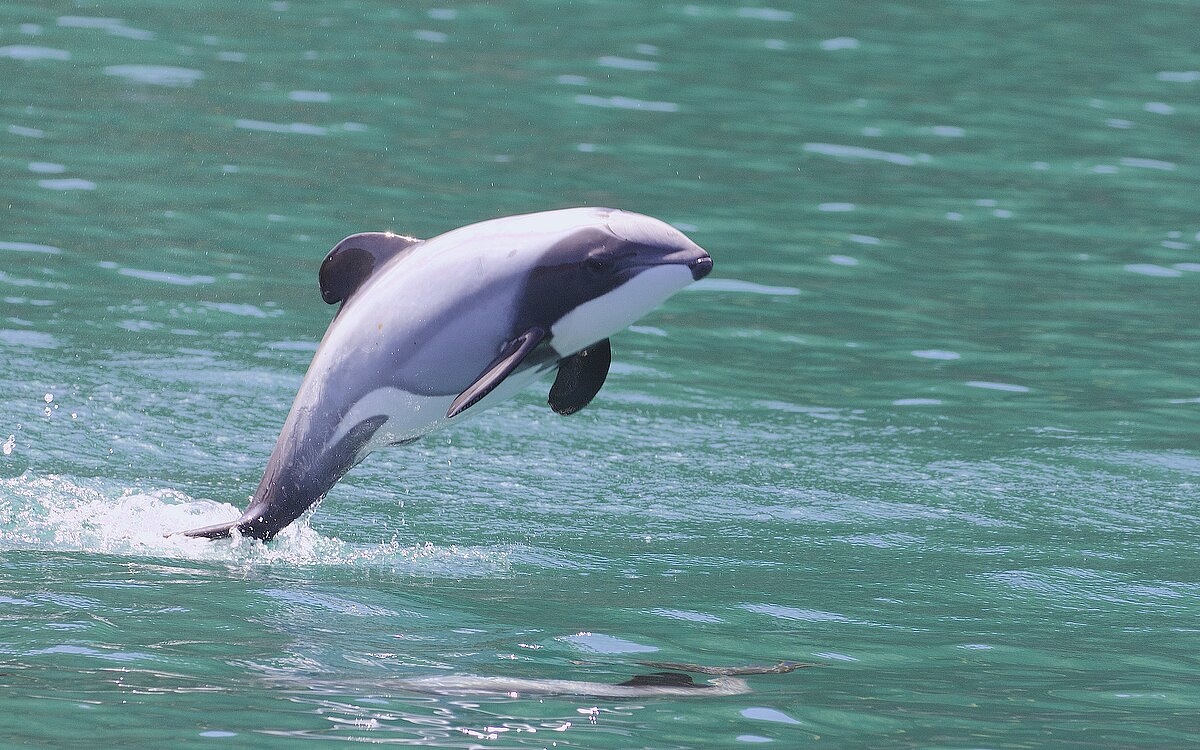
Hector's dolphin
Maui’s dolphins are found along the west coast of North Island, between Dargaville and New Plymouth. Their population is very small, with only 54 individuals in 2020, down from 111 in the 2000s. The three populations of Hector's dolphin on the South Island reside along the west, east and south coasts, excluding Fiordland. The total population of Hector’s dolphins around the South Island is estimated at 15,000 about double the number in 2004 Hector’s dolphins are most abundant between Karamea and Makawhio Point on the west coast and around Banks Peninsula on the east coast. A total of 5388 found on the west coast, mostly concentrated between 41º30S and 44º30 S in 2004.
There have been sightings as far as 7.4 kilometers (four nautical miles) off the west coast of North Island, 11 kilometers (six nautical miles) off the west coast of South Island, and 27.8 kilometers (15 nautical miles) off the east coast of South Island; all of which occurred in water no deeper than 90 meters (295 feet). Hector’s dolphins are most often observed less than one kilometer from the shoreline. During the austral summer, Hector's dolphins prefer to be close to shore. During winter they tend to be more dispersed and are found farther from shore. During spring, they may migrate to different coastal areas or return to the same area as the previous summer. [Source: Linda Lees, Animal Diversity Web (ADW) |=|]
Hector’s Dolphin Characteristics
Hector's dolphins are among the smallest dolphins in the world. They have short and stocky bodies, no external beak, and a relatively large fluke. Both subspecies typically have a total body length of 1.2 to 1.5 meters (four to five feet) at maturity. They have a very rounded dorsal fin and paddle-like pectoral fins. Their distinctive gray, black, and white coloring changes as the dolphin ages from a newborn calf into an adult. As an adult, the sides of the head, tail, dorsal fin, and flippers are black; the throat, lower jaw, and belly are white; and most of the rest of the body is gray. A thin black line also curves from the head to just behind the blowhole. They have 26 to 32 pairs of small, conical teeth in the upper and lower jaws. Dolphins and other odontocetes have one set of teeth their whole life. Hector’s dolphins can be up to 1.3 centimeters long and three millimeters in diameter at its widest point. [Source: NOAA]
Hector's dolphins range in weight from 50 to 60 kilograms (110 to 132 pounds) and range in length from 1.2 to 1.6 meters (4 to 5.3 feet), with their average length being 1.36 meters (4.5 feet). Their lifespan is At least 22 years. North Island dolphins (Maui’s dolphins) are longer than their South Island counterparts. The Hector's dolphin subspecies of the south is up to 1.5 meters (five feet) long; Māui dolphins of the north are up to 1.6 meters (5.3 feet) long. These dolphins are endothermic (use their metabolism to generate heat and regulate body temperature independent of the temperatures around them), warm-blooded (homoiothermic, have a constant body temperature, usually higher than the temperature of their surroundings). [Source: Linda Lees, Animal Diversity Web (ADW) |=|]
Sexual Dimorphism (differences between males and females) is present: Females of both subspecies are larger than males. Sexes are colored or patterned differently. Adult males (males who are eight years of age and older) along the South Island coast, are on average 1.25 meters (4.1 feet) in total length, measured from snout to tail notch, and can grow up to 1.44 meters (4.7 feet) in total length. Adult South Island females are on average 1.36 meters (4.46 feet) in total length and can grow up to 1.5 meters . North Island males can grow up to 1.46 meters (4.8 feet) in total length, and females can grow up to 1.62 meters (5,3 feet).
Historically, Maui’s dolphin on the North Island have had only three mtDNA lineages, and those alive today only have one. In comparison, the South Island population has as many as 16 different mtDNA lineages. According to Animal Diversity Web: The single mtDNA lineage that remains in the North Island population differs from those in the South Island by a single, diagnostic nucleotide substitution. In addition to significant genetic differences, the North and South Island populations exhibit significant differences in morphology. Most notably, North Island dolphins have larger skulls than South Island dolphins. Minor morphological differences exist between the three South Island populations.
From birth to around six months old, Hector’s dolphins have light grey stripes on their flanks, caused by fetal fold marks, which stand out from the rest of the dark-gray body. Color patterns around the genital slit of adults are sexually dimorphic. South Island males have an elongated black patch around the genital slit which is heart-shaped. In contrast, North Island dolphins have a reduced genital patch, or no patch at all. The beaks of Hector’s dolphins are not easily distinguished from the head. Their dorsal fin is unusual compared to other delphinids, having a rounded or lobed appearance. The body of Hector’s dolphins is predominantly light grey. Except for a black patch that runs between the flippers, their ventral surface is white. They have a white band that runs along their sides, extending towards the posterior end, outlined by dark-grey. The dorsal fin, flippers, flukes, beak tip, blow hole area, and sides of the face are dark grey to black, with much of the chin and lower jaw being white. |=|
Hector’s Dolphin Behavior, Communication, Senses and Diet
Hector’s dolphins are diurnal (active mainly during the daytime), motile (move around as opposed to being stationary), migratory (make seasonal movements between regions, such as between breeding and wintering grounds) and social (associates with others of its species; forms social groups). Hector’s dolphins are slow swimmers relative to other dolphins and use an undulating motion to move through the water. Dives usually last less than three minutes. Hector’s dolphins tend to swim closer together when in close proximity to boats, which may be an indication of stress. They have relatively small home ranges — typically less than is 15 square kilometers (5.8 square miles). They have high site fidelity, moving only short distances from their birth, although some longer movements appear to be possible (such as, over about 400 kilometers, 250 miles). The longest alongshore distance recorded was 106 kilometers. All other documented movements have been less than 60 kilometers, with an average of 31 kilometers. The home range of Hector's dolphins often overlaps with those of nearby groups. [Source: NOAA, Linda Lees, Animal Diversity Web (ADW) |=|]
Hector’s dolphins occur in small groups averaging two to four dolphins and up to 20 dolphins. Each social group has a distinct core use area. There is little movement between these core areas, which tend to be about 30 kilometers apart. Geographic separation between core use areas may have lead to genetic isolation between local populations. Hector’s dolphins live in fission-fusion social groups, which are common in many cetaceans. Males and females have a large number of weak associations with many other individuals. They are commonly found in groups of two to 8, which join, and subsequently part ways, with other groups. Groups that form temporary associations with other groups are often in close proximity to each other. Association among individuals tends to last no longer than a few days.
Similar to other marine mammals, dolphins are commonly observed foraging, socializing, and nursing their young in shallow inshore waters. Hector’s dolphins display a wide range of behaviors, including body contacts, bubble-blowing, leaping, lobtailing (slapping the water surface with the fluke), and spyhopping (holding the body vertically with head above the water surface). Generally, they are less active in terms of jumping compared to some other species (such as, spinner and dusky dolphins). Hector’s dolphins express aggression with tail-splashing, chasing, biting, and bubble-blowing. Breaching, which is often done when feeding, appears to be associated with a state of excitement. Lobtailing is associated with excitement and sometimes aggression. Dolphins often flex their body at the water surface and swim on their sides during feeding.
Hector's dolphins are carnivores (eat meat or animal parts) and recognized piscivores (eat fish) and molluscivores (eat mollusks). They have a varied diet that includes cephalopods, crustaceans, and small fish species. Species such as red cod, ahuru, arrow squid, sprat, sole, and stargazer comprise the bulk of their diet. Hector’s dolphins use echolocation (emitting sound waves and sensing their reflections to determine the location of objects) to help locate prey in the shallow, turbid, coastal waters they inhabit. During spring and summer, many prey species come in shore to spawn. It has been suggested that in-shore larvae may be the main reason Hector’s dolphins remain closer to shore during this time of year. Populations along the east coast of South Island have more a diverse range of prey than those on the west coast. Eight species make up 80 percent of their diet, while on the west coast only four species make up 80 percent of their diet.
Hector's dolphins communicate with vision, touch, sound, chemicals usually detected by smelling and vibrations and sense using vision, touch, sound, ultrasound echolocation, vibrations, chemicals and magnetism.. Hector’s dolphins produce narrow (3dB) bandwidth sounds which range from seven to 56 kHz. Recordings of high frequency clicks had peak frequencies of 82 to 135 kHz and ranged in length from 80 to 800 microseconds. Most clicks produced by Hector’s dolphins are simple and just over half (52 percent) have one peak and 40 percent have two peaks. Research suggests that clicks with one peak are best for determining distance rather than velocity. Clicks with multiple peaks may be used to determine velocities of other animals as well as communicate with other Hector's dolphins. High frequency clicks are audible to humans and are often linked with aerial behavior, which may indicate a state of excitement.
Hector’s Dolphin Mating, Reproduction and Offspring
Hector's dolphins are polygynandrous (promiscuous), with both males and females having multiple partners, and are viviparous, meaning they give birth to live young that developed in the body of the mother. They engage in seasonal breeding — once every two to four years, during the austral summer. The gestation period ranges from 10 to 12 months. The number of offspring is one. The weaning age and age of independence ranges from one to two years, although two years is more common. Females reach sexual maturity at seven to nine years; males do so at six to nine years. [Source: Linda Lees, Animal Diversity Web (ADW), NOAA]
Mature male Hector's dolphins have very large testis relative to their body size, making up as much as 2.9 percent of total body weight. During the mating season males search for receptive females. If they find one they do not appear to monopolizing access to her. Aggressiveness is not associated with sexual behavior but presenting one's abdomen or penis and physical contact are. Hector’s dolphins exhibit mincreased sexual behavior in larger groups than in smaller groups. Sexual behavior is two times greater in groups of 11 to 15 individuals than in groups of one to five or six to 10, and nearly 20 times higher than in groups of 16 to 20 individuals. The presence of young does not appear to affect sexual behavior.
Hector’s dolphin females can give birth to a maximum of seven calves during their lifetime. They usually give birth from early November to mid February. At birth, Hector’s dolphins are thought to be between 75 and 80 centimeters (2.5 to 2.6 feet) in length. Individuals less than one year old range in size from 76.6 to 99 centimeters (2.5 to 3.3 feet). Those between two and three years old are between 1.05 and 1.2 meters (3.4 and 3.9 feet)in total length. After this body length becomes more variable. Growth rates significantly decrease by five years of age.
Young are precocial. This means they are relatively well-developed when born. Parental care including pre-weaning and pre-independence protection are provided by females. There is an extended period of juvenile learning. Mother and calf stay together for one to two years, during which time the mother does not breed. Females with calves often separate from non-calving individuals and form larger calf-cow groups. Once they reach two years old, calves become more independent and have been observed in groups with other juveniles and no adults.
Hector’s Dolphins, Humans and Conservation
Hector’s dolphin are endangered, especially the Maui subspecies, which number around 50 individuals. The southern subspecies is doing better. There around roughly 15,000 of them, double the number than in the 2000s. On the International Union for Conservation of Nature (IUCN) Red List they are listed as Endangered. In the Convention on International Trade in Endangered Species (CITES) they have been placed in Appendix II, which lists species not necessarily threatened with extinction now but that may become so unless trade is closely controlled. [Source: Linda Lees, Animal Diversity Web (ADW), NOAA]
The largest threat to both subspecies of Hector’s dolphins is bycatch in commercial and recreational gillnets and trawls. Habitat-related threats, pollution, disease, and tourism may also negatively impact the dolphins. Swimming with and watching Hector’s dolphins are major tourism draws. Up to 31 commercial boat trips occur each day in Akaroa Harbour. Similar levels of tourism occur at various locations along the South Island coast. Small population size, segregated genetic groups, and low population growth rates also pose significant threats. The main known predators of Hector’s dolphins are sevengill sharks and blue sharks. Remains of Hectpr’s sharks have been found in the stomach’s of these sharks.
Fisheries restrictions and other management efforts have gradually increased over time. Between 1984 and 1988 a minimum of 230 Hector’s dolphins were killed in gill nets, and the majority of entanglements (91 percent) occurred during the spring and summer and the majority of by-catch occured less than seven kilometers (four nautical miles) from shore, in water that less than 20 meters deep. Dolphins under four years old, particularly those under two years old, are caught in gill nets more often than older individuals. This suggests that younger dolphins may be less able to determine the presence of gill nets, possibly due to immature sonar systems. Dolphins under two years of age are usually with their mothers full time, however, after two years old they become more independent and may be more susceptible to gill net entanglement.
In 1988, the New Zealand Department of Conservation created the Banks Peninsula Marine Mammal Sanctuary under section 22 of the 1978 Marine Mammal Protection Act. The sanctuary is 1170 square kilometers, covering nearly 113 kilometers of coast by prohibiting commercial gill netting within its boundaries year round and amateur gill netting from November to February. During all other months, amateur gill-netters are subject to regulations on where gill nets can be used. Despite this, commercial gill nets have been observed to be located on the sanctuary boundaries and amateur gill nets have been reported inside the sanctuary. In August 2001, a sanctuary on the west coast of North Island was established between Maunganui Bluff and Pariokariwa Point prohibiting gill netting. In 2008, the New Zealand Ministry of Fisheries submitted a proposal prohibiting gill netting along most of the east coast of South Island, four nautical miles from shore. Also in 2008, the Minister of Conservation proposed extending the Banks Peninsula Marine Mammal Sanctuary 45 kilometers north and up to 12 nautical miles from shore.
Hector’s dolphins are subject to bioaccumulation of PCBs and organochlorine pesticides, including dieldrin, hexachlorocyclohexane (HCH) and dichlorodiphenyltrichloroethane (DDT) and it’s metabolites (DDE and DDD). Dolphins on the east coast of South Island have three times higher concentrations of DDT and metabolites, and exhibit higher PCB levels than those on the west coast of South Island. The percent transfer of DDT and its metabolites from a mother to her fetus is 5.7 percent, and the transfer of PCBs to the fetus is 4.3 percent. Although it has not been documented, these numbers likely increase during nursing. Today DDT, DDE and DDD still persist in New Zealand soils, two decades after it was banned in New Zealand in 1989.
Image Source: Wikimedia Commons, NOAA
Text Sources: Animal Diversity Web (ADW) animaldiversity.org; National Oceanic and Atmospheric Administration (NOAA) noaa.gov; Wikipedia, National Geographic, Live Science, BBC, Smithsonian, New York Times, Washington Post, Los Angeles Times, The New Yorker, Reuters, Associated Press, Lonely Planet Guides and various books and other publications.
Last Updated June 2025