
Home | Category: Sea Life Around Australia
SHARKS IN AUSTRALIA
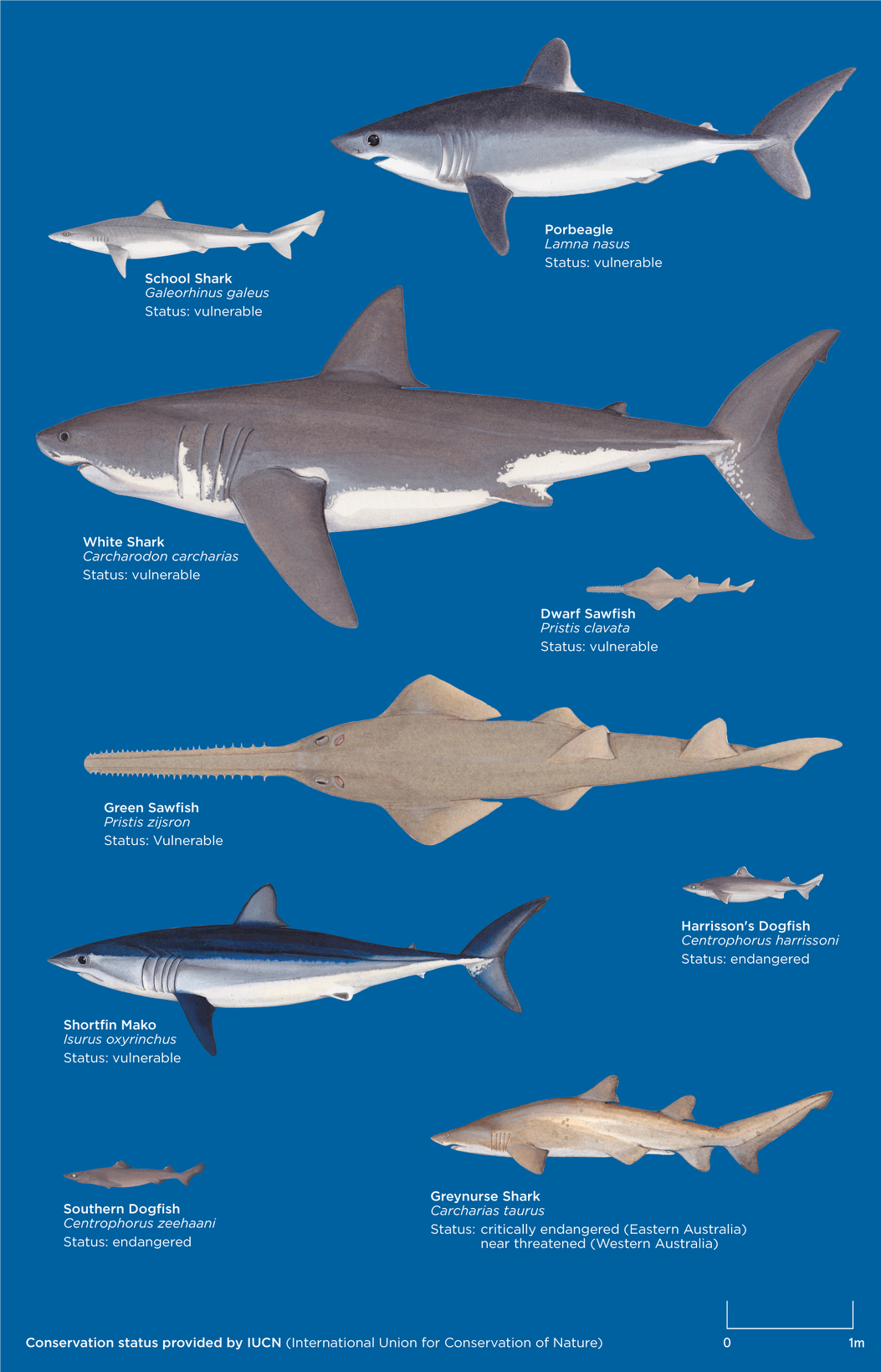
Protected shark species in Australia, from the Australian Museum
Waters off Australia are home to about 180 species of shark. Of these about 70 are found nowhere else. Among the better-known species are great white sharks, tiger sharks, bull sharks and whale shark. Other common species include the bronze whalers (copper sharks), scalloped hammerheads, blacktip reef sharks and various types of wobbegongs. Many of sharks — such as speartooth sharks, grey nurse sharks, the great white and whale sharks — are protected. [Source: Google AI]
Australians call great white sharks white pointers, white sharks and whities. They are mainly found in temperate waters. Sea lions around Neptune Island in southern Australia are a popular great white shark snack. One great white shark weighing 1,537 kilograms (3,388 pounds) was caught off of West Australia in 1976 using whale meat as bate. There aren't really any Great Whites around the Great Barrier Reef, they prefer the colder waters off of southern Australia. CSIRO, Australia's leading scientific research body, has identified two great white populations in Australia; an eastern population and a southern-western population. "The eastern Australasian population ranges along the entire eastern seaboard from the cold waters as far south as Macquarie Island into tropical waters of Papua New Guinea, and extends eastwards to include New Zealand and tropical islands such as New Caledonia," CSIRO says. "The southern-western population ranges from western Victoria to northwest Western Australia." CSIRO has sized the eastern population at 5460, but admitted there could be more than 12,802 great white cruising the waters. [Source: Raffaella Ciccarelli, Tara Blancato, Nine News, February 17, 2022]
There are river sharks such as the northern river sharks and sluggish long-tailed leopard sharks in Australia. Epaulette sharks walk along reefs and the ocean floor, propelling themselves forward with muscular fins, hunting crustacean, snails and small fish in coral crevasses. Tiger sharks are found in tropical and warm temperate waters off Australia. Ones as large of 5.5 (18 meters) have been found off northern Australia. Bull sharks inhabit both salt and freshwater environments and are found in coastal waters. They have killed people in rivers in western Australia. Wobbegongs — species of carpet sharks — are known for their flattened bodies and camouflaged appearance. Tasselled wobbegongs and spotted wobbegongs are seen in Australian waters.
Whale sharks tourism is big at Ningaloo Reef in western Australia. Every year whale sharks gather in large numbers at there to feast on spawning of coral. This is one of the largest known gathering of whale sharks in the world. It is not unusual for divers to see 20 or 30 of them in a single day. Groups at Ningaloo tend to be immature males. Fishermen have given them handouts. So many divers rode the whale sharks at Ningaloo reef that Australian government now prohibits the practice.
Australians are used to living with sharks. If a shark at popular beach is sighted, a wailing siren goes off and swimmers head for the shore. Peter Benchley, the author of “Jaws” has said to be careful of the sharks off of northern Queensland. After a video was shown on television with tourist petting great white sharks in a feeding frenzy over a dead whale, the environmental minister said, "The state government will need to look at changing the law in order to protect people too stupid to protect themselves.”
Related Articles:
COPPER SHARKS (BRONZE WAILERS): CHARACTERISTICS, BEHAVIOR AND REPRODUCTION ioa.factsanddetails.com
TIGER SHARKS: CHARACTERISTICS, BEHAVIOR, FEEDING AND MATING ioa.factsanddetails.com
TIGER SHARK ATTACKS ioa.factsanddetails.com
BULL SHARKS: CHARACTERISTICS, BEHAVIOR, FEEDING AND MATING ioa.factsanddetails.com
BULL SHARK ATTACKS ioa.factsanddetails.com ;
WHALE SHARKS: SIZE, CHARACTERISTICS, FEEDING HABITS, MATING ioa.factsanddetails.com ;
WHALE SHARKS AND HUMANS: TOURISM, CONSERVATION AND RESEARCH ioa.factsanddetails.com ;
BLACKTIP AND WHITETIP REEF SHARKS ioa.factsanddetails.com;
GREY REEF SHARKS
ioa.factsanddetails.com;
NURSE SHARKS: CHARACTERISTICS, BEHAVIOR, FEEDING, MATING, ATTACKS ioa.factsanddetails.com;
GREAT WHITE SHARKS: CHARACTERISTICS, SIZE, BODY AND SPEED ioa.factsanddetails.com ;
GREAT WHITE SHARK BEHAVIOR, SENSES, MATING AND SOCIAL ACTIVITY ioa.factsanddetails.com ;
GREAT WHITE SHARKS FEEDING, HUNTING AND PREY ioa.factsanddetails.com ;
GREAT WHITE SHARK MIGRATIONS AND WHERE THEY LIVE ioa.factsanddetails.com ;
SHARKS AND RAYS ioa.factsanddetails.com;
HUMANS, SHARKS AND SHARK ATTACKS ioa.factsanddetails.com;
SHARKS: CHARACTERISTICS, SENSES AND MOVEMENT ioa.factsanddetails.com ;
SHARK BEHAVIOR: INTELLIGENCE, SLEEP AND WHERE THEY HANG OUT ioa.factsanddetails.com ;
SHARK SEX: REPRODUCTION, DOUBLE PENISES, HYBRIDS AND VIRGIN BIRTH ioa.factsanddetails.com ;
SHARK FEEDING: PREY, HUNTING TECHNIQUES AND FRENZIES ioa.factsanddetails.com
Australian Blacktip Sharks
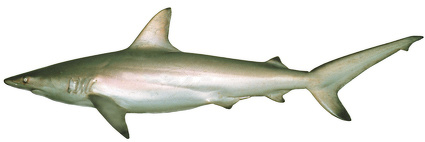
Australian blacktip shark
Australian blacktip sharks (Carcharhinus tilstoni) are also known as blacktip sharks, Tilston's whaler sharks and Whitley's blacktip sharks. Nearly identical in appearance to regular blacktip sharks, they are species of requiem shark endemic to northern and eastern Australia. Found from the intertidal zone to a depth of 50 meters (164 feet), they generally reach 1.5–1.8 meters (4.9–5.9 feet) in length and have a fairly stout-bodied and bronze in color and have a long snout and black-tipped fins. The only way to affirmatively distinguish an Australian blacktip sharks from common blacktip shark (C. limbatus) is by counting lower vertebra and by genetic markers. The ranges of Australian blacktip sharks and common blacktip sharks overlap significantly in northern and eastern Australia, and there has been hybridization between the two species.
Australian blacktip sharks are a coastal species restricted to the continental shelf. They occur oof the coasts of the northern half of Western Australia, Northern Territory, Queensland, and New South Wales. They are found in the Great Barrier Reef, and are seen found as far south as Sydney in New South Wales. Australian blacktip sharks are typically found at depths of zero to 150 meters (492 feet). They are most common in shallow coral reefs along the Australian coast. They can also be found in brackish waters. They migrate vertically in the water column, usually near the sea bed during the day and near the surface at night. [Source: Megan Vineyard, Animal Diversity Web (ADW) /=]
Australian blacktip sharks are not endangered. They are designated as a species of least concern on the International Union for Conservation of Nature (IUCN) Red List. Their main threat is overfishing by commercial fisheries. Between the mid-1950s and mid-1980s, Australian blacktip shark populations decreased an estimated 93 percent. In 1986, the Taiwanese fisheries believed to behind much of the overfishing were shut down and replaced by smaller fisheries that caught smaller quantities. Now, all fisheries that target Australian blacktip sharks are managed. Hybrids with regular blacktip sharks to exist. The effect of hybridization for Australian blacktip sharks is unknown. Illegal fishing may also harm these sharks. /=\
Australian blacktip sharks have been caught for their meat and fins. They have mainly been are netted or caught on fishing lines in the Gulf of Carpentaria, which includes coasts along the Northern Territory and Queensland. Between 1979-1986, one Taiwanese fishery caught about 2800 metric tons of Australian blacktip sharks per year until their population collapsed. Now annual harvests are 300-400 tons off the Northern Territory and 192 ton off of Queensland, and 146 tons in the Gulf of Carpentaria. Conservation measures for Australian blacktip sharks include restricting for fishing to certain areas and limitations on gear used to catch them. Recent studies in the Northern Territory of Australia suggest that their populations have recovered. They appear to be quite resilient: they reach adulthood relatively quickly and reproduce consistently.
Australian Blacktip Shark Characteristics
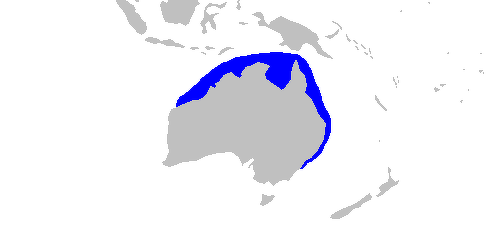
Australian blacktip shark range
Australian blacktip sharks range in weight from 29 to 63 kilograms (64 to 140 pounds), with their average weight being 32 kilograms (70.5 pounds). They range in length from 0.65 to two meters (2.2 to 6.5 feet). Sexual Dimorphism (differences between males and females): Females are larger than males. Adult males weigh 32 kilograms on average their length of adult males varies from 0.65 to two meters as stated above. Adult females are 0.68 to two meters and of 32 kilograms but can reach weights up to 63 kilograms. Despite similarities in length ranges, adult females are typically larger than males. The longest known lifespan in the wild for Australian blacktip sharks is 12 years. The expected lifespan of common blacktip sharks is 10 to 12 years. [Source: Megan Vineyard, Animal Diversity Web (ADW) /=]
Adult Australian blacktip sharks get their name from the black tips on their pectoral, dorsal, and caudal fins. These sharks have moderately robust, spindle-shaped body and a long, pointed snout. They are generally grayish or bronze on their back and sided and white or yellow-white on their bottom side. The white areas extends to the pelvic and anal fins. Their first and second dorsal fins and caudal fin are otherwise bronze or gray. Australian blacktip sharkshave a long snout. Their teeth can be up to one centimeters millimeters long and they have 32 to 35 teeth in the upper jaw and 29 to 31 teeth in the lower jaw. Each upper tooth has a slender, upright cusp and fine serrations that become coarser near the base, while the lower teeth are narrower and more finely serrated. Their large, circular eyes have nictitating membranes (transparent folds of skin that extends across the eye The five pairs of gill slits are long.
Australian blacktip sharks are nearly identical to common blacktip sharks. Identification them in the wild is nearly impossible and the only way to really to tell them apart is by counting vertebra of dead sharks or by tissue samples. Australian blacktip sharks have 182 or fewer vertebra ((174–182 total, 84–91 before the tail) and common blacktips have more than 182 182–203 total, 94–102 before the tail. There are size differences between the two species but age must be known for this to be a useful determinant.
Australian Blacktip Shark Behavior and Diet
Australian blacktip sharks are nocturnal (active at night), motile (move around as opposed to being stationary), migratory (make seasonal movements between regions, such as between breeding and wintering grounds), and social (associates with others of its species; forms social groups). They do not defend territories. [Source: Megan Vineyard, Animal Diversity Web (ADW) /=]
Australian blacktip sharks migrate vertically on a daily basis, residing near the sea bed during the day and rise vertically to near the surface to feed at night. They are characterized as nocturnal based on relative activity levels. Although males do not migrate seasonally, pregnant females migrate inshore to nursery locations to give birth. That have been reported to come together in large groups, suggesting they are social.
Australian blacktip sharks are apex predators. They are carnivores (animals that mainly eat meat or animal parts) and primarily feed on bony fish. A short-term study of juvenile Australian blacktip sharks in captivity found they consumed 3.44 percent of their body weight per day. An examination of the stomach contents of adult Australian black-tipped sharks living on along North West Shelf the continental shelf of Australia found that 89.5 percent of their diet was made up of fish, with the remainder mainly made up cephalopods such as squid and octopus.
Australian Blacktip Shark Mating, Reproduction and Offspring
Australian blacktip sharks are viviparous, meaning they give birth to live young that developed in the body of the mother and engage in internal reproduction in which sperm from the male fertilizes the egg within the female. They also employ sperm-storing in their oviducal glands, which means they can producing young from sperm that has been stored, allowing it be used for fertilization at some time after mating. When mating, male sharks bite female sharks to keep them stable. This results in mating scars on females. [Source: Megan Vineyard, Animal Diversity Web (ADW) /=]
Australian blacktip sharks engage in seasonal breeding once each year. They mate and breed between February and March. The average gestation period is 10 months. The number of offspring ranges from one to 6, with the average number of offspring being three. Young are independent immediately after they are born. On average females reach sexual or reproductive maturity at age 6.1 years when they are about 1.15 meter (3.7 feet) in length; males do so at 5.2 years when they are 1.1 meter (3.6 feet) in length.
Australian blacktip sharks have claspers for internal fertilization. Males and females come into contact when they mate. Most shark mating includes males biting females. Females store the sperm after mating.Spot-tail sharks (Carcharhinus sorrah) females did not select males on the basis of any physical characteristic or behavior. This suggests that many sharks — Australian blacktip sharks — mate with any available mate.
Females migrate inshore along Australian coasts to birth pups. Cleveland Bay along northern Queensland is a known seasonal nursery for pups of Australian blacktip sharks. Pups are fed through the placenta while inside their mothers and live births peak in January, but birthing can occur between late November and early February. Pups remain in the nursery only for a few months after birth before dispersing. Males are not involved in parenting. Females don't provide much care either. Pups are born 60 centimeters (two feet) long and weigh 1.32 to 1.40 kilograms. Pups are immediately independent after birth. Their development and life cycle is characterized by indeterminate growth (they continue growing throughout their lives). Growth is rapid the first year of life when they grow 17 centimeters or more. At five years of age their growth rate is eight to 10 centimeters per year.
Zebra Sharks
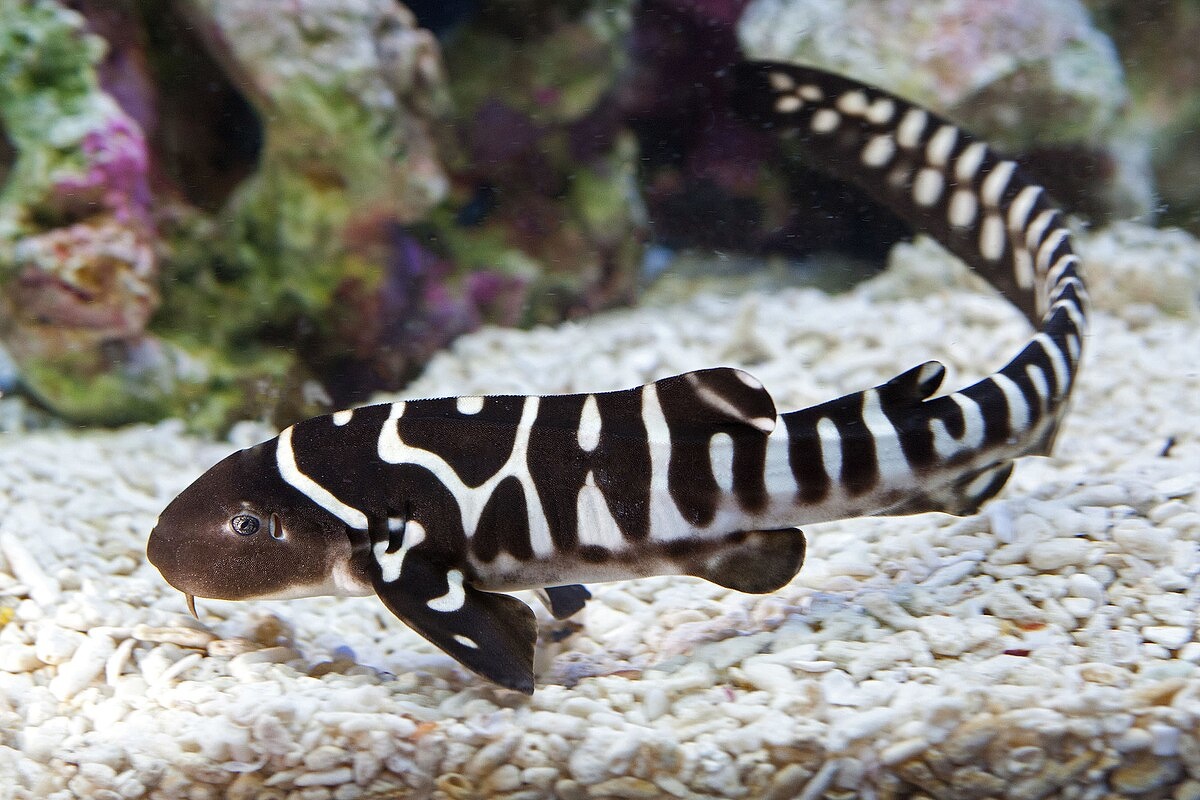
zebra shark juvenile
Zebra sharks (Stegostoma fasciatum) are also known as variegated sharks. Reaching lengths of 3.5 meters (10 feet) but weighing only around 30 kilograms (66pounds), these slender sharks have very flexible bodies and a unique downward pointing mouth near the end of their snout that allows them to penetrate deep in reef crevices to snag crabs, shrimps and small bony fish and to scoop up mollusks on the ocean floor. During down time. It rests on the ocean floor, propped on it pectoral fins, facing the current.
Zebra sharks live in coastal areas of the Indian Ocean and the western Pacific ocean. They are perhaps most numerous in Australian coastal waters. They lives mainly over continental and insular shelves and are most often seen around coral reefs and on sandy bottoms. They usually resides in water at 62 meters (203 feet) or less below the surface of the ocean. They are occasionally found in fresh water. [Source: Jessica Reum, Animal Diversity Web (ADW) /=]
The International Union for Conservation of Nature (IUCN) Red List zebra sharks are listed as vulnerable. It is believed to be their population is decreasing mainly as a result of overfishing. It the past and still somewhat today zebra sharks show up in fish markets in Indonesia, Thailand, Malaysia, the Philippines, and India. The liver is said to rich in make vitamins, and the fins are made into soups.
Zebra sharks are popular and common aquarium fish — seen in both large tourist aquariums and home aquariums. They can be bred in captivity. When they are kept in small tanks, their expected life span is about nine years. When kept in large aquariums, their average lifespan is about 25 years.
Zebra Shark Characteristics and Behavior
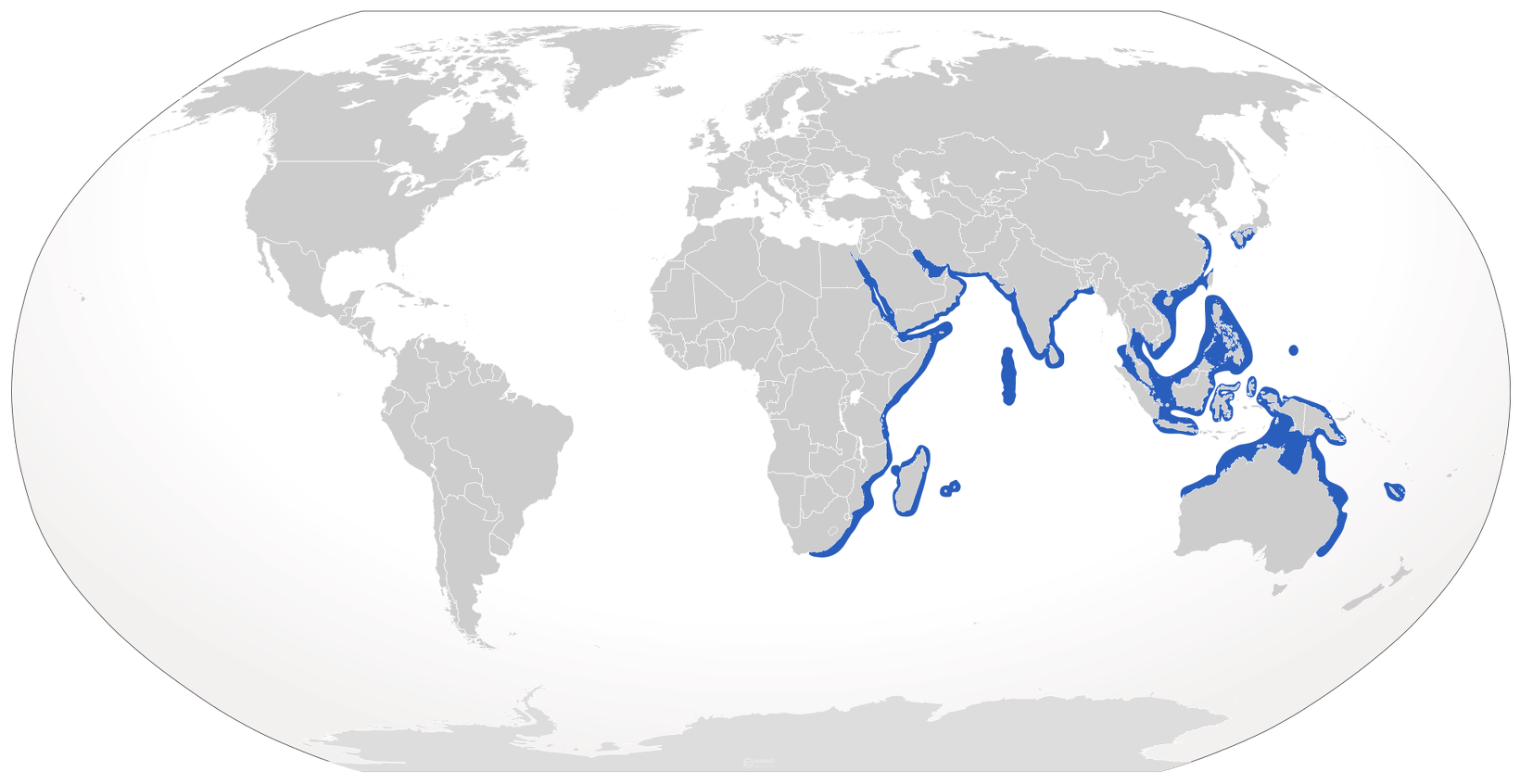
range of zebras shrks
Zebra sharks range in length from 2.0 to 3.5 meters (6.5 to 11.5 feet), with their average length being 2.5-3.0 meters (8 to 10 feet). Their body is cylindrical with lateral ridges and a tail as long as the body. The head is broad with large eyes and a transverse mouth just below them. Five gill slits are situated on the side of the head. The anterior dorsal fin is larger than the posterior one. Their gray body is covered in dark brown spots.Sexual Dimorphism (differences between males and females): Males are larger than females.[Source: Jessica Reum, Animal Diversity Web (ADW) /=]
Zebra sharks are carnivores and mainly feed on gastropods and bivalve mollusks with smaller amounts of crabs, shrimp, and small fish that they catch in reef crevises or on the sandy bottom. They are nocturnal (active at night), motile (move around as opposed to being stationary), sedentary (remain in the same area) and solitary. These sharks do not usually swim in open water, so their territories are limited mainly to the reef at which they were hatched or reefs that are closely connected to their natal area.
Zebra sharks mainly hunt at night. During the day they swim at a slow pace around the reef. Like other bottom dwelling sharks, they can pump water across their gills through their mouth, which allows them shark to respire while stationary. They are a powerful swimmers when they want to be, using their tail, which as long or longer than their body. They sense and communicate with vision, touch, sound, vibrations and chemicals usually detected with smelling or smelling-like senses. /=\
Zebra Shark Mating, Reproduction and Virgin Birth

adult zebra shark
Zebra sharks are oviparous (young are hatched from eggs) and engage in year-round breeding. The eggs are large — about 17 centimeters in diamete — and male sharks have so-called double penises. Reproduction is external, meaning the male’s sperm fertilizes the female’s egg outside her body. The number of offspring ranges from two to seven, with the average number being four. There is really no parental by either males or females. Young are independent after they are born. On average females reach sexual or reproductive maturity at age around 1.7 monthsl males do so at 1.5 to 1.8 months.
Newly fertilized eggs are laid on rocks at the bottom of reefs. The eggs are about 20 to centimeters in size when they hatch. Individuals less than 70 centimeters in length are rarely seen, indicating that they spend the first months of their lives at depths that recreational divers do not reach. Young sharks differ from adults in that they have a darker color and white stripes. As they age, the young lose their stripes and gain spots as their base color lightens. The patterning on young zebra sharks is so different from adults that for some time scientists thought they were different species.
Breeding in captivity has been achieved, but the eggs are hard to incubate. At the Henry Doorly Zoo in Omaha, Nebraska, three eggs hatched out of a group of 46 laid. Of the 46, seven were infertile and 31 did not develop entirely. Only eight developed to a full embryo. The incubation of these eggs took about 6.5 months, which is estimated to be the same as in the wild.
A female zebra shark separated from her long-term mate developed the ability to have babies on her own. Alice Klein wrote in New Scientist: Leonie the zebra shark met her male partner at an aquarium in Townsville, Australia, in 1999. They had more than two dozen offspring together before he was moved to another tank in 2012. From then on, Leonie did not have any male contact. But in early 2016, she had three baby sharks. [Source: Alice Klein, New Scientist, 16 January 2017]
Christine Dudgeon at the University of Queensland in Brisbane, Australia, and her colleagues began fishing for answers. One possibility was that Leonie had been storing sperm from her ex and using it to fertilise her eggs. But genetic testing showed that the babies only carried DNA from their mum, indicating they had been conceived via asexual reproduction. Some vertebrate species have the ability to reproduce asexually even though they normally reproduce sexually. These include certain sharks, turkeys, Komodo dragons, snakes and rays. However, most reports have been in females who have never had male partners.
Spotted Wobbegongs
Spotted wobbegongs (Orectolobus maculatus) look like a cross between a moving piece of coral and a rug. Also known as carpet sharks, catsharks, tassel sharks and wobbegongs, they often sit camouflaged on the ocean bottom, partly buried in the sand like a skate to ray, ambushing predators that pass by. Spotted wobbegongs are species a carpet shark in the family Orectolobidae found off the coast of southern and southeastern Australia. Green, yellow, or brown in color, they are fairly large, typically reaching 1.5 to 1.8 meters (4.9 to 5.9 feet) in length and have distinctive O-shaped spots all over their body. They have bitten humans, sometimes unprovoked, and have caused severe wounds. The species is fished commercially in Australia, but it is not severely threatened. They are listed as a least-concern species on the IUCN Red List. There 11 species of wobbegong shark, found mainly in the eastern Indian Ocean and western Pacific Ocean.
Spotted wobbegong are generally found in inshore waters the Fremantle region in Western Australia to Moreton Island in southern Queensland. Some sources claim that spotted wobbegong are also found Japanese waters and the South China Sea but this mostly likely the result of confusing spotted wobbegongs with other wobbegong species. [Source: Todd Szcodronski, Animal Diversity Web (ADW) /=]
Spotted wobbegong are bottom-dwelling sharks typically found at depths of zero to 110 meters (360. feet) in temperate and to a lesser extent tropical waters. Their main habitat consists of inshore areas on continental shelves in coral and rocky reefs, estuaries, seagrass beds, coastal bays, and areas with sandy bottoms. They are a primarily active at night and are found in caves, and under the overhangs of rocky and coral reefs during the day. Juveniles are commonly found in estuaries and seagrass beds. There are quite common in very shallow water.
See Separate Article: SPOTTED WOBBEGONG: CHARACTERISTICS, BEHAVIOR AND REPRODUCTION ioa.factsanddetails.com
Australian Ghostsharks
Australian ghostsharks (Callorhinchus milii) are chimaera (Holocephali) — a type of cartilaginous fish that are not sharks or rays but are similar to them and related to them and are believed to pre-date them on the evolutionary tree. Also known as elephant fish, ghost sharks, whitefish, plough-nose chimaera, silver fish, elephant shark and makorepe (in Maori), Australian ghostsharks are unique and important to our understanding of the evolution of all back-boned animals. [Source: Wikipedia]
In January 2014, Nature published research on the Australian ghostshark genome that indicated they lacked a single gene family that regulates the process of turning cartilage into bone, and showed a gene duplication event was behind the creation of bony vertebrates (which includes all mammals, birds and reptiles and amphibians and most fish). The genome of Australian ghostsharks is estimated to be 910 megabases long, the smallest among all the cartilaginous fishes and one-third the size of the human genome (3000 Mb). Because cartilaginous fishes are the oldest living group of jawed vertebrates, the Australian ghostshark genome serves as a useful reference genome for understanding the origin and evolution of vertebrate genomes including humans.
Australian ghostsharks have a fairly limited range. They are found off southern Australia, including Tasmania, and south of East Cape and Kaipara Harbour in New Zealand, at depths of 0 to 200 meters (0 to 656 feet). They prefer continental shelves with temperate waters and have been found at depths of 600 meters (1968.5 feet). Females seasonally move to shallower waters to lay eggs. It has been hypothesized that the New Zealand population and the Australian population may actually be separate species. [Source: Kayla Boyes, Animal Diversity Web (ADW) |=|]
See Separate Article: SEA LIFE OF THE TASMAN SEA, SOUTHERN AUSTRALIA AND NEW ZEALAND ioa.factsanddetails.com
Image Sources: Wikimedia Commons
Text Sources: Animal Diversity Web animaldiversity.org , National Geographic, Live Science, Natural History magazine, Australian Museum, David Attenborough books, Australia Geographic, New York Times, Washington Post, Los Angeles Times, Smithsonian magazine, Discover magazine, The Conversation, The New Yorker, Time, BBC, CNN, Reuters, Associated Press, AFP, Lonely Planet Guides, Wikipedia, The Guardian, Top Secret Animal Attack Files website and various books and other publications.
Last updated September 2025