
Home | Category: Sea Life Around Australia
SEA TURTLES
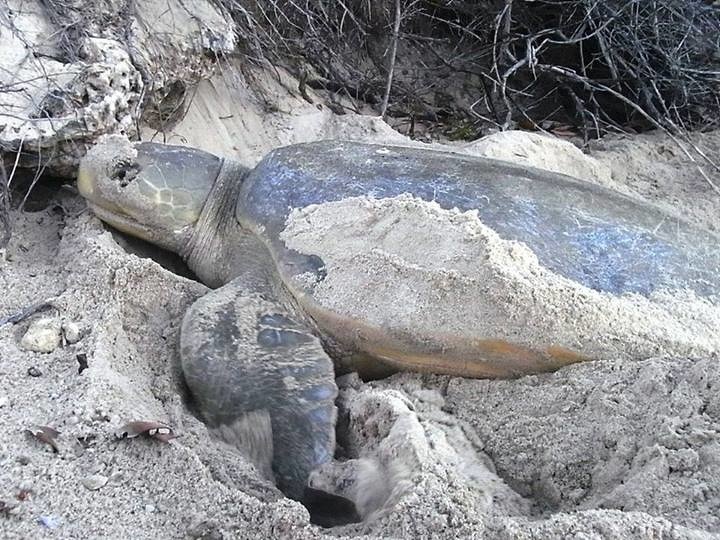
Flatback turtle nesting on Great Keppel Island off Queensland
Six of the world's seven sea turtle species live in waters off Australia: 1) Green turtles, 2) Hawksbill turtles, 3) Leatherback turtles, 4) Loggerhead turtles, 5) Olive Ridley turtles and 5) Flatback turtles. The Flatback turtle is unique to Australian shores, nesting only on the continent's northern coast. All six species are protected by the Australian government under the Environment Protection and Biodiversity Conservation Act 1999 (EPBC Act).
1) Green turtles are found mostly around grassy estuaries. 2) Hawkbill turtles hangs out around coral reefs. 3) Leatherback turtles are the world's largest turtle. They are found worldwide. 4) Olive ridley turtles are the smallest and most abundant sea turtles. 5) Loggerhead turtles are found in the world's subtropics. 6) The Australian flatback is found in Indian and west Pacific oceans.
Guugu Yimidirrh Aboriginals live on the northern of the Cape York Peninsula. They are stll allowed to hunt sea turtles but are more wasteful than they used to be. When a turtle was caught in the old days the Aboriginals used to eat the whole thing, now they take the choicest meat and leave the rest for the feral pigs. Only Aboriginal are allowed to catch turtles on Thursday Island in the Torres Strait north of Queensland. Explaining how he went about hunting the animals, a Cypriot who caught the turtles in the 1980s said, "We just take a black bloke with us and that makes it legal."
On Mast Head Island in the Great Barrier reef people used to lasso sea turtles and ride on their backs as if they were slow moving jetskis. The islands also contained turtle pup factory that produced 36,000 cans of turtle soup from 1,000 turtles in 1930s.
See Separate Articles: TURTLES AND TORTOISES factsanddetails.com; SEA TURTLES: CHARACTERISTICS, BEHAVIOR, REPRODUCTION ioa.factsanddetails.com ; ENDANGERED SEA TURTLES, FISHING, EGG HARVESTING AND POLLUTION ioa.factsanddetails.com
Websites and Resources: Animal Diversity Web (ADW) animaldiversity.org; National Oceanic and Atmospheric Administration (NOAA) noaa.gov; Fishbase fishbase.se; Encyclopedia of Life eol.org; Smithsonian Oceans Portal ocean.si.edu/ocean-life-ecosystems ; Monterey Bay Aquarium montereybayaquarium.org ; MarineBio marinebio.org/oceans/creatures
Flatback Turtles
Flatback sea turtles (Natator depressus) live in shallow continental seas off of northern Australia and southern New Guinea. Unlike most sea turtles, they stay within a small range most of their life and rarely travel far from home. They have the smallest geographic range of all sea turtles. They are most seen in waters off northern Australia and occasionally cross the Tropic of Capricorn to coastal Papua New Guinea to feed. [Source: Emily Thielk, Animal Diversity Web (ADW) /=]
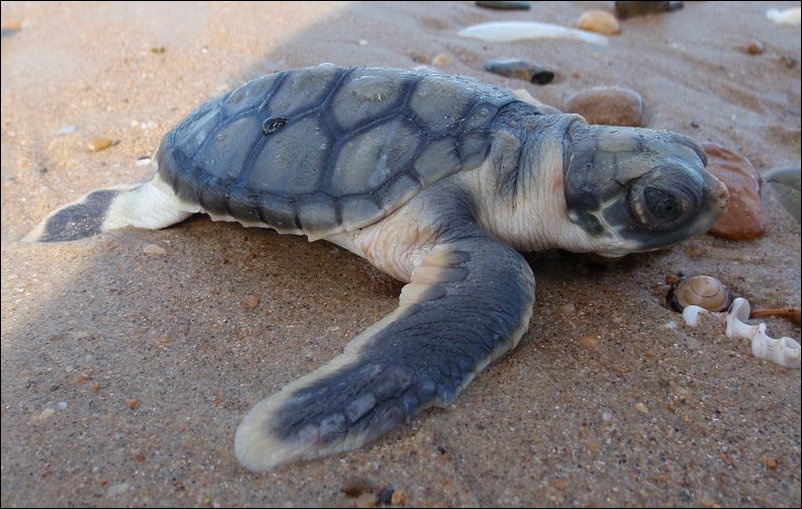
Flatback hatchling
Flatback turtles prefer shallow, soft-bottom areas close to the shore, or inshore bays. They usually do not venture past the continental shelf or visit coral reefs. They have long lifespans of up to 100 years. Flatbacks raised in captivity mature and grow faster than those in the wild because they have more protein in their diets. Age is measured by the length of the carapace.Flatback turtles feed on sea cucumbers, mollusks, jellyfish, soft corals, prawns, bryzoans and other invertebrates in shallow waters. They sometimes feed on vegetation, perhaps when no their food is available. Adult flatback turtles seem to sleep near rocks or under ledges, while young flatbacks sleep on the surface. They can rest of sleep underwater for hours before needing another breath. However, if they are under stress or excited they cannot hold their breath as long.
Because flatback turtles are born relatively large (around five centimeters in length), have a hard shell and are strong swimmers, they are less likely to be caught by predators. Their main known predators of adults are saltwater crocodiles. sharks and orcas (killer whales). In terms of their roles in local ecosystems, they eat many different kinds of marine invertebrates and may impact prey populations. /=\
Flatback turtles are considered one of the least Endangered of all the sea turtles in part because their its meat and eggs are not desired much as humans for food and they stay close to shore in places where not so many people live and do not often get caught in fishing nets. The number of flatback sea turtles is unknown. They are threatened by habitat loss and incidental capture in prawn trawls. They are listed as Vulnerable on the International Union for Conservation of Nature (IUCN) Red List. They have no special status according to the Convention on the International Trade in Endangered Species (CITES). At at one time flatback eggs were harvested for food. Today they are well protected. One measure being taken to prevent accidental turtle catches is the implementation of Turtle Exclusion Devices (TEDS). These are funnels positioned inside nets so that only smaller fish can get caught. The sea turtles are too large to fit in the TEDS and so they are not caught.
Flatback Turtle Physical Characteristics
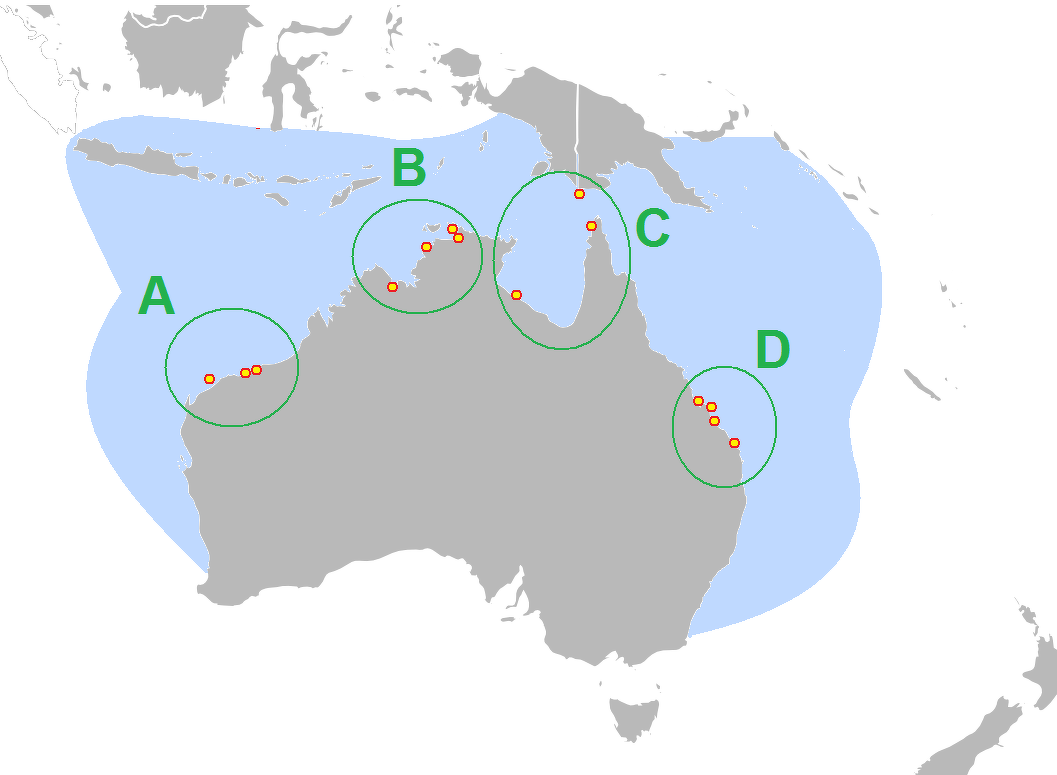
range of flatback turtles
Flatback turtles have a carapace length that ranges rom 76 to 96 centimeters (30 to 38 inches). Their average weight is 70 kilograms (154 pounds). Sexual Dimorphism (differences between males and females):Females are larger than males. Size is used by scientists to be determine make visual sex identifications. [Source: Emily Thielk, Animal Diversity Web (ADW) /=]
Flatbacks are moderately-sized turtles. In adults, females are larger than males but males have longer tails. Both males and females have rounded heads which usually match the olive green color of their outer shells (carapaces). Their plastron (the underside shell part) is an off-white or yellow color. The most distinctive feature of these is their smooth, flat shell which tends to turn up at the edges. /=\
According to Animal Diversity Web: One interesting note about flatbacks' carapaces is that they are much thinner than those of other sea turtles. The keratin layer which protects both the carapace and flippers is so fragile that even small amounts of pressure (such as flapping its flippers against the plastron) can draw blood. This may be one reason the flatback stays away from the rocky terrain of coral reefs. /=\
Flatback Turtle Reproduction, Nesting and Development
Flatback turtles are oviparous (young are hatched from eggs) and iteroparous (offspring are produced in groups, multiple times in successive seasonal cycles). They engage in seasonal breeding. The breeding season is November-December, with the average number of eggs laid at one time being 50. The average gestation period is 42 days. [Source: Emily Thielk, Animal Diversity Web (ADW) /=]
Flatback sea turtle females nest both in the day and at night. They lay large eggs on the mainland and near-shore island beaches. They sometimes dig nests on the slopes of dunes. The eggs are relatively large — around five centimeters long. Hatchlings are the same size. Their large size provides them with some protection from predators but not always. When the turtles go ashore they are sometimes attacked by giant saltwater crocodiles. One area where they have been observed nesting is the island of Mon Repos, located 15 kilometers (nine miles) northwest of the coastal city of Bundaberg, Queensland. This seems to be a major egg laying site for flatback turtles. It is currently a natural reserve with limited access to tourists.
According to Animal Diversity Web: Flatback hatchlings are much larger than other sea turtle young, with an average carapace length of 60 millimeters. Their size not only helps protect them from predators such as crabs and gulls, it also makes them stronger swimmers. Their size and swimming ability makes them less likely to be thrown off course by sea currents or strong waves.
Despite their swimming ability, young flatback turtles generally stay close to shore and do not have a pelagic (open ocean) phase like most other sea turtles. They do have a "lost year” phase which young sea turtles venture out of their usual habit and explore the sea but nobody is sure where they go during this time. They reach sexual maturity anywhere between seven and 50 years of age. /=\

Comparison of sea turtles, from the Smithsonian
Olive Ridley Sea Turtles
Olive ridley sea turtles (Lepidochelys olivacea) are also known as Pacific ridley turtles. They are one of the smallest marine turtles. Adults are generally 60 to 75 centimeters (2 to 2.5) feet in length. They rarely exceed one meter (three feet). They have a maximum weight of 80 kilograms (176 pounds) and an average weight of 37 kilograms (85 pounds). Their lifespan is unknown, but estimated to be between 30 and 50 years.
Olive ridley sea turtles get their its name from the olive green color of their heart-shaped shell. They are mainly a pelagic (open ocean) sea turtle, observed by trans-Pacific ships over 4,000 kilometers (2,400 miles) from shore, but they are also known to inhabit coastal areas, spending most of their time within 15 kilometers of shore, preferring shallow seas for feeding and basking in the sun. Seabirds sometimes perch on their back as they bob on the surface of the sea hunting for crustaceans.
See Separate Article OLIVE RIDLEY SEA TURTLES ioa.factsanddetails.com
Green Turtles
Green sea turtles (Chelonia mydas) are the largest hard-shelled sea turtle. They can weigh up to 200 kilograms (440 pounds) and reach a 1.3 meters (four feet) in length. They can stay underwater or 30 minutes and travel 2,000 kilometers (1.250 miles) from its feeding grounds to its nesting sites.
The green sea turtle name is derived from the reptile's greenish-colored fat. They are unique among sea turtles in that they are mostly herbivores, eating mostly seagrasses and algae. This diet is what gives their fat a greenish color (not their shells), which is where their name comes from. A critter cam hooked up to one in 2007 by National Geographic researchers showed that they were omnivores rather than vegetarians as had been previously thought. [Source: NOAA]
The Green turtle lifespan is unknown, but estimated to be 70 years or more There has been very little research regarding the lifespan of green turtles, due to lack of tagging but it is believed that adults routinely live to be older than 50 or 60. Some may live past the age of 100. AnAge reported a maximum green turtle lifespan of 75 years. Green turtles are not often held for long in captivity, so longevity records from aquariums are not so useful. Threats include bycatch in fishing gear, climate change, direct harvest of turtles and eggs, disease, loss and degradation of nesting and foraging habitat, ocean pollution/marine debris, vessel strikes
See Separate Article GREEN SEA TURTLES ioa.factsanddetails.com
Leatherback Sea Turtles
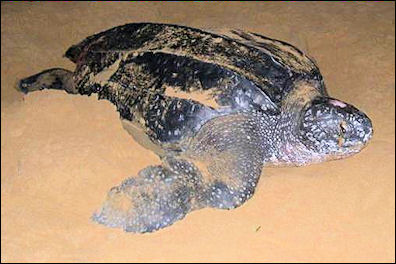
Leatherback sea turtles Leatherback sea turtles (Dermochelys coriacea) are the world’s largest and fastest reptile, and the most ancient and fastest-swimming turtle. Their have been around for 100 million years, surviving the asteroid that wiped out the dinosaurs 65 million years ago. Generally they spend less that two hours on land a year. [Source: Tim Appenzeller, National Geographic, May 2009]
No one known how long leatherbacks live. It has been estimated that their lifespan could be 50 years or more. Leatherback turtles grow faster than hard-shelled turtles. However, there is uncertainty about the age at which they reach sexual maturity. Average estimates range from nine to 20 years of age. Based on growth layers in the bones that encircle their pupils it could be 30 years before they reach maturity. [Source: NOAA]
A leatherback hatchling is smaller than a child's hand when it hatches, yet it grows to a length of two meters (six feet) and can weigh over 900 kilograms (half a ton). It flippers can stretch three to 4.5 meters (10 to 15 feet). A male leatherback found washed up on a beach in Wales in 1988, was 2.87 meters (9 feet, 5½ inches) long and weighed 962 kilograms (2,120 pounds).
See Separate Articles LEATHERBACK SEA TURTLES: ioa.factsanddetails.com ; ENDANGERED LEATHERBACK TURTLES ioa.factsanddetails.com
Hawksbill Turtles
Hawksbill sea turtles (Eretmochelys imbricata) are frequently seen by divers and snorkelers. They cruise around reefs, grazing on sponges and other plant life, but stay close to the reef in case they need to make a quick escape from a predator such as a shark.
Hawksbill sea turtles inhabit tropical and sub-tropical waters in all of the world’s major oceans. They get their name from their unique beak-like mouth, which resembles that of a hawk and is perfect for finding food sources in hard-to-reach cracks and crevices. They are the only species of sea turtle that can survive on a diet consisting mainly of sponges. Hawksbill turtles play a key role in the function of marine ecosystems. Hawksbills are estimated to reach maturity between 20 to 35 years of age, depending upon a variety of factors, especially resource availability. Although life expectancy remains unconfirmed, they are long-lived and estimated to live 50 to 60 years. [Source: NOAA]
Hawksbill sea turtles have traditionally been hunted for their shells: a source of some of the most beautiful tortoise shell. The shells of many hawksbill sea turtles ended up in Japan, where the shells are carved into hair decorations traditionally worn by Japanese brides on their wedding day. At one point Japan reportedly imported 31,000 shells a year, paying an average of $375 a shell. Under U.S. pressure Japan agreed to stop importing the shells in 1992.
See Separate Article HAWKSBILL SEA TURTLES ioa.factsanddetails.com
Loggerhead Turtles
Named for their relatively large heads,loggerhead sea turtles (Caretta caretta) are the largest hard-shelled sea turtles. They can weigh up to 230 kilograms (500 pounds). They generally live in depths of 9 to 22 meters (30 to 72 feet) but sometimes dive over 230 meters (755 feet) to regulate their body temperatures.
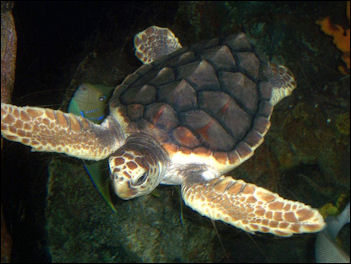
Loggerhead turtle The loggerhead turtle head supports powerful jaw muscles that enable them to feed on hard-shelled prey, such as whelks and conch.A typical adult weighs 90 to 160 kilograms (200 to 350 pounds) and is 0.75 to 1.1 meters (2.5 to 3.5 feet) in length. Their lifespan is unknown, but estimated to be 70 years or more. Some loggerhead sea turtles may be over 100 years old. In Australia it has been predicted that the annual survival rate is 92 percent for juveniles and 88 percent for adults.
Loggerhead sea turtles are generally not aggressive but the powerful beak can inflict a crushing bite. A fisherman in the Caribbean was crippled when one bit him in the knee. Loggerheads are also sometimes attracted to blonds with bikinis and feed on Portuguese man-o-war jellyfish. A critter cam was hooked up to a one in 1987 by National Geographic researchers
See Separate Article LOGGERHEAD SEA TURTLES ioa.factsanddetails.com
Image Sources: Wikimedia Commons, NOAA
Text Sources: Animal Diversity Web (ADW) animaldiversity.org; National Oceanic and Atmospheric Administration (NOAA) noaa.gov; Wikipedia, National Geographic, Live Science, BBC, Smithsonian, New York Times, Washington Post, Los Angeles Times, The New Yorker, Reuters, Associated Press, Lonely Planet Guides and various books and other publications.
Last Updated May 2023