
Home | Category: Sea Life Around Australia / Shark Species
COPPER SHARKS (BRONZE WAILERS)
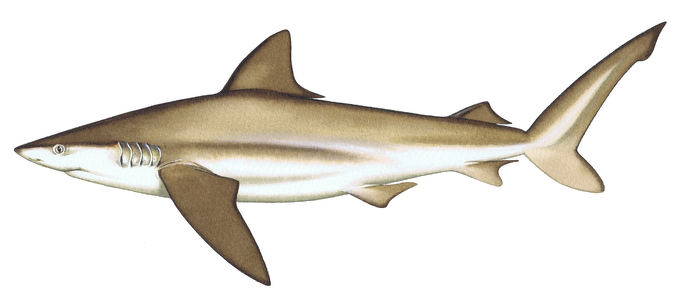
bronze whaler (copper shark)
Copper sharks (Carcharhinus brachyurus) are known as bronze whalers in Australia and also called narrowtooth sharks. A fairly common species of requiem shark, they are generally found in temperate latitudes, with a number of separate populations in the northeastern and southwestern Atlantic, off southern Africa, in the northwestern and eastern Pacific, and around Australia and New Zealand, with occasional reports from equatorial regions. They are a large species, reaching 3.3 meters (11 feet) in length and difficult to distinguish from other large requiem sharks such as whitetip, grey and blacktip reef sharks, dusky sharks and bull sharks. Copper sharks are distinguished by their their narrow, hook-shaped upper teeth, lack of a prominent ridge between the dorsal fins, and plain bronze coloration. [Source: Wikipedia]
Copper sharks are dangerous and common sharks associated mostly with Australia and South Africa. Bronze whalers are regarded by some as the second most dangerous sharks in Australian waters after great white sharks. They have been involved in a number of attacks, most non-fatal. According to one tour boat captain, "They're the ones that do the most damage. Cheeky beggars. Usually they just come rushing in and shoot through. Got to watch them, though. They can be nasty. But no worry! Sharks hardly ever bother scuba divers." One diver told National Geographic, "They hunt in small packs and they like to come right up for a look, give you a bit of a squeeze. Just back toward the reef if you can. “Don't” go popping to the surface." [Source: National Geographic]
Copper sharks are considered to be apex predators. Their main known predators are humans and perhaps great white sharks and orcas (killer whales). Copper sharks are often found close to shore and often common in contact with fishermen. Copper sharks normally live up to around 30 years old and have a maximum lifespan of 34.5 years old in the wild. Copper sharks are fished commercially, which may cause limitations to their natural lifespan. [Source: Kailee Louk, Animal Diversity Web (ADW) |=|]
Copper sharks are wide-ranging sharks living in separate populations in various parts of the world in both the northern and southern hemispheres in the Pacific, Atlantic, and Indian oceans and the Mediterranean Sea. They are mainly found in coastal regions and nutrient-rich waters above continental shelves in temperate or warm waters at depths of 10 to 100 meters (33 to 328 feet), at an average depth of 100 meters. They are rarely found in brackish rivers and estuaries, shallow bays and harbors. They sometimes occur in the open ocean, especially when they are migrating. Adolescent copper sharks appear year-round at depths less than 30 meters. Habitats for adults and younger adults vary during the year, and include shelves, banks, and offshore islands. Females are found apart from males for most of the year, and conduct seasonal migrations. [Source: Kailee Louk, Animal Diversity Web (ADW) |=|]
Related Articles:
SHARKS OF AUSTRALIA: SPECIES, CHARACTERISTICS, BEHAVIOR AND REPRODUCTION ioa.factsanddetails.com
TIGER SHARKS: CHARACTERISTICS, BEHAVIOR, FEEDING AND MATING ioa.factsanddetails.com
TIGER SHARK ATTACKS ioa.factsanddetails.com
BULL SHARKS: CHARACTERISTICS, BEHAVIOR, FEEDING AND MATING ioa.factsanddetails.com
BULL SHARK ATTACKS ioa.factsanddetails.com ;
WHALE SHARKS: SIZE, CHARACTERISTICS, FEEDING HABITS, MATING ioa.factsanddetails.com ;
WHALE SHARKS AND HUMANS: TOURISM, CONSERVATION AND RESEARCH ioa.factsanddetails.com ;
BLACKTIP AND WHITETIP REEF SHARKS ioa.factsanddetails.com;
GREY REEF SHARKS
ioa.factsanddetails.com;
NURSE SHARKS: CHARACTERISTICS, BEHAVIOR, FEEDING, MATING, ATTACKS ioa.factsanddetails.com;
GREAT WHITE SHARKS: CHARACTERISTICS, SIZE, BODY AND SPEED ioa.factsanddetails.com ;
GREAT WHITE SHARK BEHAVIOR, SENSES, MATING AND SOCIAL ACTIVITY ioa.factsanddetails.com ;
GREAT WHITE SHARKS FEEDING, HUNTING AND PREY ioa.factsanddetails.com ;
GREAT WHITE SHARK MIGRATIONS AND WHERE THEY LIVE ioa.factsanddetails.com ;
SHARKS AND RAYS ioa.factsanddetails.com;
HUMANS, SHARKS AND SHARK ATTACKS ioa.factsanddetails.com;
SHARKS: CHARACTERISTICS, SENSES AND MOVEMENT ioa.factsanddetails.com ;
SHARK BEHAVIOR: INTELLIGENCE, SLEEP AND WHERE THEY HANG OUT ioa.factsanddetails.com ;
SHARK SEX: REPRODUCTION, DOUBLE PENISES, HYBRIDS AND VIRGIN BIRTH ioa.factsanddetails.com ;
SHARK FEEDING: PREY, HUNTING TECHNIQUES AND FRENZIES ioa.factsanddetails.com
Copper Shark Habitat and Where They Are Found
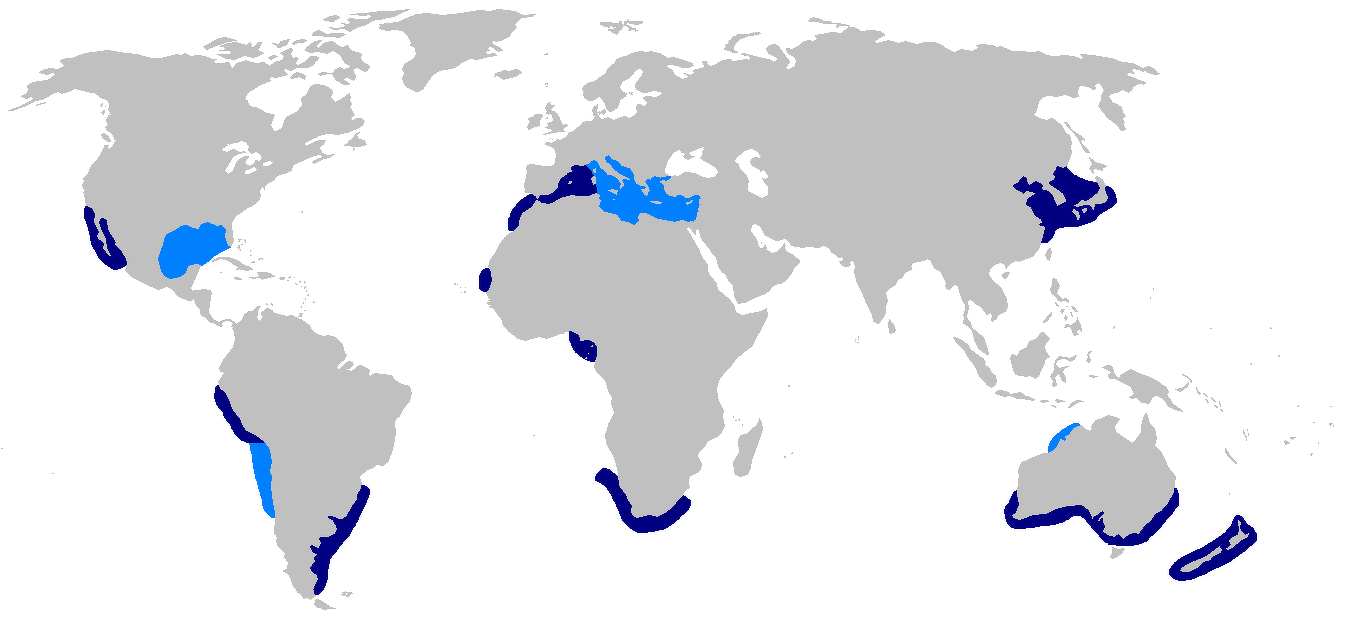
range of copper sharks: confirmed (dark blue); suspected (light blue)
Copper sharks inhabit at least nine identified coastal regions. 1) One region spans along the southern coast of Australia and all of New Zealand. 2) Another region spans from Baja California southward to Peru. 3), 4) Two separate regions in South America include one on the coast of Peru and another along the entire length of Argentina. 5), 6), 7) In Africa, there are three distinct regions: South Africa, northwestern Africa, and the coast of northern Africa. 8) They also inhabit waters along Spain. 9) The coast of Japan. has a disjunct group of copper sharks as well.
Copper shark habitats vary by season and by sex. In the summer, copper sharks are found at higher latitudes in response to the temperature of the water. In the winter, females and juveniles migrate to subtropical regions while males migrate to higher latitudes in late winter until spring. It is common for adult males to inhabit subtropical regions throughout the year. Copper sharks occupy waters along New South Wales, Australia From September to May, with large populations in February and April. Copper sharks also occupy the coastal temperate waters of New Zealand during the summer. In colder months, they typically inhabit warm, temperate waters in the southwestern Atlantic Ocean. KwaZulu-Natal's coast, in South Africa, provides warm waters in which copper sharks appear in large numbers during the winter. From October to late March copper sharks are found along the coast of Argentina. Along Anegada Bay, females outnumber males throughout the months of January, February, March, and migrate by April.
Copper Shark Characteristics
Copper sharks are copper or bronze colored and have a white belly and a triangular dorsal fin. They weigh up to 305 kilograms (671 pounds) and range in length from two to 2.94 meters (6.5 to 9.6 feet). Like other sharks, copper sharks are cold blooded (ectothermic, use heat from the environment and adapt their behavior to regulate body temperature). At birth, copper sharks measure approximately 60 to 70 centimeters (2 to 2.3 feet) long. By maturity, males are two to 2.4 meter (6.6 to 7.9 feet) long and females are 2.15 to 2.23 meters (7 to 7.3 feet) long. Sexual Dimorphism (differences between males and females) is not really present: Both sexes are roughly equal in size and look similar. [Source: Kailee Louk, Animal Diversity Web (ADW) |=|]
The back side of copper sharks is a brownish bronze or greyish bronze color. They have white banded flanks, and white on their undersides. Their snouts are long and narrow with a rounded or pointed tip. Their pectoral fins are long, and their dorsal fins are small and spineless, with posterior-facing tips. Their eyes are located on either side of the head. Besides the darker edges surrounding the fins, there are no clearly identifiable markings on the fins. It is uncommon for copper sharks to have an interdorsal ridge. |=|
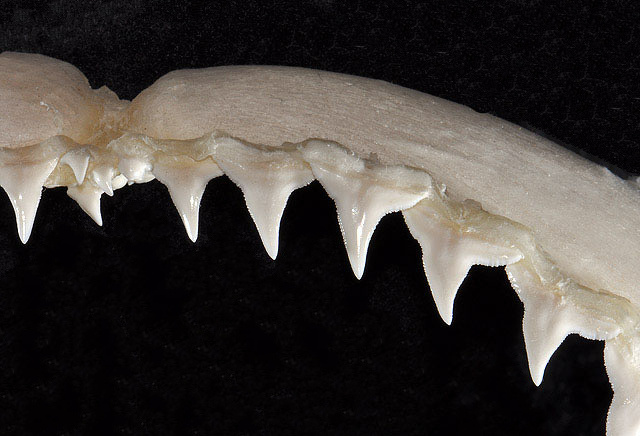
upper teeth of the copper shark
Copper sharks have upper teeth ranging from 2.9 to 3.5 centimeters in size with hooked bent cusps. Their lower teeth are 2.9 to 3.3 centimeters long. The lower teeth are narrower and not as skewed as their upper teeth. The examination of a 2.2-meter female copper shark from the Balearic Islands — the western part of the Mediterranean Sea revealed upper jaws measuring 3.9 centimeters thick and lower jaws measuring 3.2 centimeters thick. horizontal opening was 19.7 centimeters and the vertical opening was 14.4 centimeters.
Copper Sharks Food and Eating Behavior
Copper sharks are carnivores (mainly eat meat or animal parts) and recognized as piscivores (eat mainly eats fish), molluscivores (mainly eat mollusks) and scavengers. They feed mainly on bony fishes, small schooling fish and cephalopods such as squid and octopus and feed on both benthic fish (those living on or near the bottom of the sea) and pelagic fish (those that swim in the open water). Their pelagic diet includes, salmon (genus Salmo) and sardines (Sardinops sagax). Copper sharks over two meters long prey on sharks and stingrays. [Source: Kailee Louk, Animal Diversity Web (ADW) |=|]
The ability of copper sharks to consume sharks and rays depends on the size of the shark. As copper sharks grow, their diets shift to larger prey. They are able to consume prey larger than their mouth by cutting the prey into pieces. Studies of the stomach contents of copper sharks found on the Eastern Cape Coast of South Africa and found the types and variety of prey consumed differed by shark size. Those less than two meters long mainly ate squids (Loligo vulgaris reynaudii), cuttlefish (genus Sepia), sardines (Sardinops sagax), cape horse mackerel (Trachurus capensis), other fish from the Clupeidae family, and teleost remains. |=|
Analysis of somach contents has revealed that copper sharks greater than two meters consume of squids (Loligo vulgaris reynaudii), cuttlefish (Sepia), octopuses, sardines (Sardinops sagax), Whitehead's round herrings (Etrumeus whiteheadi), Southern African anchovies (Engraulis capensis), European hakes (Merluccius capensis), kingklips (Genypterus capensis), olive grunts (Pomadasys olivaceus), cape horse mackerel (Trachurus capensis), chub mackerel (Scomber japonicus), teleost remains, sharks and rays such as shortnose spurdogs (Squalus megalops), eagle rays from the Family Myliobatidae, St. Joseph sharks (Callorhinchus capensis), and shark remains.
Copper Shark Behavior
Copper sharks are motile (move around as opposed to being stationary), migratory (make seasonal movements between regions, such as between breeding and wintering grounds), solitary and social (associates with others of its species; forms social groups). Copper sharks are not restricted to a particular home range and do not defend a territory. [Source: Kailee Louk, Animal Diversity Web (ADW) |=|]
Although copper sharks are seasonally migratory across their range, separate populations that are near each other interact very little if at all. Within one population, however, there is more social activity as it possible to see sharks in schools as well as alone. During the spring and summer, schools with up to 100 members have been observed off New Zealand and Australia. In the winter, along South Africa, some schools make rushes at bait balls during the sardine run. Copper sharks sometimes travel along continental coastlines for long distances.
Nursery areas for young copper sharks are widely dispersed. They can be located in shallow coastal waters or in the open coast. Neonate and juvenile sightings in Australia have been reported in Albany, Port Lincoln, the upper Gulf St. Vincent, Robe, and Port Phillip Bay. There have been sightings in New Zealand of pregnant females and newborns further south on the western coast in the Waimea Inlet, as well as in Hawke Bay on the east coast. Copper sharks that inhabit the waters around South Africa tend to have nursery areas at higher latitudes, including the Mediterranean coast of Morocco, temperate Cape waters, and central Namibian waters. In the southwest Atlantic region, coastal waters of Bahia Blanca to Bahia San Blas serve as nutrient-rich nursery areas for copper sharks. More juveniles have been reported along California, Brazil, Peru, Sea of Japan, and along the West Alboran Basin, which is in between the coasts of Spain and Morocco.
Copper Shark Perception and Communication
Copper sharks sense and communicate using vision, touch, vibrations, electric signals, chemicals detected by smelling. They also employ pheromones (chemicals released into air or water that are detected by and responded to by other animals of the same species). [Source: Kailee Louk, Animal Diversity Web (ADW) |=|]
Kailee Louk wrote in Animal Diversity Web: Copper sharks require good visual perception for their predatory habits. Their vision allows them to catch swift-moving pelagic teleosts. Their lateral line system is the same system used by other fish to detect movements and vibrations in the water. Specifically, they use electric signals to detect prey (or other objects) and localization. They do this using electrosensory pores that are spread equally on the dorsal and ventral sides of the shark. Because these pores are abundant and evenly distributed, copper sharks are able to locate the specific position of their prey in any direction. These receptors allow sharks to detect and capture prey. |=|
The three main vertebrate sensory systems of the head distinguish behaviors and are linked through different parts of the brain. These three sensory systems include olfactory, visual, and octavolateral. The forebrain, midbrain, and hindbrain are neural structures that obtain signals from these sensory systems. The mesencephalon, or midbrain, of copper sharks is an average size, which gives evidence that vision is the main sense they use to detect prey. The motor function of the mesencephalon is specific to the movements of eyes. In older sharks, optic tecta — the main visual processors — decrease. When this happens, other senses have greater influence over vision. The olfactory lobes of copper sharks allow them to identify smells and pheromones, which helps them identify prey and potential mates.
Copper Shark Mating, Reproduction and Offspring
Copper sharks likely are polygynandrous (promiscuous), with both males and females having multiple partners. They engage in internal reproduction in which sperm from the male fertilizes the egg within the female and are viviparous, meaning they give birth to live young that developed in the body of the mother. Copper sharks give birth every other year. The breeding season is during spring in temperate waters at high latitudes. The average gestation period is 12 months.The number of offspring ranges from seven to 24. Copper sharks sexually mature relatively late and have long reproductive cycles. Females reach sexual or reproductive maturity at 15 to 20 years; males do so at 13 to 19 years. [Source: Kailee Louk, Animal Diversity Web (ADW) |=|] |=|
Copper sharks likely mate offshore and there are specific regions for breeding and nursing. Mating beings with the male shark biting the female. During copulation, males use their claspers (external sex organs situated in back of their pelvic fins) to deliver semen into the oviducts of females. Females give birth in select nursing areas within their geographic range. As is the case with most sharks it is assumed that mothers do not provide any type of parental care and newborns swim away after birth and immediately independent. Beyond the act of mating, males provide no parental care.
Newborn copper sharks are 60 centimeters (two feet in length). However, this average length varies considerably across populations. Along South Africa’s Eastern Cape, the smallest free-swimming copper sharks were 58.5 centimeters long. In the southwest Atlantic Ocean region, the smallest free-swimmers were greater than 60 centimeters long. The lengths at birth found in a southwest Indian Ocean population were approximately 74 centimeters.
The development and life cycle of copper sharks is characterized by indeterminate growth (they continue growing throughout their lives). Males are identified as having reached sexual maturity when they have developed calcified claspers that rotate forward. Such Mature males range from 1.8 to 2.55 meters (5.9 to 8.4 feet) in length. Mature females possess yolk-filled oocytes, large oviducal glands, and widened uteri. Their total length at maturity can range from 1.91 to 2.47 meters (6.3 to 8.1 feet).
Copper Sharks, Humans and Conservation
On the International Union for Conservation of Nature (IUCN) red list copper sharks are listed Vulnerable worldwide as their global population is unknown and their long maturation time and low reproductive rate makes them highly susceptible to overfishing. Regionally, the IUCN has listed copper sharks as a species of Least Concern off Australia, New Zealand, and South Africa, where fisheries are generally well-managed; the local copper shark population for each of those three countries is contained almost entirely within their respective Exclusive Economic Zones (EEZ). Reported catches by New Zealand have steadily declined from a peak of 40 tons in 1995 and 1996 to 20 tons 2001 and 2002, though it is uncertain whether this reflects a genuine decline or changing fishing habits. [Source: Wikipedia]
The meat and fins of copper sharks have been consumed by humans. Their fins have been used to make shark fin soup in China and Asia. In Australia, shark fillets are popular. South Africa exports copper shark meat to Australia because Australia can not supply enough meat from its own sharks to meet demand. [Source: Kailee Louk, Animal Diversity Web (ADW) |=|]
The main threat to copper sharks is overfishing. They face immense fishing pressure throughout their range and they live in widely-used fishing area. Whether being targeted directly or caught as bycatch all copper sharks close to shore waters are vulnerable to being caught by fishermen. Their nursery habitats may experience habitat loss and pollution as a result of developments along coastlines. Conservation efforts for copper sharks include banning fishing in certain management areas and restricting the kind of fishing gear used in some places.
Copper Sharks Attacks on Humans
Copper sharks (Bronze Whalers) are responsible for infrequent and mostly non-fatal attacks on humans, with only one recorded fatal unprovoked attack and a handfull of provoked attacks globally. They are not inherently aggressive but do attack when they mistake humans for prey, especially spearfishermen or during frenzies when competing for food as during the annual sardine run in South Africa. Attacks by unidentified sharks are possibly from copper sharks as they are fairly widespread in coastal area where encounters with humans are common and identification is difficult, as copper sharks look very similar to other requiem sharks species such as bull sharks and reef sharks. Victims and witnesses often can not correctly identify which species of shark is responsible for an attack. Experts trying to confirm shark attacks by species warn that their statistics under count the number of attacks by requiem sharks like the copper.
Copper sharks rank sixth in the number of unprovoked attacks on people. During the tracking period from 1962 through 2013, the University of Florida attributed 20 attacks to copper shark, compared to 279 for great white sharks. According to the International Shark Attack File, bronze whaler sharks (copper sharks) has been implicated in fifteen attacks since 1962, one of which resulted in a fatality. They are considered potentially dangerous to humans because of their behavior in the presence of food and association with feeding events. Copper Sharks have been known to harass and attack spear fishers in an attempt to steal catches. They have bitten several swimmers in Australia and New Zealand, where the species is common.
Fatal attacks attributed to the copper sharks include the 2014 death of a swimmer in Tathra, New South Wales, Australia, and the 1976 death of a swimmer in Te Kaha, New Zealand. Three out of ten shark attacks in New Zealand are attributed to Copper sharks. Witnesses also attributed a fatal attack on September 2011 in Bunker Bay, Western Australia to a copper shark.
Image Sources: Wikimedia Commons
Text Sources: Animal Diversity Web animaldiversity.org , National Geographic, Live Science, Natural History magazine, Australian Museum, David Attenborough books, Australia Geographic, New York Times, Washington Post, Los Angeles Times, Smithsonian magazine, Discover magazine, The Conversation, The New Yorker, Time, BBC, CNN, Reuters, Associated Press, AFP, Lonely Planet Guides, Wikipedia, The Guardian, Top Secret Animal Attack Files website and various books and other publications.
Last updated September 2025