
Home | Category: Sea Life Around Australia
SPOTTED WOBBEGONGS
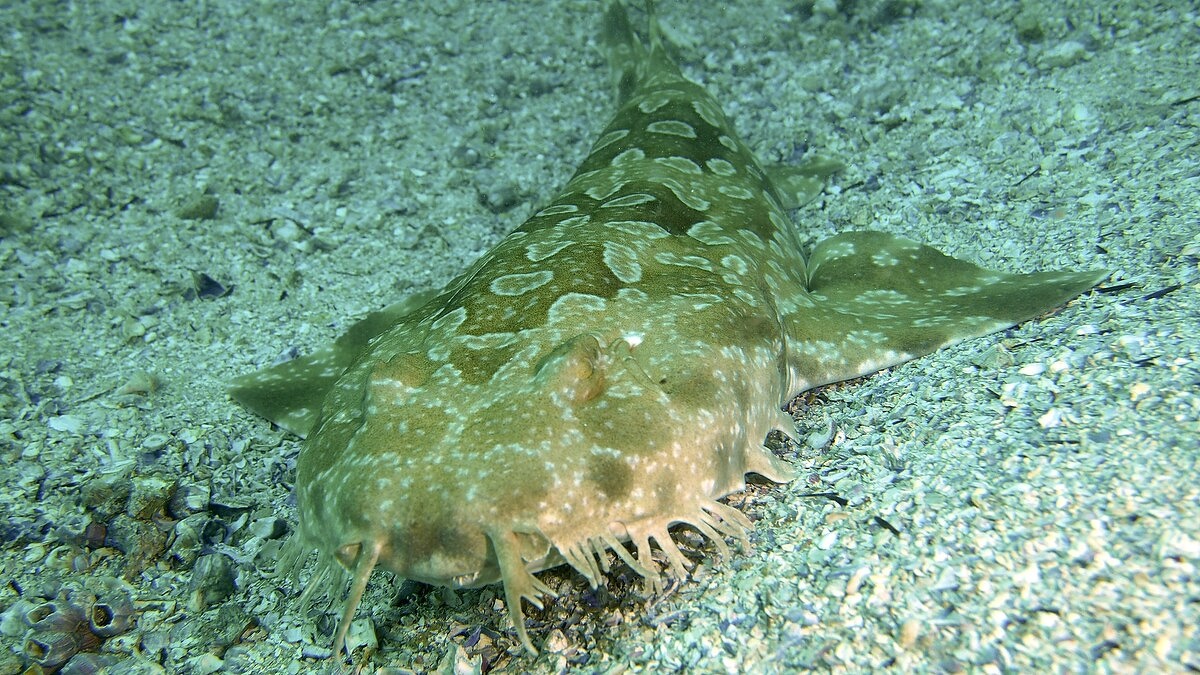
spotted wobbegong
Spotted wobbegongs (Orectolobus maculatus) look like a cross between a moving piece of coral and a rug. Also known as carpet sharks, catsharks, tassel sharks and wobbegongs, they often sit camouflaged on the ocean bottom, partly buried in the sand like a skate to ray, ambushing predators that pass by. Spotted wobbegongs are species a carpet shark in the family Orectolobidae found off the coast of southern and southeastern Australia. Green, yellow, or brown in color, they are fairly large, typically reaching 1.5 to 1.8 meters (4.9 to 5.9 feet) in length and have distinctive O-shaped spots all over their body. They have bitten humans, sometimes unprovoked, and have caused severe wounds. The species is fished commercially in Australia, but it is not severely threatened. They are listed as a least-concern species on the IUCN Red List. There 11 species of wobbegong shark, found mainly in the eastern Indian Ocean and western Pacific Ocean.
Spotted wobbegong are generally found in inshore waters the Fremantle region in Western Australia to Moreton Island in southern Queensland. Some sources claim that spotted wobbegong are also found Japanese waters and the South China Sea but this mostly likely the result of confusing spotted wobbegongs with other wobbegong species. [Source: Todd Szcodronski, Animal Diversity Web (ADW) /=]
Spotted wobbegong are bottom-dwelling sharks typically found at depths of zero to 110 meters (360. feet) in temperate and to a lesser extent tropical waters. Their main habitat consists of inshore areas on continental shelves in coral and rocky reefs, estuaries, seagrass beds, coastal bays, and areas with sandy bottoms. They are a primarily active at night and are found in caves, and under the overhangs of rocky and coral reefs during the day. Juveniles are commonly found in estuaries and seagrass beds. There are quite common in very shallow water.
Spotted Wobbegong Characteristics and Diet
Adult spotted wobbegongs range in length between 1.5 and 1.8 meters (4.9 and 5.9 feet), with their average length being 1.65 meters (5.4 feet). Males usually mature at around 60 centimeters (two feet). Large one are around 3.2 meters (10.5 feet), The largest on spotted wobbegong on record measured 3.6 meters (11.8 feet).
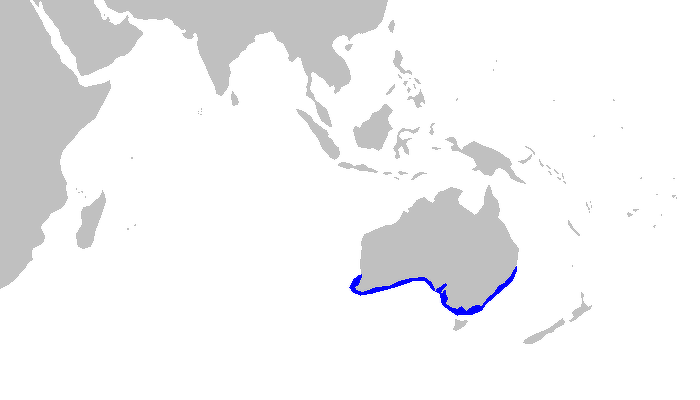
range of spotted wobbegongs
Spotted wobbegongs are often called carpet sharks because of their rug-like appearance. They are generally pale yellow or green-brown in color with large, dark areas down the midline of the body. White "O"-shaped spots often cover the entire back of the shark. This patterning distinguishes them from other wobbegongs and provides camouflage in against the varying color patterns of the environment it inhabits. Other distinguishing features of spotted wobbegongs include a flattened heads, six to ten dermal lobes below and in front of the eyes, and having long catfish-like nasal barbels around the mouth and on the sides of head. The barbels are sometimes branched. The mouth lies in front of the eyes with two rows of fang-like teeth in the upper jaw and three in the lower jaw. Spotted wobbegongs can also be characterized by their large spiracles, a lack of skin ridges on the back and grooves on the chin and around the nostrils. The back fins are spineless and the first begins over the pelvic area with the anal fin originating behind the second dorsal fin. The pectoral and pelvic fins are large and broad, and the tail fin is relatively short. body. [Source: Todd Szcodronski, Animal Diversity Web (ADW) /=]
Spotted wobbegongs are carnivores (mainly eat meat or animal parts) and also regarded as molluscivores (mainly eat mollusks) and piscivores (eat mainly eats fish). They mainly prey bottom dwelling invertebrates such as crabs, lobsters, and octopus but feed on some bony fishes such as sea bass, scorpionfishes and (luderick) as well as rays and smaller sharks including juvenile spotted wobbegongs.
Spotted wobbegong are mainly sit-and-wait predators that lie — maybe partly buried — on the ocean floor, striking quickly on unsuspecting prey that may even nibble on the shark’s dermal lobes before they are sucked in. The short broad mouth and large broad throat appear to help the sharks suck in prey. Video footage shows prey being sucked into the mouth as the throat opens and water rushes in. This feeding mechanism is similar to that of angel sharks except that the prey in angel sharks are taken from above while that of spotted wobbegongs is taken to in front of the mouth. There is some evidence that if spotted wobbegongs may be active, prowling and stalkinghunters as well as ambush predators. Some wobbegongs have been observed sneaking up to bait items as if stalking.
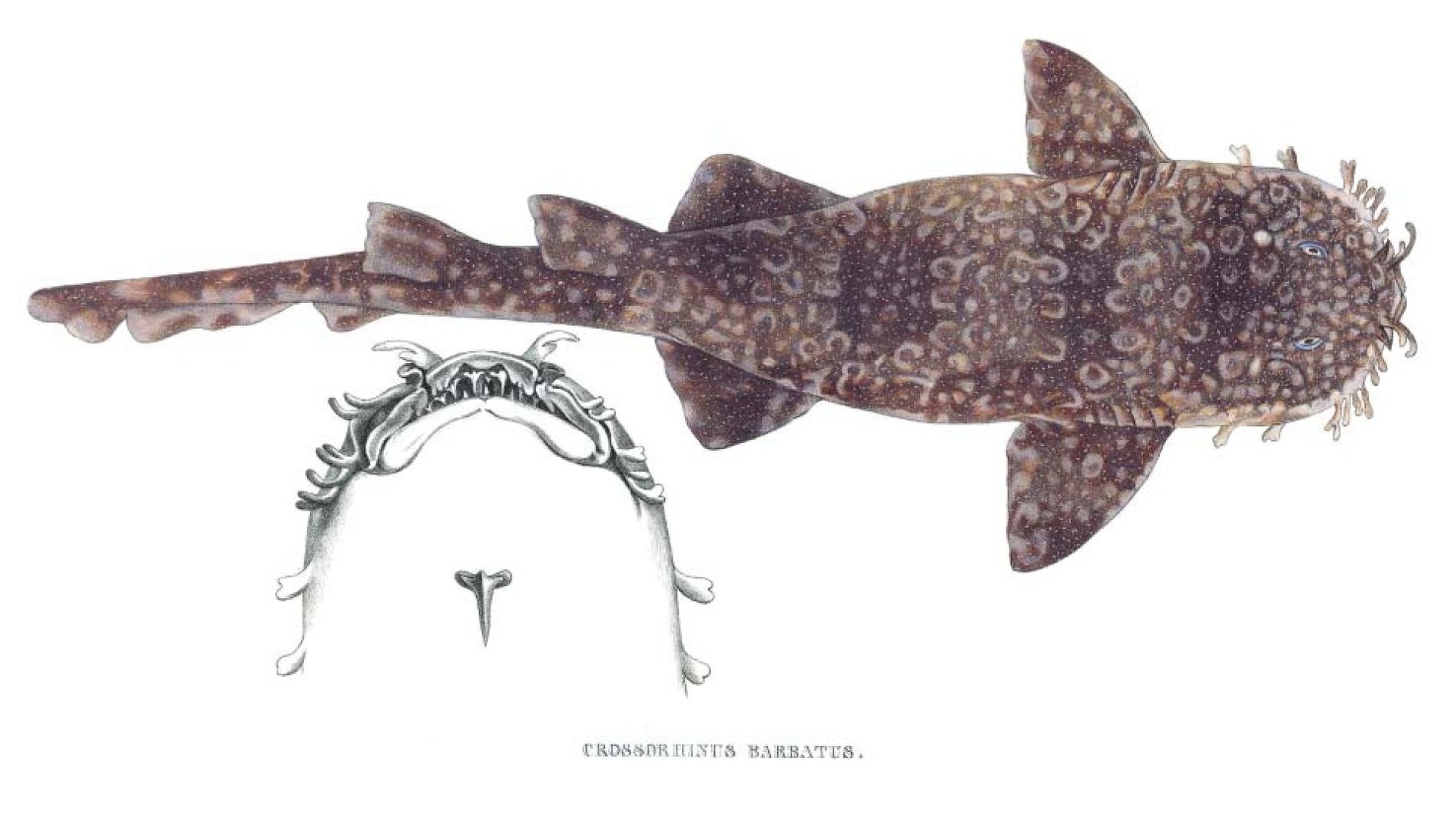
illustration of a wobbegong made in 1841
Spotted wobbegongs have a specialized jaw protrusion that is not found in most other shark species. The palatoquadrate (cartilaginous structure or bones forming the upper jaw and roof of the mouth) and Meckel’s cartilage (cartilaginous structure in jawbone) project forward and are the major component of protrusion. The movement of these jaw structures simultaneously enlarges the oral cavity to generate much of the suction forces. This sucking force created by this protrusion, the shark’s powerful jaws and multiple rows of enlarged fang-like teeth in the upper and lower jaw make spotted wobbegongs formidable predators. /=\
Spotted Wobbegongs Behavior, Senses and Reproduction
Spotted wobbegongs are nocturnal (active at night), motile (move around as opposed to being stationary), sedentary (remain in the same area) and solitary. They rest during day, feed on fish and invertebrates at night and swim along the ocean bottom in a way that is similar to nurse sharks. When they are seen by divers during the day they are often completely motionless on the sea floor and remain inactive for extended periods of time. Their cryptic coloration pattern allows them to remain relatively unnoticed. Spotted wobbegongs appear to be largely solitary but at times do congregate in groups. They wobbegongs do not seem to have a specific home range but some individuals and groups of around a dozen sharks have been observed returning to the same site.[Source: Todd Szcodronski, Animal Diversity Web (ADW) /=]
Spotted wobbegongs communicate with chemicals usually detected by smelling and sense using vision, electric signals and chemicals. The only form of communication that has been documented is the release of pheromones (chemicals released into air or water that are detected by and responded to by other animals of the same species) released by females during the breeding season. Females use pheromones to attract potential mates. Most sharks are capable of sensing their environment through electroreception with electrosensors called ampullae of Lorenzini situated in clusters around the head that can sense the weak electrical currents associated with the functioning of nerves and muscles of living animals. The presence of these ampullae in spotted wobbegong has yet to be confirmed, but it is presumed they possess electroreception capabilities.
Spotted wobbegongs are 1) polygynous (males have more than one female as a mate at one time). 2) engage in internal reproduction in which sperm from the male fertilizes the egg within the female, and 3) and ovoviviparous, meaning that eggs are hatched within the body of the female and live young emerge from her body. They engage in seasonal breeding, primarily in July in captivity, but breeding intervals are unknown. During breeding season, the males are attracted to chemical pheromones released into the water by females. During copulation, the male bites the female in the gill region, and use his modified pelvic fin, called a clasper, to insert sperm into the cloaca. In captivity males fight fiercely over opportunities to court females. The number of offspring can be as high 37, with the average number of offspring being 20. [Source: Todd Szcodronski, Animal Diversity Web (ADW) /=]
Spotted wobbegongs gives birth in the spring, during which time males can act aggressively towards other males and females. At birth, the average newborn is 21 centimeters (8.3 inches) in length. Pups are unnourished while developing inside the mother and often eat unfertilized eggs as well as other pups. Young leave their mother almost immediately after birth, often to avoid being eaten by her. The development and life cycle of spotted wobbegongs is characterized by indeterminate growth (they continue growing throughout their lives) but a slow rate.
Spotted Wobbegongs, Humans and Conservation
Spotted wobbegongs are not endangered are designated as a species of least concern on the International Union for Conservation of Nature (IUCN) Red List since 2015. Before that they were considered near threatened. Spotted wobbegong have been commonly caught by trawls and trammel nets, and inside lobster nets and pots as bycatch (unwanted fish caught by fisheries). They are considered pests in the lobster industry because they squeeze themselves inside lobster traps to eat both the bait and the catch.
Spotted wobbegongs are not usually targeted by fishermen but are still commonly consumed by humans. The meat is said to taste good and is eaten in Australia and some other places. Wobbygong and carpet shark meat is sometimes used in fish and chips. The tough skin is very durable and has unique patterning, making it at one time desirable for leather products. They are often spotted by scuba divers who generally regarded them as docile and easy and safe to observe.
Spotted wobbegong are commonly caught as bycatch and there appears to be low and stable catch levels in southern and western coastal fisheries. However, serious declines have occurred in New South Wales. Spotted wobbegongs may be sensitive to damage to their inshore coastal habitats. Estuaries and seagrass beds may be home to important nursery areas for juvenile spotted wobbegongs. /=\
Spotted Wobbegongs Attacks
Spotted wobbegong are relatively docile and appear sluggish but when viewed by divers, but they should still be considered dangerous. They are not an aggressive species of shark, but have been known to bite people if provoked. In most cases, bites result when the shark is stepped on or if someone steps too close to their mouth and may be mistaken for prey. Spotted wobbegong also become aggressive when speared or caught by nets. Their strong jaw musculature, sharp teeth, and tendency to hold on after biting has produced some serious injuries. There have even been reports of wobbegongs biting fishing boats; some victims have lost limbs to wobbegong bites.
Wobbegong sharks as a species group have accounted for 31 non-fatal unprovoked attacks and 0 fatal attacks according to the International Shark Attack Files. Spotted wobbegong have accounted for four non-fatal unprovoked attacks and 0 fatal attacks. Ornate Wobbegong (Orectolobus ornatus) have accounted for three non-fatal unprovoked attacks and 0 fatal attacks for of total of 3 attacks. [Source: International Shark Attack Files, Florida Museum of Natural History, 2023]
Man Attacked by Wobbegong That Wouldn't Let Go
In February 2004, a man was attacked by a small shark wobbegong while snorkeling and then swam 300 meters, walked to his car and drove to a local surf club to get help while the shark was still attached to his leg. Australia Associated Press reported: The wobbegong, or so-called carpet shark, attacked 22-year-old Luke Tresoglavic yesterday as he was snorkelling on a reef off Caves Beach, south of Newcastle. Mr Tresoglavic said that when the 60 centimeter shark attacked him, he "instantly grabbed hold of it with both hands as hard as I could to stop it shaking". [Source: Australia Associated Press, February 11, 2004]
"I just realised I had to swim in like that, hanging on to it," he told ABC radio. "Once I got on to shore, a couple of people tried to help me but I could not remove it, it was stuck there. "So I got up into my car and then drove to the clubhouse and luckily the guys down there had a clue what to do."
Senior lifeguard Michael Jones could hardly believe his eyes when Mr Tresoglavic turned up. "The first we knew of it was a bloke lobbed up here at the lifeguard tower with a shark attached to his leg," Mr Jones said. "He basically asked the question, 'Can you help me get it off?' — there's nothing in our procedure manual for that type of thing. It latched on and wouldn't let go, it was thrashing around and he's lucky he didn't get into difficulties in the water trying to swim with that thing thrashing around."
With the help of another lifeguard, all three men took hold of the shark and attempted to flush its gills with fresh water to make it loosen its grip on Mr Tresoglavic's leg. "I grabbed the tail and one jaw, Luke grabbed the other jaw and my partner, the other beach inspector, flushed it with water and we were able to get it off without creating too much more tissue damage," Mr Jones said.
With blood oozing from 70 needle-like punctures in his leg, Mr Tresoglavic drove to hospital, taking the dead shark with him. Mr Jones said Mr Tresoglavic remained in good spirits throughout the ordeal. "There was a side of humour to it," he said. The last shark sighting at the beach was seven years ago, although it is common for them to linger around the reef flushed with fish. Wobbegong sharks can grow up to three meters in length, have razor-like teeth and are said to be moody and short-tempered.
Image Sources: Wikimedia Commons
Text Sources: Animal Diversity Web animaldiversity.org , National Geographic, Live Science, Natural History magazine, Australian Museum, David Attenborough books, Australia Geographic, New York Times, Washington Post, Los Angeles Times, Smithsonian magazine, Discover magazine, The Conversation, The New Yorker, Time, BBC, CNN, Reuters, Associated Press, AFP, Lonely Planet Guides, Wikipedia, The Guardian, Top Secret Animal Attack Files website and various books and other publications.
Last updated September 2025