
Home | Category: Birds, Crocodiles, Snakes and Reptiles
LIZARDS IN AUSTRALIA
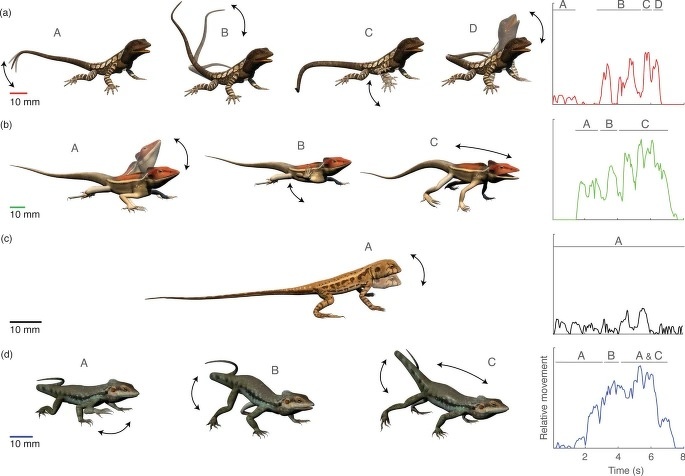
Display sequences of the four Australia lizard species; a) the Jacky dragon (Amphibolurus muricatus) starts with tail-flicks (A, B), followed by limb waves (C) and finishes with a whole body movement centred on a push-up (D); b) the long-snouted lashtail or long-nosed water dragon (Gowidon longirostris) has a series of head bobbing (A) and limb waving (B), the final push up is followed by a forward body thrust/rise (C); c) the Mallee dragon or Mallee sand-dragon (Ctenophorus fordi), is comparatively simple, and consists of rapid movement of the head up and down (head-bobbing, A); d) Tawny Dragon (Ctenophorus decresii) has several limb waves (A) and a distinct raising of the tail with a coil at the distal end of the tail (B), it finishes with a forward body thrust with tail coiled (C), from "Simulations with Australian dragon lizards" Nature
Australia is home to over 800 species of lizards. This makes Australia a global hotspot for lizard diversity, with a high percentage of endemic species, meaning they are found nowhere else in the world. The lizard families include skinks, geckos, dragons, legless lizards, and goannas (monitors), each with unique adaptations to different environments. The exact number is constantly being refined as new species are discovered and taxonomic research continues, according to Monash Lens.
Australia is home to over 1,000 species of reptiles (about 800 lizard species and 200 snakes specie . This represents a significant portion of the world's reptile diversity, with Australia boasting the highest number of reptile species of any country. Many of these reptiles, around 93 percent are unique to Australia, meaning they are not found anywhere else in the world. The Australia Outback contains more different kinds of reptile than any other desert in the world. Overall the reptiles that attract the most attention are snakes and crocodiles.
There are some fairly dramatic lizards in Australia, including frill-necked lizard of the north and colorful species of ceiling-walking geckos. The Moloch lizard is only one a few centimeters (inches) long. It parks itself on ant trails and feast on ants as they march by. The 15-centimeter (six-inch) -long mountain devil lizard looks like a horned toad with cactus leaves and thorns growing on it. Many Aboriginal like to eat goannas.
Large prehistoric reptiles that lived in Australia included Megalania prisca, six-meter-long venomous lizards; giant carnivorous goannas that perhaps weighed as much as a ton and reached lengths of 21 feet; and Quinkana, 10-foot-long, 500-pound land crocodiles that seemed to able to survive without water, and may have jumped from trees onto their prey; and six-meter long venomous lizards called megalania. Megalonia prisca and giant goannas went extinct about 12,000 years ago.
In May 2025, scientists announced that 17 footprints preserved in a slab of sandstone discovered in southeastern Australia dating to about 355 million years belonged to a reptile — rewriting the history of the evolution of land vertebrates, showing that reptiles arose much earlier than previously known. See “355-Million-Year-Old Footprints from Australia Reveal Earliest-Known Reptile” Under DINOSAURS IN AUSTRALIA: TYPES, CHARACTERISTICS, WHEN AND WHERE factsanddetails.com
RELATED ARTICLES:
THORNY DEVILS: CHARACTERISTICS, BEHAVIOR AND REPRODUCTION ioa.factsanddetails.com
FRILLED LIZARDS: CHARACTERISTICS, BEHAVIOR AND REPRODUCTION ioa.factsanddetails.com
SHINGLEBACK AND BLUE-TONGUED LIZARDS: CHARACTERISTICS, BEHAVIOR, REPRODUCTION ioa.factsanddetails.com
GOANNAS (MONITOR LIZARDS) factsanddetails.com
GOANNAS (MONITOR LIZARD) SPECIES OF AUSTRALIA ioa.factsanddetails.com
MONITOR LIZARDS OF NEW GUINEA: SPECIES, CHARACTERISTICS, BEHAVIOR AND REPRODUCTION ioa.factsanddetails.com
BIGGEST AND MOST COMMON MONITOR LIZARDS: ASIAN WATER AND BENGAL MONITORS factsanddetails.com
KOMODO DRAGONS: CHARACTERISTICS, HABITAT, SENSES, MOVEMENT factsanddetails.com
REPTILES: TAXONOMY, CHARACTERISTICS, THREATENED STATUS factsanddetails.com
LIZARDS: CHARACTERISTICS, SENSES, ODDITIES factsanddetails.com
CROCODILES IN AUSTRALIA: HISTORY, SPECIES, BIG ONES, DWARVES, BATS, SHARKS ioa.factsanddetails.com
Skinks in Australia
Australia is home to over 370 species of skinks, about half of the lizard species found there, according to Backyard Buddies and Waratah Software. Skinks are kinds of lizards with small legs and bodies that can squirm like a snake. They are quick and their tails break off and will grow back. They often have stripes. Some are bluish in color. Skinks and rattlesnakes give birth to live young. Sometimes when the skinks tail comes off it keeps moving. Skinks perform this dramatic form of self-amputation by suddenly contracting their muscles, which in turn causes a fragile vertebrae to break. The new tail often looks different from the original. Instead of bonding to vertebrae it has a tube of cartilage.
In November 2023 researchers from from the Queensland Museum and James Cook University announced that they had found three species of skink tfeared could be extinct Mount Surprise in Queensland in northeastern Australia: spotted Lyon's grassland striped skinks (Austroablepharus barrylyoni), which have bright-orange tails and hadn’t been seen since 1981, Mount Surprise sliders (Lerista storri) and limbless fine-lined sliders (Lerista ameles). [Source Patrick Pester, Live Science, November 11, 2023]
Lyon's grassland striped skinks are very small, measuring just 5 centimeters (two inches). Mount Surprise sliders have small stumps as their back legs, while limbless fine-lined sliders don't have any legs at all. The sliders' reduced limbs enable them to "essentially swim through the soil," Andrew Amey, the collection manager of amphibians and reptiles, herpetology at Queensland Museum, told Live Science. All three lizards have tiny distributions in the Mount Surprise area, which means they are particularly vulnerable to disturbances such as bushfires, droughts and disease.
New Species of Lizard Found in Australia
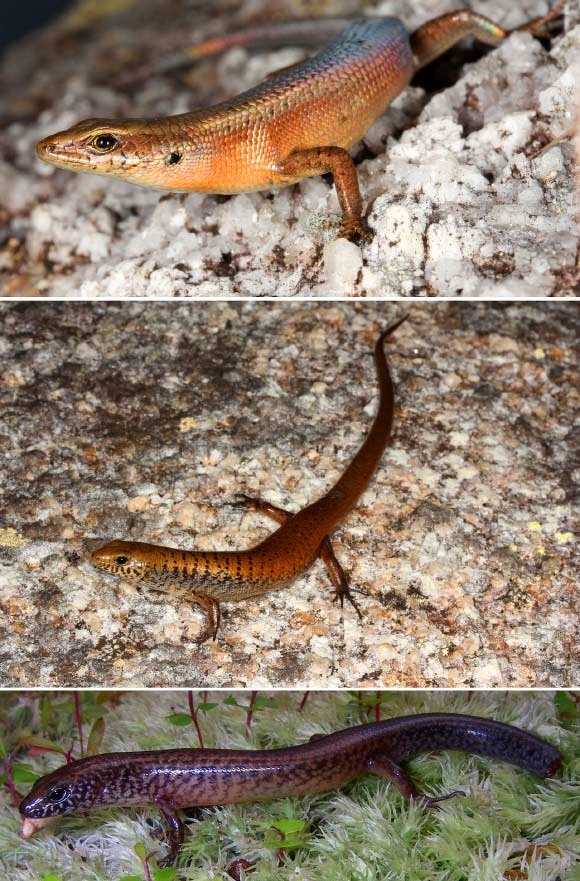
Three new species of lizards discovered in Australia (from top to bottom): the Cape Melville Rainbow Skink (Carlia wundalthini), the Cape Melville Bar-lipped Skink (Glaphyromorphus othelarrni) and the McIlwraith Bar-lipped Skink (Glaphyromorphus nyanchupinta), images from Conrad Hoskin, Stephen Williams, Sci News
Several new species of lizards have recently been discovered in Australia. These include a new species of skink on Scawfell Island, a new rock skink in central Australia, and several new sand dragon lizards in South Australia. The scawfell island sunskink (Lampropholis isla) was discovered by James Cook University scientists and formally named in March 2025. It was was found on Scawfell Island, a remote island off the coast of Queensland. It's the second unique lizard species found on the island, alongside the previously discovered leaf-tailed gecko. The central ranges rock skink was discovered by researchers from Monash University. A new rock skink species and characterized by its orange, pointed snout, it is found in central Australia in the Mann-Musgrave Ranges near the northern border of South Australia. Four new sand dragon lizard species have been identified in South Australia, named after traditional Aboriginal languages.
Many of of the newly-discovered lizard species are skink, including three new species found on the Cape Melville Range, including the Cape Melville Rainbow Skink ( Carlia wundalthini ) and two Bar-lipped Skinks (: Glaphyromorphus othelarrni and G. nyanchupinta.
In October 2012, scientists announced the discovery of a new species of lizard in sand dunes outside Perth in Western Australia — six-centimeter (two-inch) long coastal plains skink (Ctenotus ora). AFP reported: They fear it is only a matter of time before it will be extinct with urban sprawl rapidly closing in. The discovery, detailed in the journal Zootaxa, took place during research south of the city to determine the levels of biological diversity in southwestern Australia. "The discovery of a new species is a momentous occasion in science," said Geoffrey Kay, an ecologist from the Australian National University who found the lizard with colleague Scott Keogh. "To find something as yet undetected, so close to one of the country's largest cities, demonstrates how much we've still got to discover." [Source: AFP, October 29, 2012]
But he warned of the real threat to the reptile. "Although it's a fantastic discovery, it's poor cause for celebration. Our new lizard is under serious risk of being erased just as suddenly as it appeared to us," he said. "Only a few of these lizards have ever been found in the wild, so while we know numbers are low, we are not sure of the exact size of the remaining population." The small stretch of sand the brown and white skink calls home is steadily being concreted. "Developments along the coastline near Perth need to consider this new lizard and potentially a large number of other species yet to be discovered in this diverse part of the world," added Kay. Southwestern Australia is recognised as one of the top 25 biodiversity hotspots in the world., alongside places such as Madagascar, the tropical jungles of West Africa, and Brazil's Cerrado. "We've known for a long time that the southwest has an outstanding diversity of plants, as exhibited by its stunning wildflowers," said Kay. "But only now with this research are we seeing that the level of diversity in animals, in particular reptiles, is far deeper and more extreme than we previously imagined."
Legless Lizards
The Australian region is home to around 45 species of legless lizards from the family Pygopodidae. Legless lizards refer members of several groups of lizards that have independently lost limbs or have limbs so small you can barely see and can not be used to move around. Ones belonging to the family Pygopodidae look just like snakes except they have eyelids and external ear openings which snakes don’t have and lack broad belly scales which snakes have. Legless lizards also often have a notched rather than forked tongue, two more-or-less-equal lungs (most snakes have one) and have a very long tail (by contrast snakes have a long body and short tail). [Source: Wikipedia]
Most legless lizards are either long-tailed surface dwellers that “swim” through grass or short-tailed burrowers. The surface dwellers have long tails that can be bitten off by predators without causing serious harm to the lizard. Burrowers that live underground don’t need this defense. Every stage of reduction of the shoulder girdle — including complete loss — occurs among limbless squamates, but the pelvic girdle is never completely lost regardless of the degree of limb reduction or loss. At least the ilium is retained in limbless lizards.
Many families of lizards have independently evolved limblessness or greatly reduced limbs including the following examples: 1) Anguinae, an entirely legless subfamily native to Europe, Asia, North America and North Africa, that contains well-known species such as slowworms, glass snakes and glass lizards; 2) Cordylidae, an African family of 66 species, with one virtually legless genus Chamaesaura, containing five species with hindlimbs reduced to small scaly protuberances; 3) Pygopodidae, with 44 species, almost all of which are endemic to Australia. Pygopodids are not strictly legless since, although they lack forelimbs, they possess hindlimbs that are greatly reduced to small digitless flaps, hence the often used common names of "flap-footed lizards" or "scaly-foot".The pygopodids are considered an advanced evolutionary clade of the Gekkota, which also contains six families of geckos.
New Species of Legless Lizard Discovered Near Sydney
In July 2022, the Australian Museum confirmed the discovery of a new legless lizard species, the Hunter Valley Delma (Delma vescolineata), endemic to the Hunter Valley and Liverpool Plains of New South Wales. Stephen Mahony of the Australian Museum wrote. Found just two hours out of Sydney, a team of Australian Museum scientists have described the Hunter Valley Delma — the first legless lizard species endemic to New South Wales.
A team of scientists from the Australian Museum has just officially confirmed that a legless lizard from the Hunter Valley represents a new species to science, now named the Hunter Valley Delma (Delma vescolineata). Previously confused with a very similar-looking species with a much wider distribution further south, the new species is known only from the Hunter Valley and Liverpool Plains of New South Wales. [Source: Stephen Mahony, Australian Museum, July 11, 2022]
The Hunter Valley Delma (Delma vescolineata) was first found in 2012 by a local herpetological enthusiast Ryan Harvey and was initially considered a new population of the Striped Delma (Delma impar). However, this population looked somewhat different — it had barred lips and wasn’t as strongly striped, so the team at the Australian Museum began an investigation.
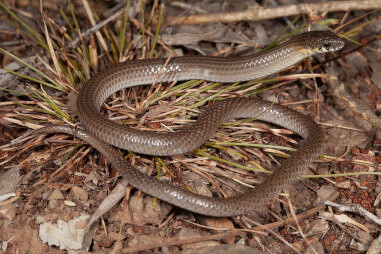
Hunter Valley delma
To confirm whether the species was indeed distinct, the team had to compare genetic samples to those from the Striped Delma from southern New South Wales , the Australian Capital Territory, Victoria and South Australia. They also had to compare the physical features of the species to other similar legless lizards. In doing so they found that in addition to barred lips and weaker stripes there were also subtle differences in scales and head shape. The new species scientific name means “weakly striped”, a comparison to the Striped Delma found further south.
The Hunter Valley, where the lizard was discovered, is only two hours from the city of Sydney and even closer to Newcastle, so it is amazing how long this species went undetected. This is partially explained by its cryptic nature, living down burrows, in dense grass tussocks, and under rocks and fleeing rapidly when disturbed. It is also probable it was found earlier and assumed to be the Leaden Delma (Delma plebeia) which also occurs in the Hunter Valley. The Hunter Valley Delma is only found in the Hunter Valley and the nearby Liverpool Plains and like other related species it prefers open grassland habitats.
The Hunter Valley Delma can be locally abundant in some environments and even seems to display a tolerance for disturbance, being found in very weedy, cleared, and grazed areas. However, the small area it is known to occur in and threats like loss of habitat to mining, development and cropping make it likely to be considered threatened with extinction.
Dragon Lizards of Australia
Australia is home to a diverse array of "dragon" lizards, belonging to the family Agamidae. These include well-known species like the bearded dragon, frilled-neck lizard, and water dragon, as well as various other species in the genus commonly called "military dragons" or "rock dragons" such as central netted dragons, mallee dragons, and spotted military dragons — each adapted to different Australian environments. Military dragons often feed on insects knocked down by incoming cars.∝
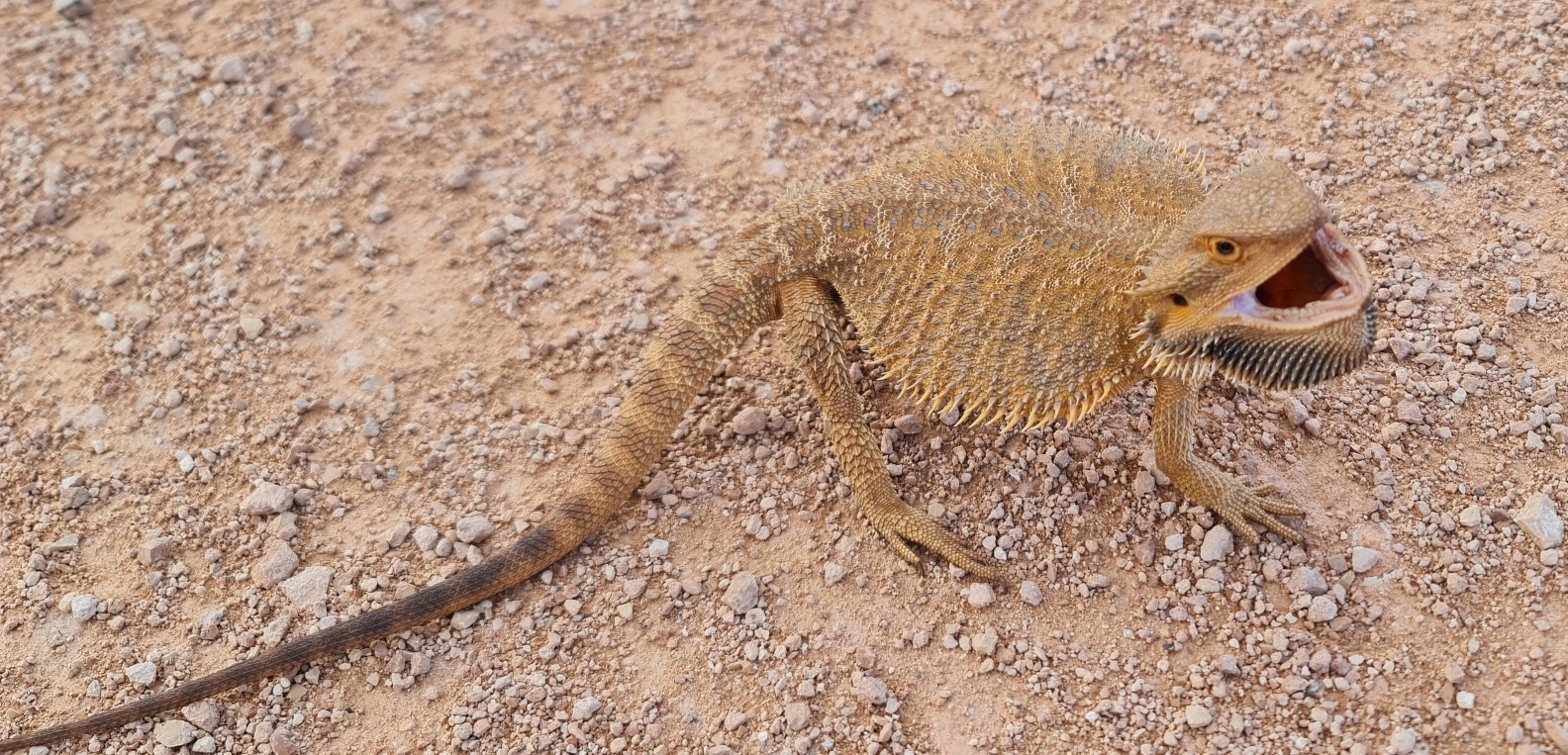
defensive posture of a central bearded dragon
Several species of bearded dragons (Pogona genus) are found across Australia, thriving in diverse habitats from arid regions to coastal dunes. Frilled-neck lizards (Chlamydosaurus kingii) are famous for their large, colorful frill, which they displays when threatened. Both Eastern Water Dragons (Intellagama lesueurii) and Gippsland Water Dragons are semi-aquatic lizards found along Australia's east coast, typically near waterways. Jacky dragons (Amphibolurus muricatus) are also well-known species in Australia. They are found in southeastern Australia, with a bright yellow mouth and a vertebral crest.
Aboriginal mythology features stories of large, serpent-like creatures called Neitee and Yeutta, often associated with water and power, which may have been inspired by Australian dragon lizards. Many Aboriginal tribes have stories of large, serpent-like creatures, sometimes called Rainbow Serpents, who can be both helpful and dangerous. Dragons, in various forms, play a significant role in Aboriginal mythology, representing powerful forces of nature and often linked to water sources and creation stories.
Central Bearded Dragons
Central bearded dragons (Pogona vitticeps) are also known as inland bearded dragons. They are a species of agamid lizard found in a wide range of arid to semiarid regions of eastern and central Australia from the eastern half of south Australia to the southeastern Northern Territory. They live in deserts, dry forests, grasslands and scrublands and are semiarboreal (live partly in trees) and are often seen basking on fallen branches, fence posts and picnic tables.[Source: Jennifer Periat, Animal Diversity Web (ADW) |=|; Wikipedia]
Central bearded dragons are 33 to 60 centimeters (13 to 24) inches long, including the tail. Theire common name is derived from their "beard" — an expandable throat pouch with spikey scales. They have a broad, triangular head, round bodies, stout legs, and robust tails. Their skin color — ranging from dull brown to tan with red or gold highlights — tends to match the color of the soil in region they inhabit.
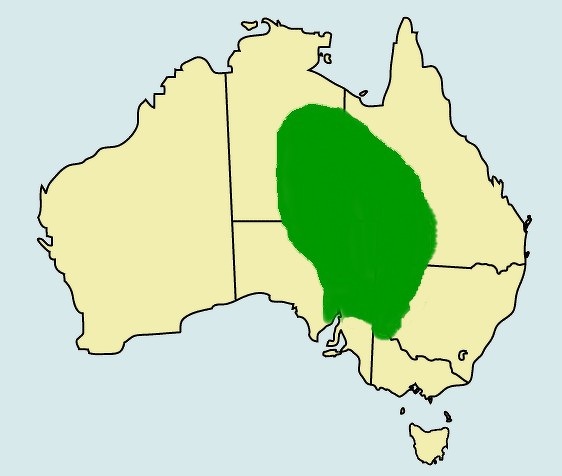
range of central bearded dragons
Central bearded dragons are not endangered or threatened. On the International Union for Conservation of Nature (IUCN) Red List they are listed as a species of Least Concern. Central bearded dragons have been used in scientific research and are very popular in the pet trade because they are relatively easy to keep and breed, have manageable size and pleasant temperament and have interesting social behaviors and an inquisitive nature.
Central bearded dragons are the most commonly found captive-bred bearded dragon species. Breeders focusing on breeding for particular colors such as red phase or gold phase, which fetch higher prices than other colors. Since the 1960s, Australia has strictly prohibited exports of any native wildlife. It is believed that the "founder stock" of captive bred bearded dragons found outside of Australia today were smuggled out of the country between 1974 and 1990.
Central Bearded Dragon Behavior, Diet and Reproduction
Central bearded dragons are opportunistic omnivores (animals that eat a variety of things, including plants and animals). They live in areas where food if often hard to find and this eat almost anything. Their stomachs are large to accommodate large quantities of plant matter. They also eat insects, and occasionally feed on small rodents or lizard. [Source: Jennifer Periat, Animal Diversity Web (ADW) |=|; Wikipedia]
The beard of Central bearded dragons is used for both mating and aggression displays. Both sexes have a beard, but males display more frequently, especially for courtship rituals. Females will, however, display their beard as a sign of aggression also. The beard turns dark to jet black and inflates during the display. The bearded dragon may also open its mouth and gape in addition to inflating its beard to appear more intimidating. |=|
Central bearded dragons engage in head bobbing — males quickly bob their head up and down, often with a darkened beard — to show dominance to both smaller insubordinate males and females they would like to mate with. They also enage in a peculiar behavior called arm waving: they stands on three legs and wave one of their forelimbs in a slow circular pattern. It looks a bit like the reptile is waving hello. Arm waving appears to be used for species recognition and to show submission. Smaller bearded dragons respond with arm waving when faced with larger, more dominant bearded dragons. Females use arm waving to avoid aggression from males, especially if the male is head bobbing. |=|
Central bearded dragons reach sexual maturity at one to two years of age. Mating occurs in the Australian spring and summer months of September to March. However, captive indoor dragons do not seem to be seasonal and can breed year round. Females dig a burrow and lay up to 24 eggs per clutch, and up to nine clutches per year. Females have also been known to store sperm and are able to lay many clutches of fertile eggs from one mating. In captive conditions, the eggs hatch in 55 to 75 days, at 28.9̊Celsius (84̊F).
Blue-Tongued Lizards
Blue-tongued skinks (Tiliqua scincoides) are also called blue-tongued lizards, common blue-tongued skinks, blue-tongued lizards and common bluetongues. They use their vibrant blue tongues to startle predators, according to the San Diego Zoo. When threatened, they puffs up their body so that they appears larger, opens their mouth and hisses while sticking out their tongue. There are three subspecies: 1) eastern blue-tongued skinks ( Tiliqua scincoides scincoides) in southern and eastern Australia; 2) northern blue-tongued skinks (Tiliqua scincoides intermedia) in northern Australia; and 3) Tanimbar blue-tongued skink (Tiliqua scincoides chimaera) in Maluku Province, Indonesia. [Source: Wikipedia]
Blue-tongued skinks live in savannas, grasslands and scrub forests (in areas with an extended dry season). Scott Dutfield wrote in How It Works magazine: Found roaming through tussock grass and forest leaf litter, at around 24 inches (60 cm) long, this lengthy lizard is famous for sticking out its blue tongue.The front of the tongue reflects ultraviolet (UV) light, according to San Diego Wildlife Alliance. This suggests that common predators of the skink, such as bird species that can see UV rays, will be dazed by a flash of UV and think twice about attacking them. [Source: Scott Dutfield, How It Works magazine, May 19, 2021]
Blue-tongued skinks have an average weight of 493 grams (17.4 ounces) and an average length of 33 centimeters (13 inches). Their average basal metabolic rate is 0.2127 watts. Sexual Dimorphism (differences between males and females) is not present: Both sexes are roughly equal in size and look similar. Blue-tongued skinks have relatively smooth skin, covered by overlapping scales with a fish-like appearance. They have grayish undersides. Their head is pale brown and their back has alternating streaks or blotches of dark brown and cream. Juveniles a wider variety of coloration which serves as camouflage. The body is robust and cylindrical with relatively short legs. The massive tongue is supported by the hyoid skeleton, which is true of most reptiles. The tip of the tongue is supported by one rod of the hyoid skeleton — the lingual process. Blue-tongued skinks move with a waddling motion because of their short legs. The average lifespan for females in captivity is 9.0 years. They can live up to 14.3 years. [Source: Don Abbey, Animal Diversity Web (ADW) |=|]
See Separate Article: SHINGLEBACK AND BLUE-TONGUED LIZARDS: CHARACTERISTICS, BEHAVIOR, REPRODUCTION ioa.factsanddetails.com
Geckos in Australia
Australia is home to more than 241 species of native geckos, according to a research paper on the top gecko-rich countries published in Researchgate. These geckos are found in three families: Diplodactylidae, Gekkonidae, and Carphodactylidae. The Carphodactylidae family is unique to Australia and includes some of the most impressive gecko species, like the leaf-tailed geckos.
Southern leaf-tailed geckos are small geckos with a broad tail, found in the Sydney region. Granite belt leaf-tailed geckos are found in Queensland and listed as endangered. These geckos are masters of disguise, with tails that mimic decaying leaves, complete with "bite marks" and "mold patterns". Leaf-tailed geckos are usually active at night and typically found in rocky outcrops, forests, and woodlands. Most are are insectivores, feeding on insects and other invertebrates.
Among of strangest creatures in Northern Australia are knob tailed geckos who, because it has no eyelids, must constantly lick its eyes to keep them clean. There are several the knob-tailed geckos (or “knob-tails”) in the genus Nephrurus. They are small, desert-dwelling, drought-tolerant Australian gecko are named for their stubby, carrot-shaped tails that often end in a small knob. They are also easily identified by their rather large eyes which are indicative of their predominantly crepuscular or nocturnal lifestyle.
In May 2023, researchers said in a study published in the journal Records of the Western Australian Museum that they found a “cryptic” new species of spiny-tailed gecko among the the trees, shrublands and open rocky areas in the mulga woodlands in the southern part of Western Australia. The new species was named lesser thorn-tailed gecko (Strophurus spinula). According to the Miami Herald: Photos shared on Twitter by co-author Ian Brennan show the lesser thorn-tailed gecko’s light gray coloring. The creature has brown speckles across its body and lighter brown spines running from its neck to the tip of its tail, photos show. The gecko has “psychedelic eyes,” Brennan said. Photos show its vertical pupil surrounded by mosaic-like gray irises and a brown-gold outer ring. The lesser thorn-tailed gecko ranges from about six to nine centimeters (2.4 to 3.6 inches) in size, the study said. A photo taken at night shows the gecko is exceptionally skilled at blending in with tree branches. [Source: Aspen Pflughoeft, Miami Herald, May 27, 2023]
RELATED ARTICLES:
GECKOS: CHARACTERISTICS, AMAZING FEET, WALKING ON WALLS factsanddetails.com
INTERESTING GECKOS IN SOUTH AND SOUTHEAST ASIA factsanddetails.com
Image Sources: Wikimedia Commons
Text Sources: Animal Diversity Web animaldiversity.org , National Geographic, Live Science, Natural History magazine, Australian Museum, David Attenborough books, Australia Geographic, New York Times, Washington Post, Los Angeles Times, Smithsonian magazine, Discover magazine, The Conversation, The New Yorker, Time, BBC, CNN, Reuters, Associated Press, AFP, Lonely Planet Guides, Wikipedia, The Guardian, Top Secret Animal Attack Files website and various books and other publications.
Last updated August 2025