
Home | Category: Animals / Birds, Crocodiles, Snakes and Reptiles
FRILLED LIZARDS

frilled lizard
Frilled lizards (Chlamydosaurus kingii) are one Australia's iconic and bizarre-looking animals. The mane-like skin around their neck, which normally stays folded against the lizard's body or hangs limp, and opens like a scaly flower blossom when they feel threatened. The Gagudju Aboriginals believe their peculiar appearance was a punishment from their elders for breaking the law. Males live up to six years compared to four years for females.
Frilled lizards are also known as frill-necked lizards, frillneck lizards, frilled agamas and frilled dragons. Native to the bushlands of eastern and northern Australia as well as southern New Guinea, the are in the family Agamidae. And are the only member of the genus Chlamydosaurus.
Australia frill lizard can reach lengths of almost a meter (three feet). They can run for long distances on its hind legs, with their upward-pointing tail providing balance. When they raise their collar-like skin "frill" when disturbed or frightened, they and opens they open their mouth threateningly and hisses loudly — all of it pure bluff. Some scientists say that the frilled lizards cannot erect their frill without opening its mouth as well.
Only one species of frilled lizard is currently recognized, but the color differences between the Queensland populations and the Western Australia-Northern Territory populations have lead scientists to suggest they may be two separate species or at least subspecies.[Source: Melissa Savage, Animal Diversity Web (ADW) |=|]
RELATED ARTICLES:
LIZARDS IN AUSTRALIA: TYPES, SPECIES, CHARACTERISTICS, BEHAVIOR ioa.factsanddetails.com
THORNY DEVILS: CHARACTERISTICS, BEHAVIOR AND REPRODUCTION ioa.factsanddetails.com
SHINGLEBACK AND BLUE-TONGUED LIZARDS: CHARACTERISTICS, BEHAVIOR, REPRODUCTION ioa.factsanddetails.com
GOANNAS (MONITOR LIZARDS) factsanddetails.com
GOANNAS (MONITOR LIZARD) SPECIES OF AUSTRALIA ioa.factsanddetails.com
BIGGEST AND MOST COMMON MONITOR LIZARDS: ASIAN WATER AND BENGAL MONITORS factsanddetails.com
KOMODO DRAGONS: CHARACTERISTICS, HABITAT, SENSES, MOVEMENT factsanddetails.com
REPTILES: TAXONOMY, CHARACTERISTICS, THREATENED STATUS factsanddetails.com
LIZARDS: CHARACTERISTICS, SENSES, ODDITIES factsanddetails.com
CROCODILES IN AUSTRALIA: HISTORY, SPECIES, BIG ONES, DWARVES, BATS, SHARKS ioa.factsanddetails.com
Frilled Lizard Habitat and Range
Frilled lizards are found across northern Australia and southern New Guinea mainly in subhumid to semi-arid grassy woodlands and dry sclerophyll (hard leaf) forests. They are arboreal (live mainly in trees), and spend most of its time on trunks and limbs of standing trees, Due to their excellent camouflage, they are usually only observed when they descend to the ground after a rainfall or to search for food. [Source: Melissa Savage, Animal Diversity Web (ADW) |=|]
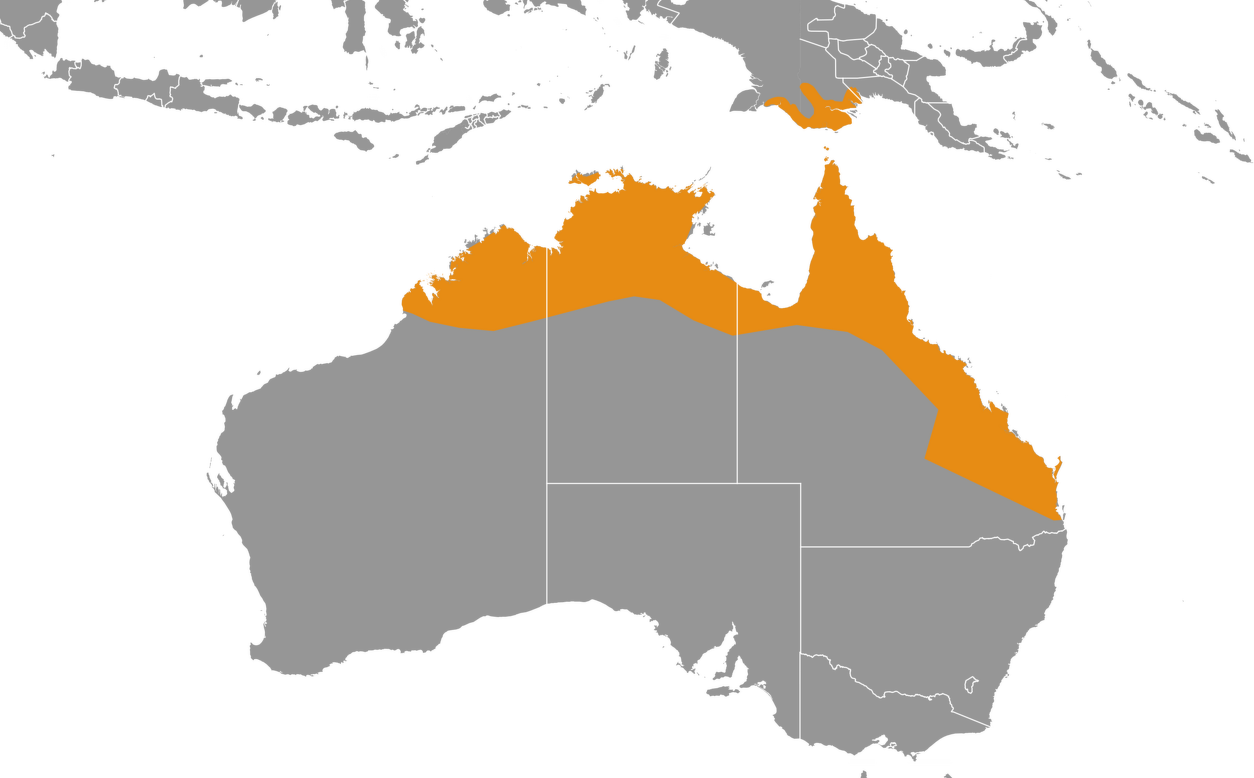
frilled lizard range
In Australia, the range of frilled lizards stretches from the Kimberley region of Western Australia east through the Top End of the Northern Territory to Queensland's Cape York Peninsula and nearby islands of Muralug, Badu, and Moa, and south to Brisbane. In New Guinea, they live in the Trans-Fly ecosystem on both the Papua New Guinean and Indonesian sides of the island. [Source: Wikipedia]
Frilled lizards prefers highly elevated areas with good soil drainage and a greater variety of tree species, mostly Eucalyptus species, and avoids lower plains with mostly Melaleuca and Pandanus trees. Frilled lizards also prefer areas with less vegetation on the ground, as they can then better spot prey from above.
Frilled Lizards Characteristics and Diet
Frilled lizards are Australia's most distinctive and familiar dragon lizard. They are fairly large, reaching a total length of around 90 centimetres (35 inches), with the head and body making up 27 centimeters (11 inches) of that, and weigh at least 600 grams (1.3 pounds). Sexual Dimorphism (differences between males and females) is present: Males are larger and more robust than females. Males have a head body length that reaches 29 centimeters (11.4 inches) and weigh of at least 870 grams (1.9 pounds). Females have a head body length that reaches 23.5 centimeters (9.2 inches) and weigh 400 grams (0.9 pounds). Males also have proportionally bigger frills, heads and jaws.[[Source: Wikipedia; Melissa Savage, Animal Diversity Web (ADW) |=|]
The body of frilled lizards is generally grey, brown, orangish-brown, or black in colour. The frills have red, orange, yellow, or white colours. The tail is obscurely striped with a dark grey tip. The tongue and mouth lining are pink or yellow. The frill, which raises abruptly around its neck when the lizard’s becomes alarmed, is a thin but extensive fold of skin surrounding the throat, which when fully erected may measure almost 30 centimeters (12 inches) across. The frill usually lies like a cape over the shoulders and drops slightly from the bottom of the neck until erected.
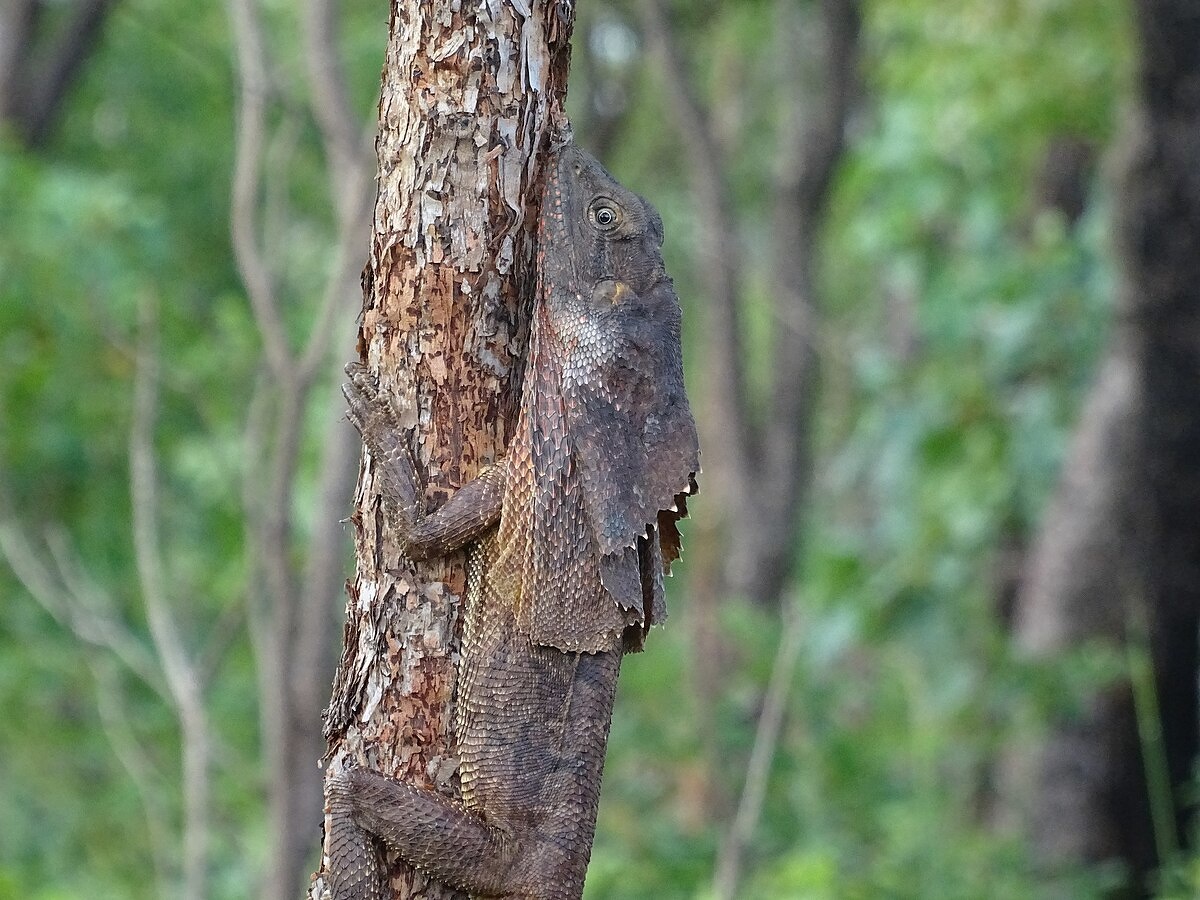
frilled lizard its usual well-camouflaged position on a tree
Frilled lizards have a particularly large and wide head; a long neck to accommodate the frill; long legs and a tail that makes most of its total length. The corners of the frilled lizard's eyes are pointed and the rounded nostrils face away from each other and angle downwards. Most of the lizard's scales are keeled, having a ridge down the centre. From the backbone to the sides, the scales alternate between small and large.
Frilled lizards primarily feed on insects and other invertebrates, and very rarely take vertebrates. Mainly theuy prey on termites, ants and centipedes, with termites being particularly important during the dry season, and moth larvae being important during the wet season. Consumption of ants declines after early dry season fires but increases following fires later in the season. Frilled lizards are mostly a sit-and-wait predator. Typically the look for potential prey on the ground from a tree and, upon seeing it, climb down the tree and rush towards it on two legs before descending on all four to grab and eat it. After feeding, they retreats back up a tree.
Frilled Lizard Behavior
Frilled lizards are diurnal (active during the daytime) and spend 90 percent of their time in trees, mostly resting on tree trunks or low branches. Usually, they only descend to the ground to feed. Frilled lizards experience seasonal changes in regard to diet, growth, habitat use, and activity. They are more active during the wet season, when they spends more time near or on the ground and seek out shorter trees with small diameters. They are less seen during the dry season when they seek out shade and hang out in large trees with canopy perches.
Frilled lizards are well known for running on two legs. They do it while hunting or to escape from predators. To keep balanced, they lean their heads far back enough, so it lines up behind the tail base. When disturbed, they quickly dash to the to the nearest tree, hide beneath low vegetation or go into a "freeze" mode. The main predators of frilled lizards are birds of prey, larger lizards and snakes. If a lizard feels cornered, it usually turns to face its aggressor and launches into the defense mechanism for which frilled lizards are most famous. The lizard erects the frill by opening its brightly colored pink or yellow mouth. This sudden apparent increase in size and bright mouth color is sometimes accompanied by hissing, standing up on its hind legs, and leaping at or chasing the predator. If the "bluffing" doesn't work, the lizard usually runs up the nearest tree. [Source: Melissa Savage, Animal Diversity Web (ADW) |=|]
Frilled lizards spends as little time as possible on the ground, mostly to feed, interact socially, or to travel to a different tree. Males move around more, 69 meters (225 feet) per day on average versus 23 meter (75 feet) for females at Kakadu National Park. In the same area, male lizards were found to have an average home range of 1.96 hectates (4.8 acres) during the dry season and 2.53 hectares (6.3 acres) during the wet season; while females an average home range of 0.63 hectates (1.6 acres) during the dry season and 0.68 hectares (1.7 acres) during the wet season. Male lizards assert their boundaries with frill displays. Frilled lizards use large trees and termite mounds to escape wildfires. After a forest is burnt, they select trees with more continuous canopies. [Source: Wikipedia]
Frilled lizards do not enter torpidity (go into a hibernation-like state) during the dry season, but they can greatly reduce their energy usage and metabolic rate in response to less food and water. Body temperatures can approach 40 °C (104 °F). When basking in the sun to warm, they usually do so on the main trunk of a tree in the morning and near the end of the day, In the dry season they cease basking at a lower body temperature to better maintain energy and water. When it gets hotter during day, they climb higher in the canopy for shade.
Frilled Lizards Mating, Reproduction and Offspring
Frilled lizards are oviparous, meaning that young are hatched from eggs. They breeds in the late dry season and early wet season — from October or November to February or March. Male Frilled lizards are territorial and may use their frills to attract potential mates. Competing males display with gaping mouths and spread frills. Fights can ensue, in which the lizards pounce and bite each other's heads. [Source: Melissa Savage, Animal Diversity Web (ADW) |=|]
Females lay eggs during the wet season, and the eggs incubate for two to four months. Clutch size ranges from 4 to 20, with the average being eight eggs. Nests are located in areas of flat, coarse-grained sandy soil surrounded by sparse grass and leaf litter, with no vegetation directly over the nest, allowing the nest to receive sunlight for most of the day. There are notable differences in frilled lizard clutch sizes between geographic regions.
Females dig a shallow cavity for their eggs. They can lay multiple clutches per season. Milder temperatures produce more males and hotter temperatures produce more females. Hatchlings have proportionally smaller frills than adults. Lizards grow the most during the wet season when food is more abundant, and males grow faster than females. Juvenile males disperse further from their hatching area. Males and females reaches sexual maturity within two years. [Source: Wikipedia]
Frilled Lizards, Humans and Conservation
Frilled lizards are not endangered or threatened. They are designated as a species of least concern on the International Union for Conservation of Nature (IUCN) Red List and have no special status on the Convention on International Trade in Endangered Species (CITES). Frilled lizard are reasonably abundant over a wide range, but population may be declining locally in some areas. [Source: Melissa Savage, Animal Diversity Web (ADW) |=|]
Frilled lizards are are popular species in the pet trade even though do not survive well in captivity and they seldom display their frill when captive. Most pet lizards appear to come from breeders or from lizards from Indonesia, as exporting them is banned in Australia and Papua New Guinea. Frilled lizard are difficult to breed in captivity and thus it may be presumed many lizards passed off as captive bred lizards are likely to have been taken from the wild. Frilled lizards may also be threatened by feral cats, but they they do not appear to be significantly affected by the invasive cane toads. Frilled lizards are protected species in Indonesia.
Frilled lizard up there with kangaroos and koalas as symbols and icons of Australia. Archaeological evidence indicates that frilled lizards were eaten by some indigenous peoples in ancient times. They experienced widespread fame in Japan during the early 1980s and almost They have been featured in a popular automobile commercial on television and were on an Australian two-cent coin, which was sold for a dollar a piece in Japan while the frilled lizard was popular there.
Because of its unique appearance and behaviour, the creature has often been used in media. In Steven Spielberg's 1993 film Jurassic Park, the dinosaur Dilophosaurus was portrayed with a similar neck frill that rose when attacking.[15] Its image has been used in the 1994 LGBT-themed film The Adventures of Priscilla, Queen of the Desert.
Image Sources: Wikimedia Commons
Text Sources: Animal Diversity Web animaldiversity.org , National Geographic, Live Science, Natural History magazine, Australian Museum, David Attenborough books, Australia Geographic, New York Times, Washington Post, Los Angeles Times, Smithsonian magazine, Discover magazine, The Conversation, The New Yorker, Time, BBC, CNN, Reuters, Associated Press, AFP, Lonely Planet Guides, Wikipedia, The Guardian, Top Secret Animal Attack Files website and various books and other publications.
Last updated August 2025