
Home | Category: Birds, Crocodiles, Snakes and Reptiles
BLUE-TONGUED SKINKS
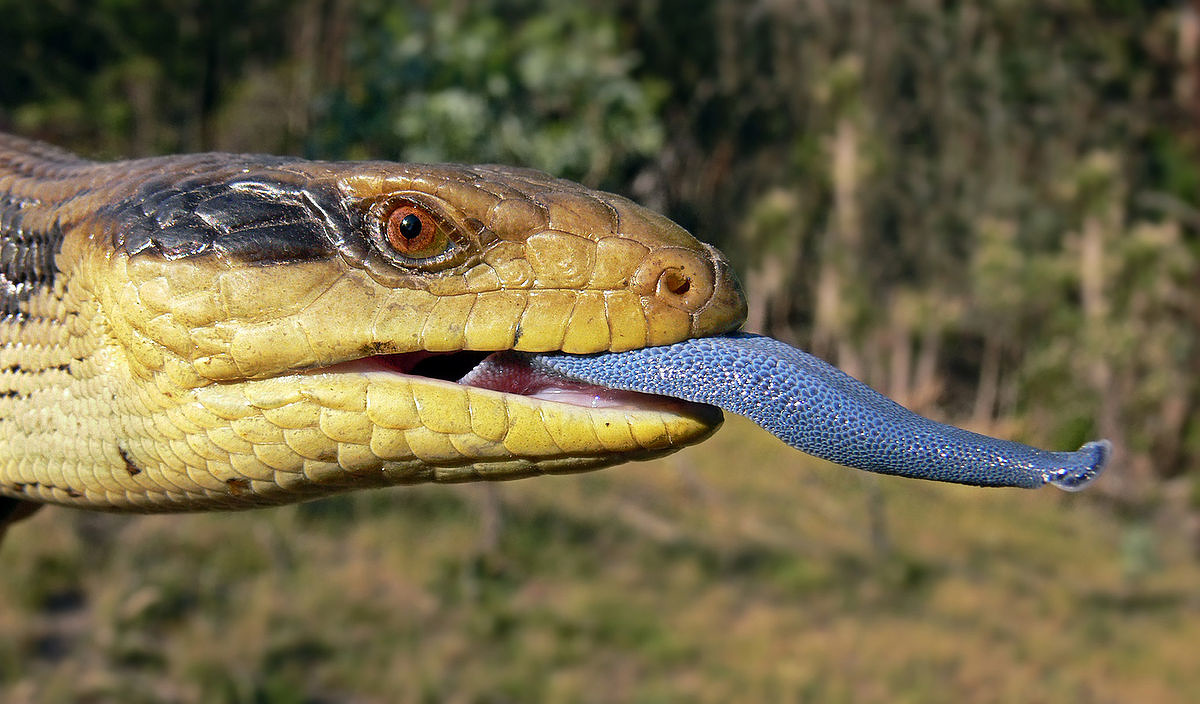
tongue of the blue-tongued skink (Tiliqua scincoides)
Blue-tongued skinks (Tiliqua scincoides) are also called blue-tongued lizards, common blue-tongued skinks, blue-tongued lizards and common bluetongues. They use their vibrant blue tongues to startle predators, according to the San Diego Zoo. When threatened, they puffs up their body so that they appears larger, opens their mouth and hisses while sticking out their tongue. There are three subspecies: 1) eastern blue-tongued skinks ( Tiliqua scincoides scincoides) in southern and eastern Australia; 2) northern blue-tongued skinks (Tiliqua scincoides intermedia) in northern Australia; and 3) Tanimbar blue-tongued skink (Tiliqua scincoides chimaera) in Maluku Province, Indonesia. [Source: Wikipedia]
Blue-tongued skinks live in savannas, grasslands and scrub forests (in areas with an extended dry season). Scott Dutfield wrote in How It Works magazine: Found roaming through tussock grass and forest leaf litter, at around 24 inches (60 cm) long, this lengthy lizard is famous for sticking out its blue tongue.The front of the tongue reflects ultraviolet (UV) light, according to San Diego Wildlife Alliance. This suggests that common predators of the skink, such as bird species that can see UV rays, will be dazed by a flash of UV and think twice about attacking them. [Source: Scott Dutfield, How It Works magazine, May 19, 2021]
Blue-tongued skinks have an average weight of 493 grams (17.4 ounces) and an average length of 33 centimeters (13 inches). Their average basal metabolic rate is 0.2127 watts. Sexual Dimorphism (differences between males and females) is not present: Both sexes are roughly equal in size and look similar. Blue-tongued skinks have relatively smooth skin, covered by overlapping scales with a fish-like appearance. They have grayish undersides. Their head is pale brown and their back has alternating streaks or blotches of dark brown and cream. Juveniles a wider variety of coloration which serves as camouflage. The body is robust and cylindrical with relatively short legs. The massive tongue is supported by the hyoid skeleton, which is true of most reptiles. The tip of the tongue is supported by one rod of the hyoid skeleton — the lingual process. Blue-tongued skinks move with a waddling motion because of their short legs. The average lifespan for females in captivity is 9.0 years. They can live up to 14.3 years. [Source: Don Abbey, Animal Diversity Web (ADW) |=|]
Blue-tongued skinks are not endangered or threatened. They are designated as a species of least concern on the International Union for Conservation of Nature (IUCN) Red List. They are sometimes kept as pets. Skinks in general make good pets because they are docile, easily tamable and relatively easy to take care of. Australia prohibits commercial export of most wildlife (including lizards), and this means that the pet trade stock is either captive-bred or illegally smuggled out of Australia. Some Aboriginal groups say that their tongues became "bruised" after falling headfirst onto a rock. |=|
RELATED ARTICLES:
LIZARDS IN AUSTRALIA: TYPES, SPECIES, CHARACTERISTICS, BEHAVIOR ioa.factsanddetails.com
THORNY DEVILS: CHARACTERISTICS, BEHAVIOR AND REPRODUCTION ioa.factsanddetails.com
FRILLED LIZARDS: CHARACTERISTICS, BEHAVIOR AND REPRODUCTION ioa.factsanddetails.com
GOANNAS (MONITOR LIZARDS) factsanddetails.com
GOANNAS (MONITOR LIZARD) SPECIES OF AUSTRALIA ioa.factsanddetails.com
BIGGEST AND MOST COMMON MONITOR LIZARDS: ASIAN WATER AND BENGAL MONITORS factsanddetails.com
KOMODO DRAGONS: CHARACTERISTICS, HABITAT, SENSES, MOVEMENT factsanddetails.com
REPTILES: TAXONOMY, CHARACTERISTICS, THREATENED STATUS factsanddetails.com
LIZARDS: CHARACTERISTICS, SENSES, ODDITIES factsanddetails.com
CROCODILES IN AUSTRALIA: HISTORY, SPECIES, BIG ONES, DWARVES, BATS, SHARKS ioa.factsanddetails.com
Blue-Tongued Skinks Diet, Behavior and Reproduction
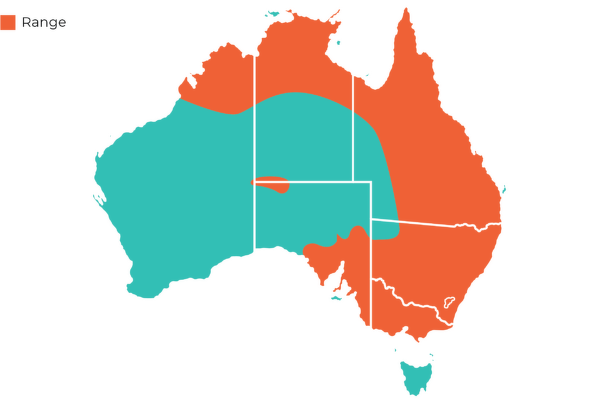
ranges of 1) eastern blue-tongued skinks ( Tiliqua scincoides scincoides) in southern and eastern Australia; and 2) northern blue-tongued skinks (Tiliqua scincoides intermedia) in northern Australia;
Blue-tongued skinks are omnivores (eat a variety of things, including plants and animals).They feed on small creatures such as insects, other reptiles, as well as some plant material and fruits. Captive one, studies show, do best with high quality dog food, which contains added vitamins and minerals, and adapt well to vegetables such as collard greens, turnips, and dandelions. Blue-Tongued Skinks feed during the day and regarded as diurnal (active during the daytime). [Source: Don Abbey, Animal Diversity Web (ADW) |=|]
Blue-tongued skinks tend to very docile creatures and rarely show aggression. They are shy and secretive and seldom go far from their shelters in hollow logs and ground debris. They use claws to cling to logs and rocks. When they are disturbed, and go into defensive mode, they open their mouth, sticks out their bright blue tongue, puffs up their body and hiss loudly. Buffing up their body makes them look bigger than they really are. The blue tongue may be a warning that lizard may taste bad. Some scientists believe that blue-tongued skinks mimic poisonous Death Adders which share some of the skink's range. The two animals have similar coloration and short legs of of blue-tongued skinks help them look like snake. Blue-tongued skinks also have the ability to automize or lose their tail during a confrontation — a trait possessed by most skinks.
Blue-tongued skinks are ovoviviparous. This means that offspring develop in eggs which are not laid but stay in female’s body for further development. The female lay or seemingly “give birth” live young. This prevents eggs from being taken by predators. The number of offspring of blue-tongued skinks ranges about 10-15, the average number being 10.
Blotched Blue-Tongued Lizards
Blotched blue-tongued lizards (Tiliqua nigrolutea) are also known as blotched bluetongues, southern blue-tongued lizards and blotched blue-tongued skinks. Endemic to southeastern Australia, this species is a relatively large member of the skink family (Scincidae) with a robust body and relatively short limbs. There are several species of blue-tongued lizards in Australia. Blotched blue-tongued lizards is restricted to the highland areas between the Victorian border and the Blue Mountains. Their average lifespan in captivity is 11.5 years.[Source: Joyce Liu, Animal Diversity Web (ADW) |=|]
Blotched blue-tongued lizards live mostly in the southern parts New South Wales and a little bit in neighboring South Australia as well as on Tasmania and the islands of the Bass Strait These reptiles like open country with lots of ground cover such as leaf litter and shrubs. At night, they find shelter under leaf litter, rocks and logs. However, Blotched blue-tongued lizards are often live in suburbs and urban areas are often seen in yardsm gardens and parks. Because they cannot produce their own body heat, these skinks live in areas where they can bathe in sunlight during periods of the day in the summer. They need to maintain a body temperature of 30-35̊C (86-95̊) when active.
Blotched blue-tongued lizards range in weight from 300 to 450 grams (10.6 to 15.9 ounces). Their common name refers to the entire body not their tongue, which is all blue. These lizards are usually dark brown or black with yellow, cream or pink blotches on it. Although blue-tongues are skinks they differ from most skinks in that they have an unusual body shape with a stout torso, short limbs and a thick, short tail, plus they rarely lose their tails. Sexual Dimorphism (differences between males and females) is present: Males have proportionally bigger head and a more heavyset body. This is due to the shape of their two hemipenes (male sex organs). Females are longer in length — 27-30 centimeters (10.6-11.8 inches) to the males' 25-27 centimeters (to 9.8-10.6 inches). Females weigh between 350 and 450 grams (10.6 and 15.9 ounces) and males weigh 300 and 350 grams (12.3 and 10.6 ounces)
Blotched blue-tongued lizards are not endangered or threatened. On the International Union for Conservation of Nature (IUCN) Red List they are a species of least concern. A related species — Adelaide pygmy blue-tongue skinks (Tiliqua adelaidensis) are considered Endangered. Rather than being hemmed in by human activity in New South Wales, where the lizards live and Sydney is located, blotched blue-tongued lizards have adapted. Some reside in backyards for many years. They bathe in the sun on the lawns and paths and cool off in rock piles, pipes and cavities under houses. There are hazards, though. Blue-tongues that live in the suburbs often eat snails and insects carrying human-applied insecticides. The poison sometimes kills the lizard. Another danger for suburban-dwelling lizards is lawn mowers.
Blotched Blue-Tongued Lizard Diet, Behavior and Reproduction
Although blotched blue-tongued lizards are common in Australia they are not often seen. They are very secretive and most often observed bathing in the sun to keep warm. To keep from getting too warm they shuttle back and forth between shady places and open areas. As a defense, they use their trademark tongue. As a warning or display, these skinks opens their mouthes wide and hisss. Often this is enough to scare predator away. If it doesn’t work, the lizards’ flatten their ribcage and turn onto their side so they appear larger than they are.
Blue tongues are omnivores (animals that eat a variety of things, including plants and animals). They are not particularly fast or agile so they mostly eat plant material that is easy to access and slow-moving animals such as snails and beetles. In suburban areas, they eat snails, slugs and caterpillars, which are plentiful in backyard gardens. Their strong jaws can crush the shells of snails. They fancy garden strawberries very much. In captivity, they are fed catfood and soft fruits such as bananas and kiwifruit.
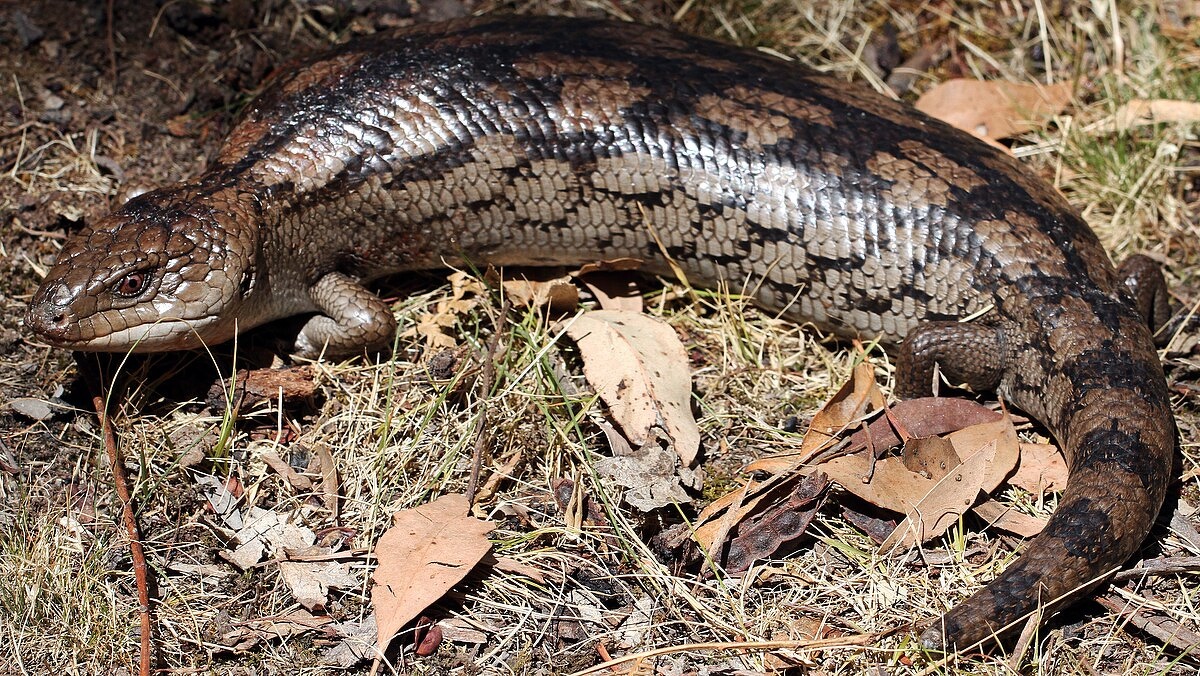
Blotched blue-tongued lizard
Blotched blue-tongued lizards are solitary except during mating season. Males and females emerge from hibernation at different times. The males come out in late September while the females come out in late October. Mating occurs soon after in the months of November and December. Studies done at the University of Tasmania show that males begin to produce their sperm as early as the previous fall so that only the final stages of sperm production occur in the spring. It is at this time that males fight aggressively among themselves. Furthermore the actual coital process can be very rough and violent. Afterwards, females often bear scrape marks and scars from the male's biting and grabbing.
According to Animal Diversity Web : After impregnation, embryos develop in their mother's oviduct with the help of an exceptionally well-developed placenta. The placenta contains a large yolky egg which supplies the nutrition for the developing young. The clutch size is generally around six. Earlier studies that put the clutch size at 25 have been dismissed because the strain would have been too much on the mother. At birth, the newborns eat the placental membrane. Within a few days, they shed their skin for the first time. Subsequently, the young are on their own and disperse soon after. There is virtually no parental care. Even though they are now fully independent, they will not be sexually mature for four to five years. Because of the great toll on female lizards during their pregnancy, they are likely to only reproduce every other year. Males are reproductively active every year. |=|
Shingleback Lizards
Shingleback lizards (Tiliqua rugosa) are also known as shingle-backs, stumpy tail lizards, pinecone lizards, sleepy lizards, shingleback skink, bobtail lizards, and bobtails. They are a type of blue-tongued skink. Unlike most lizards that mate, give birth and abandon their young, these lizards practices monogamy. Shingleback lizard have an average life span of about 10 to 15 years, although one captive individual in England named Stumpy lived to an amazing 35 years old!
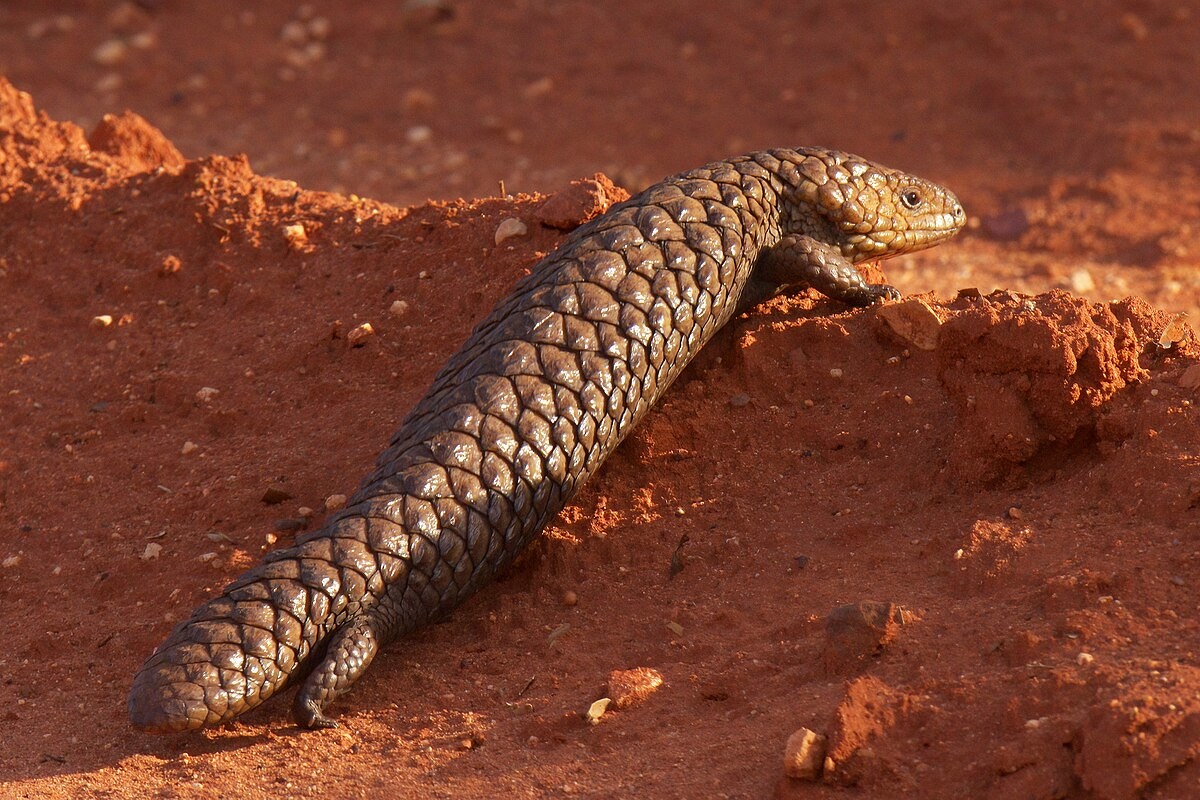
Western shingleback lizard
Shingleback lizards are one of the more abundant reptiles in Australia. They range throughout the drier parts of Southern Australia, from approximately Bathurst in New South Wales all the way to the coast of Western Australia. Shingleback lizards inhabit semiarid plains and woodlands that typically have a harsh, dry summer and fall, followed by a cool winter and spring with increased precipitation and resources. These areas are subject to a great deal of variability in precipitation and often experience droughts. [Source: Thomas Loch, Animal Diversity Web (ADW) |=|]
Shingleback lizards are not endangered or threatened. They are designated as a species of least concern on the International Union for Conservation of Nature (IUCN) Red List. They look as if they have been run over. Nonetheless they are popular in the pet trade in some places. They and other protected reptiles have been air mailed from Australia to Japan where they sell on the black market for up to $5,000. Aboriginals traditionally ate them food and some southern tribes of Australia used them for medicine.Shingleback lizards do not suffer from many serious predation threats. Many are killed by vehicles.
Shingleback Lizard Characteristics and Subspecies
Shingleback lizards are among the largest of the Australian skinks. They range in weight from 600 to 900 grams (1.3 to 2 pounds) and have a snout-vent lengths (SVLs) of 41 to 46 centimeters (16 to 18 inches). They have a short, blunt tail that is about one quarter of their SVL. The tail looks a lot like the head and may viewed as such by a potential predator. The scales of the body and tail are very large in size, and have a rough, knobby appearance, making this creature greatly resemble a pine cone — the source of one of their common names. Head scales are fragmented and irregular, making them difficult to count and compare to other reptiles. Shingleback lizards are heterothermic (having a body temperature that fluctuates with the surrounding environment). [Source: Thomas Loch, Animal Diversity Web (ADW) |=|]|
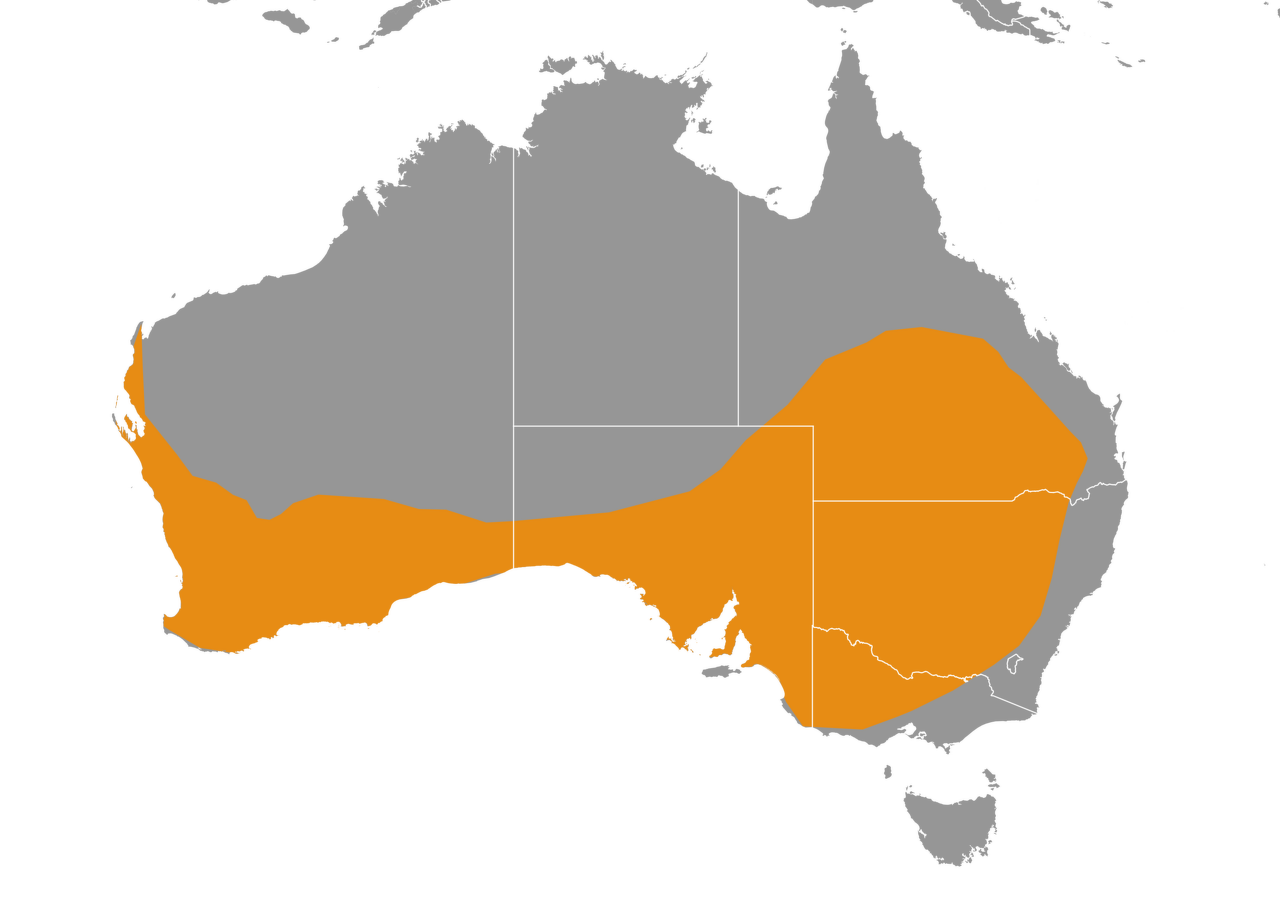
Shingleback lizard range
The tongue of Shingleback lizards is cobalt blue in color, and is used extensively as a sensory organ, in conjunction with their Jacobson's organ (an organ used for chemoreception found in many reptiles). The dentation of this species is acrodont, meaning that the teeth are set on the edges of the jaw bones and are not in grooved sockets . The legs of shingleback lizard are relatively short and stubby. The hind limbs are approximately twenty percent of the SVL. The toes are short and fat. Ear-openings are conspicuous and without anterior lobules. Nales have a more slender, slightly longer tail than females, although this is by no means a sure way to sex this species. A better way of sexing is by cloacal examination (male hemipenes can be everted with pressure). Shingleback lizards molt their skin about four or five times a year. |=|
Four subspecies of Shingleback lizard are currently recognized:
1) Eastern shingleback lizards (Tiliqua rugosa asper) live in eastern Australia (New South Wales, Queensland, South Australia and Victoria). They have the shortest, widest tail, with a very fragmented scalation pattern and are usually solid brown with no pattern at all.
2) Bobtails or western shingleback lizards (T. rugosa rugosa) are found in Western Australia. They have a moderately long, slender tail and are brownish-red in color with yellow spots or white bands;
3) Rottnest Island bobtails or Rottnest Island shingleback lizards (T. rugosa konowi) reside on Rottnest Island, Western Australia. They are small and dark, with gray coloration and numerous tiny, white specks on the belly and back.
4) Northern bobtails or Shark Bay shingleback lizards (T. rugosa palarra) occur in Shark Bay, Western Australia.
Shingleback Lizard Behavior and Diet
Shingleback lizards are omnivores (eat a variety of things, including plants and animals) and are regarded as opportunistic feeders. They mainly feed on vegetable matter, such as herbs and seedlings, and also blossoms and fruits if they are available. Other foods include animal matter like insects and other arthropods, snails, carrion, as well as anything edible that they come across Shingleback lizards are good at overcoming droughts. They eat a lot during the spring months after the winter rains but there is less to eat in the summer and fall months. Fat stored in their tails helps see them through lean times in addition to their opportunistic feeding habits but their inclination to go into roads to consume road kill carrion often makes them road kill carrion themselves.[Source: Thomas Loch, Animal Diversity Web (ADW) |=|]
Shingleback lizards are colonial (live together in groups or in close proximity to each other) in the wild, and therefore are not aggressive towards one another. They are usually sedentary (remain in the same area), but do move about sometimes, although usually returning to the same home range. Home ranges of individuals (undefended areas of inhabitance) are about 200 meters in diameter but do not usually have any particular shape; they tend to overlap with home ranges of other shingleback lizards.
Shingleback lizards begin their daily routine with a warming period in the morning, followed by active feeding and continued basking, then finding shelter under litter, logs, or debris as the temperature falls towards the end of day. When they are threatened, shingleback lizards do into blufee mod: they open their large mouths real wide and stick out their large blue tongue, while hissing aggressively. They usually face the threat and do bite of the threat gets too close. Bites can be quite painful due to their strong jaws and fairly sharp teeth. |=|
Shingleback Lizard Monogamy and Reproduction
Most male lizards leave their mates after mating is over and never see them again or their offspring. Many female lizards lay their eggs and leave and never see their offspring either unless by chance. Shingleback lizards in contrast practices monogamy on a scale unheard of in the reptile kingdom. Scientist at the University of Adelaide discovered that more than 80 percent of shingleback lizards remain with their mate for two breeding season or more and some have stayed together for at least ten years. Shingleback females can discriminate their offspring from other shingleback lizards — another unusual trait for a lizard. Most lizards can not distinguish their young from the young of other lizards.
Copulation is usually observed around late October or early November and is typically over with very quickly. An 11 year study of shingleback lizards conducted from 1981 to 1992 showed that males typically stayed with one female and vice versa over extended periods of time. After copulation, pairs usually separate for 10 months and then pair again with the same partner the following year. Although the chance of pairs remaining together decreases with an increasing amount of years — partly due to death of partners. [Source: Thomas Loch, Animal Diversity Web (ADW) |=|]
Shingleback lizards are viviparous, meaning they give birth to live young that developed in the body of the mother. Females typically produce one or two young, occasionally three. A type of placenta very much like that of primitive mammals is formed between the mother and young. This permits the exchange of food and waste between the mother and the developing embryos Young are produced in late March or early April of each year after an approximately five month gestation period. Young lizards weigh about 60 to 140 grams at birth. The small litter size and large size of individuals is believed to reduce risk of predation and aid in the potential survival through the oncoming winter months.
Image Sources: Wikimedia Commons
Text Sources: Animal Diversity Web animaldiversity.org , National Geographic, Live Science, Natural History magazine, Australian Museum, David Attenborough books, Australia Geographic, New York Times, Washington Post, Los Angeles Times, Smithsonian magazine, Discover magazine, The Conversation, The New Yorker, Time, BBC, CNN, Reuters, Associated Press, AFP, Lonely Planet Guides, Wikipedia, The Guardian, Top Secret Animal Attack Files website and various books and other publications.
Last updated August 2025