
Home | Category: Birds, Crocodiles, Snakes and Reptiles
THORNY DEVILS
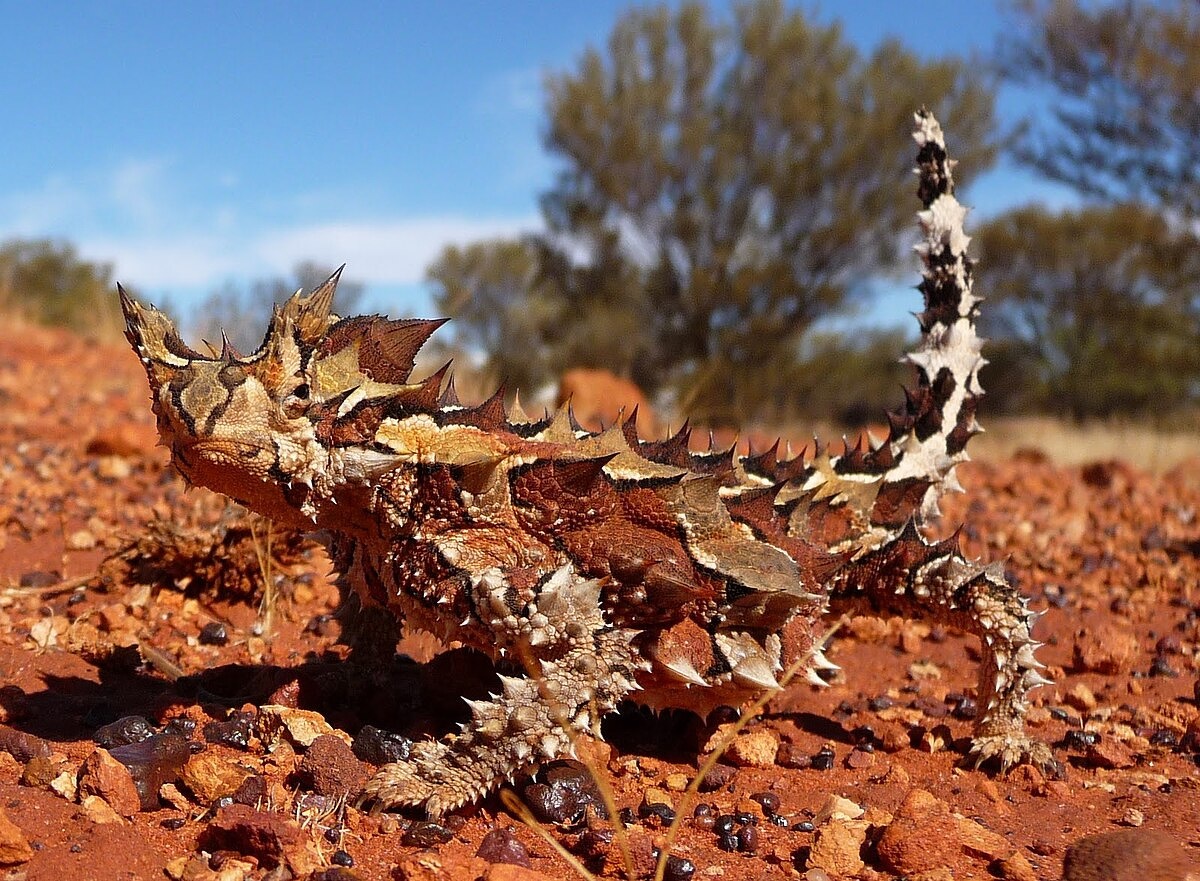
thorny devil
Thorny devils (Moloch horridus) are also known as mountain devils, thorny lizards, thorny dragons, and molochs. Members of the family Agamidae, they are found only in Australia and are the only species in the genus Moloch. They grow up to 21 centimeters (8.3 inches) in total length (including tail)., with females generally larger than males. Their scientific name is derived from the terrible Canaanite god Moloch and horridus, meaning thorny or dreadful.
Thorny devils live in Australia’s hot, dry interior. Their spiny, armored exterior isn’t just for self-defense. It also helps the reptile capture moisture from condensation on its body. Thorny devils are slow moving and eats only ants. When alarmed they tuck their heads between their legs and off offers the thorny lump on their neck (a false head) to predators. Tiny channels in their necks direct rain and dew into their mouth.
Thorny devils are found in the Great Sandy Desert interior of Australia.They are found in sand plain and sand ridge deserts and in mallee scrub (low-growing bushy Australian eucalyptus which have several slender stems). They are found only in places with sandy or sandy loam soils, not rocky or hard soils. Vegetation in these habitats is often dominated spinifex grasses (Triodea) and acacia scrub ("mulga"). Molecular research suggests that despite their extreme morphological difference between thorny devils and other agamid lizards, thorny devils are relatively recently derived from the rest of the Australian, arid-adapted agamids. Thorny devils have a lifespan of six to 20 years in the wild. [Source: Tanya Dewey, Animal Diversity Web (ADW) |=|]
Thorny devils are not endangered or threatened. They are designated as a species of least concern on the International Union for Conservation of Nature (IUCN) Red List. They do not suffer from habitat loss and degradation so much because humans generally steer clear of the harsh environment these lizards live in. They are popular in zoos because of they look really weird and have been studied because of their unique adaptation to specialized diets in a harsh landscape. |=|
RELATED ARTICLES:
LIZARDS IN AUSTRALIA: TYPES, SPECIES, CHARACTERISTICS, BEHAVIOR ioa.factsanddetails.com
FRILLED LIZARDS: CHARACTERISTICS, BEHAVIOR AND REPRODUCTION ioa.factsanddetails.com
SHINGLEBACK AND BLUE-TONGUED LIZARDS: CHARACTERISTICS, BEHAVIOR, REPRODUCTION ioa.factsanddetails.com
GOANNAS (MONITOR LIZARDS) factsanddetails.com
GOANNAS (MONITOR LIZARD) SPECIES OF AUSTRALIA ioa.factsanddetails.com
BIGGEST AND MOST COMMON MONITOR LIZARDS: ASIAN WATER AND BENGAL MONITORS factsanddetails.com
KOMODO DRAGONS: CHARACTERISTICS, HABITAT, SENSES, MOVEMENT factsanddetails.com
REPTILES: TAXONOMY, CHARACTERISTICS, THREATENED STATUS factsanddetails.com
LIZARDS: CHARACTERISTICS, SENSES, ODDITIES factsanddetails.com
CROCODILES IN AUSTRALIA: HISTORY, SPECIES, BIG ONES, DWARVES, BATS, SHARKS ioa.factsanddetails.com
Thorny Devil Characteristics
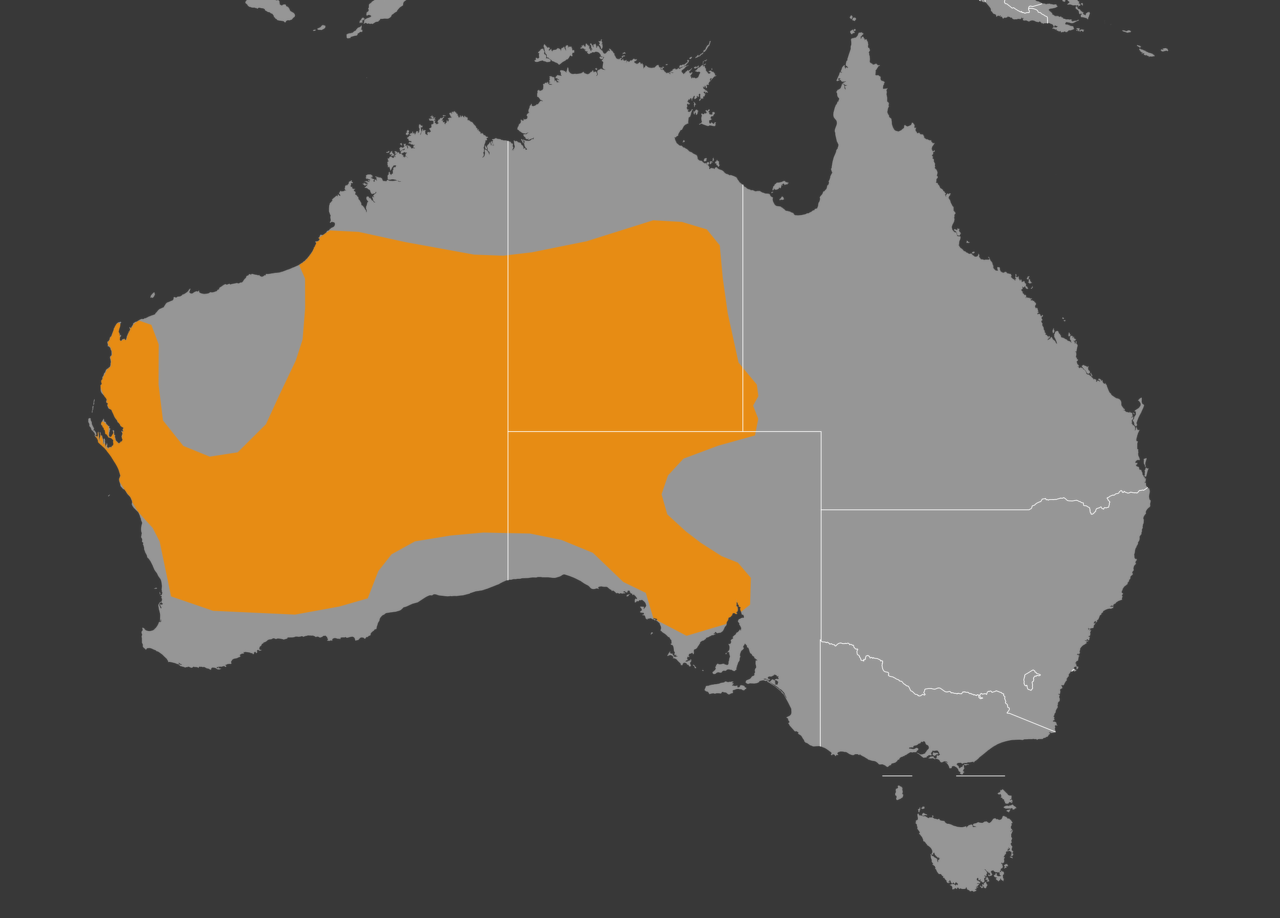
range of thorny devil
Thorny devils are about the size of horned toads found in deserts of the American southwest. They range in weight from 28.5 to 57 grams (one to two ounces) and have a head and body length of 7.6 to 11 centimeters (3to 4.3 inches). Their tail is about as long as their body and head and their total length (including tail) can be up to 21 centimeters (8.3 inches). Thorny devils are heterothermic (having a body temperature that fluctuates with the surrounding environment).
Sexual Dimorphism (differences between males and females) is present: Females are larger than males, averaging 45.5 grams (1.6 ounces) in weight and having an average head and body length of 9.1 centimeters (3.6 inches). Males average 31.2 grams (1.1 ounces) and have a head and body length of 7.9 centimeters (3.1 inches). Body weight changes significantly throughout the year, rising and falling up to 30 percent in a few months. Egg-production by females can result in substantial weight loss, which can be regained quickly. One female gained 40 percent of her body mass in a little over a month. [Source:Tanya Dewey, Animal Diversity Web (ADW) |=|]
Thorny devils are well-known for the many, large spines on their bodies. Tanya Dewey wrote in Animal Diversity Web: Their large spines are entirely boneless, only two parietal spines are supported by modest bony bosses on the skull. Their bodies are covered with thick shields and spiny cones and they are marked with golden and brown patches that serve to camouflage them in their arid habitats. They are extremely difficult to find because of their camouflage and escape detection even at close quarters. The head is ornamented with a large, spiny boss on the back and the eyes are small. Even the ventral surface is covered in conical, non-overlapping scales. It was long assumed that the spiny armor of thorny devils was exclusively a defensive trait, protecting them from predators. However, the complicated surface texture of thorny devils also helps them to retain and absorb water through body contact, especially condensation of water on body surfaces. Thorny devil skin color varies with temperature; individuals are brown or olive in the mornings and become light yellow as temperatures rise in the afternoon. Observations suggest thorny devils use postural changes to regulate body temperature, either maximizing contact with a warm surface (the ground) or minimizing it via standing with two feet against a shrub.

absorption and distribution of water through the scales and skin of the thorny devil lizard from the area around it to the mouth for ingestion
Thorny devils have been compared with North American horned lizards. The two species are examples of convergent evolution. Both are highly armored, slow-moving, thermally labile, and specialized in eating ants even though they evolved in totally different places. Unlike most Australian agamid lizardss, thorny devils have no femoral pores on their the undersides of their thighs and lack a supratemporal bone on the side of their skulls, which is characteristic of many reptiles species. There are 21 presacral vertebrae and 22 postsacral vertebrae. Thorny devils have short digits and vary in the number of phalangeal bones, with a reduced formula throughout most of their range. The primitive agamid phalangeal formula is found in portions of the range.
Thorny devil teeth hav adaptions for their ant specialist diet. Ants are relatively hard-bodied insects, with high levels of chitin. The mandibular teeth of thorny devils are modified to fit neatly between two maxillary (upper jaw bone) teeth, creating a shearing apparatus. Thorny devils have also lost the anterior pleurodont teeth, reflecting their use of the tongue to capture prey, rather than the teeth. |=|
Thorny Devil Ant Diet, Water and Feeding Behavior
Thorny devils are obligate myrmecophages, which means they eat only ants. They primarily eat ants of the genera Iridomyrmex (especially Iridiomyrmex rufoniger) and Crematogaster. Other ants recorded in their diet include Ectatomma, Monomorium, Camponotus, Pheidole, and Polyrhachis species. Thorny devils are "sit-and-wait" predators, finding a feeding site near cover and waiting for their ant prey to pass, and capturing them with their sticky tongue. Iridomyrmex species are eaten as they pass in terrestrial trails and Crematogaster species are eaten mainly from their trails on currant bushes (Leptomeria preissiana). Thorny devils select feedings sites near Triodia tussocks or Thryptomeme or Leptomeria shrubs. [Source: Tanya Dewey, Animal Diversity Web (ADW) |=|]
Thorny devils only actively feed at temperatures above 24̊̊C (̊75F). In some areas they have been observed only feeding in the morning (before 11:00am) or in the late afternoon (3:00pm to 6:00pm), but not from 11:00am to 3:00pm. Because ants are mostly chitin and formic acid and are relatively low in nutrition, value, large amounts of them have to be consumed.

shy thorny devil found east of Geraldton that clearly didn't want his photo taken
Thorny devils have large stomachs to accommodate consuming large numbers of ant prey. It has been estimated that they eat 750 ants daily. Feeding rates averaged 2.9 ants per minute, but rates up to one ant per second have been recorded. Research suggests that thorny devils assimilate about 59 percent of the metabolizable energy in their ant prey. This compares to an assimilation rate of about 70 percent for generalized insect diets. Their fecal pellets are distinctive: oval, black, and glossy, they easily crumble to reveal many ant exoskeletons.
Thorny devils live in extremely arid regions and water condensation onto their bodies is often the most reliable and abundant form of water available to them. They use their complicated surface textures to direct water to their mouths for drinking. The base of each spine is surrounded by a deep interscalar groove that effectively collects water and these grooves interconnect to enable capillary movement of water along the body, even against the pull of gravity, as on the legs. These grooves continue onto the head and empty into the angle of the mouth for drinking.
Thorny Devil Behavior
Thorny devils are terricolous (live on the ground), diurnal (active during the daytime), nomadic (move from place to place, generally within a well-defined range), sedentary (remain in the same area), hibernate (enter a state during the winter in which normal physiological processes are significantly reduced, thus lowering the animal's energy requirements) and employ aestivation (prolonged torpor or dormancy such as hibernation) and solitary. They sense using vision, touch and vibrations. Some research suggested that thorny devils may use landmarks to navigate visually.
The home ranges of thorny devils are variable. Tracked individuals have been recorded remaining both within a very limited area for long periods and wandering widely. Some individuals were found within 100 meters of an originally recorded location for three years. They are not territorial (defend an area within the home range) and do not seem to have exclusive home ranges, as tracked individuals overlapped widely in their use of areas. Average daily movement was estimated at 77.9 meters in one study, but some individuals moved more than 500 meters. Males may move more than females, on average. [Source: Tanya Dewey, Animal Diversity Web (ADW) |=|]
Thorny devils can remain active at a wide range of body temperatures. The Average body temperature in one study was 28.3̊C (83̊F). . Thorny devils are active most in the fall (March through May) and in the late winter through early summer (August through December). They become almost completely inactive during the hottest (January to February) and coldest parts (June and July) months of the year, taking refuge in burrows that they dig themselves.
Thorny devils are deliberate in their movements and walk with a characteristic slow, rocking gait. Movement patterns have been described as "semi-nomadic" as they adapt to changing patterns of ant availability, but their movement occurs within a relatively small area. During the summer and fall thorny devils are relatively sedentary. Areas they occupy contain several shrubs, ant trails, and a defecation site. Individuals emerge from their shrub cover in the morning, warm themselves on the sand, walk to the defecation site, containing piles of their distinctive fecal pellets, and then return to their shrub cover along the same route, sometimes stopping to eat ants along the way. In August and September thorny devils range widely, possibly in search of of mates. Thorny devils take shelter in small burrows, larger enough to fit a single individual at up to 10 centimeters below the surface and approximately 5-x-5-x-12 centimeters (2-x-2-x-5 inches) in area.
Thorny Devil Predators and Ecological Roles
Thorny devils are solitary and specialize in eating ants. They protects themselves with their spiny scales, changing their coloration to match their background and walking slowly and jerkily. They sometimes freeze in place and hold their tails erect which makes them look like a desert plant. When threatened these lizard puffs up and bends their head down between their legs, exposing the peculiar hump or “false head” on the back of their neck, instead of their real head. [Source: Natural History magazine, July, August 2006]
Despite being well-protected with their extensively armored bodies and camouflaged coloration, tThorny devils are preyed on by Australian bustards, black-breasted buzzards and goannas and possibly dingoes and and red foxes. When they tuck their false head between their forelegs and present the "false head" they are difficult to swallow. Their cryptic coloration and elaborate spiny decoration make thorny lizards difficult to see, especially when they remain motionless. They freeze when approached by a threat, often in mid-step.
Thorny devils are ant-specialists and impact ant populations in the regions they inhabit. They co-occur with other insectivorous agamid lizards that eat mainly insects, including military dragons and central netted dragons. Thorny devils are usually heavily parasitized by nematode worms (Parapharyngodon kartana and Abbreviata species). These worms may use ants or termites as intermediate hosts to get to their lizard definitive hosts. A new species of tapeworm (Oochoristica piankai) was described from the guts of thorny devils.
Thorny Devil Mating, Reproduction and Offspring
Thorny devils are oviparous, meaning that young are hatched from eggs. They engage in seasonal breeding — once a year, usually mating and laying eggs mainly in the late winter through early summer (August to December). Mating has also been observed in the fall, suggesting there may be a mechanism for sperm storage. The egg incubation period ranges from 90 to 132 days, with the average being 118 days. The number of offspring ranges from three to 10. Females have fat stores that vary seasonally, with lower fat body reserves in summer and higher reserves in the winter. The timing is related to egg-laying when they must mobilize fat reserves to supply eggs with nutrients. Three observed females lost about 40 percent of their body weight during the egg-laying period. [Source: Tanya Dewey, Animal Diversity Web (ADW) |=|]
Anecdotal evidence, as well as their wide-ranging habits during the mating season, suggests that thorny devils may travel relatively long distances to converge at landmarks for mating. Observations suggest that males approach females, bob their heads, and mount the female if she seems receptive. Females fall and roll to throw off males if they are unreceptive.
Females lay eggs in burrows up to 15 centimeters (six inches) long at depths up to 22 centimeters (9 inches) below the surface. These burrows are different from their normal burrows and are often dug into southern facing sand ridges. After laying their eggs, females fill in the oviposition burrows and smooth out the surface to cover evidence of their activity. Hatchlings weigh 1.8 grams on average and eat their own egg casing before climbing out of the ovipostion nest.
After the eggs are layed and buried there is little or parental involvement is the raising of offspring by either males or females. Male and female thorny devils hatch out of eggs at approximately the same size and grow at similar rates for their first year. Females begin to grow faster after that and growth continues until they reach five years old.
Image Sources: Wikimedia Commons
Text Sources: Animal Diversity Web animaldiversity.org , National Geographic, Live Science, Natural History magazine, Australian Museum, David Attenborough books, Australia Geographic, New York Times, Washington Post, Los Angeles Times, Smithsonian magazine, Discover magazine, The Conversation, The New Yorker, Time, BBC, CNN, Reuters, Associated Press, AFP, Lonely Planet Guides, Wikipedia, The Guardian, Top Secret Animal Attack Files website and various books and other publications.
Last updated August 2025