
MONITOR LIZARD SPECIES IN NEW GUINEA
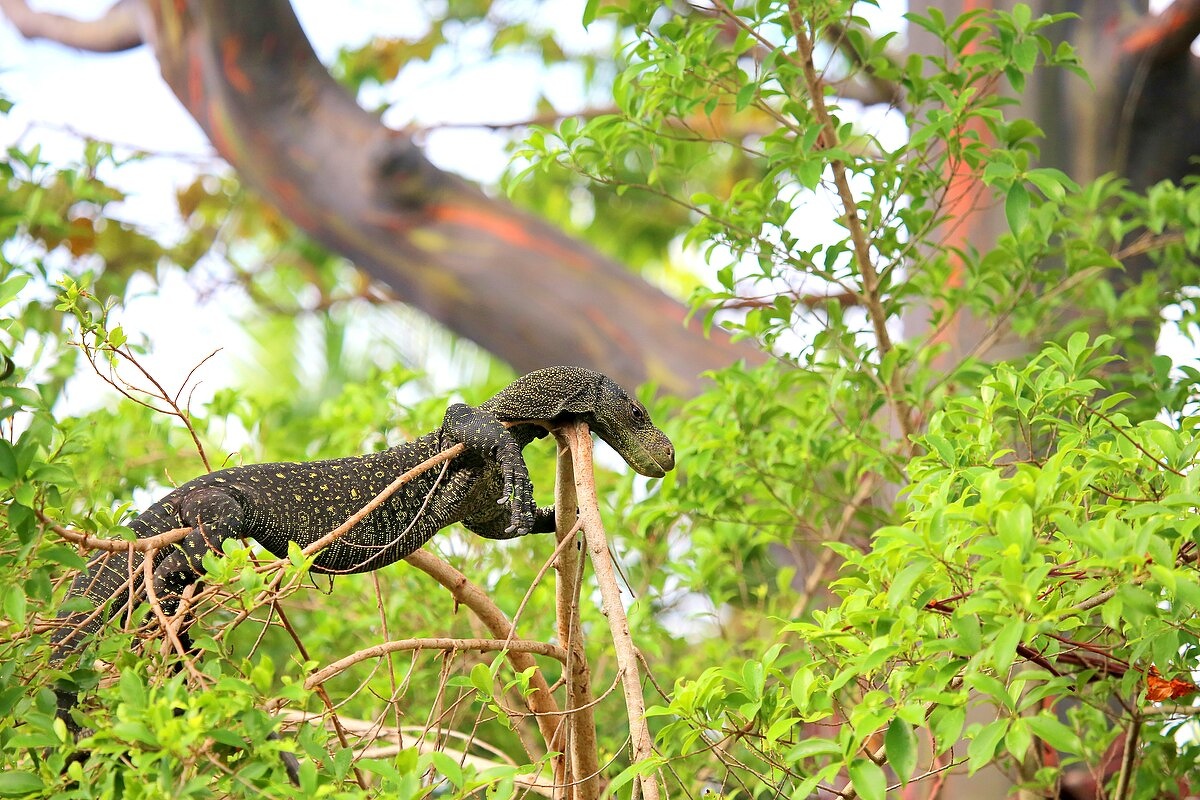
crocodile monitor
New Guinea is home to several species of monitor lizards, including crocodile monitors (Varanus salvadorii), mangrove monitors (Varanus indicus), louisiade monitors (Varanus louisiadensis), a recently discovered species, black tree monitors, blue-tailed monitors, bogert's monitors, emerald tree monitors, Finsch's monitors, Mussau Island blue-tailed monitors, Peach-throated monitor, and Yellow-spotted monitor.
Mangrove monitors have a wide distribution across the western Pacific, including northern Australia, New Guinea, and the Solomon Islands. They are also called the mangrove goannas and Western Pacific monitor lizards.
Louisiade monitors were discovered on the Louisiade Archipelago. They are about 60 centimeters (2 feet) long with a black, scaly body and yellow spots, and a blue tongue. The blue tongue is used for various purposes, including attracting prey, intimidating predators, and regulating body temperature. Mussau Island blue-tailed monitors (Varanus semotus) are another newly discovered species. The only large predator and scavenger on Mussau Island, they have a turquoise or blue-pigmented tail and a pale yellow tongue.
RELATED ARTICLES:
MONITOR LIZARDS factsanddetails.com
LIZARDS IN AUSTRALIA: TYPES, SPECIES, CHARACTERISTICS, BEHAVIOR ioa.factsanddetails.com
GOANNAS (MONITOR LIZARD) SPECIES OF AUSTRALIA ioa.factsanddetails.com
BIGGEST AND MOST COMMON MONITOR LIZARDS: ASIAN WATER AND BENGAL MONITORS factsanddetails.com
KOMODO DRAGONS: CHARACTERISTICS, HABITAT, SENSES, MOVEMENT factsanddetails.com
REPTILES: TAXONOMY, CHARACTERISTICS, THREATENED STATUS factsanddetails.com
LIZARDS: CHARACTERISTICS, SENSES, ODDITIES factsanddetails.com
Crocodile Monitors
Crocodile monitors (Varanus salvadorii) are largest monitor lizard species in New Guinea and are one of the longest lizards, with verified individuals measuring up to 2.55 meters (8.4 feet) and weigh about 20 kilograms on average. Also known as Papuan monitors and Salvadori's monitor, they have exceptionally long tails. Some specimens have even been claimed to be longer than Komodo dragons, but they are less massive and about 70 percent of their length is tail..
Crocodile monitors are endemic to the island of New Guinea, both Papua New Guinea and Papua and West Papua in Indonesia. They primarily reside in coastal lowland environments, mainly tropical rainforests and mangrove swamplands, but have been found in mountains up to 650 meters (2132 feet) above sea level. They live mainly in trees and also occur terrestrial habitats, depending on availability of sunlight and prey. As a rainforest dweller, its optimal temperatures are high, from 29-31ºC (84-88ºF) during the day. [Source: Gregory Wojtasek, Animal Diversity Web (ADW) |=|]
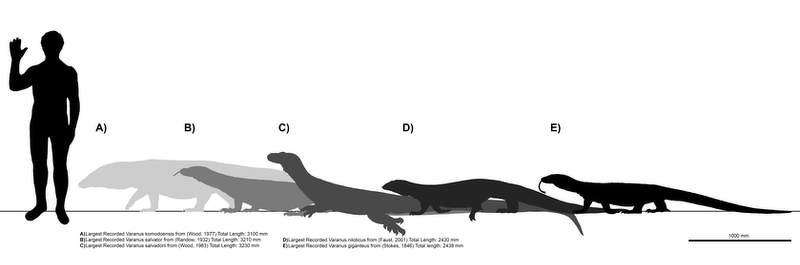
five largest lizards in the world: A) Komodo dragon; B) Asian water monitor; C) crocodile monitor; D) Nile monitor; E) perentie
Crocodile monitors are arboreal lizard with a dark green or blackish body marked with bands of yellowish spots or specks of yellow, white, or green, . They have a blunt snout and a very long prehensile tail that is rounded at the base and triangular near the end. Their skin is covered with non-overlapping scales, with folds around the neck. They have round snouts with long, forked tongues used for chemoreception, and very long, vertical teeth, as well as strong claws. Sexual Dimorphism (differences between males and females) is present: Males are larger than females. [Source: Gregory Wojtasek, Animal Diversity Web (ADW) |=|]
Crocodile monitors feed opportunistically on everything from birds and small mammals to eggs, other reptiles, amphibians and carrion. Their large, backwards-curving teeth are better adapted than those of most monitors for seizing fast-moving prey. They are known to prey on both adult cockatoos and maleos and their eggs and swallow food items whole. Like all monitors, they have anatomical features that enable them to breathe more easily when running than other lizards. They considered by some to one of the most agile monitor species. Their lifespan in the wild is typically 12 to 20 years.
Crocodile monitors are not endangered or threatened. They have been designated as a species of least concern on the International Union for Conservation of Nature (IUCN) Red List since 2014. However, they are by pressured deforestation, habitat loss and degradation and poaching, and are protected by CITES. Little is known of their reproduction and development, as they are is difficult to breed in captivity. Attempts at captive breeding have been mostly unsuccessful. In New Guinea, these lizards are sometimes hunted and skinned by tribesmen to make drums and have described as an evil spirit that "climbs trees, walks upright, breathes fire, and kills men". Some local people say they give warnings if crocodiles are nearby.
Crocodile Monitor Behavior, Diet and Reproduction
Crocodile monitors are solitary, diurnal (active during the daytime) and highly arboreal (adapted to living in trees) but can be terricolous (live on the ground). They can hang onto branches with their rear legs, and occasionally use their prehensile tail to grab branches. The primary function of the tail, however, is as a counterbalance when leaping from branch to branch. The tails can also be used used for defense and can deliver a powerful blow. In the pet trade, these lizards have a reputation for being aggressive and unpredictable. Although they are known to rest and bask in trees, they sleep on the ground or submerged in water.
Crocodile monitors bask in the sun throughout the day. They are temperature sensitive and, when their body temperature exceeds temperatures of around 38ºC (100ºF), body contractions aid in lowering body temperature. Crocodile monitors rise up on their hind legs to check their surroundings, behaviour that also has been observed in sand goannas in Australia. Crocodile monitors also adopt a warning posture, in which they carry their tails rolled up behind them. According to native belief, they give a warning call if they see crocodiles. In general crocodile monitors avoid human contact, but their bite is capable of causing infection, like the Komodo dragon's. One fatality was reported from a bite in 1983 when a Papuan woman was bitten and later died from an infection.
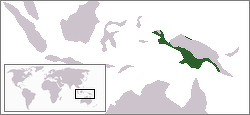
crocodile monitor range
Crocodile monitors are the top predator in New Guinea, feeding on birds (including cockatoos), eggs, small mammals (such as rats and bandicoots), frogs, reptiles, and carrion. Local people have reported that they can take down pigs, deer, and hunting dogs, and hauls their prey considerable distance up a tree to consume it. Rather than following prey to ambush it from behind, crocodile monitors may stalk its prey and anticipate where it will run, meeting it headlong. The teeth of crocodile monitors are different from those of other monitor species, which typically are blunt, peglike, and face slightly rearward. Crocodile monitor upper teeth are long, fang-like, set vertically in the jawbone, adapted to hooking into fast-moving prey such as birds, bats, and rodents. Their lower teeth are housed in a fleshy sheath.
Reproduction of crocodile monitors has only been observed in captivity. Females lay four to 12 eggs from around October to January. The eggs have different dimensions. It is not known why. Dimensions vary from 7.5-×-3.4 to 10-×-4.5 centimeters (3.0-×-1.3 to 3.9-×-1.8 inches) and weigh from 43.3 to 60.8 grams (1.53 to 2.14 ounces). Most clutches laid in captivity have been infertile, and only four successful breedings have been documented thus far. Hatchlings are about 46 centimeters (18 inches) long and weigh around 56 grams (2.0 ounces). Hatchling crocodile monitors are more colourful than adults and feed primarily on insects and small reptiles.
According to Animal Diversity Web: Male Crocodile monitors are aggressive, fighting (as all vanarids do) in a ritualized fashion that involves head weaving, bipedal clinching and wrestling in order to attract females; the larger a male is, the more likely he is to succeed. After combat, males will proceed in courting the female (by licking, stroking and scratching in other varnids), followed by a forceful act of mating, with the male biting the female's neck, resulting in bleeding wounds called mating marks. The female will then either comply, lifting her tail to allow the male to insert his hemipenes (one at a time, though both are used in one mating) or flip over in order to make copulation more difficult, if not impossible. Generally, female vanarids may mate with one or several males over a period of a few days. [Source: Gregory Wojtasek, Animal Diversity Web (ADW)]
Mysterious Tree Monitor
The mysterious tree monitor (Varanus telenesetes) is an enigmatic monitor lizard that may actually represent a color faded specimen of the emerald tree monitor. The species was described based on a single specimen supposedly collected on Rossel Island in the Louisiade Archipelago of Papua New Guinea. However, later searches of this island have failed to turn up any specimens and native islanders deny ever seeing it. It is now believed that the original collection data was in error and that the species occurs on some other, currently unknown, island east of New Guinea.
Like all tree monitors, the body of the mysterious tree monitor was described as slender with a long, prehensile tail about twice as long as the body. It was originally described by Robert Sprackland in 1991 as being similar to the emerald tree monitor: with a green black with indistinct black chevrons, and a nape and tail were visibly dark green. However, the specimen in question has since become entirely dark grey, appearing as if it was melanistic. It lacks a visible dorsal pattern unless held under alcohol, at which point narrow dark crossbands can be faintly seen. The underside is cream-colored with deep brown spots and the throat is banded.
Unique for tree monitors, which usually have a pink tongue, the tongue color is yellow and the soles of the hands and feet are light-colored versus dark of most tree monitors. The total length of the known specimen is just over 60 centimeters (two feet), though it is likely that this represents an animal not fully grown as most tree monitors average a total length of around 90 centimeters (three feet).
Emerald Tree Monitors and Their Close Relatives
Emerald tree monitor (Varanus prasinus) are also known as green tree monitors. They are small to medium-sized arboreal monitor lizards greatly valued by zoos and lizard owners because of their unusual coloration, which consists of shades from green to turquoise, topped with dark, transverse dorsal banding. This coloration helps camouflage them in rainforests and other arboreal habitat.
Emerald tree monitors and their close relatives can be found on the island of New Guinea in Papua and West in Indonesia and Papua New Guinea as well as several adjacent islands and the northern Torres Strait Islands. They are found in humid, tropical lowland environments in rain forests, mangroves, and cocoa plantations from sea level to 830 meters (2723 feet). As their name suggest they are spend most of their time in trees as that is where they seek prey, escape predators and even lay their eggs. [Source: Jillian Krynock, Animal Diversity Web (ADW) |=|]
Emerald tree monitors are not endangered or threatened. They are designated as a species of least concern on the International Union for Conservation of Nature (IUCN) Red List. They are one of, if not the most, popular monitor lizard species in the international pet trade. Their skins have been used to make leather products sold in China. They are federally protected in Indonesia, which theoretically should protect wild ones from being caught and exported. However, laws in Indonesia are not rigorously enforced, leading to many wild-caught species being sold into the pet trade despite the protection. CITES (Convention on International Trade in Endangered Species of Wild) places them in Appendix II, which lists species not necessarily threatened with extinction now but that may become so unless trade is closely controlled mainly because of the very active pet trade of emerald monitor lizards.
Historically, many of the monitor lizards found in New Guinea and the islands in the area of New Guinea were described as emerald tree monitors. However, upon closer inspection some new species previously described as emerald tree monitors have been official designated based on differences in coloration, scale shape, and some specific cranial morphologies. Among these are — black tree monitors (Varanus beccarii) — which are similar in size and shape but are have dark black coloration. Similarly, blue-spotted tree monitors (Varanus macraei) are also similar in size and shape but have unique blue-colored rings.
Emerald Tree Monitor Characteristics and Diet
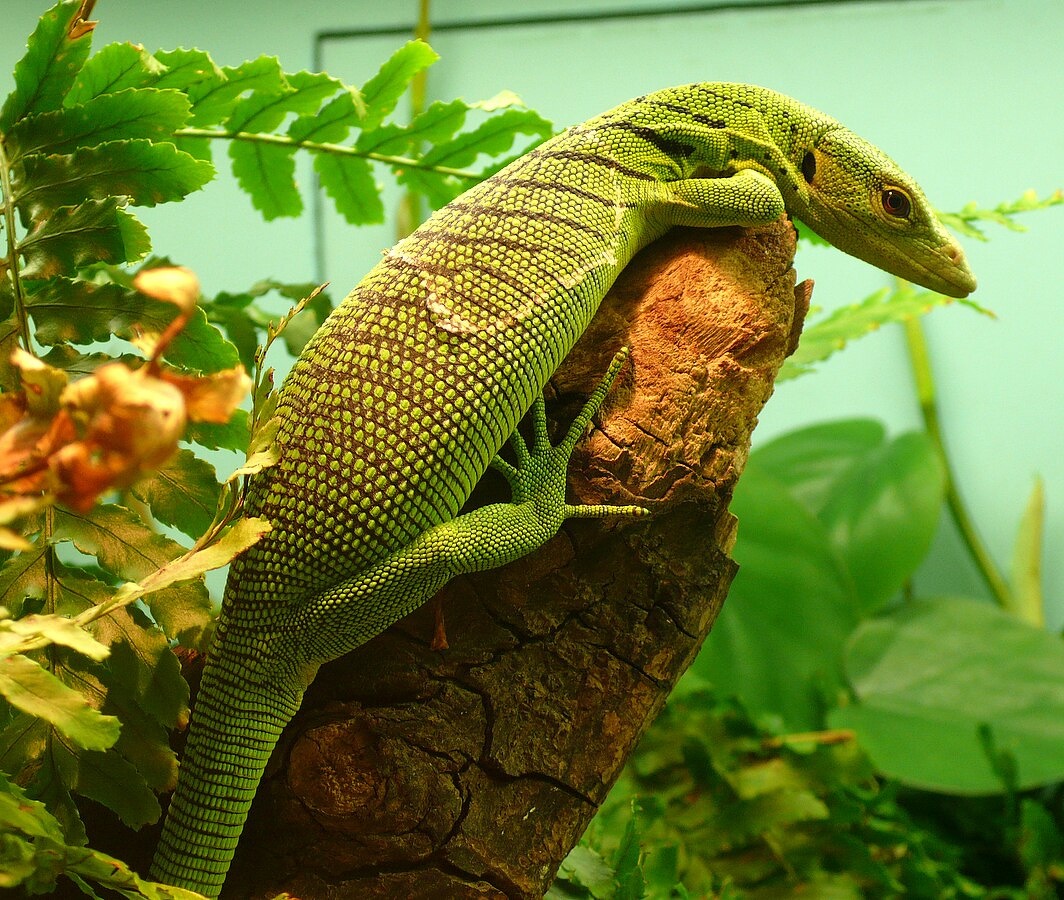
Emerald tree monitor
Emerald tree monitors have an average weight is 300 grams (10.6 ounces) and range in length from 67 to 1.14 centimeters (2.2 to 3.8 feet), with their average length being 80 centimeters (2.7 feet), with an average snout-vent length of 29 centimeters (almost one foot) and an average tail length of 51 centimeters (1.7 feet). Their prehensile tail is about 1.75 times their snout-vent — an adaptation for their arboreal lifestyle. Sexual Dimorphism (differences between males and females) is present: Males are slightly larger than females. [Source: Jillian Krynock, Animal Diversity Web (ADW) |=|]
Emerald tree monitors have specialized feet for climbing in trees. The bottoms of their feet are covered in larger scales which aid them in climbing and gaining traction on branches and tree trunks. Their long, slender digits are ideal for grasping end in sharp claws that help them move, climb, and catch prey. Emerald tree monitors are easily recognizable by their vibrant emerald coloration, although that can vary to a lighter yellow-green and even a turquoise color. Sometimes a darker dorsal coloration is seen as well.
Emerald tree monitors are primarily insectivores (eat insects) but also recognize as carnivores (eat meat or animal parts). Katydids (Tettigoniidae) and grasshoppers (Caelifera) are their main and most abundant prey item. They also eat centipedes (Chilopoda), spiders (Araneae), and a few coleopteran larvae. Emerald tree monitors sometimes take small mammals, such as Moncton's mosaic-tailed rat (Paramelomys moncktoni). Emerald tree monitors have been observed using their long claws to rake and disembowel small rodents after first biting them around the nape of their neck and slamming them against the nearest surface. Emerald tree monitors require relatively relatively low prey to predator mass ratio and they are known consuming relatively large prey relative to their body size in comparison to other monitor lizards. Feeding on larger prey allows them to conserve energy by requiring less frequent feedings. They have an elongated crania and mandibles (lower jaw bones), which may be adaption to help them feed on large prey.
Behavior and Reproduction of Emerald Tree Monitor and Their Relatives
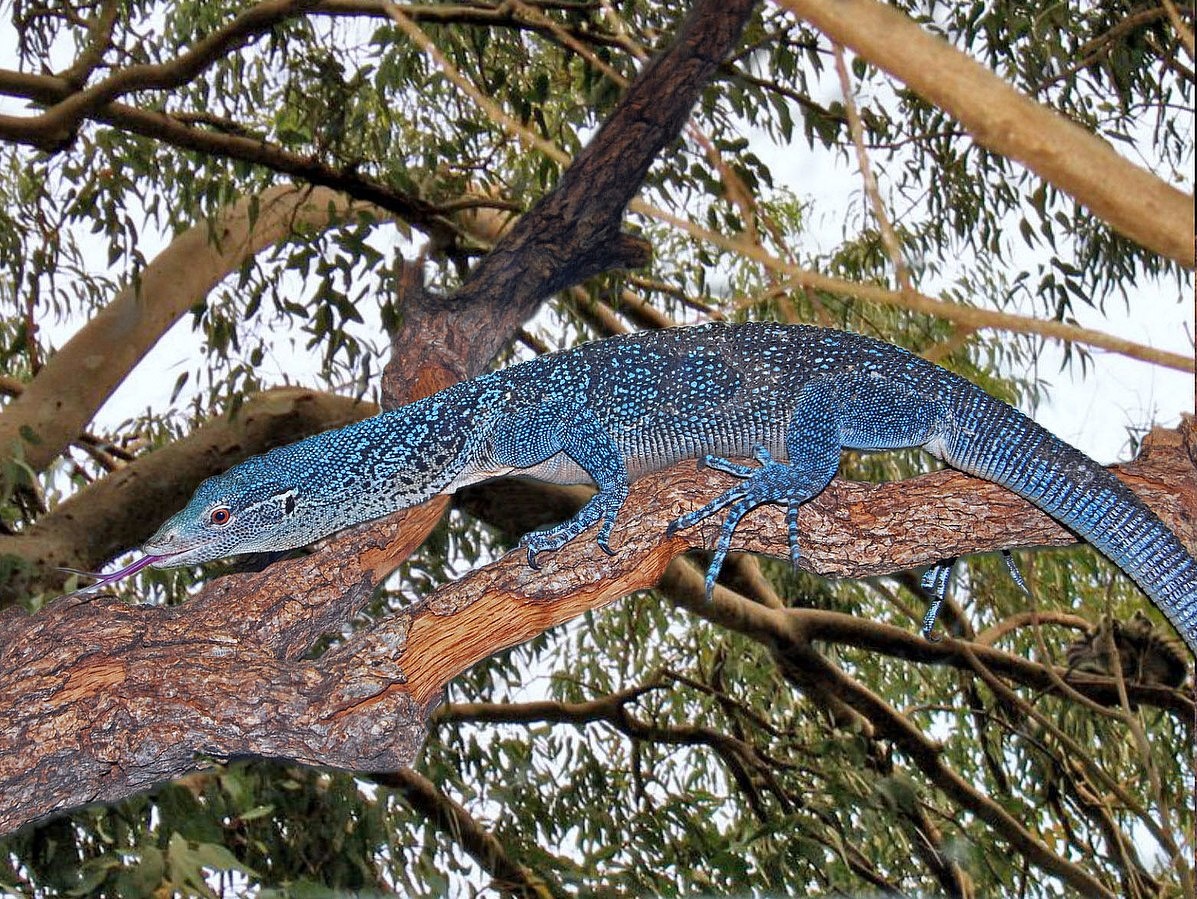
blue-spotted tree monitor
Emerald tree monitors are arboreal (live mainly in trees), scansorial (good at climbing), diurnal (active during the daytime), motile (move around as opposed to being stationary) and solitary. They have many adaptations that facilitate life in the trees. They are one of the few monitor lizards with a prehensile tail, which allows them to grasp branches with their tail. They rarely come down to the forest floor as most everything they need is in the trees. They catch prey in trees and are believed to leap from one tree to the next if a predator is senses.[Source: Jillian Krynock, Animal Diversity Web (ADW) |=|]
Emerald tree monitors communicate and sense with chemicals usually detected by smelling. Monitor lizards often track and locate prey using chemical cues. They interpret these cues using their vomeronasal organs, which are two sensory receptors on the roof of their mouth, that receive inputs from their tongue, which flicks in and out as they move along.
Emerald tree monitors are oviparous, meaning that young are hatched from eggs, and employ sexual-induced ovulation (release of a mature egg from the ovary triggered by sexual intercourse). They can breed up to three times a year. The gestation period ranges from 154 to 190 days. The number of offspring ranges from two to four. Young are precocial. This means they are relatively well-developed when born. |=|
On average females and males reach sexual or reproductive maturity at two years. After mating emerald tree monitors return to their solitary lifestyle. There is no data on whether they are monogamous or polygamous. |=|
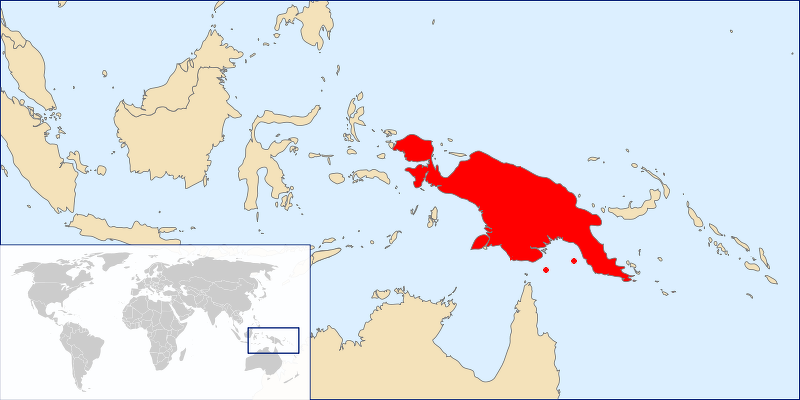
Emerald tree monitor range
Male black tree monitors, endemic to the Aru Islands off New Guinea, aggressively pursue females and engage in rough courtship behavior. Male black-headed monitors follow the scent of female for about 800 meters yards to mate. Black tree monitors been observed mating while hanging onto the side of their enclosure, with females laying eggs the morning after copulation.
There is some evidence that show that female Emerald tree monitors do provide a food source and protection for young before to hatching. A clutch of eggs in Papua New Guinea was observed hatching in an arboreal termite nest. This provides protection for the eggs as well as a source of food once they hatch. Emerald tree monitors are born looking almost identical to their parents; the only noticeable difference being size in the young compared with adults.
Newly-Discovered Monitor Lizard Species on Islands Off New Guinea
Louisiade monitors (Varanus louisiadensis) are a species of monitor lizard native to the Louisiade Archipelago of Papua New Guinea. They inhabit all three major islands of the Louisiade Archipelago — Tagula Island, Misima Island, and Rossel Island — and were first described in 2023, alongside Tanimbar monitors (See Below) Louisiade monitors have three percent genetic divergence from other species of monitor lizards. Their body is generally black, with yellow patterns that become less distinct with age. Measurements of 11 individuals resulted in a snout–vent length ranging from 11.5 to 46 centimeters (4.5 to 18 inches) and tail length ranging from 27 to 117 centimeters (10.6 to 46 inches). [Source: Wikipedia]
Tanimbar monitors (Varanus tanimbar) are a species of monitor lizard native to the Tanimbar archipelago of Maluku, Indonesia first described in 2023 using specimens that were preserved at the Western Australian Museum. Tanimbar monitors are the only species of monitor lizard native to the Tanimbar Islands, where it resides on the two largest islands: Yamdena and Selaru.
Mussau Island blue-tailed monitors(Varanus semotus) are also called Mussau monitors. They are endemic to Mussau Island in Papua New Guinea and were formally described in 2016 by a team of researchers from Finland and Australia. The species was named Varanus semotus due to its isolated location, with "semotus" meaning remote or distant in Latin. Their closest relatives are several hundred kilometres away. Although once likely common throughout Mussau, Mussau Island blue-tailed monitors are now restricted to a small coastal area of the island due to logging. However, they are common in its current range and can be found on palm trees, shrubs, and other dry coastal vegetation. There are unconfirmed reports of this species also occurring on Emirau Island.
The Mussau Island blue-tailed monitors reach a length of just over one meter. They have a pale yellow tongue (a trait shared by blue-tailed monitors) and have a marbled black and cream colored throat and a banded tail with varying levels of blue coloration. Juveniles are black and more strikingly patterned, with white spots on the head, orange spots on the back, and pale green to cream colored bands on the tail. Mussau Island blue-tailed monitors mainly feed on skinks, birds, eggs, and crabs. They are the only large terrestrial generalist predators and scavengers on Mussau Island.
Image Sources: Wikimedia Commons
Text Sources: Animal Diversity Web animaldiversity.org , National Geographic, Live Science, Natural History magazine, Australian Museum, David Attenborough books, Australia Geographic, New York Times, Washington Post, Los Angeles Times, Smithsonian magazine, Discover magazine, The Conversation, The New Yorker, Time, BBC, CNN, Reuters, Associated Press, AFP, Lonely Planet Guides, Wikipedia, The Guardian, Top Secret Animal Attack Files website and various books and other publications.
Last updated August 2025