
Home | Category: Pinnipeds (Seals, Sea Lions, Walruses)
STELLER SEA LIONS

Steller sea lions
Steller sea lions (Eumetopias jubatus) are the largest of the eared seals, with males weighing as over a tonne. The body length of males is 2.6 to 3.9 meters (8.5 to 12.8 feet); females, up to 2.6 meters (8.5 feet). Males generally weigh around 1100 kilograms (1.2 US tons); females, 270 to 350 kilograms (600 to 770 pounds). Steller sea lions live in coastal waters and offshore islands in the North Pacific, breeding in Kamchatka and Sakhalin Island in Russia and the Pribilof Islands in Alaska. In the eastern Pacific Ocean they are found as far south as southern California. Male Steller sea lions can live up to 20 years; whereas, females can live up to 30 years.
Larger than fur seals but not as large as elephant seals and also known as northern sea lions, Steller sea lions are named after Georg Wilhelm Steller, the German surgeon and naturalist who first described and wrote about the species in 1742 and was on the Bering expedition that explored the Kamchatka peninsula of eastern Russia. While they are the only living member of their genus, they share parts of their range with a smaller related species, California sea lions. Steller sea lions' impressive low-frequency vocalizations sound more like roars than California sea lions’ barks. They also share parts of their range with another otariid: northern fur seal. [Source: NOAA]
Adult males are known as bulls. Females are called cows and young are referred to as pups. Historically, Steller sea lions were highly abundant throughout many parts of the North Pacific. Indigenous peoples and other settlers hunted them for their meat, hides, oil, and other products. Also, they were killed for predator control and commercial harvests, causing their numbers to decrease.
Steller sea lions are currently listed as near threatened on the International Union for Conservation of Nature (IUCN) Red List. They have attracted attention in recent decades due to their significant (and largely unexplained) declines in their numbers over an extensive portion of their northern range—notably in Alaska. Their population declined 80 percent in the 1970s, 80s and 90s to 33,600. They lion are believed to victims of the massive nets used in industrial fishing that have taken the fish the sea lions would eat. The nets are used primarily to harvest pollock, a white fish turned into fish sticks, imitation crab, and fish fillets for fast food restaurants. The disappearance of Arctic ice is blamed. In the last couple of decades their numbers have rebounded somewhat and they are no longer regarded as endangered.
Related Articles:
CATEGORY: SEALS: ioa.factsanddetails.com;
SEA LIONS AND FUR SEALS: CHARACTERISTICS, BEHAVIOR, SPECIES, REPRODUCTION ioa.factsanddetails.com
CALIFORNIA SEA LIONS: CHARACTERISTICS, BEHAVIOR AND REPRODUCTION ioa.factsanddetails.com
FUR SEALS: CHARACTERISTICS, BEHAVIOR, SPECIES ioa.factsanddetails.com ;
NORTHERN FUR SEALS: CHARACTERISTICS, BEHAVIOR, REPRODUCTION ioa.factsanddetails.com
SEALS: CHARACTERISTICS, SENSES, WHISKERS, SPECIES ioa.factsanddetails.com;
SEALS: HISTORY, BEHAVIOR, DIVING, FEEDING, REPRODUCTION ioa.factsanddetails.com
SEALS AS PREY FOR ORCAS, GREAT WHITES AND POLAR BEARS ioa.factsanddetails.com ;
SEALS AND HUMANS: CLOTHES, HUNTS AND THE MILITARY ioa.factsanddetails.com ;
SEAL AND SEA LION ATTACKS ON HUMANS ioa.factsanddetails.com ;
NORTHERN SEALS: ARCTIC, SPECIES, CHARACTERISTICS, BEHAVIOR ioa.factsanddetails.com
HARBOR SEALS: CHARACTERISTICS, BEHAVIOR AND REPRODUCTION ioa.factsanddetails.com
BEARDED SEALS: CHARACTERISTICS, BEHAVIOR AND REPRODUCTION ioa.factsanddetails.com
RINGED SEALS: CHARACTERISTICS, BEHAVIOR AND REPRODUCTION factsanddetails.com
LEOPARD SEALS: CHARACTERISTICS, BEHAVIOR AND PENGUINS ioa.factsanddetails.com ;
ELEPHANT SEALS, THEIR BEHAVIOR AND AMAZING DIVING ABILITY ioa.factsanddetails.com ;
NORTHERN ELEPHANT SEALS: CHARACTERISTICS, BEHAVIOR, FEEDING, MATING ioa.factsanddetails.com ;
SOUTHERN ELEPHANT SEALS: CHARACTERISTICS, BEHAVIOR, MATING ioa.factsanddetails.com
WALRUSES: CHARACTERISTICS, BEHAVIOR AND REPRODUCTION ioa.factsanddetails.com
Websites and Resources: Animal Diversity Web (ADW) animaldiversity.org; National Oceanic and Atmospheric Administration (NOAA) noaa.gov; Fishbase fishbase.se; Encyclopedia of Life eol.org; Smithsonian Oceans Portal ocean.si.edu/ocean-life-ecosystems ; Monterey Bay Aquarium montereybayaquarium.org ; MarineBio marinebio.org/oceans/creatures
Steller Sea Lion Habitat, Range and Populations
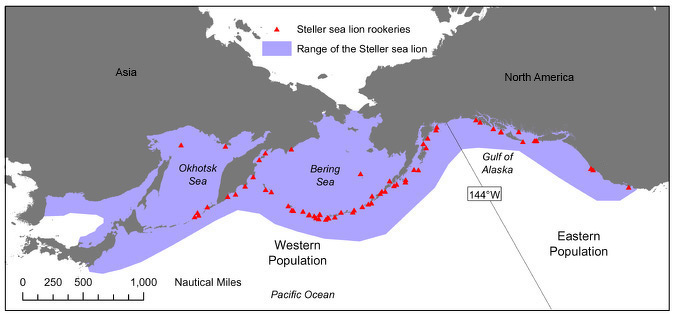
steller sea lion range
Steller sea lions are found mainly around the coasts along the North Pacific Ocean rim from northern Hokkaido, Japan through the Kuril Islands and Okhotsk Sea, the Aleutian Islands and Bering Sea, the southern coast of Alaska, and south to central California. While they are most typically found in coastal waters on the continental shelf, they also occur and sometime forage in much deeper continental slope and pelagic waters, especially in the non-breeding season. [Source: NOAA]
Steller sea lions prefer the colder temperate to subarctic waters of the North Pacific Ocean. They need both terrestrial and aquatic habitats. They mate and give birth on land, at traditional breeding grounds called rookeries. Haul-outs (non-breeding grounds). and rookeries usually consist of beaches (gravel, rocky, or sand), ledges, and rocky reefs. In the Bering Sea and Okhotsk Sea, sea lions may also haul out on sea ice. They can dive to depths of 400 meters Within a 37 kilometer (20 nautical miles) radius of the rookeries and haul-outs is where Steller sea lions typically are found. These areas are protected by the species recovery plan.
Steller sea lions are considered Endangered west of 144º W latitude and threatened east of 144º W latitude. The western DPS ( distinct population segment) includes Steller sea lions that originate from rookeries west of 144° west longitude (Cape Suckling): those in the Gulf of Alaska, the Aleutian Islands, the Bering Sea, and Asia. The eastern DPS includes sea lions originating from rookeries in southeast Alaska, British Columbia, Washington, Oregon, and California. The two populations of Steller sea lions represent different genetic, morphological, ecological, and population trends. Data show that the foraging ranges of the two DPSs overlap, especially in the non-breeding season. For example, females from the eastern Gulf of Alaska regularly occur in parts of southeast Alaska and males from the eastern DPS have been observed as far north as the Bering Sea. In recent years, a “mixing zone” has also become established in northern southeast Alaska on at least two new rookeries partially established by western DPS females, who left their traditional rookeries during the period of sharp decline in the western population.
Steller Sea Lion Characteristics
Steller sea lions are the largest member of the family Otariidae, the “eared seals,” which includes all sea lions and fur seals but not true seals, and the fourth largest pinniped in the world after southern elephant seals, northern elephant seals and walruses. Steller sea lions range in weight from 350 to 1,120 kilograms (771 to 2,470 pounds) and range in length from 2.3 to 3.4 meters (7.55 to 11.15 feet). Pups range from 16 to 22.5 kilograms (35 to 50 pounds). [Source: NOAA]

size comparison: Steller sea lion male (left), female (middle)
Sexual Dimorphism (differences between males and females) is present: Males are much larger than females. Adult males may be over 3.3 meters (11 feet) long and can weigh up to about 1,134 kilograms (2,500 pounds). Adult females are 2.3 to 2.8 meters (7.5 to 9.5) feet long and weigh up to about 362 kilograms (800 pounds). This high level of dimorphism increases their vulnerability to disturbance when they are hauled out on land — large animals may crush smaller ones if they flee towards the water.
Adult males are further distinguished by long, coarse hair on the chest, shoulders, and back. An adult male’s chests and neck are also more massive and muscular than a female’s. Both adult males and females have light blonde to reddish brown coats that are slightly darker on the chest and abdomen. When Steller sea lions are wet, the light coloration on their body is still visible. This different than other pinnipeds. Similar to other pinnipeds, Steller sea lions molt their winter coat every year. [Source: Danielle Keranen, Animal Diversity Web (ADW) |=|]
Both sexes have long whitish whiskers (vibrissae) on their muzzles, which they use to sense prey and feel their way underwater. The flippers and other hairless parts of the skin are black. On land, sea lions, unlike "true" seals, can turn their hind flippers forward for walking. They can climb and are sometimes be found on rocks or cliff faces high above the water. When they swim, Steller sea lions use their back flippers to steer and their broader, longer front flippers to propel themselves.
Steller Sea Lion Food, Feeding Behavior and Predators
Steller sea lions are carnivores (eat meat or animal parts) and are opportunistic predators and also recognized as piscivores (eat fish) and molluscivores (eat mollusks). They forage and feed primarily at night on over a hundred species of fish (including Atka mackerel, walleye pollock, salmon, cod, sand lance, arrowtooth flounder, Irish lords, rock sole, capelin, eulachon, Pacific sandfish, herring, rockfish, smooth lumpsucker, and hake) and cephalopods (including squid and octopus). [Source: NOAA]
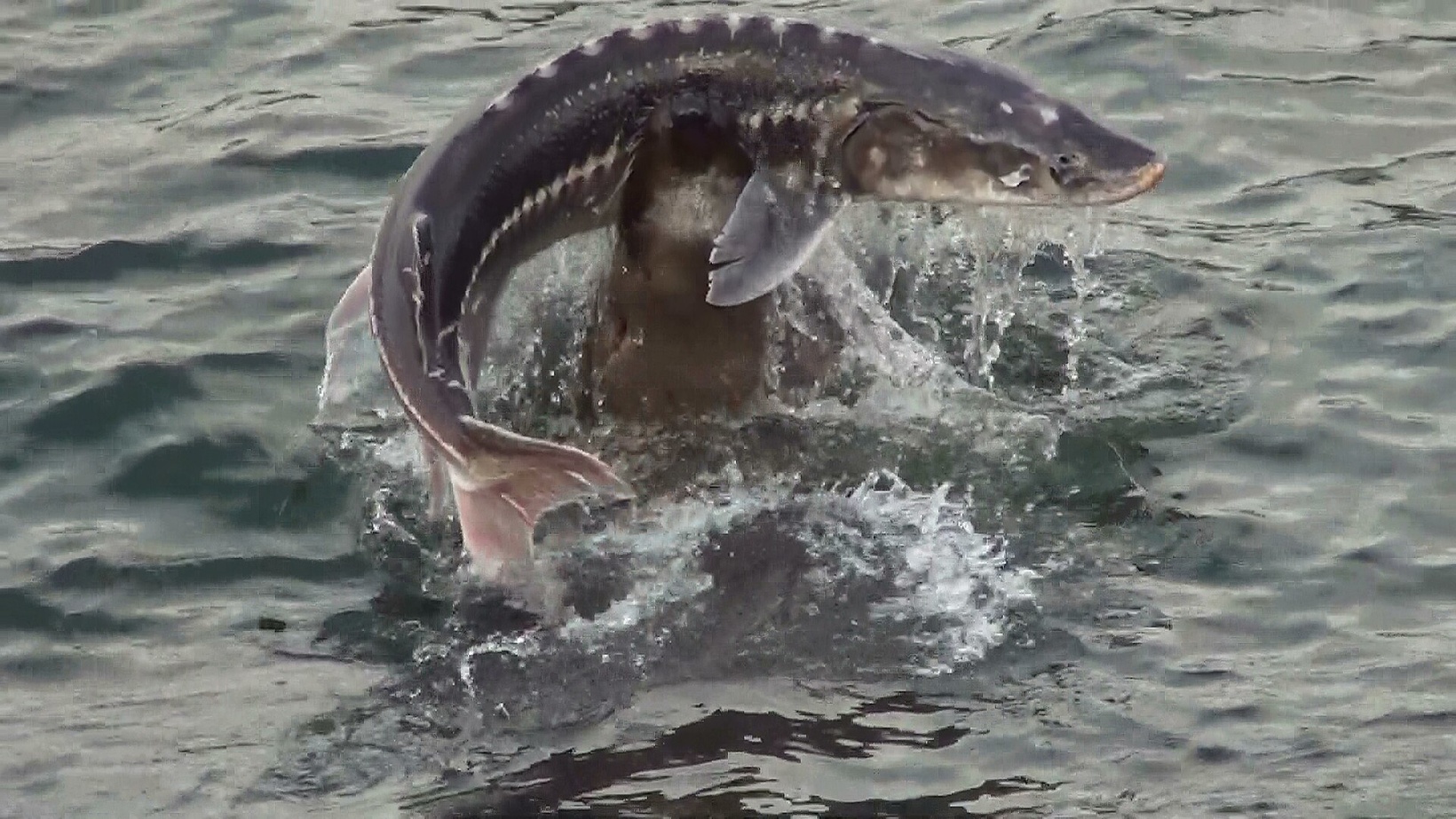
sea lion with a white sturgeon
Their primary prey diet varies in different parts of their range and at different times of the year, depending on the abundance and distribution of prey. To meet their energy requirements to grow, survive, and reproduce, Steller sea lions likely depend on predictable prey that are available in sufficient distribution and abundance to allow them to forage efficiently throughout the stages of their lives and during different times of the year.
Steller sea lions forage for food along the shoreline and near pelagic (open ocean) waters. In the winter, walleye pollock and Pacific cod are their main food source. Atka mackerel is their most common food source all year long. Steller sea lions have also been known to kill other animals, such as harbor seals and ringed seals, along with younger northern fur seals. They store and cache food.[Source: Danielle Keranen, Animal Diversity Web (ADW) |=|]
Different individuals may have different foraging strategies. NOAA Fisheries’ research shows that in the non-breeding season, some adult females may spend long periods of time foraging well off the continental shelf while others forage much nearer to terrestrial sites. During the breeding season, a female must forage close enough to her rookery to return often and nurse her young. An adult female has very high energy demands — especially in the winter, when she must find enough food to feed herself and nurse her pup, possibly while pregnant with the next year’s pup. [Source: NOAA]
Salmon sharks, killer whales, and Pacific sleeper sharks are some of their known predators. The recovery of Steller sea lions is related more strongly to predator abundance than resource abundance. Great white sharks have been known to kill and consume Steller sea lions. Humans may also prey on Steller sea lions. |=|
Steller Sea Lion Behavior
Steller sea lions are natatorial (equipped for swimming), motile (move around as opposed to being stationary), migratory (make seasonal movements between regions, such as between breeding and wintering grounds), and social (associates with others of its species; forms social groups). [Source: NOAA, Danielle Keranen, Animal Diversity Web (ADW) |=|]
Steller sea lions, especially males, can travel long distances in a season. Young Steller sea lions usually travel farther than adults, because they are unable to mate they will go farther for food. Steller sea lions can stay under water for up to 16 minutes. Diving ability changes with age. The deepest dive documented is about 427 meters (1,400 feet) in depth. Small pups learn to swim and begin to dive in nearshore waters near rookeries.
Steller sea lions are highly social and may rest in large groups, overlapping their bodies. They are generally social within their populations and can be found in large groups in rookeries or haul out sites on beaches. They are usually found in groups ranging from one to twelve, but have been seen in masses with as many as a hundred individuals on a beach. Steller sea lions need undisturbed land habitat to rest, molt, socialize, mate, give birth, and nurse small pups during the breeding season. At sea, they are seen alone or in small groups, but may gather in large "rafts" at the surface, including areas near important seasonal prey resources.
Steller sea lions communicate with vision and sound and sense using vision, touch, sound and chemicals usually detected with smell. They communicate with others individuals though low frequency roars. At their rookeries, during the mating season, males are constantly roaring with a lingering bass roar that is reminiscent of a steamer horn. The roar can be heard for several kilometers away. This contrasts with the vocalizations of their relatives, California sea lion, whose vocalizations sound more like barking. |=|
Steller Sea Lion Mating and Reproduction
Steller sea lions are polygynous (males have more than one female as a mate at one time) and employ delayed implantation (a condition in which a fertilized egg reaches the uterus but delays its implantation in the uterine lining, sometimes for several months). Steller sea lions breed once a year in the summer, after pups are born. The average gestation period is nine months, 12 months if the delayed implantation is included. . Steller sea lions are colonial breeders and breed, give birth and nurse young on remote islands called 'rookeries'. In their polygynous mating system only a small proportion of the sexually mature males father most of the pups in a given season. Adult males arrive early on rookeries to establish breeding territories that they defend through the breeding season. Bulls become sexually mature between three and eight years of age, but typically are not large enough to hold territory successfully until nine or 10 years old. [Source: NOAA]
During the breeding season Steller sea lion males vigilantly guard their territories. They often do not eat and rely solely on far reserves, At their rookeries, the males behave uneasily and are constantly roaring. A mature male may go without eating for one to two months while it is aggressively defending his territory. Females begin to arrive on rookeries in mid-May. They typically reproduce for the first time at four to six years of age, usually giving birth to a single pup each year but may not pup every year. Females usually mate again within two weeks after giving birth however, the fertilized egg won’t become implanted in the uterus for several months.
Dominant males are the only males that are supposed to mate. They guard and mate with up to 30 females during one mating season. Younger males may sneak onto the dominant male’s territory try to mate with females without dominant male noticing. The number of females that are successfully bred has been decreasing over the years.[Source: Danielle Keranen, Animal Diversity Web (ADW) |=|]
Rookeries are occupied during the summer months by dominant males, females, and the pups born during that year. Yearlings and older juveniles do not stay at the rookeries as long as the others because they are unable to breed. The rookeries break-up during August, at this time, females and young move to a different haul-out islands. As they are very social, continue to live with one another after the breeding season. During non-breeding periods, Steller sea lions go to beaches and lay out together.|=|
Steller Sea Lion Offspring and Parenting
The Steller sea lion pupping season is from about mid-May to mid-July and peaks in June. Parental care is provided by females. Some protection is provided by males. The weaning age ranges from 12 to 36 months, with average weaning age being 12 months. Females reach sexual maturity at three to six years. Males do so maturity at three years but do not start mating until about age 10.
At birth, pups are about one meter (three feet) in length and weigh 16 to 23 kilograms (35 to 50 pounds) . Pups have a thick, dark brown to black "lanugo" coat until four to six months old, when they molt to a lighter brown. By the end of their second year, pups are the same color as adults. Males can live to be up to 20 years old, while females can live to be approximately 30. [Source: NOAA]
Adult females stay with their pups for a few days after birth before beginning a regular routine of foraging at sea, nursing pups on land, then going back to forage. Female Steller sea lions use smell and distinct vocalizations to recognize and create strong social bonds with their newborn pups. While most pups likely wean before their first birthdays, some pups are nursed for as long as three years.
Female Steller sea lions provide care for their young for as long as three years. They generally nurse their young for up to a year, but some will let their young nurse longer. Male Steller sea lions aren’t involved much parental care but they do guard all the females that they impregnated. After females give birth, they forage around the rookery and onshore, mostly at night, and may be gone for as long as a day. After feeding they return and nurse their pup. [Source: Danielle Keranen, Animal Diversity Web (ADW) |=|]
Steller Sea Lions, Humans and Conservation
Steller sea lions are currently listed as Near Threatened on the International Union for Conservation of Nature (IUCN) Red List. Threats include effects of fisheries on prey, climate change, predation, toxic substance, incidental take due to interactions with active fishing gear, illegal shooting, disturbance, disease and parasites, vessel strikes, entanglement with nets and illegal feeding.
Historically, Steller sea lions were highly abundant throughout many parts of the North Pacific. Indigenous peoples and other settlers hunted them for their meat, hides, oil, and other products. In addition, they were killed for predator control and commercial harvests, causing their numbers to decrease. Steller sea lions were first listed under the Endangered Species Act in 1990. In 1997 NOAA Fisheries recognized two populations, classifying the eastern population as threatened and the western population as endangered. The eastern population has since recovered and is no longer listed, which is a significant achievement under the ESA. The western population remains endangered. [Source: NOAA]
The western stock of Steller sea lions decreased from an estimated 220,000 to 265,000 animals in the late 1970s to less than 50,000 in 2000. While the western population has been increasing slowly overall since about 2003, it is still declining quickly in large areas of its range.The eastern stock increased at a rate of 4.76 percent per year between 1989 and 2015, based on an analysis of pup counts in California, Oregon, British Columbia, and southeast Alaska. Population trends for the eastern and western DPSs differ for complex reasons; most simply, the difference likely results from the different kinds and magnitudes of threats the species faces throughout its range.
Image Sources: Wikimedia Commons, NOAA
Text Sources: Animal Diversity Web (ADW) animaldiversity.org; National Oceanic and Atmospheric Administration (NOAA) noaa.gov; Wikipedia, National Geographic, Live Science, BBC, Smithsonian, New York Times, Washington Post, Los Angeles Times, The New Yorker, Reuters, Associated Press, Lonely Planet Guides and various books and other publications.
Last Updated June 2025