
Home | Category: Pinnipeds (Seals, Sea Lions, Walruses)
HARBOR SEALS

harbor seal
Harbor seals (Phoca vitulina) are found throughout the temperate, Arctic and subarctic coastal waters of the Northern Hemisphere. They primarily feed on fish and spend most of their time in the same area and are known for raiding fishermen’s nets.
Harbor seals are one of the most common marine mammals along the U.S. West and East Coasts. They are commonly seen resting on rocks and beaches along the coast and on floating ice in glacial fjords with their head and rear flippers elevated in a “banana-like” position. Their lifespan is about 25 to 30 years. They have lived up to is 47.6 years in captivity. [Source: NOAA]
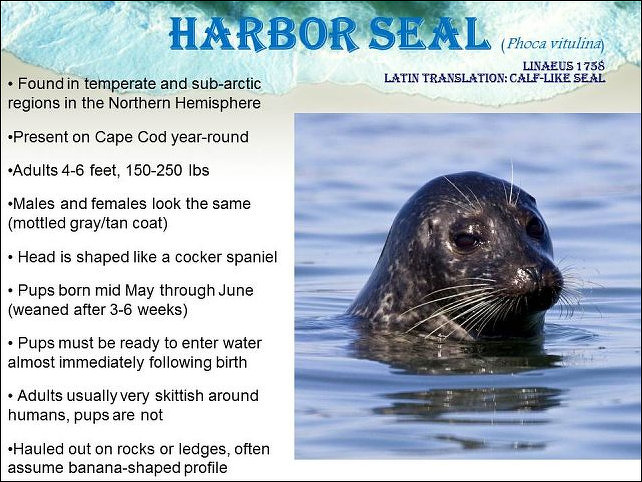
Harbor seals weigh up to 130 kilograms (285 pounds) and measure up to 1.8 meters (6 feet) in length. Males are slightly larger than females, and seals in Alaska and the Pacific Ocean are generally larger than those found in the Atlantic Ocean. Harbor seals have short, dog-like snouts. The color of each seal’s fur varies but there are two basic patterns: light tan, silver, or blue-gray with dark speckling or spots, and a dark background with light rings. Harbor seals molt (shed hair) in the mid to late summer for 1-2 months, spending more time out of the water.
Harbor Seal Subspecies: The five proposed subspecies of Phoca vitulina are:
1) Eastern Atlantic common seals (P. v. vitulina (L., 1758) occur in Europe and northwestern Asia.
2) Pacific common seals (P. v. richardii (Gray, 1864) occur in western North America.
3) Ungava seals (Lacs des Loups Marins seals) (P. v. mellonae (Doutt, 1942) are found in eastern Canada in fresh water
4) Western Atlantic common seals (P. v. concolor (DeKay, 1842) live in eastern North America. The validity of this subspecies is questionable, and not supported by genetic evidence. They might be part of the Eastern Atlantic subspecies.
5) Insular seals (Phoca vitulina stejnegeri (J. A. Allen, 1902) reside in Eastern Asia. Currently not recognised as a separate subspecies, but part of P. v. ricardsi [Source: Wikipedia]
Related Articles:
CATEGORY: SEALS: ioa.factsanddetails.com;
SEALS: CHARACTERISTICS, SENSES, WHISKERS, SPECIES ioa.factsanddetails.com;
SEALS: HISTORY, BEHAVIOR, DIVING, FEEDING, REPRODUCTION ioa.factsanddetails.com
SEA LIONS AND FUR SEALS: CHARACTERISTICS, BEHAVIOR, SPECIES, REPRODUCTION ioa.factsanddetails.com
SEALS AS PREY FOR ORCAS, GREAT WHITES AND POLAR BEARS ioa.factsanddetails.com ;
SEALS AND HUMANS: CLOTHES, HUNTS AND THE MILITARY ioa.factsanddetails.com ;
SEAL AND SEA LION ATTACKS ON HUMANS ioa.factsanddetails.com ;
NORTHERN SEALS: ARCTIC, SPECIES, CHARACTERISTICS, BEHAVIOR ioa.factsanddetails.com
BEARDED SEALS: CHARACTERISTICS, BEHAVIOR AND REPRODUCTION ioa.factsanddetails.com
RINGED SEALS: CHARACTERISTICS, BEHAVIOR AND REPRODUCTION factsanddetails.com
LEOPARD SEALS: CHARACTERISTICS, BEHAVIOR AND PENGUINS ioa.factsanddetails.com ;
STELLER SEA LIONS: CHARACTERISTICS, BEHAVIOR AND REPRODUCTION: ioa.factsanddetails.com ;
CALIFORNIA SEA LIONS: CHARACTERISTICS, BEHAVIOR AND REPRODUCTION ioa.factsanddetails.com
FUR SEALS: CHARACTERISTICS, BEHAVIOR, SPECIES ioa.factsanddetails.com ;
ELEPHANT SEALS, THEIR BEHAVIOR AND AMAZING DIVING ABILITY ioa.factsanddetails.com ;
NORTHERN ELEPHANT SEALS: CHARACTERISTICS, BEHAVIOR, FEEDING, MATING ioa.factsanddetails.com ;
SOUTHERN ELEPHANT SEALS: CHARACTERISTICS, BEHAVIOR, MATING ioa.factsanddetails.com
WALRUSES: CHARACTERISTICS, BEHAVIOR AND REPRODUCTION ioa.factsanddetails.com
Harbor Seal Habitat and Where They Are Found
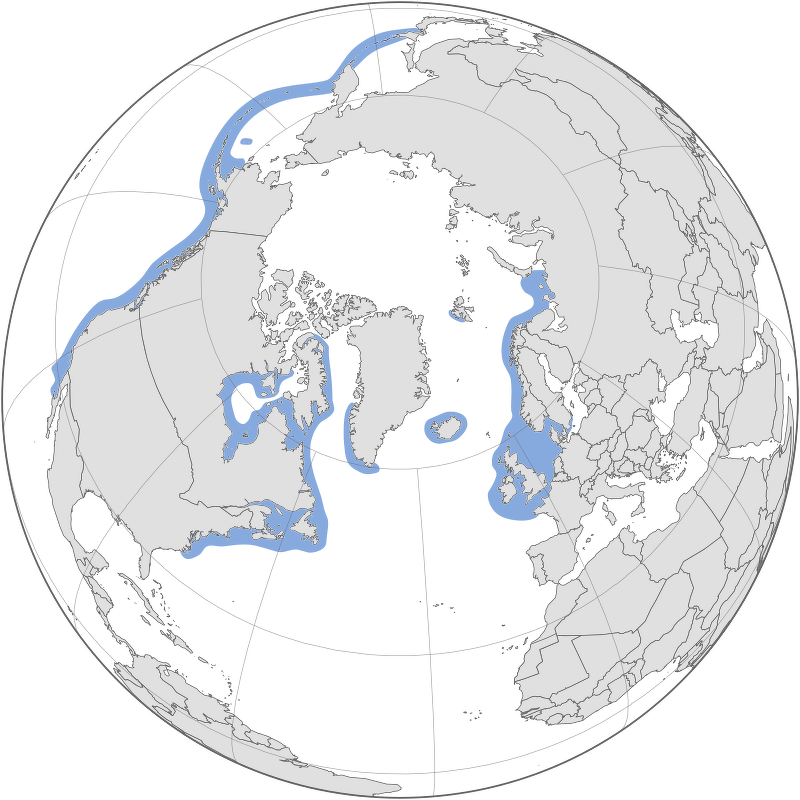
harbor seal range
Harbor seals have the largest geographical range of any pinniped. They live in temperate coastal habitats along the northern coasts of North America, Europe, and Asia in the east and west Pacific and Atlantic Oceans in the Northern Hemisphere. Their range spans from the western Pacific Ocean coast north towards the Gulf of Alaska and to the southeastern Bering Sea. The western Atlantic Ocean harbor seals are distributed from the French coast to the North Sea and northward to the Barents Sea, as well as along the Atlantic coast of North America. Although they inhabit a large range of coastal and insular regions, the Pacific and Atlantic colonies are separated by large intervals with uncertain boundaries and five subspecies are recognized. [Source: Kristan Cale, Animal Diversity Web (ADW) |=|]
In the United States and North America, harbor seals occur on the U.S East and West coasts. On the East Coast, harbor seals are found from the Canadian Arctic to New York and occasionally as far south as the Carolinas. Harbor seals are found all along the West Coast of North America, from California to the Bering Sea. They have long been considered non-migratory and typically stay within 15 to 31 miles of home, but telemetry data have shown they sometimes travel 100 to 400 kilometers (62 to 250 miles) from their tagging location. [Source: NOAA]
Harbor seals inhabit the shallow waters of coastal areas, bays, rocky islets, estuaries, and even freshwater lakes. They are typically seen near piers and beaches, as well as on intercoastal islands. They are more common in relatively cold marine waters that lack annual sea ice coverage. However, tidewater glaciers are utilized for shelter, breeding, and occasionally transportation. They forage at an average depth of 91 meters (299 feet), but can go as deep as 427 meters (1,400 feet).
Harbor Seal Characteristics
Harbor seals are part of the true seal family. All true seals have short forelimbs, or flippers. They also lack external ear flaps and instead have a small hole (opening to the ear canal) on either side of their head. independent of the temperatures around them). They range in weight from 80 to 170 kilograms (176 to 375 pounds) and range length from 1.6 to 1.9 meters (5.2 to 6.2 feet). Those in Alaska and the Pacific Ocean are generally larger than those found in the Atlantic Ocean. Their average basal metabolic rate is 73.29 watts. Sexual Dimorphism (differences between males and females) is present: Males are slightly larger than females. Adult males measure 1.6 to 1.9 meters in length, and weigh 80 to 170 kilograms. Females range from 1.6 to 1.7 meters long and weigh 60 to 145 kilograms. [Source: NOAA,Kristan Cale, Animal Diversity Web (ADW) |=|]
Harbor seals have short, dog-like snouts and vibrissae (whiskers) whose follicles are surrounded by three blood sinuses as opposed to two. The color of each seal’s fur varies but there are two basic patterns: light tan, silver (the “light phase”), or blue-gray with dark speckling or spots, or a dark background with light rings (the “dark phase”). “Light phase” individuals have a yellowish coat covered in small pale ringed black spots. “Dark phase” seals have a black coat containing dark spots with light rings found mostly on their their back. Color patterns result from differing concentrations of sking pigment cells in the skin. Their fur protects their skin from damage while on land, and is kept moist by secretions from sebaceous glands. Thick layers of subcutaneous fat provide energy and insulation, giving them a higher resting metabolism rate that is 1.7 to 2.2 times higher than other terrestrial mammals their size.
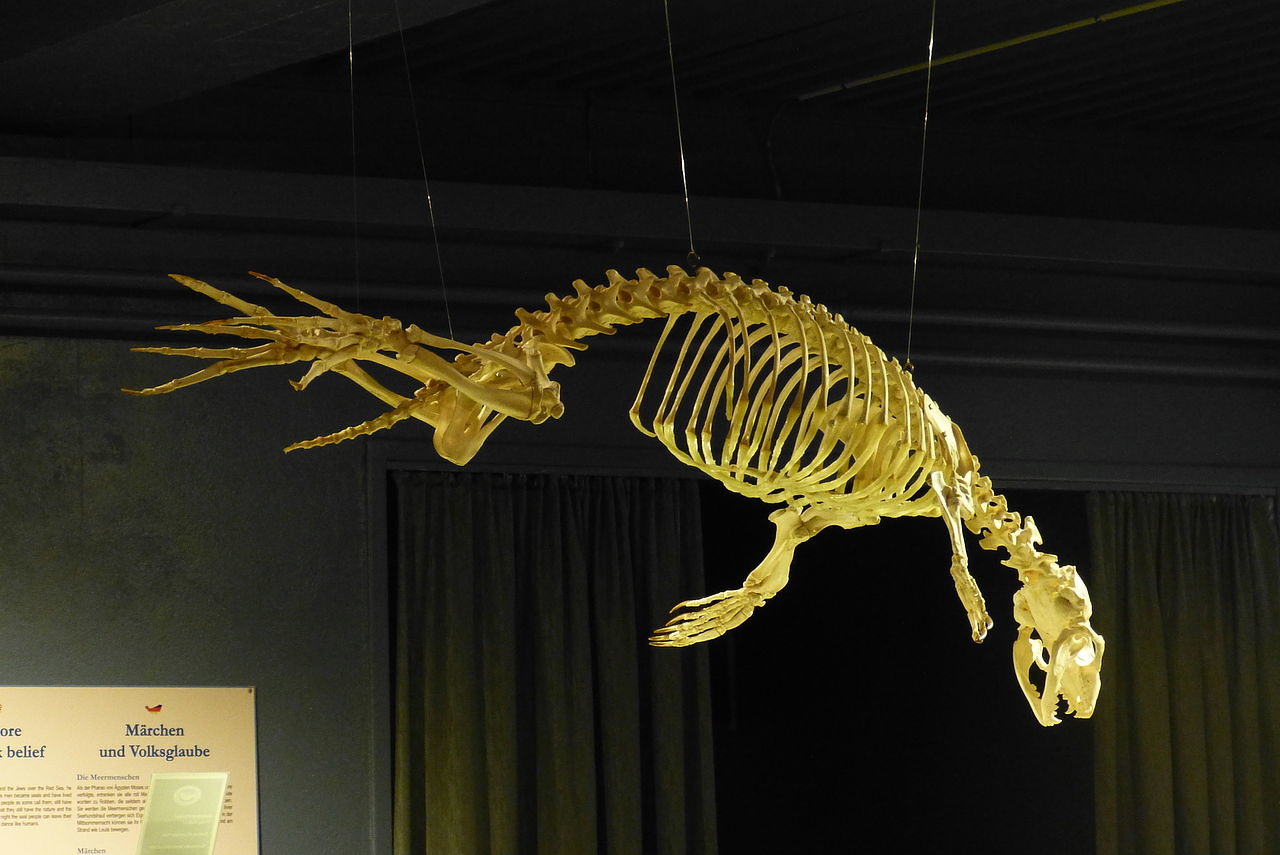
harbor seal skeleton
Kristan Cale wrote in Animal Diversity Web: Harbor seals are physically adapted to maximize propulsion while diving. Their large round heads that lack external ears, although their middle ear bones are large. Rather than exhaling before diving, they essentially stop breathing underwater and their heart rate slows, resulting in conservation of oxygen in their bodies. They have narrow nostrils that easily close during swimming. Their flippers are long and flat, each made up of five webbed digits. Speed and agility in the water is enhanced by use of their hind limbs and flexible side-to-side movements of their trunks. |=|
Harbor Seal Diet and Predators
Harbor seals are carnivores (animals that mainly eat meat or animal parts). Their diet consists mainly of fish, shellfish, crustaceans, octopus and squid. Harbor seals complete both shallow and deep dives while hunting depending on the availability of prey. that consume mostly fish. Mostly they to keep foraging efforts to a minimum and eating what is abundant and easily caught. [Sources: Kristan Cale, Animal Diversity Web, NOAA |=|]
Preferred medium-sized fish species include codfish (Gadus), hake (Merluccius merluccius), mackerel (Scombridae), and herring (Clupea harengus). When adults eat fish, they consume the fish whole or head first. Because newly weaned pups have poorly developed diving abilities, their diet consists primarily of crustaceans that are easier to catch. Harbor seals weighing 100 kilograms eat about five to seven kilograms of food per day.
Marine predators of harbor seals include large sharks, orcas (killer whales), and polar bears. Haul out sites help reduce predation by shortening the time they spend in water, Among dangers on land are polar bears and coyotes that sometimes prey on pups when their mothers are foraging in the sea. Humans hunt harbor seals in some areas of the Arctic. |=|
Harbor Seal Behavior
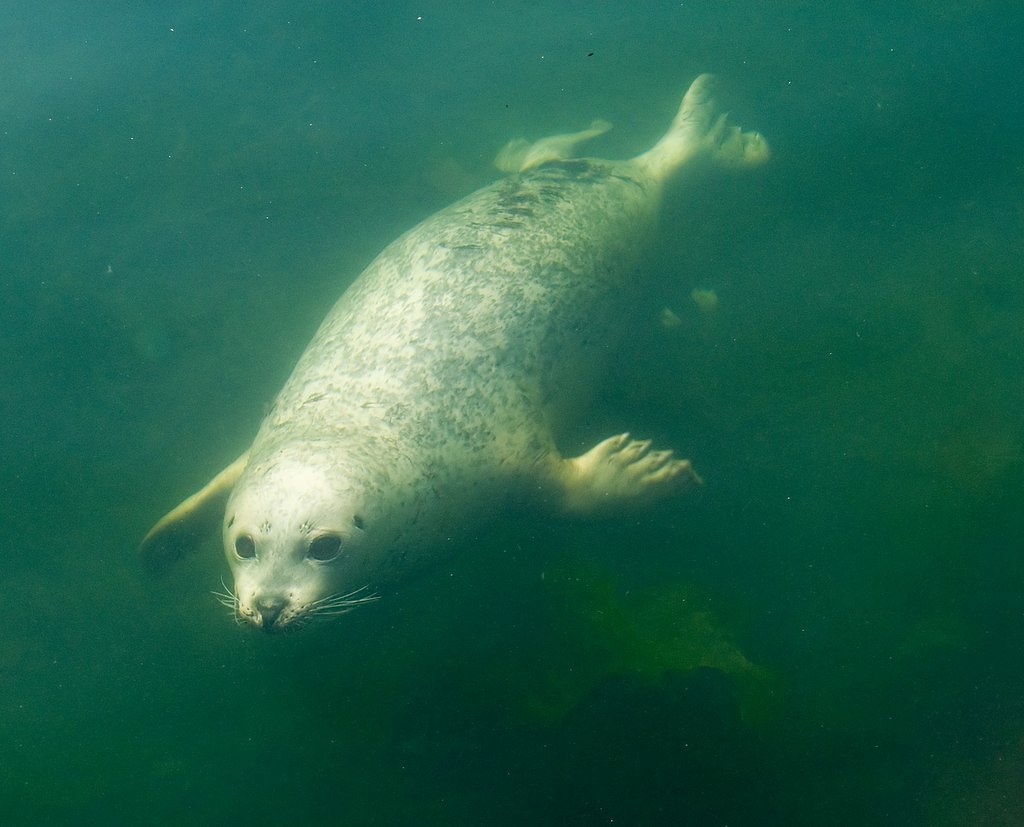
harbor seal swimming
Harbor seals are natatorial (equipped for swimming), diurnal (active mainly during the daytime), motile (move around as opposed to being stationary), sedentary (remain in the same area) and solitary. They can sleep underwater and come up for air once every 30 minutes. Their average territory size on land is 25 square meters. Harbor seal pups can swim at birth. They can also dive for up to two minutes when they are only two to three days old. [Source: NOAA, Kristan Cale, Animal Diversity Web (ADW) |=|]
Harbor seals haul out (rest) on rocks, reefs, beaches, and drifting glacial ice when they are not traveling and/or foraging at sea. They haul out to regulate their body temperature, molt, interact with other seals, give birth, and nurse their pups. Depending on the region, the majority of haul outs occur on land but can be onto to ice flows. Harbor seals haul out in groups to avoid predators and spend less time being watchful for predators than those that haul out alone.
Harbor seal pelvic bones are fused, preventing them from moving their hind flippers under their pelvis to walk on land like sea lions. Instead, they move by undulating in a caterpillar-like motion. This behavior does not mean they are injured. Harbor seals on land usually stay within a 50 meter radius of their haul out site. Closer proximity to land during foraging allows for an easier escape from predators, so most of their activity occurs within a 10 meter radius from haul out sites.
Harbor seals are usually solitary. They form small mixed groups of males, females, and pups around the pupping season and during molting, but individuals do not interact so much or exhibit social organization. Harbor seals usually molt within two to three months after the pupping season, which brings high numbers of seals to haul out locations. Pups normally molt first, followed by juveniles, then female adults, and lastly male adults. However, environmental factors such as precipitation and air temperature can affect their hauling out activity. |=|
Harbor seals do not migrate, but disperse a couple hundred kilometers away from where they reside to forage and breed, or occasionally to avoid environmental disturbances. They perform dives in different patterns. One study categorized their dives as either V-shaped or U-shaped. U-shaped dives account for 89 percent of feeding events regardless of region, sex, and age but were observed most often in adult females. Unweaned young engage in diving patterns similar to those of adult females while pups that are no longer nursing display more V-shaped dives which are more characteristic of adult males.
Harbor Seal Senses and Communication
Harbor seals communicate with vision and sound and sense using vision, touch, sound and chemicals usually detected with smell. They are regarded as less vocal than other eared seals. However, they do use non-harmonic vocalisations to maintain breeding territories, attract mates and also during mother and pup interactions. [Source: Wikipedia, Kristan Cale, Animal Diversity Web (ADW) |=|]
Harbor seals are extremely alert and appear to be continuously aware of their surroundings, even when in captivity. According to Animal Diversity Web: Their detected sound frequencies range from 0.1 to 10 kHz. Their relative “quietness” may be an adaptation to avoid predication. The noises they produce have been associated with sounding more like burping, grunting, and yelping. Harbor seals are recognized to be a profoundly playful species in both pups and adults. They often play by themselves and with other objects such as kelp.
Harbor seals have large eyes with corneas that are flattened that allow them to take in more light and see brighter images in dark water. Their sensitive whiskers acoustically detect sound waves, which is useful for catching prey. Another behavior they are known for is slapping their flippers vigorously against the water’s surface; the motive behind such action is still unknown. With such a wide geographical range, behaviors may vary between regions. |=|
Harbor Seal Mating and Reproduction
Harbor seals are considered mostly monogamous but there have been reports of polygamy (males have more than one female as a mate at one time) with a maximum of five successful fertilizations. Harbor seals employ delayed implantation (a condition in which a fertilized egg reaches the uterus but delays its implantation in the uterine lining, sometimes for several months) and embryonic diapause (temporary suspension of development of the embryo). Harbor seals usually breed once per year, normally in late winter to summer for a period of 10 weeks. The average gestation period is 10.5 months. The number of offspring is usually one, rarely two. [Source: Kristan Cale, Animal Diversity Web (ADW) |=|]
Harbor seals reach sexual maturity between three and seven years old and mate in the water. Males try to attract potential mates in different ways — mainly by showing off their vocal or diving skills and through fighting with other males near haul out sites where many females have gathered. Males may also establish territories in areas with many females to maximize contact with potential mates.
Female harbor seals typically give birth every season with pregnancy rates that are about 85 percent. After a female becomes fertilized, the delay of implantation lasts about 2.5 months. Then implantation resumes and develops for eight months before birth. The total gestation period lasts about ten and a half months.
Harbor Seal Offspring and Parenting
Parental care is provided by females. Birthing occurs close to the shore or on land, which appears to be an adaptation to protect females and pups from aquatic predators. The weaning age ranges from four to six weeks and the age in which they become independent ranges from four to six weeks. On average females reach sexual maturity at age three to four; and males do so at four to five years. Males reach physical maturity at seven to nine years of age. [Source: NOAA, Kristan Cale, Animal Diversity Web (ADW) |=|]
While females usually give birth during the spring and summer, the pupping season varies by location. Pups are born earlier in the south than in the north. The only exception is harbor seals in the inland waters of Washington, which are born two months later than seals along the coast of Washington. Within the first hour of birth, mothers bond to establish recognition, which is critical to the success or raising a harbor seal.
Newborns weigh eight to 12 kilograms (16 to 24 pounds) at birth. While some pups retain a fine, downy coat of hair called lanugo after birth, most shed it well before they are born. At birth, the pups' fur is the same texture as that of the adults, which allows them to safely enter cooler waters. However, adult fur coats don't develop until the end of the first summer.
Pups are ready to swim within minutes after birth. They can dive for up to two minutes when they are only two to three days old. They are nursed on milk that is 50 percent fat. The high fat content helps them grow fact. Like adults, seal pups haul out on shore to rest and regulate their body temperature.
Harbor seal pups are typically born within 10 week window which may occur at different times in different places. Mother harbor seals raise their pups in nurseries — groups of mothers and their young — that helps in protect the seals from predators. Until until the pups are weaned, they may cling to their mothers' backs in the water. By the end of their first month of life young embark on journeys of over 163 kilometers (100 miles) from their natal area.
Harbor Seals, Humans and Conservation
Harbor seals are not endangered. They are designated as a species of least concern on the International Union for Conservation of Nature (IUCN) Red List and have no special status according to the Convention on International Trade in Endangered Species (CITES).Harbor seals, like all marine mammals, are protected under the Marine Mammal Protection Act. [Source: Kristan Cale, Animal Diversity Web (ADW) |=|]
But that doesn’t mean they don’t have a hard time. Threats to harbor seals include net entanglement, illegal feeding and harassment, habitat degradation, chemical contaminants, oil spills, energy exploration, vessel collisions, disturbance and disease. Harbor seals have been hunted for their blubber, meat, fur, and skin. State-financed bounty hunters once hunted harbor seals in Washington and Oregon because they were considered competitors of fishermen. This hunting program ended in 1960. [Source: NOAA]
The total population of harbor seals has been increasing since around the 1970s. However, major die-offs have occurred in recent years where thousands of seals have died from diseases not previously known to be a problem. Harbor seals sometimes interfere with commercial and local fisheries. They lower the available fish supply for consumption. When they become entangled in nets they may break the nets, resulting in the release of fish that could have been caught by fishermen. |=|
Harbor seals have become entangled in fishing gear and other types of marine debris, either swimming off with the gear attached or becoming anchored. They can become entangled in many different gear types, including gillnets, trawls, purse seines, or weirs. Once entangled, seals may drown if they cannot reach the surface to breathe, or they may drag and swim with attached gear for long distances, ultimately resulting in fatigue, compromised feeding ability, or severe injury, which may lead to reduced reproductive success and death.
Illegal feeding of harbor seals can lead to many problems including habituation, aggression, negative impacts to fisheries, entanglement, injury, and death. Harassment, including repeated exposure to vessel traffic and disturbance, can degrade important nursery areas for harbor seals. Increased vessel traffic can also cause altered behavior, increased energetic expenditures, and increased exposure to stress. In Alaska, vessel traffic can also displace seals from ice floes, putting pups at risk from increased time spent in cold water and separated from their mothers.
Image Sources: Wikimedia Commons
Text Sources: Animal Diversity Web animaldiversity.org ; National Geographic, Live Science, Natural History magazine, David Attenborough books, New York Times, Washington Post, Los Angeles Times, Smithsonian magazine, Discover magazine, The New Yorker, Time, BBC, CNN, Reuters, Associated Press, AFP, Lonely Planet Guides, Wikipedia, The Guardian, Top Secret Animal Attack Files website and various books and other publications.
Last updated June 2025