
Home | Category: Pinnipeds (Seals, Sea Lions, Walruses)
BEARDED SEALS
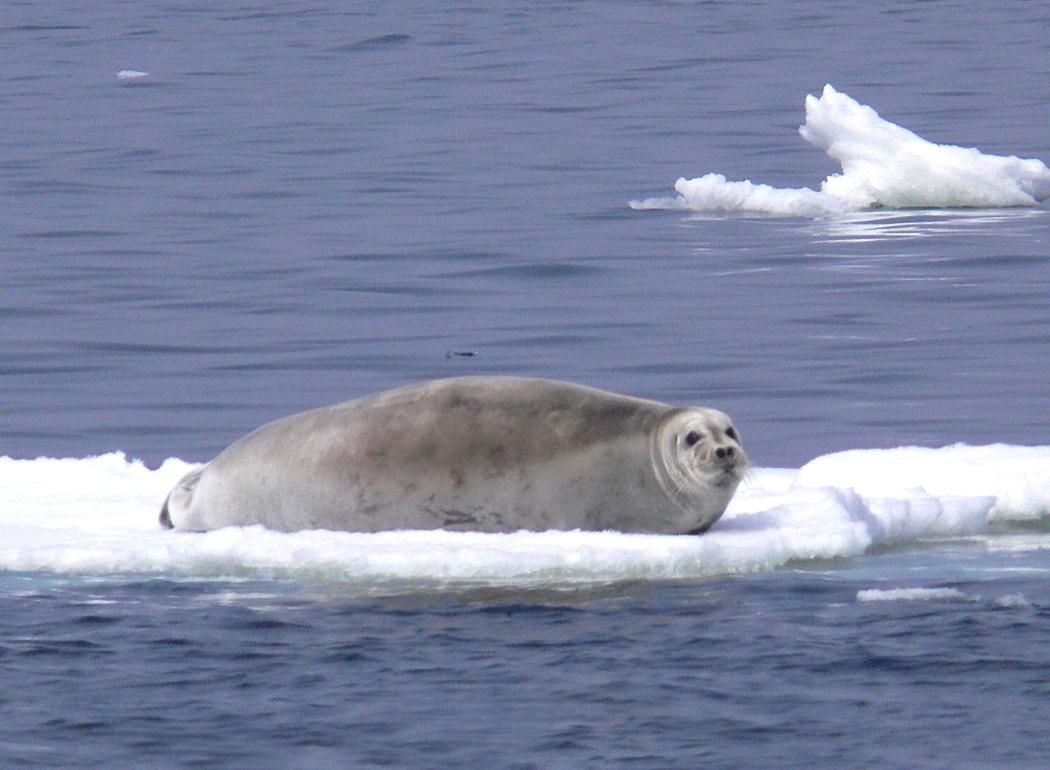
bearded seal resting on an ice floe
Bearded seals (Erignathus barbatus) are the largest northern seal species. They can reach 2.5 meters (8.2 feet) in length and weigh 340 kilograms (750 feet). Usually solitary they were hunted by the sealing industry. Inuit still hunt them for meat, leather and oil. Although most bearded seals do not live over 25 years in the wild, some have been recorded to live as long as 31 years. A critter cam was hooked up to one in 1997 by National Geographic researchers — one of the first uses of the devise on an aquatic animal.
Bearded seals get their name from the long white whiskers on their face. These whiskers are very sensitive and are used to find food on the ocean bottom. These seals give birth and rear pups on drifting pack ice over shallow waters where prey is abundant. They're very similar to walrus in behavior. They're bottom feeders. They eat crabs and shelled organisms on the floor, so they need ice over shallow water, over the (continental) shelf. If the ice retreats too far off the shelf, they're denied access to their food source." When females give birth, they need ice to last long enough in the spring and early summer to successfully reproduce and then molt, or shed and grown back their fur.
Bearded seals inhabit circumpolar Arctic and sub-Arctic waters that are relatively shallow (primarily less than about 490 meters, 1,600 feet deep) and seasonally ice-covered. Because bearded seals are closely associated with sea ice, particularly pack ice, their seasonal distribution and movements are linked to seasonal changes in ice conditions. To remain associated with their preferred ice habitat, bearded seals generally move north in late spring and summer as the ice melts and retreats and then south in the fall as sea ice forms. As such, they are sensitive to changes in the environment that affect the annual timing and extent of sea ice formation and breakup. [Source: NOAA]
Related Articles:
CATEGORY: SEALS: ioa.factsanddetails.com;
SEALS: CHARACTERISTICS, SENSES, WHISKERS, SPECIES ioa.factsanddetails.com;
SEALS: HISTORY, BEHAVIOR, DIVING, FEEDING, REPRODUCTION ioa.factsanddetails.com
SEA LIONS AND FUR SEALS: CHARACTERISTICS, BEHAVIOR, SPECIES, REPRODUCTION ioa.factsanddetails.com
SEALS AS PREY FOR ORCAS, GREAT WHITES AND POLAR BEARS ioa.factsanddetails.com ;
SEALS AND HUMANS: CLOTHES, HUNTS AND THE MILITARY ioa.factsanddetails.com ;
SEAL AND SEA LION ATTACKS ON HUMANS ioa.factsanddetails.com ;
NORTHERN SEALS: ARCTIC, SPECIES, CHARACTERISTICS, BEHAVIOR ioa.factsanddetails.com
HARBOR SEALS: CHARACTERISTICS, BEHAVIOR AND REPRODUCTION ioa.factsanddetails.com
RINGED SEALS: CHARACTERISTICS, BEHAVIOR AND REPRODUCTION factsanddetails.com
LEOPARD SEALS: CHARACTERISTICS, BEHAVIOR AND PENGUINS ioa.factsanddetails.com ;
STELLER SEA LIONS: CHARACTERISTICS, BEHAVIOR AND REPRODUCTION: ioa.factsanddetails.com ;
CALIFORNIA SEA LIONS: CHARACTERISTICS, BEHAVIOR AND REPRODUCTION ioa.factsanddetails.com
FUR SEALS: CHARACTERISTICS, BEHAVIOR, SPECIES ioa.factsanddetails.com ;
ELEPHANT SEALS, THEIR BEHAVIOR AND AMAZING DIVING ABILITY ioa.factsanddetails.com ;
NORTHERN ELEPHANT SEALS: CHARACTERISTICS, BEHAVIOR, FEEDING, MATING ioa.factsanddetails.com ;
SOUTHERN ELEPHANT SEALS: CHARACTERISTICS, BEHAVIOR, MATING ioa.factsanddetails.com
WALRUSES: CHARACTERISTICS, BEHAVIOR AND REPRODUCTION ioa.factsanddetails.com
Bearded Seal Habitat, Range and Subspecies
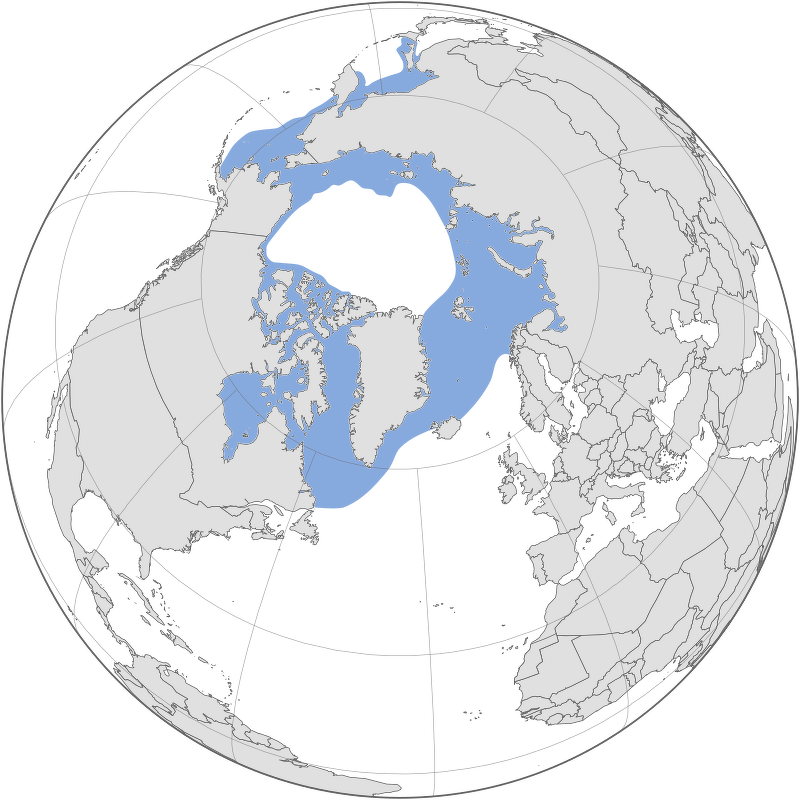
range of bearded seals
Bearded seals are circumpolar in their distribution, extending from the Arctic Ocean (85° north) south to Hokkaido (45° north) in the western Pacific. They generally inhabit areas of relatively shallow water (primarily less than 200 meters, 650 feet deep) that are at least seasonally ice-covered. Typically, these seals occupy ice habitat that is broken and drifting with natural areas of open water (such as, leads, fractures, and polynyas), which they use for breathing and accessing water for foraging. [Source: NOAA]
In U.S. waters off the coast of Alaska, bearded seals are found over the continental shelf in the Bering, Chukchi, and Beaufort Seas. The shallow shelf of the Bering and Chukchi Seas provides the largest continuous area of habitat for bearded seals. In late winter and early spring, bearded seals are widely but not uniformly distributed in the broken, drifting pack ice, where they tend to avoid the coasts and areas of fast ice (sea ice that remains attached to the coastline). To remain associated with their preferred ice habitat, most adult seals in the Bering Sea are thought to move north through the Bering Strait in late spring and summer as the ice melts and retreats. They then spend the summer and early fall at the edge of the Chukchi and Beaufort Sea pack ice and at the fragmented edge of multi-year ice. Some bearded seals — mostly juveniles — remain near the coasts of the Bering and Chukchi Seas during summer and early fall, where they are often found in bays, estuaries, and river mouths. As the ice forms again in the fall and winter, most bearded seals are thought to move south with the advancing ice edge. [Source: NOAA]
Bearded seal populations are geographically divided into two subspecies: 1) Eastern bearded seals (E. barbatus barbatus) and 2) Western bearded seals ( E. barbatus nauticus). Eastern bearded seals occupy parts the Arctic near the Atlantic Ocean, from the eastern Canada at the Gulf of Saint Lawrence to the waters around Norway. Western bearded seals reside in the Sea of Okhotsk and Bering Sea, and in areas of the Arctic Ocean not occupied by Eastern bearded seals. Bearded seals are often sighted as far south as Hokkaido, Japan. There have been sightings of Western bearded seals in China and of Eastern bearded seals in Portugal. It currently unknown why some animals travel so far south outside their normal range.[Source: Anthony Neuberger; Laurel Popplewell; Hillary Richardson, Animal Diversity Web (ADW) |=|]
Bearded seals prefer areas in shallow Arctic waters with lots of ice floes or pack ice, as these are what adults "haul out" on. They generally segregate, with one adult per ice floe. Bearded seals ride drifting ice floes for great distances, and their "migration" is thus dependent on the season, movements and distribution of ice floes. Bearded seals follow ice further south during the winter and further north during the summer. Riding drifting ice floes provides access to shallow water, in which they feed. However, they avoid ice floes on which walruses are abundant. Bearded seals rarely choose land over ice floes for hauling out. However, in summertime when ice floes are sparse, they have been known to haul out on land and gravel beaches. |=|
Bearded Seal Characteristics
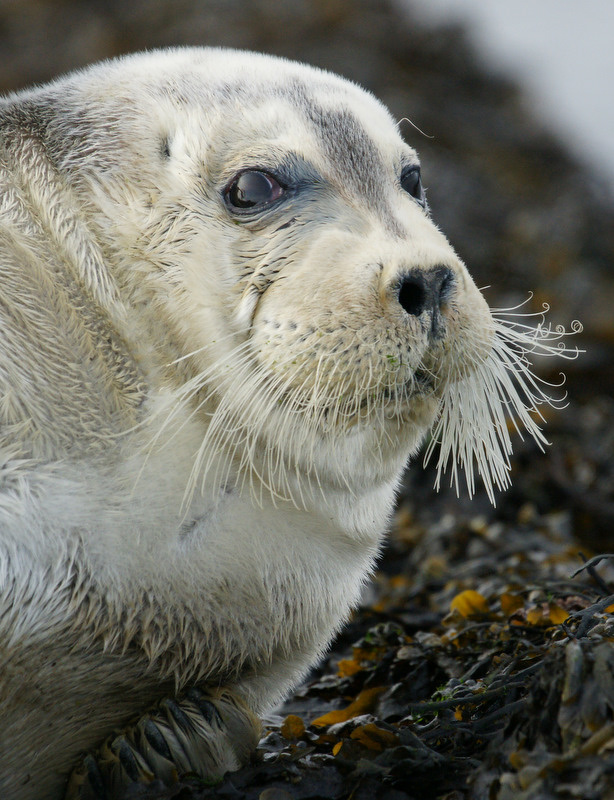
good look at a bearded seal "beard"
Bearded seals are the largest species of Arctic seal. They range in weight from 200 to 430 kilograms (440 to 947 pounds) and reach 2.5 meters (8.2 feet) in length. Their average length is 2.3 meters (7.55 feet) and their average weight is 200 to 250 kilograms. But between late fall and early spring can weigh up to 430 kilograms (950 pounds. At birth, pups average about 1.3 meters centimeters (four feet) in length and weigh 34 kilograms (75 pounds). Sexual Dimorphism (differences between males and females) is present: In some regions, females appear to be slightly larger than males. [Source: NOAA, Anthony Neuberger; Laurel Popplewell; Hillary Richardson, Animal Diversity Web (ADW) |=|]
Bearded seals generally have unpatterned gray to brown coats and large bodies. They have a short snout with thick, long white whiskers, which gives this species its "beard." Bearded seals can be distinguished from other northern seals by their distinctive whiskers as well as their small square foreflippers. Their front and hind flippers have pronounced, pointed claws. Their head appears proportionally small compared to their long body. |=|
Adult bearded seals possess straight, evenly-colored light gray to dark brown hair, and their back is darker then the rest of their body. Their flippers and face are generally brick to deep rust in color. In contrast, bearded seal pups are born with lighter colored faces with assorted ribbon-like bands across their back and crown. Pups have soft, fluffy fur that tends to be a silvery blue, light brown or gray. |=|
Bearded Seal Diet, Eating Behavior and Predators
Bearded seals are carnivores (eat meat or animal parts), molluscivores (eat molluscs) and piscivores (eat fish). They are primarily benthic (bottom-dwelling) feeders and primarily feed on or near the sea bottom on a variety of invertebrates (such as, shrimp, crabs, clams, and welks) and some fish (such as, cod and sculpin). While foraging, they typically dive to depths of less than 100 meters (325 feet). They do not like deep water and prefer to forage in waters less than 200 meters (650 feet) deep where they can reach the ocean floor. Still, adult bearded seals have been known to dive to depths greater than 1,600 feet. [Source: NOAA]
Bearded seals primarily eat local mollusks and crustaceans and Arctic cod. They have also been known to eat benthic (bottom-dwelling) fishes such as sculpins and flatfishes, and also American Plaice (Hippoglossoides platessoides). Bearded seals are important predators of benthic mollusks, crustaceans, fish, and octopi. They compete with other seal species for food; however walruses tend to be their main food competitor.[Source: Anthony Neuberger; Laurel Popplewell; Hillary Richardson, Animal Diversity Web (ADW) |=|]
Two primary predators feed on bearded seals: polar bears and orcas (killer whales.) Polar bears hunt seals by waiting near a breathing hole for their prey to surface. However, breathing holes of bearded seals usually form domes or caps of ice that they must dig through to reach the surface. This may serve as a defensive strategy, obscuring breathing hole positions and making them more difficult for polar bears to locate. Killer whales do not actively hunt bearded seals, but eat them opportunistically. Although rarely observed, pups of bearded seals are occasionally eaten by walruses. Bearded seals are also taken by humans through subsistence fishing by Native Americans in Canada and Alaska.
Bearded Seal Behavior
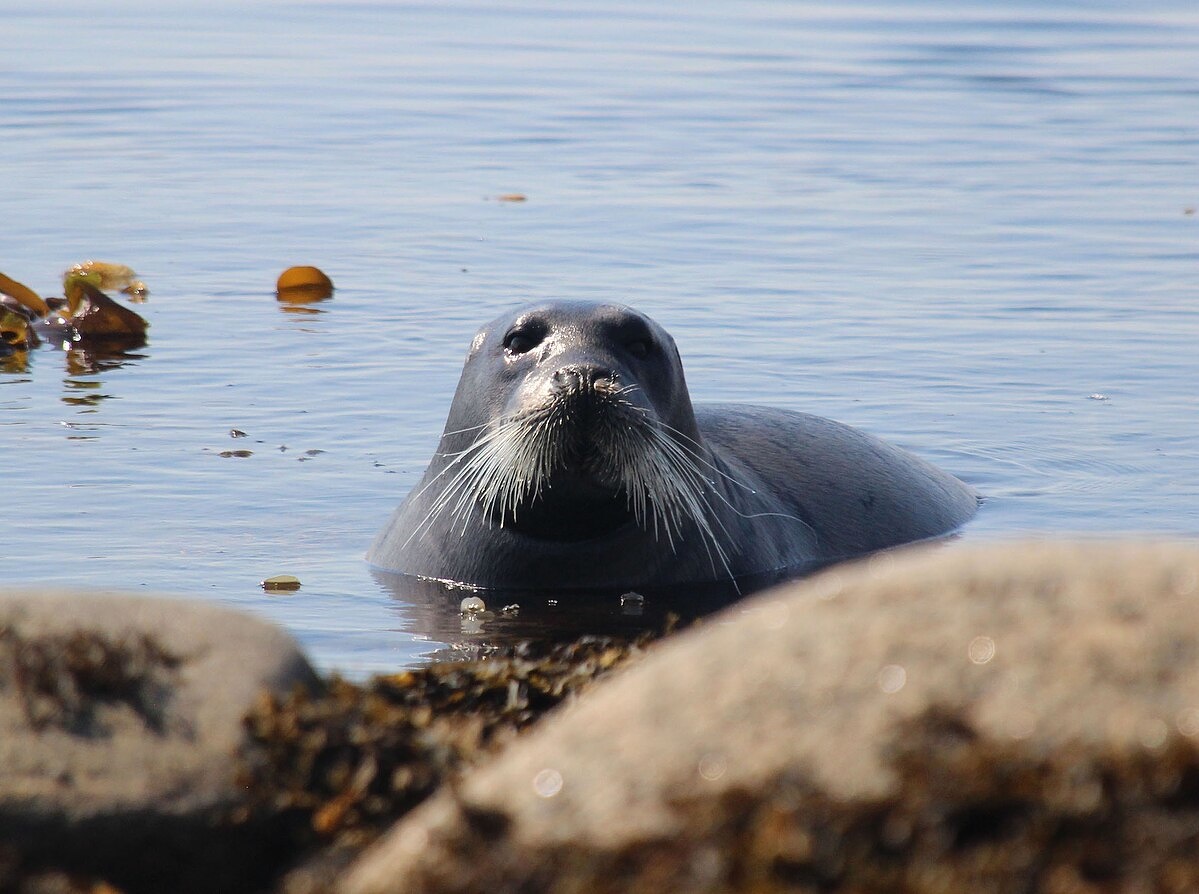
curious bearded seal in Russia
Bearded seals are solitary, natatorial (equipped for swimming), diurnal (active mainly during the daytime), motile (move around as opposed to being stationary), migratory (make seasonal movements between regions, such as between breeding and wintering grounds), and territorial (defend an area within the home range). Bearded seals home territories range from 0.27 to 12.5 square kilometers. They become territorial during fast-ice season and during breeding season when they haul out on separate ice floes. [Source: Anthony Neuberger; Laurel Popplewell; Hillary Richardson, Animal Diversity Web (ADW) |=|]
Bearded seals prefer sea ice with natural openings, though they can make breathing holes in thin ice using their heads and/or claws. Sea ice provides the bearded seal and its young some protection from predators, such as polar bears, during whelping and nursing. Sea ice also provides bearded seals a haul-out platform for molting and resting. Bearded seals are solitary creatures and can be seen resting on ice floes with their heads facing downward into the water. This allows them to quickly escape into the sea if pursued by a predator. Bearded seals also have been seen sleeping vertically in open water with their heads on the water surface. [Source: NOAA]
Bearded seals are solitary even in high densities. They maintain some distance from each other except during the breeding season. Generally, they maintain a density of one individual per ice floe or less. While hauling out, bearded seals face the water in order to spot predators. Bearded spend most of their awake time foraging in coastal and shallow seas. During breeding season, they are more localized and spend more time on pack ice. Occasionally, males fight over a female mate. |=|
Bearded Seal Senses and Communication
Bearded communicate with vision, touch and sound and sense using vision, touch, sound and chemicals usually detected with smell. They are extremely vocal. Males use elaborate songs to advertise breeding condition or establish aquatic territories. These vocalizations, which are individually distinct, predominantly consist of several variations of trills, moans, and groans. Some trills can be heard for up to 20 kilometers (12 miles) and can last as long as three minutes. [Source: NOAA]
Male bearded seals sing in what is believed to be either a courtship routine and/or a territorial , warning during the breeding season. Their minute-long songs can be described as sinister and monotone but also harmonious. They are generally characterized as chirps, ascents, sweeps, or grumbles.
During their song, bearded seals begin a slow, circular dive while emitting bubbles until resurfacing. It is believed that these songs are typical of courtship routines and or distinguishing breeding territory. Many underwater recordings of marine mammal communication in the Alaskan and Bering Strait region are predominately composed of songs of bearded seals. [Source: Anthony Neuberger; Laurel Popplewell; Hillary Richardson, Animal Diversity Web (ADW) |=|]
Bearded Seal Mating, Reproduction and Offsping
Bearded seals are polygynandrous (promiscuous), with both males and females having multiple partners, and employ delayed implantation (a condition in which a fertilized egg reaches the uterus but delays its implantation in the uterine lining, sometimes for several months). [Source: NOAA, Anthony Neuberger; Laurel Popplewell; Hillary Richardson, Animal Diversity Web (ADW) |=|]
Bearded seals breeds approximately once a year, usually in March through June. Males are at peak potency during May. The average gestation period is 11 months, including the two-month delayed implantation. The average number of offspring is one. Bearded seals breeding varies with seasonal ocean productivity.
In general, bearded seal females reach sexual maturity at around five to six years and males at six to seven years. Males exhibit breeding behaviors up to several weeks before females arrive at locations to give birth. Mating takes place soon after females wean their pups and males leave after mating. Due to their solitary nature, bearded seals do not establish long-term bonds with mating partners. Occasionally, males fight over a female mate. Male bearded seals sing in what is believed to be part of their courtship ritual routine and/or a territorial warning to other males. Due to delayed implantation and a long gestation period, female bearded seals do not give birth until the following summer. During gestation, females gain weight to build up a supply of milk.
Parental care by bearded seals is provided by females. Males leave females after mating and provide no parental care to pups. Like many Arctic seals, female bearded seals give birth to their pups on ice floes. Unlike their close relative ringed seals, however, they do not use or assemble subnivean birth lairs. While weaning her pup, a mother does not leave the ice flow. She does not eat until her pup is weaned and can be left alone. The weaning age ranges from 18 to 24 days. Females reach sexual maturity at three to eight years. Males reach sexual maturity at six to seven years.
Females give birth to a single pup while hauled out on annual pack ice, usually between mid-March and May. Bearded seal pups weighs approximately 34 kilograms at birth. Within several days, pups enter the water. Pups are nursed on the ice, and by the time they are a few days old, they spend half their time in the water. Pups transition to diving and foraging while still under maternal care during a lactation period of about 24 days. Within a week of birth, pups are capable of diving to a depth of 65 meters (200 feet). Pups are weaned by late summer have ample time to create blubber before the winter.
Bearded Seals, Humans and Conservation
Bearded seals are not endangered. They are designated as a species of least concern on the International Union for Conservation of Nature (IUCN) Red List and have no special status according to the Convention on International Trade in Endangered Species (CITES). There are estimated to be between 500,000 and 1 million bearded seals worldwide. Threats include climate change, increased shipping activity, oil and gas exploration and development
Bearded seals have been traditionally hunted by the Inuit people for meat, blubber, oil and leather. The skin has been used to make umiaks (boats) and maklak (boots). Although subsistence harvest of bearded seals occurs in some parts of the species’ range, there is little or no evidence that these harvests currently have or are likely to pose a significant threat. While the United States does not allow commercial harvest of marine mammals, such harvests are permitted in some other portions of the species’ range; however, there is currently no significant commercial harvest of bearded seals and significant harvests seem unlikely in the foreseeable future. [Source: NOAA]
Bearded seals, like all marine mammals, are protected under the Marine Mammal Protection Act. The Okhotsk and Beringia distinct population segments of the Pacific sector are listed as threatened under the Endangered Species Act. In some cases, bearded seals have been harmed by habitat destruction and overfishing of their prey species. Climate change may result in decreased ice floes, which would negatively impact habitat availability for bearded seals. |=|
Tama-Chan
In 2002 and 2003, Japanese became enchanted with Tama-chan, a bearded seal that forsook its usual hunting grounds in Arctic waters and choose instead to spend her time in rivers around Tokyo. She became a media star and tourist attraction. Sightings of her were top stories on the evening news. Whenever she decided to beach herself large crowds would gather, alerted of her location by cell phone messages. It is believed to that she hung around the areas because she found plentiful supplies of fish and shellfish to eat. She was named Tama-chan after the Tama River, where she was first spotted.
It wasn’t clear whether Tama-chan was male of female. She (he) was spotted mostly in rivers and canals around Yokohama, Tokyo and Kanagawa and Saitama Prefecture, where she liked to rest on the rear deck of a pleasure boat. She became so famous songs were written about her, ice cream and drinks were sold by vendors at places where people gathered to watch her. She was even given honorary citizenship to Yokohama’s Nishi Ward and a special society was established to watch over her. A religious cult announced that saving Tama-chan was paramount to saving the world.
Bakers made Tama-chan bean paste deserts. Toy makers rushed to Tama-chan stuffed toys on the shelves. A group of animals rights activists in scuba gear tried to catch her with nets because they worried about the effects of polluted water in her skin. Others were worried about power boats, There was great concern when a fish hook became lodged near her eye (after a couple of days it was gone).
Image Sources: Wikimedia Commons
Text Sources: Animal Diversity Web animaldiversity.org ; National Geographic, Live Science, Natural History magazine, David Attenborough books, New York Times, Washington Post, Los Angeles Times, Smithsonian magazine, Discover magazine, The New Yorker, Time, BBC, CNN, Reuters, Associated Press, AFP, Lonely Planet Guides, Wikipedia, The Guardian, Top Secret Animal Attack Files website and various books and other publications.
Last updated June 2025