
Home | Category: Pinnipeds (Seals, Sea Lions, Walruses)
NORTHERN FUR SEALS
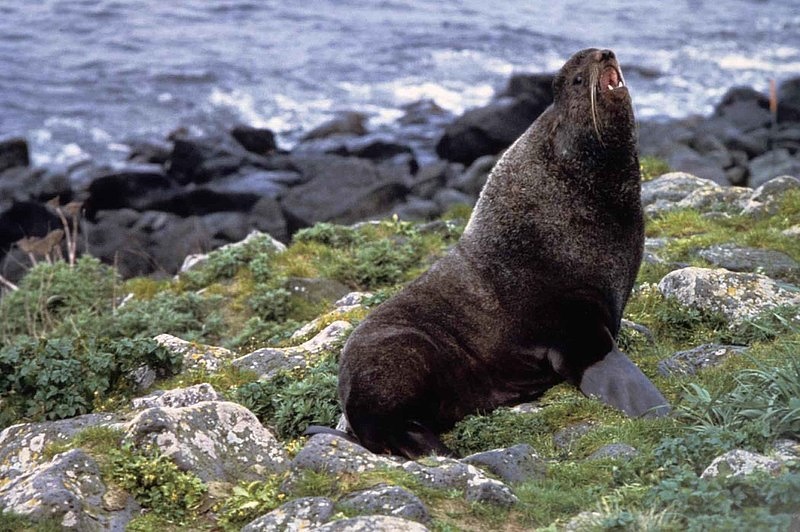
Northern fur seal
Northern fur seals (Scientific name: Callorhinus ursinus) range over a large area from the Bering Sea in the east to the Japanese islands of Hokkaido and Honshu in the west. Also known as the Alaska or Proibilof fur seal, northern fur seals feed on fish and squid and hunt at night. They have very sensitive whiskers which they use to track prey. They in turn are fed on by sharks and killer whales. Sometimes pups are taken by foxes on land. There are around 650,000 of them. It was once estimated that there were more than a million of them.
Northern fur seals get their name from their fur, which looks black when wet but is brownish gray or reddish brown on males and silvery-gray with a white patch on females. Their hair is densely packed at 60,000 hairs per square centimeter, forming a waterproof coat and layer of insulation that allows the animal to thrive in cold water and deep sea environments. Their blood contains 3½ times the hemoglobin of humans.
Northern fur seals are members of the "eared seal" family (Otariidae). They spend most of the year in the ocean. Males can live up to 18 years, while females can live up to 27 years. Weaned pups typically spend nearly two years away before returning to their breeding colonies. Northern fur seals primarily use open ocean for foraging and rocky beaches for resting and reproduction. [Source: NOAA]
Northern fur seals often sleep in the open sea. They sleep unihemispherically, which means that one hemisphere of the brain sleeps while the other is awake. Dominant males form harems with 20 or 30 members and occasionally up to 100. They copulate with females for a month without eating and lose about 25 percent of their body weight. Sometimes females mate again within 48 hours of giving birth.
Northern fur seals have been hunted by Russians, Americans, Canadians and Japanese. for their fur and body parts which are regarded as having medicinal properties. One Japanese shogun ate fur seal extracts for strength. Hunting them is a matter of considerable controversy. Images of baby fur seals being clubbed
Related Articles:
CATEGORY: SEALS: ioa.factsanddetails.com;
FUR SEALS: CHARACTERISTICS, BEHAVIOR, SPECIES ioa.factsanddetails.com ;
SEA LIONS AND FUR SEALS: CHARACTERISTICS, BEHAVIOR, SPECIES, REPRODUCTION ioa.factsanddetails.com
STELLER SEA LIONS: CHARACTERISTICS, BEHAVIOR AND REPRODUCTION: ioa.factsanddetails.com ;
CALIFORNIA SEA LIONS: CHARACTERISTICS, BEHAVIOR AND REPRODUCTION ioa.factsanddetails.com
SEALS: CHARACTERISTICS, SENSES, WHISKERS, SPECIES ioa.factsanddetails.com;
SEALS: HISTORY, BEHAVIOR, DIVING, FEEDING, REPRODUCTION ioa.factsanddetails.com
SEALS AS PREY FOR ORCAS, GREAT WHITES AND POLAR BEARS ioa.factsanddetails.com ;
SEALS AND HUMANS: CLOTHES, HUNTS AND THE MILITARY ioa.factsanddetails.com ;
SEAL AND SEA LION ATTACKS ON HUMANS ioa.factsanddetails.com ;
NORTHERN SEALS: ARCTIC, SPECIES, CHARACTERISTICS, BEHAVIOR ioa.factsanddetails.com
HARBOR SEALS: CHARACTERISTICS, BEHAVIOR AND REPRODUCTION ioa.factsanddetails.com
BEARDED SEALS: CHARACTERISTICS, BEHAVIOR AND REPRODUCTION ioa.factsanddetails.com
RINGED SEALS: CHARACTERISTICS, BEHAVIOR AND REPRODUCTION factsanddetails.com
LEOPARD SEALS: CHARACTERISTICS, BEHAVIOR AND PENGUINS ioa.factsanddetails.com ;
ELEPHANT SEALS, THEIR BEHAVIOR AND AMAZING DIVING ABILITY ioa.factsanddetails.com ;
NORTHERN ELEPHANT SEALS: CHARACTERISTICS, BEHAVIOR, FEEDING, MATING ioa.factsanddetails.com ;
SOUTHERN ELEPHANT SEALS: CHARACTERISTICS, BEHAVIOR, MATING ioa.factsanddetails.com
WALRUSES: CHARACTERISTICS, BEHAVIOR AND REPRODUCTION ioa.factsanddetails.com
Websites and Resources: Animal Diversity Web (ADW)
Northern Fur Seal Habitat, Migrations and Where They Are Found
Northern fur seals live in the north Pacific Ocean, with breeding grounds in Pribilofs and Commander islands and off the coast of California. There are estimated to 8,000 breeding pairs on San Miguel island, 628,000 in the Pribilofs and 442,000 at Russian rookeries. [Source: Canon advertisement]
Northern fur seals primarily inhabit two types of habitat: open ocean and rocky or sandy beaches on islands for resting, reproduction, and molting. They seals seasonally breed on six islands in the eastern North Pacific Ocean and Bering Sea in the United States — St. Paul, Bogoslof, St. George, Sea Lion Rock, San Miguel, and South Farallon. They also breed on the Commander Islands, Kuril Island, and Robben Island. The Pribilof Islands support the largest aggregation of northern fur seals, which breed on St. Paul, St. George, and Sea Lion Rock (about half of the world's northern fur seal population). Non-breeding northern fur seals haul-out on Walrus Island and Otter Island which are also part of the Pribilof Islands. [Source: NOAA]
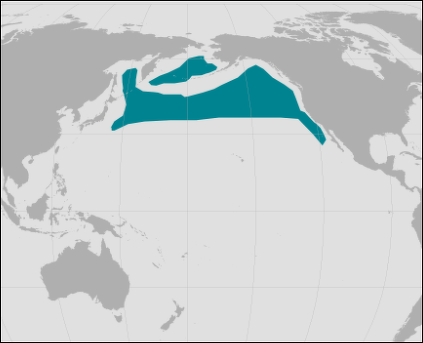
Northern fur seal range
Adult northern fur seals spend more than 300 days per year (about 80 percent of their time) at sea. During the summer and autumn they intermittently fast while on land and feed at sea. During the winter and spring they are pelagic, occupying the North Pacific Ocean as well as the Bering and Okhotsk Seas. In the open ocean, concentrations of northern fur seals may occur around oceanographic features — such as eddies, convergence-divergence zones, and frontal boundaries — because of the availability of prey in those places. In the winter, the southern boundary of the northern fur seal range extends across the Pacific Ocean, between southern California and Honshu Island, Japan, but they are found as far north as the Bering Sea.
In the spring, most northern fur seals migrate north to breeding colonies in the Bering Sea. Territorial adult male northern fur seals leave their breeding colonies in August and are thought to spend most of their time in the Bering Sea and North Pacific Ocean along the Aleutian Islands. Pregnant adult females begin their winter migration in November and generally travel to either the central North Pacific Ocean or to offshore areas along the west coast of North America to feed. Some northern fur seals may spend all year in the waters around San Miguel Island, California.
Northern Fur Seal Physical Characteristics
Sexual dimorphism (differences between males and females) is very pronounced with Northern fur seals. Adult males are up to 370 percent larger than adult females. Adult Northern fur males reach a length of 2.1 meters (7 feet) and weigh up 275 kilograms (600 pounds). Females reach 1.5 meters (5 feet) and weigh up to 65 kilograms (140 pounds) Pups are 60 centimeters (two feet) long when they are born. Their lifespan is up to 18 years for males and 27 years for females.
Northern fur seals have a stocky body, small head, very short snout, and extremely dense fur (46,500 fibers/centimeters²) that ends at the wrist lines of their flippers. Their flippers are the longest in the Otariidae family. Their hind flippers can measure up to one-fourth of their total body length. Their fore flippers are incredibly strong allowing them to walk or run on all fours. They can outrun a human on slippery rocks and can climb nearly vertical cliffs. [Source: NOAA]
Adult males are dark brown to black, and adult females are dark gray or brown on their backs and light gray, silver, or cream on their throat, chest, and stomach.The adults also have white whiskers, known as vibrissae, while the juveniles and pups have black vibrissae. Pups are uniformly black until they molt when they are around three months old.
Northern Fur Seal Behavior and Feeding
Northern fur seals are a highly pelagic (open ocean), mostly solitary, nocturnal species. They seals often sleep in the open sea — unihemispherically, which means that one hemisphere of the brain sleeps while the other is awake. They are known to be aggressive on land, especially during breeding and mating season. Adult males forcefully defend their breeding territory site. Male to male aggression is most frequently used in defense of territories and consists of pushing and biting, sometimes to the death. Female to female aggression is frequent but mild (open mouth threat). Intense female to female aggression (biting and pushing) is rare. [Source: NOAA]
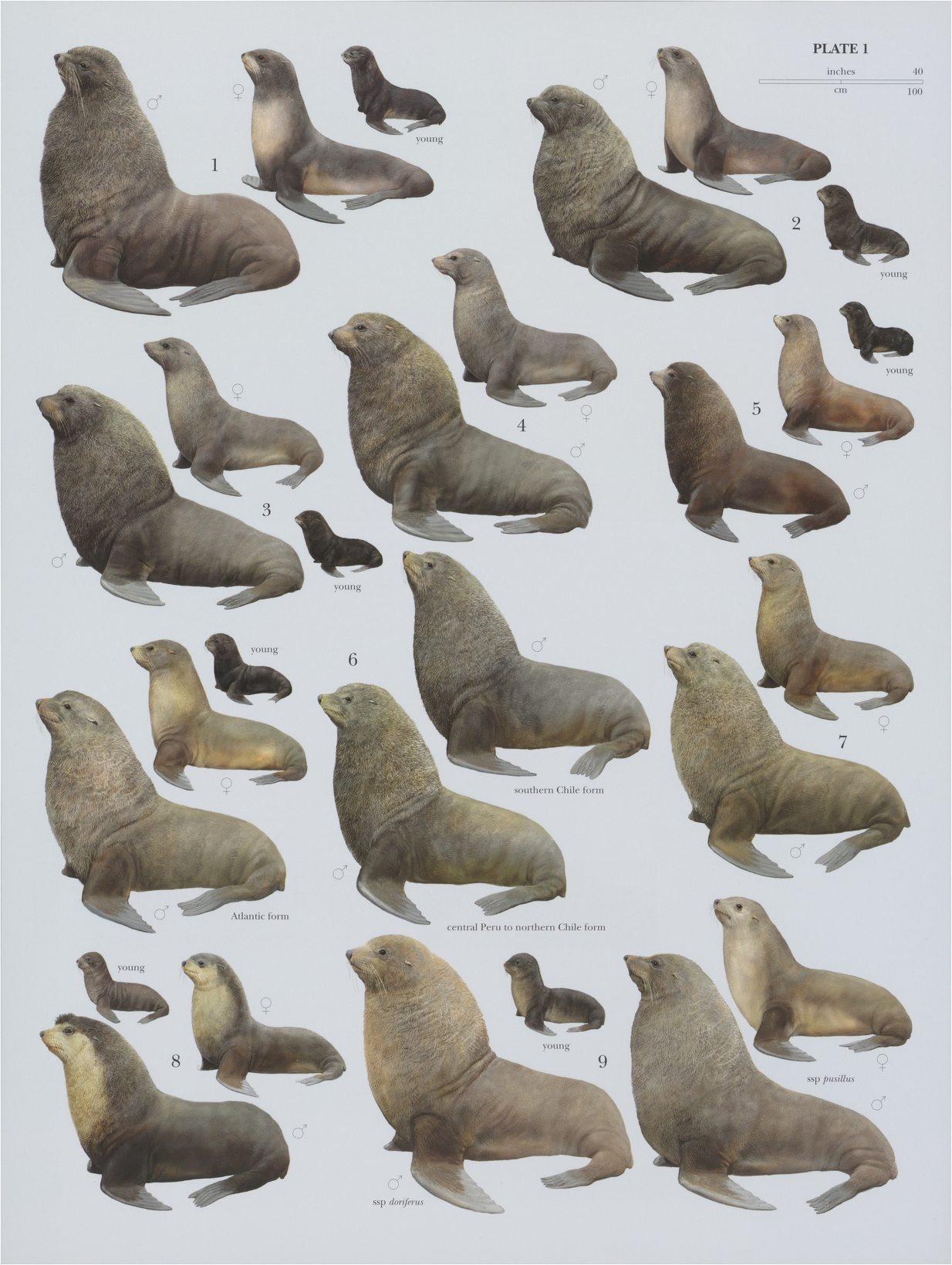
1) Northern Fur Seal (Callorhinus ursinus), 2) Antarctic Fur Seal (Arctocephalus gazella), 3) Juan Fernandez Fur Seal (Arctocephalus philippii), 4) Guadalupe Fur Seal (Arctocephalus townsendi), 5) Galapagos Fur Seal (Arctocephalus galapagoensis), 6) South American Fur Seal (Arctocephalus australis), 7) New Zealand Fur Seal (Arctocephalus forsteri), 8) Subantarctic Fur Seal (Arctocephalus tropicalis), 9) Afro-Australian Fur Seal (Arctocephalus pusillus)
Northern fur seals feed on wide variety of fish and sea creatures and are able to sleep in the water on their back due to their extraordinary buoyancy. Only during the breeding season to they spend a lot of rime on land, when bulls aggressively defend territories of several square meters,
Northern fur seals are described as generalist or opportunistic foragers, consuming a wide variety of midwater shelf fish and squid species. Walleye pollock is the predominant prey of northern fur seals that forage over the Bering Sea shelf. They consume greater amounts of oceanic fish and squid species when they forage over the slope and in off-shelf waters. Other primary prey include Pacific sand lance, Pacific herring, Northern smoothtongue, Atka mackerel, and Pacific salmon. The northern fur seal diet differs depending on geographic area and time of year. Northern fur seal diet and tracking (telemetry) studies indicate they forage in colony-specific areas, while they use their preferred land sites for resting and reproduction.
Northern Fur Seal Reproduction
Northern fur seals are born in the water. They stay close to their mothers the first few days and after that explore and feed on their own, Dominant males form harems with 20 or 30 members and occasionally up to 100. They copulate with females for a month without eating and lose about 25 percent of their body weight. Sometimes females mate again within 48 hours of giving birth. [Source: NOAA]
Beginning in May, male seals start returning to the breeding islands. Older males, or bulls, arrive first to vie for prime breeding territories before the females arrive. A male’s ability to mate depends on several factors, such as body size, fighting ability, size and location of the chosen breeding territory, and skill at interacting with females. Because males do not leave the breeding territory to feed, their ability to fast is critical. Males remain on their territory an average of 50 days, losing 20 percent to 25 percent of their body mass. Breeding males are typically 10 or more years old and maintain females within their territories. A small number of the total adult males in a territory accomplish most of the breeding.
Adult males are counted annually during the peak of the breeding season as an index of the population size. They are categorized as territorial with females, territorial without females, or non-territorial. There is some turnover of territorial males in August, allowing non-territorial males to occupy sites abandoned by territorial males, but the vast majority of adult females have already mated at this point. Territorial males exclude juvenile males from the breeding areas.
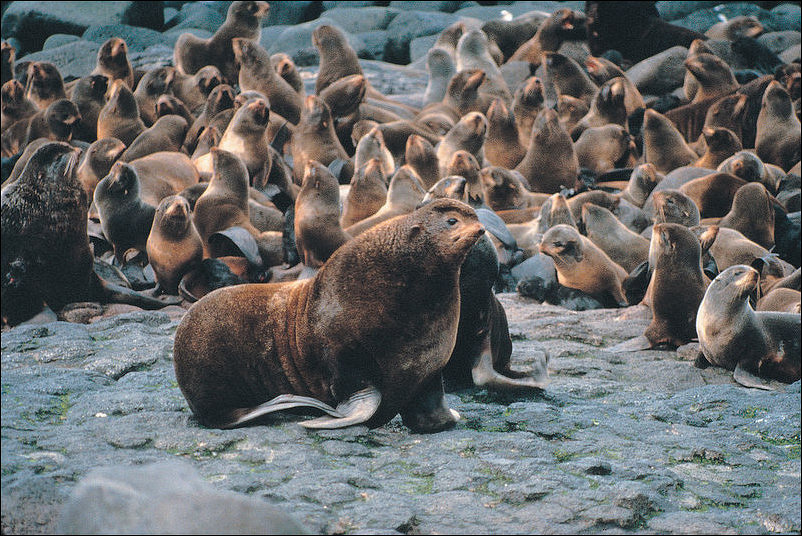
Northern fur seal male with his harem
Juveniles instead congregate on land in areas called "haulouts" during the summer breeding season. The haulouts can be located inland, typically behind the breeding areas, or adjacent to the breeding areas. The typical structure of northern fur seal terrestrial habitat consists of the core group of breeding males with females, idle males without females on the fringe of the core area, and non-territorial males and juvenile males on haulouts outside the breeding areas.
Females generally have their first pup at 5 to 6 years of age and are in their reproductive prime between the ages of 8 and 13. They are not selective in their choice of mate, but they do show an affinity for a specific breeding site. Females typically start returning to the breeding islands in late June and give birth to a single pup a few days after arriving on land. Mating occurs within 5.3 days of giving birth. Female northern fur seals undergo embryonic diapause, meaning the embryo does not immediately implant in the uterus but is delayed until after lactation, or weaning. Females suckle their pups for 5 to 6 days and then go to sea to forage for 3.5 to 9.8 days. Pups are nursed until weaning (about 4 months) and leave the breeding site before their their mothers to forage independently for the first time.
Threats to Northern Fur Seals
The greatest threat to northern fur seals has been human hunters. They were hunted aggressively in the early 20th century for their fur on land and at sea, and their numbers shrunk considerably. In 1911, the Fur Seal Treaty created an international prohibition on hunting fur seals at sea. In 1984, the United States ended commercial harvest of northern fur seals on the Pribilof Islands. They have come back strong since then and are not hunted so much but are sometimes affected by disease ad food-chain disturbances. [Source: NOAA]
Northern fur seals, like all marine mammals, are protected under the Marine Mammal Protection Act (MMPA). In 1988, the Pribilof-Islands-Eastern Pacific population was designated as a depleted stock under the Marine Mammal Protection Act (MMPA) because it had declined by more than 50 percent from its estimated population of 2.1 million seals in the 1950s. The 2017 abundance estimate for the eastern Pacific stock is 620,660 northern fur seals. The California Stock is significantly smaller than the eastern Pacific stock. It was estimated to have 14,050 northern fur seals in 2016.
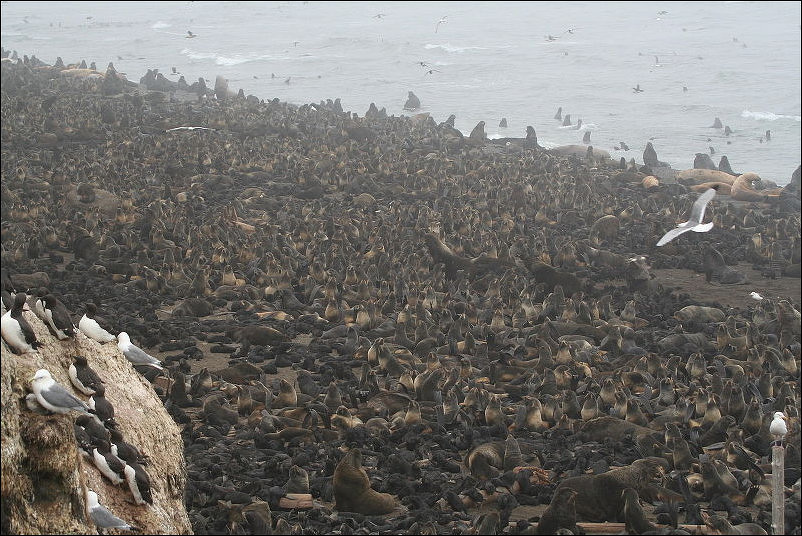
huge Northern fur seal rookery on Tyuleny Island (Ostrov Tyuleniy, a small island in the Sea of Okhotsk, east of Russia's Sakhalin Island, in Northeast Asia
The killer whale is a primary predator of northern fur seals, but Steller sea lions are also known to prey on northern fur seals. Sharks may also prey on them. Human-produced threats include changes in available food, entanglement in fishing gear, habitat degradation, illegal taking, oil spills, environmental changes, oil and gas exploration, human presence, disturbance by marine vessels or aircraft, chronic pollution, and illegal harvests.
Entanglement in Marine Debris and Lost or Abandoned Fishing Gear: Northern fur seals can become entangled in lost or abandoned fishing gear such as trawl webbing, packing bands and monofilament nets, or other marine debris, either swimming off with the gear attached or becoming anchored. Northern fur seals encounter marine debris during their winter and spring migrations when they spend most of their time in the North Pacific foraging in the transition zone and eddies. They also encounter marine debris in the Bering Sea during their travels to and from their rookeries. Once entangled, seals may drag and swim with attached gear for long distances, ultimately resulting in fatigue, compromised feeding ability, or severe injury, which may lead to reduced reproductive success and death.
Changes in Available Food Due to Commercial Fishing: The type of available prey, access to prey, and distribution of prey can change for a variety of reasons. For example, regional and local prey can change because of changes in climate, oceanography, and the overall complexity of the oceans ecosystem. In addition, cumulative and annual commercial fisheries may result in reduced availability of northern fur seal prey. Fishery interactions can include fisheries bycatch and indirect effects like competition for commercial fish species.
Environmental Contaminants can enter the ocean and subsequently affect the food chain of the northern fur seal. Contaminant studies on northern fur seals have shown exposure to various toxic substances and evidence of accumulation in various tissues. Contamination sources can include oil and gas development, industrial runoff, vessel discharge, microplastics, vessel grounding, and oil spills. These contaminants have the potential to affect the immune system of northern fur seals, leaving them more susceptible to disease.
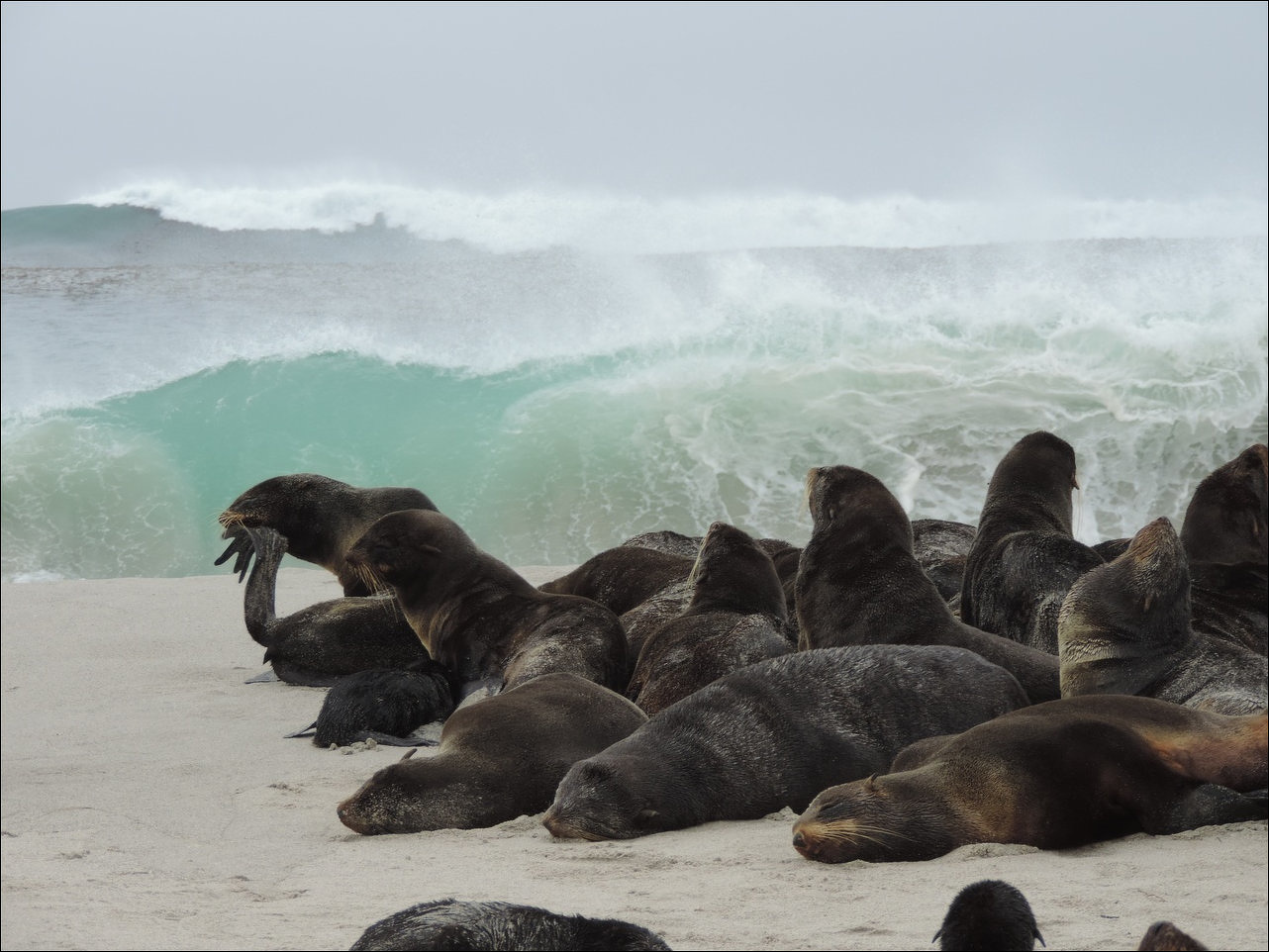
Northern fur seal on the Channel Islands
Image Sources: Wikimedia Commons, NOAA
Text Sources: Animal Diversity Web (ADW) animaldiversity.org; National Oceanic and Atmospheric Administration (NOAA) noaa.gov; Wikipedia, National Geographic, Live Science, BBC, Smithsonian, New York Times, Washington Post, Los Angeles Times, The New Yorker, Reuters, Associated Press, Lonely Planet Guides and various books and other publications.
Last Updated June 2023