
Home | Category: Pinnipeds (Seals, Sea Lions, Walruses)
WALRUSES
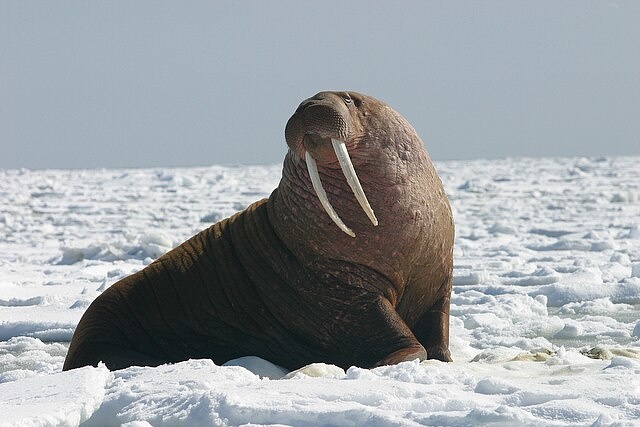
Pacific walrus bull
Walruses are the largest northern mammal save whales. Their scientific name, “Odebenus rosmarus, “means "tooth walking sea horse." Residing primarily in the Arctic, walruses are the sole member of the Odobenidae family which was considerably more diverse in the past. Walruses are pinnipeds like seals and sea lions but the Odobenidae family is different from seals and sea lions a;though they share anatomical characteristics with them. Like sea lions, walruses are able to turn their hind flippers forward, enabling them to move with some speed on land. Seals can't do this and have to move like caterpillars. Like seals, walruses don’t have external flaps on their ears. [Source: Richard Mathews, Smithsonian magazine; G. Carleton Ray, National Geographic, October 1979 ☺]
A male walrus is called a bull. A female is called a cow. Young are called calves. A group is used to be called a herd. Atlantic and Pacific walrus inhabit moving pack ice and rocky islands in the Arctic and subarctic. All have tusks. Males have larger ones than females. . Their coarse whiskers help them locate their food. The average lifespan for walruses is between 30 to 40 years in the wild. Calves have a high survival rate due to the protection by females. Lower life spans may be a result of poachers and hunters.
There are an estimated 250,000 walruses in the world. Walrus subspecies:
Atlantic walruses (O. r. rosmarus) have been designated Near Threatened on the International Union for Conservation of Nature (IUCN) Red List. There are around 25,000 of them
Pacific walruses (O. r. divergens) are listed as Near Threatened on the IUCN Red List. There are estimated to be around 200,000 of them
For a while a third subspecies — Laptev walruses (O. r. laptevi) — was considered. This isolated population in the Laptev Sea off of Russia was not accepted by International the IUCN, but accepted by Mammal Species of the World, the Integrated Taxonomic Information System (ITIS) and many Russian biologists. It is now widely recognize to be of Pacific walrus origin. Laptev walruses are the smallest walruses and only a few thousand exist; relatively little is known about them.
Walruses are difficult and expensive to study and they have little impact on people and thus little is known about the details of walrus life. Walrus numbers have declined. The disappearance of Arctic ice is blamed. With ice flows farther from shore the walruses have dive deeper and longer to find food. In some cases summer sea ice receded beyond the shallow continental shelf, making food very difficult to get.
Related Articles:
WALRUSES, HUMANS AND CONSERVATION: HUNTS, ATTACKS, CLIMATE CHANGE, DEATHS factsanddetails.com
SEALS: CHARACTERISTICS, SENSES, WHISKERS, SPECIS ioa.factsanddetails.com;
SEALS: HISTORY, BEHAVIOR, DIVING, FEEDING, REPRODUCTION ioa.factsanddetails.com
SEA LIONS AND FUR SEALS: CHARACTERISTICS, BEHAVIOR, SPECIES, REPRODUCTION ioa.factsanddetails.com
NORTHERN SEALS: ARCTIC, SPECIES, CHARACTERISTICS, BEHAVIOR ioa.factsanddetails.com
BEARDED SEALS: CHARACTERISTICS, BEHAVIOR AND REPRODUCTION ioa.factsanddetails.com
STELLER SEA LIONS: CHARACTERISTICS, BEHAVIOR AND REPRODUCTION: ioa.factsanddetails.com ;
FUR SEALS: CHARACTERISTICS, BEHAVIOR, SPECIES ioa.factsanddetails.com ;
ELEPHANT SEALS, THEIR BEHAVIOR AND AMAZING DIVING ABILITY ioa.factsanddetails.com ;
NORTHERN ELEPHANT SEALS: CHARACTERISTICS, BEHAVIOR, FEEDING, MATING ioa.factsanddetails.com ;
SOUTHERN ELEPHANT SEALS: CHARACTERISTICS, BEHAVIOR, MATING ioa.factsanddetails.com
Walrus Habitat and Where They Are Found

walrus range
Walruses are found in northern seas and Arctic waters around Alaska, northern Canada, Greenland, Russia and Scandinavia, usually above 58 degrees latitude, but occasionally stray further south. They live in polar land and saltwater and marine environments in, on and around icecaps and ice They are typically found in coastal areas. [Source: Hillary Baker, Animal Diversity Web (ADW) |=|]
Pacific walruses (Odobenus roasmarus divergens) live primarily in the Bering Sea. In warm summer months they may could travel as far the Beaufort Sea and the East Siberian Sea. Atlantic walruses (Walruses rosmarus) resides in the eastern and western Atlantic Ocean. Laptev walruses with are now recognized as Pacific walruses are found in the Laptev Sea — a marginal sea of the Arctic Ocean, located off the northern coast of Siberia, Russia between the Taimyr Peninsula and Severnaya Zemlya.
Walruses spends the majority of its time in or around water and ice. They live in areas in the Arctic that are largely made up of ice and prefer areas with shallow water so they can easily access food as they feed mainly on the sea floor. Females spend more time on ice than males, who spend more of their time on sand or boulder beaches. Walruses migrate north during the summer and south in the winter to be where the most optimal ice is found. Optimal ice is relatively thin ice but thick enough to hold the enormous weight of the walruses.
Walrus Characteristics
Walruses are the largest pinnipeds after elephant seals. Pacific walruses tend to be bigger than Atlantic walruses. Walruses range in weight from 600 to 1500 kilograms (1322 to 3304 pounds), with their average weight being 1000 kilograms (2202 pounds). They range in length from 2.7 to 3.2 meters (8.8 to 10.5 feet), with their average length being three meters (10 feet). Sexual Dimorphism (differences between males and females) is present: Males are larger than females. Male weigh up to 1500 kilograms (3304 pounds) and can be as long as 3.2 meters (10.5 feet). Females of similar age generally weigh 600 to 850 kilograms (1,322 to 1,874 pounds) and grow to a length of 2.7 meters (8.8 feet). Males also usually have thicker skin and longer and thicker tusks than females. [Source: Hillary Baker, Animal Diversity Web (ADW) |=|]
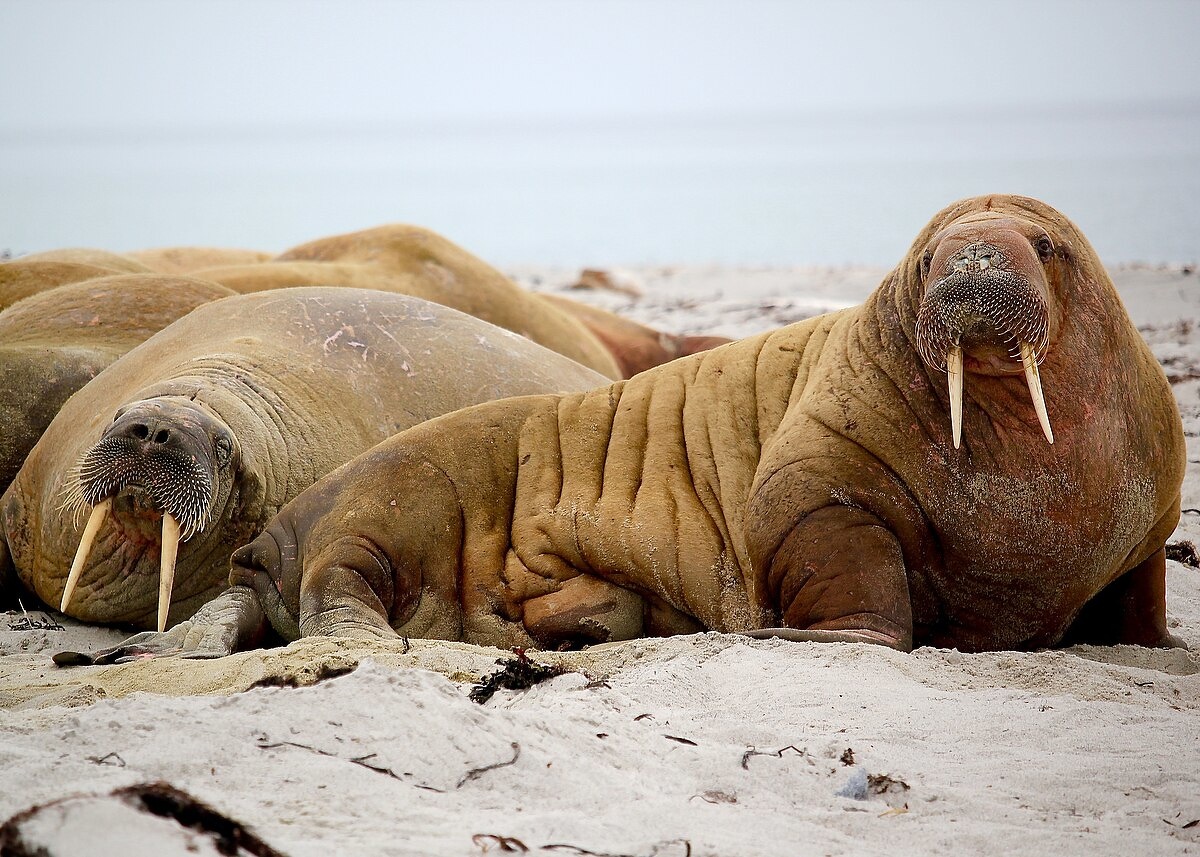
Atlantic walruses in Svalbard, Norway
Walruses have thick skin that ranges from a light gray to yellowish brown in color. Walrus pups skin color differs from the adults. They are usually solid grey, while adults can range in colors. The skin thickness varies across the body but is usually two to four centimeters thick. Walruses have short fur in most areas of their bodies except their appendages. Walruses have whiskers to help them feel around on the ocean floor. They have relatively small eyes because they rely mainly on sense of touch to find food. They have short front flippers not only for swimming but also to assist them on land. They use their hind flippers as a motor to move their large body through the waters and use the front flippers to navigate and steer direction they will go.
Phil Myers wrote in Animal Diversity Web: There's no mistaking a walrus. Their bodies are heavy, appearing swollen. Their heads are round and they have broad muzzles, well endowed with thick vibrissae that appear to form a moustache. They lack external ears. The skin is thick and wrinkled, with underlying blubber. The hide has scattered hairs. Walruses have large, paddle-like forelimbs, which extend about one quarter the length of the body. Their hind limbs, like those of otariids (sea lions not seals), can be rotated under their bodies and are useful in locomotion on land. The plantar surfaces of both limbs are roughened, probably to provide traction on ice.A large baculum (penis bone) is present in males. This structure, which may exceed 60 centimeters in length, is said to frequently show signs of healed fractures. [Source: Phil Myers, Animal Diversity Web (ADW) |=|]
The skulls of walruses have alisphenoid canals (passages for the carotid artery in the sphenoid bone at the base of the cranium) and enormous mastoid processes (smooth cone-shaped bone projection at the base of the skull). These processes support the powerful neck muscles that pull the head downward. Walruses lack the prominent supraorbital processes (bony elongated opening above the eye sockets) seen in sea lions. Walruses also have an unusually strong, nearly-fused joints joining the lower jaws. |=|
Walrus Adaptions for Life in Cold Water
Walruses are rapid, efficient swimmers and good divers, regularly foraging at depths up to 90 meters (300 feet) and able to stay underwater for about 12 minutes before resurfacing. Although awkward and ungainly on land walruses are quite graceful in the water, swimming with alternating side sweeps of the fins almost like a human swimmer doing the crawl. They may be able to stay submerged for half an hour. Generally they dive in depths less than 30 meters (100 feet) and stay submerged about five minutes.
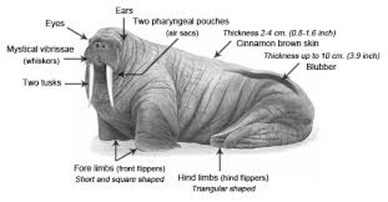
Walruses have thick layers of blubber (muscle and fat mixture) that helps to keep them warm. The thickness of the blubber varies depending on the body but is generally about 7.5 centimeters (three inches) but may may reach 15 centimeters (six inches) in some places. A thickness of 25.4 centimeters has been documented.
Walruses have a basketball-size inflatable pharyngeal pouch that helps maintain buoyancy and serves as a resonance chambers to amplify sounds. During deep dives or extremely cold conditions blood is pumped from the blubber to underlying tissues to maintain the animal’s body temperature (about 98 degrees F like humans), which makes the animal looked bleached. When it warms up again the walrus reddish brown color returns.
David Attenborough wrote: Their blubber efficiently insulate them from the cold and works so well that when they bask in the summer Arctic sun they risk overheating. Running through the blubber is a network of blood vessels. When a walrus warms up,. The vessels dilate and bring blood close to the surface of the skim where it is cooled by the Arctic air and turns the animals pink. In the water the process is reversed and the walruses lose their color and appear almost white. [Source: “Life of Mammals” by David Attenborough]
“Walruses have a unique adaption to a swimming life — an inflatable life-jacket. There are two large internal pouches on either side of the head, opening from the throat, that the animal can inflate with air from its lungs. Fully blown up each can contain a cubic foot of air and in the water they support the animal’s head so well that a walrus can go to sleep at sea with no danger of its head slipping beneath the surface.These pouches may have another function too. The walrus, when courting, makes a wide range of underwater noises — clicks, knocks and rasping noises — which the huge air pouches amplify by acting as resonators.
Walrus Tusks
Both male and female walruses have broad whiskered muzzles and tusks, although the male tusks are usually longer. There is no evidence that walruses use their tusks for feeding, which had long thought was the reason they had them. In fact they seem to get in the way at the high number of broken tusks seems to testify. Tusks seem to be uses mainly for self defense and chopping breathing holes in ices. Some scientist believe they determine status within the group.
It cold be argued that the tusks are used by males to fight during the mating season. But then why do females have them? Beached walruses constantly jab each with their tusks. Blood is often visible especially around the neck. Most of the jabbing is done with far less than full force. Some jabbed walrus act as is they barely feel it. The walrus's hide is so thick that when animals fight they are rarely hurt.
Walruses seem use their tusks mainly for defense, to display their rank and pull themselves onto ice floes. David Attenborough wrote:”The tusk’s primary function seems to be to indicate strength and seniority within a herd rather the same way as horns of goats do. Even so, the tusks can have quite practical uses. Walruses have been seen to use them like ice-picks, jabbing them on the edge of an ice flow in order to help in hauling themselves out of the water.”
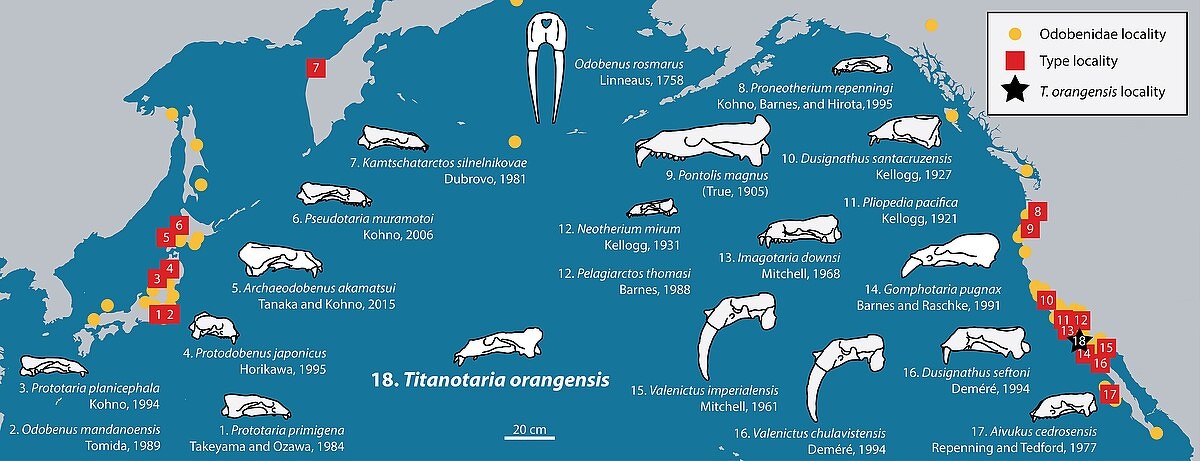
Walrus diversity: Distribution of fossil walrus genera throughout the north pacific; Skulls facing right belong to species of the east pacific, skulls facing left to species from the west pacific; All skulls are drawn to scale
Walrus tusks are enlarged canine teeth. Tusks often grow to a length of 90 centimeters (three feet) but the average size is roughly 50 centimeters (1.6 feet). They can break through 20 centimeters of ice and assist walruses in climbing out of the water and onto the ice. The tusks can be used for the walruses to defend themselves from larger predators and are also a way to establish dominance and a hierarchy among walruses.[Source: Hillary Baker, Animal Diversity Web (ADW) |=|]
Walrus tusks grow continuously. They may exceed 100 centimeters (3.3 feet) in length in males but generally are under 60 centimeters (two feet) in females. Enamel is present only at the tip of the tusk, and usually only for a brief time after it erupts. Most of the exposed tooth is dentine (hard, calcified tissue that forms the main part of a tooth). The dental formula is 1/0, 1/1, 3/3, 0/0 = 18, but much variation exists among individuals. The cheek teeth are conical or flattened, perhaps specialized for crushing the mollusks and other marine invertebrates on which walruses feed. [Source: Phil Myers, Animal Diversity Web (ADW) |=|]
How Tusks Evolved
The earliest known tusks are found in Dicynodonts, a group of stocky, pig-like herbivores that lived 270 million years ago and had unique pointed beaks with protruding teeth on either side. According to Live Science: Members of this clade with true tusks were also missing several teeth. Researchers theorized that it may have been more energetically favorable to develop tusks that continuously grow, rather than replacing teeth that may have fallen out. They also suggested that the tusks evolved independently in different populations over time. When the tusks developed, soft tissue ligaments formed, anchoring the large teeth to the jaw. [Source: Elise Poore, Live Science, January 6, 2024]
According to a study published in October 2021 the journal Proceedings of the Royal Society B, it takes two key adaptations to teeth to make a tusk — and the evolutionary pathway first appeared millions of years before the first true mammals. Asher Elbein wrote in the New York Times: “Around 255 million years ago, a family of mammal relatives called dicynodonts — tusked, turtle-beaked herbivores ranging in stature from gopher-size burrowers to six-ton behemoths — wandered the forests of the supercontinent Pangea. A few lineages survived the devastating Permian extinction period, during which more than 90 percent of Earth’s species died out, before being replaced by herbivorous dinosaurs. “They were really successful animals,” said Megan Whitney, a paleontologist at Harvard University and lead author of the study. “They’re so abundant in South Africa that in some of these sites, you just get really sick of seeing them. You’ll look out over a field and there’ll just be skulls of these animals everywhere.”[Source: Asher Elbein, New York Times, October 29, 2021]
Early elephant relatives had enlarged canines that were covered with enamel, Whitney said. Later members of the family reduced the enamel to a thin band on one side of the tooth, like a rodent incisor, allowing the tooth to grow continuously. Finally, they ditched the enamel entirely. “You’re providing the means for a tusk to evolve if you unlock the evolution of reduced tooth replacement and soft tissue attachments,” Whitney said. “Once you have a group that has both conditions, you can go a long time of animals playing with different tooth combinations, and you start to see these independent developments of tusks.”
Walrus Diet
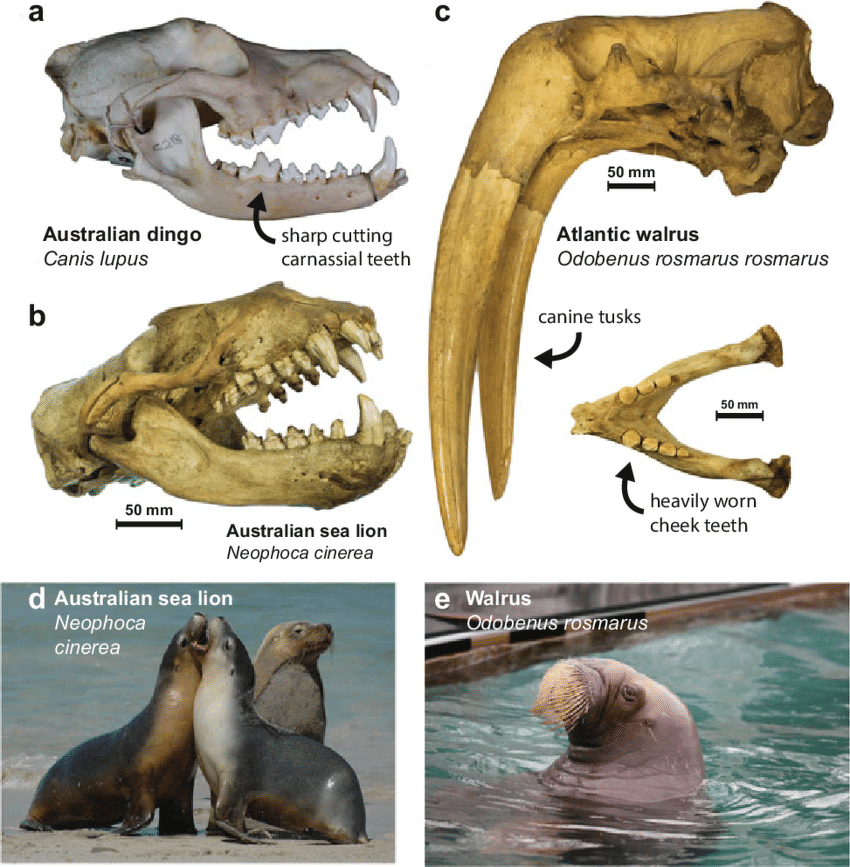
a) Skull of a typical terrestrial carnivoran, the Australian dingo, note the well-developed carnassial teeth; b) Skull of an Australian sea lion , characterised by equally-sized postcanine teeth and no carnassials; c) Skull of a walrus, with simplified, peg-like teeth and enlarged vertical tusks; d, e) Sea lions and a walrus
Walruses occasionally eat bigger animals such as seals and some seabirds. There are some rare but habitual seal-eating walruses. The remains of ringed-seals and bearded-seals have been found in their stomachs. It is not clear whether the seals were killed by the walruses or already dead when the walruses found them. But there is form evidence that walruses do kills seals.
One Norwegian who witnessed an attack on a seal told National Geographic, "The walrus hit the seal in the water to stun it, then dragged it onto the ice and stabbed it with its tusks." Walruses that feed on seals usually male walruses usually larger than other males, with powerful shoulder and chest muscles. Their skin may become grease-stained from the blubber of the seals they prey on.
Walrus are carnivores (eat meat or animal parts) and mainly molluscivores (eat molluscs). They feed mostly on clams and other bivalves they dig up from sea bottom — and also eat other benthic invertebrates such worms, sea squirts, gastropods (snails), cephalopods (squids and octopus), crustaceans, sea cucumbers, and other soft-bodied animals. They catch a fish such as polar cod. now and then and sometimes accidently swallow ocean sediment and bits of sea plants.
Due to the walrus’s diet of small organisms, large quantities are required to sustain them. Each time a walrus dives down to eat, they can consume up to 60 clams. Walruses may eat the carcasses of young seals when food is scarce. Researchers have found numerous pebbles and small stones in the stomachs of walruses. These are thought to be ingested while feeding. Walruses may store and cache food. [Source: Hillary Baker, Animal Diversity Web (ADW) |=|]
Walrus Feeding Habits
Walruses have enormous appetites and need to eat 25 to 45 kilograms (55 to 100 pounda) of food a day, which translates to about three percent to six percent of their total weight per day. Adults may eat as many as 3,000 to 6,000 clams in a single feeding session. Observations of feedings indicate that walruses usually fill their stomachs twice daily. Walruses do most of their feeding in the winter when they hang out along the edge of the southern edge of the ice pack and forage from ice flows. It is not unusual for a walruses to head out to sea 245 kilometers (150 miles) or more. In the summer months, and during the southward migration in the fall, walruses spend most of their day foraging. They eat less on their northward migration in the spring.Food intake for mature male walruses dramatically decreases during the breeding season and probably for a shorter time for females in estrus. Pregnant females increase food consumption about 30 percent to 40 percent Walruses sometimes feed in groups, diving and ascending together.[Source: seaworld.org]
Walruses use their muzzle and whiskers to root and “feel” for food at the bottom of the ocean like a wild pig. It was once thought that walruses used their tusks to pry open mollusk shells but now it seems tusks serve no purpose in feeding. When a walrus finds a mollusk its lips purse the shell and the mouth and tongue may be used open the shell. The walrus then power sucks and slurps out the soft animal inside. The slurping, sucking vacuum action of a walrus muzzle is so strong that it has sucked the paint off walls, pulled in five-pound plugs from the bottom of tanks and herrings from their skeletons. To get shellfish open walruses may crushing them open with their rounded teeth. Walrus dives for food usually last five to 20 minutes.

Suction feeding in walruses: (a Schematic drawing of a walrus excavating bivalves buried in the seafloor via a jet of water from its mouth; b) Photo a wild walrus feeding on the seafloor. c-e) Walrus feeding patch littered with empty shells
Because visibility is poor in deep and murky waters, walruses rely on their stiff vibrissae (whiskers) to locate food. David Attenborough wrote:”in the murky depths several hundred feet down, there is little light — and during the long Arctic winter none at all — but the walrus’s bulbous snout carries a spectacular array of snout bristles with which it is able to feel its way across the sea bottom and identify things to eat. It used t be thought that the animals dug out clams with their tusks...Now, its believed that this not the case. They excavate their food from the muddy sea floor by squirting jets of water from their mouths.” Abrasion patterns of the tusks show that they are dragged through the sediment, but are not used to dig up prey.
Walruses usually forage on the sea bottom within 80 meters (262 feet) of the surface. Most feeding probably takes place between 10-50 meters (33-164 feet), where they move their snout along the bottom, rooting through the sediment and using its vibrissae to help detect prey. They use their hind fins to propel themselves forward, while their tusks, mouth, and whiskers drag the bottom of the ocean floor.
According to Sea World: In addition, researchers have seen foraging Atlantic walruses rapidly waving a foreflipper to uncover prey from the sediment. The walruses that were observed, preferentially used their right flipper when foraging this way. Walruses do not chew their food, but they do sometimes crush clam shells. Soft-bodied invertebrates are usually not crushed or torn. A walrus sucks off the foot and the fleshy siphon of a clam and swallows it whole. The cheek teeth do get worn, but this is probably from abrasion by minute particles of sand that walruses inadvertently take into their mouths and not from crushing clam shells. [Source: seaworld.org]
Walrus Behavior
Walruses are motile (move around as opposed to being stationary), sedentary (remain in the same area), socialcolonial (live together in groups or in close proximity to each other), and have dominance hierarchies (ranking systems or pecking orders among members of a long-term social group, where dominance status affects access to resources or mates). [Source: Hillary Baker, Animal Diversity Web (ADW), National Geographic, Smithsonian magazine]
Unlike seals, walrus cannot swim indefinitely and must rest. They use their tusks to “haul out,” or pull themselves onto ice or rocks. The major events of a walrus’s life — eating, courting, mating — takes place in the sea. Most of their out-of-water time on ice flows and a small islands is spent sleeping. During the winter walruses haul out of the water usually at night or midday and stay on land or ice for 40 or so hours then enter into the water for one to three days, without any sign of a 24 hour rhythm. In the summer they average around seven days at sea and rest on land or ice for two days.
Walruses can move the fastest while in the water. On land they can move faster than seals but not as fast as sea lions. Walruses are extremely curious animals. On a number of occasion they have hooked their tusks over the gunwales of boats. And what are people supposed to do when this happens? You put on your mittens and gently lift the head out. If you don't put on mittens the warmth of your hands might panic the animal.
Walrus Group Behavior
Walruses are highly gregarious. They spend most of their time with other walruses of the same sex. Female walruses stay in one herd, while males stay in another herd until breeding time. . In the winter and summer, male and females come together in large groups and get very close to each other sometimes even piling on top of each other. Walruses can form herds of hundreds and sometimes more than 2000 individuals. They usually stay close to land or to ice masses, and they migrate seasonally as the position of the ice pack changes. [Source: Hillary Baker, Animal Diversity Web (ADW), National Geographic, Smithsonian magazine]
When walruses head out to sea they do so in groups of four, eight or sometimes a dozen. They amass in huge groups, sometimes with several hundred, or even thousands, of animals at places known as "haul outs." Great herds of them migrate southward in the winter and return to the north in the spring, haling out in large numbers at traditional spots on beaches and islands. When they congregate around ice flows they rarely travel more than a couple kilometers away from the ice flow while the ice flow itself may travel 100 kilometers.
Walruses live in a hierarchal system based on age, body size, and tusk length. The older and stronger the walrus, the higher up it will be in the hierarchy. The male walruses establish dominance and compete for females by fighting with their tusks. The tusk fighting takes place while the walruses are at haul-out sites, which are usually rocky or sandy beaches near the water. The walruses go to these haul-out sites to rest and sleep.
Walrus Senses and Communication
Walruses sense and communicate with vision, touch, sound and chemicals usually detected by smelling. Hillary Baker wrote in Animal Diversity Web: Their senses of smell and hearing are poorly developed, but they have excellent vision, and the vibrissae on their snouts also provide tactile information. Walruses have small eyes that are adapted to the cold environment. Some fat cells are in place to help keep the eyes warm. Some studies indicate that walruses can see in color, but the range of the color spectrum is unknown. Walruses has short-range vision and often cannot see when they are on the ocean floor scavenging for food. The whiskers, also called vibrissae, are used for feeling their way around the ocean floor. Walruses use their whiskers to help identify food or any other small objects. They can hear relatively well on land but under water, they use a system of tissue conduction to hear. This system closes their auditory meatus and only allows them to hear through their outer ear tube. [Source: Hillary Baker, Animal Diversity Web (ADW) |=|]
Walruses are noisy animals both in and out of water. They bellow and trumpet while on land. Female and baby walruses communicate with "woof talk" while rutting bulls make knocking and bell noises reminiscent of the familiar folk drumming "shave and a haircut, two bits!" It has been suggested that rasping and clicking noises made by walruses while swimming may indicate some use of echolocation (emitting sound waves and sensing their reflections to determine the location of objects). [☺ Source: Phil Myers, Animal Diversity Web (ADW) |=|]
Walruses communicate during mating season, for mother and calf interactions, and when establishing dominance among other walruses. Walruses have a series of grunts and barks they use in the situations described above. The Atlantic walrus and the Pacific walrus have slightly different vocalizations. A study showed that walruses could differentiate between the two different subspecies vocalizations.
Walruses also snore very loudly. One fisherman told journalist Gordon Young in the 1970s, "A few years ago I wintered over on one of the small islands near Svabard. Suddenly heard what I thought was an airplane. I grabbed my lantern and rushed outside-it turned out to be a big bull walrus, sleeping on a passing ice floe. By hell that walrus sure could snore." [Source: Gordon Young, National Geographic, August 1978]
Walrus Mating and Reproduction
Walruses are polygynous (males have more than one female as a mate at one time) and copulation takes place exclusively in the water. They employ delayed implantation (a condition in which a fertilized egg reaches the uterus but delays its implantation in the uterine lining, sometimes for several months). Walruses engage in seasonal breeding and breed once every two to three years. between January and April. The average gestation period is 11 months — 15 months if the delayed implantation is included. The number of offspring is usually one. Walruses produce offspring most of their lives.[Source: Hillary Baker, Animal Diversity Web (ADW)
Males reach sexual maturity at seven to 10 years but don’t mate until they are approximately 15 years old, when they are socially mature. During the winter and summer, both male and female walruses gather in the thousands to breed. Both sexes congregate in their haul-out sites, which are rocky or sandy beaches, to pick potential mates.
Male and female walruses meet and mate in largely mysterious rituals that take place in the darkness of the Arctic winter. Dominant males establish harems like dominant male seals and fight of rivals in violent battles. Males have a large baculum (penis bone), which may exceed 60 centimeters (two feet) in length. It often has signs of healed fractures. Food intake for mature male walruses dramatically decreases during the breeding season and probably for a shorter time for females in estrus. Pregnant females increase food consumption about 30 percent to 40 percent
Males have many mating calls and noises they make during mating season to attract females, mark their territory and intimidate other males. Underwater, males make bell whistling noises and thumping noises to get the attention of females. Their basketball-size inflatable pharyngeal pouches act as resonators amplifying the wide range of underwater clicks, knocks and rasping noises made by the males. Usually the strongest, largest and oldest of the males get to mate with the females. Tusk fights occur between males over who gets to mate with a group of females either on land or in water. Sometimes these fights can be very gruesome and even fatal. They can leave bloody scars though deaths from fighting are rare.
Walrus Offspring and Parenting
Parental care by walruses is provided by females. Males play no part in raising their young. The weaning age ranges from 12 to 36 months and the age in which they become independent ranges from two to three years, with average time to independence being three years. Females reach sexual maturity at five to seven years; males do so at seven to 10 years. [Source: Hillary Baker, Animal Diversity Web (ADW)
Females give birth to a single calf usually between April and June, 15 months after mating. Females forage and nurse their young from ice floes in the north during the summer. The average weight of a walrus pups is about 60 kilograms (132 pounds) and are 1.2 meters long. When the calves are born, they immediately know how to swim. This, along with the mother’s protection, decreases the chance for predation.
Describing a mother and calf David Attenborough wrote , “gentle sweeping with her whiskers, call vibrissae, cements the bond between a female and her newborn calf as the mother inhales its scent. A nursing calf will rapidly gain weight from mother’s fatty milk. Babies swim within hours of birth, but nurturing continues for about two years. A calf may takes rides on its mother’s back or be reassured by a flipper hug and a tusk rub after a solo swim.”
Before the calves are weaned, they live with the herd of female walruses. They are very dependent on their mothers for the first few years. At age two, they learn to scavenge for their own food. At age three, when they are completely weaned, male walruses join the male herd and females stay in the female group but are independent from their mothers. |=|
Natural Predators of Walrus — Mainly Polar Bears
The main known predators of walruses are polar bears and humans and to a lesser extent orcas (killer whales). Adults use their giant tusks as a weapon to defend themselves. Tusks can reach almost one meter (three feet) and can be used with such lethal force that polar bears rarely take on adults Young walruses are more susceptible to predation. [Source: Norbert Rosing, National Geographic, September 2001; [Source: Hillary Baker, Animal Diversity Web (ADW)]
Where polar bears hunt walrus they normally do so by charging a walrus herd and hope to grasp a straggling calf and sometimes evan an adult. Polar bears have been observed causing walruses to stampede and trample one another — and then feed on the carcasses. Otherwise, polar bears can be scared off with a display of tusks. Killer whales are usually undeterred by the tusks because they kill walruses and other large mammals by ramming them and crushing their thoracic cavity.
Norbert Rosing wrote in National Geographic: “Once I was caught flat-footed as a white giant galloped straight at me. I grabbed my camera and ran towards our tent 900 feet away. The bear passed by, plunged into a walrus herd, and made a kill. [Source: Norbert Rosing, National Geographic, September 2001]
“Walrus herds up to several thousand can often be found huddled together on ice floes. Territory at the edge gives a better chance to flee predators by splashing into the relative safety of water Their condensed breath visibly thickens when a polar bear or other threat sets them scrambling. Roused from lethargy, a group senses danger as a polar bear and her cubs paddle by... Panic erupts as looming bear ignites a churning frenzy to escape. Wary of adults armed with tusks powered by enormous girth, the stalker presses it search for the young and defenseless. Dragging a calf by the head, the bear retires to the end of the islet where for ten minutes it mauls and tosses is prey before dispatching it with a bite to the throat.
Bears flay their victims to eat blubber and muscle. The predators show remarkable finesse. Zoologist Daryl Boness of the Smithsonian Institute has seen small walrus skeletons, almost completely articulated. Lying near skins so intact that one could fit inside the other like hand in a mitten.
Image Sources: Wikimedia Commons
Text Sources: Animal Diversity Web animaldiversity.org ; National Geographic, Live Science, Natural History magazine, David Attenborough books, New York Times, Washington Post, Los Angeles Times, Smithsonian magazine, Discover magazine, The New Yorker, Time, BBC, CNN, Reuters, Associated Press, AFP, Lonely Planet Guides, Wikipedia, The Guardian, Top Secret Animal Attack Files website and various books and other publications.
Last updated June 2025