
Home | Category: Marsupials
WOMBAT SPECIES
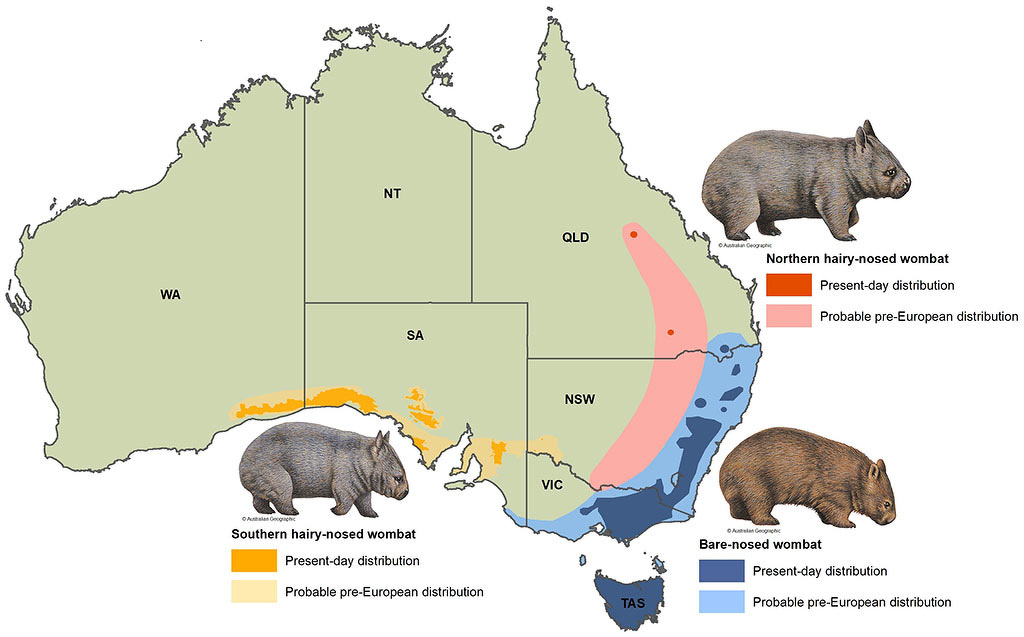
range of the three wombat species
There are three wombat species, all in Australia:
Common wombats (Vombatus ursinus), also known as the bare-nosed wombats and coarse-haired wombats. There are three subspecies: a) Vombatus ursinus hirsutus, found on the Australian mainland; b) Vombatus ursinus tasmaniensis, found in Tasmania; and c) Vombatus ursinus ursinus, found on Flinders Island in the Bass Strait and Maria Island in the Tasman Sea.
Northern hairy-nosed wombats, or yaminon (Lasiorhinus krefftii),
Southern hairy-nosed wombats (Lasiorhinus latifrons), the smallest of the three species +
While all three wombat species are of similar size, Northern hairy-nosed wombats are regarded as the largest. They are one of the largest burrowing animals in the world and can grow to be about a meter (3.25 feet) long and weigh to to 35 kilograms (77 pounds). The northern hairy-nosed wombat and the southern hairy-nosed wombat live in semiarid regions. The southern hairy-nosed wombat live s from the Murraylands surrounding the Murray River in South Australia to the Nullabar Plane in Western Australia. The common wombat occupies a range of up to 23 hectares (57 acres), while the hairy-nosed species have much smaller ranges, of no more than four hectares (10 acres).
All species of wombats are protected in every Australian state The northern hairy-nosed wombat is a critically endangered species. They exist in two locations in Queensland, the Epping Forest National Park, and a smaller colony being established by translocating wombats to the Richard Underwood Nature Refuge at Yarran Downs. Estimates of wombat distribution prior to European settlement are that numbers of all three surviving species were prolific and that they covered a range more than ten times greater than that of today.
RELATED ARTICLES:
WOMBATS: CHARACTERISTICS, BEHAVIOR AND REPRODUCTION ioa.factsanddetails.com
NORTHERN HAIRY-NOSED WOMBATS: ENDANGERED, CHARACTERISTICS, BEHAVIOR, REPRODUCTION, COMING BACK ioa.factsanddetails.com
MARSUPIALS: HISTORY, EVOLUTION, CHARACTERISTICS, BEHAVIOR, REPRODUCTION ioa.factsanddetails.com
MARSUPIALS IN AUSTRALIA ioa.factsanddetails.com
ICE-AGE ANIMALS IN AUSTRALIA: WHEN, WHERE AND HOW THEY LIVED AND WENT EXTINCT ioa.factsanddetails.com
GIANT ICE-AGE ANIMALS IN AUSTRALIA: WOMBATS, KANGAROOS AND THUNDER BIRDS ioa.factsanddetails.com
Common Wombats
Common wombats as we said before are also known as the bare-nosed wombats and coarse-haired wombats. There are three subspecies: a) Vombatus ursinus hirsutus, found on the Australian mainland; b) Vombatus ursinus tasmaniensis, found in Tasmania; and c) Vombatus ursinus ursinus, found on Flinders Island in the Bass Strait and Maria Island in the Tasman Sea. [Source: Benjamin Galetka, Animal Diversity Web (ADW) |=|]
Common wombats are found southeastern Australia along the eastern edge of Queensland and New South Whales, Victoria, Flinder's Island, Tasmania, and parts of South Australia. Rget inhabit temperate areas with suitable burrowing conditions in woodlands, shrublands, open forests, heathlands, hilly coastal scrub, savanna grasslands and areas adjacent to rivers and other water bodies at elevations from sea level to 1800 meters (5905 feet).
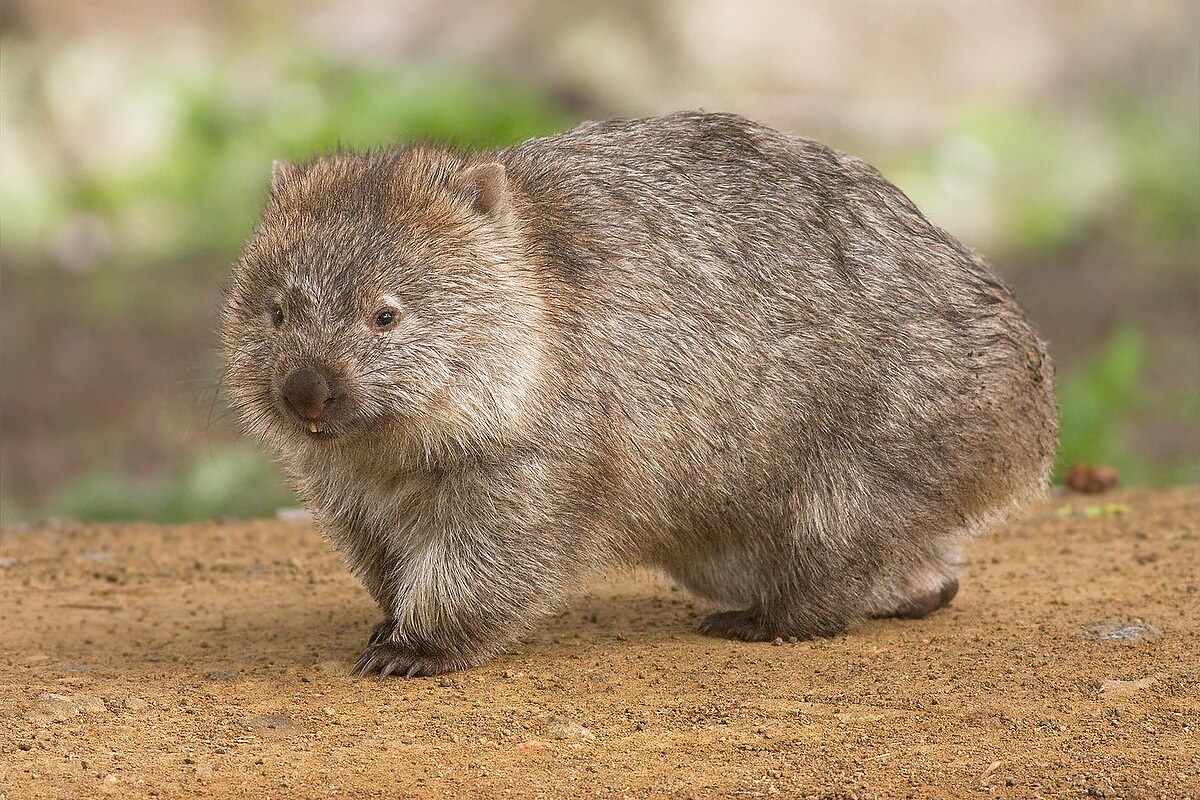
Common wombat (subspecies Vombatus ursinus tasmaniensis) at Maria Island National Park in Tasmania
On the International Union for Conservation of Nature (IUCN) Red List common wombats are classified as a species of “Least Concern” and their general population is stable. Wombats were hunted for their pelts; now they are protected in all states of Australia. But despite their name, common wombats are no longer as common as they once was, and are under significant threat in some places. In eastern Victoria, they are numerous enough that and they are considered by some to be pests, especially due to the damage they cause to rabbit-proof fences. Wombats sometimes burrow under rabbit fences, giving rabbits a means escape path. Wombats are sometimes seen as pests in areas of farming due to their burrowing behavior, especially for creating hazards for livestock.
Predators of the common wombat include Tasmanian devils, dingoes, dogs, wedge-tailed eagles, and humans. Prior to their extinction, Tasmanian wolves probably preyed on the wombats too. Their main defense is hanging out in their burrow. The combination of low metabolic rate and efficient digestion allows wombats to spend much of their time in their burrows away from predators. Wombats sometimes build dirt plugs to close off their tunnels, which may be a defensive behavior.
Common Wombat Characteristics and Diet
Common wombats have relatively large, squat and thick-set bodies with a broad, rounded head, stubby tail, small dark eyes, small round ears and short limbs with sturdy claws for burrowing. They range in weight from 20 to 35 kilograms (44 to 77 pounds) and have a head and body length of 70 centimeters to 1.1 meters (27.5 to 43.3 inches), including their very short, nearly non-existent tail. Wombats have lived over 30 years in captivity. They typically they live 12 to 15 years at most in the wild. [Source: Benjamin Galetka, Animal Diversity Web (ADW) |=|]
Wombats have a pair of rootless, ever-growing incisors differs them from marsupials and more like those of rodents. They can used for cutting through obstacles such as roots when burrowing. Their fur is thick and coarse and can range in color from grey-brown to blackish, patchy grey and buff, or uniformly cream colored. Unlike the two other species of wombat, common wombats lack hair on their rhinarium (skin surrounding the nostrils). In addition, their ears are smaller and more furred than the other two wombat species. Northern and southern hairy nosed wombats have longer muzzles that are more square-like in shape. Common wombats that inhabit Tasmania tend to be members than those on the mainland. Flinders Island is home to smallest ones of all.
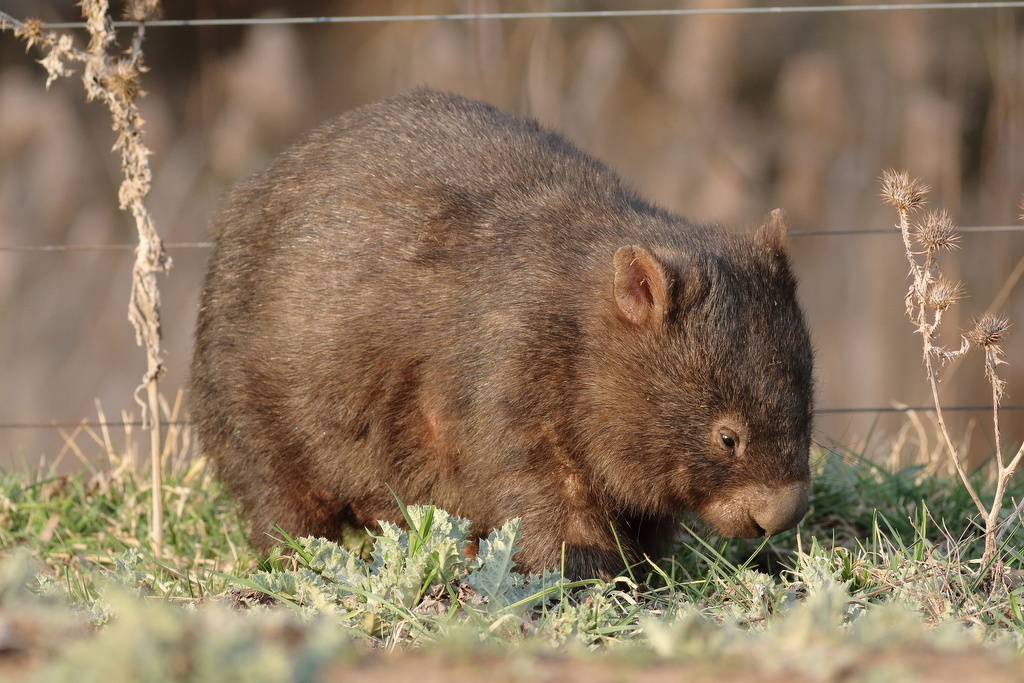
Common wombat (subspecies Vombatus ursinus hirsutus)
Common wombats herbivores (eat plants or plants parts) and mostly grazers (eat grass or other low-growing plants) but are also recognizes as folivores (eat leaves). Among the plant foods they eat are native grasses, sedges, leaves, sometimes shrubs, roots, tubers, wood, bark, stems and bryophytes (mosses). Plant species they feed on include Poa, Themeda australis, Carex appressa, Juncas, Stipa, and Danthonia penicillata. The combination of low metabolic activity and a large digestive tract allows wombats to utilize areas where the vegetation may be of poor quality. The small, acidic stomach and simple small intestine of wombats digests plant cell material, while microbial fermentation takes place in the hind gut, allowing wombats to break down fibrous cell walls of plants so they can be digested. The hind gut consists of a proximal colon (which makes up roughly 60 to 80 percent of gut contents), a cecum, and the distal colon.
Common Wombat Behavior
Common wombats are fossorial (engaged in a burrowing life-style or behavior, and good at digging or burrowing), nocturnal (active at night), crepuscular (active at dawn and dusk), motile (move around as opposed to being stationary), solitary, territorial (defend an area within the home range). Their home territories range from 0.024 to 0.083 square kilometers. and often contains multiple burrows.[Source: Benjamin Galetka, Animal Diversity Web (ADW) |=|]
Wombats tend most of the day in their burrows and emerge at dusk to graze in the cooler night temperatures. However during colder seasons they may be seen sunbathing in the day. When foraging, common wombats sometimes travel several kilometers in search of food, often visiting the same sites repeatedly, creating short patches of grass known as "marsupial lawns." To conserve energy, they may spend up to 16 hours a day sleeping.
Wombats are solitary, but their home ranges tend to overlap. Multiple wombats might use the same burrow, but rarely at the same time. When burrowing, they remove dirt in front of them using the claws, then "bulldoze" the dirt backwards using their rump. They use a similar tactic for defense against predators in their burrow, backing up at the attacker and using their strong back legs to dter or injur the attacker. Wombats often have multiple resting chambers in the burrow system, in which they build nests out of grass, leaves and sticks, on which they sleep..
Common wombats sense and communicate with vision, sound and chemicals usually detected by smelling. They also leave scent marks produced by special glands and in their feces that are placed so others can smell them. Other forms of communication include vocalizations, aggressive displays, and markings on logs and branches made by rubbing against them repeatedly.
Common Wombat Mating, Reproduction and Offspring
Common wombats are polygynous (males have more than one female as a mate at one time) and breed about once every two years. They breed year-round and reproduction is not strongly linked to seasons though births are sometimes more common in summer.. The gestation period ranges from 27 to 31 days. Typically, one offspring is born.
The mating rituals of common wombats includes the male chasing the female in circles for several minutes at a time until the female slows down enough for him to catch up. At this point he bites her rump, grasps her with his forelegs, and flips her onto her side. The male then mounts her while laying on his side; after which the female may break off into a jog, and the chasing behavior ensues again. These sessions may last about 30 minutes.
Parental care is provided by females. Young are altricial, meaning they are relatively underdeveloped at birth, and about the size of a jelly bean when born. Joeys (young) grows in the pouch until they are weaned. The weaning age ranges from 12 to 20 months and the age in which they become independent ranges from 18 to 20 months. On average males and females reach sexual or reproductive maturity at age two years.
Southern Hairy-Nosed Wombat
Southern hairy-nosed wombats (Lasiorhinus latifrons) are the smallest of the three wombat species and the state animal of South Australia. The are found in scattered areas of semiarid scrub, mallee (bush with low-growing bushy Australian eucalyptus), semi-arid and arid grasslands and woodlands that receive 20 to 50 centimeters of rain per year. They reside from the eastern Nullarbor Plain to the New South Wales border in in southeastern Western Australia, southern South Australia, and southwestern New South Wales. Southern hairy-nosed wombats require sturdy soil that is able to support the digging of large burrows. They also require perennial grasses and bluebush scrub (Maireana and Chenopodium), essential parts of their diet. [Source: Emily Green, Animal Diversity Web (ADW) |=|]
Southern hairy-nosed wombats are not endangered or threatened. They are designated as a species of least concern on the International Union for Conservation of Nature (IUCN) Red List and have no special status on the Convention on International Trade in Endangered Species (CITES). In the past they were hunted for meat by aboriginal people and Europe settlers. Wombats have traditionally been valued by aboriginal people, who often left their own land to hunt them elsewhere so that they could keep their own wombat populations healthy Today they are protected and hunting them is illegal. Southern hairy-nosed wombats are sometimes considered agricultural pests and livestock pests. Their burrows can damage crops, create problems for livestock and create ways for rabbits to breach fences set up to contain them. They sometimes comepte for forage with livestock and livestock sometimes injure themselves when they step into wombat burrow entrances. Burrows also provide places for rabbits and other pests to hide and breed.
Southern hairy-nosed wombats have endured massive habitat loss due to human clearing and development of land. One of their main threats is rabbits and livestock. Rabbits, domestic livestock, and wombats may all feed on the same forage and overgrazing, which happens in many areas, can hurt all of them. Once the land is overgrazed, dominant grass species shift from perennial ones, the native diet of wombats, to annual species that do not provide wombats with enough nutrition. Human clearing of the land removes vegetation that wombats rely on during drought periods. Low wombat reproduction rates means that populations do not quickly recover from disruptions.
Southern Hairy-Nosed Wombat Characteristics and Diet
Southern hairy-nosed wombats are stocky, muscular animals built for digging. They range in weight from 19 to 32 kilograms (42 to 70.5 pounds) and have a head and body length of 77 to 93 centimeters (30.4 to 36.8 inches). Their average basal metabolic rate is 16.001 watts. The average lifespan of Southern hairy-nosed wombats in the wild is 14 years. They have lived in captivity up to 24.5 years. The main limit on their lifespan is drought and rainfall rather than predation. Wombats are able to escape predators because they live in burrows Sexual Dimorphism (differences between males and females) is present: Males are larger than females. [Source: Emily Green, Animal Diversity Web (ADW) |=|]
Southern hairy-nosed wombats have a plantigrade posture (allowing to walk on the soles of the feet, like a human or a bear) and have flattened claws on each of their five digits which are used for digging. On the hind feet, the second and third toes are fused, creating a digit with two claws that the wombats use for grooming. The robust head is flattened and has narrow, pointed ears that extend over its top. The tail is short and usually hidden by fur. Southern hairy-nosed wombats can be distinguished from other wombat species by their nasal bone, which is longer than the frontal bone. Their silky fur ranges in color from grey to tan. Soft, usually white, fur covers the rhinarium (skin of the nostrils), giving these wombats their name.
Southern hairy-nosed wombats are herbivores (eat plants or plants parts) and primarily grazers (eat grass or other low-growing plants), mainly feeding on grasses and herbs. When available, they like new green shoots of grass, especially species in the genus Stipa, and will eat them until they are no longer available. During droughts, wombats are more likely to eat leaves and stems of short bushes, particularly the bluebush species in the genus Maireana. There is some evidence that wombats feed on roots during dry periods, with some preference shown for Eucalyptus species.
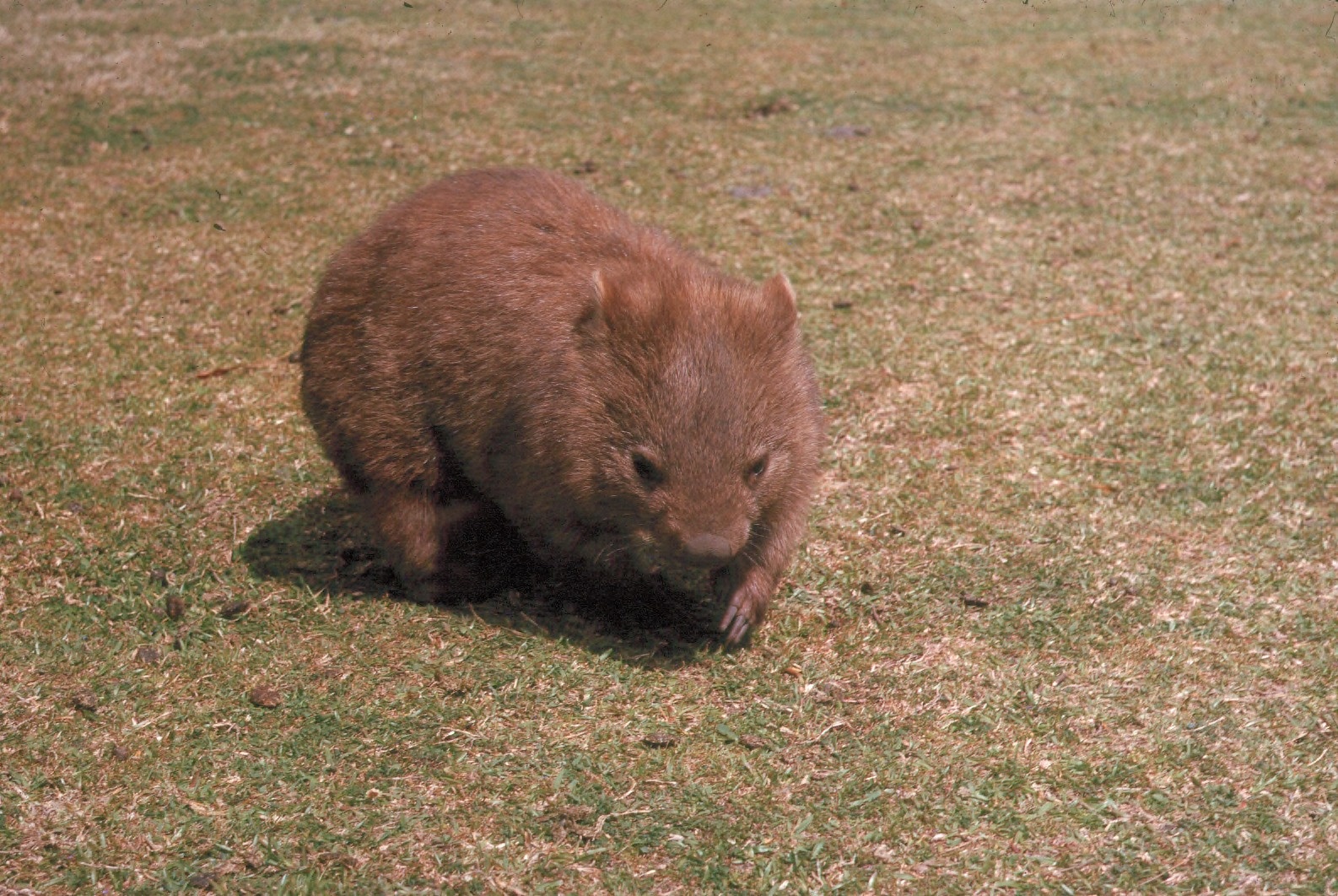
Southern hairy-nosed wombat
When feeding, southern hairy-nosed wombats choose green shoots if they are present to maximize their water and nutrient uptake.The incisors of Southern hairy-nosed wombats are rodent-like. The palate between the molars is wide. All the teeth grow continuously throughout their lives, perhaps an adaptation to accommodate their harsh diet. The digestive system has two adaptations that aid wombats in the uptake of water and energy from their food sources. Wombats use fermentation by bacterial colonies in their intestines to help them digest cellulose. Since hairy-nosed wombats eat a coarser diet than that of common wombats, they need to masticate their food more thoroughly and thus their temporalis muscle is better developed and the masseteric muscle is more reduced.
Southern Hairy-Nosed Wombat Mating, Reproduction and Offspring
Little is known about the mating system of Southern hairy-nosed wombats. It is believed that they are polygynandrous (promiscuous), with both males and females having multiple partners. They engage in seasonal breeding — breed once a year, if there is enough rainfall, from September to December. The average gestation period is 21 days. Usually one offspring is born. [Source: Emily Green, Animal Diversity Web (ADW) |=|]
During the breeding season, males are aggressive towards each other, biting the ears, rump, and flanks of other male wombats. Females ready for mating may emit a coughing call when they are pursued by males. A lot of the mating and courting activity probably takes place underground in their burrows. Southern hairy-nosed wombats breed when rainfall and the growth rates of the native grasses that make up their diet are high. During periods of drought, native grasses do not grow, and wombats do not breed. When the grasses begin to germinate, female wombats become ready for reproduction. Males also reach their peak reproductive activity when females are active. During the breeding season, males maintain dominance hierarchies. Mating occurs in the burrow, with males usually remaining in one warren, while females move among them. When wombats copulate, the male lengthens the time of intromission by turning the female on her side and mounting her from behind.
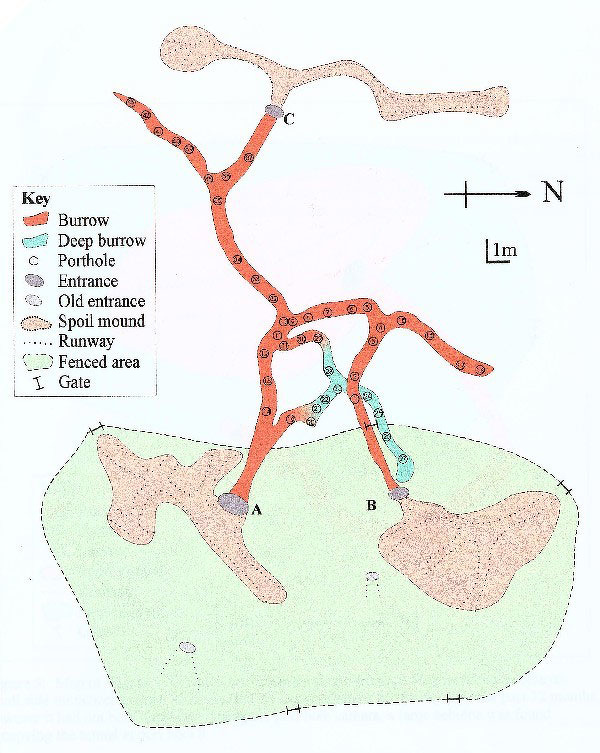
Map of a burrow of a northern hairy-nosed wombat at Epping Forest National Park
Young are altricial, meaning they are relatively underdeveloped at birth. Parenting duties are performed by females. At birth young make their way to their mother’s pouch where they develop and begin to leave between six and eight months of age, and leave permanently by nine months. Young wombats may continue to suckle at the pouch until they have reached 15 months of age. Females are able to reproduce again after weaning is complete. On average males and females reach sexual or reproductive maturity at age three years.
Life can be tough for young wombats; they often do not survive dry seasons. Since the breeding of Southern hairy-nosed wombats occurs in the summer, young wombats are weaned in the early spring, making them vulnerable to food stress and dependent on the amount of rain received in April, when rains sometimes don’t occur. Wombats usually require two to three years with enough rainfall to successfully raise young. Without enough rainfall, there is not enough grass to sustain juveniles through their growth. Additionally, overgrazing of the land can destroy perennial grasses in favor of annual grasses that do not meet the nutritional needs of juvenile wombats.
Northern Hairy-Nosed Wombats
Northern hairy-nosed wombats (Lasiorhinus krefftii) are the largest wombat species, one of the world's largest burrowing animals. and the most endangered marsupial. Their range once extended across a large swath of New South Wales, Victoria, and Queensland, and as recently as 100 years ago it was considered extinct mainly as a result of the rapid introduction of sheep, cattle and rabbits into their range by European settlers in the 19th century and the competition of these animals with the wombats for grass, especially during droughts, which are where northern hairy-nosed wombats live. In the 1930s a population of about 30 individuals was discovered in a three-square-kilometers(1.2-square-mile) area within the 32-square-kilometers (12-square-mile) Epping Forest National Park in Queensland. [Source: Wombat Foundation =]
Northern hairy-nosed wombats are heavily built and range in weight from 25 to 40 kilograms (55 to 88 pounds), averaging 32 kilograms (70.4 pounds). Their thick, stocky body averages about one meter (3.25 feet) in length. Females are larger than males These wombats have very powerful forearms, large heads, small eyes and pointed ears. They have soft, silky brown fur, and long whiskers extending from the sides of their noses — the source of their name. Like other wombats, females have rear-oriented pouches and some continuously-growing rodent-like teeth [Source: Megan Schober, Animal Diversity Web (ADW) |=|]
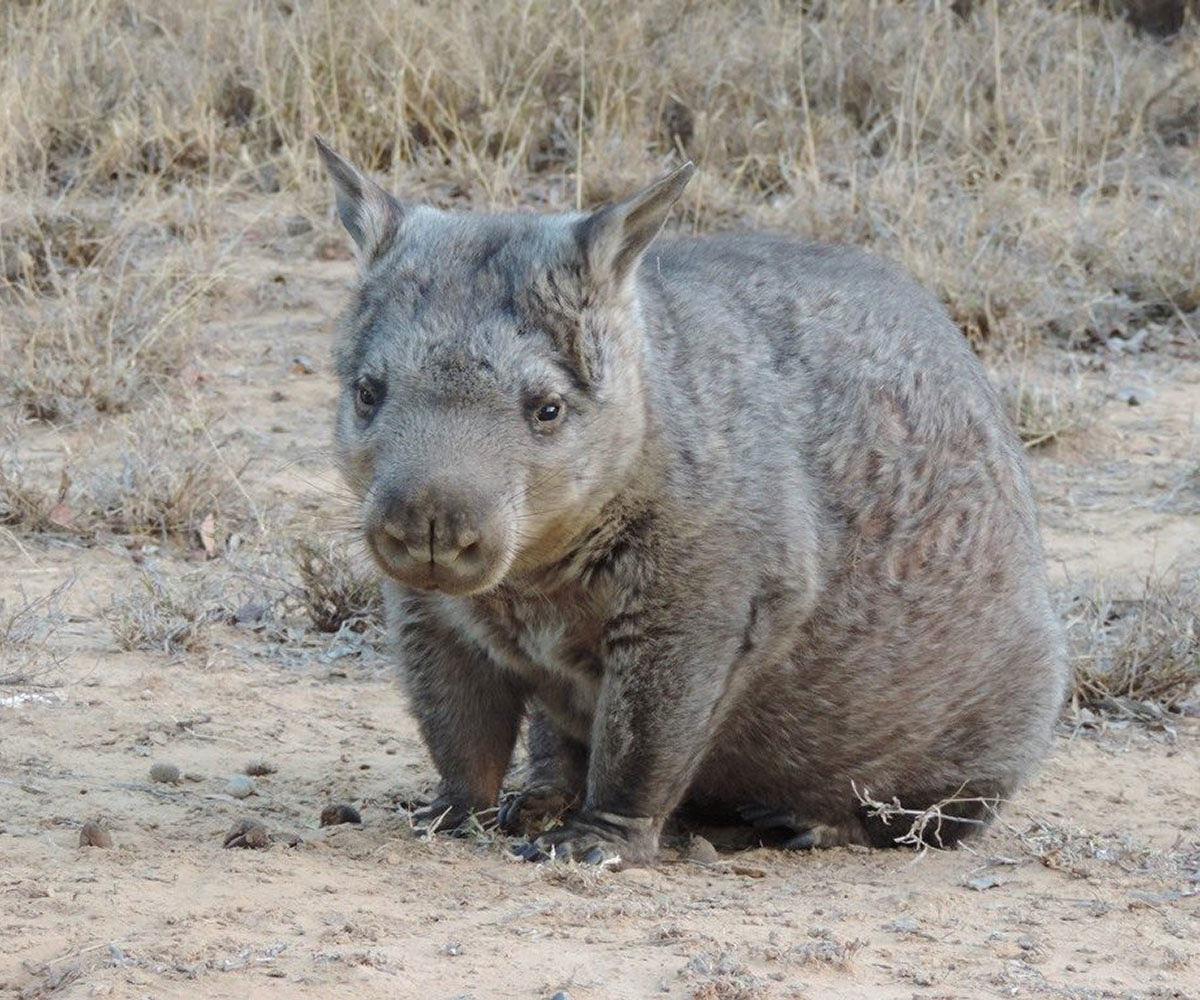
northern hairy-nosed wombat
The only known wild populations of northern hairy-nosed wombats are in three locations in Queensland: 1) the Epping Forest National Park, northwest of Clermont in Central Queensland; and 2) a smaller colony Richard Underwood Nature Refuge at Yarran Downs; and 3) a new colony in Powrunna State Forest, south west Queensland. . The Richard Underwood colony was established by translocating wombats and was created through the Xstrata reintroduction project, funded by Xstrata, a Swiss global mining company. In June 2024, 15 wombats were translocated to Powrunna.
[Source: Wikipedia]
Northern hairy-nosed wombats live in semi-arid open woodlands and grasslands. They prefer semi-arid grasslands on sandy soil which is suitable for burrowing and require a year-round supply of grass, which is their primary food source. Not all soils are suitable for northern hairy-nosed wombats to dig their burrows. In Epping Forest National Park (Scientific), they dig their burrows in the deep, sandy soils along ancient dry creek beds. They forage in areas of heavy clay soils adjacent to the sandy soils, but do not dig burrows in the clay soils, which become water-logged in the wet seasons. At Epping Forest National Park (Scientific), burrows are often associated with native bauhina trees, Lysiphyllum hookeri. This tree has a spreading growth form and it roots probably provide stability for the extensive burrows dug by northern hairy-nosed wombats. [Source: Queensland government]
See Separate Article: NORTHERN HAIRY-NOSED WOMBATS: CHARACTERISTICS, BEHAVIOR AND REPRODUCTION factsanddetails.com
Image Sources: Wikimedia Commons
Text Sources: Animal Diversity Web animaldiversity.org , National Geographic, Live Science, Natural History magazine, Australian Museum, David Attenborough books, Australia Geographic, New York Times, Washington Post, Los Angeles Times, Smithsonian magazine, Discover magazine, The Conversation, The New Yorker, Time, BBC, CNN, Reuters, Associated Press, AFP, Lonely Planet Guides, Wikipedia, The Guardian, Top Secret Animal Attack Files website and various books and other publications.
Last updated July 2025