
Home | Category: Marsupials
KOALA CONSERVATION

Koalas are a protected species in Australia but management of the species can be difficult. Some populations are pressured by numerous threats. Others can become so numerous that they damage trees on which they feed. In these cases, sometimes portions of populations have to be relocated in order to reduce the number of individuals in a given area. This is complicated by the shortage of suitable forest areas where surplus animals can be released. [Source: Jennifer Dubuc and Dana Eckroad, Animal Diversity Web (ADW) |=|]
The first successful efforts at conserving the species were initiated by the establishment of Brisbane's Lone Pine Koala Sanctuary and Sydney's Koala Park Sanctuary in the 1920s and 1930s. Its owner Noel Burnet created the first successful breeding program. Australia Zoo, set up by television personality and conservationist Steve "Crocodile Hunter" Irwin, treats an average of 70 koalas every month. Approximately 70 percent of its patients are victims of car accidents or domestic pet attacks. [Source: AFP, July 28, 2018]
Conservationist hitting the streets dressed up in koala suits helped get legislation past that prohibited logging for three years in some state forests in New South Wales, where koala live. However, some conservationists would like to see money earmarked for saving koalas used for saving less glamorous but more endangered animals such as the burrowing bettong and the northern hairy-nosed wombat. Other conservationists argue that koala act as symbol to rally support for conservation efforts to save all endangered animals.
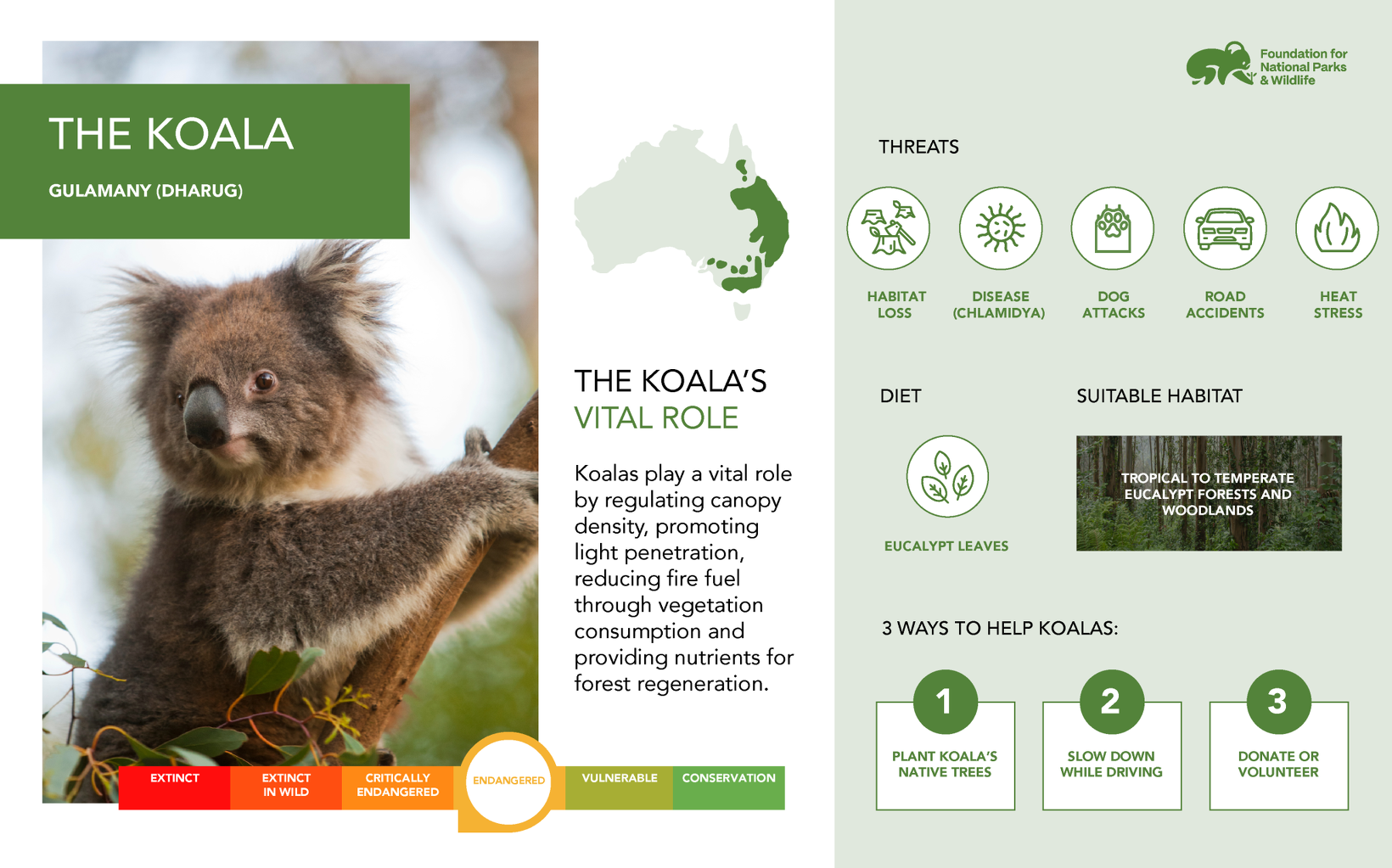
According to a 2011 report entitled “The Koala — Saving Our National Icon” by the Australian Senate koala conservation is complex and multifaceted issue. “In some areas ... their population is in sharp decline, whilst in others ... their numbers are being actively managed because of an overabundance and resulting over-browsing. A key challenge is the paucity of data on the national koala population. The koala's diversity is another aspect of added complexity, with northern koalas being far more diverse than their southern cousins...The range of threats is also varied, for example habitat loss, disease and motor vehicle strikes. As a result there are no easy solutions.[Source: ABC, November 8, 2013]
RELATED ARTICLES:
KOALAS: CHARACTERISTICS, EVOLUTION, HISTORY, ANATOMY, POPULATIONS, DIET ioa.factsanddetails.com
KOALA BEHAVIOR: TREES, COMMUNICATION, REPRODUCTION, YOUNG ioa.factsanddetails.com
KOALAS AND HUMANS: HISTORY, CARS, RESEARCH ioa.factsanddetails.com
ENDANGERED KOALAS: THREATS, FIRES, DISEASE ioa.factsanddetails.com
MARSUPIALS: HISTORY, EVOLUTION, CHARACTERISTICS, BEHAVIOR, REPRODUCTION ioa.factsanddetails.com
MARSUPIALS IN AUSTRALIA ioa.factsanddetails.com
Efforts to Help Koalas
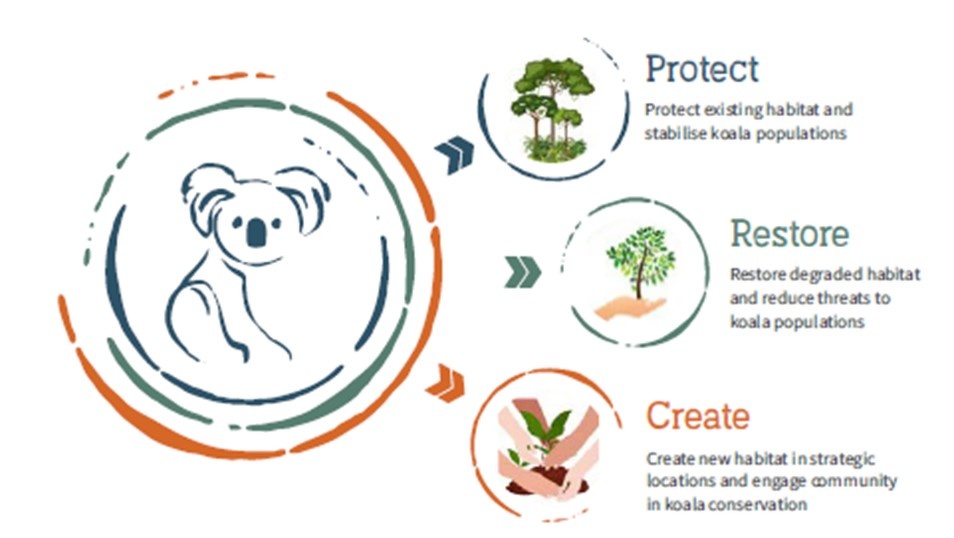
To help koalas, conservationists have made computer-derived atlases that define the core areas where koala spend most of their time and the interconnecting eucalyptus corridors they use to get from core area to core area. The city of Brisbane levies a small environmental tax which is used to buy up land to be set aside as a koala habitat. Deidré de Villiers, one of the chief koala researchers at the Queensland Department of Environment and Resource Management told National Geographic that koalas and humans can coexist in urban environments “if developers get on board with koala-sensitive designs,” such as lower speed limits for streets, green corridors for koala movement, and, most especially, preserving every precious eucalyptus tree. Unfortunately, koalas have another problem. [Source: Mark Jenkins, National Geographic May 2012]
In Port MacQuarie (190 miles north of Sydney) a special hospital has been set up for koalas that have been hit by cars, attacked by pet dogs, injured in swimming pools, stranded on top of telephone poles, and found wandering the streets, homeless. At a koala hospital in New South Wales that takes care of ailing koalas one young koala named Pebbles was admitted after her mother was hit by a car. Her jaw broken in the accident that killed her mother, Pebbles probably had to remain in the hospital for her entire life because as one caregiver told National Geographic, "She'll never be able to fend for herself in this mad world."
Japanese tourists participating in "Save the Koala Tours" at Wildlife Park in Sydney plant eucalyptus saplings that grow into trees yielding edible leaves for koalas. One woman, who led a movement to block the construction of a subdivision that would destroy a forest where koalas live, told National Geographic that her dogs were scarred for life when someone threw battery acid on them. Another time someone threw a homemade bomb on her porch, but fortunately it didn't explode.
Plans to build an international airport near Holsworthy Military Range were scretached because it contained the Sydney area’s only thriving koala colony. An animal protection statute was passed in New South Wales in the mid-1990s that banned the holding of koalas (patting them was okay) because too much handling stresses them out. The laws cost the tourism business an estimated $50 million in lost revenues from places that allow koala cuddling.
Koala Rescue
Mark Jenkins wrote in National Geographic: It’s two in the morning and a koala is caught in barbed wire on a fence, like a prisoner trying to escape. A phone rings in the home of Megan Aitken in Burpengary, a suburb north of Brisbane. Aitken, 42, runs a volunteer organization devoted to rescuing wild koalas from a surprisingly wide array of hazards. Before the dispatcher has even given her the location, she has thrown her clothes on over her pajamas.When Aitken arrives on the scene, Jane Davies and Sandra Peachey, two other volunteers, are already there. The koala is clinging to a chain-link fence, its fur snagged in horizontal strands of barbed wire. Towering eucalyptus trees, as pale as ghosts, rise on the far side of the fence.“He was obviously trying to get to the trees on the other side,” Aitken says. [Source: Mark Jenkins, National Geographic May 2012]
Standing in the bright cones of car headlights, Aitken pulls on heavy leather welding gloves. Despite their huggable, stuffed-animal appearance, koalas can be ferocious when resisting capture. They’ll growl, flail, fight, and bite like angry raccoons, and Aitken has the scars to prove it. Next she places a wire cage on the ground near the animal and opens up a thick blanket. Then the three rescuers rapidly get to work.
Davies throws the blanket over the animal, both to calm it and to protect the rescuers from its teeth and claws. Peachey opens the lid of the cage, while Aitken firmly grasps the little black-nosed beast through the blanket, frees it from the fence, and drops it snarling and snapping into the cage. “Well done, ladies!” Aitken shouts.
Looking down at the round-eyed koala they’ve just captured, Aitken considers a new problem. If this koala were sick or injured, they’d take it to the Australia Zoo Wildlife Hospital, 40 minutes north in Beerwah. But the animal is healthy. By protocol they must release it somewhere nearby, since koalas have a home range and feed in the same trees over and over. Yet this is Deception Bay, a densely populated suburb. The women study a street map with flashlights.
“This is the whole problem,” Aitken says, exasperated. “There are so few places left for the koala.” In the end they take the animal several blocks to tiny Boama Park, which borders a stretch of open land reaching all the way to the beach. Deep in the night the women carry the cage through the trees, setting it below a gray-skinned eucalyptus. Standing back, they spring the lid of the cage, and the koala dashes up the trunk and disappears.“Good luck, little one,” Aitken says.
Catching Koalas and Vaccinating Them Against Chlamydia
In the early 2020s, scientists begun vaccinating wild koalas against chlamydia in a pioneering field trial in New South Wales. The aim was test the method for protecting koalas against the widespread disease that causes blindness, infertility and death “It’s killing koalas because they become so sick they can’t climb trees to get food, or escape predators, and females can become infertile,” said Samuel Phillips, a microbiologist at the University of the Sunshine Coast who helped to develop the vaccine. [Source: Christina Larson, Associated Press, May 9, 2023]
Christina Larson of Associated Press wrote: The scientists’ initial goal is to catch, vaccinate and monitor around half of the koala population in the Northern Rivers region of New South Wales — that means vaccinating around 50 animals. The safety and effectiveness of the single-shot vaccine, which has been designed specifically for koalas, has previously been tested by vaccinating a few hundred koalas brought to wildlife rescue centers for other afflictions. Now scientists want to understand the impact of vaccinating a population of wild koalas. “We want to evaluate what percentage of the koalas we need to vaccinate to meaningfully reduce infection and disease,” said Phillips.
The first koalas were caught and vaccinated in March, 2023 and the effort was expected to last about three months. Researchers use binoculars to spot koalas in eucalyptus trees, then construct circular enclosures around the tree bases with doors leading into cages. After a few hours or days, the koalas will eventually climb down from one tree to seek tasty leaves on another, and wander into the harmless traps. After a check-up to make sure the animals are in good condition, researchers administer anesthesia and shots of vaccine, then keep them under observation for 24 hours after they wake up, to confirm there are no unexpected side effects, said Jodie Wakeman, veterinary care and clinical director at Friends of the Koala, a nonprofit that runs a wildlife hospital where the koalas are being brought for vaccination.
The goal is to vaccinate healthy koalas to prevent them from becoming infected with chlamydia. Before release, the researchers mark the koalas with a dab of pink dye on their backs, to ensure the same animals aren’t caught twice. When the first vaccinated koala was returned to her habitat on March 9, the scientists placed her cage at the base of a tree and opened the door. She quickly emerged and bounded up the tree trunk. In deciding to vaccinate, the scientists are balancing the risk of disturbing the animals against the danger of allowing the disease to spread. The trial was approved by multiple government bodies, including Australia's agriculture department and New South Wales' planning and environment department.
Vaccinating wild animals is an expensive and time-consuming undertaking, and a strategy that is not undertaken lightly.There are only a handful of other examples worldwide of scientists attempting to catch and inoculate endangered wildlife for conservation. In 2016, scientists began to vaccinate Hawaiian monk seals against a deadly strain of morbillivirus. In 2020, biologists in Brazil began to vaccinate golden lion tamarins against yellow fever. With koalas, conservationists believe that vaccinations are the best way to protect them in the wild. "Vaccination is an incredibly resource-intensive thing to do," Jacob Negrey, a biologist at Arizona State University and formerly at Wake Forest University School of Medicine in Australia told Associated Press. "But because the effects of chlamydia are so debilitating, I think it's totally worth it." [Source: Harry Baker, Live Science, May 17, 2023]
Rebecca Johnson, now chief scientist at the Smithsonian National Museum of Natural History in Washington, D.C., previously led the Koala Genome Consortium in Australia said the benefits are likely to outweigh the risks for koalas. “Vaccination is an incredibly resource-intensive thing to do. Koalas live high up in trees," she said. “But because the effects of chlamydia are so debilitating, I think it’s totally worth it.”
So Many Koalas in South Australia and Victoria, Fertility Control Is Employed
Koalas are struggling in New South Wales and Queensland, but South Australia and Victoria, their numbers are booming — to the point where authorities are actually trying to reduce the animals' breeding. In October 2022, South Australia's Natural Resources, Adelaide and Mount Lofty Ranges agency announced a "fertility control program" across the Mt Lofty Ranges in the Adelaide Hills.The agency's surveys show 150,000 koalas in the Hills and a further 50,000 on Kangaroo Island.That does not include other koala population centres such as the Lower Eyre Peninsula, in the states' south-east, and in Riverland areas along the Murray River. [Source: 7News.com, October 26, 2022]
7News.com reported: Natural Resources regional director Brenton Grear says the Mt Lofty Ranges population estimates are solid.He said the surveys used a big network of community members recording koala locations, as well as targeted surveys conducted by agency staff and scientists, with the data examined by ecological modellers. "So it has been rigorously examined and we are pretty confident we have 150,000 of them," he told 7NEWS.com.au.
Grear said the population levels had led to "over-browsing" and there are simply too many koalas for available food sources in the area. "One of the greatest threats to the koala population in parts of the Mt Lofty Ranges is the koala population itself," he said.The agency is giving hormone implants to 200 koalas in a bid to reduce breeding.
A similar story is unfolding south-west of Melbourne where, across the sprawling Cape Otway region, koala numbers reached about 20 per hectare, prompting a cull of 700 animals in early 2014 because of widespread starvation. It's thought that just one animal per hectare is a sustainable population level. In 2015, contraceptives were implanted in 166 of the animals in a bid to get the population down and relocation of the animals is ongoing.
Koala Birth Control
Koalas in parts of Australia have been sterilised and given long-term contraceptives to control overpopulation. A koala fertility program was implemented in parts of South Australia in the late 2010s in an effort to control their numbers. A hormone implant was given to around 200 koalas in an area of the Manna Gum woodland in the central hills, where 13 koalas per hectare had been recorded and were to over-browsing. Natural Resources Adelaide and Mt Lofty Ranges regional director Brenton Grear told ABC "Over-browsing deteriorates the health of the trees, which are their food trees, and those trees eventually die. The outcome is eventually the death of the trees but also potentially some pretty catastrophic deaths of koalas through no food source. In effect, one of the greatest threats to the koala population in parts of the Mount Lofty Ranges is the koala population itself." [Source: ABC, 17 May 2019]
ABC reported: Mr Grear said the fertility control program and aimed to curb breeding to reduce the koala population without harming the animals. He said trained staff would capture the koalas one at a time, bring them to the base of the tree and administer a hormone implant, then release them. "The whole treatment takes less than 10 minutes and has been developed to minimise disturbance to the animal," he said.
He said the result would be that koalas with the hormone implant would be infertile. "The evidence that we've had from the use of this implant is that they are effective for either the life of the koala or if the implant is removed, and that can be upwards of 15 years," he said. "But if it was required and things changed in the future, the evidence is that the implant can be removed and the animals becomes fertile again."
In 2004, $358,000 project to implant contraceptives in up to 2,000 koalas took place over 10 weeks at a national park in the west of Victoria state. John Thwaites, the state's environment minister said: "It would serve no one's interests if Victoria's koala management strategy wasn't about conservation of the species, and this means controlling population numbers where the animals are eating out their own food source and protecting natural habitat where numbers are low," Thwaites told Associated Press. Koala populations are unevenly spread across the state, Thwaites said. In some areas population density is so high that local vegetation is being destroyed. Trials of the slow-release hormone show that it prevents conception for up to six years, he said. Thursday. [Source: Associated Press, October 1, 2004]
A study by David Ramsey at the Arthur Rylah Institute for Environmental Research in Melbourne, Australia, published in in December 2020 suggests that programs in which koalas were sterilised and given long-term contraceptives to control overpopulation appeared to have worked. The researchers studied a programme implemented between 2004 and 2013 in Budj Bim National Park, Victoria. [Source: Donna Lu, New Scientist, January 1, 2021]
Catching a Koala to Give It an Anti-Fertility Drug
Describing the capture of a koala to administer an anti-fertility drug made by the company Ecoplan on Snake Island, near Melbourne, which has an overpopulation of koalas, Mary Roach wrote in Discover: Coaxing a koala out of a tree is harder than one would think, for koalas are surprisingly quick and stubborn. The koala catchers; Ecoplan biologists Matt West and Keith Cherry, with Peter Menkhorst, a wildlife policy officer in Victoria', lending a hand; are using telescoping fiberglass poles crowned with flapping pieces of plastic garbage bags to spook the koala. One need only shake them in the animal's face and it will back down the tree and into a waiting gunnysack. Or so the theory goes. The men extend their poles. The garbage-bag phantoms weave and bob as they rise through the foliage. The scene has the look of an avant-garde puppet show. West swings his pole in close and shakes it. Koala Z-018 shrinks back, mouth open and paws flung out in front of her chest in a comic-book gesture of surprise. Meanwhile, her distress calls rake the afternoon calm, at once squeaky and hoarse, as though she were coughing up a small squeeze toy. [Source: Mary Roach, Discover, December 1, 2000]
Koala Z-018 summons all the energy her gut-slowed metabolism can provide. She starts to back down, as West had hoped, but then turns and leaps, monkey-fast, across two feet of air to the other prong of the tree's forked trunk. Before the men have time to reposition their poles, she has scrambled back up, higher than before. Then West puts on a nylon climbing harness and goes up after her. The distress calls of koala Z-018 are more urgent now, a string of truncated squeals like sneakers on a basketball court. As West hustles her down the tree, she suddenly panics and hurls herself into the air, dropping the remaining 25 feet to the ground as onlookers clap their hands to their faces.
No worries, as Australians like to say: Koalas are apparently as unbreakable as the teddy bears they resemble. She hits with a quiet thud, bounces slightly, and is on her feet, scrambling. Cherry lunges for her. He grabs the scruff of her neck and lifts her up, his other hand supporting her from below. He holds her at arm's length, for she is wet with urine and ambitiously hostile, growling and hissing like a whip-peeved circus tiger. Cherry's caution is well warranted: A few months back, when park workers were giving vasectomies to some of the island's males, a koala bit clear through a volunteer's palm. Menkhorst picks up a burlap sack and holds it open. Cherry tries to drop the koala inside, but she has her limbs spread wide like a lobster approaching the pot. The men wrestle her in and tie off the sack.
Immunologist Anne Kitchener from the University of Newcastle knows better than to open the sack. She readies a shot of tranquilizer and sticks it through the fabric. A minute later, Ecoplan director Bryan Walters peels the burlap down to the koala's midsection, making her look like a competitor in a children's sack race. For the duration of the proceedings, koala Z-018 will remain about 80 percent unconscious, more plush toy than wild animal. Kitchener shaves a patch of the koala's forearm and searches for a vein to draw blood. That done, Walters clips a pair of colored plastic ID discs onto Z-018's ears. Walters is a soft-spoken Gepetto of a man, who calls his subjects "girl" and "darlin'. " He clearly doesn't relish the task at hand. Although this is being done for the koalas' benefit; better a few bad days than starvation; it's hard not to feel for the little guys. "It's a big step to start playing God and meddling with fertility," Walters says, idly rubbing Z-018's belly. "Whatever we do, we must do in the most benign method possible."
Shooting Koalas to Save Them?
At Kangaroo Island, off Australia's south coast, Snake Island near Melbourne and Budj Bim National Park in Victoria, some environmentalists have urged authorities to shoot hundreds of koalas because the animals are destroying vegetation and over-browsing their own foood supply. But authorities have mostly rejected the call, concerned about a possible backlash among international tourists. But not always.
Benji Jones wrote in Vox: In April 2025, government authorities shot and likely killed several hundred koalas from helicopters in Budj Bim National Park, a protected area in Victoria. A month earlier a massive bushfire burned more than 5,400 acres in the park, injuring some of the koalas and destroying a large amount of eucalyptus leaves, their food. The government says the controversial program is intended to end the koalas’ suffering from burns and starvation. [Source: Benji Jones, Vox, April 19, 2025]
But some koala advocates say there’s more to the story.The animals are not only starving because of the fire but because logging and development has destroyed much of their habitat in Victoria. Advocates have also pointed out that there are commercial plantations of blue gum eucalyptus around Budj Bim National Park that koalas have come to rely on. When those plantations are harvested, the koalas living in them move into Budj Bim, putting pressure on what natural forests remain in the park. A fire only makes the situation worse — destroying food in a region with a dense population of koalas.
Rescuing the koalas, or assessing their health up close, was not feasible, according to the Victoria government. “All other methods which have been considered are not appropriate given the inability to safely access large areas of impacted landscape by foot due to the remote location of animals often high in the canopy, the extremely rugged terrain, and in consideration of the safety risks of working in a fire affected area, with fire impacted trees,” James Todd, chief biodiversity officer at Victoria’s Department of Energy, Environment, and Climate Action (DEECA), said in a statement to Vox.
Image Sources: Wikimedia Commons
Text Sources: Animal Diversity Web animaldiversity.org , National Geographic, Live Science, Natural History magazine, Australian Museum, David Attenborough books, Australia Geographic, New York Times, Washington Post, Los Angeles Times, Smithsonian magazine, Discover magazine, The Conversation, The New Yorker, Time, BBC, CNN, Reuters, Associated Press, AFP, Lonely Planet Guides, Wikipedia, The Guardian, Top Secret Animal Attack Files website and various books and other publications.
Last updated July 2025