
Home | Category: Marsupials
KOALA BEHAVIOR

female with joey
Koalas are motile (move around as opposed to being stationary), mainly nocturnal (active at night), and almost completely arboreal (live in trees). They come to the ground occasionally to move to another food tree or to lick up soil or gravel which aids in digestion. Koalas are extremely slow-moving animals and are relatively defenseless. They prefer to move around just after sunset spending daytime asleep in the fork of a tree. They cool themselves by licking their arms and stretching out as they rest in the trees. Koalas have no sweat glands. [Source: Jennifer Dubuc and Dana Eckroad, Animal Diversity Web (ADW) |=|; AFP]
Koalas are largely sedentary and lethargic animals that spend 75 to 80 percent of their time sleeping which works out to 18 to 20 hours a day. They have even been observed sleeping 24 hours in a day. They forage for food primarily at night and sleep in the day. Koalas forage for eucalyptus leaves in home ranges that vary between 2.8 and 28 hectares (seven and 70 acres). The prefer the shade to the sun. One conservationist told National Geographic: "this is how they operate. They find a great big tree and sit with a branch between them and the sun, bums to the breeze, and fall fast asleep." [Source: Oliver Payne, National Geographic, April 1995]
Koalas can be quite irritable. They sometimes scratch and bite when disturbed. One Queensland resident told National Geographic that koalas "are grumpy little buggers. If you get a real old grumpy bugger, a big one on the ground, and you're in his way, he'll sort of make this horrible growling noise and show his claws... Oh yes, they'll rip you to pieces. You just hope they don't turn on you and come in scratching. You'd look as though you'd been dragged behind a car for a hundred yards."
Koalas are usually found in eucalyptus trees but can also be found in trees of other genera, such as Acacia, Allocasuarina, Callitris, Leptospermum, and Melaleuca. When feeding, koalas reach out to grab leaves with one forepaw while the other paws hang on to the branch. Smaller of the individuals can walk to the end of branches while larger one must stay near the trunk of the tree. Each day, koalas eat up to 400 grams (14 ounces) of leaves, spread over four to six feeding periods. Despite their adaptations to a low-energy lifestyle, they have meagre fat reserves.
The low-energy diet of koalas limits their activity and that is one reasom why they sleep so much each day. They spend most of their waking hours foraging. They typically eat and sleep in the same tree, possibly for as long as a day. On warm days, koala may rest with their back against a branch or lie down with their limbs dangling. When it gets hot, koalas rest lower in the canopy and near the trunk, where the surface is cooler than the surrounding air. When it gets cold and wet, koalas curl up. They move to lower, thicker, branches in high winds. The main reason they come to the ground is to move from from one tree to another tree, which they do so either by walking or with a leaping gait. Koalas usually groom themselves with their hind paws, with their double claws, but sometimes use their forepaws or mouth. [Source: Wikipedia]
RELATED ARTICLES:
KOALAS: CHARACTERISTICS, EVOLUTION, HISTORY, ANATOMY, POPULATIONS, DIET ioa.factsanddetails.com
KOALAS AND HUMANS: HISTORY, CARS, RESEARCH ioa.factsanddetails.com
ENDANGERED KOALAS: THREATS, FIRES, DISEASE ioa.factsanddetails.com
KOALA CONSERVATION: HELPING THEM, VACCINATIONS, RESCUES, BIRTH CONTROL ioa.factsanddetails.com
MARSUPIALS: HISTORY, EVOLUTION, CHARACTERISTICS, BEHAVIOR, REPRODUCTION ioa.factsanddetails.com
MARSUPIALS IN AUSTRALIA ioa.factsanddetails.com
Koala Social Behavior

Koala resting postures: a) basic posture; b) through d) tree postures’ e) normal ground posture; f) through h) different ground postures
Koalas are generally asocial. Outside of the breeding season there is little obvious social behavior. The only relatively long term bonds are between mother and dependent offspring. However, koalas live in loose-knit groups if enough suitable trees are present, but only one animal per tree. On average koalas spend just 15 minutes a day on social activities. In areas of higher density and fewer trees, home ranges are smaller and closer together. Sometimes koalas lives in small harems led by a single male. [Source: Jennifer Dubuc and Dana Eckroad, Animal Diversity Web (ADW) |=|]
Koala society appears to consist of "residents", mostly adult females, and "transients", mostly males. Resident males appear to be territorial and dominant. The territories of dominant males tend to be found near breeding females. Younger males have to wait until they reach full size to challenge for breeding rights. Adult males occasionally venture outside their home ranges; when they do, they usually retain their dominant status wherever they are. [Source: Wikipedia]
Combative behavior typically consists of quarrels between individuals who are trying to pass each other on a tree. This occasionally involves biting. Strangers may wrestle, chase, and bite. In extreme situations, a larger male may try to displace a smaller rival from a tree, chasing, cornering, and biting it. Once the individual is driven away, the victor bellows and marks the tree. Pregnant and lactating females can be very aggressive and attack individuals who come too close. In general, however, koalas tend to avoid fighting if for no other reason than it requires a lot energy. Maybe the same is true with social activity in general.
Koala Cool Themselves by Hugging Trees
Koalas rarely drink water and don't have any sweat glands, and thus scientists have long wondered how they kept cools when it got really off in a heatwave. The secret appears to be — hugging trees, whose trunks can be several degrees cooler than the surroundings. AFP reported: Koalas have high mortality rates in heatwaves. Unable to sweat, they use panting as a way of evaporative cooling, but in the wild, they rarely drink and when they need to, water is often scarce. As tree-dwellers, koalas don't generally seek out cool, shadowy ground surfaces like many other animals. [Source: AFP, June 4, 2014]
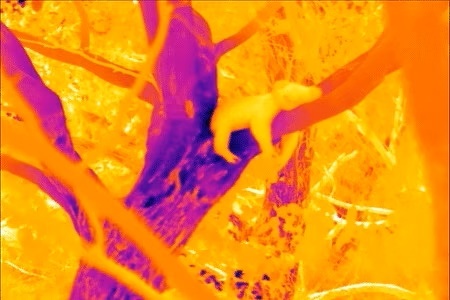
thermal image showing how tree hugging affected koala body temperature; purple tones are the coldest; yellow colors indicating warmth; Orange tones show temperatures in between those two extremes; trees gain heat from the koala body; when this happens, koalas cools off; from University of Melbourne
Keen to unlock the marsupials' secret, a team of zoologists observed 37 koalas in the wild during winter and summer seasons in southeastern Australia in 2009 and 2010-11. On hotter days, they found, the animals were more frequently positioned with all their limbs outstretched so they appeared to be hugging the tree trunk or lower branches. The warmer it got, the lower the marsupials were found in the trees, and more often in trees other than eucalyptus, their food source. This could be explained by the eucalyptus being only about 1.46-1.87 degrees Celsius (2.6-3.4 degrees Fahrenheit) cooler than air temperature, compared to about 5.0 C for the acacia.
Based on their observations of tree temperature and koala behavior, the team concluded the animals lose "substantial" body heat to tree trunks in hot weather. "Water savings from this behavior could be critical for the survival of this species during heatwaves when water availability is limited," said the study published in the Royal Society journal Biology Letters."Our results highlight the important role of tree trunks as above-ground 'heat sinks', providing cool local micro-environments not only for koalas, but also for all tree-dwelling species."
Koalas have evolved bodies that are perfectly suited for hugging trees to stay cool. "Koalas have thinner fur in their bellies, which we suspect is to aid close contact with the tree trunk," senior author Michael Kearney told Discovery News. On hot days, he said that koalas "are aiming to cool the vital organs in their chests as well as their brains by losing heat through their chests and groin areas." Kearney is a zoologist at the University of Melbourne. He conducted the study with project leader Natalie Briscoe and four other researchers. Kearney explained that as a koala hugs, "The blood flowing through the body would continually replenish cooled blood near the parts of the koala in contact with the tree with warm blood from other parts of the body, with the ultimate effect of cooling the whole body down."[Source: AFP, July 28, 2018]
Briscoe, Kearney and colleagues shared that other animals, such as leopards, hug trees too. Leopards, other big wild tree cats and even tree-climbing house cats might look like they are just lounging on branches, but they too tend to hug trees, using the tree's cooler internal temps to cool down their bodies. Many bat species go to a lot of trouble to hug trees, having to hang on with their toenails. Some trees turn out to be better than others for body temperature regulation. Kearney explained, "Trees with smooth bark seem preferable because they have what's called a 'high thermal conductivity,' which means heat flows faster into or out of the object. Also, larger trees with thicker trunks are cooler."
Koalas Have Day Trees and Night Trees
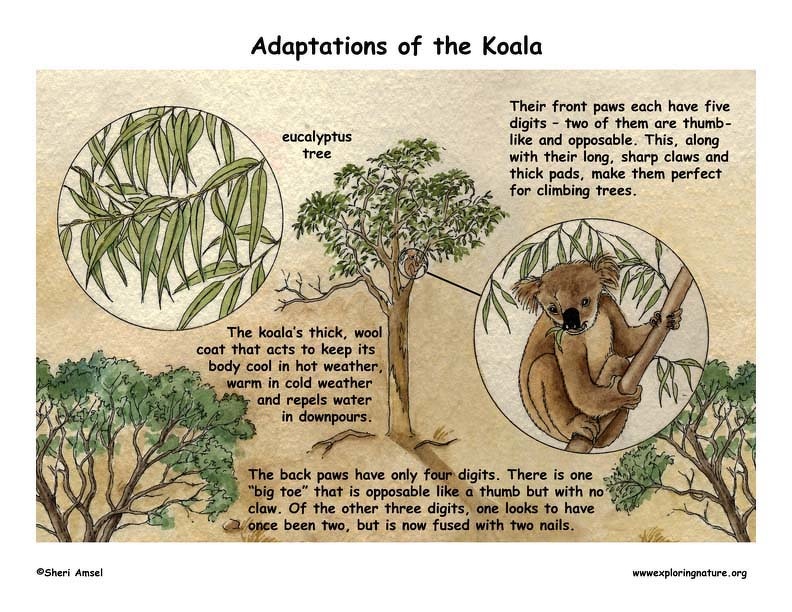
from Exploring Nature
Koalas appear to prefer certain trees to sleep in during the day, and different ones to forage in at night to eat according to a study by lead author Dr Karen Marsh of the Australian National University published in April 2014 in CSIRO journal Wildlife Research. Although koalas are a popular species for study, very little is known about their behaviour and feeding patterns, especially at night. "At the moment a koala habitat is based on the trees people find koalas in during the day, but those aren't necessarily the trees they want to eat, and so we need a broader habitat definition," says Marsh. "A lot of people have researched what trees koalas prefer from a non-feeding perspective, but there's an assumption that if you see a koala in a tree, then they probably eat it. Just by looking at koalas in trees, without taking into account how much they eat from those trees, means we're missing the larger picture of what else they use these trees for. We wanted to know what makes koalas interested in one type of eucalypt rather than another." [Source: Stuart Gary, Monday, ABC, April 7, 2014]
ABC reported: To investigate what koalas get up to day and night, Marsh and colleagues attached microphones to eight animals in a bush reserve on Victoria's Phillip Island. They used audio and radio telemetry to track koala movements and continuously monitor their activities for 14 days, to determine their feeding patterns and social interactions. "We recorded hundreds of hours of data," says co-author Dr Ben Moore of the University of Western Sydney. "We were able to determine which trees they were in at different times, and could also hear them munching on leaves. This allowed us to record the types of trees they visited, as well as when, how often and for how long they feed."
The researchers were then able to examine the trees being used by the koalas, and analyse the nutritional composition of the leaves. They found the trees koalas preferred to sit in, didn't necessarily correspond to what they preferred eating. Individual koalas varied in how many trees they visited, how many meals they ate and how long they spent feeding during each 24-hour period.
They liked to relax in blue gums (Eucalyptus globulus) during the day, but fed mainly at night, with a general preference for Manner gums (Eucalyptus viminalis). "We don't really know how koalas choose trees, but they all seem to prefer leaves with more protein and less toxins, and spend much longer feeding in those trees," says Marsh. "Koalas eat very different amounts from each tree they visit and that is highly dependent on the nutritional value of the leaves. Each tree can have very different levels of proteins and toxins compared to the tree next to it regardless of the species, which can have a big impact on how much the koalas eat."
The researchers also found koalas had a very strong preference for sitting in large trees with more shade during the day. "Because their lives are lived in trees, they use them for so many different reasons apart from feeding, such as shelter and for socialisation with other koalas or alternatively to avoid them," says Marsh. As direct observation of koala behaviour is difficult in the long-term, the researchers suggest measuring leaf cuticle fragments or waxes in feces would be a more accurate way of predicting a koala's diet intake and behavior.
Koala Senses and Communication
Koalas sense and communicate using touch, sound, vision and chemicals usually detected with smell. Adult males mark their presence with secretions from scent glands located on their chests. As they climb a new tree, they rub their chest against it and sometimes dribbles urine. This scent-marking behaviour is probably a form of communication. Individuals have been observed sniffing the bottom of newly found trees. Chest gland secretions are complex chemical mixtures—about 40 compounds were identified in one analysis—that vary in composition and concentration across season and age. [Source: Wikipedia]
The broad, dark nose of koalas gives them a good sense of smell, and is especially good at sniffing out oils of individual branchlets to assess how edible they are. Their relatively small eyes are unusual among marsupials in that the pupils have vertical slits. This is an adaptation to living on a more vertical plane. Their round ears provide koalas with good hearing. The middle ear is particularly well-developed
Koalas sometimes communicate with facial expressions. When snarling, wailing, or squawking, they curl their upper lip and points their ears forward. Screaming koalas pull their lips and ears back. Females form an oval shape with their lips when annoyed.
Koala Vocalizations
In the wild koalas are often difficult to see in trees, but their call is easy to recognize. Koalas make deep "guttural grunts" that "reverberate throughout the forest." The sound has been described by some as a cross between a grunt and burp that can be heard a half mile away. Male koalas make wheezing sounds followed by guttural grunts. Females snarl, wai and scream. These calls are produced when in distress and when making defensive threats. Younger animals squeak and older ones squawk when distraught. When another individual climbs over it, koalas makes a low closed-mouth grunt. Females and subadult males issue harsh wailing distress calls when harrassed by adult males. [Source: Jennifer Dubuc and Dana Eckroad, Animal Diversity Web (ADW) |=|; Wikipedia]
Males communicate with bellows — "long series of deep, snoring inhalations and belching exhalations" — that intimidate rivals and attract mates. They also bellow to advertise their presence when they change trees. These sounds appear to signal and exaggerate the male's body size; as females have been observed paying more attention to bellows by larger males. Because of their low frequency, such bellows can travel long distances through the forest. Koalas may bellow at any time, particularly during the breeding season. The deep, bellowing sounds made by males have been compared the singing of Barry White and are produced with a unique vocal folds located in their throat. These folds, combined with a descended larynx, allow them to produce extremely low-pitched sounds, even though they are relatively small animals. Female koalas also bellow, though more softly. While the bellow is their most distinctive sound, koalas also use snarls, screams, and other vocalizations for communication.
During the mating season, sounds produced by male koalas are as loud as those made bulls and bison and correlates with body size according to research published September 2011 in The Journal of Experimental Biology. "We've shown, for the first time, there's variation in the bellows that correlate with body size in the males," says co-author Dr Bill Ellis, part of the Koala Ecology Group at the University of Queensland. "To our ear, we can't actually hear much difference between a large and not so large koala, but it seems koalas can tell," he says. [Source: Sarah Kellett, ABC, September 29, 2011]
Sarah Kellett of ABC wrote: To see if the bellows changed with body size, scientists recorded koalas at the Lone Pine Koala Sanctuary in Queensland, and then measured their heads. Head size correlates closely to body length in koalas, and is easier to observe.Analysis of the recordings showed the difference was not in pitch, but in vocal tract resonance, or formant. "Formants are a resonant frequency of the vocal tract," says study lead author Dr Ben Charlton, a research biologist at the University of Vienna. "The vocal tract has air in it, and it vibrates at certain frequencies preferentially. Formant perception is critical for vowel perception [in humans]"
In koalas, it is the spacing of formants that changes with body size, with larger koalas having lower formant spacing, explains Charlton. According to the study, formant spacing is an honest cue for body size, as they are inextricably linked to vocal tract length, and that length is ultimately constrained by the chest and sternum. Though koalas are being honest about their size, the trait is highly exaggerated compared to other species, says Ellis. "If you just looked at the vocal tract resonances, you would expect it came from a much larger animal," he says. Koala bellows sound as though their vocal tract is 50 centimetres long, nearly the length of their entire body.
Koala’s Unique Vocal System Allows Them to Produce Very Deep Sounds
Koalas possess a descended larynx, similar to humans and some deer species, which enables them to produce deeper sounds. The koala larynx is located relatively low in the vocal tract and can be pulled further down using a large muscle embedded in the chest cavity. The key feature that makes their unique deep sounds possible is a pair of large, vocal folds located in the pharynx, where the nasal and oral cavities connect. These folds are in the velum (soft palate) and are known as velar vocal folds They are in addition to the usually vocal folds of the larynx. When breathing in and out, koalas cause their pharyngeal folds to vibrate, creating a series of sounds that resemble snoring and belching — and are much deeper than those made by animals of their size.
The folds were first identified during detailed dissections of a koala in Germany and studied in detail by Dr Benjamin Charlton from the University of Sussex in the United Kingdom, who collaborated with Allan McKinnon at Moggill Koala Hospital in Queensland, who dissected further specimens. They reported their findings in a study published in the journal Current Biology in December 2013. [Source: Rachel Sullivan, ABC, December 3, 2013
"The koala's velar vocal folds are two long fleshy lips that are located in the soft palette (or velum), just above the larynx where the oral and nasal portions of the pharynx connect," Dr. Charlton said. “Because the velar vocal folds are over three times longer and around 700 times heavier than [normal] laryngeal vocal folds they can oscillate at lower frequencies and produce lower-pitched sounds, [similar to] a guitar string."
Rachel Sullivan of ABC wrote: Researchers were able to reproduce mating bellows in koala specimens by mimicking inhalation and sucking air through the folds. A strategically placed video camera confirmed the folds' role in sound production. Charlton says that velar vocal folds may have evolved independently in koalas specifically to produce this species' characteristically low-pitched mating calls. They are the only example of a specialised sound producing organ in a land-dwelling mammal that is independent of the larynx. The only other known example of an independent, specialised sound producing 'instrument' in mammals are the phonic lips used by toothed whales to generate echolocation clicks.
"We might expect to find velar vocal folds in other closely related marsupials that produce disproportionately low-pitched calls for their size," Charlton says. "However, because velar folds are not documented in any species of placental or marsupial mammal, it also seems likely that this remarkable adaptation evolved independently in the koala."
It remains uncertain why koalas need to make such low-pitched calls. "In previous studies we have shown that the vocal tract resonances (known as formant frequencies) of koala bellows provide reliable information about the identity and size of male callers," Charlton said. "Because low pitch improves the perception of formant frequencies in humans, we think that the koala's remarkably low pitch facilitates the transfer of this important information. Another possibility is that low pitch acts as a direct cue to male quality.
Koala Mating and Reproduction
Koalas are polygynous (males have more than one female as a mate at one time) and engage in seasonal breeding. Koala reach maturity at the age of two, but males usually don't successfully mate until they are three or four. because competition for females requires larger size. During the breeding season, from October to February, adult males are very active at night and move constantly through their range, both ejecting male rivals and mating with any receptive females .
Females are seasonally polyestrous, with an estrus cycle of about 27-30 days, and usually breed once every year . The gestation period is 25-35 days with births occurring in mid-summer (December-January). Koalas usually give birth to a single joey but twins have been reported . Koalas are unusual among marsupials in that they briefly form a placenta during the gestation of their embryos. Members of the families Peramelidae , Peroryctinae, and Vombatidae are the only other marsupials with placentae. [Source: Phil Myers, Jennifer Dubuc and Dana Eckroad, Animal Diversity Web (ADW) |=|]
Koalas have a scent gland that leaves an orange-brown smudge on the animal's chest. Male koalas rub their scent gland on trees to mark their territory, drive off or rival males and attract females. Copulation is brief genrally lasting less than two minutes, and occurs in a tree . During mating the male grasps the back of the female's neck with his teeth.
Because they of their much larger size, males can overpower females. Females may scream and vigorously fight off their suitors but accede to one that is dominant or familiar. The commotion can attract other males to the scene, obliging the incumbent to delay mating and fight off the intruders. A female may learn who is more dominant during these fights. Older males typically accumulate scratches, scars, and cuts on the exposed parts of their noses and their eyelids. [Source: Wikipedia]
Koala Offsping and Parenting
As is the case with most marsupials, after the female koala gives birth, the infant, or joey, climbs into the mother's pouch where it is nourished for five month from a nipple within the pouch. Koala females have a backward-directed pouches to provide easy access for their young. In addition to milk, koala young feed on a yellow-green ooze of partially-digested eucalyptus leaves excreted from an opening in the mother's pouch.
Koala joeys weigh less than 0.5 grams when born.Young have a pouch life of five to seven months and weaned at six to 12 months . Toward the end of their pouch life the young feed regularly on material passed through the mother's digestive tract . Once the young begins to feed on leaves growth is rapid. After young leave the pouch they are carried about on the mother's back. By eleven month's of age young are independent, but may continue to live close to the mother for a few months. [Source: Jennifer Dubuc and Dana Eckroad, Animal Diversity Web (ADW) |=|]
On the the feeding of koala joeys, Keith Longhurst told National Geographic: "Then all of a sudden, when the mother reckons it's time for herbie to come out, instead of defecating pellets, she starts excreting this pap. It’s real slimy green, and the baby licks it up hungrily for about a fortnight...You should see the bloody Rotary people when I tell 'em that; they just about throw up in their plates!...The excreta gets into his gut — you know, he's got a 20 foot gut in there, it's all over the place and starts his stomach working so he can break down the stuff that's poisonous. Then the pap turns back to pills, and he's out, mate, and he's eating gum leaves." [Source: Oliver Payne, National Geographic, April 1995]
Image Sources: Wikimedia Commons
Text Sources: Animal Diversity Web animaldiversity.org , National Geographic, Live Science, Natural History magazine, Australian Museum, David Attenborough books, Australia Geographic, New York Times, Washington Post, Los Angeles Times, Smithsonian magazine, Discover magazine, The Conversation, The New Yorker, Time, BBC, CNN, Reuters, Associated Press, AFP, Lonely Planet Guides, Wikipedia, The Guardian, Top Secret Animal Attack Files website and various books and other publications.
Last updated July 2025