
Home | Category: Animals / Marsupials
KOALAS
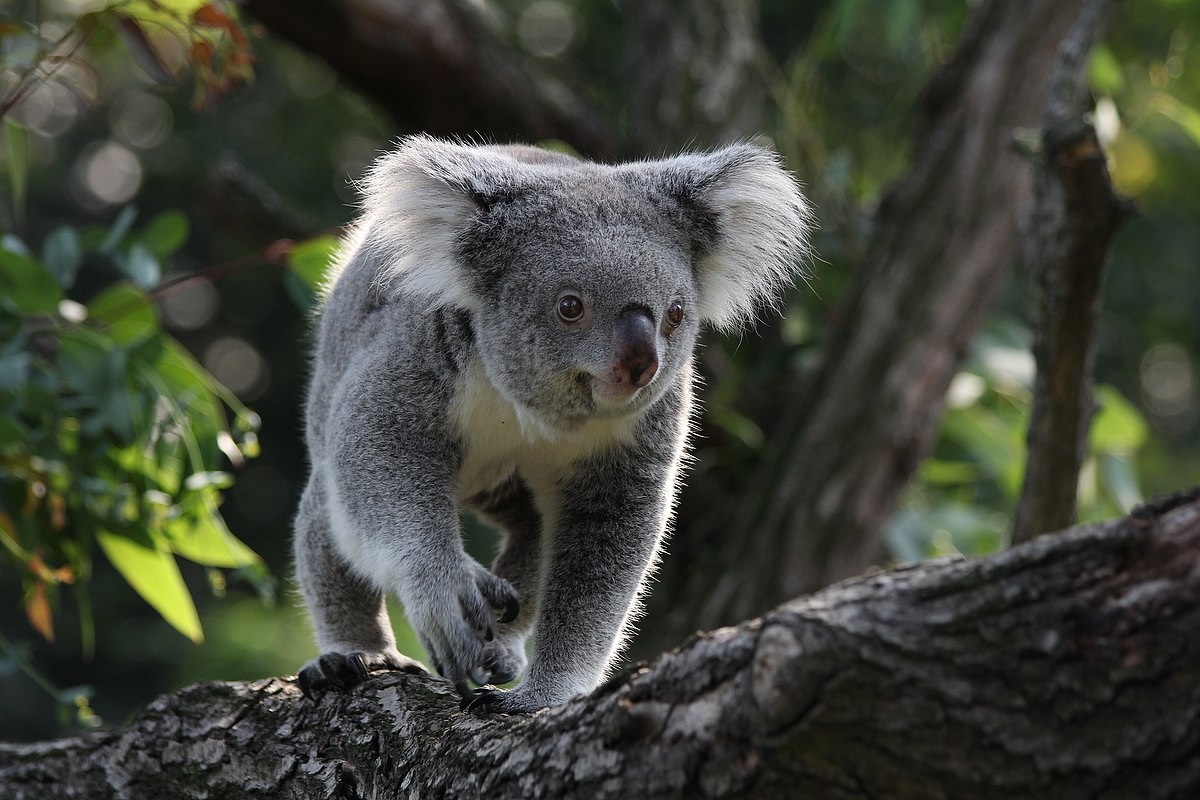
koala at a zoo in Germany
Koalas (Phascolarctos cinereus) are marsupials native to Australia that live in trees and mainly eat eucalyptus leaves. They are the only extant representative of the family Phascolarctidae; Their closest living relatives are wombats. Koalas are is easily recognisable by their stout, tailless body and large head with round, fluffy ears and large, dark nose. They weigh around 10 kilograms (22 pounds) and are about 60 centimeters (two feet) long. Koalas have dense, wooly fur that is gray to brown on top and varies with geographic location. [Source: Wikipedia]
The scientific name of koalas is “Phascolarctos” (pouched bear) “cinereus” (ash-colored). They are not bears, however. Koala is an aboriginal word that mean "no drink." They draw moisture primarily from their food although they do on occasion drink from pools. Koalas and wombats both evolved from a ground-dwelling species that roamed Australia 20 million years ago. Both animal have similarly-spaced toes, similar footpad textures and a single pair of teats in their pouches. [Source: Oliver Payne, National Geographic magazine, April 1995]
Koalas and Bennett's tree-kangaroo are the biggest tree-dwelling mammals in Australia. Koalas are much loved by Australians and non-Australians alike. They were featured for a long time in Qantas airlines advertisements that helped bring koalas to the world and travelers to Australia. Despite their cute appearance koalas have a reputation for being bad-tempered and sullen. Their maximum lifespan in captivity is 15 to 20 years. Their maximum lifespan in the wild is 13 to 17 years. Koalas are prone to chlamydia bacteria. [Source: Ilsa Sharp, “CultureShock! A Survival Guide to Customs and Etiquette: Australia”, Marshall Cavendish, 2009; Karen Black, University of New South Wales, SBS News, November 24, 2012]
Koalas are found in New South Wales, Victoria, Queensland and South Australia. They range along the east coast and southeastern corner of Australia from Townsville, Queensland in the north to Melbourne in the south. They have been reintroduced to South Australia, some parts of western Australia and nearby islands. Koalas are arboreal (live mainly in trees). They live primarily in forests with eucalyptus trees below 600 meters (1968 feet) and spend most of their time in the branches of the eucalyptus trees, where they are able to feed and stay out of reach of their predators. [Source: Jennifer Dubuc and Dana Eckroad, Animal Diversity Web (ADW) |=|]
RELATED ARTICLES:
KOALA BEHAVIOR: TREES, COMMUNICATION, REPRODUCTION, YOUNG ioa.factsanddetails.com
KOALAS AND HUMANS: HISTORY, CARS, RESEARCH ioa.factsanddetails.com
ENDANGERED KOALAS: THREATS, FIRES, DISEASE ioa.factsanddetails.com
KOALA CONSERVATION: HELPING THEM, VACCINATIONS, RESCUES, BIRTH CONTROL ioa.factsanddetails.com
MARSUPIALS: HISTORY, EVOLUTION, CHARACTERISTICS, BEHAVIOR, REPRODUCTION ioa.factsanddetails.com
MARSUPIALS IN AUSTRALIA ioa.factsanddetails.com
Koala Populations
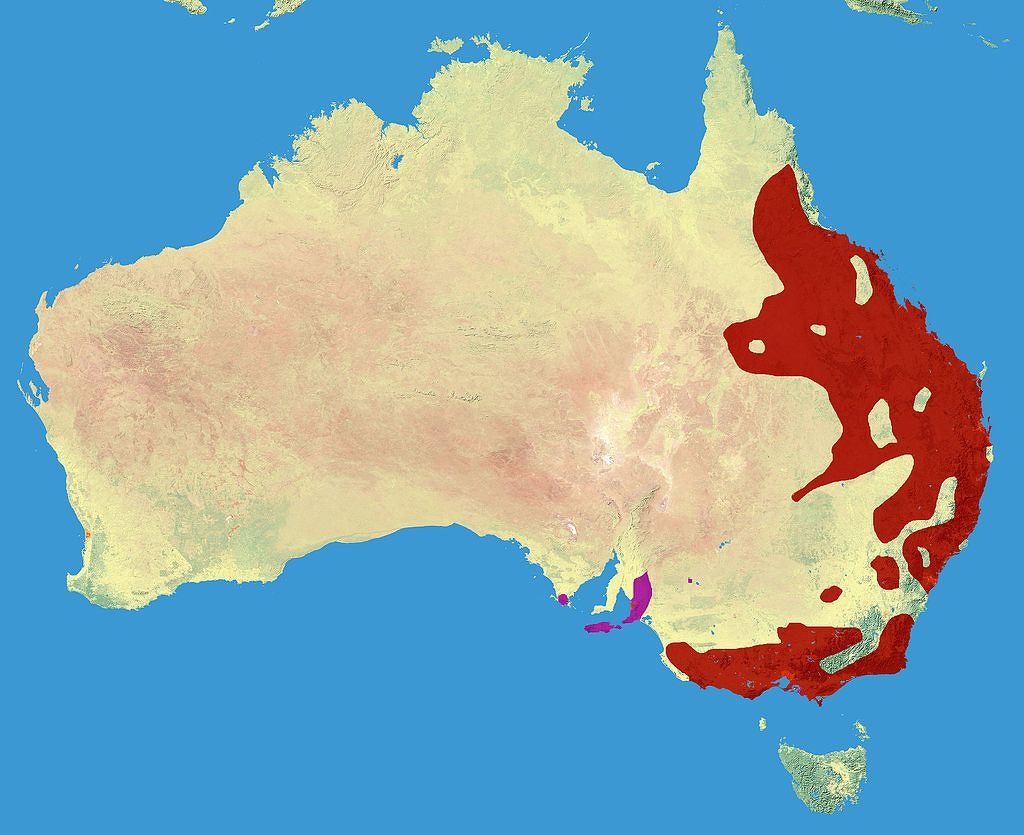
Koala range: Native (red); introduced (purple)
Estimates of the koala population vary widely — from 32,000 to 500,000 animals. The discrepancy is largely due to different methodologies and assumptions used in the calculations. Estimating the size of the koala population is difficult because they are so difficult to spot in the forest canopy and they leave behind so few clues such as droppings. Many koalas live in the last remaining coastal forests in conservation areas in Victoria, New South Wales and southeastern Queensland. Other live in suburban areas in these states.
The different population estimates for koalas: 1) The Australian Koala Foundation (AKF): Estimates between 32,065 and 57,920; 2) CSIRO ( Commonwealth Scientific and Industrial Research Organisation, is Australia's national science agency) estimates between 224,000 and 524,000; 3) The National Koala Monitoring Program (NKMP) estimates there are 95,000 to 238,000 in Queensland, New South Wales, and the Australian Capital Territory (Canberra) and between 129,000 and 286,000 in Victoria and South Australia. [Source: Google AI]
Breakdown of koala populations by state:
Victoria has a relatively large koala population, with estimates ranging from 182,500 to 325,000. A model in the early 2020s estimated the statewide population was 459,865. However, there are also concerns about habitat fragmentation and the impact of introduced populations. Some areas, like the southwest, have booming populations, while others face challenges.
Queensland has an estimated population of koalas between 95,000 and 238,000, according to the National Koala Monitoring Program. Koalas are found in various regions, including the southeast, with some areas having experienced significant population declines due to habitat loss and other factors. The population is considered vulnerable in southeast Queensland, with a significant decline in distribution and habitat loss there.
New South Wales is home to an estimated 36,350 to 75,000 koalas. Koalas there face challenges like habitat fragmentation and decline. Koala populations in New South Wales are considered vulnerable and have experienced significant declines.
South Australia is home 19,000 to 52,000 koalas. Koalas in South Australia were previously extinct, but they have been reintroduced and the population is relatively stable but vulnerable to fires. Koala numbers are particularly strong in the Mount Lofty Ranges and Kangaroo Island.
Australian Capital Territory (ACT, Canberra) has some koalas are also present in the ACT and are included in the combined population with Queensland and New South Wales.
Koala Evolution, History and DNA
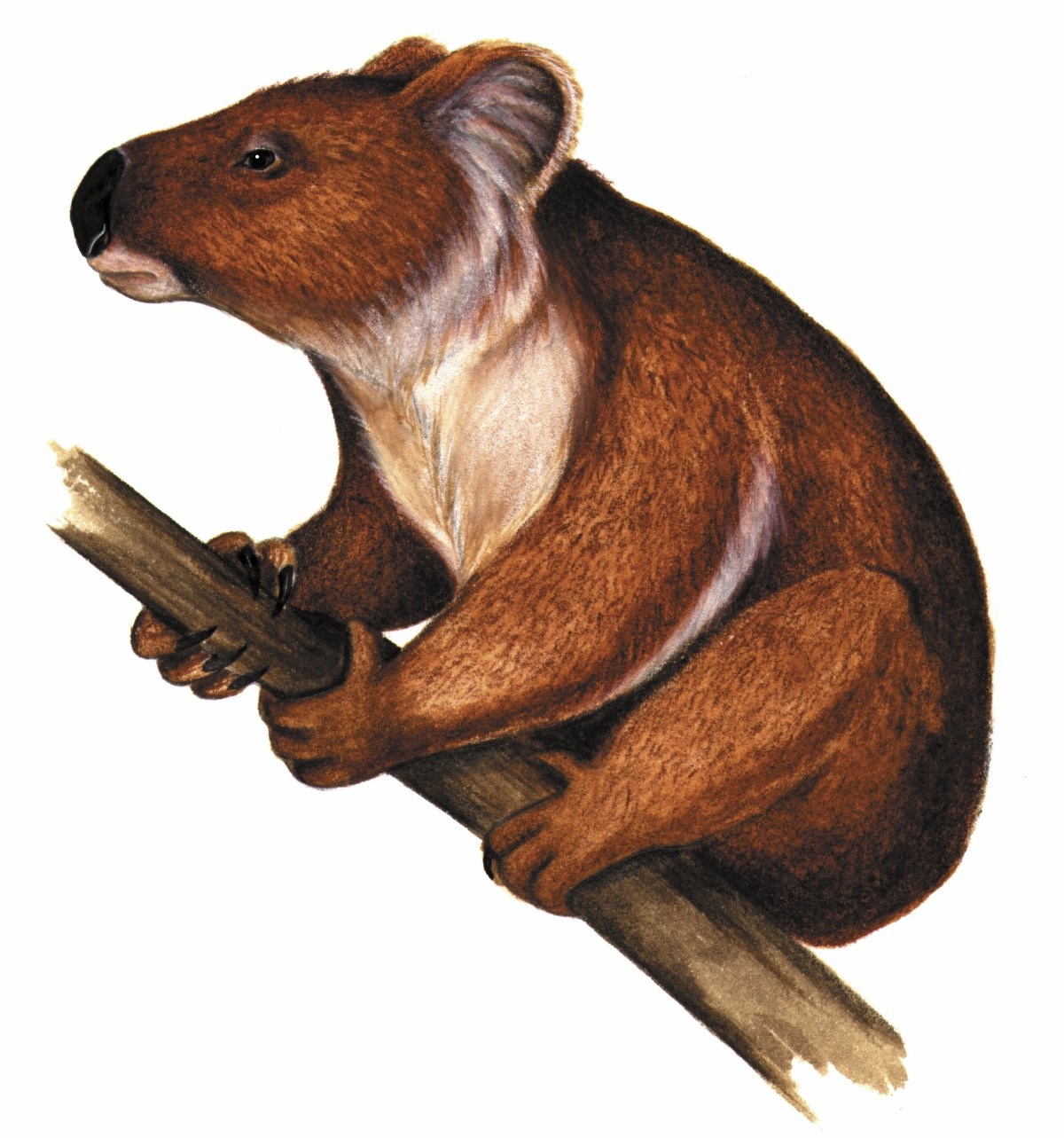
Nimiokoala greystanesi from the Australian Museum
Koalas are classified with wombats and several extinct families (including marsupial tapirs, marsupial lions and giant wombats) in the suborder Vombatiformes within the order Diprotodontia. The Vombatiformes are a sister group to a clade that includes macropods (kangaroos and wallabies) and possums. The koala's lineage possibly branched off around 40 million years ago during the Eocene Period. [Source: Wikipedia]
Modern koalas are the only extant member of Phascolarctidae, a family that includes several extinct genera and species. During the Oligocene Period (33 million to 23.9 million years ago) and and Miocene Period (23 million to 5.3 million years ago), koalas lived in rainforests and had broader diets. Some species, such as Nimiokoala greystanesi and Perikoala, were around the same size as the modern koala. Others such as Litokoala were one-half to two-thirds its size. Like modern koalas, prehistoric koalas had well developed ear structures, which suggests that they also made long-distance vocalisations and had a relatively inactive lifestyle.
During the late Miocene, the Australian continent began drying out, leading to the decline of rainforests and the spread of open Eucalyptus woodlands. The genus Phascolarctos split from Litokoala in the late Miocene, produced several adaptations that allowed them to live on a eucalyptus diet: the palate shifted towards the front of the skull; the upper teeth were lined by thicker bone, molars became relatively low compared to the jaw joint with more chewing surface; the pterygoid fossa shrank; and a larger gap separated the incisor teeth and the molars.
During the Pleistocene Period (2.6 million to 11,700 years ago) there were giant koalas (Phascolarctos stirtoni), with an estimated weight of 13 kilograms (29 pounds). Modern koalas may have emerged as a dwarf form of giant koalas, following the disappearance of several giant animals in the late Pleistocene. A 2008 study questioned this hypothesis, noting that modern koalas and giant koalas both lived in the mid to late Pleistocene period and are major difference in their teeth morphology. The fossil record of the modern koala extends back at least to the middle Pleistocene.
In April 2013, scientists from the Australian Museum and Queensland University of Technology announced they had fully sequenced the koala genome. Using samples taken from a male and female koala, the achievement could help researchers better understand the biology of koalas and develop treatments for diseases that severely harm them such as chlamydia and koala retrovirus. The koala genome contains over 26,000 genes. This is a similar number to the human genome, which also contains around 26,000 genes. Dr Rebecca Johnson from the Australian Museum's Australian Centre for Wildlife Genomics saidthe genetic blueprint provides important insights into the evolution of koalas."The koala is so interesting because they haven't had a common ancestor for 35 million years so now we can look at … why have they been so successful." [Source: Genelle Weule, ABC, April 9, 2013; Google AI]
Koala Characteristics
Koalas range in weight from four to 15 kilograms (8.8 to 33.1 pounds) and have have a body length of 60 to 85 centimeters (24 to 33 inches). Koalas do not have an external tail. Their average basal metabolic rate is 5.74 watts. Koalas in the southern part of their range are generally larger are darker than those in the north. North and south populations are possibly separate subspecies, but not all researchers accept this. In the wild koalas usually live about 10 or 15 years. In some reserves, where food is brought to them to reduce their stress level, koala have survived more than 20 years. [Source: Jennifer Dubuc and Dana Eckroad, Animal Diversity Web (ADW) |=|; Wikipedia]
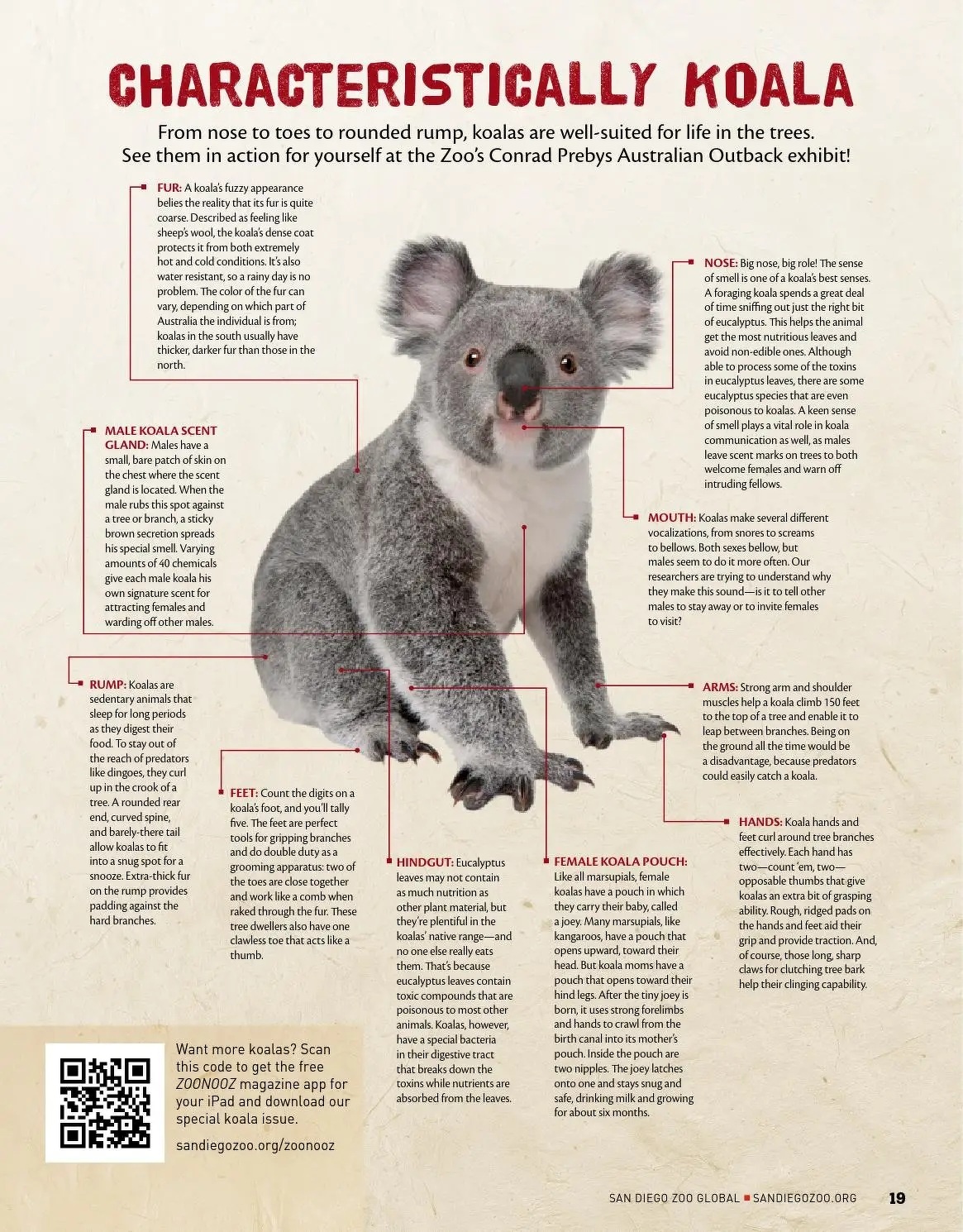
from the San Diego Zoo
Koalas have tufted ears and a hard, black nose. They are covered by a thick coat of fur that is whitish on the chest. The fur most everywhere else ranges from silver grey to chocolate brown. There is also white on the chin and inner side of the forelimbs. The rump is often dappled with white patches and the ears are fringed with long white hairs . The koala has the most effective insulating back fur of any marsupial. It is resilient to wind and rain, while the belly fur can reflect solar radiation. The coat of koalas in the north is generally shorter and lighter than that of koalas in the south.
Sexual Dimorphism (differences between males and females) is present: with the males being up to 50 percent heavier than females. In the south, males have an average head-body length of 78 centimeters (31 inches), females, 72 centimeters (28 inches). The average weight in the south for males is 11.8 kilograms (26 pounds), for females, 7.9 kilograms (17.4 pounds). The average weight in the north for males is 6.5 kilograms (14.3 pounds), for females, 7.9 kilograms (11.2 pounds). Males have a broader face, somewhat smaller ears, and a large chest gland than females Females have two mammae; and rather than a chest gland, they have a pouch that opens to the rear and extends upward and forward.
Describing a koala he held in his arms, Oliver Payne wrote in National Geographic: "I looked into the koala's eyes, unresponsive amber beads with vertical slits for pupils. His nose, dramatically Roman, was satiny black, with splashes of pink skin beneath butterfly-wing shaped nostrils. the mouth was a deep V, equipped with teeth that would give dracula goose bumps. It curled down at the corners, making for a grouchy look, as if someone had just shaken him out of a deep sleep." [Source: Oliver Payne, National Geographic, April 1995]
Koala Anatomy, Body Features and Small Brain
Koalas have a short, muscular upper body with relatively long upper limbs that contribute to their ability to climb. The thigh muscles are anchored further down the shinbone, increasing their climbing power. Koalas have thumblike digits with no claw and textured paws used to grasp onto smooth eucalyptus trees. They have vestigial tail (the remnant of a tail found, often a small, boneless protrusion at the base of the spine, a leftover from our evolutionary past when tails were functional). Koalas have cheek pouches sort of like squirrels and other rodents that allow them to store unchewed food.
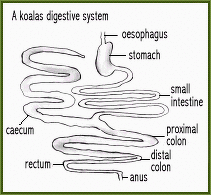
According to Animal Diversity Web (ADW): Koalas have a large, bulbous nose. Their ears are large and rounded. Their marsupium (pouch) is well developed, opens to the rear, and contains only two teats. Their stomachs are unusual, long and folded and with a unique gastric gland. Koalas also have an enormous cecum (a pouch connected to the junction of the small and large intestines), which helps them digest eucalyptus leaves [Source: Phil Myers, Animal Diversity Web (ADW) |=|]
Their paws are large, and both fore and hind feet have five strongly clawed digits. Digits two and three of the hind feet are fused up to (but not including) the claws. On the forepaw the first and second digits oppose the other three which enables the koala to grip branches as it climbs. The first digit of the hind foot is short and greatly broadened while the second and third digits are relatively small and partly fused together but have separate claws. Their paws have line marking, unique on every, animal, similar to human fingerprints. [Source: Jennifer Dubuc and Dana Eckroad, Animal Diversity Web (ADW) |=|]
Koalas have disproportionately small brains for mammal. They are 60 percent smaller than those of a typical marsupial, weighing only 19.2 grams (0.68 ounces) on average. The brain's surface is fairly smooth and "primitive". It does not entirely fill the cranial cavity, unlike most mammals, and is lightened by large amounts of cerebrospinal fluid. It is possible that the fluid protects the brain should the animal fall from a tree. [Source: Wikipedia]
"There's no other creature on earth with a brain so aberrant," an Australian naturalist told Payne. It's brain is shriveled and surrounded by a thick membrane and so small it doesn't fill the space allocated for it inside the skull. Scientists believe that the koalas' brain shrunk relatively recently in its evolutionary history and did so because their diet of eucalyptus leaves supplies few nutrients and keeping a large brain going requires lots of food and energy. In addition, reaching and for and eating eucalyptus leaves, the koala's primary activity, doesn't require a lot brain activity to do. Their small brain limits their ability to perform complex behaviours. For example, they do not eat plucked eucalyptus leaves on a flat surface, which does not match its feeding routine. [Source: Oliver Payne, National Geographic, April 1995]
Like other members of the marsupial order Diprotodonta, koalas are diprotodont (have two large, forward-pointing incisors in the lower jaw). Their dental formula is 3/1, 1/0, 1/1, 4/4 = 30. A large diastema separates incisors and post incisor teeth. All teeth are rooted. The molars appear selenodont and have a highly folded enamel pattern. |=|
Koala Diet, Digestion and Eating Behavior
Koalas are herbivores (eat plants or plants parts). They feed on both eucalypt and non-eucalypt species but the majority their food intake comes from only a few eucalypt species (See Below). Koalas bite leaves with their incisors and clip them with the premolars before chewing them into pieces with their cusped molars. The partially worn molars of koalas in their prime are optimal for breaking leaves into small particles, resulting in more efficient stomach digestion and nutrient absorption in the small intestine, which digests the eucalyptus leaves to provide most of the animal's energy. Koalas sometimes regurgitate their food into the mouth to be chewed a second time.[Source: Wikipedia]
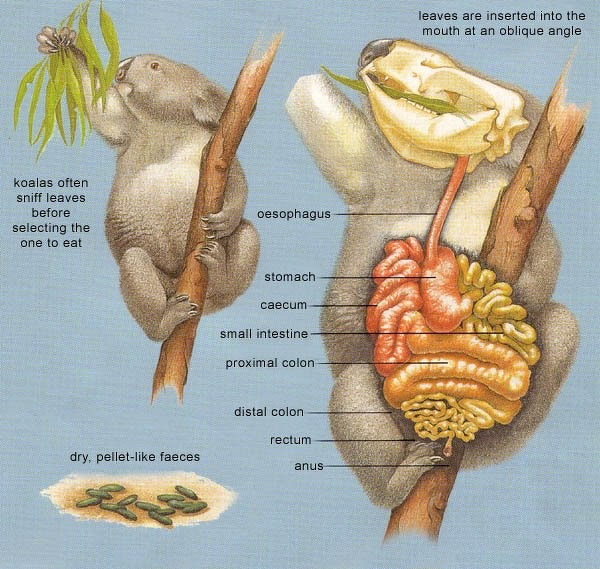
Koalas are hindgut fermenters and are more likely keep smaller particles as larger ones take longer to digest. They can retain food particles for longer fermentation if needed. While the hindgut is relatively large, only 10 percent of a koala’s energy is obtained from digestion in this chamber. Koalas do not need to drink often as they can get enough water from the leaves, though larger males may additionally drink water found on the ground or in tree hollows. Koalas replace lost water at a lower rate than species such as some possums. They maintains water by absorbing it in the cecum, resulting in drier fecal pellets packed with undigested fiber.
Koalas tend feed at night. An adult koala can eat 500 grams daily. Adaptions for their specialized, high fiber, low protein diet include a large cecum, up to four times their body length, and cheek pouches, along with dentition highly developed for grinding plant cells. The cheek teeth are reduced to a single premolar and four broad, highly cusped molars on each jaw which finely grind the leaves for easier digestion ." The cecum, which sits at the junction of small and large intestines, is where microbial fermentation takes places, augments the koala's digestive processes). Al these things help koalas process large amounts of fibrous forage. The koala diet has been compared with what it would be like to eat of box museli without the museli. Human subsisting only a diet of eucalyptus leaves would die of liver failure. [Source: Jennifer Dubuc and Dana Eckroad, Animal Diversity Web (ADW) |=|]
Koalas have unusually low metabolic rates, which reduces their need for food. Koala digestion is very slow. It can several days for food to be processed and pass through their gut. It has been suggested that that koalas get high on eucalyptus leaves and that explains why they so sluggish and get so grumpy when leaves are taken away. Most scientists dismiss this idea and say the koalas sluggish behavior is more likely the result of a nutrient-poor diet and slow metabolism.
Koalas and Eucalyptus
Koalas feed on both eucalypt and non-eucalypt species but the majority their food intake comes from only a few eucalypt species. 1) Eucalyptus viminalis and E. ovata are preferred in the south; and 2) E. punctata, E. camaldulensis and E. tereticornis are favorites in of the north . Koalas prefer plant matter with higher protein than fiber and lignin. The most favored species of eucalyptus — Eucalyptus microcorys, E. tereticornis, and E. camaldulensis — on average, make up more than 20 percent of their diet.
Koalas inhabit eucalyptus woodlands where they feed on eucalyptus leaves, stems, flowers, and bark, which are not very nutritious. Despite their reputation as a picky eater, koalas are more generalist than some other marsupial species, such as the greater glider. Koalas eat mainly young leaves of only 20 to 30 of the 800 species of eucalyptus in Australia and prefer only five species. [Source: Phil Myers, Animal Diversity Web (ADW) |=|]
Eucalyptus trees contain chemicals that are poisonous to most animals and deter most mammals from feeding on eucalyptus trees. The unusually well-developed stomachs of koalas and gastric glands equip them to handle the toxins in their diet. Koalas are able to consume highly toxic leaves by having bacteria and chemicals in their digestive system that metabolize the toxins of the leaves and break down the harmful toxin eucalyptus leaves into harmless chemical compounds. . Koalas can digest the toxic secondary metabolites, phenolic compounds and terpenes due to their production of cytochrome P450, which neutralises these poisons in the liver.
Koalas typically inhabit open eucalyptus woodland. Eucalyptus trees form a thick canopy and usually reaches heights of over 10 meter (40 feet). They grow best in low, flat areas with rich soil, which not coincidentally is the land that farmers and developers also like best.
Koalas sniff each eucalyptus leaves before they eat them and they generally consume between a half to one and half kilograms (one to three pounds) of leaves a day. After being swallowed the leaves find their way to the cescum — which can reach a length of 2.5 meters (eight feet) — where the food remains for eight days, the length of time it takes to extract proteins, fats, sugars and other nutrients from leaves.
Koalas emit an odor that is not unlike the eucalyptus leaves they munch on round the clock. A veterinarian at Queensland University told Payne, "All their tissues reek of eucalyptus oil. If you dissect one, it's whole system is perfused with cineole." Cineole is a toxic substance which gives eucalyptus its distinctive smell. [Source: Oliver Payne, National Geographic, April 1995]
Image Sources: Wikimedia Commons
Text Sources: Animal Diversity Web animaldiversity.org , National Geographic, Live Science, Natural History magazine, Australian Museum, David Attenborough books, Australia Geographic, New York Times, Washington Post, Los Angeles Times, Smithsonian magazine, Discover magazine, The Conversation, The New Yorker, Time, BBC, CNN, Reuters, Associated Press, AFP, Lonely Planet Guides, Wikipedia, The Guardian, Top Secret Animal Attack Files website and various books and other publications.
Last updated July 2025