
Home | Category: Marsupials
KOALAS AND HUMANS
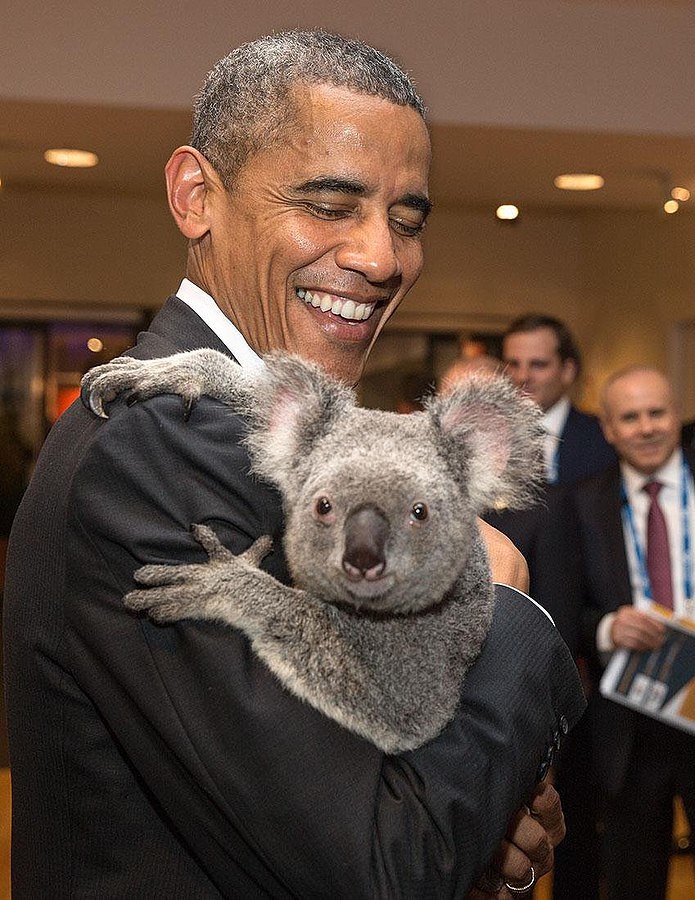
US President Barack Obama holding a koala prior to the G20 meeting in Brisbane in November 2014
Like pandas, cute and cuddly koalas are darlings of the animal rights and conservation movement. After it was alleged that the Australian government wasn’t doing enough to prtect koalas the Australian ambassador in the U.S. received 12,000 telegrams, letters and messages from people who supported the international animal rights movement directed at saving the koala. One of the message from the 1990s read, "Dear Sir, I have canceled my trip to Australia. I will re-book “only” after koala are well protected." Later, a plan to build a new international airport near Sydney was scuttled due to concerns about a koala population in the area.
Early European settlers in Australia called koalas “monkeys” and the eucalyptus tree which they most often feed on are still called "monkey gums." Today, they are protected and can no longer be hunted. Some people believe that koala dropping are good for your health. You are supposed to drop them in hot water and breath in the eucalyptus-accented vapors to clear your sinuses.
The first written reference to the koala was recorded by John Price, servant of John Hunter, the Governor of New South Wales. Price encountered the "cullawine" in January 1798, during an expedition to the Blue Mountains. In 1802, French-born explorer Francis Louis Barrallier encountered the animal when his two Aboriginal guides, returning from a hunt, brought back two koala feet they were intending to eat. Barrallier preserved the appendages and sent them and his notes to Europe.
George Perry officially published the first image of the koala in his 1810 natural history work Arcana. Perry called it the "New Holland Sloth" and made no attempt to his his dislike for the koalas in his description of the animal: “ the eye is placed like that of the Sloth, very close to the mouth and nose, which gives it a clumsy awkward appearance, and void of elegance in the combination ... they have little either in their character or appearance to interest the Naturalist or Philosopher. As Nature however provides nothing in vain, we may suppose that even these torpid, senseless creatures are wisely intended to fill up one of the great links of the chain of animated nature.”
It has been estimated that koalas are worth more than A$1 billion to the Australian economy annually mainly as a tourism draw. The first exposure that many people had to koalas was in the 1960s when Quantas airline ran commercials with a grumpy koala saying “I hate Quantas” because the airline brought so many tourists to Australia and destroyed the animal’s peace and quiet. On the top of the bucket list for many visitors to Australia is holding a koala, which has been compared to holding a stuffed toy as they hardly move.
RELATED ARTICLES:
KOALAS: CHARACTERISTICS, EVOLUTION, HISTORY, ANATOMY, POPULATIONS, DIET ioa.factsanddetails.com
KOALA BEHAVIOR: TREES, COMMUNICATION, REPRODUCTION, YOUNG ioa.factsanddetails.com
ENDANGERED KOALAS: THREATS, FIRES, DISEASE ioa.factsanddetails.com
KOALA CONSERVATION: HELPING THEM, VACCINATIONS, RESCUES, BIRTH CONTROL ioa.factsanddetails.com
MARSUPIALS: HISTORY, EVOLUTION, CHARACTERISTICS, BEHAVIOR, REPRODUCTION ioa.factsanddetails.com
MARSUPIALS IN AUSTRALIA ioa.factsanddetails.com
Koalas and Aboriginals
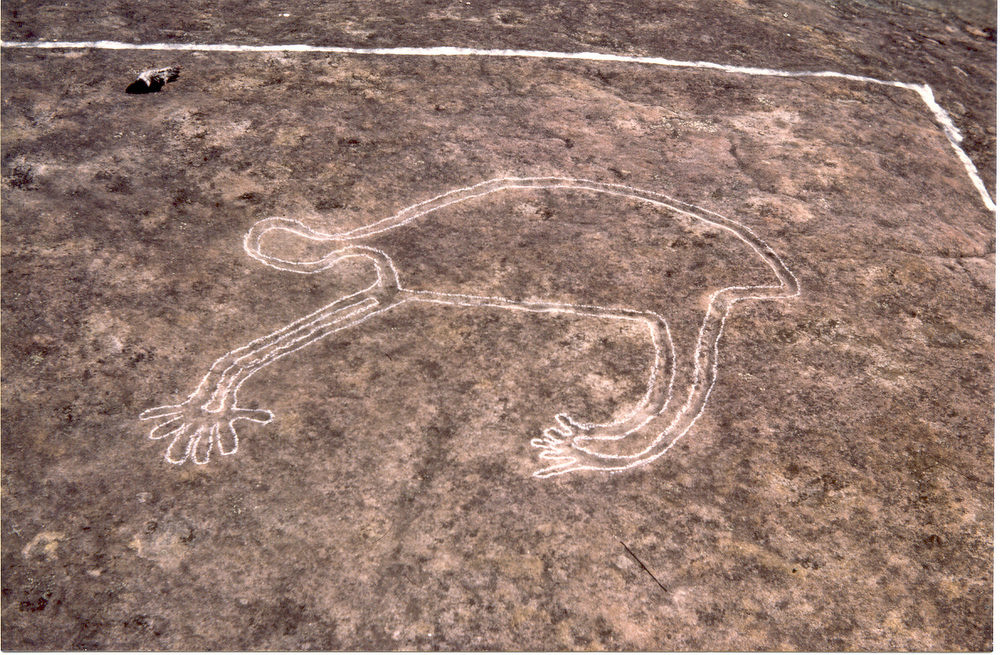
Aboriginal rock carving of a koala at Blackfellow's Head, Westleigh, New South Wales; a rock carving of a noose which was used by Aboriginals to get koalas out of the trees is located nearby; The area where the photo was taken has now been subdivided for housing, from Horny Shire Recollects hornsbyshire,recollect
There are very few images of koalas in aboriginal paintings. One explanation for this is that some tribes considered the koala to be the 'supreme totemic symbol" and thus painting it was taboo. The Gumbaynggir aboriginal viewed koalas as "mischievous children with magical powers."
A Gumbaynggir elder told National Geographic in the 1990s: "See, the koala has special significance. Our people were walking, then these women got stirred up about something or another, and they made the sea, and all other people were trapped on an island. they had two koala with them, so they stripped their stomachs — you know, the gut — and that formed a bridge back to the mainland. On the entrails of koala, when they're dried and held up to the sun, you'll see footprints." [Source: Oliver Payne, National Geographic, April 1995]
The elder used to eat koala meat as child. When Oliver Payne asked him what it tasted like, the elder replied, "The taste didn't come into it, as long as it filled the belly. I'd say a strong eucalyptus taste." The elder added, "eucalyptus was a healing aid. When you ate koala, you healed the insides."
The leader said that he began hunting koala at the age of six by simply climbing up a tree and pulling the animals down. He said he gave up hunting koalas — and understood why aboriginals thought koala contained the souls of dead children — when he heard the crying of mother koala circling the tree where her joey had been taken.
Hunting and Capturing of Koalas
In the early 20th century koalas were hunted extensively for their warm, thick coat. Two million koalas killed alone in 1924. Australia exported many of the pelts, which were used to make rugs, coat linings, muffs, and trimmings on women's garment.
Victoria lost many koalas in the late 1800s. In the early 20th century in Queensland koalas still numbered in the millions. Their gentle laid-back nature made them easy pickings for hunters who sold their fur for coats and hats. The animals were generally snared or poisoned with cyanide. Shooting sullied the pelts. Hunters were lured to Queensland with the promise "Kill a koala, make a million!" They killed millions. In the northern half, Queensland, a million were killed in 1919 alone. Public outcry to the slaughter brought an end to koala hunting in 1927, when 600,000 animals alone were killed in the August hunting season. After that only tens of thousands remained
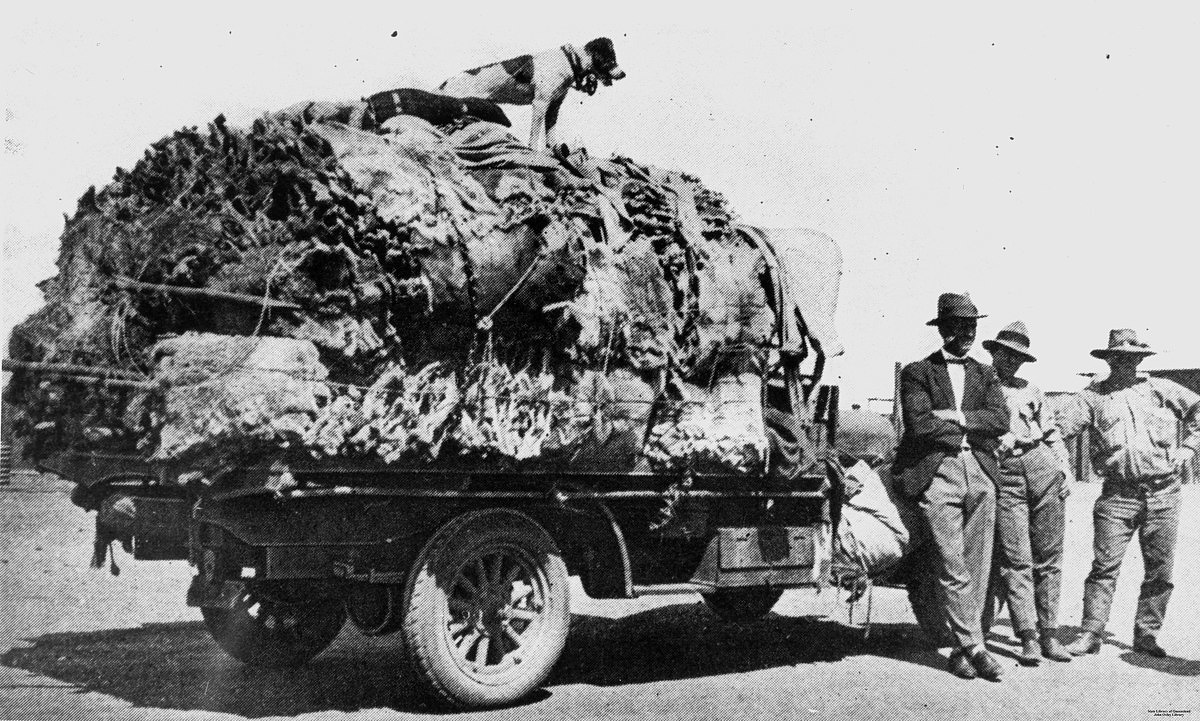
A truck load of 3600 koala skins, hunted during the last open hunting season in Queensland, 1927; the skins were obtained by a party of hunters in the Clermont area over 30 days, during the last open hunting season in Queensland, 1927
There are about 1,000 koala in zoos and tourist parks across Australia and the going rate for a koala bought from a legitimate dealer was about $5,000 in 1990s, tempting owners to snag them in the wild. Overseas, where koala' are sometimes sold for $40,000, there is even more incentive. In an attempt to cut down on the illegal capture of koalas, the animals are being paw printed by zoologists in Australia. While poaching and hunting are problem, the main reason that wildlife officials are going through all this trouble is to cut down on the number koalas taken from the wild to replace captive ones that have died. The idea behind the paw printing is to identify all the animals in captivity. If later on an animals is illegally replaced government zoologist will have proof. [Source: "Check the fine print, mate" by Randall Hyman, International Wildlife January/February
Koalas, Cars and Swimming Pools
Dozens of koalas are killed on Australia's roads and highways every year. Generally what happens is a koala gets boxed into one area and when it attempts to move to a new place it crosses a road and gets run over. New conservation plans attempting to mitigate the problem hope to link their fragmented habitats with protected koala corridors. [National Geographic Earth Almanac, May 1991].
Swimming pools can also be deadly to koalas. Koalas tend to walk in a straight line unless something, like a fence, obstructs their path. If a swimming crosses their path they walk right into and often drown. Many pool owner now insert a rope in their pool, which gives koala something to grasp onto so they can escape.
One conservationist told Reuters, Koalas "don’t have any natural enemies, so they don’t have any fear...They are very singled minded, which some say is stupid. If they have a usual path through their territory and somebody builds a house and a swimming pool in the way, they will just walk straight into the swimming pool."
Koala Survives 88-Kilometer-Ride Clinging to Car
In July 2018, a four-year-old male koala, nicknamed Timberwolf, miraculously survived an 88-kilometer (54.5-mile) ride down a busy Australian freeway clinging to the bottom of a car. The only injury he appeared to have sustained was a torn nail. [Source: AFP, July 28, 2018]
AFP reported: The koala was struck by the vehicle near Maryborough in Queensland. The Australia Zoo wildlife hospital said it latched onto the bottom of the car as it sped away, with the family inside not knowing they had a marsupial on board. It was only when they stopped in Gympie after a high-speed freeway drive that they noticed it, and called the hospital for help. The maximum speed on the freeway is 110 kilometers per hour (68 miles per hour).
Australia Zoo vet Claude Lacasse said it was amazing the koala, named Timberwolf by the rescuers who brought him in, was in such great health. "It is absolutely amazing that he has such minor injuries and he survived," Lacasse said. "It is a truly remarkable story, he is a very lucky koala." Timberwolf was given pain killers for the torn nail and is recovering in a tree at the zoo north of Brisbane as vets work out exactly where he grabbed hold of the car so they can return him to the wild.
Koala Walks into Bar...Promptly Nods off
In November 2010, a koala made headlines after it wandered into an Australian pub during a stormy evening and made himself comfortable position above the bar and then promptly fell asleep. AFP reported: The furry male marsupial stunned drinkers when he entered the Marlin Bar on Queensland's Magnetic Island, approached barman Kevin Martin and ended up climbing up a supporting wooden pole and settling on a beam. "I asked him for ID and he didn't have any so that's when he got a bit disgruntled and climbed up a pole," joked Martin."And he just sort of lay over the piece of wood, one of the little rafters, and flopped his arms down and just fell asleep, enjoying the atmosphere." [Source: AFP, November 18, 2010]
Although the koala's visit was welcome, Martin said he called wildlife workers to remove the animal out of concern for its own welfare. The koala was later set free elsewhere on the island, which has a healthy population of the animals — unlike elsewhere in Queensland where they are threatened by development.
Martin said he does not know what prompted the koala to enter the bar, but speculated it could have been attempting to escape the rain. "He was sort of hanging outside the pub beforehand," he said. "He looked a little bit out of his element, I think he wasn't expecting to find himself in the pub. But he seemed pretty happy nonetheless."
Studying Koalas
Janine Duffy, a leading expert on the behavior of koalas in the wild, launched the Koala Clancy Foundation in 2015. She has studied koalas in the You Yang area of southeast Australia koalas and developed a way of identifying them based on the unique patterns on their nose and began tracking individuals. She said: “one of the first things I remember is a koala walking into a shop when I was a kid. I’ve been fascinated ever since. They never fail to surprise you...It’s easy to think that koalas are sleepy, lazy creatures. But this not true. They are constantly aware of everything in their surroundings.
Anna White wrote in Smithsonian magazine; Koalas and humans have similar fingerprints, but researchers prefer tracking them by examining patterns of pigmentation on their noses. The monitoring technique is useful in conservation efforts, as it does not require researchers to actively capture and individually tag the animals. Identifying the marsupials by nose pigmentation patterns also allows the public to assist in conservation efforts. Anyone who spots a koala in the wild can snap a photo and help provide data on the whereabouts of individuals. [Source: Anna White, Smithsonian magazine, April 2019]
Scientists sometimes capture wild koalas by showing them flags and lassoing them with ropes extended from a long pole. Describing how this is done, Oliver Payne wrote: in National Geographic: "You maneuver the noose over twitching ears and call in the flag waver. A red flag means one thing to a bull, quite another to a koala. Flap it, and a terrible squawk-screech ensues. Waaa-owww! WAA-OW! How DARE you wake me uo! The indignant koalas backs straight down the tree. You hope. More likely it comes to a fork and tries to shinny up the other branch. Often it loses its grip and drops out of the tree," "Don't worry," one scientist told Payne, "they bounce pretty well." [Source: Oliver Payne, National Geographic, April 1995]
Counting Koalas
Estimates of the koala population vary widely — from 32,000 to 500,000 animals. The discrepancy is largely due to different methodologies and assumptions used in the calculations. Estimating the size of the koala population is difficult because they are so difficult to spot in the forest canopy and they leave behind so few clues such as droppings.
Dr Daniel Lunney studied koalas for more than four decades and played a part in the framing of policies for koala conservation and management. He has also helped recruit volunteers to count koalas using the Koala Count smartphone app 'BioTag' which allows volunteers to easily record the location of each koala they see and record data on observations and habitat. Lunney said: Counting koalas is hard. They are nocturnal, shy, hard to see among the leaves and branches, mobile, and often distributed widely and thinly across the landscape.
In the 2012 koala count in South Australia, Brett Williamson of ABC wrote: "Over 1,000 citizen scientists participated in the Great Koala Count with over 1,300 submissions and 950 koala photos submitted." Professor Chris Daniels from the Barbara Hardy Institute said the koala data was coming in at around two new results every minute."
Lunney set up community-based surveys in New South Wales in 1986 and 2006 using mail-out questionnaires. He said The results for us as scientists were brilliant. We were able to form state-wide pictures of the distribution of koalas, and their status, a task that would have been impossible by any other means. The results were a primary basis for the koala being listed in 1992 as 'vulnerable' in New South Wales, and the 2006 survey provided a basis for the NSW 2008 Koala Recovery Plan and the Commonwealth's 2009-14 National Koala Conservation and Management Strategy While the role of scientists is critical to frame the questions, conduct the spatial analyses and interpret the records, the community is a vital element in the success of these surveys. [Source: ABC, November 8, 2013]
Hundreds of Animal Cruelty Charges over Alleged ‘Koala Massacre’
In 2021, a landowner and two companies were accused of hundreds of animal cruelty violations for an alleged “koala massacre” in Australia. The New York Post reported: “According to authorities, 21 koalas were killed and dozens were injured at a timber plantation in Cape Bridgewater, about 234 miles from Melbourne in February 2020. “Suffering from a number of maladies, including broken bones and starvation, 49 of the injured koalas were later euthanized, according to Victoria state’s Conservation Regulator. [Source: David Matthews, New York Daily News, December 23, 2021]
“The incident was described by conservation group Friends of the Earth Australia as a “koala massacre” that exposed the routine destruction caused by the plantation industry in the country. The landowner and a company that performs earthmoving (the accused were not named) were hit with 126 charges each for causing “unreasonable pain or suffering to dozens of koalas.” A contracting company was hit with allegedly disturbing the koala population. The landowner faces as much as a fine of $32,000 and 12 months in prison for each animal cruelty charge. The companies face $78,000 fines for each charge.
Image Sources: Wikimedia Commons
Text Sources: Animal Diversity Web animaldiversity.org , National Geographic, Live Science, Natural History magazine, Australian Museum, David Attenborough books, Australia Geographic, New York Times, Washington Post, Los Angeles Times, Smithsonian magazine, Discover magazine, The Conversation, The New Yorker, Time, BBC, CNN, Reuters, Associated Press, AFP, Lonely Planet Guides, Wikipedia, The Guardian, Top Secret Animal Attack Files website and various books and other publications.
Last updated July 2025