
Home | Category: Marsupials
ENDANGERED KOALAS
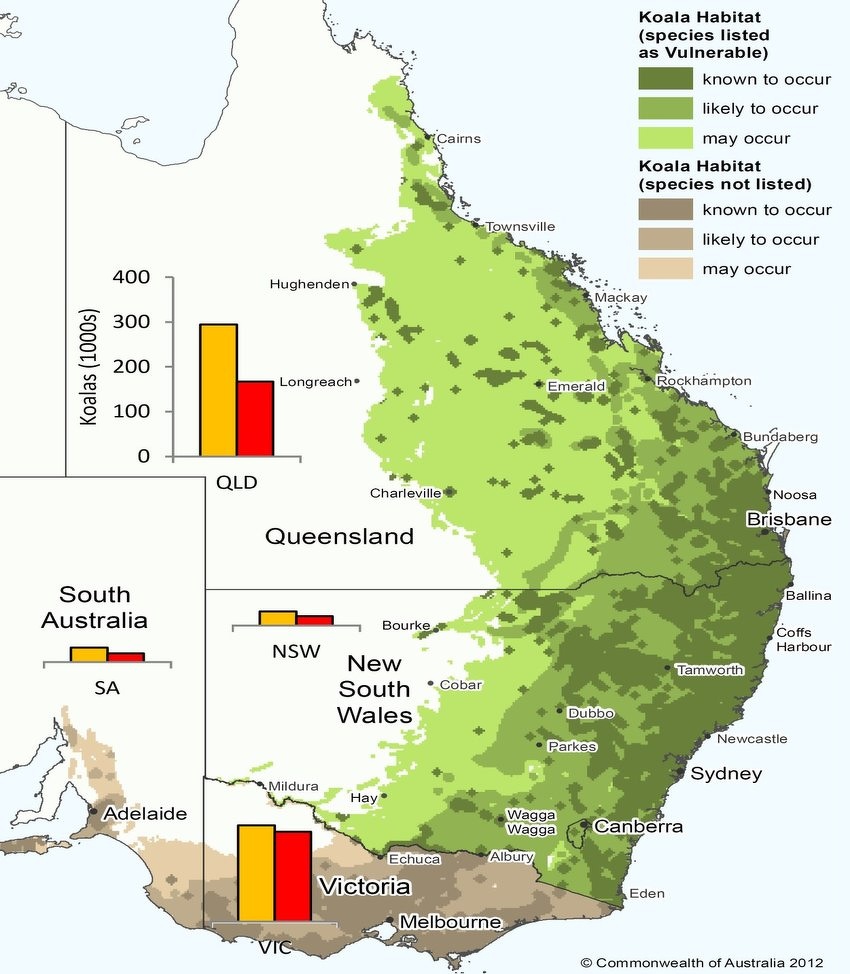
Distribution and abundance of koalas; Inset bar charts show Australian Government estimated abundance (in thousands) of koalas in each state in 1990 and 2010; Green shading shows jurisdictions in which koalas are listed as vulnerable to extinction, whereas brown shading shows jurisdictions in which they are not listed (Department of the Environment and Energy 2012; Researchgate)
The International Union for Conservation of Nature (IUCN) Red List classifies koalas as Vulnerable, which is one level below Endangered. The Australian government has listed them as Endangered in Queensland, New South Wales, and the Australian Capital Territory (Canberra). In the past koalas were listed as "potentially vulnerable" rather than "vulnerable" or "endangered" and even a species of “Least Concern”. Studies and reports indicate a substantial decline in koala populations, with some areas experiencing a 53 percent decline per generation (around 10 years). According to National Conservation and Managing Strategy reports, koala dropped 43 percent between 1990 and 2018. [Source: Anna White, Smithsonian magazine, April 2019]
The status of koalas varies a great deal from place to place. In some places koalas are on the verge of extinction. In other places koalas are so numerous there are plans to sterilize them. In some places populations are shrinking, due mainly to loss of habitat from development. The koala living in southeastern Queensland — the fastest growing area of Australia — are particularly vulnerable. Most Australians say they would never let the koala become extinct. Australia folksinger John Williamson told National Geographic: "If we lost the koala, it would be a shameful thing."
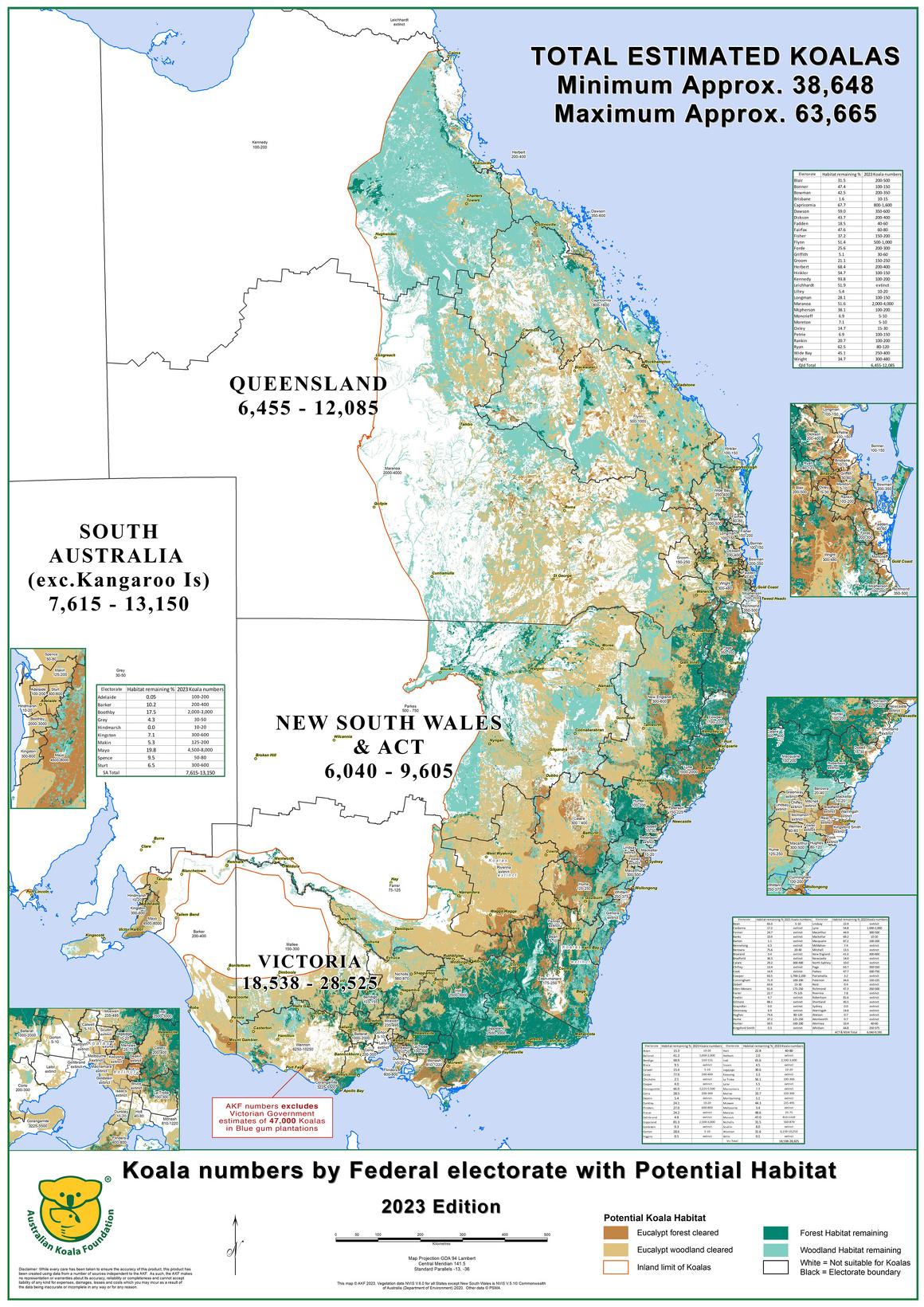
Estimates of the koala population vary widely — from 32,000 to 500,000 animals. The discrepancy is largely due to different methodologies and assumptions used in the calculations. Estimating the size of the koala population is difficult because they are so difficult to spot in the forest canopy and they leave behind so few clues such as droppings. The different population estimates for koalas: 1) The Australian Koala Foundation (AKF): Estimates between 32,065 and 57,920; 2) CSIRO ( Commonwealth Scientific and Industrial Research Organisation, is Australia's national science agency) estimates between 224,000 and 524,000; 3) The National Koala Monitoring Program (NKMP) estimates there are 95,000 to 238,000 in Queensland, New South Wales, and the Australian Capital Territory (Canberra) and between 129,000 and 286,000 in Victoria and South Australia. [Source: Google AI]
Breakdown of koala populations by state:
Victoria has a relatively large koala population, with estimates ranging from 182,500 to 325,000. A model in the early 2020s estimated the statewide population was 459,865. However, there are also concerns about habitat fragmentation and the impact of introduced populations. Some areas, like the southwest, have booming populations, while others face challenges.
Queensland has an estimated population of koalas between 95,000 and 238,000, according to the National Koala Monitoring Program. Koalas are found in various regions, including the southeast, with some areas having experienced significant population declines due to habitat loss and other factors. The population is considered vulnerable in southeast Queensland, with a significant decline in distribution and habitat loss there.
New South Wales is home to an estimated 36,350 to 75,000 koalas. Koalas there face challenges like habitat fragmentation and decline. Koala populations in New South Wales are considered vulnerable and have experienced significant declines.
South Australia is home 19,000 to 52,000 koalas. Koalas in South Australia were previously extinct, but they have been reintroduced and the population is relatively stable but vulnerable to fires. Koala numbers are particularly strong in the Mount Lofty Ranges and Kangaroo Island.
Australian Capital Territory (ACT, Canberra) has some koalas are also present in the ACT and are included in the combined population with Queensland and New South Wales.
RELATED ARTICLES:
KOALAS: CHARACTERISTICS, EVOLUTION, HISTORY, ANATOMY, POPULATIONS, DIET ioa.factsanddetails.com
KOALA BEHAVIOR: TREES, COMMUNICATION, REPRODUCTION, YOUNG ioa.factsanddetails.com
KOALAS AND HUMANS: HISTORY, CARS, RESEARCH ioa.factsanddetails.com
KOALA CONSERVATION: HELPING THEM, VACCINATIONS, RESCUES, BIRTH CONTROL ioa.factsanddetails.com
MARSUPIALS: HISTORY, EVOLUTION, CHARACTERISTICS, BEHAVIOR, REPRODUCTION ioa.factsanddetails.com
MARSUPIALS IN AUSTRALIA ioa.factsanddetails.com
Threats to Koalas
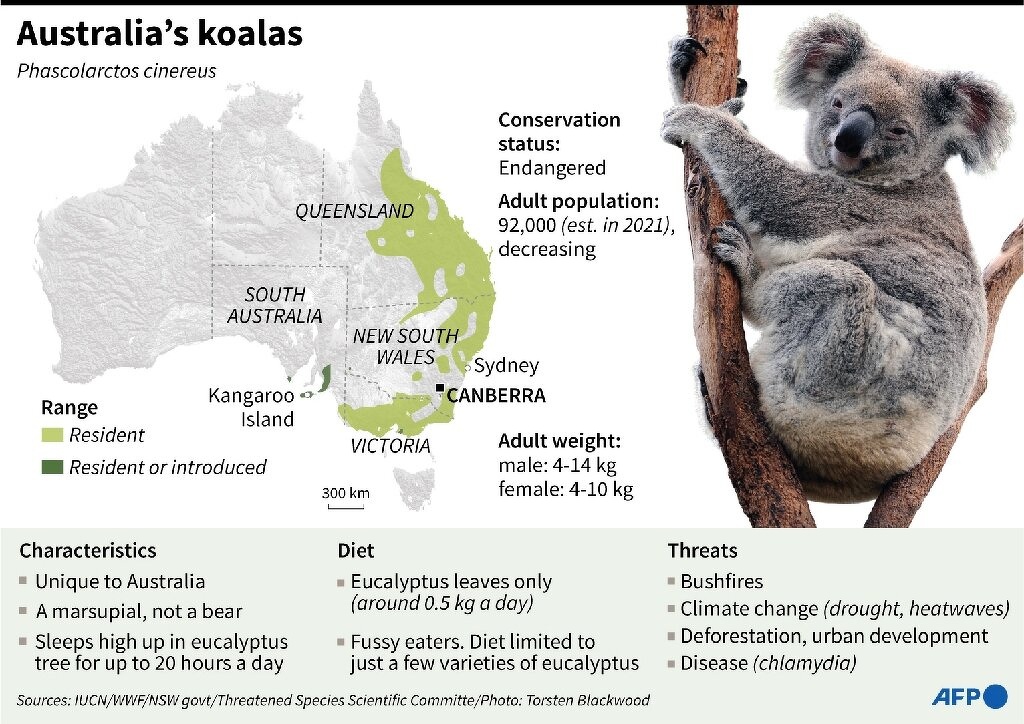
Koalas face a multitude of threats, including:
Habitat Loss and Fragmentation: Deforestation for agriculture and urban development significantly reduces their living space.
Bushfires: Koalas are particularly vulnerable to bushfires, which can destroy their habitat and lead to fatalities. It is estimated the Black Summer bushfires of 2019-20 killed 5,000 koalas and affected 24 percent of the animals; habitats in New South Wales alone.A fire September, 1994, nearly wiped out an entire colony of koalas.
Disease: Chlamydia, a sexually transmitted disease, can cause blindness, infertility, and death.
Dog Attacks and Traffic Accidents: These can also lead to injuries and fatalities. Koalas are also threatened by dingoes, foxes and birds of prey.
“Koalas are getting caught in fences and dying, being killed by dogs, struck by vehicles, even dying simply because a homeowner cut down several eucalyptus trees in his backyard,” says Deidré de Villiers, one of the chief koala researchers at the Queensland Department of Environment and Resource Management, told National Geographic. [Source: Mark Jenkins, National Geographic May 2012]
Koala are sensitive to changes in their environment. Bush fires perhaps fueled by climate change have destroyed great swaths of koala natural habitat. This and other factors such as human development have forces some koals to live more closely together enabling to disease to spread more easily and quickly among koalas.
Researchers have found found that koala populations of coastal and western Queensland are mostly declining, with the most pronounced decline is in southeast Queensland where urban development has destroyed and fragmented large areas of high quality koala habitat with increases in mortality from vehicle collisions, dog attacks and disease. In NSW, koala populations are subject to similar threats.[Source: ABC, November 8, 2013]
Australia Lists Koalas as Endangered Species
In February 2022, Australia listed the koala as an endangered species across most of its east coast, after a dramatic decline in numbers.The federal government said the listing was for Queensland, New South Wales and the Australian Capital Territory (ACT, Canberra). It has been urged to do more to protect koalas from rapidly diminishing habitats and climate change. In 2021, a New South Wales inquiry found koalas would be extinct there by 2050 unless there was urgent action. Koalas are also found in South Australia and Victoria but their numbers are on the decline nationally, according to conservation groups. [Source: BBC, February 11, 2022]
The BBC reported: “The species was listed as "vulnerable" in those states and territory only in 2012. Despite the rapid deterioration, governments have been accused of dithering. "This listing adds priority when it comes to the conservation of the koala," Environment Minister Sussan Ley said. “She said officials were designing a recovery plan, and land development applications would now be assessed for impacts on the species.
“"Koalas have gone from no-listing to vulnerable to endangered within a decade. That is a shockingly fast decline," said conservation scientist Stuart Blanch from WWF-Australia. The "decision is welcome, but it won't stop koalas from sliding towards extinction unless it's accompanied by stronger laws and landholder incentives to protect their forest homes."
““The new listing highlights the challenges the species is facing,” pointing to government plans to spend 50 million Australian dollars (US$35.7 million) to better protect them.b“The impact of prolonged drought, followed by the black summer bushfires, and the cumulative impacts of disease, urbanization and habitat loss over the past twenty years have led to the advice,” she said. The designation will provide some additional protection for koalas, namely more assessment requirements for development projects. But it doesn’t mandate any extra rules to protect their habitat, The Sydney Morning Herald noted. [Source: Nick Visser, Huffington Post, February 11, 2022]
Loss of Habitat, Logging and Koalas
Approximately 80 percent of koala's native forest habitat has been lost since European settlement. This loss is primarily due to land clearing for agriculture and urban development, as well as logging and other human activities. About 80 percent of koala habitat is on private land, much of it in urban and suburban areas. Some suburbanites plant trees for the koalas to feed from.
Native forests used by koalas have disappeared to make way for housing developments, golf courses and shopping centers. Koala suffer from the fact that the regions of Australia where they thrive are also the most accommodating to humans.
Many koalas live in isolated colonies, where they are threatened by inbreeding which in turn makes them vulnerable to disease. In southern Queensland some of the subdivision-surrounded enclaves encompass only 80 acres. Even though some developers provide green passageways between the enclaves, conservationists doubt the koala will use them.
The logging industry, which wants to open up more state forests for timber harvesting, argues that forest conservation puts people out of work; koala prefer logged forest because the young regenerated forest produce tastier leaves; and logging is already prohibited in half of Australia's millions of acres of state parks, reserves and forest.
Conservationists argue that ecotourism creates more jobs than the heavily mechanized timber industry; that koalas eat mainly from old trees which also provide them with the shade they so desire; and many of the parks and reserve the timber industry wants to exploit are regions best suited for koala.
Fires and Koalas
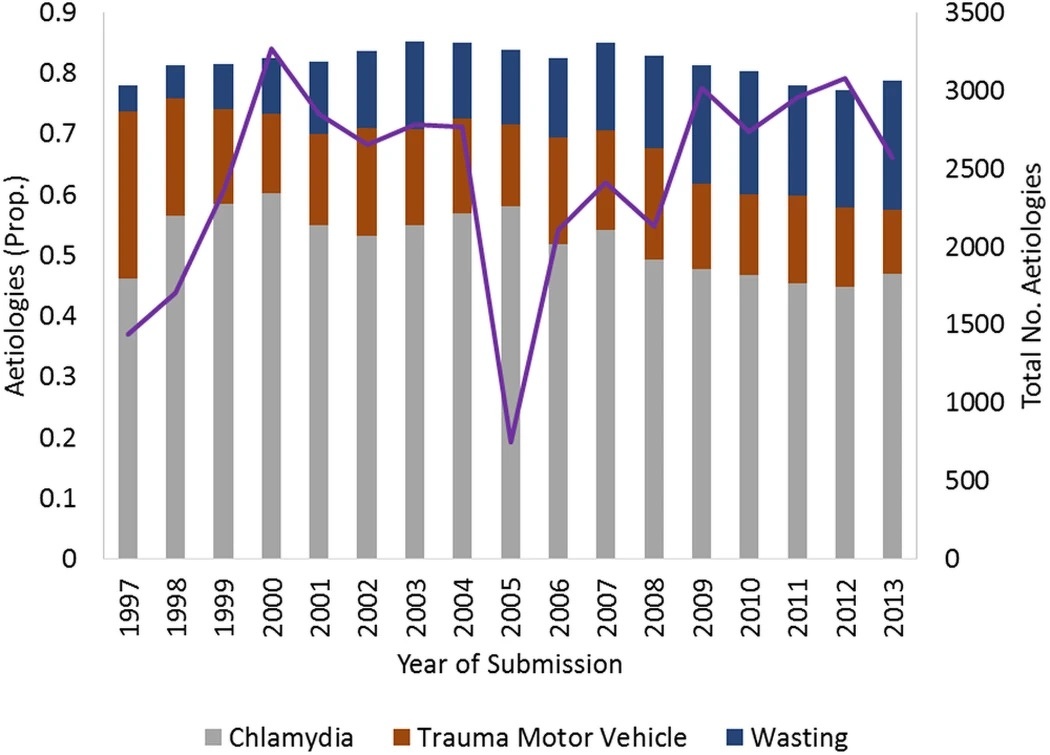
Total counts and proportions of aetiologies Chlamydia-like signs, trauma caused by motor vehicles, and wasting occurring in koalas submitted to wildlife hospitals in SEQLD from 1997–2013, from nature
The Black Summer brushfires in 2019-20 killed at least 6,400 koala despite efforts of rescuers who worked desperately to save them and treat their injuries. It is estimated the bushfires 2019-20 had killed 5,000 koalas and affected 24 percent of habitats in New South Wales alone. "There have been many pressures on the koala. The Black Summer fires, of course, was a tipping point. But we know the koala is vulnerable to climate change and to disease," Australia Environmental Minister said. [Source: Associated Press, February 12, 2022]
The catastrophic Black Summer bushfires scorched more than 60 million acres. By some estimates, up to 60,000 koalas were killed or injured in the blazes. This played a part in koalas being named endangered species in 2022. [Source: Nick Visser, Huffington Post, February 11, 2022]
Koalas on Kangaroo Island off the coast were devasted by the fires in 2020. Ceridwen Dovey, Smithsonian magazine, At least 45,000 koalas, or some 75 percent or more of the island population, are thought to have died, Some survivors were found sheltering high enough in the treetops to have escaped the flames. Hundreds were saved, treated and survived, and many were set free. Even young, orphaned koalas that must be bottle-fed and tended by hand would survive in captivity. By contrast, kangaroos and wallabies often couldn’t outrun the fires, and most of the rescued animals were badly burned and had little chance of recovery. [Source: Ceridwen Dovey, Smithsonian magazine, June 2020]
Benji Jones wrote in Vox: Climate change is one of the dynamics making wildfires more frequent and damaging in Australia. One study, published in 2023, found that roughly 40 percent of koala habitat is highly susceptible to fires, and that percentage will increase in the decades to come as the planet warms up. [Source: Benji Jones, Vox, April 19, 2025] Scientists say climate change made the conditions for catastrophic fires in late 2019 and early 2020 worse.“National parks are the last bastion for our wildlife and increasing severity of bushfires and other extreme weather events puts Australia’s incredible native species like the koala at significant risk,” said Lisa Palma, CEO of Wildlife Victoria, a wildlife rescue organization.
Suffering in the Heat Droughts, Koalas Seek Out New Water Sources
In 2017, Reuters reported from Gunnedah: Koalas are standing on their hind legs for more than 10 minutes at a time to gulp water at drinking stations in Australia as rising temperatures and rainfall disruption drive the animals to search for new sources of moisture, scientists say. The desperation to slake their thirst is driving a change in the habits of the tree-dwelling species, with animals ready to run the risk of attack from predators on the ground in their scramble for water. [Source: Reuters, March, 15, 2017]
Rather than relying solely on eucalyptus leaves for nourishment and moisture, more than 100 koalas drank from water stations both on the ground and in trees over the autumn and winter months, camera footage showed. “The more days without rain, the longer the visits koalas had at the water stations,” said researcher Valentina Mella, of the University of Sydney’s School of Life and Environmental Sciences.
The researchers placed cameras and purpose-built water stations around a farm in the rural town of Gunnedah, more than 300 kilometers (186 miles) from Sydney, and home to a large koala population. “What we found in cooler months was that koalas used the water stations extensively and that the use of the water stations was related to rainfall,” Mella added.
The koalas were drinking water for an average of more than 10 minutes even during the winter month of August last year, Mella found. “To see them in this area where there just isn’t any water was certainly a shock and an eye-opener,” said farmer Robert Frend, the designer of the koala drinking station whose property was used for the study. Mella and Frend want to create a flat-pack design for the “Blinky Drinker”, as the water stations have been dubbed, streamlining them to be more accessible for koalas, and easier for farmers and landowners to install.
Climate Change and Koalas
Scientists warn that climate change also exacerbate bushfires and drought, and reduce the quality of the animal's eucalyptus leaf diet. A study published in October 2013 warned that warmer temperatures could severly hurt koals and possibly wipe them unless “urgent” action was taken to plant eucalyptus trees for shelter and koalas to eat. Lead researcher Mathew Crowther from the University of Sydney said the three-year study tracked 40 koalas by satellite in northwestern New South Wales to examine their nesting and feeding habits. [Source: Korea Herald, October 6, 2013]
The Korean Herald reported: It was the first research to compare where the tree-dwelling marsupials spent their days against their nights and found that large, mature trees with dense leaves were critical to their survival, particularly during extreme weather events like bushfires and heatwaves. Crowther said: “We found the hotter it is during the day the more koalas will tend to seek out bigger trees with denser foliage to try to escape those temperatures.”
Unlike their very selective feeding sites ― koalas eat the leaves of a narrow range of eucalyptus species ― Crowther said the study found the animals would shelter in a relatively wide variety of trees, underscoring the impact of land-clearing on their vulnerability as Australia’s temperatures hit new records.
Crowther said one-quarter of the study group was wiped out by a 2009 heatwave that preceded Australia’s Black Saturday bushfires, an alarming statistic “given the increasing frequency of extreme weather events. Ensuring a habitat has a good supply of feed trees and protecting koalas from predators is not enough to ensure their survival. An urgent emphasis needs to be placed on retaining taller, mature trees such as remnant paddock trees, and the planting of both food and shelter trees, especially in more protected gullies to try to offset the impact of high temperatures.”
According to the non-profit Climate Council think tank, some of the hottest months ever recorded in Australia, have occurred in recent years, with national average temperatures 2.75 degrees higher than the long-term average.
Chlamydia — the Devastating Koala Disease
Many koalas suffer from a chlamydia, a stress-aggravated, sexually-transmitted bacterial infection that leads to conjunctivitis, urinary tract disorders, sterility and even death. The disease is caused by the microorganism Chlamydia psittaci and is closely related to the species that causes the sexually-transmitted disease in humans. Like in humans, chlamydia is spread by sexual transmission, as well as from mother to child during pregnancy.
Harry Baker wrote in Live Science: In koalas, chlamydia causes gastrointestinal problems, urinary tract infections and conjunctivitis that eventually leads to blindness. Blind and sick koalas are unable to climb trees to eat or escape predators and can die as a result. The disease can also cause infertility in females due to large cysts growing in their ovaries, which has massively decreased koala birth rates. "It's been devastating — there's very, very low fertility," Mathew Crowther, a conservation biologist at the University of Sydney who monitors koala populations, told AP News. "You hardly see any babies." [Source: Harry Baker, Live Science, May 17, 2023]
Scientists were initially unsure why chlamydia had spread so fastamong koalas over the past 15 years. But in 2018, researchers discovered that a large proportion of Chlamydia-positive koalas were also infected with a virus known as koala retrovirus type B, which can suppress their immune systems like the HIV virus does in humans. As a result, chalmydia can easily jump between individuals.
Chlamydia also spreads quickly because most medicines for the disease do not work on koalas. Enzymes in the marsupials' stomachs neutralize toxins found in their favorite food, eucalyptus. But these enzymes also neutralize antibiotics that would normally be used to treat chlamydia. In 2020, researchers developed a new antibiotic that could withstand the koalas’ enzymes and help fight chlamydia, but it is still difficult to find infected koalas and treat them in the wild.
Around half of wild koalas in Queensland are already infected with chlamydia, scientists estimate, and a large portion in New South Wales are too. The percentage of infected koalas in New South Wales jumped from an estimated 10 percent in 2008 to a likely 80 percent in 2023. As a result, the species was listed as endangered in New South Wales in early 2022. Of the 300 to 500 koalas that are brought to a rehabilitation center in eastern Australia each year, about 40 percent suffer from chlamydia.
Christina Larson of Associated Press wrote: The origins of chlamydia in koalas aren’t confirmed, but scientists believe it’s likely the marsupials initially caught the disease from exposure to the feces of infected sheep and cattle. Then it's spread sexually, or passed from mother to offspring. While humans and livestock infected with the bacteria that causes chlamydia can be treated with antibiotics, it’s not so simple for koalas. The “complex” microbes inside the stomachs of koalas are designed to neutralize toxins in eucalyptus leaves that are their main food source, said Crowther, But their digestive systems can also neutralize some medicines so “that means they don’t respond well to antibiotics treatment," he said. The other threats koalas face — including habitat destruction from land clearing and climate-enhanced wildfires — may increase their stress levels, weakening their immune systems and making them more susceptible to diseases including chlamydia, said Crowther. [Source: Christina Larson, Associated Press, May 9, 2023]
Rebecca Johnson, now chief scientist at the Smithsonian National Museum of Natural History in Washington, D.C., previously led the Koala Genome Consortium in Australia. She said that seeing the effects of the disease up close was heartbreaking. A necropsy of one koala with advanced chlamydia that was euthanized revealed “ovaries completely encased in cysts” and “intestines full of hard lumps of food, evidence that she couldn’t properly digest food,” recalled Johnson. “She was obviously infertile and in pain.”
See Catching Koalas and Vaccinating Them Against Chlamydia Under KOALA CONSERVATION: EFFORTS TO HELP THEM, VACCINATIONS factsanddetails.com
Image Sources: Wikimedia Commons
Text Sources: Animal Diversity Web animaldiversity.org , National Geographic, Live Science, Natural History magazine, Australian Museum, David Attenborough books, Australia Geographic, New York Times, Washington Post, Los Angeles Times, Smithsonian magazine, Discover magazine, The Conversation, The New Yorker, Time, BBC, CNN, Reuters, Associated Press, AFP, Lonely Planet Guides, Wikipedia, The Guardian, Top Secret Animal Attack Files website and various books and other publications.
Last updated July 2025