
ANIMALS OF NEW GUINEA
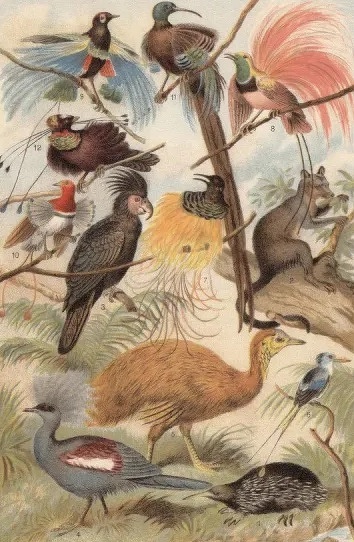
New Guinea — the world’s second largest island, with the country of Papua New Guinea occupying its eastern half and the Indonesian provinces of Papua and West Papua occupying its eastern half — is home to around 276 mammal species, 740 bird species, 314 freshwater fish species, over 640 amphibian and reptile species and an estimated 150,000 insect species. Scientists estimate that more than half of the species on the island remain scientifically undocumented, and the island contains between five and 10 percent of the world's known species despite being less than one percent of the Earth's landmass.
New Guinea is a biodiverse island with many to unique endemic species such as tree kangaroos, birds of paradise, cassowaries, the world’s largest pigeon, echidnas and wallabies. The unique long-beaked echidna is a monotreme mammal that lays eggs. Tree kangaroos such as Matschie's tree kangaroo and the Huon tree kangaroos inhabit mountain forests in both Papua New Guinea and Papua and West Papua in Indonesia. Mountain cuscuses and long-fingered triok occupy the in upper canopy of rainforests. Dugongs are found in the coastal waters. New Guinea singing dogs are considered among the world’s world’s oldest dogs and get their name from their "singing" vocalizations.
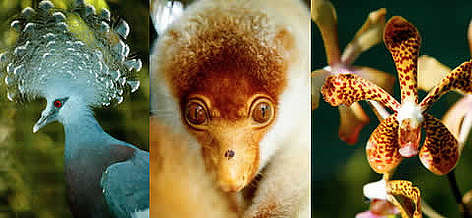
New Guinea boasts more than 40 species of birds of paradise, known for their brilliant plumage and dramatic courtship dances. Bowerbirds and riflebirds are also known their known for their elaborate displays. Southern crowned pigeons are the world's largest pigeons. New Guinea is home home to three species of cassowaries while Australia has only one. Lizards include geckos, legless lizards, and long Salvadore's monitor lizard, the second largest lizard in the world after Komodo dragons. There are over 100 species of snakes,, including sea snakes, tree snakes, pythons, and venomous death adders, brown snakes and taipans. Both saltwater crocodiles and freshwater New Guinea crocodiles are present. Queen Alexandra birdwings are the world's largest butterflies.
The wildlife found in New Guinea, Australia and the Aru Islands of Indonesia are similar. This is because a land bridge connected them during the last several ice ages when sea levels were lower and animals could move between them. Australia is well known for its marsupials but Papua New Guinea is also home to over 50 marsupial species. The main difference between the marsupials found in most of Australia and those in New Guinea is that those in Australia are adapted more for deserts and drier conditions while those in New Guinea are adapted more for rainforests and wetter conditions. The animals of rainforests of northeast Australia are most similar to ones in New Guinea.
There are no large mammals and virtually no predators in the interior of New Guinea.There are no elephants, tigers, deer or deer which are found not that far away in Asia. Most of the mammals are small rodents, marsupials and bats. New Guinea is home to a relatively small number of mammals and many of them are bats. This because is the island is only 25 million to 10 million year old and in that time only a few types had time to evolve and diversify. Niches normally filled by monkeys and large mammals have been been filled reptiles, marsupials and birds. There are no large predators. Cassowaries are the largest animals. The largest predators are eagles. Agile wallabies and monkey-like Matschie's tree kangaroo lives in New Guinea.
Ernst Mayr, the great evolutionary theorist who died in 2005 at the age of 100, spent two formative years in New Guinea, and Jared Diamond (1938-), one of the great late contemporary biologists, conducted fieldwork on the island’s birds. Animal smuggling is a serious problem in New Guinea. There have been reports of a yeti-like creature in New Guinea. Papua New Guinea doesn't have an overpopulation of cane toads, rabbits and camels like Australia, but it does it have a bunch of feral guinea pigs on the loose that descended from a two pets that escaped from a mission some years ago.
See Separate Articles: MAMMALS OF NEW GUINEA ioa.factsanddetails.com ;
BIRDS OF NEW GUINEA ioa.factsanddetails.com
Endangered Animals in New Guinea
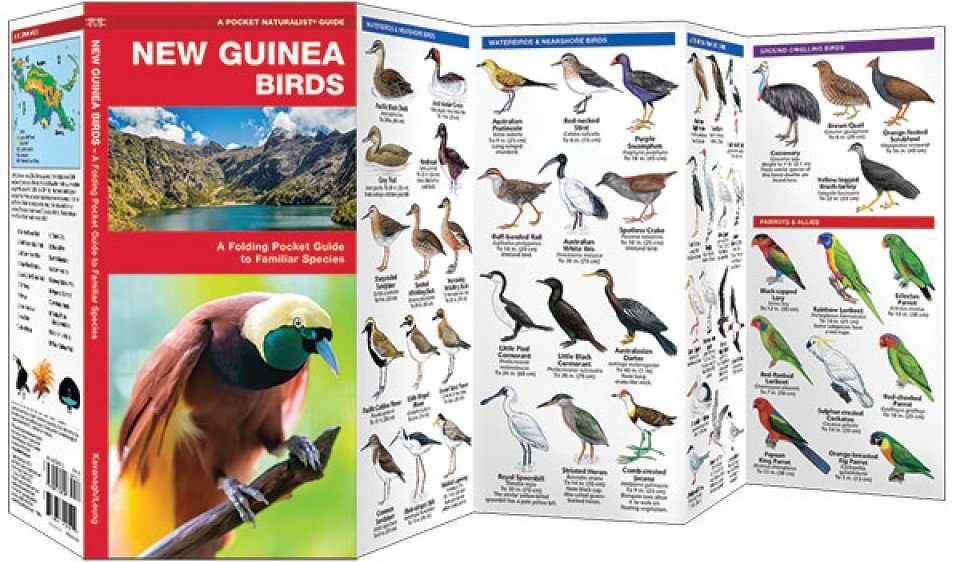
There are approximately 60 species mammals in Papua New Guinea listed as threatened or endangered. The International Union for Conservation of Nature and Natural Resources (IUCN) Red List identifies 12 endangered species of mammal, 7 critically endangered species, with 40 listed as vulnerable. There are approximately 44 threatened bird species in Papua New Guinea, including ones that endemic and those that migrate and spend time there. Over 460 endemic tree species and at least 11 frog species are threatened. Data on animals is not as good for New Guinea as other places because they place is still very wild and undeveloped and figures vary by source and timeframe.
According to a 2006 report issued by IUCN, threatened species included 58 types of mammals, 33 species of birds, 9 types of reptiles, 10 species of amphibians, 31 species of fish, 2 types of mollusks, 10 species of other invertebrates, and 142 species of plants. Threatened species in Papua New Guinea included four species of turtle (green sea, hawksbill, olive ridley, and leatherback) and Queen Alexandra's birdwing butterfly. [Source: Worldmark Encyclopedia of Nations, Encyclopedia.com, 2007]
The nations with the most threatened species include: 1) Indonesia (128 mammal and 104 bird species); 2) Brazil (71 mammal and 103 bird species); 3) China (75 mammal and 90 bird species); 4) India (75 mammal and 73 bird species); 5) The Philippines (49 mammal and 86 bird species); 6) Peru (46 mammal and 64 bird species); 7) Mexico (64 mammal species); 8) Columbia (64 bird species); 9) Australia (58 mammal species); 10) Papua New Guinea (57 mammal species); 11) Ecuador (53 bird species); 12) Madagascar (46 mammal species); 13) the U.S. (50 bird species); 14) Vietnam (47 bird species).
Lost World in the Foja Mountains of Papua
The Foja Mountains are located in northern New Guinea in Papua, Indonesia not so far from Papua New Guinea. During a 2006 expedition there scientists found dozens of animal and plant species ranging from vividly colored birds to exotic frogs, a tiny microhylid frog, less than half an inch long, and from the world’s largest-flowered rhododendron to a tree kangaroo. Some of the creatures found there were unafraid of humans and had no objection to be handled. [Source:Nick Meo, The Times of London, February 7, 2006]
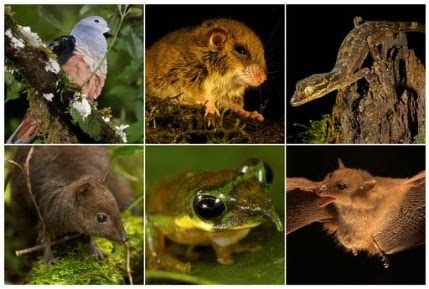
New species from New Guinea: (clockwise, from top left) The Imperial pigeon, tree mouse, gecko, blossom bat, long-nose tree frog and dwarf walla:
Nick Meo wrote in the Times of London. “The expedition identified twenty new frogs, four new butterflies, five plants including the rhododendron with the six-inch bloom, and the first new bird to be discovered in New Guinea for 60 years, a previously unknown honeyeater with a bright orange face-patch and a pendant wattle under each eye. The team also took the first known photographs of Berlepsch’s six-wired bird-of-paradise, a bird that was last recorded in the 19th century, when indigenous hunters provided a specimen but could not say where they had found it. Another find was the golden-mantled tree kangaroo. It was believed to have been hunted nearly to extinction in neighbouring Papua New Guinea, where it was discovered in 1993.
On a later expedition, Ben Webster wrote in Times of London: Wildlife found in the Foja Mountains included several new mammals, such as the world's smallest wallaby, a frog with a Pinocchio-like extendable nose, a blossom bat that feeds on rainforest nectar, and a giant woolly rat, as well as a host of insects and other animals. The discoveries — which also included a gargoyle-like gecko with yellow eyes — were made during a survey of the area by Conservation International. [Source: Ben Webster, Times of London, May 18, 2010]
“The Foja Mountains, classified as a national wildlife sanctuary, are in the Indonesian province of Papua on the island of New Guinea, and encompass more than 300,000 hectares of undisturbed rainforest. The team of 17 scientists and 30 local naturalists found an array of species, including a number believed to be new to science — such as the frog, with a long protuberance that points up when the male is calling but deflates when he is less active. Paul Oliver, a herpetologist from the University of Adelaide, noticed the amphibian sitting on a bag of rice in the campsite where the team was based. The new forest wallaby is now the smallest known member of the kangaroo family. A black-and-white butterfly related to the common monarch was also discovered, along with a tree mouse and imperial pigeons — with feathers colored rusty, white and grey. As well as the dwarf wallaby, scientists obtained the first photographs of the extremely rare golden-mantled tree kangaroo, which is critically threatened by hunting in other parts of New Guinea.
from the WWF
“The expedition, in November 2008, is featured in the June edition of National Geographic magazine, with images by Tim Laman, a wildlife photographer. Bruce Beehler, a senior research scientist at Conservation International and a member of the expedition team, said: "While animals and plants are being wiped out across the globe at a pace never seen in millions of years, the discovery of these absolutely incredible forms of life is much-needed positive news. "Places like these represent a healthy future for all of us, and show that it is not too late to stop the current species extinction crisis." Conservation International hopes that its documentation of the unique wildlife of the Foja Mountains will encourage the Indonesian Government to increase long-term protection of the area.
Expedition to the Foja Mountains of Papua
The Foja Mountain region has been called the "Lost World" because the complete absence of roads has protected it from development and, together with its tropical environment and elevation, made it a perfect incubator for diverse species. The teams for both expeditions described above was dropped off by helicopter, and spent four weeks exploring the mountains, up to 2,200 meters. Nick Meo wrote in The Times of London.“Two headmen from the Kwerba and Papasena tribes, customary landowners of the mountains, accompanied the expedition to the forest, which is 1,600 meters (5,250 feet) above sea level. Mr Beehler said: “They were as astounded as we were at how isolated it was. As far as they knew, neither of their clans had ever been to the area.” They also reveal that the million-hectare jungle, in the Indonesian part of New Guinea, is the largest surviving pristine tropical forest in the Asia-Pacific region, and probably one of the most biologically rich on Earth. [Source: Nick Meo, The Times of London. , February 7, 2006]
“To reach the forest, the team of 11 scientists, from Indonesia, America and Australia, were dropped by helicopter on to a clearing in a peat bog. “Some of the scientists had been planning the expedition for 15 years. Jance De Fretes, an Indonesian mammal expert, who helped to organise the trip, said: “In 2002 we flew over the area in a Cessna light aircraft looking for a suitable helicopter landing site. ”When we finally got out of the helicopter it really was a lost world, untouched by humans. Birds and animals had no fear of man. They were so tame you could pick them up.” “About 100,000 people have died in an insurgency in Papua, the Indonesian part of New Guinea at the far eastern end of the archipelago, and access by foreigners is tightly controlled. The team needed six permits to fly in and land.
Reptiles in New Guinea
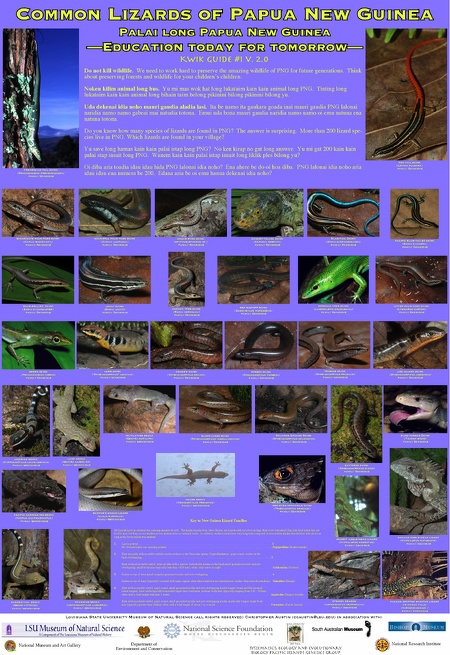
New Guinea is home to a diverse reptile population, including over 200 species of lizards, about 100 snake species, 13 species of turtles, and 2 species of crocodiles. Notable reptiles include the giant crocodile monitor, a variety of endemic skinks and freshwater turtles and widely distributed crocodiles like the New Guinea crocodile and the saltwater crocodile.
Crocodile monitors are the second largest lizard after Komodo dragon. The sometimes prey on wallabies. Many of the lizard species are skinks such as endemic New Britain crocodile skinks and Admiralty crocodile skinks. Pig-nosed turtles, also known as Fly River turtle, is a unique species found in New Guinea. Parker's snake-necked turtle is endemic to the Fly River. Saltwater crocodiles are the largest native reptile and the largest reptile period. They are mainly found in New Guinea's river mouths and estuaries. New Guinea crocodiles are endemic to New Guinea and much smaller than saltwater crocodiles.
Snakes include the highly venomous coastal taipan, which is found in the coastal regions of New Guinea and Australia. Brown tree snake: Invasive brown snakes in Guam, which are venomous but not so dangerous, probably arrived in Guam by a ship from Papua New Guinea in World War II. There are pythons in New Guinea. A 2025 study identified new species of tree snakes in the genus Dendrelaphis from islands off the coast of New Guinea.
RELATED ARTICLES:
FRILLED LIZARDS: CHARACTERISTICS, BEHAVIOR AND REPRODUCTION ioa.factsanddetails.com
GOANNAS (MONITOR LIZARDS) factsanddetails.com
MONITOR LIZARDS OF NEW GUINEA: SPECIES, CHARACTERISTICS, BEHAVIOR AND REPRODUCTION factsanddetails.com
NEW GUINEA CROCODILES: TWO SPECIES, CHARACTERISTICS, BEHAVIOR AND REPRODUCTION ioa.factsanddetails.com
TAIPANS (WORLD'S DEADLIEST SNAKES): SPECIES, VENOM, BITES, CHARACTERISTICS, BEHAVIOR ioa.factsanddetails.com
BROWN SNAKES: SPECIES, CHARACTERISTICS, BEHAVIOR, VENOM, BITE VICTIMS ioa.factsanddetails.com
GREEN TREE PYTHONS: CHARACTERISTICS, BEHAVIOR AND REPRODUCTION ioa.factsanddetails.com
Queen Alexandra's Birdwings and World's Largest Butterflies
Queen Alexandra's birdwing (Ornithoptera alexandrae) is the largest species of butterfly in the world, with females reaching wingspans slightly over 25 to 28 centimeters (10 to 11 inches). This birdwing is restricted to the forests of the Oro Province in eastern Papua New Guinea. According to the Guinness Book of Records one specimen had a wingspan of 11 inches and weighed 0.9 ounces. Queen Alexandra's birdwing butterflies are iridescent blue and green, or cream and chocolate brown with a bright yellow abdomen and a bright red coloring near the bases of the wings. Protected since 1966, its only habitat, the area in and around the Popondetta Plain, is threatened by oil palm and logging industries.
The largest lepidopteran (butterfly and moth) species overall is claimed to be either the Queen Alexandra's birdwing or the Atlas moth (Attacus atlas) from Southeast Asia. Both of these species can reach a body length of 8 centimeters (3.1 inches), a wingspan of 28 centimeters (11 inches) and a weight of 12 grams (0.42 ounces). One Atlas moth allegedly had a wingspan of 30 centimeters (12 inches) but this measurement was not verified. The larvae of the Queen Alexandra's birdwing can weigh up to 58 grams (2.0 ounces). The larvae of the Atlas moth can weigh up to 54 grams (1.9 ounces).
Matthew Teague wrote in National Geographic: “Of the planet’s roughly 20,000 species of butterflies, swallowtails are especially intriguing to collectors. The more than 560 swallowtails include the world’s largest butterflies — birdwings — and some of the most expensive and threatened. They face a triple menace of habitat loss, climate change, and poaching. Thanks to conservation programs and anti-poaching laws, swallowtails are surviving despite a black market where prices start in the pennies and run into the thousands for protected species. [Source: Matthew Teague, National Geographic, August 2018]
Among the most coveted species are the Queen Alexandra's birdwing. It and the Goliath Birdwing are the two largest butterflies in the world. The wingspan of the female Queen Alexandra's Birdwing can reach 31 centimeters (12.2 inches). Both of these are found in Papua New Guinea. Microscopic scales on their scatter light, creating iridescent colors and patterns that likely help attract mates.
Pegunungan Arfak (Arfak mountains) on the bird’s head in West Papua, in the Indonesian part of New Guinea is famous for its butterflies. Birdwing butterflies found in Papua are dried and sold abroad for as much as $350 a pair. The Hafam people in the central Arfak mountains raise pupae from these valuable insect in forest gardens.
Very Different Stick Insect and Leaf Insects the Same Species
Scientists have long wondered how a species of stick insects in New Guinea appeared seemed to exist with no of females — not even mothers. The seemingly single-sex Phyllium asekiense puzzled entomologists for more than 100 years, Stéphane Le Tirant, an entomologist at Montreal Insectarium’s Montreal's solved the mystery. CBC Radio reported: Le Tirant is an expert in beetles, but he is fascinated by the leafy insects. He was sent a batch of eggs from Papua New Guinea in April 2018, which he and his team carefully looked after in a breeding program. When the eggs hatched and the insects grew, he saw what looked like a different species of leaf insects, and put two and two together — what were previously classified as two different species are, in fact, males and females of the same species. [Source: CBC Radio, December 3, 2020]
The insectarium published their findings in the journal ZooKeys in September 2020. Julia Mlynarek of the Montreal Insectarium colleague said the two sexes of appear very differently. They're actually described as different genera, so different groups, altogether. The males tend to look more like sticks. They have... rolled leaves, so they're very elongated, and they have wings. The females look a lot more like leaves that are a bit eaten on the sides, and come in different colors from green to orange and yellows. They are a lot larger and they're a lot flatter looking, so they actually mimic leaves a lot more.
In the female insects, and especially in stick insects, some species are parthenogenetic, so they are able to lay eggs, viable eggs, even if they haven't mated with the male. In this species that was described as females-only, it was considered that maybe they were parthenogenetic. The males, they can't lay eggs, so that was a really big mystery.
Stéphane Le Tirant, the entomologist at the Insectarium, received a batch of 13 eggs that the technicians then took, led by Mario Bonneau, to rear them out. They took really great care to hatch these eggs as well as possible. It took several months … and once they hatched, they started rearing them to adulthood, giving them different leaves to eat. Once [the insects] started growing up, [the team] noticed that some of them looked a lot more like sticks and some of them started looking more like the thicker leaves that were expected, because they were expecting these thick-leaved females. Through Stéphane's knowledge of stick insects, right away he noticed that these really resemble a completely different genus. And so they knew that these species were actually the same thing, not a different species.
First of all, you have to figure out the right humidity levels and the right temperature to raise them, so that these nymphs don't die. You have to make sure you don't manipulate them too much because it can add stress, and so with stress, they can die as well. [They ate] mostly [guava] leaves Even with all that care, though, only five of these 13 eggs ultimately hatched.
Yes, yeah. In nature, insects tend to lay a lot of eggs and not all of them hatch, so actually hatching five out of 13 is not a bad ratio. Leaf insects [and] stick insects, are so cryptic in nature that... it's very difficult to find them in nature. And so, you have to either really know what you're looking for, or just a lot of luck. I think that [people] were looking for the answers, but maybe they were just looking in the wrong places at that time.
Are the males and females normally found together, if they are found? When they do mate, they are definitely found together. But because the females don't fly, they tend to sort of stick around the leaves and move about a bit. The males fly... so they may not be found in the same areas. Ecologically, this group is not very well known because, as I said, they're very difficult to observe in nature. They're high up in the trees, in a remote place of the world.
Image Sources: Wikimedia Commons
Text Sources: Animal Diversity Web animaldiversity.org , National Geographic, Live Science, Natural History magazine, Australian Museum, David Attenborough books, Australia Geographic, New York Times, Washington Post, Los Angeles Times, Smithsonian magazine, Discover magazine, The Conversation, The New Yorker, Time, BBC, CNN, Reuters, Associated Press, AFP, Lonely Planet Guides, Wikipedia, The Guardian, Top Secret Animal Attack Files website and various books and other publications.
Last updated September 2025