
NEW GUINEA CROCODILES
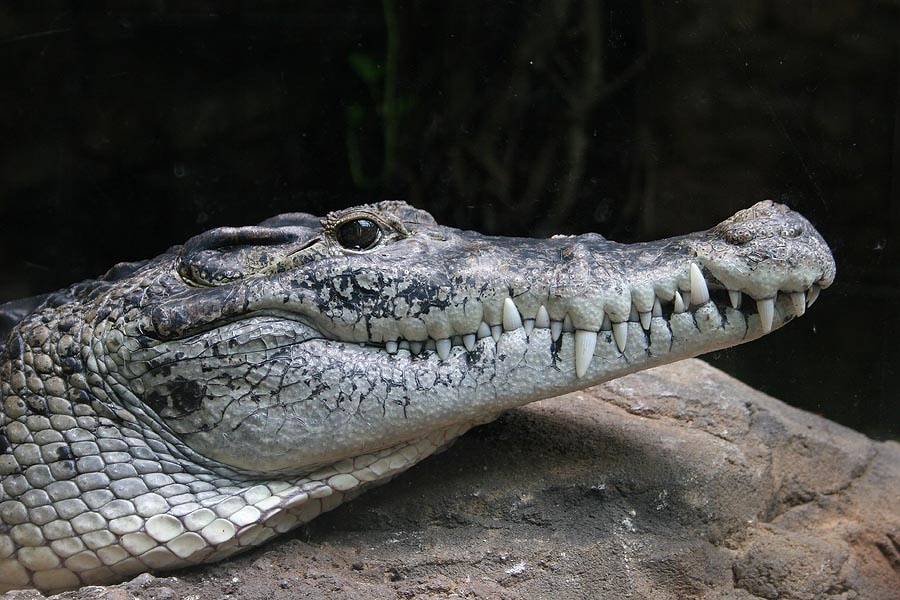
New Guinea crocodile
New Guinea crocodiles (Crocodylus novaeguineae) are a small species of crocodile found on New Guinea north of the mountain ridge that runs along the centre of the island. The population found south of the mountain ridge, formerly considered a genetically distinct subspecies, is now considered a distinct species, Hall's New Guinea crocodiles (C. halli). In the past Philippine crocodiles (C. n. mindorensis) were considered a subspecies of New Guinea crocodiles, but today they too are regarded as separate species. There are also saltwater crocodiles in New Guinea. [Source: Vi Tran, Animal Diversity Web (ADW) |=|; Wikipedia]
Both species of New Guinea crocodiles are found in mainland Papua New Guinea but not its islands and in Papua and West Papua Provinces of Indonesia. New Guinea crocodiles are divided from Hall’s New Guinea crocodiles by the main cordillera (central highlands) of New Guinea. Both species are widespread and locally common, with the northern New Guinea crocodiles found in the Sepik and Ramu River systems and the southern form Hall’s New Guinea crocodiles found in the Fly and Bamu Rivers and their associated tributaries and lakes in the southwest region of the island, and the tidal forest zone of the Gulf of Papua in the south.
Both species of New Guinea crocodiles inhabit freshwater lakes, ponds, rivers, streams, marshes, swamps and other wetlands. Larger crocodiles usually occupy main river channels, while juveniles and smaller individuals tend to inhabit nearby grassy wetlands. Seasonal changes in water levels have marked effects on population density and distribution. These crocodiles have been found at elevations from sea level to 600 meters (1968 feet). |=|
New Guinea crocodiles are most active at night when they feeds on fish and a range of other small animals. They were overhunted for their valuable skin in the mid 20th century, but conservation measures have since been put in place, and they have made a come back. On the International Union for Conservation of Nature (IUCN) Red List they are a species of "Least Concern". These crocodiles are raised in ranches for their skins. There is a record of a New Guinea crocodile reaching the age of 24.6 years of age in captivity.
RELATED ARTICLES:
CROCODILES IN AUSTRALIA: HISTORY, SPECIES, BIG ONES, DWARVES, BATS, SHARKS ioa.factsanddetails.com
CROCODILE CULTURE AUSTRALIA: URBAN CROCS, ABORIGINALS, DUNDEE, STEVE IRWIN ioa.factsanddetails.com
SALTWATER CROCODILES factsanddetails.com
CROCODILES: CHARACTERISTICS, ANATOMY, DIFFERENCES WITH ALLIGATORS factsanddetails.com
PREHISTORIC CROCODILES: EVOLUTION, EARLIEST SPECIES, TRAITS factsanddetails.com
CROCODILE BEHAVIOR: COMMUNICATION, FEEDING, MATING factsanddetails.com
CROCODILES AND HUMANS: WORSHIP, THREATS, HANDBAGS factsanddetails.com
HOW TO CATCH A CROCODILE factsanddetails.com
CROCODILE ATTACKS IN AUSTRALIA: HOW, WHERE, WHY, DETAILS ioa.factsanddetails.com
CROCODILE ATTACKS IN NORTHERN TERRITORY AUSTRALIA ioa.factsanddetails.com
SURVIVING CROCODILE ATTACKS IN AUSTRALIA ioa.factsanddetails.com
CROCODILE ATTACKS IN ASIA factsanddetails.com
SPECIES OF CROCODILES IN ASIA factsanddetails.com
New Guinea Crocodiles Characteristics and Diet
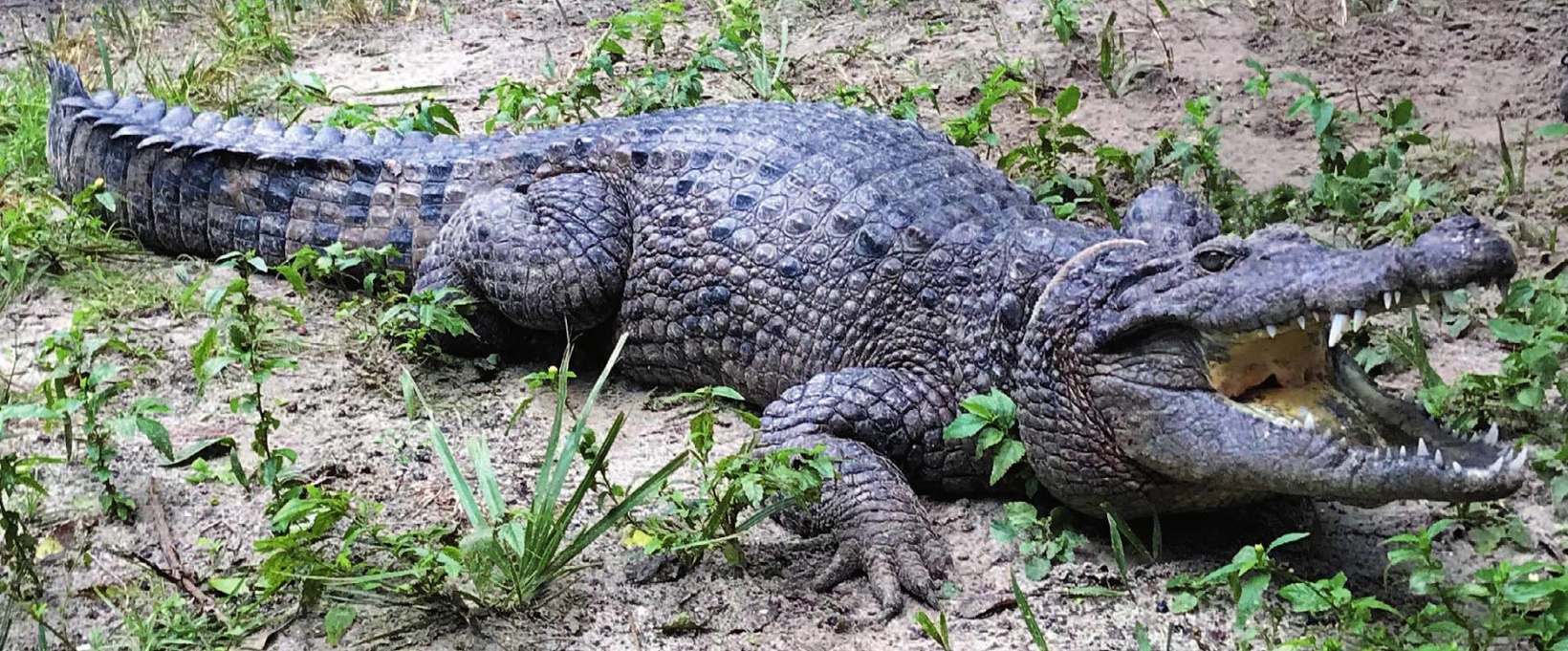
Hall's New Guinea crocodile
New Guinea crocodiles are small- to medium-sized crocodile with maximum verifiable lengths of around 3.5 meters (11.7 feet) for males and three meters (10 feet) for females. They have relatively narrow snouts and are brown to gray in color, with dark brown to black bands on their bodies and tails; banding is more visible on younger animals. These crocodiles have 66-68 teeth, of which 13-14 pair are maxillary (upper jaw bone), five pairs are pre-maxillary and 15 are mandibular (lower jaw bone) . [Source: Vi Tran, Animal Diversity Web (ADW) |=|]
Northern and southern species of New Guinea crocodiles differ slightly in morphology. The premaxillary symphysis (a fibrocartilaginous joint) of Hall’s New Guinea crocodile is longer than the maxillary symphysis, while northern Papua New Guinea crocodiles have premaxillary symphyses that are shorter than the maxillary symphysis. Southern populations have 4-6 post-occipital scales on the neck, while northern populations always have four post-occipital scales. Relative skull measurements, however, are comparable between similar-sized individuals of both populations.
New Guinea crocodiles differ be morphologically from saltwater crocodiles by differences in the number of belly scales and the arrangement of scales on the nape of the neck. These species tend to prefer different (but sometimes overlapping) habitats, with saltwater crocodiles occupying deep freshwater pools and fast-flowing, rocky streams up to 700 miles inland, as well as brackish and coastal areas, and New Guinea crocodiles being found mainly in inland river systems and freshwater swamps and marshes.
New Guinea crocodiles are carnivores (eat meat or animal parts) and primarily piscivores (eat fish) but can be insectivores (eat insects). Prey include fish, birds amphibians, reptiles, insects and other marine invertebrates. New Guinea crocodiles are opportunistic feeders. Hatchlings feed on mosquitos, grasshoppers, water bugs, and other aquatic invertebrates, and small juveniles feed heavily on schools of small fish. Adults have been reported to eat insects, fish, frogs, turtles, water snakes and lizards, rails, grebes, and ducks.
New Guinea Crocodiles Behavior and Communication

Range of New Guinea crocodiles: 1) New Guinea crocodile in reddish orange in the north: 2) Hall's New Guinea crocodile in yellowish orange in the south
New Guinea crocodiles are terricolous (live on the ground), natatorial (equipped for swimming), nocturnal (active at night), motile (move around as opposed to being stationary), sedentary (remain in the same area) and solitary. They are not known to defend specific territories, outside of nests while eggs are incubating. [Source: Vi Tran, Animal Diversity Web (ADW) |=|]
New Guinea crocodiles are semi-aquatic, with well-developed limbs that allow them to move easily through the water and over land. They thermoregulate by seeking shade, submerging in water, elevating their head above the substrate, and gaping their mouths. They are primarily nocturnal, night), tending to remain in covered, protected areas during the day, and are rarely found basking.
New Guinea crocodiles sense and communicate with touch, sound and chemicals usually detected by smelling. In general, crocodiles communicate through vocalizations, which are used in social encounters. Male crocodiles emit a variety of sounds during courtship and territorial displays. Both sexes slap their heads and tail against the water as warning signs and displays of aggression. Hatchlings emit calls to get their mothers to help them from their nests and juveniles may use distress calls to attract adult protection. Crocodiles also have musk glands beneath their throats and inside the cloaca, likely used for communication via scent. Their eyes, protected by a nictitating membrane, allow a wide field of binocular vision.
New Guinea crocodiles are considered apex predators and therefore are important in maintaining ecological balance. They are a keystone species, meaning their presence or absence strongly affects populations of other species in the area where they live. Adults have no predators other than humans. Eggs are preyed upon by wild pigs, monitor lizards, and humans. Juveniles may be harassed by larger members of their own species and even cannibalized. Other predators of young crocodiles include large birds of prey such as eagles and sharks.
New Guinea Crocodiles Mating, Reproduction and Offspring
New Guinea crocodiles are polygynous (males have more than one female as a mate at one time) and engage in seasonal breeding — assumed to be once a year, Hall’s New Guinea crocodiles in the south breed in the wet season (December to March), while northern New Guinea crocodiles breed in the dry season (June to September). The number of eggs laid and offspring ranges from 10 to 48, with the average number being 27. The gestation period ranges from 83 to 91 days. [Source: Vi Tran, Animal Diversity Web (ADW) |=|]
Female crocodiles lays a clutch of eggs in a nest composed of vegetation and camp out nearby to guard the nest. There is some degree of parental care for newly hatched juveniles. Eggs are laid approximately two weeks after mating. It is assumed before young are born their sex is determined by temperature. In closely related freshwater crocodiles (Crocodylus porosus), intermediate incubation temperatures produce males, while lower and higher temperatures produce females. Hatchling size differs between southern and northern populations. Hall’s New Guinea crocodile hatchlings in the south range from 26-32 centimeters in length, about five centimeters longer than hatchlings of New Guinea crocodiles in the north. |=|
The courtship behavior of Hall’s New Guinea crocodiles seems to be triggered by the onset of the rainy season. Captive males display head contact, a submissive display by a male to a female. A male may also blow bubbles underneath a female's body. If a female is willing to mate, she will lift her snout out of the water. A male will then circle and swim over her, pushing her into the water, where mating takes place. Size-specific dominance breeding hierarchies have been observed in captivity.
All crocodiles in New Guinea form mound nests. Vi Tran wrote in Animal Diversity Web: Eggs are deposited in a central chamber, with a constant temperature maintained by the decomposition of surrounding organic materials. The majority of nests are constructed on land, above the previous year's high water mark and under the protection of overhanging vegetation, although some are built on floating masses of vegetation. Clutch and egg sizes vary depending on the population, with southern individuals laying fewer, larger eggs that hatch into larger juveniles. Egg mass averages 19.8-150.5 grams, with a length of 6.0 to 11.6 centimeters and a diameter of 37.5-52.3 millimeters. Eggs exhibit high levels of mortality, due in large part to the high risk of nest flooding, as well as predation. The exact age at which New Guinea crocodiles reach sexual maturity is unknown, but measurements of sexually active individuals have been recorded. Females reach reproductive maturity once they have achieved 55-60 percent of their total length (1.4-2.0 meters snout-vent length), while males reach sexual maturity at around 2.4 meters snout-vent length.
Parental care by both species of New Guinea crocodiless is provided by both females and males, with the bulk of the work done by females. Females construct nests from surface litter, soil, and plant debris near mixed swamp woodland-forest, providing shelter and food for hatchlings. These crocodiles do reuse nests. Females remain near the nest while eggs are incubating. Adults of both sexes typically defend their young, both from potential predators and other adults.
New Guinea Crocodiles, Humans and Ranching
There is a large crocodile skin industry in Papua New Guinea and crocodile hunting has traditionally been a source of income in small villages. While both species of New Guinea crocodile are listed as a species of Least Concern on the IUCN Red List in CITES (Convention on International Trade in Endangered Species of Wild) they are in Appendix II, which lists species not necessarily threatened with extinction now but that may become so unless trade is closely controlled. [Source: Vi Tran, Animal Diversity Web (ADW) |=|]
According to Animal Diversity Web (ADW): Crocodile hunting is the only means of income for many villages in Papua New Guinea and the majority (75-95 percent) of the crocodiles being hunted are New Guinea crocodiles. While crocodiles in Papua New Guinea are plentiful and play an important role in the economy, increasing rates of crocodile harvesting could diminish population densities. There are many government regulations in place that help to protect this species of from overhunting.
Crocodile ranching in Papua New Guinea became a national goal in the 1990a. The reptiles are kept in large swampy pens and fed chopped fish caught by fishermen and offal from chicken processing plants. It takes two years for baby crocodiles to mature to a belly size of 15 inches, the proper selling size, when the animals were sold for about US$150 a piece in the early 2000s.
Image Sources: Wikimedia Commons
Text Sources: Animal Diversity Web animaldiversity.org , National Geographic, Live Science, Natural History magazine, Australian Museum, David Attenborough books, Australia Geographic, New York Times, Washington Post, Los Angeles Times, Smithsonian magazine, Discover magazine, The Conversation, The New Yorker, Time, BBC, CNN, Reuters, Associated Press, AFP, Lonely Planet Guides, Wikipedia, The Guardian, Top Secret Animal Attack Files website and various books and other publications.
Last updated August 2025