
Home | Category: Birds, Crocodiles, Snakes and Reptiles
CROCODILES AND AUSTRALIA
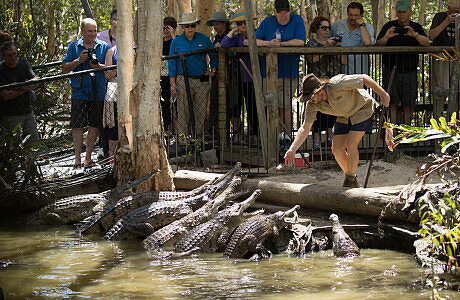
from Hartley’s Crocodile Adventures at Wangetti in Far North Queensland
Salties (saltwater crocodiles) have been featured films and television shows set in Australia such as the Crocodile Dundee series of films, horror films Black Water and Rogue and "The Crocodile Hunter" television series. with Steve Iran. There are several crocodile–themed parks in Australia as well as crocodile farms that produce leather for Hermes hangbags. A 1948 Australian 2 shilling stamp depicting an aboriginal rock artwork of a crocodile. There was illustration of one on the 1997 Australian 22-cent stamp.
Mark Mineha, a blogger and market, posted on Quora.com: No longer endangered and breeding very well, the saltwater crocodile is farmed in three states in Australia. Freshwater crocodiles are not farmed in Australia. There are more than 15 commercial crocodile farms in the north of Australia producing meat, croc skin leather and fertilisers. The farming is well regulated and Australia’s saltwater crocodile products cannot be traded except from government authorised captive breeding establishments or closed cycle farms. [Source: Quora.com]
Ilsa Sharp wrote in “CultureShock! Australia”: Crocodiles are the stuff of Australian legend and a fascinating link with Earth’s prehistory. Thanks to conservationist policies which have granted them complete protection in Australia since the early 1970s, their number has increased dramatically; some estimates now put the population of the Estuarine or Saltwater Crocodile at about 100,000, probably more.[Source: Ilsa Sharp, “CultureShock! A Survival Guide to Customs and Etiquette: Australia”, Marshall Cavendish, 2009 ^^]
The focus of public fear and awe is the ‘Saltie’, which will take human beings if they are at hand. Former labourer-turned-comic actor Paul Hogan’s sell-out Crocodile Dundee films of the 1980s did much to fuel this reputation, and in more recent times, the late, larger-than-life zoo personality Steve Irwin stoked that very same fire quite efficiently, with an outsized television image (risking his own baby in the croc pool and so on) that was beamed around the world. Make no mistake about it, the seemingly lumbering ‘saltie’ can move at an impressive speed on land. Just watch ‘showtime’ at some of the Northern Territory crocodile farms, when rangers feed huge specimens by offering them dead chickens at the water’s edge, and see what you think after that. ^^
According to Reuters, Australia politicians have passed laws that say crocodiles should considered a fish. At the same others have thrown up their hands in their efforts to advise tourists about the dangers of crocodiles. According to the Age: Authorities say they can do little but warn tourists to be careful. In Darwin, where more than 150 crocodiles were removed from the city harbor last year, officials have set up the Croc Sighting hot line, and hotel brochures warn guests to stick to swimming in the pool. "We told people, 'If you give them a chance, they'll grab you. They'll rip your arms off. They'll grab your kids and eat them in front of you'," says Dr. Grahame Webb, director of Crocodylus Park in Darwin. But critics say that the warnings are toned down in order not to frighten off tourists — and accuse the government of being too ready to resort to culling predators instead of keeping people away from them. "In the past we've been able to camp wherever we liked in designated areas. We'll have to make it a little bit more restricted," says Judith Blackshaw, an animal-behavior professor at the University of Queensland. That seems a small price to pay to save the life of another child. [Source: Xavier La Canna, Age Online, April 30, 2001]
RELATED ARTICLES:
CROCODILES IN AUSTRALIA: HISTORY, SPECIES, BIG ONES, DWARVES, BATS, SHARKS ioa.factsanddetails.com
SALTWATER CROCODILES factsanddetails.com
CROCODILES: CHARACTERISTICS, ANATOMY, DIFFERENCES WITH ALLIGATORS factsanddetails.com
PREHISTORIC CROCODILES: EVOLUTION, EARLIEST SPECIES, TRAITS factsanddetails.com
CROCODILE BEHAVIOR: COMMUNICATION, FEEDING, MATING factsanddetails.com
CROCODILES AND HUMANS: WORSHIP, THREATS, HANDBAGS factsanddetails.com
HOW TO CATCH A CROCODILE factsanddetails.com
CROCODILE ATTACKS IN AUSTRALIA: HOW, WHERE, WHY, DETAILS ioa.factsanddetails.com
CROCODILE ATTACKS IN NORTHERN TERRITORY AUSTRALIA ioa.factsanddetails.com
SURVIVING CROCODILE ATTACKS IN AUSTRALIA ioa.factsanddetails.com
CROCODILE ATTACKS IN ASIA factsanddetails.com
SPECIES OF CROCODILES IN ASIA factsanddetails.com
Aboriginals and Crocodiles
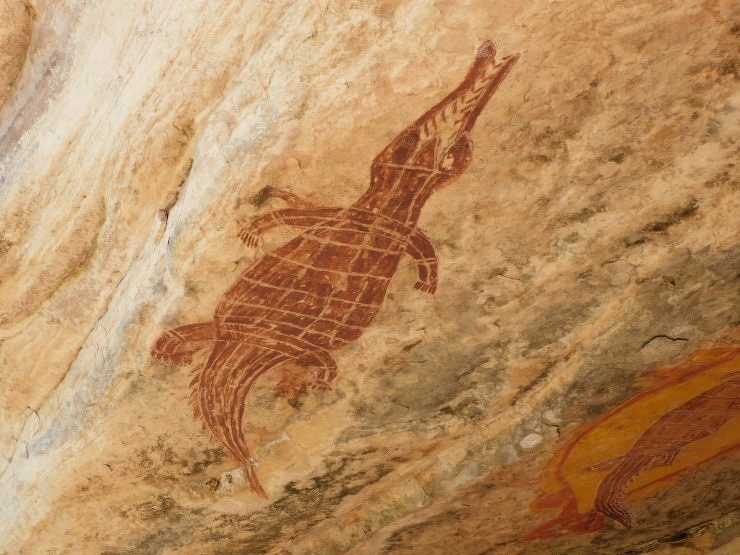
Aboriginal rock art of a crocodile from Arnhem Land in northern Australia, Inspiration Outdoors
Crocodiles feature prominently in Aboriginal stories and myths. Some Aboriginals may still eat their eggs and meat. Aboriginals respect the crocodile as a dreamtime spirit. Dreamtime is the animist framework of Aboriginal religion and mythology. The Larrakia people think of themselves as crocodile descendants, and regard the animals as their totem.They respect crocodiles as protectors of harbours and do not eat crocodile meat.
According to Wondjina, the mythology of Indigenous Australians, the saltwater crocodile was banished from the fresh water for becoming full of bad spirits and growing too large, unlike the freshwater crocodile, which was somewhat revered. Franz Lidz wrote in Smithsonian magazine: The Gagudju people of Arnhem Land believe that Ginga, a spirit ancestor who helped create the rock formations of the region, underwent a transformation after accidentally catching fire. He dashed into the water to extinguish the flames and rough, lumpy scars formed on his back. He became the first crocodile. [Source: Franz Lidz, Smithsonian magazine, March 2015]
One Aboriginal story goes: Once a young Aboriginal man died a few months after he tampered with a crocodile's nest to help a scientist. A medicine man told the man's father he had betrayed the sanctity of the crocodile's nest and his death was the croc's revenge.
Aboriginal rock art depicting saltwater crocodiles is rare, although examples of up to 3,000 years old have been found in caves in Kakadu and Arnhem Land, roughly matching the distribution of the species. Crocodiles are often depicted in contemporary aboriginal art.
Urban Crocodiles in Australia
In 2001, Reuters reported: Saltwater crocodiles were spotted swimming the streets of Cairns on Australia's northeast coast, after high tides flooded parts of the city, a newspaper said on Saturday.A baby saltwater crocodile measuring 50 centimeters was killed after being hit by a car and at least three others — as long as 1.8 meters — were seen in the flooded streets, the Cairns Post reported. [Source: Reuters, February 11, 2001]
Cairns, a popular tourist base for visits to the nearby Great Barrier Reef, was partly flooded and nearby beaches were seriously eroded by 3.6m king tides, which were expected to continue. Marcel Maujean, who operates a boat-building business in the northern Queensland city, told the Australian Associated Press one of his staff had turned the dead crocodile into wildlife officers, along with another small one that was swimming by. He said a 1.8m crocodile was also swimming in the street in about a meter of water, but made its way back into nearby mangroves. "We are one block from the inlet so I'm not really surprised to see them," he said."But you don't expect to see a crocodile in your drain."
In 1998, Associated Press reported from Brisbane: A six-foot crocodile has been spotted in a storm water drain near a neighborhood where a teen-age girl was mauled in February, police said.The crocodile was noticed on the banks of a drain running off a creek in Westcourt, a suburb of Brisbane, said police Sgt. Trevor Crawford. The animal fled into the drain after a man threw a rock at it, he said. Department of Environment officers removed another six-foot saltwater crocodile from the same area two days earlier. “The big danger is that this drain is close to a heavily populated (area) and the kids all like playing in the creeks and storm water drains,'' Crawford said. In February, a crocodile grabbed a 15-year-old girl by the legs and tried to drown her. She grabbed hold of an overhanging branch while her grandmother forced the crocodile to release its grip by kicking it in the head. [Source: Associated Press, April 19, 1998]
In 2006 Associated Press reported: Police in northern Sydney enlisted the help of a zoo keeper to capture a crocodile today after locals reported seeing one of the reptiles in a suburban waterway. The New South Wales state police said a saltwater crocodile measuring up to two feet had been spotted munching on carp in a natural spring near an industrial park in northern Sydney. A keeper from a local reptile park donned goggles and flippers and swam underneath the crocodile before grasping it underwater, officers said. It will now be placed in a suitable animal park. [Source: Associated Press, Irish Examiner, February 23, 2006]
Residents of Queenslands Town Demand the Right to Shoot Marauding Crocodiles
Mark Chipperfield wrote in The Telegraph: The residents of a small Queensland town are demanding the right to shoot marauding crocodiles which are invading their farms, beaches and golf courses and even walking up the main street. People living in the remote coastal settlement of Cooktown say that the saltwater crocodiles — which are protected as an endangered species — pose a serious risk to their lives. They claim that a 40-year-old ban on hunting the creatures has led to a large increase in crocodile numbers in tropical Australia. [Source:Mark Chipperfield, The Telegraph, November 5, 2000]
John King, the English-born editor of the Cooktown News, says the latest sighting of a 4.9-meter (16-foot) crocodile at the fishing wharf illustrates how brazen the creatures are becoming — the wharf is situated on the town's main shopping street. Others have been seen wandering across the town's golf course. Mr King said: "We've already lost several dogs over the last few months and it's only a matter of time before we lose a man or woman — and the crocs pose a real danger to children up here. At the moment the parks and wildlife service is spending $A50,000 ((£20,000) per animal to relocate crocs, but all they do is swim back here a few weeks later."
Under Queensland's tough anti-poaching legislation, anyone caught killing a wild crocodile can be fined up to $A225,000 (£81,000) or face two years in jail. The mayor of Cook Shire, Graham Elms, says that it is not only residents and tourists who are being put at risk by the crocodile plague: "big salties" are now attacking stock on nearby cattle stations. He said: "You pay five or six thousand dollars for a good bull and put him out in your paddock, then come back a week later to find him half eaten by a crocodile." Further south in Cairns, authorities have been forced to close popular tourist beaches on three occasions this year after crocodiles swam ashore and threatened bathers.
The Queensland Parks and Wildlife Service is strongly resisting pressure to allow limited culling of wild crocodiles, saying that people in the state's far north are greatly exaggerating the problem. Clive Cook, the service's regional manager in Cairns, says that humans must learn to co-exist with the reptiles and adopt sensible precautions when entering crocodile country. He said: "It's simply not practical to say we can remove the risk by 100 per cent to humans on our beaches and waterways. It's important to understand the dangers and be careful not to attract crocodiles by leaving fish scraps near boat ramps or camping too close to crocodile territory."
This strategy does not satisfy "Crocodile Mick" Pittman, a former crocodile hunter who now sells leather handbags and other goods to visiting tourists. Rather than protecting crocodiles, Mr Pittman, 42, believes the parks and wildlife service should be protecting those who live in the tropics — he advocates a return to hunting as a natural control method. He said: "I've offered my services to any of the councils free of charge. I've got my own dinghies. I've got my own catching gear. But no one will take me on. All I want is the animals. I've got Harrods interested in crocodile skins cured in bark but they won't take farmed crocodiles." Mr Pittman also disputes the government's estimates of crocodile numbers in Queensland, saying that to his knowledge there are at least 30,000 animals in the Cape York region. An additional problem for those trying to manage the threat is the sheer longevity of saltwater crocodiles. The world's biggest croc, Oscar, which is 5.5 meters (18 feet) long and lives in the Cooktown area, is more than 90 years old — and it's still going strong.
Crocodile Meat
Crocodile meat is available in Australia. It is said the tail 'the tastiest part'. A restaurant in Queensland serves crocodile meat grilled on sugar cane and served with chili jam. Darwin, the largest city in the Northern Territory, is known for its crocodile meat dishes. One of the better known restaurants there in the 2010s was Tim's Surf 'n' Turf. [Source: Keita Ikeda, Yomiuri Shimbun, February, 17, 2015]
The Yomiuri Shimbun reported: According to the restaurant's manager, Leeann Valentine, 45, special permission is required to purchase crocodile meat. On the recommendation of Valentine, who said crocodile tail is the best meat because it contains less fat than the body, I ordered "Crocodile Taste." The batter-fried tail meat cost 15 Australian dollars and offered a taste and texture that were impressively similar to chicken. Cutlet-like "Crocodile Schnitzel," which costs 28 Australian dollars, was also delicious with sweet chili sauce.
Clementine Bell posted on Quora.com: In the southern, more cosmopolitan states where crocodiles aren’t native, it’s considered to be a more high-end product. But up north, especially in the Northern Territory, where crocodiles are as common as pigeons, it’s fairly regularly eaten. I’m from Darwin, and we eat crocodile meat all the time. It’s not considered particularly high-end up here at all. I’m poor and I eat it all the time....the same way that Americans eat gator meat. It’s common and inexpensive in areas where gators are found, but in places where gators are not found, it is rarer and more expensive. [Source: Quora.com]
Joshua San from Melbourne posted on Quora.com: I do love my crocodile jerky. You can buy them in packets up in Queensland. I live in Melbourne so it’s really a sort of delicacy until you move up north. I would bet that tourists like it more than we do…supply and demand right?
Shaun Gordon from Melbourne posted on Quora.com: I'd guess 90 percent of the population has never even tried it. I've seen it in some supermarkets, but it's very expensive. Around $80 per kilo if I remember correctly. The thought of eating it doesn't appeal to me personally. John Griffiths posted on Quora.com: It’s a delicacy served only in very expensive restaurants. Having said that it’s a top end predator, like shark, so the residual chemicals don’t bear thinking about. Definitely a sometime food. [Source: Quora.com]
Camper in Queensland Wakes up With a Crocodile in His Bed
In 2001, a man camping by a river in far north Queensland awoke to discover he was sharing his bed with a large crocodile, officials said. AFP reported: The croc, which was lying across his chest, then tried to drag the 36-year-old man into the water. But he escaped with the help of a friend. [Source: AFP, July 23, 2001]
The man, who had been camping by the North Kennedy River, was recovering in Cairns Base Hospital on Monday after being treated for nothing more than bites to his right wrist. The incident happened on Saturday morning at Hanns Crossing in the Lakefield National Park, north-west of Cooktown on Cape York Peninsula.
"Two men were sleeping at their campsite about 15 meters from the water's edge at Hann Crossing on Saturday morning when one was awoken by something heavy across his chest," said Environment Minister Dean Wells. "The man yelled to his friend and the crocodile seized his wrist and tried to drag him towards the water. Fortunately, the crocodile let the man go and they were able to get clear of the animal."
Wells said campsites at Hanns Crossing had been closed while Queensland Parks and Wildlife Service (QPWS) staff tried to locate and catch the offending crocodile. "This incident reflects the need for people to exercise caution in areas known as crocodile habitat," said Wells. "Crocodiles are dangerous creatures so stay well back from the water's edge, particularly at night when crocodiles are most active."
Helicopter Triggers Massive Orgy at Queensland Crocodile Farm
A Chinook helicopter flying relatively low above a crocodile farm in Queensland appears to have set off a huge sexy frenzy, with the saltwater crocodile mistaking the noise and vibrations as a signal it was time to make babies. Jacklin Kwan wrote in Live Science: Ranchers from the Koorana Crocodile Farm in Queensland, which is home to over 3,000 crocodiles, said their scaly residents became aroused after the flyby and "mated like mad." [Source: Jacklin Kwan, Live Science, October 10, 2023]
John Lever, owner of the farm, told ABC that the Chinook pilots use his farm as a marker point to change course mid-flight, with one pilot recently coming especially low so the people on board could snap a few photos of the crocs. "All of the big males got up and roared and bellowed up at the sky, and then after the helicopters left they mated like mad," Lever said. "There's something about the sonic waves that really gets them stirred up."
So what is it about low-flying helicopters that gets crocs in the mood? Herpetologist Mark O'Shea from the University of Wolverhampton in the U.K., told Live Science there are a few reasons why a helicopter might spark a crocodile sex frenzy. One reason may be tied to helicopters simulating many of the warning signs of an incoming thunderstorm.
Heavy rains are known to have an aphrodisiac effect on many species of crocodilians. And saltwater crocodiles (Crocodylus porosus) appear to time mating so new hatchlings do not drown in flood water after heavy rains and storms, O'shea said. They mate during thunderstorms so offspring are more likely to hatch in more moderate conditions. "Usually, mating is a seasonal thing because [crocodiles] want to coincide with the best time to lay their eggs in a burrow or nest," O'Shea said. Warm and wet weather usually triggers mating behaviors, and October is just about the right time for crocodile romance in Northern Australia, where Lever's crocodile farm is located. But the low-flying helicopters' rotors may produce the same signals that tell crocodiles a storm is close.
Crocodiles have multi-sensory organs called integumentary sensory organs (ISOs) that are used to detect changes, such as movements in the water, atmospheric pressure and sounds at extremely low frequencies. "I imagine that the downdraft from a large, heavy helicopter would create a change in pressure that the ISOs on crocodile skin can detect," O'Shea said. "Dropping barometric pressure from a downdraft may resemble the change in pressure from a storm.
Another potential explanation, O’Shea says, is that the Chinooks could be producing infrasound – sounds so low in frequency that they are undetectable to the human ear. Such vibrations can also be picked up by ISOs. “Chinooks may artificially recreate the sound of the start of a thunderstorm,” he said. Such vibrations play an important function in crocodilian communication, O'Shea said. The sound of a Chinook's powerful rotors may resemble the sound of competing crocodilian males, such as the low bellowing sounds of males looking for a mate, or the sound of males slapping the water with their jaws — another territorial and courting behavior. So, is a Chinook helicopter all it takes to get crocodiles in the mood? O'Shea says he is not so sure. Crocodiles may need to already be picking up subtle cues, like changes in temperature, that signal their traditional mating season is about to start in order to be swayed by the large aircraft.
Crocodile Dundee, Paul Hogan and The Wild Man That Inspired The Character
“Crocodile Dundee”, a 1986 film staring Paul Hogan, has more than anything perpetuated the Australian stereotype of tough guys in the wildness. The adventure-comedy film, with a wry sense of humor was big international hit and was nominated for an Academy Award for best original screenplay. It made Hogan a big star in the United States. It was followed up by the 1988 sequel “Crocodile Dundee II” and “Crocodile Dundee in Los Angeles” in 2001
Nardine Saad wrote in the Los Angeles Times: “Crocodile Dundee” is fish-out-of water comedy about Mick Dundee, a crocodile-poaching bushman made famous after allegedly losing his leg to a hostile croc (spoiler: he didn't) in a savage reptile encounter. In the Peter Faiman-directed film, which was released in Australia in 1985 and in the U.S. in 1986, a glamorous American reporter (Linda Kozlowski, who later married and divorced Hogan) brings the Australian adventurer to New York City, where he has to test a new slew of survival skills. Hogan, who has been credited with single-handedly boosting Austrialia's tourism with his "Come to Australia" TV commercials in the 1980s, informally continued that campaign by co-writing and co-starring in the film, further endearing himself to international audiences as the self-described "folk hero." "Crocodile Dundee" became and remains Australia's highest-grossing homegrown movie, raking in $47.7 million (Australian). The first film became the most commercially successful Australian film ever made and is one of the most successful non-Hollywood films of all time, according to the National Film and Sound Archive of Australia. [Source: Nardine Saad, Los Angeles Times, December 24, 2024]
Hogan has been described as a former laborer and carpenter. He was a rigger and painter on the Sydney Harbor Bridge, which, it is said, was a full time job because one the entire bridge painted it was time to start again. He first came to the attention of Americans by doing his "throw another shrimp on the barbie" commercials for the Australian Tourist Commission. He then traded in his shrimp and barbie for a big knife and made it big with Crocodile Dundee. He disappeared, however, after the sequel bombed. In 2000, he did another tourism campaign for Australia in addition to his then popular Suburu commercials. His 2001 film was not a big hit.
“Crocodile Dundee” was inspired by Rodney William Ansell, an Australian rancher who hunted buffalo in northern Australia and was famous for his feats of survival and rough manner. Ansell first came to the attention of Australians in 1977 when he was swept out to sea and landed on an uninhabited island, where he lived for two months off wallabies and wild cattle he killed with wooden spears. If it wasn't for a timely visit by members of an Aboriginal tribe he probably would have died. His adventures were chronicled in a popular book and documentary film, both called “To Fight the Wild”.
Ansell's story caught the attention of Hogan who wrote a screenplay with Ken Sjadie and John Cornel that became “Crocodile Dundee”. Much of the film’s material about a crocodile hunter in a big city was based on a book tour by Ansell, who insisted on sleeping in a sleeping bag in five-star hotels. Ansell was bitter that he never received money from the successful films. He fell on hard times and was forced to sell his ranch. In 1999, he was killed in a shootout with police. He had emerged from a hiding in some bushes along a highway and shot and killed a police officer and then was gun downed by the officer’s partner. Ansell was found barefoot and with no identification. Twelve hours earlier he had broken into a house and injured two people.
Burt, the “Hot-Tempered Croc” from 'Crocodile Dundee'
Burt, a saltwater crocodile, became famous after appearing the "Crocodile Dundee" film. He lived to the age of around 90 and died in 2024 at Crocosaurus Cove, the Darwin, Australia-based aquarium and exhibition center where he was housed. "Burt’s life story is one of strength, resilience, and a personality as bold as the Top End itself," the aquarium's said, referring to the country's rugged northern territory. "Captured in the 1980s in the Reynolds River, Burt became one of the most recognised crocodiles in the world, appearing in Crocodile Dundee and helping to shape Australia’s image as a land of rugged natural beauty and awe-inspiring wildlife." Burt was estimated to be more than 16 feet long, slightly longer than the average male of his species, the Associated Press reported. [Source: Nardine Saad, Los Angeles Times, December 24, 2024]
Burt was described as "a fierce and fascinating ambassador for crocodile education" since making his way to Crocosaurus Cove in 2008. The croc was independent and apparently a "confirmed bachelor," a characteristic he made clear "during his earlier years at a crocodile farm," the cove said. "His fiery temperament earned him the respect of his caretakers and visitors alike, as he embodied the raw and untamed spirit of the saltwater crocodile," the statement said, noting that he served as a reminder of the "the power and majesty of these incredible creatures."
"While his personality could be challenging, it was also what made him so memorable and beloved by those who worked with him and the thousands who visited him over the years. Visitors from around the globe marveled at his impressive size and commanding presence, especially at feeding time," the cove said, adding, "As we mourn his loss, we are reminded of the vital role wildlife plays in our shared history and the importance of preserving it for future generations." Crocosaurus Cove plans to memorialize Burt with a commemorative sign at the attraction, which boasts the world's largest display of Australian reptiles and some of the largest saltwater crocodiles in the country.
Steve Irwin — Crocodile Hunter
Steve Irwin was host of “Crocodile Hunter”, the Animal Planet channel's most successful show. He often caught crocodiles, poisonous snakes and other dangerous animals with his bare hands and relocates them to his Queensland Reptile and Fauna Park. He was often assisted by his American wife Terri. In the early 2000s, “The Crocodile Hunter” was shown twice a week in 130 countries and had an average audience of 400,000 people. Irwin is so well known in the United States that his kids — Robert and Bindi — are now famous and himself was the subject of “Saturday Night Live” skits. He had famous friend like Jay Leno and movy ies e deal and has been made into his own action figure.
Jim Rutenberg wrote in the New York Times, "Irwin, known for his thick Australian accent and khaki outfits, seems regularly to court death in the e program as he roves the swamps of Florida, the Australian outback, and Sumatra in search of crocodiles and any other large and dangerous animal he can come upon." In one episode he wrestles a crocodile in a river with bare hands. In another he is chased by Komodo dragon and gets bitten on his boot as he runs up a tree. In another he picks up a taipan (one of the world’s deadliest snake) by the tail and tosses it around.
Irwin was an international media celebrity, nature conservationist and director of the Australia Zoo in Queensland. He was famous for saying things like “Crikey, mate. You’re far safer dealing with Crocodiles and Western Diamondback Rattlesnakes than the executives and the producers and all those sharks in the big MGM building.”
Jay Leno wrote in Time magazine: I will always remember Steve Irwin as the world's biggest 9-year-old. Every time we met, it was like a family reunion — a big hug, some jousting, and then he would say in that unmistakable Australian accent, "Hello, mate. How's the wife? How's the family? Everything good then?" And everything was good. Steve connected magically with kids. He appealed to their natural curiosity. "There I was," I heard him tell a group of 7- or 8-year-olds, "looking eye to eye with the meanest croc I'd ever seen." At that moment all the video games and TV shows in the world could not have diverted their attention. He called himself the Crocodile Hunter, but Crocodile Preserver was more like it. He taught kids — and all of us — that not just the cuddly animals are special. And he was the best ambassador Australia ever had. [Source: Jay Leno, Time magazine, Dec. 25, 2006]
Steve Irwin unfortunately now is as famous for his bizarre death in 2006 via a stingray barb that pierced his chest while he was filming underwater off the Great Barrier Reef, Steve Irwin’s Death, See STINGRAY STINGS: INJURIES, DEATHS, WHAT THEY ARE LIKE AND AVOIDING THEM factsanddetails.com
See Separate Article: HOW TO CATCH A CROCODILE ioa.factsanddetails.com
Steve Irwin’s Life
Franz Lidz wrote in Smithsonian magazine: “Steve Irwin wrassled his first crocodile at the precocious age of 9. His father, a plumber who had opened a small reptile park on the Queensland coast, taught him to stalk salties at night and lug them out of the water. Together, they relocated crocs threatened by human settlements. In his 20s, Irwin worked as a trapper, removing problematic crocs from populated areas. He performed the service free on the proviso that — rather than the animals ending up as handbags and barbecue — he could keep them for the park. [Source: Franz Lidz, Smithsonian magazine, March 2015]
“Irwin took over the business in 1992, and that same year he married Terri Raines, a tourist and wildlife rehabilitator from Eugene, Oregon. Footage from their crocodile-trapping honeymoon became the first episode of “The Crocodile Hunter.” As the show grew in popularity, Steve and Terri expanded the zoo, with more than 1,200 animals on 1,000 acres of bushland. The centerpiece was the Crocoseum, an amphitheater — inspired by the film Gladiator — in which audiences were regaled by a troupe of the all-singing, all-dancing “Crocmen.” Nowadays, crowds are entertained by Bindi and the Jungle Girls.
“Passionate preservationists, Steve and Terri Irwin set up a foundation to protect habitats and wildlife, create rescue programs and finance scientific research into endangered species. They bought large tracts of land in Australia, hoping to turn them into protected areas, and campaigned against the illegal trade of ivory and exotic furs, and the culling of kangaroos by the Australian government.
When Steve Irwin Was Bitten Badly on the Leg by a Crocodile
In 2001, Irwin was bitten badly on the leg in an encounter with a crocodile at his animal park, Australia Zoo, about 100 kilometers (60 miles north of Brisbane). Associated Press reported: The crocodile hunter nearly became a crocodile snack when a six-foot reptile sank its teeth into his leg. Irwin, described the bite — which required 12 stitches — as an ``occupational hazard.'' [Source: Associated Press, January 18, 2001]
A 13-year-old female salt water crocodile, named Toolmaker, bit Irwin earlier this week as he tried to move her to another enclosure at his Australia Zoo, about 60 miles north of Brisbane.
`I threw a jaw rope over her, jumped on her and we were lifting her over the fence, and as I got her up to that point of no return, where I'm handing her over to the other crew, she just went ballistic,'' Irwin said. `She did a huge, big, full-bodied shake and as she came down she sensed my skin and just... chomp — sunk her teeth into my leg and did a head shake which messed it up a little.''
A crew making a behind-the-scenes documentary about Australia Zoo filmed the attack. It was not immediately clear if the footage would appear in a ``Crocodile Hunter'' show. Irwin, who is regularly seen getting bitten as he tangles with snakes, lizards, crocodiles and other animals on his show, said he did not blame the 176-pound crocodile.
Controversy Over Steve Irwin’s Methods
Franz Lidz wrote in Smithsonian magazine: “Despite raising awareness for all manner of creatures great and small, Steve Irwin’s conservation legacy is decidedly mixed. His public image was dented in 2004 when he was filmed at the zoo entering the pen of a 13-foot saltie. In one hand was a dead chicken; in the other, cradled as tenderly as a six-pack of Fosters, the month-old Robert. Irwin’s antics inspired any number of tart and well-aimed comments. “For a second you didn’t know which one he meant to feed to the crocodile,” observed Germaine Greer, the Australian academic and writer. “If the crocodile had been less depressed it might have made the decision for him.” [Source: Franz Lidz, Smithsonian magazine, March 2015]
“Other critics drew comparisons to the moment when Michael Jackson dangled his infant son over a German hotel balcony. Children’s rights groups branded Irwin’s behavior as child abuse. The unrepentant Irwin claimed he had been “in complete control” and that the danger was perceived, not real. He was never charged with a crime.
“Later that year it was alleged that, while making a documentary, he had broken laws banning interaction with Antarctic wildlife. (Irwin insisted he had merely been “bobbing around.”) An Australian environmental agency investigation recommended no action be taken against him.
“Irwin’s death prompted an outpouring of grief from fans around the world. Amid the floods of tributes, Greer struck a discordant note by accusing him of tormenting animals and using them as a sideshow to his own showmanship. In an unforgiving Guardian essay, she wrote: “There was no habitat, no matter how fragile or finely balanced, that Irwin hesitated to barge into, trumpeting his wonder and amazement to the skies. There was not an animal he was not prepared to manhandle. Every creature he brandished at the camera was in distress.”
Image Sources: Wikimedia Commons
Text Sources: Animal Diversity Web animaldiversity.org , National Geographic, Live Science, Natural History magazine, Australian Museum, David Attenborough books, Australia Geographic, New York Times, Washington Post, Los Angeles Times, Smithsonian magazine, Discover magazine, The Conversation, The New Yorker, Time, BBC, CNN, Reuters, Associated Press, AFP, Lonely Planet Guides, Wikipedia, The Guardian, Top Secret Animal Attack Files website and various books and other publications.
Last updated August 2025