
PLATYPUSES
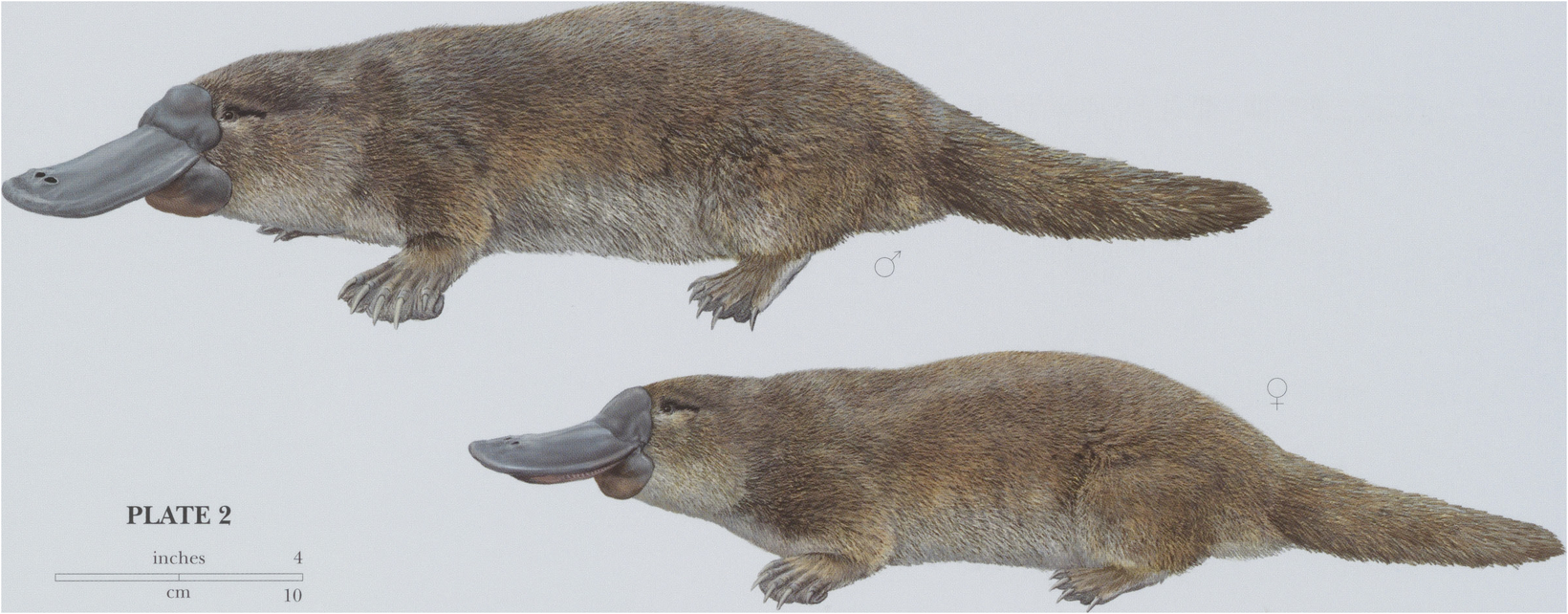
platypuses: male (top); female (bottom)
Platypuses (Ornithorhynchus anatinus) are remarkable mammals found only in Australia. Sometimes known as a duck-billed platypus, these curious animals combines the characteristics of many different species in one. They have duck-like bills, beaver-like tails, otter-like feet and lay eggs like birds. If that isn’t enough, male platypuses are one of the world’s few venomous mammals! Equipped with sharp stingers on the heels of their hind feet, they can deliver a toxic blow powerful enough to knock out a dog. Female platypuses lay their eggs in underground burrow dug near the water’s edge. Baby platypuses hatch after 10 days and nurse for up to four months before they swim off and forage on their own.[Source: NOAA]
Platypuses are not marsupials. They are egg-laying mammals called monotremes and belong to the family Ornithorhynchidae, This family consists of a single genus and species, the platypus. Among their many unique features are receptors in their bill that are sensitive both to tactile stimulation and weak electrical fields and can sense prey when digging under water. Platypuses are highly aquatic and have several adapation for life the water: webbed feet; dense, woolly, water-repellant fur; and furrows along the sides of its head to protect the eyes and ears when it swims under water. The external opening for the ear is tubular and the ears lack pinnae (external part of the ear). [Source: Anna Bess Sorin and Phil Myers, Animal Diversity Web (ADW)]
Platypuses do spend some time on land, mainly in their burrows but spend most their awake time in the water hunting for food. They water. They don’t have teeth and have mammae (nipples, teats) like most mammals. They produce milk but secrete it through their skin for young (often called puggles) to lap at. Platypuses live up to 12 years in the wild and 17 years in captivity. [Source: Amanda Schupak, CNN, May 2, 2025; Max Planck Institute for Demographic Research]
RELATED ARTICLES:
MONOTREMES: HISTORY, EVOLUTION, CHARACTERISTICS, BEHAVIOR, REPRODUCTION ioafactsanddetails.com
PLATYPUSES AND HUMANS: CONSERVATION, THEFTS, VENOM ioa.factsanddetails.com
ECHIDNAS: CHARACTERISTICS, BEHAVIOR AND REPRODUCTION ioa.factsanddetails.com
SHORT-BEAKED ECHIDNAS: CHARACTERISTICS, BEHAVIOR AND REPRODUCTION ioa.factsanddetails.com
LONG-BEAKED ECHIDNAS: SPECIES, CHARACTERISTICS, BEHAVIOR AND REPRODUCTION ioa.factsanddetails.com
Monotremes

Platypus range: native (red); introduced (yellow)' Platypus range: East Australian mainland, including the states of Victoria, New South Wales, the Australian Capital Territory, and Queensland (Northward up to near Cooktown), Tasmania, and King Island; Introduced into Western Kangaroo Island
Platypuses are monotremes (egg-laying mammals). All of the world's monotremes are found in Australia or New Guinea They are the platypus and four species echidnas. Regarded as "living fossils," they are relatives of early reptile-like mammals called prototherians and are more closely related to reptiles than birds. Monotremes are a different class of mammals than marsupials. Regarded as the ancestors of mammals that preceded all the other mammals living today, they don't have mammary glands with nipples. They instead have patches of skin that "weep" milk. Mammalian features of montremes include body hair and young nourished on milk. Reptilian features include a bare snout and egg-laying anatomy.
“There’s plenty of weirdness to go around on these little things,” Dr. Guillermo W. Rougier, a professor of anatomical sciences and neurobiology at Kentucky’s University of Louisville, told CNN. “They are one of the defining groups of mammals,” Rougier said. “The typical mammal from the time of dinosaurs probably shared a lot more biology with a monotreme than with a horse, a dog, a cat or ourselves.” Therefore, he said, monotremes provide a window into the origins of mammals on Earth. [Source: Amanda Schupak, CNN, May 2, 2025]
Monotremes belong to the order Monotremata. They are endothermic (use their metabolism to generate heat and regulate body temperature independent of the temperatures around them), but they have unusually low metabolic rates and maintain a body temperature that is lower than that of most other mammals. [Source: Anna Bess Sorin and Phil Myers, Animal Diversity Web (ADW)]
See Separate Article: MONOTREMES: HISTORY, EVOLUTION, CHARACTERISTICS, BEHAVIOR, REPRODUCTION factsanddetails.com
History of Platypuses
The first platypus-like creatures swam in swamps and rivers with dinosaurs 100 million years ago. Prehistoric animals found as recently as 50,000 years ago on the Australian continent included platypus with large canine teeth along with massive carnivorous ghost bats, rabbit-size creatures with huge projecting incisors, and nine foot birds that weighed half a ton.
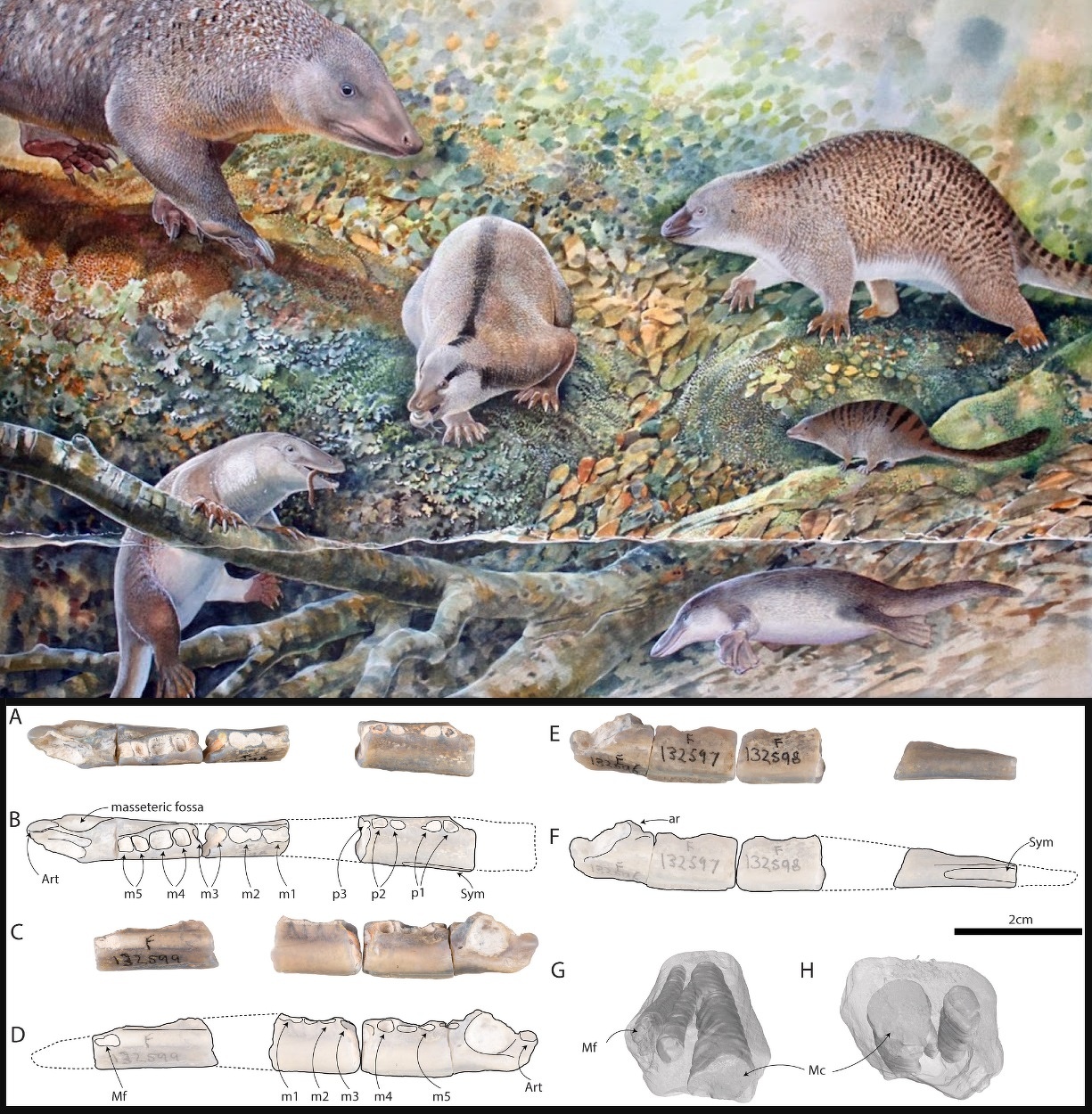
Six 100 million-year monotremes from Lightning Ridge, New South Wales, Australia (clockwise from lower left): 1) Opalios splendens; 2) Stirtodon elizabethae, the largest monotreme of the time; 3) Kollikodon ritchiei, with hot-cross-bun shaped molars; 4) Steropodon galmani, now known from additional opalized fossils; 5) Parvopalus clytiei, the smallest monotreme of the time; and 6) Dharragarra aurora, the earliest known species of platypus (artwork: Peter Schouten)
The oldest discovered fossil of the modern platypus dates back to about 100,000 years ago. The extinct monotremes Teinolophos, Steropodon and Kollikodon from the Cretaceous period Cretaceous period (145 million to 66 million years ago) are considered to be basal to the platypus and echidnas (See Monotremes factsanddetails.com ).
Dharragarra, which lived between 102 million to 96.6 million years ago, may be the oldest members of the platypus family Ornithorhynchidae, as they retain the same dental formula found in modern platypuses. In 1992, teeth of a South American platypus, Monotrematum sudamericanum, were found in Patagonia, Argentina. They were dated at 61 million years old, demonstrating platypuses had a much wider range in times past.
The closest fossil relative of modern platypuses, Obdurodon, is known from late the Oligocene Period (33 million to 23.9 million years ago) and Early Miocene (23 million to 16 million years ago) in Australia. They closely resembled modern platypuses, except they had molar teeth. A fossilised tooth of the giant platypus Obdurodon tharalkooschild was dated 5–15 million years ago. Judging by the tooth, the animal measured 1.3 metres long, making it the largest platypus known. [Source: Wikipedia]
When a stuffed platypus was first shown in Europe in 1768 people thought it was hoax like a unicorn or dragon. They believed somebody had glued the bill and webbed feet of a duck and the flat tail of a beaver onto a small dog. It wasn't until 1884 when the first platypus eggs were discovered that scientist accepted that the platypuses really existed. It was then given the scientific name “Ornithorhynchus”, meaning "bird beak like a duck." The name "platypus" comes from two Greek words meaning "flat foot."
Obdurodon Tharalkooschild — the Largest Platypus That Ever Lived
Obdurodon Tharalkooschild were the largest-known platypuses. About 1.1 meter (more than three feet) in length and equipped with powerful teeth, they lived 15 million to 5 million years ago and perhaps fed lungfish and even small turtles. A team of paleontologists from the University of New South Wales in Australia identified Obdurodon tharalkooschild as a new species based on a single molar they discovered in the Riversleigh fossil field in northwestern Queensland. From measurements of the molar, the scientists have estimated the animal grew to be about twice the size of a modern platypuses, and larger than the previously largest-known platypus ancestor, Obdurdon dicksoni. The research was published by Rebecca Pian, Mike Archer and Sue Hand, in the Journal of Vertebrate Paleontology in November 2013. [Source: Laura Poppick, NBC News, November 5, 2013]

Obdurodon Tharalkooschild; art: Peter Schouten.
Laura Poppick of NBC News wrote Modern adult platypuses don't have teeth to compare the fossil to. But ancient platypuses, like O. dicksoni, did have teeth, and like many features of the platypus that set it apart from other mammals — such as its long bill, webbed feet and the fact that it lays eggs — platypus teeth are quite distinctive from all other mammal teeth, and are fairly easy to identify in the fossil record, study co-author Rebecca Pian, a graduate student at Columbia University, told LiveScience. "The overall shape of it, including the arrangement of the bumps on the top of the tooth, the way that those are arranged in a distinct shape, and the arrangement, shape and size of the roots are all distinctive," Pian said. "At least to somebody who knows what they are looking at."
The researchers believe this molar came from the extinct platypus' lower jaw. The structure of the tooth suggests the animal was capable of eating not only the small insects and crayfish on which modern platypuses dine, but also small vertebrates such as certain fish and amphibians, and even small turtles. Based on the sedimentary rocks and other fossil assemblages surrounding the area where the tooth was found, the team has estimated that the animal lived between five million and 15 million years ago, Prior to this discovery, scientists had thought platypuses evolved fairly linearly, with only one species ever existing at any given time. But O. tharalkooschild appears to have coexisted with the slightly smaller O. dicksoni, suggesting the animal's evolutionary history is more complex than previously thought.
Platypus Characteristics
Platypuses range in weight from 0.8 to 2.5 kilograms (1.8 to 5.5 pounds), with their average weight being 1.5 kilograms (3.3 pounds). They range in length from 39 to 60 centimeters (15.3 to 23.6 inches), including their tails, with their average length being 46.5 centimeters (18.31 inches). Their tails are around 12.7 centimeterss( five inches long). Their average basal metabolic rate is 1.931 watts (468 cubic centimeters of oxygen per gram per hour). Sexual Dimorphism (differences between males and females) is present: Males are larger than females. Ornamentation is different. Males are generally larger than females, and have two venom glands attached to spurs on their hind legs. Females have mammary glands but no nipples. The young have milk teeth while the adults have grinding plates. The young are smaller than adults in size. There is a significant reduction in body fat after winter for both young and adults. |=|

Platypuses have a wide beaver-like tail, no external ear, small eyes and virtually no neck. They have webbed forefeet, partially-webbed hind feet, short legs, naked soles and a lizard-like gait. . Each foot contains five digits each consisting of a broad nail for the forefeet and sharp claws for the hind feet. When they walk on land the webbing on the feet folds up exposing their claws. Their bills are actually quite soft, flexible, and rubbery, unlike a bird's beak. . Their two nostrils are near the end of their bill. They can stay submerge underwater and breath with only the top of their bills above the surfaces.
Platypuses have stream-lined and elongated bodies and short, dark hair on their backs and silvery short hair on their bellies. Fur color ranges from medium brown to dark brown on the their and brown to silver-gray on their undersides. Their fur is dense, woolly, and water-repellant. Their eyes and ears are on either side of their heads. Furrows along the sides of their head protect their eyes and ears when they swim under water. The external opening for the ear is tubular; they lack pinnae (external part of the ear). They have a cloaca through which eggs are laid and both liquid and solid waste is eliminated. While young platypuses have molars, adults are toothless. They grind their food between horny (keratinous) plates located over the gums. [Source: Anna Bess Sorin and Phil Myers, Animal Diversity Web (ADW)]
Platypuses are endothermic (use their metabolism to generate heat and regulate body temperature independent of the temperatures around them) and homoiothermic (warm-blooded, having a constant body temperature, usually higher than the temperature of their surroundings) and venomous. |=|
Platypus Venom
Platypuses and echidnas are only known venomous mammal in the world. Male platypuses have toxic spurs near the heels of their rear legs. Normally these sharp, curved spurs are folded in out of harms way and apparently the venom is only produced in large quantities during the mating season. The spurs are grooved and connected by a long tube to a venom producing organ near the animal's kidneys.
Male platypuses have a sharp spur attached to each ankle. While both male and female platypuses are born with back ankle spurs, only the males retain them into adulthood. Similar spurs are found on many archaic mammal groups, indicating that this was an ancient general characteristic among mammals. The venom is composed largely of defensin-like proteins (DLPs) produced by the immune system, some of which are unique to platypuses. It is produced in kidney-shaped alveolar glands located in each of the thighs of the hind limbs and connected to the spur.

spur on male's hind limb used to inject venom
No one is exactly sure why males and not mature females possess the toxin (some “immature” females do). The spurs are not used in hunting and some scientists speculate the animal probably using them in fights with rival males during the breeding season.
The venom is powerful enough to inflict pain in humans Many platypus handlers have been kicked without being envenomated but on the few occasions the victims have experienced "intense pain, swelling progressing up the arm and a feeling of faintness." Pain starts from the wounded area. The affected limb may develop edema (swelling via fluid buildup) which can lead to an excruciating hyperalgesia (heightened sensitivity to pain) that can last as long as months. There are no known cases of platypus fatalities although a few reports of dog dying.
Platypuses Glow Under Blacklight
Platypuses glow under blacklights. According to a study professor the journal Mammalia in November 2020, shining an ultraviolet light on a platypus makes the animal’s fur fluoresce with a greenish-blue tint. They’re one of the few mammals known to exhibit this trait. It’s still clear why they do it — and it just may be coincidental and serve no purpose. After the study came out scientists were around to museums and shined black light on specimen and found a number of animals in Australia — including wombats, bilbies, and Tasmanian devils — known to glow under ultraviolet light,
Cara Giaimo wrote in The New York Times: “For most humans, ultraviolet light exists outside of the visible spectrum. But certain pigments can absorb it, drain off some of its energy, and reemit what remains as a color that people can see. Many manmade things contain such pigments, including white T-shirts, Froot Loops and petroleum jelly. “A lot of living things do, too. Scorpions, lichens and puffin beaks all pop under UV light. Blue light, which is a notch away from ultraviolet, makes the undersea world look like an indoor mini golf course, and causes dozens of types of amphibians to glow green. [Source:Cara Giaimo, The New York Times, November 16, 2020]

Platypuses glowing under ultraviolet light
“Mammals, though, seem to have generally gotten the short end of this paintbrush: So far, not many have been found to have coats or skin that fluoresce. But there are exceptions, all among nocturnal creatures. In the 1980s, for example, a few researchers uncovered a rainbow of opossums. “Then one night a few years ago, Jonathan Martin, an associate professor of forestry at Northland College in Ashland, Wisconsin, was exploring the woods behind his house with a UV flashlight when he saw that a flying squirrel at his bird feeder appeared bright pink.
“Martin and a few colleagues went to the Field Museum in Chicago to confirm that finding in some preserved specimens. It turns out all three North American flying squirrel species give off a bubble gum glow under UV light. While they were there, Erik Olson, an associate professor of natural resources at the college, started “wondering how broadly distributed this trait might be,” Olson said. “Like, what about platypuses? That’s kind of as far from flying squirrels as you can get.”
“After checking with the museum’s staff, the team went down to the basement, found the platypus cabinet, and flipped on their special lights. “And sure enough,” Olson said. They were eventually able to examine three platypuses: a male and a female at the Field Museum, and another male from the University of Nebraska State Museum. All gave off the same cool glow. So did a road-killed platypus, discovered by a blacklight-wielding mycologist in northeast Australia this summer. Despite the sad circumstances of the finding, “we were elated to know that it was verified in a wild specimen,” Olson said. “So why would a platypus fluoresce? “We really don’t know,” Olson said.
“Other instances of life-form Lite Brite serve a clear purpose. Bioluminescence, for example, helps ocean creatures lure prey and find each other in the depths. And hummingbirds get information from the ultraviolet hues that some flowers reflect. Fluorescence, though, is a bit more opaque. Because it’s a natural property of certain materials, “just finding fluorescence doesn’t mean it has any particular purpose,” said Sönke Johnsen, a sensory biologist at Duke University who was not involved with the study. Instead, he said, that glow could be incidental — “just something that’s there because it’s there.” “It’s unknown whether platypuses can perceive either UV rays or fluorescence, especially in natural light. One theory is that by absorbing and transforming UV light rather than reflecting it, platypuses can better hide from UV-sensitive predators.
Platypus Genome Offers Insights Into Sex
The first sequencing of the platypus genome — from Glennie, a female platypus at Washington University in St Louis — was reported in 2008. The research, which involved more than 100 researchers worldwide and was released in May 2008 in a series of papers in the journals Nature and Genome Research, revealed some new insights about sex in general and could lead to development of new antibiotics and therapeutics, Dr Kathy Belov of Australia's University of Sydney. [Source:Dani Cooper, ABC, May 9 2008]
Co-author of the Nature paper Professor Jenny Graves, from the Australian National University's (ANU) Comparative Genomics Research Group, said that understanding the platypus genome helps fill in the gaps of how mammals evolved. "The platypus is no more ancient than we are," Graves says. "But the common ancestor was the intermediary between reptiles and mammals and the platypus gives us clues as to what our ancient ancestor looked like."She says by comparing the platypus genome with the DNA of humans, kangaroos, mice and chickens, researchers can work out when genes and traits specific to mammals emerged. "It's like being able to dig down in time," says Graves, who says she is 'floored' by the sex determination finding. "The platypus is telling us that all ancient mammals [determined sex] like birds," she says. "The chromosomes that became our X and Y chromosomes were there but they didn't have anything to do with sex."
Dani Cooper of ABC wrote: ANU colleague Dr Paul Waters says before the sequencing it was believed that sex determination in mammals stretched back to when birds and mammals diverged about 350 million years ago. But he writes in Genome Research that sex chromosome mapping of the platypus DNA shows that the platypus lacks the sex-determining gene SRY found in all mammals. So he says the platypus sex chromosomes are more similar to those of birds then mammals.This means, he says, the human sex chromosomes must have evolved after the platypus diverged from the mammalian lineage about 166 million years ago. "[It] changes our understanding of sex chromosome evolution," Waters says.
Belov, who has a related paper in Genome Research, says the platypus is also a link between the simple immune system of birds and the more complex immune systems of humans. She says platypus young, like marsupial young, are born without any immune tissue, which develops as they grow. But she says an understanding of how the young survive in "hostile environments" such as dirty burrows may help in developing therapeutic treatments for immunocompromised people. The sequencing has revealed the platypus genome contains expansions in the gene family called antimicrobial peptide genes that code for molecules that "punch holes in the walls of bacteria". Belov says researchers can now look at what the peptides kill and use that to develop novel antibiotics.
The sequencing of the platypus genome revealed that the gene that produces venom in the male platypus is also present in the female. The gene has duplicated from a gene passed down from its ancestral reptile genomes and is similar, although independent of the evolutionary process that created venom in snakes. Dr Kathy Belov of Australia's University of Sydney said it is a strong example of convergent evolution and believes understanding how the genes and molecules involved in producing the venom work could lead to insights into pain management. [Source:Dani Cooper, ABC, May 9 2008]
Platypus Diet and Feeding Behavior
Adult platypuses eat up to 30 percent of their own weight everyday. They usually eat horsehair worms, other worms, aquatic insects and larvae from dragonflies and other insects. They also feed off of freshwater shrimp, crawfish, small fish, and frogs. Adults travel up to 6.4 kilometers (four miles), often in murky water, during their search for food. They swim with their eyes and ears closed, using touch and electroreceptors in their bill to locate prey.

platypus electroreceptors are arranged in stripes on its bill, giving it high sensitivity to the sides and below; platypuses make quick turns of their head as they swims to detect prey
Platypuses are bottom-feeders that use their beaver-like tail to steer and their webbed feet to propel itself through the water while hunting. The watertight nostrils on its bill remain sealed so that the animal can stay submerged for up to two minutes as it forages for food. The bill also comes equipped with specialized nerve endings, called electroreceptors, which are sensitive to both tactile stimulation and weak electrical fields. These electroreceptors sense prey when digging under water and detect tiny electrical currents generated by the muscular contractions of prey. [Source: NOAA]
Platypuses use their bill to lift up rocks and sift through mud for food. They swing their bill back and forth underwater, using it as an antennae to pick up electrical signals from the muscles of the crustaceans, frogs and small fish on which it preys. Platypuses chew with horny grinding pads in the sides of their bills rather than teeth. Platypuses store their underwatcher "catches" in their cheek pouches, and come up to the surface, mashes up the meal with the help of gravel bits hoovered up enroute, then swallows it all down. Young platypuses have teeth, but these are lost in adults. Food is masticated between horny plates located on each jaw. The anterior part of these plates is ridged and is used to chop food; the posterior part is expanded and flat and used for crushing. [Source: Evelyn Ojo, Anna Bess Sorin and Phil Myers, Animal Diversity Web (ADW)]
Platypus Behavior and Burrows
Platypuses are fossorial (engaged in a burrowing life-style or behavior, and good at digging or burrowing), natatorial (equipped for swimming), diurnal (active during the daytime), nocturnal (active at night), motile (move around as opposed to being stationary), sedentary (remain in the same area) and territorial (defend an area within the home range). Their home range size on the banks of water bodies varies depending on the area, from 0.37-7.0 kilometers (0.22 to 4,3 miles). Platypuses that forage in streams typically have larger home ranges than those that forage in ponds. [Source: Evelyn Ojo, Animal Diversity Web (ADW) |=|]
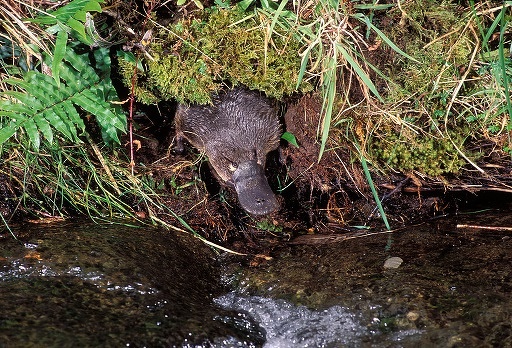
platypus emerging from its burrow
Platypuses are shy, solitary animals that are difficult to find in the wild because they spend nearly their entire lives underwater forage for food or underground in their burrows. They don't congregate in groups and don's call one another. They rarely make a sound. When they do it sound luke the growl of a puppy. Males are particularly antisocial. If the territories of males overlap, they change their foraging time to avoid each other. |=|
Platypuses sleep burrows on streambeds during the day. They come out at dusk and feed primarily at night and return to their burrows around dawn. Platypuses burrows can be on the banks of lakes, rivers, even mountain streams. Platypuses have well-developed claws and excellent diggers. Platypus burrows are usually lined with grass and built along lushly forested streambeds. There is one entrance on the stream, just below the waterline, often under a undercut bank. Sometimes there is another entrance on the bank that is disguised by ferns, shrubs or other plants. Camping burrows is a term used to describe shelters used by males and non-lactating females. They are usually a few feet from the water's edge (Nesting Burrows, See Reproduction Below).
Platypus Senses and Communication
Platypuses sense using vision, touch, sound, vibrations, electrorception and chemicals usually detected with smell. They communicate with touch, vibrations and sound. Platypuses make some sounds, but it is not clear what they mean or how they are used. [Source: Evelyn Ojo, Animal Diversity Web (ADW) |=|]
Platypuses rely on electrolocation when feeding, as their eyes, ears, and nose are closed while underwater. They dig in the bottom of streams with their bill. The electroreceptors in the bill detect tiny electric currents generated by the muscular contractions of its prey. Experiments have shown that platypuses will even react to "artificial shrimps" if a small electric current are passed through them. [Source: Wikipedia]
Platypuses have 40,000 electroreceptors arranged in rows in the skin of their bill from front to back. Mechanoreceptors for touch are uniformly distributed across the bill. The electrosensory area of the cerebral cortex is in the tactile somatosensory area of the platypus’s brain, and some cortical cells receive input from both electroreceptors and mechanoreceptors, suggesting the platypus feels electric fields as touches. These receptors dominate the somatotopic map of the platypus brain the same way human hands dominate parts of the human brain that process touch sensations and controls movement. Platypuses feel the direction of an electric source, perhaps by comparing differences in signal strength across the array of electroreceptors, enhanced by the characteristic side-to-side motion of the animal's head while hunting. It may also be able to determine the distance of moving prey via the timing difference between electrical and mechanical pressure sensations — a form of electrolocation
Platypus eyes are small and shut under water, but several features indicate that their ancestors relied on vision. The eyes of platypuses have traits also found in lungfish and amphibians, such as scleral cartilage, double cones, and droplets. Features in their eyes suggest that platypuses have adapted to an aquatic and nocturnal lifestyle by developing their electrosensory system at the cost of their visual system. The ears of platypus are adapted for hearing while out of water. As in placental mammals, the outer hair cells of the platypus are adapted for hearing high frequencies, suggesting it is an ancestral mammalian trait. However it also possesses more rows of inner hair cells. The olfactory (smelling) systems of platypuses is not so developed and is different from that in placental mammals.
Platypus Mating and Reproduction
Platypuses are polygynous (males have more than one female as a mate at one time) and are oviparous, meaning that young are hatched from eggs. As we all know platypuses and echidnas are the only mammals that lay eggs. Platypuses have five pairs of chromosomes that determine sex. Most mammals have just one pair. Perhaps even more unusual is the fact that platypus sex chromosomes have similarities with those of both mammals and birds, which are thought to have originated independently.
Platypus penises have two heads (or glans) and are covered with distinct keratinous spines. Their internal structures appear very similar to those in echidnas. Currently, there is no data on what an erect platypus penis looks like or how it functions (See Echidna Reproduction ioa.factsanddetails.com
Platypuses engage in seasonal breeding and probably breed once a year — in late winter or autumn and varies with populations. The gestation periods is 17 to 27 days and incubation of the eggs last 10 days. The number of offspring ranges from one to three, with the average number of offspring being two. There is a higher proportion of spur wounds in males than females, which may be explained by aggressive encounters between males during mating season. [Source: Evelyn Ojo, Animal Diversity Web (ADW) |=|]
During mating, the male platypus grabs onto the tail of the female with his bill and they twirl around. Often large wounds are left in the female’s tail. According to Animal Diversity Web: Male platypuses initiate most mating interactions but successful mating relies entirely on the willingness of females. Male and female platypuses touch as they swim past each other. The male grabs the tail of the female with his bill and if the female is unwilling, she will try to escape by swimming through logs and other obstacles until she is set free. However, if she is willing, she will stay near the male and will allow him to grab her tail again if he dropped it. The male then curls his body around the female, his tail underneath her to one side of her tail. Then he moves forward and bites the hair on her shoulder with his bill.
Platypus Offspring and Parenting
Female platypuses lay their eggs in a nest in an underground burrow that they dig near the water’s edge. The nest is constructed in the burrow from leaves that the female carries in the burrow curled up in her tail. Females build their burrows, which may be as much as 20 to 30 meters in length, when she is about to lay her eggs. To protect her young from floods and predators such as snakes the female block the entrance to the burrow with a soil plug, which she digs out and rebuilds every time she enters or leaves the burrow.
Breeding females lay a clutch of one to three eggs (usually two) in the spring. The eggs are have a soft shell and are about the size of pigeon eggs. After laying her eggs, the female keeps the eggs warm by lying in her burrow in a curled position around the eggs, with the eggs pressed to her belly with her tail. The incubation period usually lasts for six to 10 days.
Young are altricial, meaning they are relatively underdeveloped at birth. Parental care is provided by females. There is no pouch. The embryos are partly developed when the eggs are laid. Young are born with teeth but these fall out. Even though females lay eggs their young are nourished on a secreted milky substance that comes from ducts not nipples. Young nurse for up to four months before they swim off and forage on their own. Females reach sexual or reproductive maturity in as little as two years and males do so at 1.5 (low) years but most females don’t begin reproducing until they are four years old.
Image Sources: Wikimedia Commons
Text Sources: Animal Diversity Web animaldiversity.org , National Geographic, Live Science, Natural History magazine, Australian Museum, David Attenborough books, Australia Geographic, New York Times, Washington Post, Los Angeles Times, Smithsonian magazine, Discover magazine, The Conversation, The New Yorker, Time, BBC, CNN, Reuters, Associated Press, AFP, Lonely Planet Guides, Wikipedia, The Guardian, Top Secret Animal Attack Files website and various books and other publications.
Last updated August 2025