
Home | Category: Toothed Whales (Orcas, Sperm and Beaked Whales)
BELUGA WHALES

beluga whale in the Arctic
Beluga whales (Delphinapterus leucas) are a species of Arctic whales known for their white color and range of vocal sounds. They are very intelligent and social animals, forming groups to hunt, migrate, and interact with each other. They weigh 1,430 kilograms (3,150 pounds) on average and have an average length of four meters (13 feet), but may reach 4.9 meters (16 feet) in length. A thick layer of fat, called blubber, and thick skin helps them warm in the freezing waters of the Arctic and subArctic environment. Their lifespan is 35 to 50 years. [Source: NOAA]
Also known as white whales, beluga whales are the only member of the genus Delphinapterus, which translates translates to “dolphin without a fin.” Instead of a dorsal fin, belugas have a tough dorsal ridge, which allows them to swim easily under ice floes (sheets of floating ice). Unlike other whales and dolphins, their neck vertebrae are not fused, so belugas can nod and move their heads from side to side. [Source: NOAA]
The worldwide of beluga whales is thought to be around 200,000. The average lifespan of beluga whales is believed to be at least 40 years old, with some individuals living to 60 or more years. Similar to tree rings that can be used to age a tree, beluga teeth acquire a “growth layer group (GLG) for each year they age. The oldest beluga on record had 80 GLGs, though this may be an underestimate of the whale’s true age. The oldest Cook Inlet beluga whale had 49 GLGs. [Source: Krista Zimmermann, Animal Diversity Web (ADW), NOAA]
Related Articles:
BELUGA WHALE CONSERVATION: THREATS, HUNTING, CAPTIVITY ioa.factsanddetails.com
BELUGA WHALES AND HUMANS: MILITARY USES, A SPY? TALKING NOC ioa.factsanddetails.com
NARWHALS: CHARACTERISTICS, BEHAVIOR AND REPRODUCTION ioa.factsanddetails.com
NARWHALS, HUMANS, CONSERVATION: USES, HUNTING, CLIMATE CHANGE ioa.factsanddetails.com
TOOTHED WHALES (ORCAS, SPERM AND BEAKED WHALES) ioa.factsanddetails.com;
TOOTHED WHALES: SWIMMING, ECHOLOCATION AND MELON-HEADS ioa.factsanddetails.com;
WHALES: CHARACTERISTICS, ANATOMY, BLOWHOLES, SIZE ioa.factsanddetails.com ;
HISTORY OF WHALES: ORIGIN, EVOLUTION, SPECIES ioa.factsanddetails.com ;
WHALE BEHAVIOR, FEEDING, MATING ioa.factsanddetails.com ;
Beluga Whale Habitat and Where They Are Found
Beluga whales are found globally throughout the Arctic region, They are commonly found in Arctic or subarctic waters in the Arctic Ocean and its nearby seas and in the northern reaches of the Atlantic Ocean and Pacific Oceans. They are common to many regions of coastal Alaska, northern Russia, northern Canada, and western Greenland. The southernmost extent of their range includes isolated populations in the St. Lawrence River in the Atlantic Ocean.
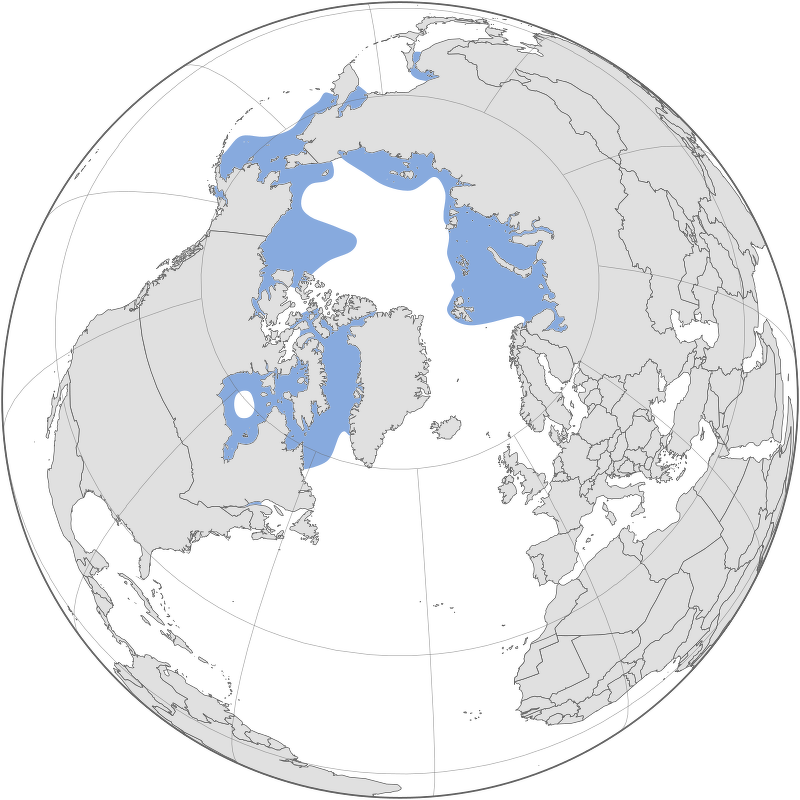
range of beluga whales
Belugas are at home in large rivers and the open sea and can move between salt and fresh water. They are usually found in shallow coastal waters during the summer months, often in water barely deep enough to cover their bodies. During other seasons, they may be found in deeper waters. They are capable of diving to 1,000-meter (3,930-foot) depths and can stay underwater for periods of up to 25 minutes. They swim among ice floes in Arctic and subArctic waters, where temperatures may be as low as 32°F. Belugas also seasonally inhabit estuaries and large river deltas and are thus well-adapted to both cold ocean habitats and relatively warmer freshwater habitats. [Source: NOAA]
In the United States, NOAA Fisheries has identified five stocks of beluga whales, all in Alaskan waters — the Beaufort Sea, Bristol Bay, Cook Inlet, eastern Bering Sea, and eastern Chukchi Sea stocks. Each stock is unique, isolated from one another genetically and/or physically by migration routes and preferred habitats.[Source: NOAA]
Worldwide, belugas may number in the hundreds of thousands; however, some stocks are small, numbering in the low hundreds. The endangered Cook Inlet beluga whale population has declined by nearly 75 percent since 1979, from about 1,300 whales to an estimated 328 whales in 2016. The population of Sakhalin Bay-Nikolaya Bay-Amur River beluga whales, a stock in the eastern North Pacific off the coast of Russia, is estimated to be around 3,961 whales. [Source: NOAA]
Monodontidae: Beluga Whales and Narwhals
Beluga whales are members of the family Monodontidae along with narwhals. Phil Myers wrote in Animal Diversity Web: The two species of this family are found at high latitudes in the Arctic seas and in most of the major rivers draining into them, south to the Saint Lawrence River. These are medium-sized whales, ranging from four to six meters in length and up to around 1600 kilograms in weight. Belugas have a very short, broad snout, while narwhales have a square head and appear to lack a snout altogether. The forehead in both species is high and globose. Members of this family lack a dorsal fin, although narwhals do have a distinctive ridge running along their backs. Adults belugas are white and adult narwhals are or white and black. [Source: Phil Myers, Animal Diversity Web (ADW) |=|]

As in the closely related delphinids, both species have a broadly expanded facial depression; this holds the melon, a fatty deposit believed to function in echolocation (emitting sound waves and sensing their reflections to determine the location of objects). The maxilla and frontal are expanded laterally, hiding the small zygomatic arch from dorsal view. The premaxillae lie flat in front of the nares, which are at the base of the short and broad rostrum (hard, beak-like structures projecting out from the head or mouth). The length of the mandibular symphysis is less than 20 percent the length of the ramus, and in the upper jaw, the toothrows diverge posteriorly. Teeth are usually simple pegs in beluga (5/2 to 11/11 in number) but occasionally slightly 3-cusped. Narwhals have but two teeth, the one on the left is developed into a spiraled, forward-projecting tusk up to 2.7 meters in length, and the other is rudimentary. The tusk of narwhals is found only in males; the teeth of females remain imbedded in their jaws. |=|
Monodontids are generally found in schools, sometimes including more than 100 individuals. They migrate in response to the shifting ice pack. Both species feed mainly on the bottom, consuming a number of species of fish and invertebrates. The tusks presumably function in social behavior; males have been seen to fence with these structures, and occasionally broken-off pieces of tusk have been found embedded in the heads of males of this species. Both species are highly vocal. Belugas make a sort of trilling sound and are sometimes known as "sea canaries."
Beluga Whale Characteristics
Beluga whales range in weight from 400 to 1,600 kilograms (881 to 3,535 pounds), with their average weight being 1,500 kilograms (3,300 pounds). They range in length from three to seven meters (10 to 23 feet), with their average length being five meters (16 feet). Their body size is between that of a dolphin and a true whale.At birth, beluga calves weigh between 80 and 100 kilograms (175 and 220 pounds) and be about 1.6 meters (5.2 feet) long. Sexual Dimorphism (differences between males and females) is present: Males are larger than females. Males and females have different shapes. On average males are about 25 percent larger than females. Male beluga can grow up to about 5.5 meters long while a females rarely exceed 4.3 meters. Males also have slightly curled tips on their flippers while female flippers are flat. [Source: Krista Zimmermann, Animal Diversity Web (ADW) |=|]
Beluga whales are dark grey as calves. Their skin lightens as they age, becoming white as they reach sexual maturity between the ages of five and 12. . They lack a pronounced rostrum (beak-like structures projecting out from the head) with a cleft upper lip. The the top of their head is characterized by a round, flexible “melon” that focuses and modulates their vocalizations, including echolocation “clicks.” They are a toothed whale, possessing 36 to 40 teeth total in both the upper and lower jawbones. Belugas have eight or nine teeth in each row of the top and bottom jaws, and these may be heavily worn down in older whales.[Source: NOAA]
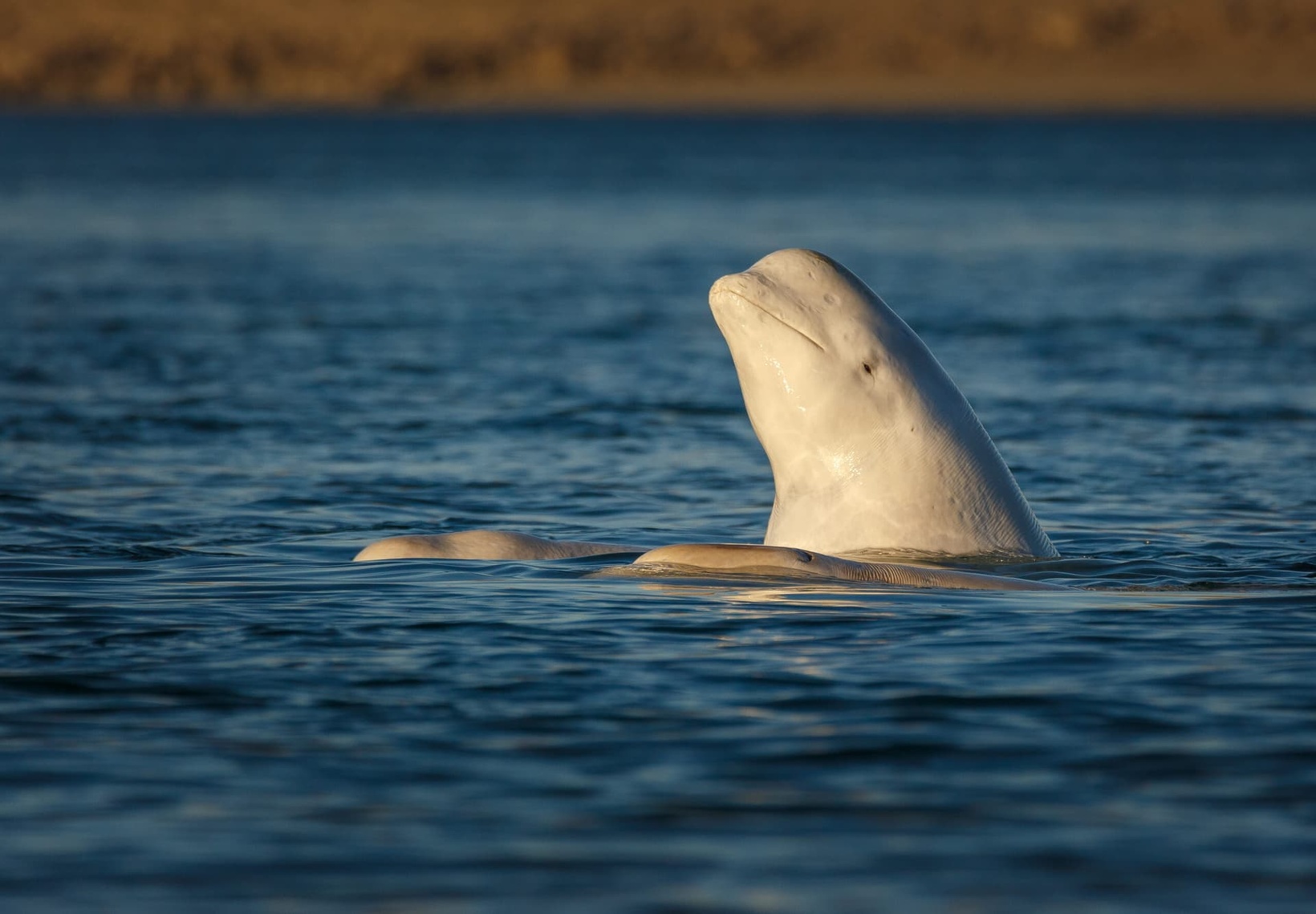
Beluga whales are covered with a thick layer of blubber that accounts for up to 40 percent of their weight. The blubber keeps them warm in the Arctic waters and stores energy. Some beluga populations shed their outer layer of skin each summer during an annual molt. They rub against coarse gravel in shallow waters to help remove the layer of old, yellowed skin. The beluga’s visible, somewhat flexible neck feature is unique among cetaceans (whales and dolphins). [Source: NOAA]
Beluga whales are well adapted to life in the Arctic. Their adpations include their all-white color and absence of a dorsal fin, which allows it to swim under ice. Their highly developed echolocation allows them to move about and find breathing holes under sheet ice. The beluga’s stout body can be covered with large folds or wrinkles and have a blubber layer about 15 centimeters thick.
Beluga Whale Diet, Eating Habits and Predators
Beluga whales are carnivores (eat meat or animal parts) and recognized as piscivores (eat fish). Theyhave a varied diet consisting of octopus, squid, crabs, shrimp, clams, snails, and sandworms. They also eat a variety of fishes, including salmon, cod, sole, herring, smelt, and flounder. Beluga often use suction to capture and ingest their prey. Their teeth are not that large, and swallow most of their food whole. [Source: NOAA]
Beluga whales are primarily bottom feeders and normally hunt alone in waters about 300 meters (1,000 feet) deep. Their diet varies geographically. Crustaceans and fish constitute about 25 kilograms of the daily diet in adults. Calves normally eat more shrimp and crab but for the first two years of life they are dependent on their mother’s milk. [Source: Krista Zimmermann, Animal Diversity Web (ADW) |=|]
The main known predators of beluga whales re polar bears, orcas (killer whales) and humans. Occasionally walruses — as well as polar bears — feed on belugas trapped in ice. Orcas are perhaps the biggest danger belugas face after humans. There have been recordings of belugas changing their chirp or whistle frequencies when orcas are nearby in an effort to warn others. Because belugas tend to return to the same areas every migratory season it easy for hunters to track where they going to be. Polar bears and humans are often waiting of them when they return. Polar bears wait near the breaks in ice caps, where the whales surface to breathe, and pull them out of the water and onto the ice. Humans have hunted belugas for centuries, and in some small areas the whales are still a major food source. |=|
Beluga Whale Behavior
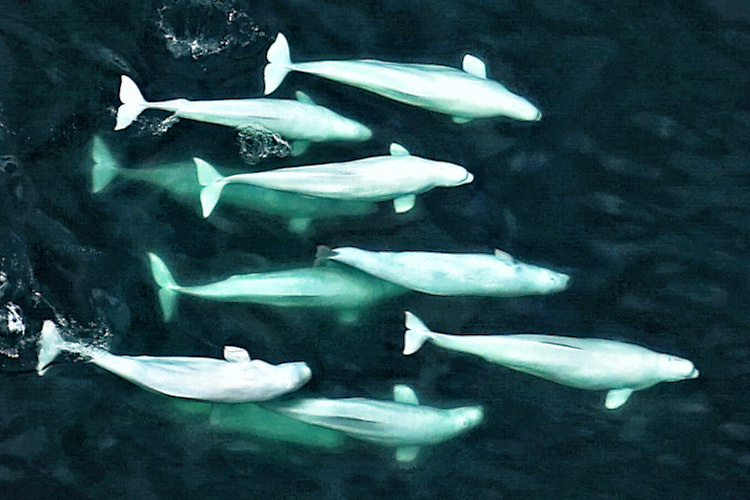
Beluga whales are natatorial (equipped for swimming), motile (move around as opposed to being stationary), migratory (make seasonal movements between regions, such as between breeding and wintering grounds), and social (associates with others of its species; forms social groups). |=|
Belugas are gregarious and form groups, sometimes called pods, of two to 10 animals, although during the summer, they can gather in the hundreds or even thousands in estuaries and shallow coastal areas. The majority of groups spend the winter around the Arctic ice cap; when the sea ice melts in summer, they move to warmer river estuaries and coastal areas. Some populations are sedentary and do not migrate over great distances during the year.
Beluga pods are often led by a dominant male but are bound by close ties between mothers and their calves. Newborns nurse for live within a multitiered matriarchal society very similar to that of elephants, are also raised by an extended group of females. Individuals move between groups within larger populations, unlike killer whales, which appear to have strong ties within their maternal-led pods. [Source: NOAA, Charles Siebert, Smithsonian Magazine, June 2014]
Most commonly, there are two types of groups: one consisting of females with several offspring varying in age and sex and the other comprised of mature males. In the group with the large female-offspring ratio, it is common for all younger, pre-weaning, calves to follow their mothers in a single-file line. Female calves tend to stay with the stock they were born into for the rest of their lives while male calves tend to leave their maternal stock, usually forming groups with other adult males. Because calves are dependent on their mothers for such a long time, both sexes become accustomed to the migration patterns of their mothers. Even after reaching the age of independence the calves still follow the same migrations patterns as they did when they were younger. |=|
Beluga whales are slow swimmers, but can dive to 700 meter (2,300 feet) below the surface, maybe 1,000 meters (3,300 feet). They do not jump or breech. They swim slowly in a smooth rolling motion, rarely raising their heads from the water. Belugas spend a lot of their time near ice packs in the winter and are commonly seen using their bulbous forehead to break through ice 10 centimeters thick in order to make a hole for breathing. During the calving season, these whales migrate into shallower warmer water (mostly estuaries) because there is an abundance of food and it easier to avoid most predators. Belugas stay underwater for 25 minutes when they dive and at least sometimes forage close to the ocean floor.
Beluga Whale Gatherings
Belugas are social animals. They return to their birth areas each summer to hunt, breed, and calve. In July and August hundreds of beluga whales gather at the north side of Somerset Island in the Canadian Arctic where fresh water from the Cunningham River mixes with the cold, salty water of the Arctic Ocean. Many of the whales are nursing mothers with their young and are molting their skin from the previous year. [Source: Craig Welch, National Geographic, April 15, 2021]
Craig Welch wrote in National Geographic: Nearly 2,000 belugas frolic each summer at Somerset Island, nursing their young,chattering in squeaks and whistles, and swimming about in shifting networks of companions and family. Scientists suspect many whale species share cultural traditions, much as humans do.. Unlike salmon, which are born with the instinct to follow specific migration routes, young belugas learn the routes from their cultural communities. [Source: Craig Welch, National Geographic, April 15, 2021]
Shallow Cunningham Inlet. allows observation of beluga behavior. Some learn to swim with their heads above water, like this adult, or waggle their flukes like the juvenile next to it. Some inch across the bottom, doing “the worm” to slough off old skin. Belugas are playful and curious. Off Somerset Island, they may pick up rocks and offer them to each other or flip kelp onto their heads and sashay about as if wearing tiaras or wigs. Are any of these cultural traits? It’s too soon to say. Beluga culture is rooted in lifelong social relationships.
Like a whale maternity ward, beluga cows and their calves flock to the slightly warmer waters at the mouth of the Cunningham River. At times, when they were temporarily trapped in river pools by receding tides, scientist Valeria Vergara recorded multiple belugas vocalizing at once. She now suspects they use individual calls suggesting they broadcast their identities.
Beluga Whale Senses, Communication and Echolocation
Beluga whales sense using touch, sound, ultrasound, echolocation (emitting sound waves and sensing their reflections to determine the location of objects) and chemicals usually detected by smell. Belugas also have sharp vision both in and out of water. When belugas surface, their lenses and corneas correct the nearsightedness that results from the refraction of light. Their eyes contain both rod and cone cells which means they can see in both dim and bright light. They do, however, lack short wavelength-sensitive visual pigments in their cone cells, indicating a more limited capacity for color vision than most mammals. [Source: Wikipedia]
Beluga whales communicate with sound and vibrations. They are considered to be the most vocal species of cetaceans (whales and dolphins). They are known as the "canaries of the sea" because they produce many different sounds, including whistles, squeals, moos, chirps, and clicks (ranging from 3-9 kHz). Their very distinct “bell tone” is unique to beluga whales. [Source: NOAA]
Beluga whales rely on their highly-developed senses of hearing and sound and ability to echolocate to navigate, hunt for prey and find cracks in the ice sheets to surface and breathe. Their clicks are often in short pulses and are used in conjunction with the melon on their forehead to echolocate. Beluga echolocation is even more sensitive than dolphins’. They can discern the shape of an object behind an opaque screen. No human technology can do this. [Source: Krista Zimmermann, Animal Diversity Web (ADW) |=|]
In the 1980s, a young beluga named "Noc" at least mimicked human voices and may have tried to talk to humans. Charles Siebert wrote in Smithsonian Magazine: ““Belugas produce sounds by building up air pressure in the nasal cavities within their melon, the echolocation organ at the front of their heads, and then forcing the air through a set of “phonic lips” atop each cavity. The vibrations of the lips result in the whale’s typical repertoire of echolocation clicks, pulse bursts and chirp-like whistles and squeaks”. [Source: Charles Siebert, Smithsonian Magazine, June 2014]
“For 16 years, Toni Frohoff, a marine mammal behaviorist based in Santa Barbara, California, has studied a subset of the beluga population in the St. Lawrence estuary known as “solitary sociables”: whales separated from their families, usually because of a mother’s death at the hands of hunters or from effects of pollution, who end up gravitating to people for companionship.
“Most orca and dolphin vocalizations, Frohoff has found, occur underwater. But solitary sociable wild belugas rise up out of the water when they speak to us, purposefully orienting their bodies and voices in our direction. “Wild, free-ranging belugas,” says Frohoff, “do not initiate this kind of vocal behavior, no matter how many boats and people may be around. So there’s an obvious analogy between these geographically isolated and socially deprived animals in the wild and captive belugas like Noc. We’re talking about social deprivation here, a lack of any reasonable normal interaction with his own kind. So what may seem amusing to us, or an attempt to communicate with us, is in a sadder vein a coping mechanism for him, both an outgrowth and avoidance of his own boredom.”
Beluga Whales Bubble Communication
Shimane Aquarium AQUAS in Hamada, Japan, is famous for its beluga whales who do bubble ring tricks. The belugas blow air bubbles out of their mouths, creating what are often called "bubble rings of happiness" or "angel halos". The belugas create bubble rings by blowing air through their blowholes and then releasing it through their mouths. The bubble ring trick was developed by aquarium staff who noticed one beluga, Aliya, could squirt water and then trained her to blow air bubbles, which she seemed to enjoy. In addition to the bubble rings, the belugas also perform other tricks, such as the "Magic Ring of Happiness".
Some cative beluga whales are famous blowing bubbles. One in Japan could blow smoke-ring-like bubble rings. “But why do they do it?, Jennie Rothenberg Gritz wrote in Smithsonian Magazine: “To find out, researchers spent eight years gathering data on 11,858 “bubbling events” — the most comprehensive study of this form of cetacean creativity. [Source: Jennie Rothenberg Gritz, Smithsonian Magazine, March 2016]
As they observed belugas at Marineland Park near Toronto, the biologist Michael Noonan and his students discovered a kind of bubble semantics. The whales often expelled big bursts of bubbles through their blowholes when they were startled. Pairs released bubble streams as they swam side by side — apparently in a spirit of companionship, unlike the aggression shown by bubbling humpback duos. The belugas also blew bubble rings, but apparently not when they had more serious things to do: Males rarely did it during the spring breeding season. “That’s when they’re busy patrolling the pool, cruising for females,” Noonan says. In summer, males again blew bubble rings, swatting to change their shapes and swimming through them as if they were hoops. “This is a species that makes its own toys,” says Noonan.
Whimsical behavior isn’t unique to belugas. Apes, dogs, birds, reptiles and even spiders play. But animal play usually takes the form of tugging, chasing or wrestling — activities that might help develop survival skills down the line. In contrast, a mammal has every reason not to exhale underwater. “When you’re a breath-holding animal,” says Noonan, “you can hardly think of anything more precious than air.” One possible explanation is that the belugas are bored. In the wild, they cover vast distances and dive into deep trenches. At a marine park, they’re confined to concrete pools. “Captive animals are deprived of a lot of normal stimuli,” says Gordon Burghardt, a professor at the University of Tennessee and the author of The Genesis of Animal Play. “So you often see them engaging with their environments in ways they wouldn’t normally do.”
But Noonan, an expert on animal cognition at Canisius College in Buffalo, New York, thinks there’s more to it than that. He argues the whales might be blowing rings for much the same reason that people dance or draw: to engage with the world and express their innate curiosity about it. “We’re mammals and they’re mammals,” Noonan says. “That doesn’t mean their mental lives are identical to ours. But until proven otherwise, I think we can assume we are more similar than we are different.”
Beluga Whale Mating, Reproduction and Offspring
Beluga whale are polyandrous, with females mating with several males during one mating season. Beluga whales are believed to mate in late winter and early spring, from February to May. Depending on the population, this may occur during migration or in their wintering grounds. Females give birth once every three years, during warmer months (April to September). The gestation period ranges from 12 to 15 months, with the average being 14 months. One offspring, rarely two, are born. Young stay for a long time with their mothers. The weaning age ranges from six to 36 months, with the average being 25 to 32 months. The average time to independence is two years. After this young generally stay in the same groups as their mothers and may continue to nurse. Females reach sexual maturity when they are about nine to 14 years old, and males when they are slightly older. Menopause has not been documented in belugas.[Source: NOAA, Krista Zimmermann, Animal Diversity Web (ADW) |=|]
Male belugas normally reach sexual maturity around the time the changing of their skin color from grey to white is complete. Females have around 10 pregnancies in their lifestime. The generally give birth during summer in areas where the water is relatively warm, as newborn calves lack a thick blubber layer to protect them from cold water. At birth, beluga calves weigh between 80 and 100 kilograms (175 and 220 pounds) and be about 1.6 meters (5.2 feet) long. Calves benefit from the warmer water of shallow tidal flats and estuaries.
Parental care is provided by females. The post-independence period is characterized by the association of offspring with their parents. Young inherit the territory of their mother. Usually Beluga calves are completely dependent on their mother for the first two years of life. Mother’s milk is only source of food for the first year. After two years, shrimp and small fish are consumed along with mother’s milk. Many studies have shown that calves stay close to their mother even after the first two years of life although it is no longer dependent. A female beluga protects her calf during encounters with predators by swimming slowly and non-erratically so that her calf will not become separated from her. It is not uncommon to see a calf riding on top of its mother’s back when swimming long distances. Male beluga provides no parental care.
Image Sources: Wikimedia Commons, World Wildlife Fund
Text Sources: Animal Diversity Web animaldiversity.org ; National Geographic, Live Science, Natural History magazine, David Attenborough books, New York Times, Washington Post, Los Angeles Times, Smithsonian magazine, Discover magazine, The New Yorker, Time, BBC, CNN, Reuters, Associated Press, AFP, Lonely Planet Guides, Wikipedia, The Guardian, Top Secret Animal Attack Files website and various books and other publications.
Last updated June 2025