
Home | Category: Toothed Whales (Orcas, Sperm and Beaked Whales)
NARWHALS
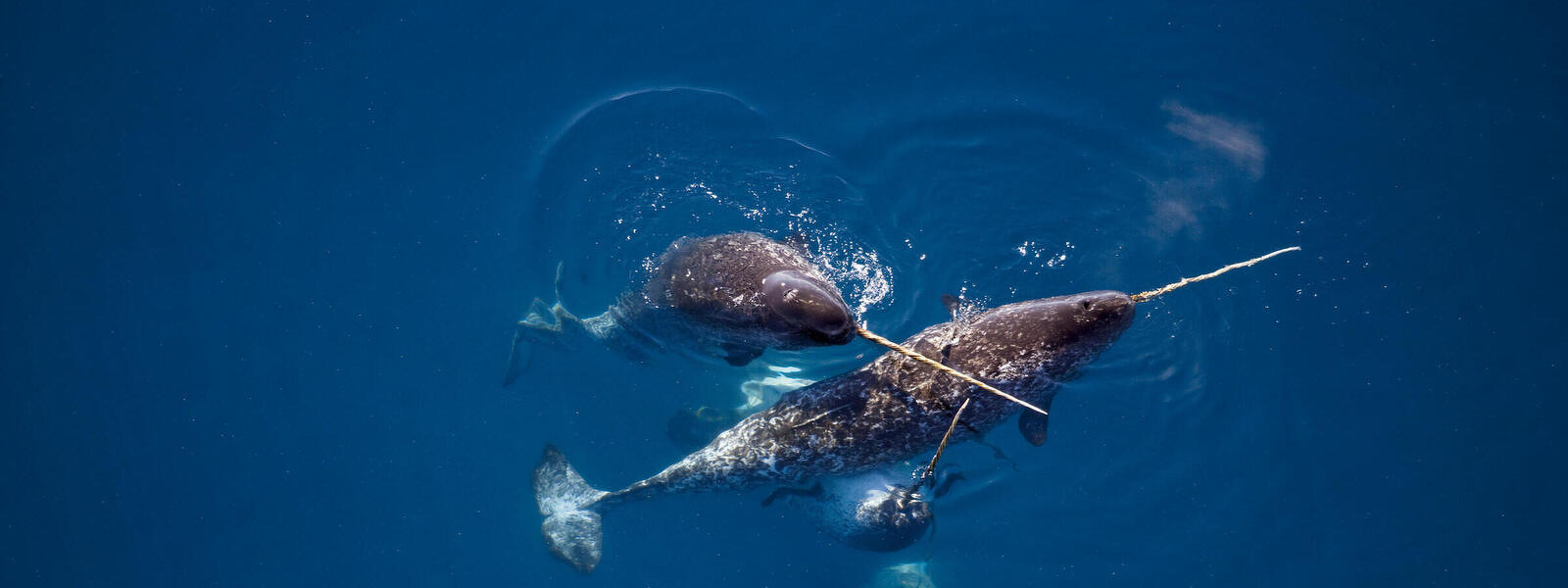
Narwhals, from the WWF
Narwhals (Monodon monoceros) are a species of toothed whale native to the Arctic, primarily in the Arctic Ocean. They are the only members of the genus Monodon and one of two living members of the family Monodontidae. These whales are stout cetacean with a relatively blunt snout, a large melon, and a shallow ridge in place of a dorsal fin. Male narwhals have a javelin-like tooth-tusk that grows into a long clockwise-spiraled tusk, resembling a unicorn horn. It is a protruding left canine tooth — 1.5 to 3 meters (4.9 to 9.8 feet) long tusk — that is believed to serve as a weapon, a tool for feeding and sensing water salinity and/or a means of attracting mates. [Source: Wikipedia]
Adult narwhals measure 3 to 5.5 meters (9.8 to 18.0 feet) in length and weigh 800 to 1,600 kilograms (1,800 to 3,500 pounds). Specially adapted slow-twitch muscles, along with the jointed neck vertebrae and shallow dorsal ridge allow for easy movement through the Arctic environment, where the narwhal spends extended periods at great depths. The narwhal's geographic range overlaps with that of the similarly built and closely related beluga whale. The two whales are known to interbreed.
There are an estimated 170,000 narwhals living today. Their lifespan is believed to be up to 50 years but that is not known for sure. In the past the age of narwhals was estimated by counting the growth rings on the male’s tooth-tusk (unerupted tooth). However, after being reviewed in the 1980s, this method does not seem accurate. If it were true, their reproductive capabilities in a lifetime would be twice that of their close relatives, beluga whales, and that seems unlikely. Narwhal coloration thus can be used as a rough indicator of their age (See Characteristics Below). The longest a narwhal lived in captivity was four months; the shortest was one month. [Source: Ann Dunford, Animal Diversity Web (ADW)]
Narwhals have no dorsal fin and can be up 50 percent blubber which helps them retain heat. They can be social animals. Their pods or herds can have more than 100 animals. They prefer dense sea ice in open water in the winter and as a result are likely to among the animals most disturbed by global warming. When they are near you can smell their sour breath. [Source: Abigail Tucker, Smithsonian magazine, May 2009]
Related Articles:
NARWHALS, HUMANS, CONSERVATION: USES, HUNTING, CLIMATE CHANGE ioa.factsanddetails.com
BELUGA WHALES: CHARACTERISTICS, BEHAVIOR AND REPRODUCTION ioa.factsanddetails.com
BELUGA WHALE CONSERVATION: THREATS, HUNTING, CAPTIVITY ioa.factsanddetails.com
BELUGA WHALES AND HUMANS: MILITARY USES, A SPY? TALKING NOC ioa.factsanddetails.com
TOOTHED WHALES (ORCAS, SPERM AND BEAKED WHALES) ioa.factsanddetails.com;
TOOTHED WHALES: SWIMMING, ECHOLOCATION AND MELON-HEADS ioa.factsanddetails.com;
WHALES: CHARACTERISTICS, ANATOMY, BLOWHOLES, SIZE ioa.factsanddetails.com ;
HISTORY OF WHALES: ORIGIN, EVOLUTION, SPECIES ioa.factsanddetails.com ;
WHALE BEHAVIOR, FEEDING, MATING ioa.factsanddetails.com ;
Narwhal Habitat and Where They Are Found
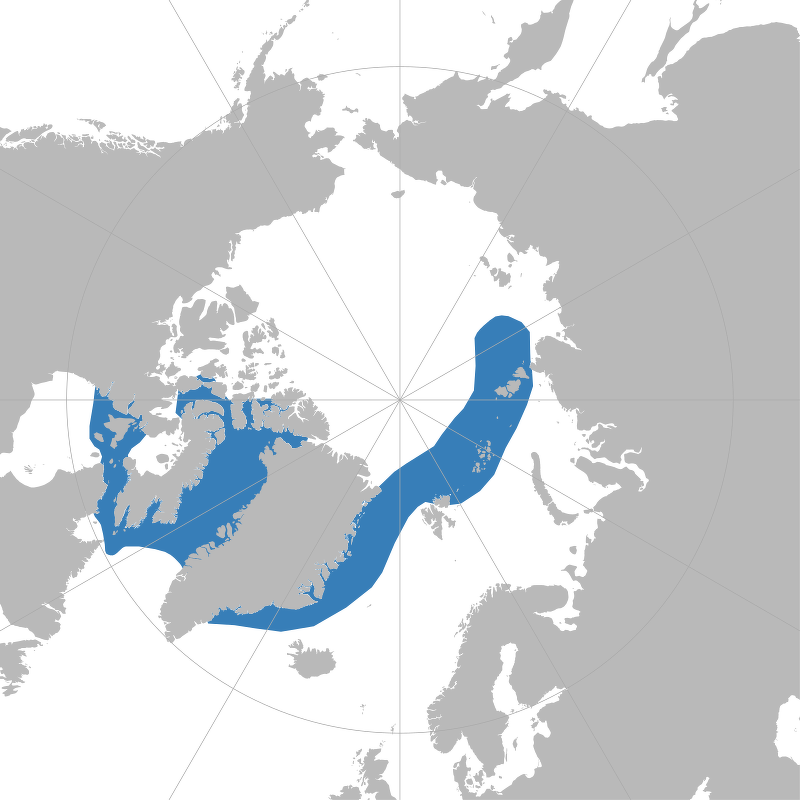
narwhal range
Narwhals can be found in the Arctic and Atlantic Oceans. Regarded as the northernmost cetacean, they are generally found between 70° and 80°N latitude and migrates seasonally. During the summer, narwhals are found in the northern Canadian Arctic, near the eastern shore of Greenland. In late September, most narwhal begin moving southward to their winter home in Baffin Bay off Canada. The start of freezing or melting of ice around the narwhal appears to trigger these migrations. It is likely that narwhals can be found elsewhere because they are rarely seen the surface and live in places where humans rarely go. [Source: Ann Dunford, Animal Diversity Web (ADW) |=|]
Narwhal can be found in predominantly open, deep Arctic waters. They spend time in different depths of the water depnding on what they are doing. While hunting narwhals tend to dive deeper and spend a longer amount of time underwater. During migration narwhal stay close to the surface; their dives tend to be shallower and more frequent. Maximum dives are about 900 meters (2953 feet). Both the summer and winter locations for the narwhal includes deep fjords.
Narwhal are generally found in the Atlantic around east coast of Greenland and Canada and in Russian areas of the Arctic Ocean. They are commonly recorded in the Canadian Arctic Archipelago in the northern part of Hudson Bay, in Hudson Strait and in Baffin Bay and in a strip running east from the northern end of Greenland to eastern Russia (170° east). Land in this strip includes Svalbard, Franz Joseph Land and Severnaya Zemlya. The northernmost sightings of narwhals occurred north of Franz Joseph Land, at about 85° north. There are an estimated 12,500 narwhals in the northern Hudson Bay and around 140,000 reside in Baffin Bay. [Source: Wikipedia]
Monodontidae: Narwhals and Beluga Whales
Narwhals are members of the family Monodontidae along with Beluga whales. Phil Myers wrote in Animal Diversity Web: The two species of this family are found at high latitudes in the Arctic seas and in most of the major rivers draining into them, south to the Saint Lawrence River. These are medium-sized whales, ranging from four to six meters in length and up to around 1600 kilograms in weight. Belugas have a very short, broad snout, while narwhales have a square head and appear to lack a snout altogether. The forehead in both species is high and globose. Members of this family lack a dorsal fin, although narwhals do have a distinctive ridge running along their backs. Adults belugas are white and adult narwhals are or white and black. [Source: Phil Myers, Animal Diversity Web (ADW) |=|]
As in the closely related delphinids, both species have a broadly expanded facial depression; this holds the melon, a fatty deposit believed to function in echolocation (emitting sound waves and sensing their reflections to determine the location of objects). The maxilla and frontal are expanded laterally, hiding the small zygomatic arch from dorsal view. The premaxillae lie flat in front of the nares, which are at the base of the short and broad rostrum (hard, beak-like structures projecting out from the head or mouth). The length of the mandibular symphysis is less than 20 percent the length of the ramus, and in the upper jaw, the toothrows diverge posteriorly. Teeth are usually simple pegs in beluga (5/2 to 11/11 in number) but occasionally slightly 3-cusped. Narwhals have but two teeth, the one on the left is developed into a spiraled, forward-projecting tusk up to 2.7 meters in length, and the other is rudimentary. The tusk of narwhals is found only in males; the teeth of females remain imbedded in their jaws. |=|

narwhal size
Monodontids are generally found in schools, sometimes including more than 100 individuals. They migrate in response to the shifting ice pack. Both species feed mainly on the bottom, consuming a number of species of fish and invertebrates. The tusks presumably function in social behavior; males have been seen to fence with these structures, and occasionally broken-off pieces of tusk have been found embedded in the heads of males of this species. Both species are highly vocal. Belugas make a sort of trilling sound and are sometimes known as "sea canaries."
Narwhal Characteristics
Narwals range in weight from 800 to 1600 kilograms (1,763 to 3524 pounds).They have a head and body length ranging from three to 5.5 meters (9.8 to 18 feet). Newborn narwhals measure about 1.5 meters (five feet) in length and weigh around 80 kilograms (176 pounds). Blubber makes up 30 to 35 percent of the weight of a typical narwhal. This layer of fat, which ranges in thickness from 5 to 10 centimeters, is essential for keeping warm and surviving in Arctic waters. Sexual Dimorphism (differences between males and females) is present: Males are larger than females. Ornamentation is different. [Source: Ann Dunford, Animal Diversity Web (ADW) |=|]
Abigail Tucker wrote in Smithsonian magazine: The narwhal is not a conventionally beautiful animal. Its unlovely name means "corpse whale," because its splotchy flesh reminded Norse sailors of a drowned body. This speckled complexion is "weird," says James Mead, curator of marine mammals at the Smithsonian's National Museum of Natural History (NMNH); usually, he says, whales are a more uniform color. Like belugas and bowheads, which also inhabit Arctic waters, narwhals are about 50 percent body fat; other whales are closer to 20 or 30 percent. [Source: Abigail Tucker, Smithsonian magazine, May 2009]
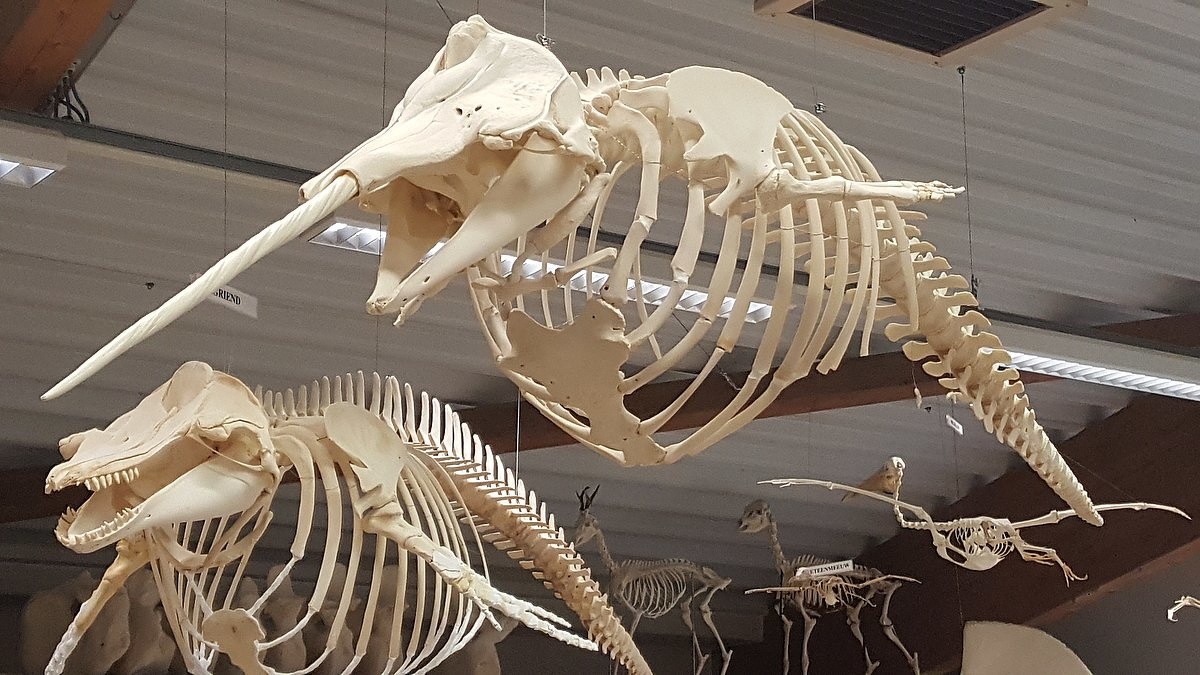
narwhal skeleton
Narwhals can be identified by their fins, which are smaller than those of most other cetaceans and have a distinctive tip that curls up. Another unique physical characteristic of narwhals is the lack of a dorsal fin on their back side. Instead they have a dorsal ridge. Dorsal ridges and the notch pattern on them are unique and can be photographed and used to identify and distinguish individual narwhals. |=|
Another distinguishing feature of narwhals is they way they change coloration with age. They are a dark blue-gray color at birth. As they age, white begins to work into the dark color and create a mottled pattern. Adult narwhal have a dark mottled dorsal side and a cream colored ventral side. Old narwhal continue to get lighter and very old males can be mostly white in color. Narwhal coloration thus can be used as a rough indicator of their age.
Narwhal Tusks
Narwhal males are easily recognized by their "tusk," which can grow to three meters (10 feet) in length. The tusk is actually a left canine tooth that protrudes out of the upper left lip. Narwhal have just two teeth. In males the left one erupts and becomes the tusk. The right tooth is embedded. In most females both teeth are embedded, It is possible for both sexes to have one or two tusks. In the event of both tusks being present the left is always larger. All tusks spiral to the left, with a polished end and the rest of the horn being covered in algae. [Source: Ann Dunford, Animal Diversity Web (ADW) |=|]
Both sexes have a pair of embedded teeth which can become tusks embedded in their upper jaw. Those of males erupt from the lip somewhere between two and three years of age. The tusk grows throughout the animal's life. It is hollow and weighs up to 7.45 kilograms (16.4 pounds). Some males may grow two tusks, occurring when the right canine also protrudes through the lip. Females rarely grow tusks that erupt through their lips and then when they do, the tusks are typically smaller than those of males, with less noticeable spirals. Beside the tusk are a single pair of small vestigial teeth that reside in open tooth sockets in the upper jaw. These teeth, which differ in form and composition, encircle the exposed tooth sockets. The varied morphology and anatomy of small teeth indicate a path of evolutionary obsolescence. [Source: Wikipedia]
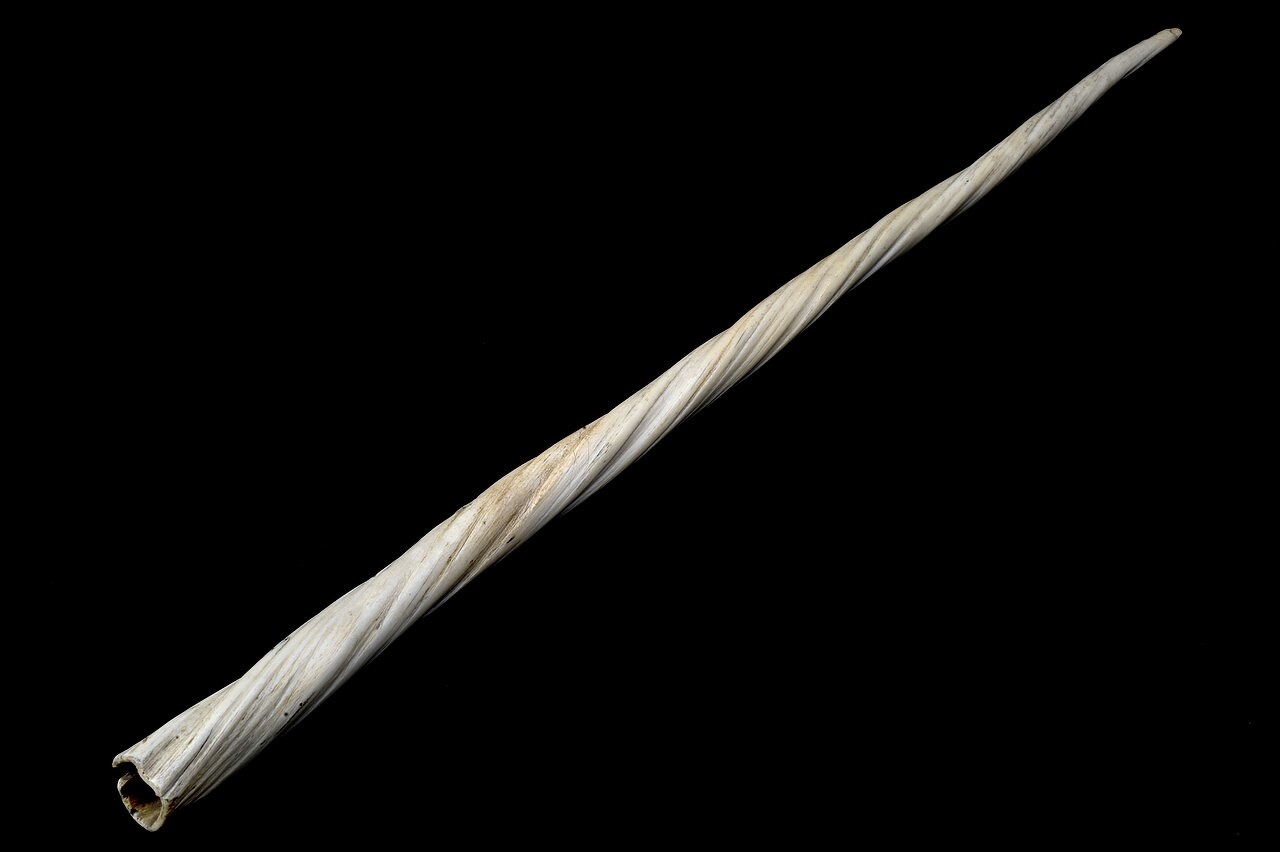
narwhal tusk
Abigail Tucker wrote in Smithsonian magazine: The whales' most dazzling feature, of course, is the swizzle-stick tusk that sprouts from their upper left jaw. Though the whales' scientific name is Narwhals, "one tooth, one horn," an occasional male has two tusks (the Smithsonian’s National Museum of Natural History has two rare specimens) and only three percent of females have a tusk at all. The solitary fang, which is filled with dental pulp and nerves like an ordinary tooth, can grow thick as a lamppost and taller than a man, and it has a twist. On living whales, it's typically green with algae and alive with sea lice at its base.[Source: Abigail Tucker, Smithsonian magazine, May 2009]
The current scientific consensus is that that narwhal tusks are secondary sexual characteristics which indicate social status and plays a role in sexual selection.. Other functions of narwhal tusks are debated, with some biologists suggesting they are used in fights and others saying that they serve some purpose in feeding. The The tusks are highly innervated sensory organs with millions of nerve endings, allowing the narwhal to sense temperature variability in its surroundings. These nerves may also be able to detect changes in particle concentration and water pressure. Male narwhals rid themselves of encrustations on their tusks by rubbing them together, which in the past had been interpreted as a form of fighting or posturing. Drone footage from August 2016 in Tremblay Sound, Nunavut, showed narwhals using their tusks to tap and stun small Arctic cod, making them easier to catch for feeding. Females, who usually do not have tusks, live longer than males and is seen as indication that tusks are not crucial to survival.
Tucker wrote in 2009" No one's sure precisely how or why it evolved — it has been called a weapon, an ice pick, a kind of dousing rod for fertile females, a sensor of water temperature and salinity, and a lure for prey. Herman Melville joked that it was a letter opener. "Everybody has a theory on this," Laidre says with a sigh. (The question comes up a lot at cocktail parties.) Most scientists, Laidre included, side with Charles Darwin, who speculated in The Descent of Man that the ivory lance was a secondary sex characteristic, like a moose's antlers, useful in establishing dominance hierarchies. Males have been observed gently jousting with their teeth — the scientific term is "tusking" — when females are nearby. The tooth, Laidre patiently explains, cannot be essential because most females survive without one.
Narwhal Food, Eating Behavior and Predators
Narwhals are carnivores (eat meat or animal parts) and recognized as piscivores (eat fish) and molluscivore (eat mollusks). They also eat crustaceans. As they don’t really have teeth in the conventional sense it is assumed that narwhals swim as close as they can to prey and use suction to eat their prey. [Source: Ann Dunford, Animal Diversity Web (ADW) |=|]
Abigail Tucker wrote in Smithsonian magazine: No one has ever seen a submerged narwhal eat. Biologist Kristin Laidre of the University of Washington led a study of the stomach contents of 121 narwhals that suggested they fast in summer and gorge on fish in winter.” They are fond of bottom-dwelling prey like Greenland halibut, which often require incredibly deep dives to reach. [Source: Abigail Tucker, Smithsonian magazine, May 2009]
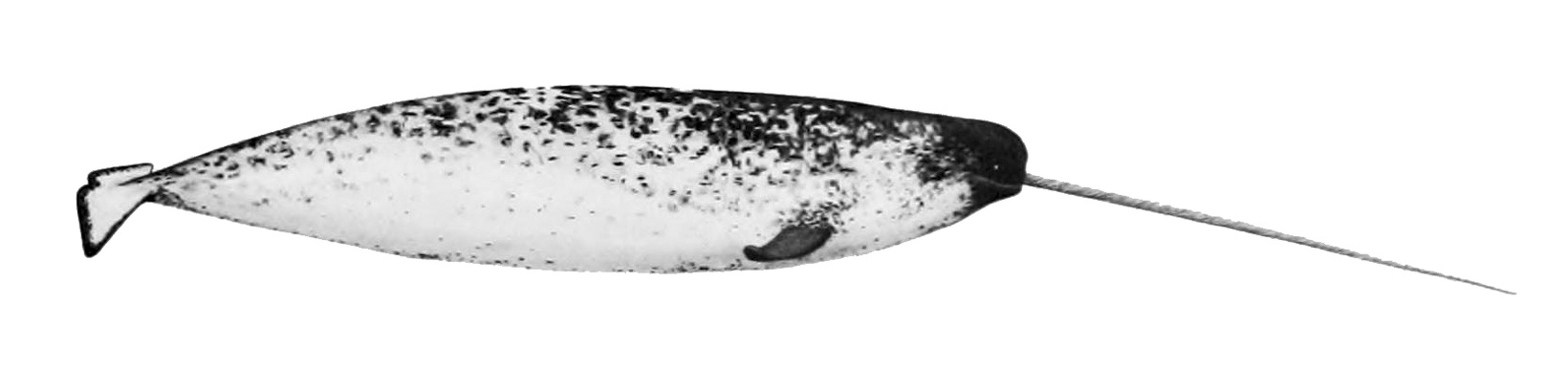
illustration of a narwhal
The studies of the stomach contents of narwhal revealed a rather limited diet that varies depending on the season. Food during the fall and winter consists mainly demersal prey, mostly flatfish such as Greenland halibut, and boreoatlantic armhook squid under dense pack ice. During the spring narwhals eat polar cod and Arctic cod. They don’t seem to feed much during the summer and when they do they eat mostly Arctic cod, Greenland halibut and polar cod. These seasonal variations likely are linked to the migration patterns of the narwhal in that they directly seek these prey out or the happen to be in the places they migrate to. Crustaceans have also been found in narwhal stomachs, but fish and cephalopods are much more prevalent. |=|
It has been hypothesized that narwhals used their tusks to spearing prey, or that it is used to disturb the sediment at the bottom of the ocean and reveal prey or flush it out. Scientists that these theories are unlikely because tusks are most frequently found on males. If the tusk were an adaptation for food it would be found on all narwhal.
The main known predators of narwhals are humans, walruses, orcas (killer whales), Greenland sharks and polar bears. Narwhals have been found in the stomachs of Greenland sharks and there is evidence that they have also been eaten by walrus and polar bears. With all this animals it often not clear whether they killed the narwha;s they ate of whether the narwhals were already dead when the predators ate them. Polar bears and maybe walruses too go after narwhals when are trapped in a savassat (open areas surrounded by too much ice to allow escape) and have no way of escaping to open water.
Narwhals generally travel in small groups. When chased by a predator they have been seen observed getting closer together and traveling in a tighter group. This behavior has been seen in response to being chased by orcas and humans. Their coloration serves as camouflage. Lighter coloration on their bottom side helps them blend in with the sky when viewed from below. Their darker, mottled color on their back side helps them blend in with the fark deep ocean water when viewed from above. It has been suggested that the narwhal male’s tusk can be used as a weapon to fend off predator but there is no evidence to support this.
Narwhal Behavior
Narwhals are natatorial (equipped for swimming), motile (move around as opposed to being stationary), migratory (make seasonal movements between regions, such as between breeding and wintering grounds), and social (associates with others of its species; forms social groups). Narwhals tend to be very inactive while they are at the surface. They have also been known to slowly sink when they sense vibrations from a ship. This paired with their coloration makes it hard to observe them. [Source: Ann Dunford, Animal Diversity Web (ADW) |=|]
Abigail Tucker wrote in Smithsonian magazine: Fond of bottom-dwelling prey like Greenland halibut, narwhals are incredibly deep divers. When Mads Peter Heide-Jorgensen, Laidre's Danish colleague and frequent collaborator, pioneered narwhal-tagging techniques in the early 1990s, his transmitters kept breaking under the water pressure. Five hundred meters, 1,000, 1,500 — the whales, which have compressible rib cages, kept plunging. They bottomed out around 1,800 meters — more than a mile deep. At such depths, the whales apparently swim upside down much of the time. [Source: Abigail Tucker, Smithsonian magazine, May 2009]
Narwhals are gregarious animals and are usually found in pods ranging from two to twenty-five members, with the average being 3.6 members. These pods become much larger while migrating as many pods merge into one large herd. Under these circumstances, groups of several hundred members are possible. After migration, however, the whales return to their original smaller pods. Pods do not seem to follow a pattern of sex, age, or relatedness and details of their social structure are not known.
Narwhals spend a lot of time in Arctic ice. Shifting currents and winds create breaks in the ice, enabling the animals to surface and breathe, the whales must keep moving to avoid getting trapped. Occasionally narwhal can get caught in savassat (open areas surrounded by too much ice to allow escape). This usually results in the death of all the trapped animals either by predation or starvation. The whales have been seen using their heads to smash into the ice in an effort to break it. Unfortunately, this causes water to splash out of the hole, which freezes and reinforces their entrapment. There have also been observations of narwhals being extremely careful not to harm other members of its group with their tusks while stuck in a savassat.
Narwhal Senses and Communication
Narwhals communicate acoustically with sound and sense using touch, sound, ultrasound, echolocation (emitting sound waves and sensing their reflections to determine the location of objects) and chemicals usually detected by smell. Examinations of tusks have revealed they have about ten million nerve endings that has led researchers to believed the tusks have some sort of sensory function, but the specific function is not yet known (See tusks above). [Source: Ann Dunford, Animal Diversity Web (ADW) |=|]
Like most toothed whales, narwhals use sound to navigate and hunt for food. They primarily vocalise through clicks, whistles and knocks, created by air movement between chambers near the blowhole. Sounds are reflected off the sloping front of the skull and focused by the animal's melon: a mass of fat which can be controlled through surrounding musculature. Narwhals sometimes adjust the duration and pitch of their pulsed calls to maximise sound propagation in varying acoustic environments. Narwhals trumpet and make "squeaking-door sounds". Their vocal repertoire is similar to that of beluga whales. However, the frequency ranges, durations, and repetition rates of narwhal clicks differ from those of belugas. [Source: Wikipedia]
Narwhal produce two different types of calls. The first is categorized as a pulse — call typically between 12 and 20kHz that are short burst of sound and sound to human ears like click. These are are sent out frequently and are likely a type of echolocation, perhaps allowing them to efficiently locate and catch prey, and probably having a spatial function that likely helps a group of whales to stay together while they are migrating. |=|
The other type of acoustic call is the whistle. Unlike the pulsed call, whistles are longer calls with varying frequency and are likely used mainly for communication. These calls vary from 300Hz to 10kHz. Some research has suggested that whistles may be group specific, meaning that the calls of narwhals in one group are more similar to each other than they are to the calls of members of other groups.
Narwhal Mating, Reproduction and Offspring
Narwhals engage in seasonal breeding. The breeding season is from March to May in their summer range. The mating systems of narwhals are not known but it assumed . It is assumed that the protruding tooth in males is used by the females to judge the fitness of males, and thereby choose a mate. However, there are still conflicting opinions about the purpose of the tooth.
Narwals often mate in cracks of ice towards the end of winter in darkness, when the wind chill can drive the air temperature to -51̊ Celsius (-60̊ Fahrenheit). Females conceive every two or three years. The average gestation period is 14 months. The usual number of offspring is one, occasionally two. The average weaning age is 20 months. Females reach sexual maturity at four to seven years. Males reach sexual maturity at eight to nine years. [Source: Ann Dunford, Animal Diversity Web (ADW) |=|]
Narwal young are born in June or July following the 14 month gestation period. Newborn narwhals measure about 1.5 meters (five feet) in length and weigh around 80 kilograms (176 pounds). Parental care is provided by both females and males, with females nursing the young and doing much of the care while males protects them. Males and females generally do not travel together, unless there is a calf with them. Whether the males provide food or offer other kinds of care is not known. Family association after weaning are also not known.
Narwhal calves are born tail first and begin swimming shortly after birth. Because of the extreme cold, calves are born chubby, about one-third the size of their mothers. The newborns are assumed to stay with their mother for at least the 20 month period of lactation, however, there are conflicting opinions on the exact duration of lactation. As a result of a long lactation period, female narwhals conceive every two to three years.
Image Sources: Wikimedia Commons
Text Sources: Animal Diversity Web animaldiversity.org ; National Geographic, Live Science, Natural History magazine, David Attenborough books, New York Times, Washington Post, Los Angeles Times, Smithsonian magazine, Discover magazine, The New Yorker, Time, BBC, CNN, Reuters, Associated Press, AFP, Lonely Planet Guides, Wikipedia, The Guardian, Top Secret Animal Attack Files website and various books and other publications.
Last updated June 2025