
Home | Category: Toothed Whales (Orcas, Sperm and Beaked Whales)
NARWHALS AND THE PEOPLE WHO KNOW THEM BEST
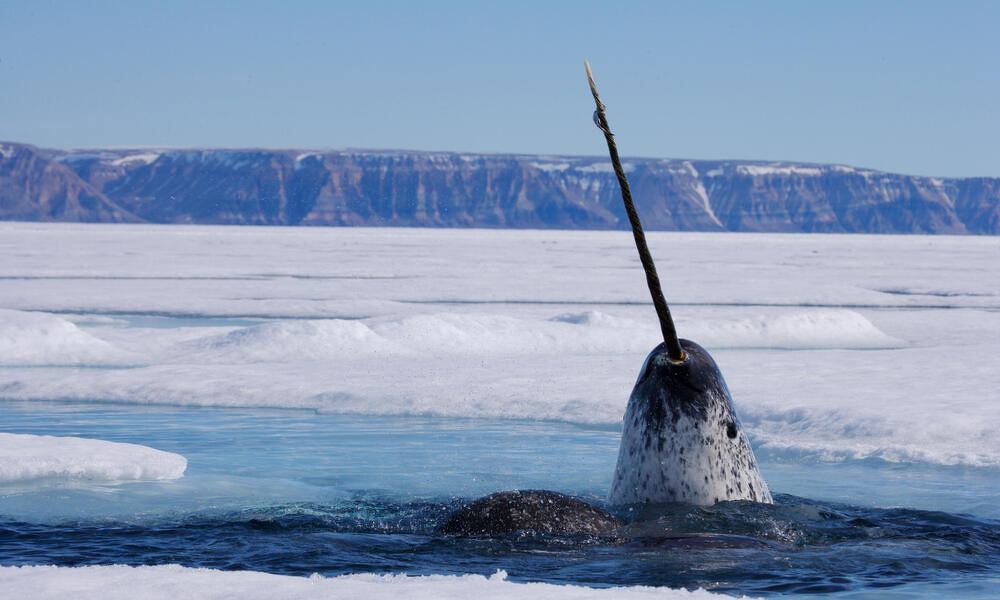
Narwhals, from the WWF
Narwhals have been hunted for thousands of years by Inuit in northern Canada and Greenland for meat and ivory. These people still hunt them today under strict rules. Inuit (Eskimos)have traditionally made use of most of the whale. The blubber and oil were used for lighting, heating and cooking. Narwhal skin, known as muktuk was an important part of their diet. It provided the vitamin C that they could not get otherwise. Sinews from narwhals were used as thread. The meat of narwhal was consumed by humans but more often used as dog food for working dogs. The tusks have been used the tips of spears or harpoons, but later proved much more useful items of trade.
Abigail Tucker wrote in Smithsonian magazine: To the Inuit, the whale and its horn are hardly luxury goods. Greenlanders traditionally used every part of the animal, burning its blubber in lamps, using the back sinews to sew boots and clothes and the skin for dog sled traces. The tusks were tools of survival in a treeless landscape, used as sled runners, tent poles and harpoons. The tusks were also bleached and sold whole or carved into figurines (and, yes, Mr. Melville, letter openers). Even today, when iPods are sold at the Niaqornat village store, narwhals remain a vital source of food. Narwhal meat feeds dogs and fills freezers for the winter, a last nutritional opportunity before total darkness closes over the town like a fist. Mattak, the layer of skin and blubber that is eaten raw and rumored to taste like hazelnuts, is an Inuit delicacy. [Source: Abigail Tucker, Smithsonian magazine, May 2009]
There was some excitement when a young hunter, having learned that I had passed my whole life never having tasted narwhal mattak, arrived with a frozen piece from last year's harvest. (I had asked him what it tasted like, and he said, with a pitying gaze, "Mattak is mattak.") Hazelnut was not the flavor that came to my mind. But some scientists tucked away great mouthfuls of the stuff, dipped in soy sauce. In the old days, foreign sailors who abstained from vitamin-C-rich whale mattak sometimes died of scurvy.
Related Articles:
NARWHALS: CHARACTERISTICS, BEHAVIOR AND REPRODUCTION ioa.factsanddetails.com
BELUGA WHALES: CHARACTERISTICS, BEHAVIOR AND REPRODUCTION ioa.factsanddetails.com
BELUGA WHALE CONSERVATION: THREATS, HUNTING, CAPTIVITY ioa.factsanddetails.com
BELUGA WHALES AND HUMANS: MILITARY USES, A SPY? TALKING NOC ioa.factsanddetails.com
TOOTHED WHALES (ORCAS, SPERM AND BEAKED WHALES) ioa.factsanddetails.com;
TOOTHED WHALES: SWIMMING, ECHOLOCATION AND MELON-HEADS ioa.factsanddetails.com;
WHALES: CHARACTERISTICS, ANATOMY, BLOWHOLES, SIZE ioa.factsanddetails.com ;
HISTORY OF WHALES: ORIGIN, EVOLUTION, SPECIES ioa.factsanddetails.com ;
WHALE BEHAVIOR, FEEDING, MATING ioa.factsanddetails.com ;
Narwhal Conservation
There are an estimated 170,000 narwhals, and they are listed as a species least concern by the International Union for Conservation of Nature (IUCN). In the past they were listed as “Near Threatened.” Their main threats are effects of climate change, such as reduction in ice cover, and human activities such as pollution and hunting. Narwhals, like all marine mammals, are protected under the Marine Mammal Protection Act. On the Convention on International Trade in Endangered Species (CITES) narwhal are placed in Appendix II, which lists species not necessarily threatened with extinction now but that may become so unless trade is closely controlled. [Source: Ann Dunford, Animal Diversity Web (ADW) |=|]
The males are prized for their tusks and thus have traditionally been the primary target of human hunters. This may explain why adult males tend to stay farther offshore and spend less time at the surface than juveniles and females. There are concerns about shipping accidents involving narwhals especially if Arctic waters are used more for trade as ice disappears because of climate change. The route taken by some ships crosses the narwhal’s migration routes.
Narwhals, Ice, Climate Change and Killer Whales
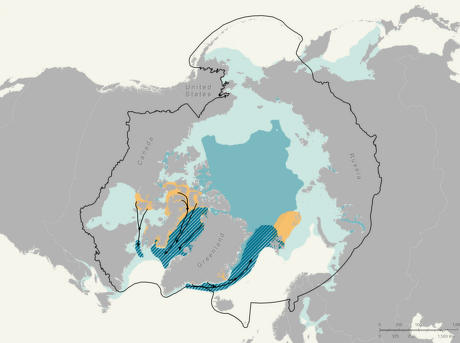
Arctic ice and narwhal distribution
straight line — CAFF definition of the Arctic
line with arrow — Approximate seasonal movement
dark grayish blue — narwhal winter distribution
yellow — narwhal summer distribution
Sea ice extent: middle grayish blue — Minimum 2011
light grayish blue — Maximum 2011 [Source: WWF]
Abigail Tucker wrote in Smithsonian magazine: The whales' fate is tied to the ice. Narwhal fossils have been found as far south as Norfolk, England, to which the ice cover extended 50,000 years ago. Ice protects narwhals from the orcas that sometimes attack their pods; the killer whales' high, stiff dorsal fins, which are like fearsome black pirate sails, prevent them from entering frozen waters. Even more important, biologist Kristin Laidre of the University of Washington says, narwhals beneath the pane of ice enjoy almost exclusive access to prey — particularly Greenlandic halibut, which may be why they are such gluttons in winter. [Source: Abigail Tucker, Smithsonian magazine, May 2009]
Occupying an icy world has its risks. Narwhals lingering too long in the fjords sometimes get trapped as the ice expands and the cracks shrink; they cut themselves horribly trying to breathe. In Canada this past fall, some 600 narwhals were stranded this way, doomed to drown before hunters killed them. These entrapments are called savssats, a derivative of an Inuit word meaning "to bar his way." Laidre believes that massive die-offs in savssats thousands of years ago may account for the narwhal's extraordinarily low genetic diversity.
Still, less ice could spell disaster for narwhals. Since 1979, the Arctic has lost an ice mass the size of nearly two Alaskas, and last summer saw the second-lowest ice cover on record (surpassed only by 2007). So far the water has opened mostly north of Greenland, but hunters in Niaqornat say they've noticed differences in the way their fjord freezes. Even if warming trends are somehow reversed, Laidre's polar-expert colleagues back in Seattle doubt that the ice will ever regain its former coverage area and thickness. Narwhals may be imperiled because of their genetic homogeneity, limited diet and fixed migration patterns. Laidre was the lead author of an influential paper in the journal Ecological Applications that ranked narwhals, along with polar bears and hooded seals, as the Arctic species most vulnerable to climate change.
"These whales spend half the year in dense ice," she says. "As the ice's structure and timing changes, the whole oceanography, the plankton ecology, changes, and that affects their prey. Narwhals are a specialist species. Changes in the environment affect them — without a doubt — because they are not flexible." For the past several years Laidre has been attaching temperature sensors along with tracking gear to captured narwhals. One morning in Niaqornat, she received an e-mail with an analysis of water temperature data collected by 15 tagged narwhals from 2005 to 2007. Compared with historical information from icebreakers, the readings showed warming of a degree or more in the depths of Baffin Bay. Laidre was ecstatic that her collecting method seemed to have worked, though the implications of rising temperatures were disturbing. Indeed, there are already reports of more killer whales in the Arctic.
Narwhale Tusks — Unicorn Horns
During Europe’s Middle Ages narwhal tusks were worth ten times their weight in gold — and today they can still fetch hunters more than $1,000 a piece. Abigail Tucker wrote in Smithsonian magazine: During the Middle Ages, and even earlier, narwhal tusk was sold in Europe and the Far East as unicorn horn. Physicians believed that powdered unicorn horn could cure ills from plague to rabies and even raise the dead. It seems also to have been marketed as a precursor to Viagra, and it rivaled snake's tongue and griffin's claw as a detector of poison. Since poisonings were all the rage in medieval times, "unicorn horn" became one of the most coveted substances in Europe, worth ten times its weight in gold. French monarchs dined with narwhal-tooth utensils; Martin Luther was fed powdered tusk as medicine before he died. The ivory spiral was used to make the scepter of the Hapsburgs, Ivan the Terrible's staff, the sword of Charles the Bold. [Source: Abigail Tucker, Smithsonian magazine, May 2009]

sea unicorn or monoceros from Gesner 1558
Historians have not definitively identified where the ancient tusks originated, though one theory is that the narwhals were harvested in the Siberian Arctic (where, for unknown reasons, they no longer live). But in the late 900s the Vikings happened upon Greenland, swarming with narwhals, their teeth more precious than polar bear pelts and the live falcons they could hawk to Arabian princes. Norse longboats rowed north in pursuit of the toothed whales, braving summer storms to trade with the Skraelings, as the Vikings called the Inuit, whom they despised.
It was Laidre's intellectual ancestors, the Enlightenment scientists, who ruined the racket. In 1638, the Danish scholar Ole Wurm refuted the unicorn myth, showing that the prized horn material came from narwhals, and others followed suit. In 1746, faced with mounting evidence, British physicians abruptly stopped prescribing the horn as a wonder drug (though the Apothecaries' Society of London had already incorporated unicorns into its coat of arms).
Dozens of tusk were taken from narwhals entrapped by ice and killed near Disko Island in 1915. Today, the tusks fetch more humble prices — about $1,700 a foot at a 2007 auction in Beverly Hills. (It has been illegal to import narwhal tusk into the United States since the 1972 Marine Mammal Protection Act, but material known to have entered the nation earlier can be bought and sold.)
Narwhal Town, Greenland
Niaqornat (pop. 60) in northern Greenland lies on a tongue of land in Baffin Bay inside the Arctic Circle. Abigail Tucker wrote in Smithsonian magazine: I first reached the village, after a two-hour boat ride that involved rounding icebergs in the inky blackness of a late Arctic afternoon Signs of narwhals are everywhere, especially now that the tusk market has been shut down and hunters can't sell the ivory for gas money and other expenses. The whales' undeveloped inner teeth are strung up over front porches like clothespins on a line. A thick tooth is proudly mounted on the wall of the little building that serves as the town hall, school, library and church (complete with sealskin kneelers). It seems the fashion to lean a big tusk across a house's front window. [Source: Abigail Tucker, Smithsonian magazine, May 2009]
Niaqornat sits hard against a white wall of mountains, where men hunting Arctic grouse leave tiny red droplets in their footsteps on the slopes: blackberries crushed under the snow. Greenland has its own home-rule government but remains a Danish possession, and thanks to the Danish influence the town is fully wired, with personal computers glowing like hearths in almost every living room. But none of the houses, including the drafty three-room field station used by Laidre and other scientists, has plumbing or running water; the kerosene stoves that keep the water from freezing are easily puffed out by the ripping wind, which also brings waves bashing against the town's scrap of black beach.
With its tide line of pulverized ice crystals, the beach is the chaotic center of village life, scattered with oil drums, anchors and the hunters' little open boats, some of which are decorated with Arctic fox tails like lucky giant rabbit's feet. There are waterfront drying racks hung with seal ribs, waxen-looking strips of shark and other fish, and the occasional muskox head masked with ice. Throughout the town, sled dogs are staked to the frozen ground; there are at least three times as many dogs as people. "There are months when no supplies are coming into the town, and people depend only on what they pull out of the sea," Laidre told me. "The arrival of these whales is a small window of opportunity, and hunters have to have an extremely deep knowledge of how they behave."
Hunting Narwhals in Greenland
Abigail Tucker wrote in Smithsonian magazine: In 2004, Greenland set narwhal-hunting quotas for the first time, despite some hunters' protests, and banned the export of the tusks, halting a thousand-year-old trade. Conservationists — newly roiled this past summer by the discovery of dozens of dead narwhals in East Greenland, the tusks chopped out of the skulls and the meat left to rot — want still more restrictions. It's estimated there are at least 80,000 of the animals, but nobody knows for sure. The International Union for Conservation of Nature this year said the species was "near threatened." [Source: Abigail Tucker, Smithsonian magazine, May 2009]
In the darkness they can tell the difference between a beluga and a narwhal by the sound of their breathing. And if the hunters can't hear anything, they search them out by smell. "They smell like blubber," a young man told me.
When an animal is killed, word spreads by radio, and the whole town rushes down to the beach, shouting the hunter's name. After the butchering, families share the carcass, part of a traditional gifting system now almost unknown outside the settlements. "We make a living only because the whales come," Karl-Kristian Kruse, a young hunter, told me. "If narwhals didn't come, there would be nothing here."
The new whale quotas will probably make life more difficult in Niaqornat: before 2004, there were no limits on the number of narwhals hunters could catch, but in 2008 the whole village was allotted only six. "The scientists want to know how many whales there are," Anthon Moller, a 25-year-old hunter, said bitterly. "Well, there are a lot, more than ever before. With quotas it's hard to live."
Narwhal Hunt in Arctic Canada — Many Killed But Only A Few Retrieved
In the spring as the ice pack recedes in the Canadian Arctic, narwhals push into cracks and holes as they migrate. Only Inuits are allowed to hunt the whales. Methods vary on the season and location. Rifles are generally used. Only the best marksmen can make a kill with a single shot. Many that are shot are not retrieved. Some sink. Others escape. It is not clear whether high numbers are lost.
Paul Nicklen wrote in National Geographic: The return of the narwhal is a long-anticipated event in the Canadian Arctic. After months of darkness and temperatures as low as minus 40 degrees Fahrenheit, winter gives way to spring, and the sea ice covering Lancaster Sound begins to splinter. Open stretches of water, called leads, become travel lanes for the small whales as they follow the retreating sea ice toward their ancestral summering grounds around Baffin Island. In remote Inuit communities such as Pond Inlet and Arctic Bay, news of the narwhals’ arrival stirs hunters to reach for their rifles and head for the ice edge. Like the Inuit, I too am eagerly awaiting the return of the tusked whales...When finally we hear the squeaks, squeals, and blows of these vocal whales, we climb a large block of ice and cheer their arrival. [Source: Paul Nicklen, National Geographic. August 2007]
At first the narwhals parade past in pods of eight or ten, then in grand processions of hundreds. As news of their return spreads over the local field radio, Inuit hunters, many of them good friends I’ve known for years, begin arriving on snowmobiles carrying camping gear and high-powered rifles. Taking up positions along the ice edge, they watch and wait for narwhals to surface near enough to shoot with a rifle and retrieve with a grappling hook thrown by hand.
The Inuit have looked forward to this moment all winter. Each man waiting on the ice hopes to land a whale with a tusk that could sell for more than a thousand dollars, a windfall in a remote region where jobs are scarce and the cost of living high. The hunters also look forward to fresh muktuk, the top layer of blubber and skin, which is prized as a traditional delicacy.
But like most of life in the Arctic, hunting narwhals requires patience. The open water is wide here, and the whales stay beyond reach. So we light camp stoves, brew tea, and share stories and laughter. In the endless daylight of spring, our vigil continues around the clock. Cries of Tuugaalik! Tuugaalik! — Narwhal! Narwhal! — ring out as big males lift their tusks skyward. Then comes word over the radio that narwhals have been spotted moving up a newly formed lead 20 miles (32 kilometers) to the west. We quickly relocate and see that the crack in the ice is narrow. It’s a can’t-miss situation. Yet even at this close range, making a clean kill as the whales surface for air will be difficult.
The gunfire begins in the afternoon and goes on all through the twilit night. Over the span of 12 hours 109 rifle shots ring out, but something is wrong: In the morning only nine narwhals lie dead on the ice. Surely more were hit, I think, and begin asking each hunter how he fared. “I hit two, but they didn’t die.” “I sank seven and landed none.” This was not the first time I had heard reports of many narwhals being shot but few landed. Just weeks earlier, a man I know to be a skillful hunter confided that he had killed 14 narwhals the previous year but managed to land only one.
For even the best hunters, killing and retrieving a narwhal at the ice edge is a formidable challenge, one that requires near-perfect aim and timing. The whale must be shot in the spine or brain (an organ the size of a cantaloupe) the instant it fills its lungs with air. Kill it at the wrong moment, and it will sink. Wound it, and it will swim away and possibly die later — though many narwhals apparently survive. I’ve seen more than a few bearing multiple bullet wounds. Even whales killed with a perfect shot often float beyond reach of the hunter’s hook and sink. So much ivory rests on the seafloor, said one hunter, that a salvager could make a fortune.
Studying Narwhals
Unlike other whales, narwhals die shortly in captivity, greatly reducing the opportunity to study them. "We've only had a glimpse of the beast," Pierre Richard, a prominent Canadian narwhal specialist, said. Biologist Kristin Laidre of the Polar Science Center at the University of Washington in Seattle is an expert on narwhals She described them as "possibly the worst study animal in the world." "Most creatures on earth we know a lot more about," she told Laidre says. "We probably know a lot more about the brains of grasshoppers than we do about narwhals." [Source: Abigail Tucker, Smithsonian magazine, May 2009]
Abigail Tucker wrote in Smithsonian magazine: Narwhals live in the cracks of dense pack ice for much of the year. They flee from motorboats and helicopters. They can't be herded toward shore like belugas, and because they're small (for whales) and maddeningly fast, it's little use trying to tag them with transmitters shot from air rifles. They must be netted and manhandled, although Laidre is trying a variation on an aboriginal method, attaching transmitters to modified harpoons that hunters toss from stealthy Greenlandic kayaks.
"Narwhals are hopelessly hard to see, never come when you want them to, swimming far offshore and underwater the whole time," she says. "You think you'll catch a whale in three weeks, you probably won't. Whole field seasons go by and you don't even see a narwhal. There are so many disappointments. It takes great patience and optimism — those are my two words."
The species is practically a blank slate, which is what drew her to narwhals in the first place — that and the crystalline allure of the Arctic. By now she has analyzed scores of narwhal carcasses and managed to tag and follow about 40 live animals, publishing new information about diving behavior, migration patterns, relationship to sea ice and reactions to killer whales. Much of what the world knows about the narwhal's picky eating habits comes from Laidre's research, particularly a 2005 study that offered the first evidence of the whales' winter diet, which is heavy in squid, Arctic cod and Greenland halibut. She is the co-author of the 2006 book Greenland's Winter Whales.
Hunters and Scientists Collaborate to Study Narwhals
Abigail Tucker wrote in Smithsonian magazine: To track the whales, Laidre and Mads Peter Heide-Jorgensen of the Greenland Institute of Natural Resources have collaborated with hunters on Greenland's west coast and were just starting to build relationships in the village of Niaqornat... We would arrive in late October and the scientists would remain through mid-November, as darkness descended and the ice glided into the fjords, and the pods of whales, which they suspect summer in Melville Bay several hundred miles north, made their way south. [Source: Abigail Tucker, Smithsonian magazine, May 2009]
The hunters were small, spare men, smelling of fish and wet flannel, with wind-burned skin, flared nostrils. Their aim was to catch a narwhal in a net and transfer it from ocean to beach and back again. When a narwhal was caught in a net it bucked like a bronco as the hunters, led by one of Laidre's technicians, pinned a transmitter, about the size of a bar of soap, to the dorsal ridge. When at last the tag was secure, the technician was so relieved he smooched the animal's broad back. Then they walked it out with the tide and let it go. One of the hunters had videotaped the entire frothy episode on his cellphone; a year later, the villagers still watched it raptly.
"Kusanaq," Heide-Jorgensen told the hunters. "Beautiful. A great collaboration. This time we'll move the tag back a little and also put on a tusk transmitter." He and Laidre paid 20,000 Danish kroner, or about $3,700, for a captured beluga, which the scientists were also studying; $4,500 for a qernertaq, or narwhal; $5,500 for a qernertaq tuugaalik, or tusked narwhal (hunters expect more for males because they're accustomed to selling the tusks); and $6,400 for an angisoq tuugaaq, or large tusked narwhal.
The scientists screened a map of the tagged narwhal's travels, its movements traced in green. The whales can migrate more than 1,000 miles in a year. After leaving Niaqornat this one had wandered farther into the fjord in December and January, near Uummannaq, a bigger town with bars and restaurants, where many of the hunters had friends and rivals. Then in March it had turned north toward its summering grounds near Melville Bay, at which point the transmitter stopped working. The hunters eyed the crazy green zigzag with fascination.
Image Sources: Wikimedia Commons
Text Sources: Animal Diversity Web animaldiversity.org ; National Geographic, Live Science, Natural History magazine, David Attenborough books, New York Times, Washington Post, Los Angeles Times, Smithsonian magazine, Discover magazine, The New Yorker, Time, BBC, CNN, Reuters, Associated Press, AFP, Lonely Planet Guides, Wikipedia, The Guardian, Top Secret Animal Attack Files website and various books and other publications.
Last updated June 2025