
Home | Category: Oceans and Sea Life
VENOMOUS SEA CREATURES
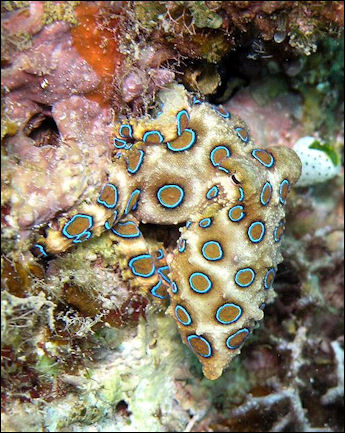
blue-ringed octopus Poisonous marine creatures like lionfish, stone fish and sea snakes are basically gentle and only attack if provoked. Scuba divers generally approach such creatures with little to fear. Though venom has evolved 18 separate times in 2,500 venomous fish species, fish venom is understudied, Leo Smith, an associate professor of ecology and evolutionary biology at the University of Kansas, told the New York Times.
Flower urchins (Toxopneustes pileolus) are the world’s most dangerous sea urchin according to the Guinness World Records. Spines and appendages deliver venom causing paralysis, breathing problems, and intense pain. Found in Indo-West Pacific seagrass beds and reefs; grows up to 28 centimeters (15 inches) across. [Source: Megan Shersby, Live Science, August 28, 2023]
Striped pyjama squids (Sepioloidea lineolata) are both venomous and poisonous. They are a species of small Australian cuttlefish (not squids) that grow up to five centimeters (two inches) long and are also known by name of striped dumpling squids. Their bite contains tetrodotoxin, the toxon found in pufferfish and their skin secretes toxic slime.
Crown-of-thorns starfish (Acanthaster planci) are as venomous as they are large. They are covered in sharp spines, found throughout the Indo-Pacific. They feed by extruding their stomachs and wrapping them around corals to digest the tissues. Stings cause pain, swelling, vomiting, and in rare cases severe allergic reactions or death.
RECOMMENDED BOOKS:
“Strange Sea Creatures Hardcover” by Erich Hoyt Amazon.com
“The Extreme Life of the Sea”“ by Stephen and Anthony Palumbi, Princeton University Press (2014) Amazon.com
“Biological Oceanography” by Charles B. Miller (2004) Amazon.com
“Biological Oceanography: An Introduction” by Timothy R. Parsons (1993) Amazon.com
“The Marine World: A Natural History of Ocean Life” by Frances Dipper (2016) Amazon.com
“Marine Biology For The Non-Biologist” by Andrew Caine Amazon.com
“Introduction to the Biology of Marine Life:” by John Morrissey, James L. Sumich Amazon.com
“Dive into the Ocean: Exploring Different Types of Sea Life” by Shane McAleer , Cameron McAleer, et al. (2023) Amazon.com
“The Soul of an Octopus: A Surprising Exploration into the Wonder of Consciousness” by Sy Montgomery (2015), a book about marine biology, with an emphasis on the intelligence and consciousness of octopuses. Amazon.com
“Ocean, New Edition (DK Definitive Visual Encyclopedias)” Amazon.com
“Oceanology: The Secrets of the Sea Revealed” (DK Secret World Encyclopedias) Amazon.com
“The Unnatural History of the Sea” by Callum Roberts (Island Press (2009) Amazon.com
“Ocean: The World's Last Wilderness Revealed” by Robert Dinwiddie , Philip Eales, et al. (2008) Amazon.com
“The Sea Around Us” by Rachel Carson, an influential work that highlights the importance of ocean conservation (1950) Amazon.com
“The Life & Love of the Sea” by Lewis Blackwell Amazon.com
“Blue Hope: Exploring and Caring for Earth's Magnificent Ocean” by Sylvia Earle (2014) Amazon.com
“National Geographic Ocean: A Global Odyssey” by Sylvia Earle (2021) Amazon.com
Blue-Ringed Octopuses
Blue-ringed octopuses (Hapalochlaena) are diminutive creatures that get their names from the blue markings the animals display when they are aroused or disturbed. Adults are generally 15 centimeters or less in length. They wards off predators with tetrodotoxotin and catch prey such as crabs with a second, less-potent toxin. The arousal display includes a wide array of indigo rings and lines along their mantle and arms.
The four species of blue-ringed octopuses are all extremely venomous. The tetrodotoxin they carry is 1,000 times stronger than cyanide and is found in their tissues, making them both venomous and poisonous. Their blue rings flash when threatened. Bites are often painless but can cause rapid paralysis and respiratory failure; death can occur within 20 minutes to 24 hours. Only a few human deaths are documented. [Source: Megan Shersby, Live Science, August 28, 2023]
Blue-ringed octopuses are native to Australia, the Indian Ocean and Pacific Ocean. They are most commonly seen in rocky, shallow pools of water or in shallow corals or reefs and can also found under rocks in sandy or muddy stretches of bottom where alga is plentiful. They are particularly common after storms when they search around for crabs and bivalves. [Source: Ashleigh MacConnell, Animal Diversity Web (ADW) /=]
Blue-ringed octopuses have striking colors and lack an ink sac and therefore are desired by aquarium enthusiasts. The trade of these octopus is frowned by toxicologists who feel that the people buying and selling them are uninformed of about the danger they pose. This species also is used for its venom. Australia has a venom industry, whose main purpose is to supply toxins for medical research. /=\
See Separate Article: BLUE-RING OCTOPUSES: VENOM, SPECIES, CHARACTERISTICS, VICTIMS ioa.factsanddetails.com
Box Jellyfish
Box jellyfish— which are found off mostly of the north and northeast coast of Australia and to a lesser degree in Southeast Asia and other parts of the world— are one of the world’s most venomous creatures. Victims sometimes die within three minutes and over 80 people have died from their stings off of Queensland alone since 1880. [Source: William Hammer, National Geographic August 1994]
Box jellyfish have bells up to 30 centimeters (0ne foot) and tentacles that reach three meters (10 meters). Venom is injected via specialized cells in the tentacles called nematocysts. The powerful venom causes intense pain, paralysis, and heart failure within minutes. What makes them particularly dangerous is the fact that their translucent box-shaped bodies and 60 spaghetti-like tentacles are difficult to see. They are also known as marine stingers or sea wasps. [Source: Megan Shersby, Live Science, August 28, 2023]
Box jellyfish, named for their body shape, have tentacles covered in biological booby traps known as nematocysts — tiny darts loaded with poison. People and animals unfortunate enough to be injected with this poison may experience paralysis, cardiac arrest, and even death, all within a few minutes of being stung.But of the 50 or so species of box jellyfish only a few have venom that can be lethal to humans.
See Separate Articles:
BOX JELLYFISH: CHARACTERISTICS, SPECIES AND VENOM ioa.factsanddetails.com ;
BOX JELLYFISH: STINGS, VICTIMS AND DEATHS ioa.factsanddetails.com
Irukandji Jellyfish

Irukandji box jellyfish(Carukia barnesi) are tiny but highly dangerous box jellyfish. Both tentacles and bell can sting. Initial sting is mild, but Irukandji syndrome—severe pain, high blood pressure, lung fluid, and cardiac issues—develops 20–40 minutes later. Australia sees 50–100 hospitalizations yearly. About 25 species can cause the syndrome, but C. barnesi is the classic culprit. The name "Irukandji" comes from the Aboriginal people in the Cairns area of Australia, where the species occurs frequently. [Source: Megan Shersby, Live Science, August 28, 2023]
Irukandji Syndrome is the name of the illness that occurs after someone has been sting by a Irukandji box jellyfish. It causes waves of intense aches all over the body, severe cramps, nausea, vomiting, fever and anxiety. Twenty five species of box jellyfish can cause Irukandji syndrome, but Carukia barnesi is the one usually associated with it. Australian toxicologist Jamie Seymour made a documentary about the jellyfish called Killer Jellyfish.
There are several similar species of Irukandji jellyfish. Adults are about a cubic centimeter (0.061 cubic inch), in size. They are both one of the smallest and one of the most venomous jellyfish in the world. They inhabit the northern marine waters of Australia, and cost the Australian government $AUD 3 billion annually through tourism losses and medical costs associated with stings. In 2015, North Queensland researchers discovered evidence that Irukandji jellyfish actively hunt prey. [Source: Wikipedia]
See Separate Articles:
IRUKANDJI (EXTREMELY SMALL KILLER BOX JELLYFISH): CHARACTERISTICS, SPECIES AND VENOM ioa.factsanddetails.com ;
IRUKANDJI JELLYFISH: STINGS, VICTIMS AND DEATHS ioa.factsanddetails.com
Portuguese Man O’ War
.jpg "20120518-jellyfishPortuguese_Man-O-War_(Physalia_physalis).jpg")
Portuguese Man-of-War The Portuguese man o’ war (Scientific name: Physalia physalis) is often called a jellyfish, but is actually a species of siphonophore, a group of animals that are closely related to jellyfish. A siphonophore is unusual in that it is comprised of a colony of specialized, genetically identical individuals called zooids — clones — with various forms and functions, all working together as one. Found mostly in tropical and subtropical seas, men o' war are propelled by winds and ocean currents alone, and sometimes float in legions of 1,000 or more! [Source: NOAA]
Portuguese men o' war have stinging tentacles that can be about 10 meters (30 feet) long and are used to catch and paralyze fish. These tentacles can cause a painful sting when touched by humans, even when a Portuguese man of war is dead. The toxin is very potent and can cause excruciating pain, shock and fever. Deaths have been recorded, but cases are extremely rare.
Portuguese man-of-war are been found in the Atlantic Ocean, the Pacific Ocean, the Indian Ocean, the Caribbean, and the Sargasso Sea. They float on or near the surface of the water and can be found in coastal areas and the open sea. They are often seen along the Florida Keys and the Atlantic coast, in the Gulf Stream, the Gulf of Mexico, the Indian Ocean, the Caribbean Sea, and other warm areas of the Atlantic and Pacific oceans. They are especially common in the warm waters of the Sargasso Sea.
See Separate Article: PORTUGUESE MAN-OF-WAR: CHARACTERISTICS, REPRODUCTION AND STINGS factsanddetails.com
Cone Snails
There are more than 1,000 species of cone snails, which are in in the “ Conus” genus. Their conical-shaped shells feature an endless variety of intricate patterns created from repeating triangles, strips, spots and cobblestones. But don't let their good looks fool you. These mollusks are predatory and have venom-filled, harpoon-like modified teeth that they use to paralyze their prey — usually small fish, invertebrates and other cone snails. [Source: Megan Shersby, Live Science, August 28, 2023]
Cone snails range in size from grape-size to pear-size and are among the slowest moving of all mollusks. They rely on their poison for both defense and to catch prey. Some cone snails are quite aggressive. They can actively reach out to sting prey or potential predators.
The geography cone snail Conus geographus) is the most deadly cone snail. It contains a venom so powerful that human victims can quickly go into a coma and die within several hours. Geography cone snails can grow up to 15 centimeters (6 inches) long. They are estimated to have more than 10,000 active compounds in their venom, and a sting can cause respiratory paralysis resulting in death. According to a study published in 2016 in the International Journal of Clinical Pharmacology and Therapeutics, geography cone snails have been responsible for about 15 deaths in the last 30 years. [Source: Megan Shersby, Live Science, August 28, 2023]
See Separate Article:DEADLY CONE SNAILS: CHARACTERISTICS, TOXINS, DEATHS AND DRUGS ioa.factsanddetails.com
Stonefish
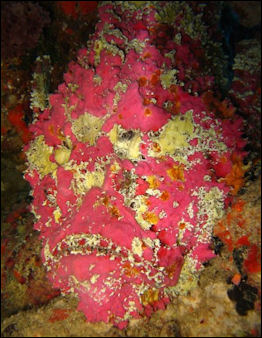
stonefish Stonefish are the world's most venomous fish. They are also amazingly well camouflaged. Some species look like small boulders covered with red and green algae, and even if you are looking straight at one it is difficult to make out were the mouth and eyes are and tell the front of the fish from the back. Spines on the fishes' back contain a powerful venom that is released under pressure — such as when someone steps on them . Always make sure you have on a pair of foot-covering flippers if you are anywhere in a place with stone fish because the way most people are stung is by steeping on one. [Source: David Doubilet, National Geographic, November 1987 ┭]
Stonefish are found through the South Pacific and Indian Oceans. The sting causes extreme pain, swelling and rapid paralysis, but is rarely fatal. Dozens of people are stung by stonefish in Australia every year. While most are mild cases requiring a short hospital stay, extreme cases can result in respiratory difficulties, convulsions, heart failure and death. In 2018, an 11-year-old boy died after a stonefish sting led to pulmonary edema. If stung by a stonefish, immerse your foot in hot water to relieve the pain. [Source: Megan Shersby, Live Science, August 28, 2023]
Stonefish have venom on each of their thirteen spines. "The sting is so excruciating," says Doubilet, "that people have begged for death and sometimes gotten their wish...The pressure of a victim's hand foot or hand on a dorsal spine pushes back a fleshy sheath containing venom glands, squeezing venom up two grooves on the needle-sharp spine. In a sense the victim shoots itself. Even the sting of a dead stonefish can be disabling.” An antivenin developed in Australia is effective against several bit all of the stonefish species. ┭
See Separate Article: VENOMOUS REEF FISH: SCORPIONFISH, STONEFISH AND STARGAZERS ioa.factsanddetails.com
Lionfish are venomous fish that get their name from their feather-like dorsal fins. They have also been called zebrafish because of their brown and white striped bodies and turkeyfish because of the flappy skin under their chin. There are different species of lionfish such as the zebra lionfish and the twinspot lionfish which display species-specific pectoral fins when threatened or trying to attract females .[Source: David Doubilet, National Geographic, November 1987 ┭]
Lionfish
Lionfish are carnivores that feed on small crustaceans and fish, including the young of important commercial fish species such as snapper and grouper. They are native to the Pacific Ocean and Indian Ocean, but are now established along the southeast coast of the U.S., the Caribbean, and in parts of the Gulf of Mexico. Since lionfish are not native to Atlantic waters, they have very few predators.
Lionfish belong the genus Pterois and characterized by conspicuous warning coloration with red or black bands, and ostentatious dorsal fins tipped with venomous spines. They can are generally found around the seaward edge of shallow coral reefs, lagoons, rocky substrates, and on mesophotic reefs at depths down to and past 100 meters (330 feet), They and can live in areas of varying salinity, temperature, and depth and frequently found in turbid inshore areas and harbors, They have also been called a devil fish, firefish, red lionfish, scorpion-cod, zebrafish, ornate butterfly-cod, featherfins, butterfly cod, Indian lionfish, soldier lionfish, and poison scorpion. Pterois species are popular aquarium fish. [Source: NOAA, Wikipedia]
See Separate Articles:
LIONFISH: CHARACTERISTICS, BEHAVIOR AND MATING ioa.factsanddetails.com ;
LIONFISH SPECIES: FIREFISH, TURKEYFISH AND INVASIVE SPECIES ioa.factsanddetails.com
Sea Snakes
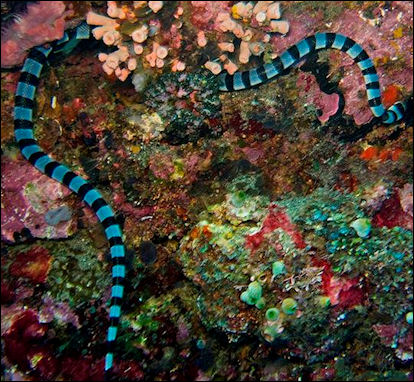 Sea snakes are found throughout the tropical western Pacific and Indian oceans, and are particularly numerous around Australia. The Philippines and Indonesia. Even though some species have some of the world's most toxic venoms, they are not aggressive and rarely present a threat to humans or cause human injuries or fatalities. Generally they do not bite unless they are handled. Often they don't even release venom when they bite. They are not found in the Atlantic Ocean or the Caribbean Sea.
Many sea snakes look the same: namely they have black and white bands. Only a few species are black above and yellow underneath. Their rudder-like tail is very distinctive. Sometimes they come on beaches. Stay away from them. They lay very still on the beach, but can be very much alive. Many sea snakes bite defensively if grabbed but unprovoked attacks are rare. They also are very clumsy on the beach. It is very hard for them to move on the sand. Keep always in your mind that the poison of some of the seasnakes is probably four times as potent as the poison of the king cobra.
Sea snakes, or coral reef snakes, are elapid snakes (of snakes characterized by their permanently erect fangs at the front of the mouth) that inhabit marine environments for most or all of their lives. They encompass two subfamilies — Hydrophiinae and Laticaudinae. Hydrophiinae also includes Australasian terrestrial snakes, Laticaudinae only includes the sea kraits (Laticauda), of which three species are found exclusively in freshwater..Most sea snakes are venomous. [Source: Wikipedia]
See Separate Article: SEA SNAKES: VENOM, CHARACTERISTICS, BEHAVIOR ioa.factsanddetails.com ; SEA SNAKE SPECIES ioa.factsanddetails.com
Pufferfish (Fugu)
Japanese pufferfish (Takifugu rubripes) is one of the best-known pufferfish species due to it being commercially farmed for human consumption. The majority of pufferfish species are toxic, with their skin and organs accumulating tetrodotoxin through bacteria in their diet. According to Live Science around 50 people die from pufferfish poisoning in Japan every year but that figure seems way to high. [Source: Megan Shersby, Live Science, August 28, 2023].
Eating “fugu”, Japanese puffer fish, has been called the gastronomic equivalent of playing Russian roulette. A powerful poison is found in the fugu's ovaries, kidneys, skin, eyes, liver and intestines. It is one of the most toxic substances known, hundreds of times more poisonous than strychnine or cyanide and so deadly that just of trace of it can kill an adult man in minutes. [Source: Noel Vietmeyer, National Geographic]
There are more than 120 species of puffer fish with differing poison capacity. Migaki fugu refers to fugu that has had its poisonous parts removed. The most dangerous part of the fish is the liver, which Japanese say is also near the tastiest meat. The methods for removing the poison from the liver are not always reliable. The best fugu chefs leave in just enough poison so it tingles the lips and gives one a tastes of the fragility of life.
Despite all this fugu is popular dish. Japanese eat 10,000 tons of fugu a year. There are 80,000 fugu chefs in Osaka alone. Fugu is considered a winter delicacy, typically eaten in December and January. Blowfish is also known as puffer fish and globefish. The fish of choice in Japan is “torafugu”, a species that is found in Japanese waters. The best fugu is said to some from Shimonoseki. Even though fugu is very poplar in Osaka, Tokyo is the nation's largest consumption center of the fish.The word “fugu” is made of two Chinese characters meaning “river” and “pig.”
See Separate Articles: FUGU (BLOWFISH): POISON, ZOMBIES AND EATING AND FARMING IT factsanddetails.com
Image Sources: Wikimedia Commons
Text Sources: “Encyclopedia of World Cultures, Volume 2: Oceania,” edited by Terence E. Hays, 1996, National Geographic, Live Science, Metropolitan Museum of Art, Natural History magazine, Australian Museum, New York Times, Washington Post, Los Angeles Times, Smithsonian magazine, Encyclopedia.com, Times of London, Library of Congress, The Conversation, The New Yorker, Time, BBC, CNN, Reuters, Associated Press, AFP, Lonely Planet Guides, Google AI, Wikipedia, The Guardian and various websites, books and other publications.
Last updated November 2025