
Home | Category: Nature, Environment, Animals
FROGS IN NEW ZEALAND
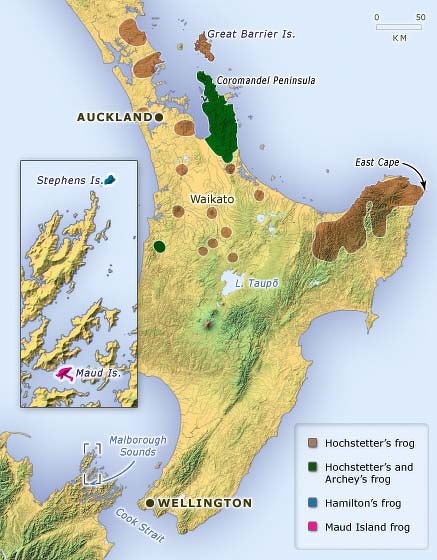
location of New Zealand's endemic frogs
New Zealand has only three native amphibian species, all of which are primitive frogs from the genus Leiopelma. These are Archey's frogs, Hamilton's frogs, and Hochstetter's frogs. Maud Island frogs, previously thought to be a separate species, are now considered the same species as Hamilton’s frog. In addition to these native species, there are three introduced frog species that are also found in the country. There are no native salamanders in New Zealand.
New Zealand are unique They are small, nocturnal and hard to see as they camouflage themselves well. Two species, Archey's and Hamilton's frog, live on land in shady, moist forested areas, and the Horchstetter's frog is semi-aquatic, living on stream edges. New Zealand's native frogs have several distinctive features that make them very different from frogs elsewhere in the world: they have no external eardrum and don't croak regularly like most frogs. [Source: New Zealand Government Department of Conservation (DOC)]
All native New Zealand frogs (pepeketua in Māori) share tail-wagging muscles, inscriptional ribs, round pupils (most frogs have slit-shaped pupils, and lack eustachian tubes ( narrow passages that connect the middle ear to the back of the throat) , and vocal sacs. in some ways more similar to salamanders than modern frogs, they use chemical signals over acoustic signals to mark habitat and recognize competitors. [Source: Wikipedia]
Archey’s and Hamilton’s frog don't have a tadpole stage. The embryo develops inside an egg, and then hatches as an almost fully formed frog with developed back legs, but with a tail. Parents then care for their young. Male Archey's frogs carry their young around on their back. Hochstetter’s frog, which is semi-aquatic, does have a tadpole-like stage and the embryos can swim after hatching.
Subfossil remains indicate all native species were once widespread across New Zealand until roughly 200 years ago and the decline is believed to have been mainly caused by Invasive species such as rats, cats, stoats, weasels, goats, and pigs. The three invasive frog species in New Zealand are the Green and Golden Bell Frog (Litoria aurea), the Southern Bell Frog (Ranoidea raniformis), and the Southern Brown Tree Frog (Litoria ewingii), also known as the whistling frog. All three species were introduced from Australia and can be distinguished from native New Zealand frogs by their loud mating calls, horizontal pupils and visible external eardrums. The three introduced species all pass through a tadpole stage.
RELATED ARTICLES:
FROGS AND TOADS: CHARACTERISTICS, BEHAVIORS, ODDITIES factsanddetails.com
AMPHIBIANS: CHARACTERISTICS, TYPES, THREATS factsanddetails.com
FROGS IN AUSTRALIA: UNUSUAL, THREATENED, EXTINCT AND REDISCOVERED SPECIES ioa.factsanddetails.com
CANE TOADS IN AUSTRALIA: CHARACTERISTICS, BEHAVIOR AND REPRODUCTION ioa.factsanddetails.com
CANE TOAD PESTS IN AUSTRALIA: WILDLIFE AND EFFORTS TO GET ROD OF THEM ioa.factsanddetails.com
Archey's Frogs
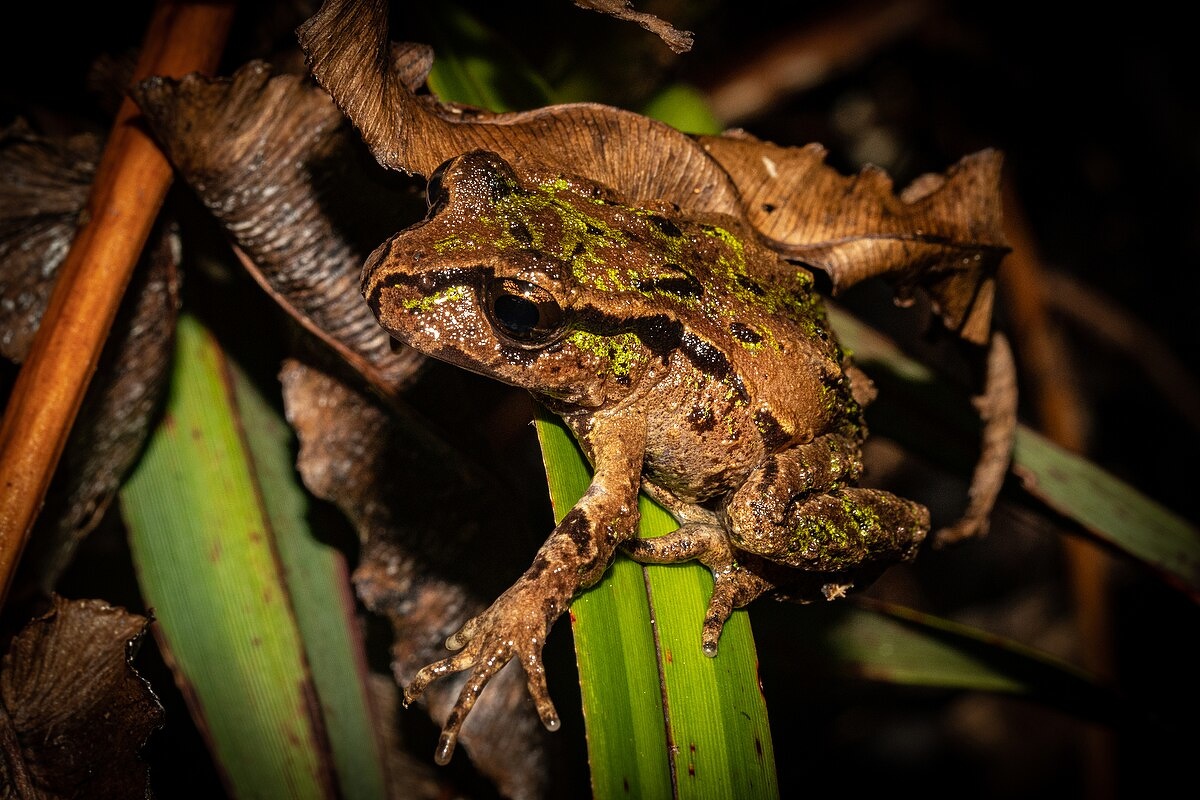
Archey's frog
Archey's frogs (Leiopelma archeyi) are the smallest native frog in New Zealand. Growing up to 3.7 centimeters (1.5 inches) long, they are nocturnal and were first described as a separate species in 1942. They generally reside in damp forest habitats above 400 meters, (1312 feet) but has been found as low as 100 ro 200 meters (333 to 665 feet) above sea level on the Coromandel Peninsula on the North island of New Zealand. Archey's frogs are named after Sir Gilbert Archey, a New Zealand zoologist, expert on New Zealand frogs and former Director of the Auckland Institute and Museum. [Source: New Zealand Government Department of Conservation, Wikipedia]
Archey's frogs are only terrestrial frog found on mainland New Zealand and one of the world's most primitive frog species. Almost unchanged from their 150 million-year old fossilised relatives, they mainly eat insects and lack many typical traits of modern frogs. They have no ears, they do not vocalise, and can not jump very well. At 3.7 centimeters females are larger than males, who are around 3.1 centimeters (1.2 inches) in length. These frogs lack webbing on their hind feet, and they have primarily smooth skin and mostly black eyes. The species can be distinguished from Hochstetter's frog by their smoother skin, longer digits, typically smaller size and lack of webbed toes on their hind feet.
Archey's frogs are mottled red, green and brown in color are master of camouflage. Their patterns are so distinctive and different that New Zealand’s Department of Conservation (DOC) uses them to individually identify the frogs in its monitoring programme. DOC uses an innovative photo stage method to identify Archey's frogs. Images taken with the photo stage are used to identify individual frogs to help us monitor and better understand ’if populations are stable, increasing or in decline and if predator control is working.
Archey's frogs are primarily active at night and hide under rocks in the day. They are mostly terrestrial, occasionally spending time in the lower branches of trees, and can live up to 35 years. The breeding season occurs between September and November, with females laying clutches four to 15 translucent eggs, about 8–11 millimeters (0.31–0.43 inches) in size, between December and February. The equivalent of tadpoles develop on land within gelatinous egg capsules. Upon hatching, tailed froglets crawl onto the male's back and are carried around until metamorphosis is complete several weeks later. Males appear to be the primary care providers, and may prepare "nests" they guard for the eggs, secreting antimicrobial peptides onto them, to ensure successful embryonic development. Froglets remain with males for between three and four years. Adult frogs do not produce a mating call and instead are believed to communicate with chemical signalling. These frogs are capable of vocalizing; they sometimes give startle calls when threatened by predators.
Endangered Archey's Frogs
Archey's frogs are is listed as Critically Endangered on the International Union for Conservation of Nature Red List of Threatened Species. The population of Archey's frogs was previously estimated to be between 5,000 and 20,000 mature individuals, but recent research has revised the population to over 100,000 individuals, thanks to new survey data on the Coromandel Peninsula, The main threats to their survival are predation by introduced mammals, such as rats, and the spread of the amphibian fungal disease, chytridiomycosis. [Source: New Zealand Government Department of Conservation, Wikipedia, Google AI]
Archey's frogs and are fed on by a number of invasive species such as rats, mice, pigs, stoats, hedgehogs, possums, cats and introduced frogs. Archey’s frog are especially at risk to predation from rodents (rats and mice). Browsing animals such as goats, deer and pigs can also damage their forest habitats by eating plants and trampling undergrowth.
Archey's frog are found in only three locations: 1) Coromandel Peninsula, 2) Whareorino Forest and 3) Pureora. The Coromandel Peninsula the population declined by up to 88 percent in the late 1990s and early 2000s. While the population appears stable at a key monitoring site, numbers have not bounced back to those of the 1990’s. The population at the Whareorino Forest frog protection area is stable or increasing at monitored sites where predator control is in place but has declined where predator control is absent. Pureora is home to a successfully translocated population, The frogs were first transferred in 2006; more were brought in in 2016. The population is establishing well and protected by predator control.
Efforts to protect Archey’s frog are part of DOC’s National Predator Control Programme. At Whareorino Forest, biodegradable 1080, bait stations and self-resetting traps are used to control rodents. With frogs stable or increasing at monitoring sites where pest control is undertaken, predator control has been expanded to cover the entire Archey's frog 600 hectare range in Whareorino. Whareorino and Coromandel are the last strongholds for Archey’s frogs and the predator control at Whareorino is a nationally important native frog conservation project. Auckland Zoo have a captive programme dedicated to developing captive breeding techniques.
Hochstetter's Frogs
Hochstetter's frogs (Leiopelma hochstetteri) are also known as Hochstetter's New Zealand frogs. Primitive and Semi-aquatic. They are the most widespread New Zealand frog and found mostly in fragmented populations in northern North Island. hey are dark brown or dark in color and have partially webbed feet, yellow bellies, dark bands has more warts than the other native frogs. Males are are smaller than females. Males reach 3.8 centimeters (1.5 inches) and females reach five centimeters (2.0 inches) in snout–vent length.[Source: Wikipedia, New Zealand Government Department of Conservation]
Hochstetter's frogs are nocturnal, staying under leaf litter and the like during the day. Hochstetter's frog prefers moist gaps under shaded debris, like rocks and logs and along streams and seepages in native temperate rainforest. They prey on invertebrates such as spiders, beetles, and mites.Hochstetter's frogs poor hearing is complemented by their lack of vocalization.

Hochstetter's frog
Hochstetter's frogs can live to 30 years old. Adults do not breed until they are three years old, laying up to 20 eggs each season. As the only semiaquatic species of the three New Zealand frog species, Hochstetter's frogs develop as tadpoles inside the egg, as the two others, hatching as froglets with developed back legs and tail, but continue to develop in water while the two other species are cared for by their parents.
In the past Hochstetter's frogs span the upper North Island, including the Waitākere and Hunua Ranges, the Coromandel Peninsula, Great Barrier Island, Maungatautari Ecological Island, and the East Coast. Ten populations have have been found to be genetically distinct, owing to the history of glacial isolation. Currently Hochstetter's frogs survive in fragmented populations across the North Island between Whangārei and the Waikato Region, and can also be found on Great Barrier Island. They have sighted at Waipu in the upper North Island, and in the Coromandel, Waikato, central North Island and Raukumara Ranges.
Hochstetter's frogs have been listed on the IUCN Red List as as a species of "Least Concern" since a a 2015 assessment. Before that they were listed as "Vulnerable". However, under New Zealand's own classification system, the New Zealand Threat Classification (NZTCS), the species is still considered "At Risk–Declining". Their greatest threats are invasive species and habitat loss and degradation. Invasive species like rats, goats, and pigs have caused declines in their population in the past and probably still continue to do so.
Hamilton's Frogs
Hamilton's frogs (Leiopelma hamiltoni) are also known as Stephen's Island frog. One of the world's most endangered and ancient frogs, they were discovered in New Zealand in 1917 and are believed to be a close relative of the world's first frogs. They don't have webbed feet and are virtually identical to frogs that lived from 275 million to 170 million years ago, These frogs are is named in honour of Harold Hamilton the collector of the type specimen.
Fossil records show that Hamilton's frogs were once spread from Waikato south of Auckland in the North Island to Punakaiki in the central South Island of New Zealand. Now they survive only on two offshore islands — on 1) Takapourewa (Stephens Island) in the Cook Strait between the North and South Islands and on 2) Maud Island in the Marlborough Sounds. Boyj populations are is carefully managed by the DOC. The formerly named Maud Island frog is now considered genetically similar enough to Hamilton’s frog to be the same species. The populations of this species on Maud Island and Takapourewa (Stephens Island) are likely to have been separated since before people arrived in New Zealand and are managed today as separate populations. [Source: New Zealand Department of Conservation]
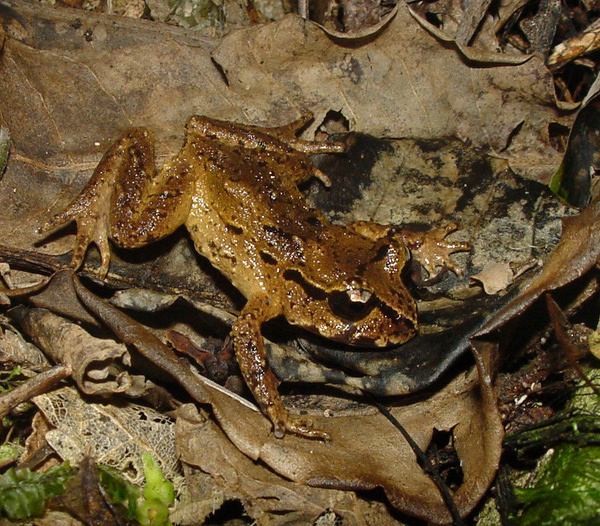
Hamilton's frog
Stephens Island is located in the Marlborough Sounds, off of the coast of the South Island of New Zealand. The area of the island is approximately 2.6 square kilometers (one square mile), but the population resides in a 600-square-meter (6,460-square-foot) area on the southern tip. Hamilton's frogs historically inhabited coastal forests, but are now limited to a rocky area known as the “frog bank” at the peak of Stephens Island. This area was initially covered with dense vegetation, but was later deforested when grazing farm animals moved into the area. Fortunately, some of the cover was restored after 1951 when a fence was built to keep other animals out of the area. Today, the vegetation consists mainly of grasses and small vines. The many deep crevices within the rock provide a cool, moist, suitable environment for the frog to inhabit during the day. Hamilton’s frogs live in temperatures ranging from approximately eight °C in the winter to 18°C in the summer. They inhabit elevations around 300 meters (985 feet) above sea level. [Source: Jackie Carron, Animal Diversity Web (ADW) |=|]
Hamilton's frogs range in length from 3.7 to 4.7 centimeters (1.46 to 1.85 inches). Hamilton's frogs are mostly brown in color, with a dark brown or black stripe on each side of the head, running the length of the head and passing through the eye. Unlike most frogs which have slit-like pupils, Hamilton's frogs have round pupils. They have visible rows of callus-like granular glands on their back, sides, and limbs that a secrete distasteful fluid when the frog is disturbed by predators. Like other native New Zealand frogs of the family Leiopelmatidae,
Hamilton’s frogs have ribs that are not fused to vertebrae. They are cold blooded (ectothermic, use heat from the environment and adapt their behavior to regulate body temperature) and heterothermic (having a body temperature that fluctuates with the surrounding environment). Their lifespan is estimated to be between 23 and 33 years. Sexual Dimorphism (differences between males and females) is slightly present: Both sexes look similar but female are a little larger. The to snout-vent length of females range from 4.2 to 4.7 centimeters (1.65 to 1.85 inches) while that of males ranges from 3.7 to 4.3 centimeters (1.46 to 1.7 inches).
Hamilton's Frog Behavior, Diet, Communication and Senses
Hamilton's frogs are terricolous (live on the ground), saltatorial (adapted for leaping), nocturnal (active at night), motile (move around as opposed to being stationary) and sedentary (remain in the same area). They emerge after sunset from the crevices and hiding places they rest during the day and are most active on rainy nights with high relative humidity. Their social activity is unknown. These frogs appear to be solitary but the entire population lives in a relatively small area and individual live close to each other, but this seems to be largely they result of limited to habitat availability. [Source: Jackie Carron, Animal Diversity Web (ADW) |=|]
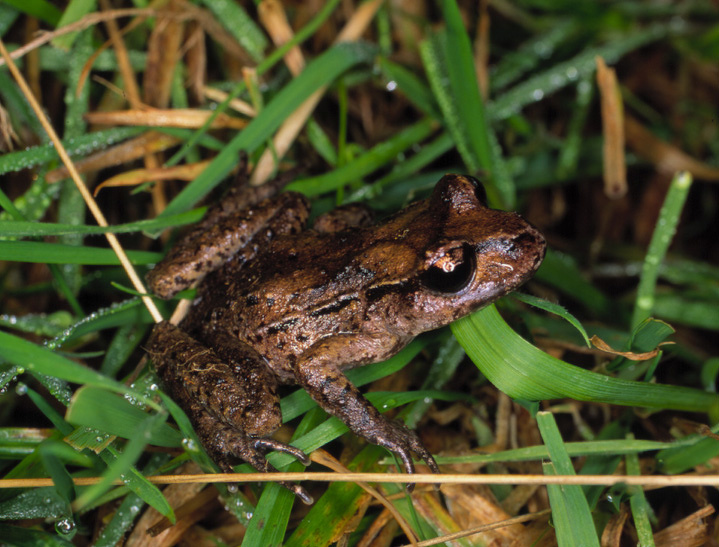
Maud Island frog
Hamilton’s frogs are carnivores (eat meat or animal parts) and are primarily insectivores (eat insects). They feedi on a wide variety of invertebrates including fruit flies, small crickets, moths, and springtails. Juveniles two centimeters in size or less lack teeth, and thus have to eat soft-bodied arthropods like mites and fruit flies. The feeding method of Hamilton's frogs is different from that of most other frogs. Most frogs use their protrusible tongues to snag prey, but because the tongues of Hamilton's frogs are attached to the floor of their mouths, frogs must move their entire heads to capture prey.
Hamilton’s frogs sense using vision, sound and chemicals usually detected with smelling or smelling-like senses and communicate with vision, touch and chemicals usually detected by smelling. They can leave scent marks produced by special glands and placed so others can smell and taste them. As Hamilton's frogs are nocturnal their eyes are adapted for seeing in low intensity light. A high ratio of receptor cells to ganglia, as well as large rod segments and relatively few cone photoreceptor cells aid their night vision. Hamilton's frogs lack an external eardrum and sound perception is limited to noises with low frequencies. Although they lack vocal chords and cannot call like other frogs, Hamilton’s frog do squeak and chirps in response to predators or during mating. The purpose of the squeaks during mating is not completely understood, but it is speculated that they might be emitted when males release sperm during mating. |=|
Hamilton's frogs use odors emitted by their feces to communicate. Chemically, the feces of each frog are somewhat different. Frogs can distinguish relatives from intruders by simply smelling a pile of feces. By defecating in a certain area, frogs are able to claim foraging territories as well as prevent intruders from coming near. If a frog encounters a pile of feces, it can determine the size of the individual who left it and decide whether to stay or flee. |=|
Hamilton's Frog Mating, Reproduction and Offspring
Hamilton's frogs are oviparous, meaning that young are hatched from eggs. Reproduction is external, meaning the male’s sperm fertilizes the female’s egg outside her body. They engage in seasonal breeding — breed once annually from October to December. The time to hatching ranges from seven to 10 weeks. The number of offspring ranges from seven to 19. On average females and males reach sexual or reproductive maturity at age three to four years. On average males reach sexual or reproductive maturity at three to four years. [Source: Jackie Carron, Animal Diversity Web (ADW) |=|]
The mating system of Hamilton's frogs is not known. Unlike other frogs, Hamilton's frogs do not use calls as a primary method of finding a mate. They lack eardrums and vocal chords, so have no way of producing or perceiving calls. Although no calling is done, Hamilton's frog has been known to emit tiny chirps or squeaks during the breeding season.Like most frogs, the mating posture for Hamilton's frogs is amplexus; a position in which the male grasps the female from behind with his forelegs. Fertilization is external, occurring during amplexus when the male and female are in close contact. |=|
Hamilton's frog eggs are laid in cool, moist places, often under stones or logs that are present on the forest floor. They are laid in multiple strings that tend to clump together. Each egg has a visible yolk that is surrounded by a clear capsule comprised of three layers: an inner vitelline membrane, a middle gel-like layer, and a protective outer coat. Before fertilization occurs, male frogs seek out and occupy a spot for the female to lay her eggs. Males have been observed to remain at these spots for weeks to months before the eggs are actually laid. After the eggs are laid, the males stay at the nest and brood the eggs. They protect them and maintain a relatively stable environment for them to develop in. |=|
The life cycle of Hamilton's frogs is characterized by metamorphosis — a process of development in which individuals change in shape or structure as they grow. These frogs undergo almost all development while in the egg. Development is direct, so tadpoles are not formed. Instead, hatchlings which resemble miniature adults emerge from the eggs. Most froglet features are the same as an adults, except for the temporary tail which eventually is lost.
Parental care is provided by males. After hatching, young climb onto the hind legs and backs of the males. Juveniles complete their development here, spending 11 to 13 weeks completing their development, undergoing such changes as the loss of the tail and further development of the limbs. This period ends when young completely lose their tail and reach a snout-vent length of 1.2 to 1.3 centimeters (about half an inch).
Hamilton's Frogs, Humans and Conservation
Hamilton's frogs are listed Critically Endangered on the IUCN Red List and classified as Threatened - Nationally Vulnerable in New Zealand. The primary threats to the species are introduced predators like rats, disease (including the potential risk of chytridiomycosis), and habitat loss. The species is primarily found on predator-free Stephens Island (Takapourewa) and Maud Island (Te Pākeka). The population on Stephens Island has about 200–300 individuals. The one Maud Island has around 19,000, though estimates vary. A third, captive population is being maintained at ZEALANDIA in Wellington, New Zealand, with successful breeding and dispersal noted in 2024, indicating positive outcomes for conservation efforts. [Source: Google AI]
The New Zealand Department of Conservation (DOC) monitors the population size, and has various conservation programs in place such as building fences around the "frog bank" to keep predators out, as well as transporting a portion of the population to nearby islands to try and expand their range. [Source: Jackie Carron, Animal Diversity Web (ADW) |=|]
DOC has created a second population of the Stephens Island frog lineage on Nukuwaiata Island. These translocations were undertaken as insurance against a disaster such as fire, disease or a predator incursion, which has the potential of wiping out all or nearly all of population lineages on Stephens Island. In 1997, 300 frogs from the Maud Island population were successfully transferred to Motuara Island — the first-ever translocation of a native frog between islands. A second translocation of 300 frogs was undertaken in 2014 to boost this population after a mouse incursion was discovered on Maud Island. In 2006, 60 frogs from the Maud Island population were translocated to Zealandia Te Māra a Tāne ecosanctuary in Wellington. [Source: New Zealand Government Department of Conservation]
Threats to Hamilton’s frogs include predation by native tuataras, as well as introduced mammalian predators like black rats. Hamilton's frogs are well camouflaged. Their cryptic brown and slightly green coloration blends in well in the rocks, logs and vegetation that make up their habitat. When Hamilton’s frogs are disturbed they stiffens their body and remain motionless and can stay this way for a long period of time. They may also stiffen in upright position with their legs extended to deter predators. Hamilton’s frogs also secrete a distasteful substance from its granular glands to prevent being eaten by the predator. Although no cases have been reported in Hamilton’s frogs yet, the species may be susceptible to a deadly fungal disease called chytridiomycosis or chytrid fungus. The disease has been has been acquired by Archey’s frogs.
Maud Island Frogs
Maud Island frogs were regarded as a separate species but are now considered a subspecies of Hamiltion’s frogs. Described the longest lived wild frogs in the world, they are found on Maud Island, three other off shore islands and Zealandia (formerly Karori Wildlife Sanctuary). These dark brown frogs grow up to five centimeters (two inches) in length and are nocturnal and are rarely seen in the day, when they seek shelter under large rocks, crevices or within boulder piles. They are most active during warm humid nights and not as much on full moons. As ambush predators, they like to sit and wait till insects come their way to catch them with their mouths. Despite not having ear drums and a tail, the frog still has the set of muscles used for tail-wagging. Without a voice or a tail to attract mates, these frogs send out chemical signals to each other. Eggs are laid under rocks or logs and the male sits over the eggs until they hatch as well formed, tailed froglets. With a average life span of 33 years they rarely travel, their lifetime range around 30 squared meters. [Source: Zealandia]
Having adapted to life without mammals, when faced with threats they 'freeze' and rely on their appearance to avoid predators. This put them at a huge risk to mammalian predators. Diseases such as Zoospores and Chytrid are also a threat. Maul Island frogs were once abundant in many parts of New Zealand and were once thought to have possibly gone extinct until they were rediscovered in the 1940s surviving only on Maud Island, a mammal free island. The a population on Maud island was estimated to be 40,000 in 2013.
Maud Island frogs successfuly bred at Zealandia in 2008. With successful translocations to Motuara Island in 1997 and less successful translocation to Long Island due to poor habitat and predation by kiwis, 60 Maud Island frogs were first transferred to Zealandia in 2006 and with another 101 in 2012. This is a huge step for Maud Island frogs as this was the 1st re-introduction of a native frog back to mainland and the first to coexsist with mice. With the release of 101 frogs outside the enclosures in 2012, 86 percent were recaptured at least once after release showing that kiwis and mice have no significant negative impact on frogs. Breeding has occured successfully between the three enclosures that the other Maud Island frogs were kept in Zealandia and outside the enclosures.
Image Sources: Wikimedia Commons
Text Sources: Animal Diversity Web animaldiversity.org , National Geographic, Live Science, Natural History magazine, David Attenborough books, New Zealand Geographic, New Zealand Tourism, New Zealand Herald, Te Ara Encyclopedia of New Zealand, New York Times, Washington Post, Los Angeles Times, Smithsonian magazine, Discover magazine, The Conversation, The New Yorker, Time, BBC, CNN, Reuters, Associated Press, AFP, Lonely Planet Guides, Wikipedia, The Guardian and various books, websites and other publications
Last updated September 2025