
FROGS IN AUSTRALIA
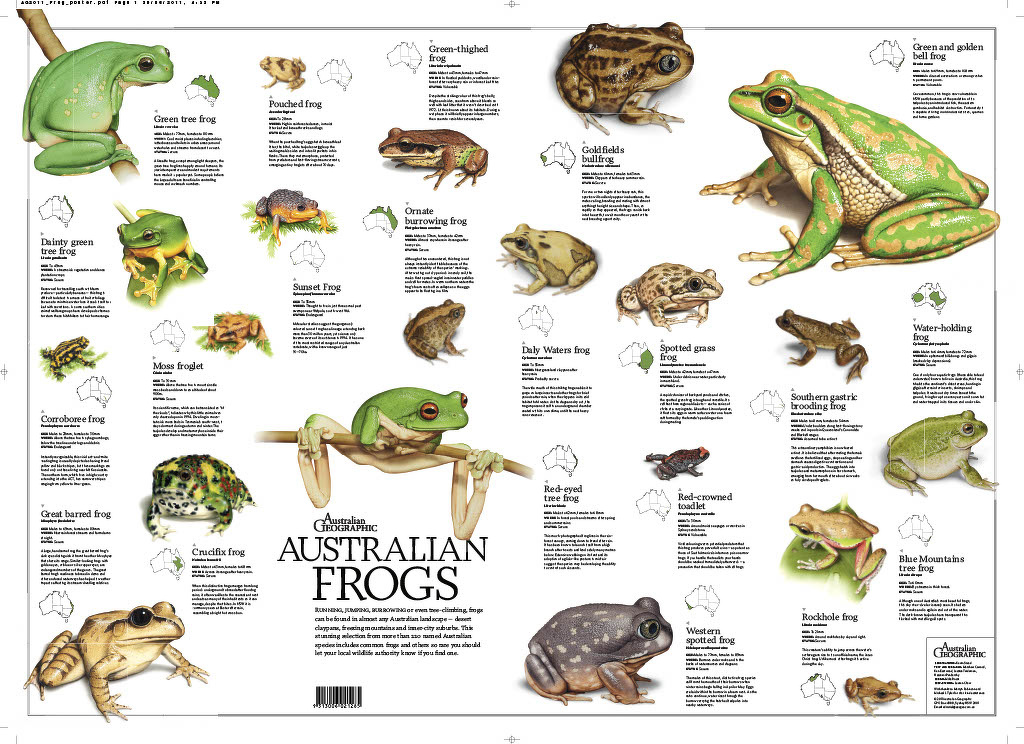
Australia is home to 240 known species of native amphibians, all of which are frogs. These frogs belong to the order Anura. A significant portion of these frog species are found only in Australia. There are no native salamander species in Australia. A small population of introduced smooth newts (Lissotriton vulgaris) has established itself in southeastern Australia, likely originating from the aquarium pet trade, according to Invasive Species Council. There is only one species of true toad found in Australia: the introduced cane toad (Rhinella marina). While many native Australian frogs are sometimes referred to as "toads" due to their appearance, they are not true toads.
Myobatrachidae, commonly known as Australian ground frogs or Australian water frogs, is a family of frogs found only in Australia and New Guinea. They vary greatly in size, from species less than 1.5 centimeters (0.59 inches) long, to the second-largest frog in Australia, the giant barred frog (Mixophyes iteratus), at 12 centimeters (4.7 inches) in length. The family Myobatrachidae are known for their unusual forms of parental care, which are unique in the animal kingdom. The two species of gastric-brooding frog (genus: Rheobatrachus), are found in this family. The females of these species swallow their young, where they develop until metamorphosis. The pouched frog (Assa darlingtoni) has pouches on the sides of its body. The male guards the eggs until hatching, and assist the tadpoles into its side, where they stay until metamorphosis.Another form of parental care, although not unique, is found in many species of the genus Limnodynastes, where the male buries himself near an egg mass, and protects the eggs.
Myobatrachidae are the dominant terrestrial frogs of Australia, filling niches that are elsewhere occupied by bufonids (toads) and other frog families: leptodactylids, microhylids, pelobatids, and ranids. All genera are found on the Australian mailand, and only a few occur anywhere else. Three genera are also known from Papua New Guinea; four from Tasmania. Heather Heying wrote in Animal Diversity Web: The Australian frogs are split almost evenly into two subfamilies, each of which have several distinct characters. Across both subfamilies, these frogs lack ribs, have eight amphicoelous presacral vertebrae, completely fused astragalus and calcaneum, and inguinal amplexus. Most myobatrachids have teeth on the upper jaw (some genera lack teeth altogether), and a cartilaginous omosternum and sternum. [Source: Heather Heying, Animal Diversity Web (ADW)

Dainty green tree frog (Litoria gracilenta) one of the most common frogs to become lost
The Myobatrachidae family is broken into subfamilies based mainly upon their egg-laying habits. Those of the subfamily Limnodynastinae lay foam nests. The female creates foam by agitating a chemical on her skin with her hands. The foam may float on top of water, or be on land. The subfamily Rheobatrachinae contains the two species of gastric-brooding frogs, and the rest are within the subfamily Myobatrachinae. Many are found in arid deserts (See Below). Other species are found in marshes (Limnodynastes, Crinia), along mountain streams (Taudactylus), or in the streams themselves (Rheobatrachus). Some species have aquatic, feeding, type IV tadpoles. Megistolotis tadpoles are adapted for torrents. The females of some species make foam nests for their young, in open water, burrows, or even on land (e.g. Kyarranus). Terrestrial eggs undergo direct development in Arenophryne and Myobatrachus. In several species, elaborate parental care has evolved. Nonfeeding tadpoles develop in the inguinal brood pouches of male Assa. Eggs and tadpoles of Rheobatrachus develop in the stomach of the mother. Both species of these "gastric-brooding frogs" may now be extinct, perhaps early victims of an epidemic disease spreading among Australian anurans in the early 1980s. |=|
Fossils of extant genera are known from the Miocene Period (23 million to 5.3 million years ago) and Pleistocene Pleistocene Period (2.6 million to 11,700 years ago) of Australia. Additionally, an extinct genus, Indobatrachus, from the Eocene Period (56 million to 33.9 million years ago), has been tentatively assigned to the Myobatrachidae. This placement raises biogeographical questions, as Indobatrachus was found in India. |=|
RELATED ARTICLES:
CANE TOADS IN AUSTRALIA: CHARACTERISTICS, BEHAVIOR AND REPRODUCTION ioa.factsanddetails.com
CANE TOAD PESTS IN AUSTRALIA: WILDLIFE AND EFFORTS TO GET ROD OF THEM ioa.factsanddetails.com
FROGS AND TOADS: CHARACTERISTICS, BEHAVIORS, ODDITIES factsanddetails.com
AMPHIBIANS: CHARACTERISTICS, TYPES, THREATS factsanddetails.com
Threatened Frogs in Australia
Populations of frogs have dropped dramatically worldwide and scientist are particularly worried about their decline in Australia. The overall numbers of amphibians dropped 15 percent a year from 1960 to 1966 and continued to decline 15 percent a year through 1997.
Scientist are not sure of why populations of frogs have dropped so dramatically. Possible explanations include loss of wetlands to development, uses of fertilizers and pesticides, depletion of the ozone layer, global warming and introduction of exotic species. A large percentage Australia’s amphibian species are threatened by severe habitat loss and disease.
The chytrid fungus has affected about 20 percent of Australia’s native frog species. Chytrid is a disease caused by a waterborne fungus that has devastated frog populations in Australia and Central America. This fungi is common in nature but until recently was not known to attack vertebrates.
Since the mid 1970s more than a dozen Queensland frog species, especially stream dwellers have experienced massive die-offs. In some Queensland’s mountains population of some kinds of frogs such as the Australian lace-lid and torrent frogs have disappeared in a few months The mountain mist frog was last seen in 1990.
Unusual Frogs in Australia
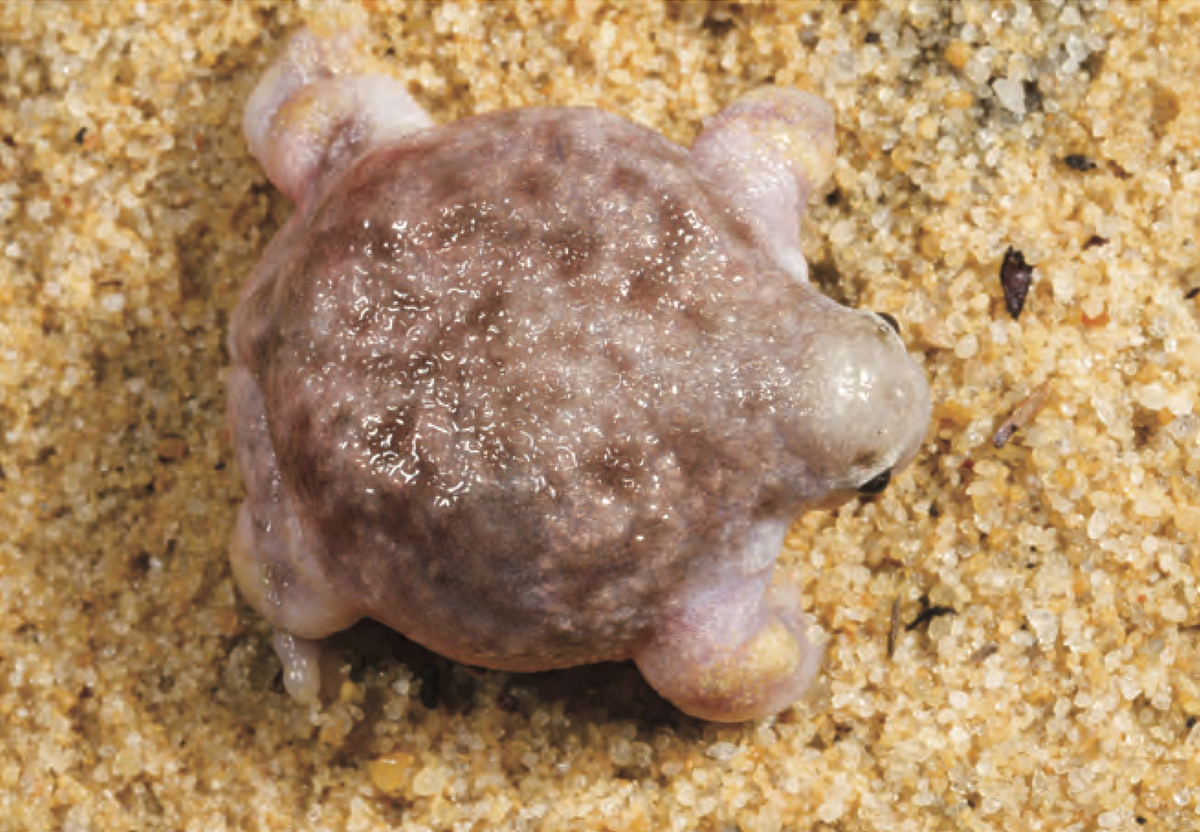
turtle frog
Australia is also the home of many bizarre species of frogs: The thumb-sized graceful tree frog looks like it was just freshly painted with black and yellow enamel paint. The bloated holy cross toad can be dug up in droughts and squeezed as a water source. Some frogs in Australia are blue melanos, which means they have too much pigment and consequently are the opposites of albinos.
The turtle frog (Myobatrachus gouldii) is an Australian frog that resembles a turtle and burrows into the ground. It is unique for its stout, turtle-like body shape, small head, and short limbs, which are well-suited for digging. This frog is endemic to southwestern Australia and spends most of its life underground, emerging primarily after rain to feed on termites. They like to burrow beneath termite mounds and spend nearly all of their awake time eating termites. Turtle frogs and sandhill frogs to lay their eggs directly into moist sand several feet below the surface, rather than into water. These species lack tadpoles, with the eggs hatching directly into miniature frogs.
Stuttering frogs (Mixophyes balbus) get their name from their unique reproductive calls, described as a series of one to four short notes in rapid succession — “krook..krook..krook.….kra-a-ak..kruk..kruk.” These frogs have flat heads, prominent snouts, large eyes and long legs. Their backs are brown but range from a copper color to a dark brown, and their skin has a green tint. In 2023, scientists from University of Newcastle, described a new species, Mixophyes australis, the southern cousin of the Mixophyes balbus. According to a university press release, the frogs are among the largest in New South Wales’ largest — growing up to about 7.5 centimeters (3 inches). The new species have shades of burnt orange or peach near their groin and their limbs have dark, horizontal stripes. [Source: Moira Ritter, Miami Herald, June 6, 2023]
Gastric Brooding Frogs — Extinct Frogs That Raised Their Young in Their Stomachs
Gastric brooding frogs were only five centimeters (two inches) long and lived in streams. They were unique in animal kingdom in that females swallowed fertilized eggs or tadpoles, shut off their digestive system, with the young hatching or metamorphosing in their mothers’ stomach with 20 or so young hopping out of her mouth in a regurgitated broth about a month later. One of the two species of Australian gastric brooding frog, discovered only in 1973, vanished seven years later; the other disappeared in 1985.
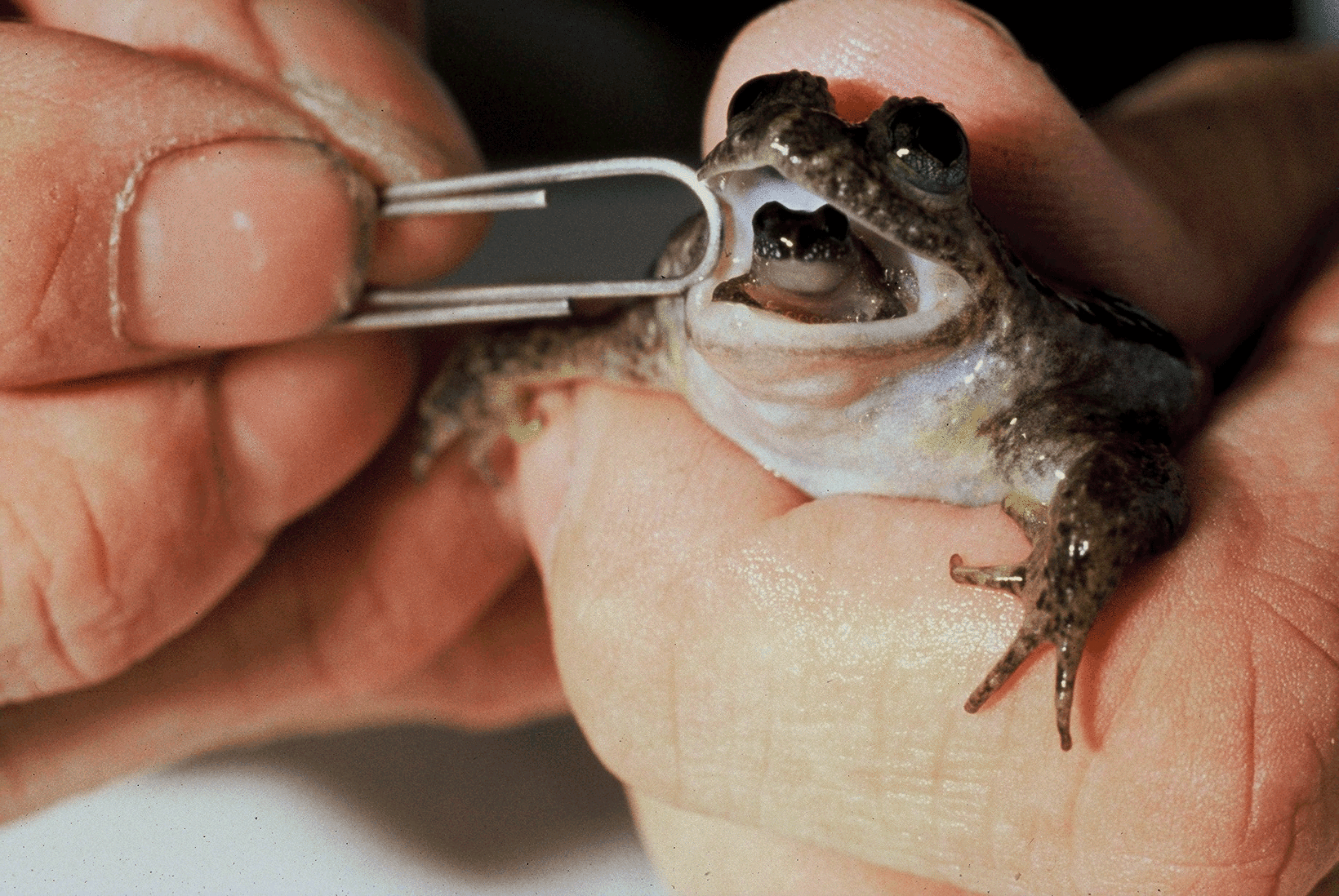
Gastric brooding frog with young in its mouth
Gastric brooding frogs were discovered in 1974 by Micheal Tyler of the University of Adelaide in the rain forests of Queensland in northeast Australia. It was considered impossible for a female to swallow her own eggs and incubated them in her stomach because it was though that the eggs would be destroyed by stomach acids. It was later discovered that the frog could turn of its output of stomach acids and shut down her digestive system when the eggs were inside her stomach. By the time drug companies were opening up to the potential of this ability the frog was extinct.
The two species of gastric-brooding frogs were known as the northern gastric-brooding frog and the southern gastric-brooding frogs. The southern gastric brooding frog was last seen in 1983 and was declared extinct in 2006. The northern gastric brooding frog was last seen in 1987 and was declared extinct in 2015. [Source: Wikipedia]
The cause for their extinction is not known. It speculated to have been due to human introduction of pathogenic fungi into their native range. Populations of southern gastric-brooding frogs were present in logged catchments between 1972 and 1979. The effects of such logging activities upon southern gastric-brooding frogs was not investigated but the species did continue to inhabit streams in the logged catchments. The habitat that the southern gastric-brooding frog once inhabited is now threatened by feral pigs, the invasion of weeds, altered flow and water quality problems caused by upstream disturbances. Despite intensive searching, the species has not been located since 1976 or 1981 (depending on the source).
Armoured Mistfrogs — Thought Extinct, Rediscovered
A tiny frog species — the 3.7-centimeters (1.5 inch) -long armoured mistfrog — thought to to be extinct was rediscovered in 2008 in a remote area of Australia's tropical north. The frog had not been seen since 1991, and many experts assumed it had been wiped out by a devastating fungus that struck northern Queensland state. In July 2008, a doctoral student at James Cook University in Townsville conducting research on another frog species in Queensland came across what appeared to be several armoured mistfrogs in a creek, said professor Ross Alford, head of a research team on threatened frogs at the university. DNA tests on tissue samples from the frogs determined they were Armoured Mistfrog. [Source: Kristen Gelineau, Associated Press, September 11, 2008]
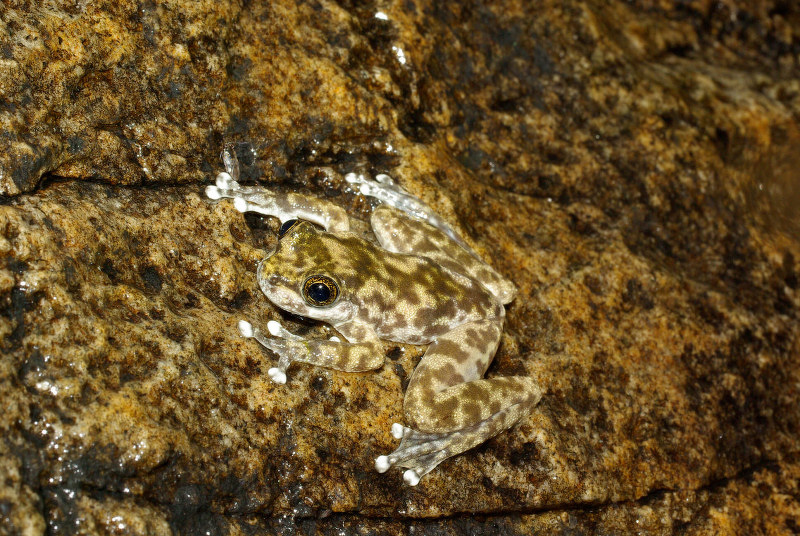
armoured mistfrog
Conrad Hoskin, a researcher at The Australian National University in Canberra who has been studying the evolutionary biology of north Queensland frogs for more than a decade said: "A lot of us were starting to believe it had gone extinct, so to discover it now is amazing, It means some of the other species that are missing could potentially just be hidden away along some of the streams up there." Craig Franklin, a zoology professor at The University of Queensland who studies frogs, said the Mistfrog's rediscovery was exciting. "It's very significant," Franklin said. "We've lost so many frog species in Australia... Hopefully it's a population that's making a comeback."
According to Associated Press: The light brown frogs, with dark brown spots, congregate in areas with fast-flowing water. So far, between 30 and 40 have been found. The chytrid fungus was blamed for decimating frog populations worldwide, including seven species in Queensland's tropics between the late 1980s and early 1990s. Armoured Mistfrogs had been classified as critically endangered rather than extinct, but most researchers believed they had died out from the disease, Alford said.
Most of the Armoured Mistfrogs that Alford's group has found are infected with the fungus, but the disease does not appear to be making them sick, he said. Alford and his team plan to study the creatures to try and determine how they managed to coexist with the fungus, in a bid to aid future conservation and management of vulnerable frogs.
Desert Frogs of Australia
Desert spadefoot frogs live under the red sands of Simpson Desert sometimes for years before emerging after a rain. Water-holdings frogs stay underground for years and emerge when it rains and feed and breeds. They store water in their bladder and under their skin during droughts. There are at least 19 species of desert frog in Western Australia alone.
According to the Western Australia Museum: Desert frogs burrow underground during the dry months, in order to escape the searing sun. They can stay underground for many months while they wait for the next rains to fall. Whilst underground, many species produce a type of cocoon with many layers of their shed skin that covers their entire body (except for the nostrils). This helps to reduce water loss.
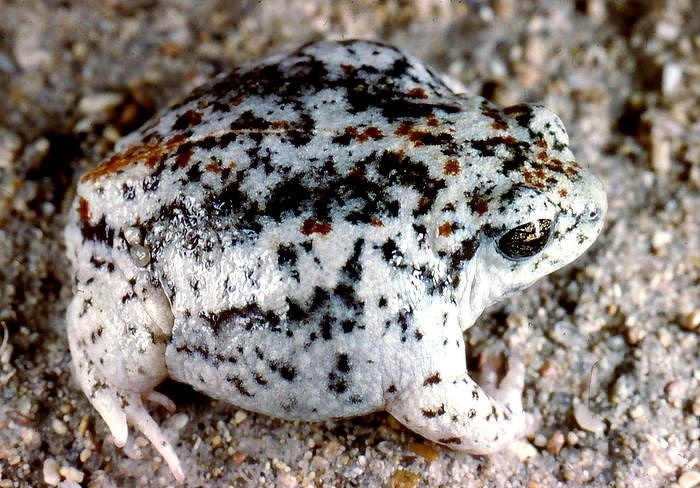
sandhill frog
Most desert frogs only reproduce in response to a significant rainfall event. Females can then lay eggs in temporary pools. Some even lay their eggs in mud. These eggs then hatch when they are eventually flooded with water, and the tadpoles can swim straight into the water! Smart. One particular type of frog, the Northern Sandhill Frog, doesn’t even need water to hatch its eggs. These babies hop right over the tadpole stage, hatching out of their eggs as tiny, fully formed versions of their adult parents.
Many desert frogs spend most of their lives underground, burrowing through sand with the help of a digging spade on each hind foot (e.g. Heleioporus, Neobatrachus). Species of Notaden also burrow, but are distinguished in having poorly ossified skulls, being brightly colored, and secreting sticky white toxins. Some fossorial (engaged in a burrowing life-style or behavior, and good at digging or burrowing), species burrow head first (Myobatrachus). [Source: Heather Heying, Animal Diversity Web (ADW)
Image Sources: Wikimedia Commons
Text Sources: Animal Diversity Web animaldiversity.org , National Geographic, Live Science, Natural History magazine, Australian Museum, David Attenborough books, Australia Geographic, New York Times, Washington Post, Los Angeles Times, Smithsonian magazine, Discover magazine, The Conversation, The New Yorker, Time, BBC, CNN, Reuters, Associated Press, AFP, Lonely Planet Guides, Wikipedia, The Guardian, Top Secret Animal Attack Files website and various books and other publications.
Last updated August 2025