
CANE TOAD PESTS IN AUSTRALIA
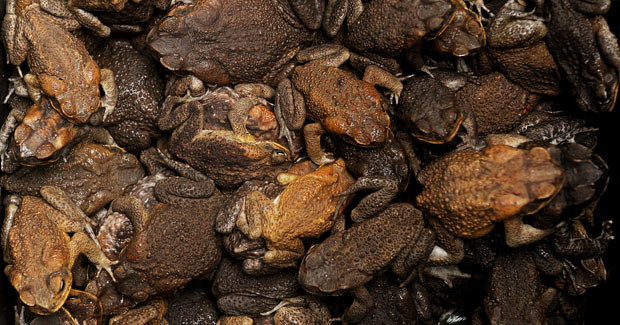
cane toads
Cane toads are considered the most widely-introduced amphibian species in the world and one of the world's most destructive introduced species. They were brought to Australia to control grey-backed cane beetle (Lepidoderma albohirtum) which threatened sugar cane production but there is no evidence that they have controlled any pest in Australia and they are now considered pests themselves not only in Australia but in all Pacific and Caribbean Islands they were also brought to. In their native range cane toads are common but there are natural ways their numbers are kept in check.
Cane toads have been described an "eco-nightmare" in Australia. They capable of covering huge distances, according to a 2006 study in the journal Nature. Cane toads can quickly colonize and take over habitats, due in part to the ability of female cane toads to produce up to 30,000 eggs in a season every year for their 10- to 15-year lifespan . Cane toads can move up to 1.8 kilometers in one night. By 2006, they were found in an area covering over a million square kilometers.
By some estimates the cane toad population in the mid 2000s was around 100 million. By the early 2020s there numbers were estimated to be over two billion. Ecologist Emily Vincent' told the BBC: "They've got an incredible breeding capacity... so with every female cane toad that's removed from the environment, it's the prevention of up to 70,000 new cane toads each year."
Frogwatch coordinator Graham Sawyer told AAP: They’re a huge problem — obviously there's millions out there and they really have no predators," he said.Frogwatch is a not-for-profit environmental organisation, focused on increasing the native frog population in the Northern Territory. "Toads are the biggest threat to frogs and other animals." [Source: AAP, September 5, 2005]
Chris Bonner, a farmer in Queensland told The Guardian: “It’s public enemy number one,” While the toads are conquering new territory in New South Wales and and Western Australia, they have been entrenched across the eastern seaboard of Queensland for decades — and so too, toad busting. “You wouldn’t be a kid in Queensland if you hadn’t hit a few toads with a golf club,” one Queensland female toad hunter said.
RELATED ARTICLES:
CANE TOADS IN AUSTRALIA: CHARACTERISTICS, BEHAVIOR AND REPRODUCTION ioa.factsanddetails.com
FROGS IN AUSTRALIA: UNUSUAL, THREATENED, EXTINCT AND REDISCOVERED SPECIES ioa.factsanddetails.com
FROGS AND TOADS: CHARACTERISTICS, BEHAVIORS, ODDITIES factsanddetails.com
AMPHIBIANS: CHARACTERISTICS, TYPES, THREATS factsanddetails.com
Impact of Cane Toads on Other Animals
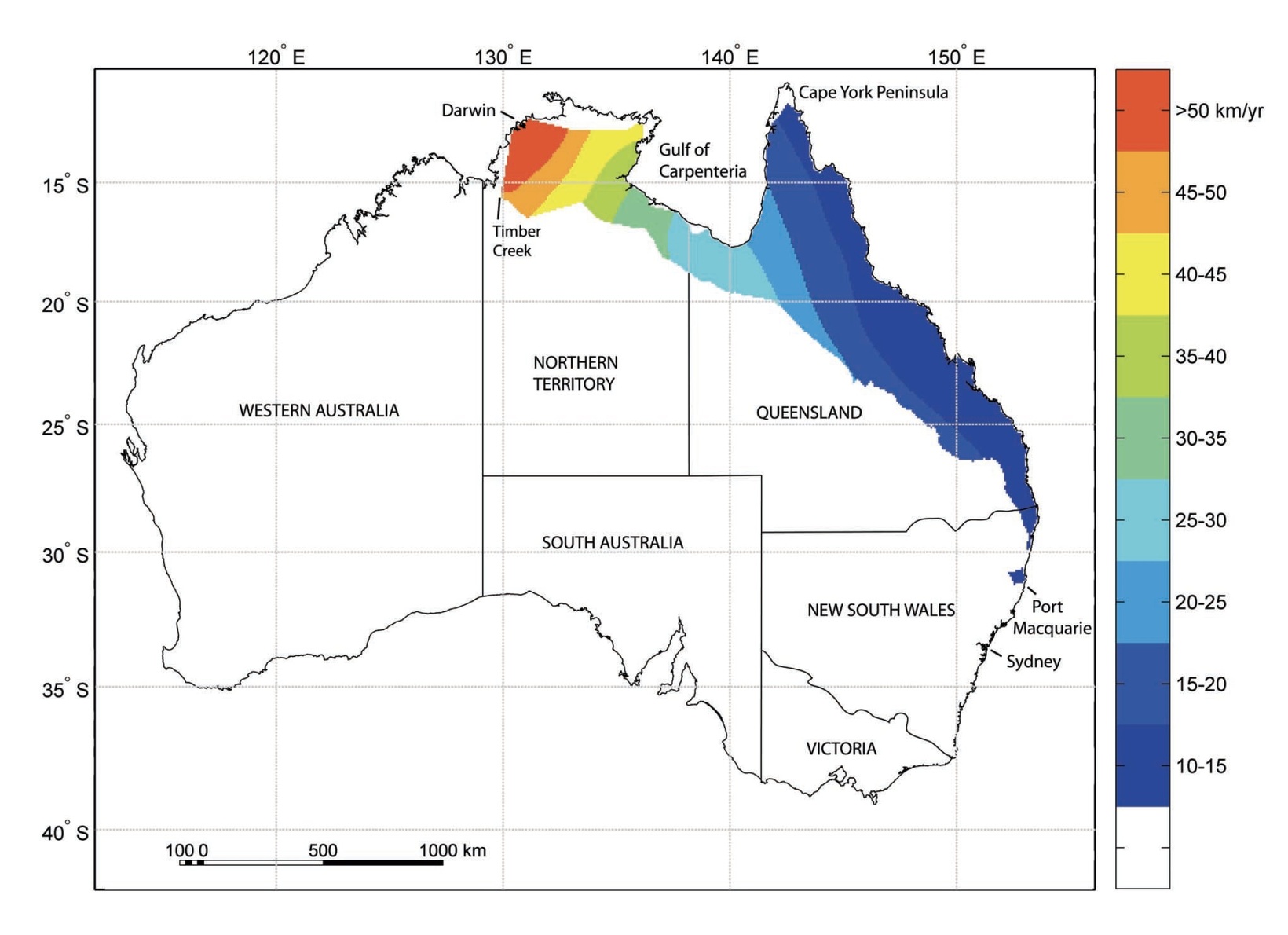
colors show speed of can toad range expansion, from 10-15 kilometers per year in the 1930s (blue) through to 50 to 60 kilometers per year by 2015 (red), from Cane Toads in Oz
Cane toads prey on and outcompete native amphibians and also causes predator declines among predators that prey on them as they have no natural immunity to the toxins cane toads secrete and have in their skin and bodies. The cane toad has been linked to the decline and extinction of several of its predators, including the northern quoll, which is now endangered in northern Australia, according to the group. [Source: Aina J. Khan, NBC News, January 20, 2023]
When harassed cane toads secrete poison carried in two sacs behind the head which can be lethal to a potential predator within minutes of being ingested. Cane toads have kill snakes, lizards, turtles, water birds — even crocodiles and dingoes — this way. Cane toads are capable of squirting venom a considerable distance if they feel really threatened, and animals that receive a dose can die within 15 minutes.
The toads are believed to be advancing across some of Australia's most remote and wildlife-rich provinces at a rate of 60 miles per year. Wildlife officials believe that their arrival in Kakadu could also have a devastating impact on self-sufficient aboriginal communities which rely on native animals for "bush tucker". Dr John Woinarski of the Northern Territory Parks and Wildlife Commission said: "A worst-case scenario would see these people forced to abandon their lands."
[Source: Barbie Dutter, January 18, 2001]
In the early 2010s, it was reported that cane toads were threatening the unique dwarf crocodiles of the Northern Territory. AFP reported: A team from Charles Darwin University studying the impacts of the foul toad in upstream escarpments found "significant declines" in numbers of dwarf freshwater crocodiles after the amphibians' arrival.Dwarf crocodiles are thought to be stunted due to a lack of available food and researchers believe the crocs started gobbling up the cane toads when they came along. Lead researcher Adam Britton said there had been 28 of the rare crocs across the study area, around the Victoria and Bullo rivers in the Northern Territory, prior to the arrival of the toads. The population declined to ten after the toads arrived, the study, conducted from 2007-2008 and published in the Hune 2013 edition of the journal Wildlife Research. "Dead crocodiles and evidence of their having eaten cane toads strongly suggest that these declines were caused directly by the arrival of cane toads into the area," the study found. [Source: AFP, July 3, 2013]
Zoologist Dr Adam Britton said: "We already know that cane toads kill freshwater crocodiles, but we were concerned that cane toads might have a major impact on dwarf populations because of their small size and lack of alternative food sources.These are low-density populations to begin with," he continued. "They disappeared totally from one study site."
The insects that cane toads eat are also an issue. Joe Hinchliffe wrote in The Guardian: While the toad has shown little appetite for the cane beetle that sugar growers originally hoped to control, it does consider the dung beetle a delicacy. This means more cowpats left in paddocks, exacerbating fly and parasite problems among cattle and reducing the nutrients being returned to soils. [Source: Joe Hinchliffe, The Guardian, January 27, 2023]
Wildlife Learns to Eat Around the Poison Parts of Cane Toads
Butcherbirds and rats were among the first animals observed flipping cane toads on their back and feeding on the non-toxic bellies. As cane toads spread across Australia, birds like hawks and crows quickly also figured out how eat around the poison glands on their shoulder. They would flip the toads on their back and rip out their insides, leaving the glands untouched. Dwarf crocodiles have been reported feeding on only their back legs. See “Dwarf Crocodiles Feed on Poisonous Cane Toad By Eating Only Their Back Legs” Under CROCODILES IN AUSTRALIA: HISTORY, SPECIES, BIG ONES, DWARVES, BATS, SHARKS ioa.factsanddetails.com
Tiffanie Turnbull of the BBC wrote: There are few Australian animals more reviled than the white ibis. It has earned the moniker "bin chicken" for its propensity to scavenge food from anywhere it can — messily raiding garbage and often stealing food right out of people's hands. But the native bird may have figured out how to overhaul its bad reputation. It has developed an "ingenious" method of eating one of the only animals Australians hate more — the cane toad, [Source: Tiffanie Turnbull, BBC, November 25, 2022]
Emily Vincent, who runs the invasive species programmes at environment charity Watergum, was surprised when people started sending her pictures and videos of ibis "playing" with the cane toads and told the BBC the behavior has been reported up and down Australia's east coast. "Ibis were flipping the toads about, throwing them in the air, and people just wondered what on earth they were doing," she told the BBC. "After this they would always either wipe the toads in the wet grass, or they would go down to a water source nearby, and they would rinse the toads out." She believes it is evidence of a "stress, wash and repeat" method that the birds have developed to rid the toads of their toxins before swallowing them whole.
Macquarie University Professor Rick Shine told the BBC. They seem to be less susceptible to the poison than other animals, like snakes, mammals or crocodiles. But they can still die from too much of it and it tastes "awful". Prof Shine — who has studied toads for 20 years — said the ibis’s method of seemingly washing away the toxin was the first he heard of birds using a method like this to eat them whole. "Ibis do get an unfair reputation... [but] this demonstrates that these are clever birds," Ms Vincent says. "They've actually forced the cane toad to get rid of the toxin itself, they haven't had to mutilate it in any way. The cane toad is doing all the work for them."
Professor Shine and Ms Vincent both say it is a promising sign that native animals are learning to adapt to the toads, Some species are slowly recognising the pests are "a very bad choice for lunch" and there are suggestions others are undergoing genetic changes that leave them less susceptible to the poison. And then there are animals like the ibis that have worked out how to eat toads safely, which could help bring the population back under control. Most of the heavy lifting is being done by animals that Australia loves to hate — like the ibis, rodents or ants — Prof Shine says. "All of those animals are actually doing a wonderful job as an unseen army that are reducing the numbers of cane toads every year," Professor Shine says. "So we really should be grateful for some of these unloved Australians."
Efforts to Get Rid of Cane Toads
A lot of time and money has been spent researching how to control cane toads and extermination them. To get rid of them scientists have suggested introducing a parasite or disease, which is a strategy that brought the toads to Australia in the first place. Some Australian motorists swerve to hit them and golfers are encouraged to practice their swing whenever a toad is encountered on the golf course.
There is no control method or biological control agent known that can target cane toads without harming native species. Instead the toads are laboriously collected and removed by hand, according to the New South Wales Environment and Heritage Group. Extermination teams seek out the toads at night by following their mating call. When a toad is caught it is tossed into freezer (the most humane way to kill them, apparently). [Source: Aina J. Khan, NBC News, January 20, 2023]
Scientists in the Northern Territory have had success using ultraviolet black lights — the same as those used in nightclubs — to lure and trap cane toads. AAP reported: "We've found that the old toads are definitely a disco animal,"Frogwatch coordinator Graham Sawyer said. As part of the Toad Buster project, the researchers caught more than 200 cane toads in three weeks at Ringwood Station, about 120 kilometers south of Darwin. After using red and blue moving lights that failed to attract the amphibians, Mr Sawyer said they trialed dark UV lights that were an instant success. "They certainly work well and the toads can't seem to resist," Mr Sawyer said. Part of the attraction for toads to the UV lights are the mass of insects that swarm around the lights, Mr Sawyer said. The lights were placed inside specially-designed cane toad trap doors that include one-way doors on the edges providing no escape for toads once they are inside. Over an eight month period more than 1500 toads were caught at the site. "We've shifted the traps around six locations at the same site and they have all been successful." [Source: AAP, September 5 2005]
Humanely Killing Cane Toads with the Fridge-Freezer Method and Then Recycling Them
The most humane way to kill cane toads, it is said, is fridge-freezer method. Joe Hinchliffe wrote in The Guardian: After 24 hours in the fridge, the cold-blooded creatures slip peacefully into a state of torpor. The freezer induces sleep from which they never wake. This leaves the obvious problem, though, of what to do with so many frozen toads. “We emptied a 120 litre freezer three times in a day last year,” cane toad hunter Linda Kimber said. [Source: Joe Hinchliffe, The Guardian, January 27, 2023]
Emily Vincent from Watergum, the not-for-profit organisers of the Toad Busting toad hunting competitions, recommends that keen participants take the matter into their own hands. “If toad busting is something you enjoy, an extra toad fridge-freezer in your garage is definitely a worthwhile investment,” she says. [Source: Joe Hinchliffe, The Guardian, January 27, 2023]
But Watergum has established permanent drop-off stations in southeast Queensland where people can dispose of toads year-round. From these toads the environmental charity extracts poison glands which it uses to make bait for cane toad tadpole lures. Watergum is beginning to roll out these traps commercially in an effort to turn the tide against this invasive species.
Toad Busting — Cane Toad Hunting Competitions
Joe Hinchliffe wrote in The Guardian: The sun has set southwest of Brisbane and Linda Kimber marches off into a paddock dragging a shopping trolley lined with plastic behind her and shining a head-torch in front. Meters to her left, Jo Davies walks a parallel trajectory into the gathering gloom, also carrying a customised carrier — hers a large dog-biscuit bag slung on rope with a downpipe offcut protruding from its sealed top. Joan Sheldon, to Kimber’s right, completes the human chain, carrying a bucket. The women methodically shine their lights beneath shrubs, beside puddles and, especially, on cowpats. [Source: Joe Hinchliffe, The Guardian, January 27, 2023]
European lords hold stag hunts, the Inuit chase whales beneath waves and ice. Kimber is leading a quintessentially Queensland search. This company of women are on a toad hunt. They are not alone. Across three states and a territory, a small army of Australian volunteers is embarking on a week-long event dubbed the Great Cane Toad Bust.
Now in its second year, it is a competition which is taken deadly seriously around the town of Boonah. Kimber’s group — WACT (Women Against Cane Toads) — are the defending local champions, having caught 928 of the district’s 9,468 toad tally in the 2022 Bust. “Many of the ladies were a bit squeamish at first,” Kimber says. “But it got to the stage where it was really hard to go home if you didn’t have 150 toads.”
The Great Cane Toad Bust, Vincent says, is about buying nature more time to deal with this problem in her own way. “Native species, one day, will be able to manage cane toads on their own,” she says. “But, for now, if the cane toads continue to multiply and multiply, we run the risk that they are going to overwhelm our native species.”And the anecdotal evidence shows toad busting can help control local populations. This year, the women of WACT are getting dozens of toads where last year they bagged hundreds. That’s partly to do with a cooler summer — but their organised efforts can’t have hurt.
And besides, says Jo Davies, it’s the right thing to do. Initially, the Boonah woman says she was uncomfortable with the ethics and practicality of killing toads. But now, spotting the unmistakable silhouette of a cane toad, she places a Doc Marten deftly upon its back, plucks a hind leg and coolly drops the toad down the pipe and into her dog-biscuit bag.
Image Sources: Wikimedia Commons
Text Sources: Animal Diversity Web animaldiversity.org , National Geographic, Live Science, Natural History magazine, Australian Museum, David Attenborough books, Australia Geographic, New York Times, Washington Post, Los Angeles Times, Smithsonian magazine, Discover magazine, The Conversation, The New Yorker, Time, BBC, CNN, Reuters, Associated Press, AFP, Lonely Planet Guides, Wikipedia, The Guardian, Top Secret Animal Attack Files website and various books and other publications.
Last updated August 2025