
CANE TOADS

cane toad
Cane toads (Rhinella marina) are large, terrestrial, true toads native to South and mainland Central America that have been introduced to Northern Australia as well as various islands in Oceania and the Caribbean. Cane Toads are big time pests in Queensland and are also found in the Northern Territories and New South Wales. They are unsightly and in some places they gather in huge numbers. Their toxic skin has killed many native species.
Cane toads are the world's largest toads. One 10½ inch specimen at zoo in Iowa weighed slightly over five pounds). In Queensland they are sometimes found living in concentrations of 500 an acre. They have been described as a "mobile cow patties" and "ugly even by toad standards." Cane toads are one animal that many people wish were endangered but they are designated as a species of least concern on the International Union for Conservation of Nature (IUCN) Red List and have no special status on the Convention on International Trade in Endangered Species (CITES).
A total of 102 cane toads were introduced to Queensland in 1935 to combat root-eating beetles menacing economically-important sugarcane plantations. The toads had successfully battled similar pests on sugar plantations in Puerto Rico and Hawaii. The toads do a fairly good job getting rid of the beetles in those places, but in Queensland they didn't work out. The toads dehydrated in the hot sun of dry season when the beetles did most of their damage and the beetles lived at the tops of sugar cane — and cane toads are not good climbers. Not only did the toads not eat the beetles were brought in to eradicate they also consume baby snakes and frogs that ingested the beetles and other harmful insects.
In any case cane toads spread widely across the north and began to eat native animals as well. Many of the native animals that ate the toads were poisoned by poison glands in their skin. On top of this, cane toads are relatively long-living toads, reaching ages up to 15 years. One in captivity lived to age 35 years. Cane toads has been called one of the 100 worst invasive species worldwide by the Invasive Species Specialist Group. In 2010, one was found on the far western coast in Broome, Western Australia. The 1988 film “Cane Toads: An Unnatural History” documented the various issue involved in of the introduction of cane toads in Australia.
RELATED ARTICLES:
CANE TOAD PESTS IN AUSTRALIA: WILDLIFE AND EFFORTS TO GET ROD OF THEM ioa.factsanddetails.com
FROGS IN AUSTRALIA: UNUSUAL, THREATENED, EXTINCT AND REDISCOVERED SPECIES ioa.factsanddetails.com
FROGS AND TOADS: CHARACTERISTICS, BEHAVIORS, ODDITIES factsanddetails.com
AMPHIBIANS: CHARACTERISTICS, TYPES, THREATS factsanddetails.com
Cane Toad Habitat and Where They Are Found
Cane toads hail from Latin America where they are known as the giant American toad and buffalo toad. They are they are the most common amphibian in the Western hemisphere and they have hardly changed at all in the last 19 million years.∈
The natural range of Cane toads is from the Rio Grande Valley of south Texas south to the to the central Amazon and southeastern Peru, and some of the continental islands near Venezuela (such as Trinidad and Tobago). This area embraces both tropical and semiarid environments. The density of the cane toad is significantly lower within its native distribution than in places where it has been introduced. In South America, the density was recorded to be 20 adults per 100 meters (330 feet) of shoreline, one to two percent of the density in Australia.
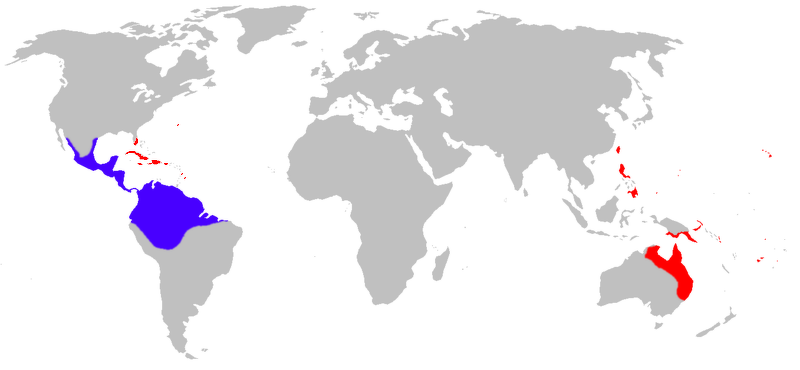
range of cane toads: native (blue); introduced (red)
Before the early 1840s, cane toads were introduced into Martinique and Barbados, from French Guiana and Guyana. In 1844, they were introduced to Jamaica in an unsuccessful attempt to reduce the rat population there. Cane toads were introduced to Puerto Rico in the early 20th century to counter a beetle infestation ravaging the sugarcane plantations. The effort was successful and the scheme was promoted as an ideal solution to agricultural pests in the 1930s, when cane toads were introduced to most Caribbean Islands, South Florida (Key West and Stock islands, Tampa Bay, Hillsborough, Dade and Broward counties), the Hawaiian islands, Fiji, other Pacific islands, Taiwan and parts of Japan and the Philippines.[Source: Wikipedia, Ryan Hilgris, Animal Diversity Web (ADW) |=|]
The 102 cane toads first introduced to Australia were collected from Hawaii. In August 1935 sugar scientists released them into Queensland cane fields. After this initial release, Australia’s Department of Health decided to ban future introductions until a study was conducted into the feeding habits of the toad. The study was completed in 1936, the ban lifted and afterwards large-scale releases began. By March 1937, 62,000 toadlets had been released into the wild. It didn’t take all that long for the toads to become firmly entrenched in Queensland, increasing exponentially in number and extending their range into the Northern Territory and New South Wales.
Cane toads inhabit open grassland and woodland, and show a "distinct preference" for areas modified by humans, such as gardens and drainage ditches. In their native habitats in Latin American, the toads are most often found in subtropical forests, where dense foliage tends to limit their dispersal.
Cane Toad Characteristics and Poison
Cane toads are fairly large for a toad. They have an average weight is 106 grams (3.7 ounces) and range in body from 15 to 24 centimeters (5.9 to 94 inches). Big ones grow up to 26 centimeters (10.2 inches) and weigh up to 2.5 kilograms (5.5 pounds) but are rare. Their average basal metabolic rate is 0.0303 watts. They are (ectothermic (“cold blooded”, use heat from the environment and adapt their behavior to regulate body temperature), heterothermic (having a body temperature that fluctuates with the surrounding environment). Sexual Dimorphism (differences between males and females) is not present: Both sexes are roughly equal in size and look similar. [Source: Ryan Hilgris, Animal Diversity Web (ADW) |=|]

spread of cane toads in Australia
Cane toads have grey olive brown skin on their back and sides with many warts ending in dark brown caps. Their undersides tends to be whitish yellow with dark brown speckles or granular mottles. Cane toads possesses huge paratoid glands stretching from the anterior side of the tympanum to halfway down the back. A high bony ridge meets at the snout between the nostrils. Cane toads, like other species that are active at night have horizontal pupils.
Cane toads secrete a latex-like toxic fluid from a gland in back of their neck. This fluid is powerful enough to kill almost any animal attempting to eat it — even crocodiles. People who have picked up cane toads and squeezed them in the wrong place have been squirted in the face with it. The 20,000 or so eggs laid by female toads are also poisonous. A student from Sydney, who swallowed some on a dare, had three heart attacks. The skin of the adult cane toads is toxic. They have other glands that emit toxins across their back.
The white, viscous bufotoxin of cane toad contains cardioactive agents. If a predator ingests these toxins, or they contact mucous membranes, they may cause profuse salivation, twitching, vomiting; shallow breathing and collapse of the hind limbs. This toxin can cause temporary paralysis or even death in some predators, including dogs. Dogs are especially prone to be poisoned by licking or biting toads. Pets showing excessive drooling, extremely red gums, head-shaking, crying, loss of coordination, and/or convulsions require immediate veterinary attention.It is said Cane toad poison can kill a dog in 15 minutes. [Source: Wikipedia, Ryan Hilgris, Animal Diversity Web (ADW) |=|]
Toadzilla
In January 2023, park rangers in Queensland have stumbled upon a cane toad so large they felt they had no choice but to name it Toadzilla. The rangers were doing track work in Conway National Park in the state of Queensland when the discovered the 2.7-kilogram (5.5 pound) monster. Aina J. Khan of NBC News wrote: In the wild rainforest of Australia’s north, A snake slithering across the track beside the Conway Circuit serendipitously forced the team to stop their vehicle, Ranger Kylee Gray recounted, leading her to step out, look down and gasp when she spotted the toad. “I reached down and grabbed the cane toad and couldn’t believe how big and heavy it was,” she said in a statement from the Queensland Department of Environment and Science. “We believe it’s a female due to the size, and female cane toads do grow bigger than males,” Gray added.[Source: Aina J. Khan, NBC News, January 20, 2023]
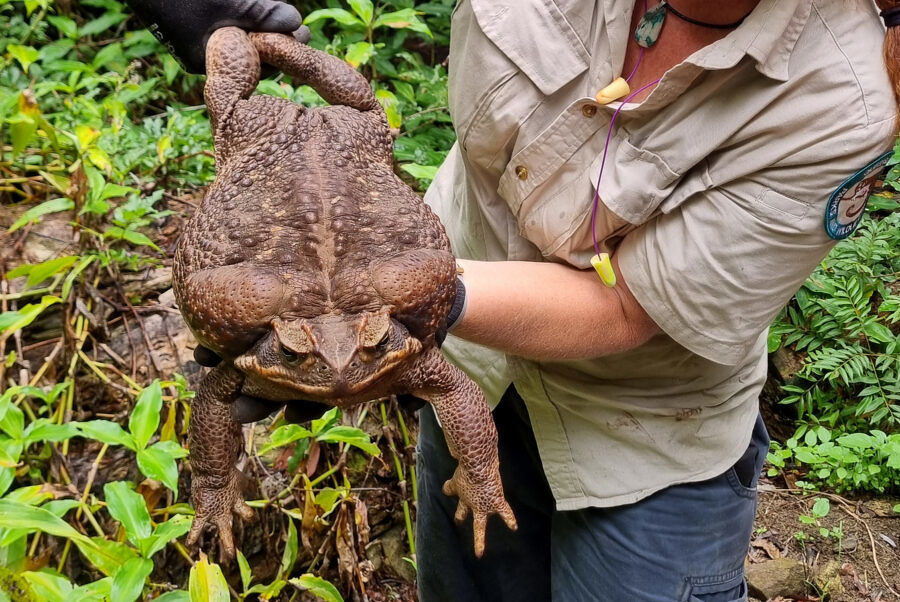
Toadzilla
According to the Guinness World Records, the current record held for the world’s largest toad is at 2.65 kilograms (5.8 pounds), measuring at 38 centimeters (1.3 feet) from snout to vent. The record was set in March 1991 by a cane toad owned by a Swedish man. “When we returned to base, she weighed in at 2.7 kilograms, which could be a new record,” Gray said of the newly discovered Toadzilla. The team had initially considered calling the large amphibian Connie after Conway National Park, she said in an interview with the state broadcaster ABC on Friday, but ultimately settled on naming it after the fictional monster.
“We dubbed it Toadzilla, and quickly put it into a container so we could remove it from the wild,” Gray said in the statement. Not unlike its namesake, Toadzilla was viewed as a grave threat to its surroundings. “A cane toad that size will eat anything it can fit into its mouth, and that includes insects, reptiles and small mammals,” Gray said. With this in mind, the giant toad was “humanely euthanized,” according to a statement from the Department of Environment and Science, due to the risk of environmental damage and donated to the Queensland Museum for research.
Cane Toads Becoming Quicker as They Develop Longer Legs
Cabe toads, scientists say, are evolving longer legs to better adapt to new habitats and get better food. Carina Dennis wrote in Nature: In the frog world, the cane toad is typically thought of as a slow plodder. But, in a report published in Nature in February 2006, researchers from the University of Sydney debunk this perception.[Source: Carina Dennis, Nature, February 15, 2006]
By strapping tiny radiotransmitters to the toads' waists, the researchers revealed that they can travel at an alarming rate. The sprinters can move up to 1.8 kilometers a night and generally opt to travel along roads. "The toads are making it on their own — they aren't hitchhiking on the back of trucks as had been suspected," says Richard Shine, who led the research team. "Toads are slow. They don't jump, they just kind of crawl. The idea that they are long-distance athletes is amusing and surprising," says David Skelly, an amphibian ecologist at Yale University.
So how are they making the distance so easily? Shine and his colleagues looked at preserved museum specimens and historical records and found that the toads have become 25 percent leggier and fivefold faster over a 60-year period. The researchers checked that the long legs really do translate into speedy crawling. Camping out in the wilderness in advance of the pests' invasive front, the researchers measured leg length as the newcomers arrived. They found that the first arrivals had legs stretching up to 45 percent of their total body length. Later waves of toads consisted of shorter-limbed kinfolk; frogs arriving a year later had legs measuring about 40 percent of their body length.
Although insects and bacteria quickly adapt to changing circumstances, Skelly says this study is one of the first known examples of a vertebrate rapidly evolving in a new environment. "People have this deep-seated feeling that vertebrates don't evolve on of these sorts of timescales. But this work shows that it can happen," says Skelly. Cane toads typically start breeding at the age of one year, and can produce some 200,000 eggs in an average ten-year lifespan.
Cane Toad Food and Eating Behavior
Cane toads are primarily carnivores (eat meat or animal parts) and insectivores (eat insects and non-insect arthropods),. Animal foods include insects, non-insect arthropods such as spiders, Cane toads forages primarily during the night in mature forests and roadways. They have been recorded feeding on ants, beetles, earwigs, dragonflies, grasshoppers, truebugs, crustaceans, gastropods, and plant matter and even dog and cat food.
Cane toads are opportunistic, voracious eaters and will also eat almost anything. They have been seen eating honeybees, white mice, baby toads and even ping pong balls and light cigarettes.
In 2013 a cane toad was observed trying to eat bat. Douglas Main wrote in Live Science: Ranger Yufani Olaya snapped a photograph of the bat-chomping toad in the Cerros de Amotape National Park in Peru. The bat in the photograph is likely a type of free-tailed bat, perhaps a velvety free-tailed bat, which is common throughout northern South America. In another instance, a different type of toad was observed eating a free-tailed bat in Brazil, Torres told LiveScience. [Source: Douglas Main, Live Science, September 25, 2013]
The bat appeared literally to fly into the toad's mouth. Olaya said: "out of nowhere the bat just flew directly into the mouth of the toad, which almost seemed to be sitting with its mouth wide open." The bat was likely foraging for insects close to the ground, Torres said, and the toad got lucky. Sorta. The story has a happy ending, at least for the bat. After failing to swallow the bat whole, the toad gave up, and the bat — still alive — flew away, Torres said.
Cane Toad Behavior
Cane toads are terricolous (live on the ground), saltatorial (adapted for leaping), nocturnal (active at night), motile (move around as opposed to being stationary), sedentary (remain in the same area), employ aestivation (prolonged torpor or dormancy such as hibernation) and solitary. Cane toads sits in an upright position when they move, and hop in short fast hops. During cold or dry seasons it will remain inactive in shallow excavations beneath ground cover. When confronted by a predator, they can secrete white, viscous bufotoxin fluids from their paratoid and other glands on their back. [Source: Ryan Hilgris, Animal Diversity Web (ADW) |=|]
Cane toads generally sleep all day and hang out at night under street lamps where they wait for kamikaze bugs to fall dead at their webbed feet. Cane toads enjoy sitting on people's bare feet and sometimes several toads will fight with one another to secure the best position. They are also pretty dumb. Males have been observed trying to mate with a shoes as well as with fish, rocks, clumps of earth and horse dropping. One male was filmed trying to get it on for eight hours with a run-over female.
Cane toads sense and communicate with touch, sound and chemicals usually detected by smelling. They also employ choruses (joint displays, usually with sounds, by individuals of the same or different species) to communicate. When cane toads are run over they make a noise similar to their mating call.
Cane Toad Mating, Reproduction, Offspring and Inflated Females
Cane toads are oviparous, meaning that young are hatched from eggs, are polygynandrous (promiscuous), with both males and females having multiple partners. Reproduction is external, meaning the male’s sperm fertilizes the female’s egg outside her body. Males congregate in temporary or permanent still or slow moving water and call for mates. More than one male may fertilize the eggs of a single female, and a particularly successful males may fertilize the eggs of multiple females in a breeding season. [Source: Ryan Hilgris, Animal Diversity Web (ADW) |=|]
Cane toads are able to reproduce nearly year round and typically start breeding at the age of one year. They breed once a year and may engage in seasonal breeding if there are distinct seasons. Eggs are laid in long jelly-like strings on rocks, debris, or emergent vegetation; in excess of 30,000 eggs at a time. A female and can produce some 200,000 eggs in an average ten-year lifespan. Once the eggs are fertilized and arrayed in the water, there is no further parental care. The eggs hatch in two to seven days. The tadpoles tend to be small and black and aggregate in dense numbers. Their life cycle is characterized by metamorphosis — a process of development in which individuals change in shape or structure as they grow. Tadpoles metamorphose into small toadlets identical to the adults in forty-five to fifty-five days
Female cane toads can pump themselves up to a super-size to deter smaller males trying to mate with them according to a study published in the British journal Biology Letters in January 2010.. AFP reported: The unusual tactic suggests that female frogs and toads may have far more power to select their sexual partner than thought, Female cane toads are typically choosier than males when it comes to reproduction. They discriminate among potential mates by approaching the toad with the best call. But as they head to a rendezvous with the hunk with the mightiest ribbit, they also have to run the gauntlet of excited rival males. An unwanted suitor will seek to climb on the female's back, grasping her tightly in the armpit or groin, waiting until she starts laying her eggs in order to fertilise them.[Source: AFP, January 2010]
This is where the pneumatic trick comes in, say the scientists, led by Benjamin Phillips of the University of Sydney. By inflating sacs in her body, the female is able to loosen the grip and the luckless male slides off her body, defeated. As a result, the female is able to choose the size of her mate, a factor that is important to the species, researchers say, as fertilisation among cane toads are most successful when males and females are similar in size.
Phillips and his two colleagues worked on the small-to-XXXL hunch after noting that the cane toad puffs itself up in the presence of a predator to make itself look scarier. Female toads likewise inflate at copulation time, but until now this was presumed to be a reflex to being pushed, kicked and occasionally flipped over as panting males wrestled for amorous contact. Phillips' team went to exceptional lengths to test their hypothesis, inflating a dead anuran with a pump to measure the sacs' air pressure. There was even a touch of toad necrophilia. Male toads were given a jolt of sex hormones to encourage them to mate with dead females, so that the scientists could measure the strength of the copulatory grip.
In the final phase, nine living females were given tracheal surgery to prevent them from inflating their body — meaning they were unable to shake off even the smallest male. After the experiments, the nine were killed humanely. The paper suggests that females in other species may similarly use a defence mechanism to help them choose a mate. "Many of the traits that enable a female to repel a predator also allow her to repel unwanted suitors, and hence facilitate mate choice," it notes.
Cane Toad Culture and Getting High Off Them
Teenagers in the United States and Australia have smokes the dried skin of dead cane toads for a hallucinogenic high. Impatient druggies have been known to lick the toads for quick rush. Bufotenin, one of the chemicals excreted by the cane toad, is classified as a schedule 9 drug under Australian law, alongside heroin and LSD. The effects of bufotenin are thought to be similar to those of mild poisoning; the stimulation, which includes mild hallucinations, lasts less than an hour. As the cane toad excretes bufotenin in small amounts, and other toxins in relatively large quantities, toad licking could result in serious illness or death. [Source: Wikipedia]
Ilsa Sharp wrote in “CultureShock! Australia”: Certainly, there is a mass of folklore surrounding the cane toad. In fact, the cane toad has become a cult object in Australia, regarded with perverse affection. A brilliantly hilarious and surprisingly informative, award-winning documentary called Cane Toads have been made; this is a ‘must-see’ item of really offbeat Australiana. There is even an underground political newspaper in Queensland named after the toad and political satirists regularly cartoon unpopular Queenslander politicians as cane toads. [Source: Ilsa Sharp, “CultureShock! A Survival Guide to Customs and Etiquette: Australia”, Marshall Cavendish, 2009]
Traditional Chinese medicine doctors sometimes use a chemical taken from cane toads as a treatment for patient with coronary problems. A taxidermy shop in Queensland sells dead cane toad paperweights.
See Separate Article: PSYCHEDELIC TOAD VENOM (5-MeO-DMT, BUFO): USERS, SESSIONS AND EXPERIENCES ioa.factsanddetails.com
Image Sources: Wikimedia Commons
Text Sources: Animal Diversity Web animaldiversity.org , National Geographic, Live Science, Natural History magazine, Australian Museum, David Attenborough books, Australia Geographic, New York Times, Washington Post, Los Angeles Times, Smithsonian magazine, Discover magazine, The Conversation, The New Yorker, Time, BBC, CNN, Reuters, Associated Press, AFP, Lonely Planet Guides, Wikipedia, The Guardian, Top Secret Animal Attack Files website and various books and other publications.
Last updated August 2025